Select Board Work Session Pt. 2 - September 16, 2026
words this meeting uses free cash · affordable housing trust · Select Board · capital improvement plan (CIP) · public comment · Town Meeting — the glossary says what they mean
 tap to load the tape · nothing plays until you do
the same, as a table
| time | kind | the moment |
|---|---|---|
| 3:35 | decision | Yeah. I mean, you could also just keep it at chair's discretion and then like it's a case by case basis of like if if… |
| 9:54 | decision | So, so the question is how do we reject someone like that? And I guess it's decision that uh the chair and um well… |
| 11:04 | pushback | I just want to make sure that the chair has an opportunity to uh make sure that we're not giving the impression that… |
| 14:04 | decision | Um David you raised this question on the uh the second bullet. Members retain the right to descent from any action may… |
| 14:47 | decision | Yeah. And I think I think you're I actually I like the the language that you have here because it's it makes clear why… |
| 15:15 | decision | you entitled be mad about it. You're entitled to go post on Facebook about it. You can be you can be mad. Um but what… |
| 15:45 | decision | Uh I yeah I think that's where I mean the Yeah. Well, I well, I think I think that's that to me is a question that I I… |
| 16:32 | decision | Select board approves a contract. |
| 17:27 | decision | Can a member of the losing faction then because I'm less worried about proposing something at town meeting like that's… |
| 17:54 | decision | So for example, when we have a debt exclusion, we then need a generally a twothirds majority of town meeting to support… |
| 18:27 | decision | No. Um I I I think what it's what this is saying is right like you're it's trying to thread the needle between you can… |
| 19:12 | decision | That that makes perfect sense. But like a lot of times there are two votes. |
| 39:14 | pushback | Yeah. But those would not be as I I also think this is an opportunity for you as board you know we have gotten you know… |
| 42:36 | pushback | The concern is going against state law, but we can always have a higher minimum. |
| 2:19:39 | pushback | So, yeah. So really the question is has is the cap the reason we are not getting as much funding to the affordable… |
| 2:42:38 | pushback | [laughter] I think I but that's another way that's another way to go around it. But I mean I think that um you know we… |
| 1:27:24 | money | $5 million — said 7 times |
| 1:27:35 | money | $10 million — said 4 times |
| 1:27:46 | money | $10 — said 4 times |
| 1:33:53 | money | $1 million — said 3 times |
| 1:42:48 | money | $2 million — said 5 times |
| 2:08:42 | money | $15 — said 2 times |
| 2:17:46 | money | $700,000 — said 2 times |
| 2:18:12 | money | $2 — said 5 times |
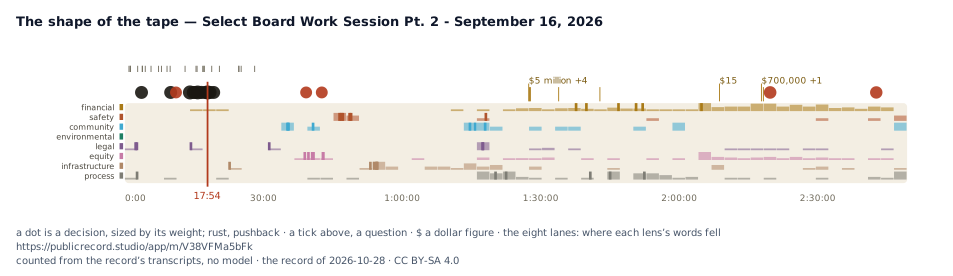
Cut from the analyzer’s scored moments — a measurement, not a choice made for you. Open a reel and press make this reel yours to re-cut it; tick any moment or transcript line below to cut your own.
The Select Board discussed member reappointment processes [0:00] before evaluating proposed code of conduct guidelines regarding public statements, information gathering, and interactions with staff and vendors [11:20]. The board considered policies on hybrid meeting accessibility [38:40] and public comment rules [46:55], followed by a presentation on a new online roadmap tracker for municipal goals [53:19]. Members reviewed twenty warrant articles for the Fall Special Town Meeting [1:17:03] and voted to place the warrant articles for the meeting [1:19:19]. The board further deliberated on Article 17 regarding Community Preservation Act funding for affordable housing [1:23:26] and Article 18 regarding proposed revisions to the free cash policy allocation cap [2:01:59]. Lastly, the board voted to approve appointments to the Brookline Youth Council [2:47:33].
What it means: The board discussed procedural timelines for committee applications and vacancies [0:00], proposed changes to member conduct guidelines regarding vendor and public communications [12:45], hybrid meeting requirements, and standardized public comment policies [38:46], [45:54]. Staff presented a draft 2030 roadmap dashboard to track town goals online [53:22]. The board also reviewed upcoming Town Meeting warrant articles, focusing heavily on formulas for allocating free cash and Community Preservation Act funds to the affordable housing trust fund [1:17:01], [2:01:48].
Who moved it: The board voted to execute the warrant authorizing the moderator to hold a hybrid meeting [1:19:19], with recorded votes from Michael [1:19:52], Anthony [1:19:54], and Amanda [1:20:07]. The board also voted to approve appointments to one-year terms on the Brookline Youth Commission [2:48:37]. The transcript does not explicitly name individual movers for every routine policy item or warrant article review [9:54], [1:19:26].
What to watch: Staff will incorporate feedback to refine draft conduct policies regarding information gathering [34:36] and adjust the visual design of the online strategic goal tracker before going live [1:14:12]. Board members plan to hold further joint discussions with the Community Preservation Act committee and the Housing Advisory Board to address funding formulas and policy alignment ahead of Town Meeting [1:46:00], [1:57:41].
Scored, not chosen for you — the salience bar is a measurement, and every moment is a receipt into the transcript below. With JavaScript on, tick moments to compose a reel — and tick moments on other meetings too; a reel can span the record.
→ the publish kit for this meeting — the clips worth cutting and draft copy, for a producer.
Counted, not modeled — each lens is a word list; drift compares the first half to the second.
the same, as a table
| word | mentions |
|---|---|
| million | 114 |
| housing | 95 |
| trust | 74 |
| fund | 70 |
| free | 66 |
| policy | 65 |
| cash | 65 |
| affordable | 65 |
| cap | 50 |
| cpa | 46 |
| select | 42 |
| article | 40 |
| meetings | 36 |
| point | 36 |
| language | 35 |
| mean | 34 |
| something | 34 |
| clears | 34 |
| throat | 34 |
| funding | 34 |
| put | 32 |
| little | 32 |
| take | 31 |
| much | 31 |
| back | 30 |
| maybe | 29 |
| staff | 29 |
| another | 28 |
| first | 25 |
| information | 25 |
| sure | 24 |
| page | 24 |
| sorry | 24 |
| agree | 24 |
| trying | 23 |
| boards | 23 |
| people | 23 |
| done | 23 |
| reason | 23 |
| hybrid | 23 |
| doesn't | 22 |
| good | 22 |
| still | 22 |
| money | 22 |
| example | 21 |
| didn't | 21 |
| goal | 21 |
| change | 20 |
| someone | 20 |
| case | 20 |
| project | 20 |
| specific | 20 |
| years | 20 |
| balance | 20 |
| even | 19 |
| committees | 19 |
| come | 19 |
| give | 19 |
| contract | 19 |
| anything | 18 |
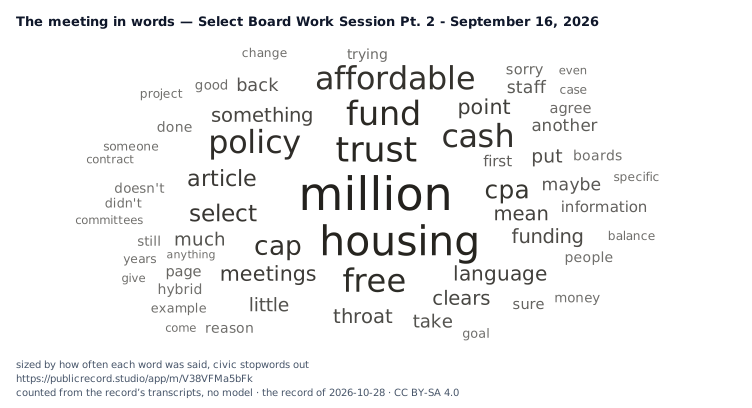
“million” came up 114 times. Sized by how often; civic stopwords out. With JavaScript off, a word opens the tape at its first mention.
0:00 seeking reappoint for for their seats
0:02 and then you have additional candidates.
0:05 What what we're saying then which I
0:07 think is a substantive change is that we
0:10 actually want to go through the
0:11 interview process for those new
0:13 candidates
0:15 even if
0:18 whatever whatever sense we have the the
0:22 uh incumbents are likely to be
0:24 reappointed
0:26 right so take the example that parks and
0:28 wreck has three candidates up each year
0:30 I think that's the the number
0:32 right then even If all three submit for
0:37 reappoint, if there are two additional
0:39 new candidates that put in, um, I I
0:43 personally would like to say like we
0:44 should interview them and then we can
0:46 have the conversation about who actually
0:48 gets nominated to fill those three
0:50 seats.
0:51 So, are we only setting a certain time
0:52 where we accept applications? Because if
0:54 they're not due for reappointment till
0:56 the end of August, say somebody applies
0:58 for this board in December, are we
1:00 holding their application until the
1:01 following reappoint period or do you
1:04 want to interview them in December when
1:06 they're up and keep them on the back
1:07 burner until August? And if there are no
1:10 current vacancies, but
1:11 why would it be up in December?
1:12 Not up in December. If they apply in
1:14 December, a new applicant, there are
1:16 zero vacancies, but there are maybe
1:18 three incumbents that will be up for
1:20 reappointment in August, but we have
1:22 somebody who applied say let's just say
1:24 January February keep
1:26 I mean if we interview someone in
1:27 February I'm not going to remember but
1:32 there could be a new selection
1:34 right so I would prefer in this case
1:37 that like we try especially since
1:39 summers are later right we're trying to
1:41 reappoint in September 1st so then most
1:44 of the interview should take place after
1:46 the election so like May through August
1:50 unless there's a vacancy
1:51 right I think if we have a window of
1:53 time that you apply or you send in that
1:57 you want to be reappointed in the May to
2:00 July time frame.
2:02 I like that it keeps it very concise.
2:04 Everybody applies from May to July and
2:06 then we can handle interviews or
2:08 reappointments and as
2:11 right and then the exception being an
2:12 actual vacancy in which case then we
2:14 want to put out like actually we need
2:16 someone to throw their head in. And the
2:18 one other exception would be those where
2:20 by state statute the term actually
2:21 doesn't start in September 1st. So we
2:23 have some where it ends in May. And yes,
2:26 we're and that's one of those that's one
2:28 of the our projects from boards and
2:30 commissions once we get this through is
2:32 standardizing that as well. Um where we
2:34 obviously ones that we can't by a
2:36 statute except you know you've got that
2:38 you've got that um Warren article that's
2:39 coming up for discussion today about the
2:41 T-board which will will help on that
2:42 front. Are there other committees other
2:44 than the TA board that are not that
2:46 demand a certain type?
2:47 Yes. Yes.
2:50 Now, Michael raised a question about do
2:52 we want to be interviewing incumbents if
2:54 we already know them and we think that
2:56 they're going to get it anyway. Um, and
3:00 I think that is a good question. And I'm
3:01 not sure that we necessarily would want
3:04 to do that, but I could envision
3:07 scenarios where the incumbents want to
3:09 be interviewed if they feel that they're
3:10 at a competitive disadvantage that we're
3:12 only interviewing new candidates.
3:14 Yeah. I mean, you could also just keep
3:15 it at chair's discretion and then like
3:18 it's a case by case basis of like if if
3:22 we feel that they need to, but then like
3:23 we're actually paying attention. At the
3:25 very least, we should have and I I know
3:27 I' I've made this case. I I think the
3:30 one instance I'm thinking of, people did
3:32 submit for reappointment, but I did not
3:34 see any of the forms when we had the
3:35 laundry list that we were voting on. Um,
3:38 but theoretically, when they were
3:39 submitting their application for
3:40 reappoint, we have the opportunity to
3:42 read it. Even if we're not interviewing
3:45 them to say, "What have you done? What
3:46 are you most proud about? Why do you
3:48 want to continue?"
3:50 And I do remember at a prior meeting you
3:51 brought that up. So, we might want to
3:54 also create a reappoint application.
3:56 Very simple. Not looking to make it
3:58 overly difficult, but more than a simply
4:01 I want another term.
4:03 So the application for reappointment and
4:05 for appointment are pretty much the same
4:07 and there are similar questions. There's
4:09 just one little tab that says new
4:11 application or reappoint, but it asks
4:13 the same question.
4:14 Yeah, some of these though come back and
4:15 just they're empty and everything
4:17 because they haven't filled out the
4:18 question. [laughter]
4:19 So that's the question. Do we make it
4:21 mandatory that they have to complete the
4:23 application in full? I don't think you
4:25 make it mandatory, but we can set the
4:28 expectation that if it is competitive,
4:30 it behooves them to fill out all of the
4:33 answers because otherwise we don't have
4:35 anything to judge them on,
4:36 right? And
4:37 that should be obvious.
4:39 It's not.
4:40 And and the the other the other piece of
4:43 this in order to I think make your life
4:46 a little easier is that if we're going
4:47 to do reappoints, we shouldn't we
4:50 shouldn't allow reappointments until
4:53 August 31st. We should have the same end
4:55 date for reappoint at the end of July so
4:58 that we then have the office.
5:02 So what do we want to do for the time
5:03 frame? Do we want it to be May 1st, July
5:05 1st, May 1st, end of July which would
5:08 give us because I'm a little worried
5:10 about if we leave it to end of July
5:12 because then we have to pack all this
5:13 into two meetings in August. So it
5:16 should probably be something like May 1
5:17 and July 1 is what I'm thinking.
5:20 I like that idea. Yeah, it's
5:23 we only have two meetings in August
5:24 typically,
5:25 right?
5:26 And sometimes you only have one
5:27 and sometimes only one. And if we're
5:29 going to be appointing and reappointing
5:31 for every board
5:33 in two meetings, only one more than two
5:35 meetings.
5:35 Yeah. [laughter]
5:36 Yeah.
5:37 And I mean some of these will not be
5:39 competitive, right? And like that will
5:41 expedite it, but then it does open it up
5:43 for
5:44 right like not necessarily automatically
5:47 reappointing someone for their 10th
5:49 term,
5:49 right? So, so I think the answer is
5:55 from the first starting at the first
5:58 meeting of the select board would be the
6:00 opening of applications and then closing
6:04 July one and then scheduation
6:11 in January, February. You'd like me to
6:13 hold it till May for till that period of
6:16 time. Yeah. Okay. Yeah, I think it's
6:19 fine to do it that way. Um, but if we're
6:21 explicit about the windows, I think that
6:24 the vast majority will apply within that
6:26 window.
6:26 Yeah.
6:27 Right. And it also makes the
6:29 communication of like what's open and
6:31 available more concentrated and will
6:35 make it easier for people to focus.
6:37 Yes.
6:37 But, you know, on our website, we talk
6:40 about openings and sort of encourage
6:42 people to apply whenever there's an
6:45 opening. So I think to figure out how to
6:48 if you shift that to only be vacancies,
6:50 right?
6:50 Actual vacancies like someone stepped on
6:53 in December
6:53 list that's on the Morton Commission web
6:56 page. There's a list at the top of all
6:58 the vacancies. I can pull it off.
7:00 But I I think in the past we sort of
7:02 blurred the line between vacancies and
7:04 those who are just not reapplying.
7:07 And I would like to keep it only for
7:09 [laughter]
7:10 right. a separate category helps and
7:12 vacancies would be handled in the manner
7:13 that Bernard is suggesting because those
7:15 come up at any point. It's harder to
7:17 predict, right?
7:18 Uh and then also it sounds like Chaz and
7:22 is going to work on having a list of
7:24 those positions that don't fall into
7:26 this September 1st
7:29 appointment date. Correct.
7:32 I I'm I'm trying to think if we need to
7:34 put
7:36 we we have this language around
7:38 structure the structure for building a
7:40 vacancy. I'm wondering if for example,
7:43 you know, I'm sure there's some some
7:46 committee that has a vacancy right now.
7:48 Do we need to publish a schedule for
7:51 taking applications for that vacancy so
7:54 that they don't just tread in?
7:58 Well, we can make it mirror what we're
8:00 doing for those that are on September
8:02 1st. So, it's a two-month block of time,
8:04 right? And then we'll interview them in
8:06 the third month.
8:06 Right. And if nobody applies in that
8:09 time, then we will create another
8:12 two-month block of time.
8:14 Right.
8:16 But if one person applies,
8:18 then we will interview them and
8:20 potentially appoint them.
8:22 These are just for those outlier. Yeah.
8:26 So vacancy whenever it comes up they'll
8:28 have the same two-month block of time to
8:30 apply and the presumption would be in
8:32 month three they'd be interviewed.
8:34 Okay.
8:34 Right. And if no if nobody has bought
8:37 then we
8:39 we have to keep extending it but if any
8:41 one person applies then they have to
8:43 leave.
8:45 Okay.
8:47 I think they're done.
8:48 And the idea is to funnel them into
8:50 short time windows instead of like six
8:52 months in advance sending you something.
8:55 Um, but it would be good to update the
8:56 vacancy current list because I know some
8:58 of the ones on there we just filled in
9:00 the last couple meetings.
9:02 Yeah. Um,
9:04 you said if they apply they have
9:07 priority. What do you mean by that? If
9:09 someone applies for vacancy and is a
9:12 horrible candidate
9:13 Yeah. We don't have we don't have we
9:15 don't have to appoint them.
9:16 Yeah.
9:17 Right. No, the idea is that if somebody
9:19 applied within that two-month window and
9:21 they're not totally horrendous
9:24 advantage,
9:25 right? I the point I was trying to make
9:27 is that we wouldn't just we wouldn't
9:30 just we would interview them and have
9:33 the discussion and either accept them or
9:35 reject them,
9:38 but we wouldn't say, well, we don't have
9:40 enough candidates to fill the position.
9:44 So, so the question is how do we reject
9:47 someone like that? And I guess it's
9:50 decision that uh the chair and um
9:54 well someone would have to move to vote,
9:57 right? And if there is no person moving
10:00 to appoint said individual, it could be
10:05 they don't have to be a horrible
10:06 candidate. They also could just not be a
10:08 good fit.
10:08 Yeah. Especially
10:11 some of these committees, we want
10:12 certain expertise and it's entirely
10:15 possible that we don't get it in the
10:16 applicant.
10:18 So, if you interview a candidate, do you
10:21 have to then put them on an agenda after
10:23 that for appointment or you can you just
10:24 say we just don't want them on the next
10:27 agenda? Even though you've interviewed
10:28 them, it doesn't necessarily mean they
10:30 have to go on an agenda for appointment.
10:32 Correct.
10:32 Correct. But theoretically in the
10:34 vacancy case, eventually we're going to
10:36 appoint someone to it and then we should
10:39 at least list all the people who have
10:41 applied. Um
10:43 so like it could right they will get a
10:47 hearing eventually.
10:48 I just want to make sure that the chair
10:51 has an opportunity to uh make sure that
10:54 we're not giving the impression that
10:57 someone who, for example, has a history
10:59 of being abusive to um staff or or for
11:02 some other reason is just totally
11:04 unacceptable.
11:05 No, we're certainly not obligated to
11:06 appoint someone we're not comfortable
11:08 with in any context.
11:13 But that does highlight the second point
11:15 that I wanted to, which is the code of
11:16 conduct, which
11:17 Yes. Um I I do think it is really
11:20 important that we are I don't remember
11:23 what page it's on. I'm sorry.
11:26 Uh I do think it is important that we
11:28 are specifying what we expect um our the
11:32 members of abortion commissions to how
11:35 how to act as a reasonable member of a
11:37 border commission. And the assumption is
11:40 uh there we can either take action or I
11:45 I'd probably say except for egregious
11:47 cases just not reappoint if someone is
11:49 not upholding what we expect as a code
11:52 of conduct.
11:54 Yeah, that's in the requirement section
11:57 as well as the code of conduct.
12:00 I don't know if that was on
12:01 Oh, sorry. Well, I have to I have to let
12:03 Joe
12:04 separate.
12:12 Yeah, that's in the requirements on page
12:13 five.
12:16 I believe
12:19 page we're saying that over and over
12:21 again.
12:21 Yeah. And I think that's an important
12:23 point to me.
12:40 I think some of you guys also had
12:42 comments on the code of conduct.
12:44 Yes, there were several different kind
12:45 of code of conduct comments as well as a
12:48 request from one board chair to add some
12:52 language to the code of conduct that we
12:54 should discuss.
12:57 Um, so right the code of conduct and
12:59 standards of service. Um,
13:01 what page is that?
13:03 Sorry, it's page nine. Yeah,
13:06 there's also a weird box around it. I
13:08 wasn't sure why.
13:09 Yeah, the box is around a lot of things.
13:11 Well, the there's a reference at the
13:13 very top about what that box means. And
13:16 that's actually where I raised the
13:17 question of whether or not you think
13:19 this section should be bought. Um it it
13:22 refers to those sections that uh may be
13:26 applicable to
13:29 um public bodies that are not appointed
13:31 by the select commission.
13:34 And that's
13:37 should be some other way of doing that.
13:41 Has the moderator signed onto this code
13:43 of conduct?
13:44 No.
13:44 Okay.
13:46 That's what I thought.
13:47 Yeah. So I think based on that probably
13:50 take the box out of the section we have.
13:55 Um so yeah there are a couple of
13:56 different comments here on this section.
13:58 Um David you raised this question on the
14:01 uh the second bullet. Members retain the
14:03 right to descent from any action may
14:04 vote against a measure. I added some
14:06 additional language. They may continue
14:08 to express public disapproval of the
14:09 public body's decision after a vote is
14:10 taken. However, once a decision is
14:12 formally adopted, the member must
14:13 fulfill our duty by refraining from any
14:15 actions public or private intended to
14:16 actively inhibit structure or deter
14:18 implementation of that legally adopted
14:19 decision. David, you had some there's
14:21 different language there, which
14:23 yes, I I [clears throat] accepted sort
14:26 of your proposed language. I added
14:29 a lot a lot more to it. I'm not sure
14:30 that we want it to be that long, but I
14:32 wanted to convey a couple of additional
14:33 concerns I had with it.
14:35 Yeah. And I think I think you're I
14:36 actually I like the the language that
14:38 you have here because it's it makes
14:41 clear why this is in here. Um and it's
14:44 it makes it differentiates between right
14:47 like you can you know you vote against
14:49 the measure it doesn't go the way you
14:52 want it to. You are entitled to you know
14:53 you entitled be mad about it. You're
14:55 entitled to go post on Facebook about
14:56 it. You can be you can be mad. Um but
14:59 what you can't do is you can't actively
15:01 subvert it. you can't like you know then
15:04 you know because that's not the point of
15:06 being on a once once the board speaks as
15:08 a body you're expected to abide by the
15:10 decision with the board. So I think
15:12 that's that's the distinction which is
15:13 you can be upset about it you can even
15:15 file a motion to reconsider. Well you
15:17 can't because you were on the losing
15:18 side unless unless someone else changes
15:19 their mind. Um you can't file the motion
15:21 but someone else can. So I'm sorry.
15:24 No. Yeah. Can you vote to not fund it?
15:26 Uh
15:28 I yeah I think that's
15:29 where I mean the Yeah. Well, I well, I
15:32 think I think that's that to me is a
15:34 question that I I don't think that's I
15:36 think that's a question for you on the
15:37 selector, right? Like I think if you
15:40 from my perspective if you serve on a
15:42 border committee that the select board
15:44 appoints and then you vote against
15:48 budget of the select board or you know
15:50 it is the advisory committee's budget
15:52 but if you vote against a pol if if you
15:55 vote or especially if you table a motion
15:57 that is actively opposed to the conduct
16:00 of your board you're basically saying
16:02 you know I'm going to I'm going to throw
16:04 it to the house right I'm going to take
16:05 it I'm you know do does the select board
16:08 want boards and committee members to be
16:11 doing that. Um, I think that's, you
16:15 know, they have the freedom of speech to
16:17 do that as, you know, you can't prevent
16:18 them doing it, but you don't have to let
16:20 them serve on a board if they're then
16:22 actively disrupting what it is that the
16:24 board intends to be doing.
16:26 I'm I'm trying to understand the the the
16:29 case here.
16:30 Kind of an example.
16:31 Yeah.
16:32 Select board approves a contract.
16:34 Advisory committee looks at the
16:35 contract. Advisory committee doesn't
16:37 agree with the contract. Advisory
16:39 committee not to fund the contract.
16:40 But the advisory committee is not bound
16:42 by this. This is someone
16:43 replace advisory committee with any
16:44 other board.
16:45 Yeah. But when you say with any other
16:48 board, what other boards like
16:51 get into this question of funding?
16:53 Well, park and wreck. So for example,
16:55 the Biva country contract, park and
16:56 wreck will be looking at that. They
16:58 might decide to go in another direction.
17:00 Would this proposed policy change
17:04 prevent them from being able to do that?
17:09 No.
17:10 But after the fact, right? So like your
17:12 your question is as a member of Parks
17:15 and Wreck, take this example, there's
17:17 going to be a losing faction.
17:19 Can a member of the losing faction then
17:23 because I'm less worried about proposing
17:25 something at town meeting like that's an
17:27 open process. That's an open vote. I am
17:29 however concerned about like uh if they
17:33 have any power to then prevent the
17:35 contract from being enacted.
17:37 Right. I'm I'm more worried about the
17:38 scenario that Amanda just laid out. This
17:40 does come up in a town meeting context
17:43 with a bonding a vote. Yeah.
17:44 So for example, when we have a debt
17:46 exclusion, we then need a generally a
17:49 twothirds majority of town meeting to
17:52 support it. And there's always a
17:54 contingent that votes no even though the
17:57 voters have passed it.
17:59 Mhm. [clears throat]
18:00 And so is this language looking to bar
18:04 obviously not town meeting just using
18:06 that as the illustrative example. Is
18:08 this language looking to bar town
18:10 meeting members from not bonding a
18:12 project? The the functional equivalent
18:13 of that.
18:14 No. Um I I I think what it's what this
18:17 is saying is right like you're
18:22 it's trying to thread the needle between
18:24 you can you can continue to express
18:27 disapproval of something but take man's
18:29 example right so the paper country day
18:30 pilot or the fields right if the parks
18:33 and recck commission votes not to do
18:35 that that's that's fine and then it is
18:38 what it is but say you were on the
18:40 losing side of that vote and you called
18:42 Beaver Country Day and said hang on like
18:44 don't do anything.
18:46 Well, that's a different that's another
18:47 part, isn't it?
18:48 Yeah, you can't do it.
18:50 Yeah, you couldn't do that for other
18:51 reason.
18:51 That's but that's also a different part
18:53 of the code of conduct. That's not part
18:54 two. I don't think I feel like that part
18:57 is the second to last bullet point of
18:59 the code of conduct, which I agree with
19:01 completely. Right.
19:05 Right. You don't want board and
19:06 commission members undermining the
19:08 decisions of board and commissions.
19:10 Right.
19:10 That that makes perfect sense. But like
19:12 a lot of times there are two votes.
19:14 There's the vote of approving a contract
19:16 where you can vote no and then there's
19:18 the vote of funding a contract where you
19:19 can also have the chance to vote no. If
19:22 the board votes yes on the proving the
19:23 contract, I would still like boards and
19:25 commission members to not be scrutinized
19:27 for voting no for the funding of that if
19:29 they voted no for the contract.
19:30 Yeah. And I I I think that's right. I I
19:32 think if that's what the if that's what
19:34 you wanted, then I think that's fine. I
19:36 mean that David's language might
19:37 actually help with that because you
19:39 basically are saying it's not construed
19:42 as limiting individual members from
19:44 revisiting this at a subsequent date or
19:47 a subsequent hearing. Um essentially
19:51 well kind of that's already blocked
19:52 because a because a member who votes no
19:55 can't bring a motion to reconsider.
19:57 Right.
19:57 Right. Okay. but like six months from
20:01 when
20:02 and this comes up sort of context of CIP
20:05 priorities and so I I don't want someone
20:10 to look at this if we don't have that
20:12 language it can look like we're limiting
20:14 people from
20:15 uh proposing a change once months have
20:18 gone by and the landscape has changed
20:20 fundamentally.
20:21 That makes total sense.
20:22 Yeah, that makes sense to me.
20:25 Um,
20:27 are we okay with this point? No, Mike.
20:29 Um, I'm just I'm just reading the the
20:32 added language about public body speak
20:34 with the body as such members may not
20:36 individually communicate the
20:38 municipality vendors or interested
20:39 parties regarding business of the
20:41 public.
20:42 That's the second to last bullet. If you
20:44 want to scroll down,
20:46 it's in the middle there.
20:47 It's in the middle.
20:51 Yeah. Yeah.
20:53 version I share with you right sorry
20:57 the question the question I have here is
20:58 because we include you know one of the
21:02 reasons that I that I I appreciate the
21:05 addition of this is this whole question
21:07 of contracting um and who speaks for the
21:10 town with regard to vendors in
21:12 particular um and I'm just wondering
21:16 my understanding is that the select
21:19 board is responsible for contracting yes
21:22 Um, and unless it specifically
21:26 authorizes, I mean, I'm not even sure if
21:28 it would ever do this, but if it were to
21:32 authorize
21:33 a a a another body to contract, then
21:38 that would be one thing. But this
21:41 language, as it is, seems to give the
21:43 chair of any other public body the
21:47 capacity to speak for that body with
21:50 vendors.
21:52 um regarding contracts.
21:55 Um and
21:57 that is concerning to me.
22:02 You're talking about this language about
22:04 the
22:04 So you would like to delete vendors from
22:06 that line.
22:07 Um
22:09 no. What um
22:11 I I think the concern
22:14 um that is trying to be addressed with
22:16 this language is having an individual
22:18 member call and create uh a certain
22:22 impression about having authority in
22:25 making a contract or in making some kind
22:28 of agreement with a vendor or other
22:31 interested party or business. Right.
22:33 So, I understand why the language is
22:35 there, but I agree with you that I'm I'm
22:38 somewhat troubled by the current
22:40 construction for a couple reasons. One,
22:42 I think it's empowering board chairs way
22:45 too much.
22:47 Secondly, I think it's potentially
22:49 subverting the opportunity for
22:52 individual members on bodies to be able
22:54 to u engage in research.
22:57 Sure.
22:57 In order to gather information to be in
22:59 a position to make an informed decision.
23:02 So I think we can address the concern
23:03 differently by requiring that if an
23:07 individual member is going to make these
23:09 kinds of contacts, they must explicitly
23:11 disclose that they are not speaking on
23:14 behalf of the body. Y
23:15 that they are not they do not have the
23:17 authority to enter into any agreement or
23:20 to influence the outcome of a
23:24 transaction in any way. So that it's
23:27 very clear that the purpose of the uh
23:30 communication is to learn is research
23:33 and if there's an affirmative obligation
23:35 to make those disclosures and maybe we
23:37 can have an actual disclosure drawn up
23:39 that's part of any such communication I
23:42 think we can have that protection about
23:45 not having members go rogue but by the
23:47 same token protect an individual
23:48 member's right to learn about a
23:51 situation. I also wouldn't mind uh the
23:54 an individual board member having to
23:55 disclose to their chair that they're
23:56 doing that research.
23:59 Well, I mean the language here is is
24:02 stronger than that that um it's not that
24:06 they just have to disclose but they
24:07 actually have to seek approval and I and
24:09 I think the stronger language is
24:11 appropriate.
24:12 I don't know if I agree with approve. I
24:15 don't locking that research getting
24:18 action behind the approval of the chair
24:20 of the board.
24:21 Well, it's not it doesn't have to be the
24:23 chair of the board. It could be
24:25 approval from anyone. I would prefer it
24:27 just be disclosure. I don't think you
24:28 need to get approval to go and talk to
24:30 somebody for research about a decision,
24:32 right? I agree with Anthony.
24:35 Um I'm trying to think of like the
24:37 context of
24:39 cases, right? So, let let's take the
24:40 dump truck contract, right? Um, I put my
24:45 vision zero hat on and I my approach to
24:48 making sure that we are confined with
24:50 vision zero is to bring it up in the
24:52 select board. But let's say someone on
24:53 the transportation board sees that and
24:55 says I'm going to go out of my way to
24:58 reach out to um who we are obtaining the
25:01 dump trucks from and tell them that they
25:03 need to have side cards. Um,
25:06 disclosing is not a great solution in
25:10 that that case, right? Like I guess you
25:12 could tell the T-board chair that you're
25:13 going to do that, but that doesn't help
25:14 us. Um,
25:16 but that breaks
25:18 but in your scenario though, you're
25:20 engaging in advocacy.
25:22 That's not research.
25:23 That's not research. So to me, the
25:25 exception is to information gather, not
25:27 try to influence, which is why I think
25:29 the disclosure needs to be very clear
25:32 about what the contact is and isn't so
25:36 that we're not in that gray area. But I
25:38 I think in the in those cases where
25:42 you're doing research that a better
25:46 avenue for doing that research for the
25:48 town overall is to do that research
25:51 through staff. Right? Staff should be a
25:54 neutral
25:56 I I see you shaking your head Anthony
25:58 but but we should be treating staff as a
26:02 neutral provider of information. So if
26:05 you have a question like does this con
26:07 does this dump truck contract include
26:10 sidecards right then you don't have to
26:14 go to the vendor and and disrupt the the
26:18 contract negotiations in ways that you
26:21 may not be aware of. You can go to staff
26:23 and that's what part of what staff's
26:25 role is.
26:27 So ideally that's how it would function,
26:29 but I'm not trying to cast dispersions
26:31 on any individual staff member. But
26:34 sometimes because of bandwidth issues or
26:37 a staff member is just not particularly
26:39 responsive and again not on them. It
26:41 happens. I understand it sometimes. I'm
26:44 that way too. Uh I don't want to leave
26:46 somebody hanging if they have a burning
26:48 question or they want to get
26:50 information. So we could encourage going
26:52 through staff where feasible, but there
26:55 may be times where someone feels that
26:57 they need that direct contact if they're
27:00 not getting the information they need.
27:01 But if somebody actually needs that in
27:04 order to make a decision and they go to
27:06 staff and they're unable to get the
27:08 information, then in the discussion of
27:10 that topic, it would be perfectly
27:13 legitimate for them to say, I tried to
27:15 get this piece of information which I
27:17 feel is very important to this question
27:19 and I didn't get this information. And
27:22 therefore, we should either defer the
27:23 question or I'm going to vote no because
27:27 because it's
27:28 I don't think the limiting factor of
27:30 what is in the bounds of a debate topic
27:33 should just be the information that is
27:35 coming from staff. And I think that
27:37 there should be other avenues to gather
27:39 information. One of them being the other
27:42 party of a contract. And I can think of
27:44 numerous examples where I'm in the
27:46 advisory committee and again just
27:48 because I've served on the advisory
27:49 committee where I reach out to staff for
27:50 information and I do not receive
27:52 information back a week plus and then I
27:56 come to an advisory committee me meeting
27:58 lacking information. So I don't want
28:00 there to be this friction barrier to
28:02 people who are trying to do you know
28:05 what are you thinking? I think we need
28:07 to set the advisory committee aside
28:08 because we're specifically talking about
28:11 select board
28:12 the select board authorizing. So so I I
28:15 appreciate your case but but I don't
28:18 think it's necessarily relevant for this
28:20 question.
28:21 You think the same principle doesn't
28:22 apply?
28:23 I I think it doesn't. And the reason I
28:25 think it doesn't is because when you
28:28 have contract negotiations between the
28:32 town and another party,
28:35 um it can be it can be um very
28:40 disruptive to those negotiations
28:43 for somebody on the other side to be
28:46 having to determine whether or not the
28:49 person that they're talking to who is
28:52 from a town body is like the authorized
28:56 person. Like that's that is that is a an
29:00 unfair position for the vendors.
29:03 It gives a vendor an opportunity to sort
29:05 of manipulate the negotiations
29:08 as well.
29:10 So I I agree with your concern, Michael,
29:12 but that's why I was suggesting a very
29:14 clear upfront disclosure. I'm not
29:17 speaking for the public body. I have no
29:20 say in the negotiation. I am purely
29:22 reaching out for information gathering
29:24 purposes and we can have something
29:25 crafted explaining all that and it must
29:28 be provided or it would be in violation
29:30 of the policy correct to lay all that
29:32 out because I do I do think Anony's
29:35 advisory committee example is germanine
29:37 because that can happen all the time the
29:39 numbers on various other boards it can
29:42 even in theory doesn't happen on this
29:44 select board but it could on a future
29:45 select board where we're not getting the
29:47 information that we feel that we need
29:49 and uh in order to govern effectively. I
29:52 think timeliness is important. And so if
29:54 we limit ourselves to only accepting
29:57 what a future staff, again, not the
29:59 staff, what a future staff might or
30:01 might not provide to us. Uh I I think
30:04 that's a disservice to the public
30:05 potentially.
30:06 And I agree with you. Yeah. Go ahead.
30:08 Isn't the select boards in a similar
30:10 position as the advisor as the advisory
30:12 committee? I mean, we we we're not
30:14 really talking about select board. We're
30:15 talking about committees.
30:18 Committees that advise the select board
30:20 essentially,
30:20 right? Yeah. Right.
30:21 You know, and I and I think, you know,
30:23 right?
30:24 There are examples that I can think of
30:26 with like
30:28 you know I could see it happening in in
30:32 you know ZAB or you know or you know the
30:35 transportation board or you know the
30:37 advisory committee of council on public
30:39 health where you you could have a
30:42 situation where
30:44 I don't know if you want to encourage
30:47 members doing their own research which
30:49 they are absolutely entitled to do to do
30:52 so in a way that that encourages or
30:55 implicitly condones that sort of direct
30:57 contact because every direct contact
30:59 with a vendor or another municipality
31:02 adds that layer of question as to who is
31:04 in charge here. Um you know
31:08 I might try to thread the needle. I
31:09 think if we have a policy that says
31:14 if if you sorry someone can legally this
31:17 better uh if if you need to get more
31:20 information in order to fulfill your
31:23 duty as a member of this board which is
31:25 what we're essentially asking first we
31:29 want you to ask staff for information if
31:31 you are not getting that information
31:32 from staff then tell your chair this is
31:36 what I'm going to ask and also by the
31:39 Now that I'm going to go down this this
31:41 pathway, I am going to disclose that
31:43 this is purely information gathering.
31:45 I'm not acting on behalf of the town.
31:47 You want to negotiate, go talk to the
31:49 town, [laughter]
31:51 but I need to be able to do my job as a
31:53 member of the board.
31:54 Is that like sequence of events
31:56 principle?
31:57 That sequence of events should be
31:58 encouraged. I I I don't think that
32:00 sequence of events should necessarily be
32:02 mandated to be honest. I think
32:05 I from my point of view I think it's
32:06 like actually totally I I think it's
32:08 totally reasonable to receive something
32:10 from staff as a board member and then
32:12 say okay when we look at the vendor I
32:14 want to go to the website I want to ask
32:16 them about other things about and then
32:18 you know and I agree with David where
32:20 there has to be an explicit explanation
32:22 at the upfront that [snorts] this is not
32:25 for any other reason other information
32:27 gathering and if it comes out that they
32:29 said anything other than they're in
32:30 complete violation of the code of
32:31 conduct and would
32:33 and there would be an issue here. But if
32:34 not, then I I don't see an issue.
32:36 And there can be even more layers of
32:38 protection such as if it's a written
32:40 correspondence, you have to CC the chair
32:42 of your board.
32:43 Love that.
32:44 And uh if [clears throat] it's going to
32:47 be an in-person meeting, you have to
32:49 tell the chair of the board, I'm looking
32:50 to arrange this so that there's an
32:52 opportunity for them to be there. So
32:53 there are other ways of adding even more
32:56 protections beyond the explicit uh
32:59 written disclosure that will be up
33:00 front,
33:01 right? Um I think I think more
33:05 importantly than the chair because
33:08 presumably the chair might themselves
33:10 want to do this easily
33:12 would be to have somebody either on
33:16 ideally on staff or the select board to
33:19 fulfill that to fulfill that the
33:24 auditing role or what where
33:26 I think that's that would be fine too
33:28 could have a requirement to uh copy the
33:31 relevant department head.
33:33 Yeah.
33:33 And it's a public record. Yeah.
33:35 That should be explicit.
33:36 I agree with that.
33:37 And there should be some place where
33:39 it's available to the public.
33:40 But if a meeting were to occur between a
33:42 chair or board vendor for the purposes
33:45 of information gap, are you suggesting
33:47 that a staff person like board member
33:48 needs to be present
33:50 to
33:50 be aware
33:52 aware is 100% given the opportunity to
33:54 attend.
33:55 I agree with that. GI given the
33:56 opportunity to attend because the staff
33:58 person may themselves be in the loop of
34:02 negotiating the contract.
34:03 I agree with that completely that being
34:06 board members. I
34:07 agree.
34:07 So I think the desire here is not to
34:09 make a a complete bar as this language
34:12 currently reads.
34:14 Um I think you've I mean you've
34:16 obviously been following a conversation
34:17 here. So, we're just looking to not
34:18 completely outlaw y the ability for
34:22 individual members to reach out
34:23 directly, but it's subject to this
34:25 litany of protection layers.
34:27 Right. I think I think what what Amanda
34:29 said, it seems to me that you guys you
34:31 you the board have kind of moved towards
34:34 that sort of as a nucleus and then
34:36 there's so we'll I'm I've been taking
34:38 notes and we'll we'll formulate some
34:41 changes here. Get back to you next week.
34:42 Right. We should we should also in those
34:44 changes to to a comment that Anthony
34:47 made um make it clear that um
34:51 information gathering research that
34:54 doesn't involve direct contact with with
34:57 other parties in all cases is allowed.
35:00 Yeah.
35:01 Right. You know websites looking at
35:03 other public records examining examining
35:07 contracts whatever.
35:08 Right. examining a contract with another
35:11 community.
35:13 Think about that, right? That's
35:14 that's fine. Okay.
35:16 Like as an example, we have so we have a
35:17 code of ethics for ICMA for professional
35:19 managers. And so if we get inquiries
35:21 from other communities, we are obligated
35:23 to inform the administrator in that
35:24 community that we are answering
35:26 questions. Perfect.
35:27 So that's kind of the similar thing that
35:28 we're talking about here.
35:29 That makes sense. That's perfect. Every
35:31 every time I get a call from and I do
35:32 get calls from, you know, city council
35:35 members in other communities, I call the
35:37 manager or the mayor and I said, "Just
35:39 so you know, um, this is happening."
35:42 Okay, that makes sense. That makes
35:44 sense.
35:46 That that's that's sort of a
35:49 professional. Well, no, it's it's it's a
35:51 third category. There's there's research
35:53 that doesn't involve other people.
35:54 there's research involving uh
35:57 counterparties that you might be
35:59 negotiating with and there's um there
36:03 are other parties that you might engage
36:05 with which is this
36:07 third category and maybe we should be
36:09 explicit about those three different
36:10 kinds of research.
36:12 Yeah.
36:12 So we'll we'll we'll do some tinkering.
36:14 I actually think I I think because now
36:16 this is getting more complex I think the
36:18 bulleted list format does this a
36:20 disservice. So I'd like to actually
36:21 revamp this a little bit. I'm going to
36:23 try and come back to you with a version
36:25 that's cleaner and more plain language
36:28 as opposed to the bulleted list. I also
36:30 think these some of these are some of
36:31 these have just because over time
36:33 they've been building have gotten a
36:34 little repetitive like yes, I get it. I
36:36 get it. We got to be civil and
36:38 constructive. Don't be abusive and
36:39 threatening. 100% yes. However, I don't
36:42 need to say that three times. So, I will
36:44 figure out a way. Um this is just this
36:46 is because this has been touched by now
36:48 like 20 different people. So
36:51 but but to Michael's point splitting out
36:52 those three kinds of contact
36:54 y
36:54 explicitly because like there are
36:56 different ways to deal with it.
36:58 Yeah. Yeah.
37:00 So we will we will hack through this and
37:02 we'll try and bring it back to you next
37:03 week on that on this issue but I think
37:06 we should continue to move through to
37:07 speak.
37:08 Yeah.
37:08 Were there other things that people have
37:11 flagged that we should discuss in this?
37:12 I had brought up this in the sense of
37:14 attendance.
37:15 Yes. Um, and one of the reasons I did
37:18 that is I I broadly generalized the case
37:21 for removal.
37:23 Yeah. So that's further down.
37:25 What page?
37:27 Um, that's right up above. Sorry. We
37:30 skipped ahead a bit to talk about the
37:31 code of conduct.
37:31 Middle of page nine.
37:32 Middle of page. Well, uh, sorry, middle
37:34 of if you we we actually start on seven
37:36 and the bottom of page seven, top of
37:38 page eight. Um,
37:42 so there's a new there's new language
37:44 about removal.
37:47 Now, previously it opened with this, you
37:49 know, shall attend at least twothirds of
37:50 the public body's meetings. Michael
37:53 raised the issue that having that in
37:55 there made it seem like that's the only
37:57 that's actually the only ground for
37:58 removal. Whereas this new language that
38:01 was proposed makes it clear select board
38:03 may remove and possibly replace members
38:05 who fail to uphold these guidelines or
38:06 have conflict of interest. should not be
38:08 used to penalize a person because they
38:09 express unpopular opinions in their
38:11 private capacity or to restrict the
38:12 exercise of a person's free speech
38:14 rights. Select board may remove member
38:16 asking in writing for a member etc. Um
38:18 so all this you know all this does is
38:22 say failure to uphold these guidelines
38:24 is grounds for removal and one of the
38:26 guidelines is you have to attend at
38:27 least two individuals.
38:34 All right, toward the varants of page 24
38:40 where it talks about public bodies must
38:42 hold meetings where people are
38:43 physically present in a public building.
38:46 I think it would be helpful to qualify
38:48 that language a little bit in this
38:49 hybrid age that uh to the extent that a
38:53 meeting is being held in person and must
38:56 be in a publicly accessible location.
38:59 Yep. because we obviously have some
39:01 meetings that are virtual only.
39:04 Yeah. But those would not be as
39:08 I I also think this is an opportunity
39:10 for you as board you know we have gotten
39:12 you know members of the public have
39:14 raised concerns that certain boards and
39:15 committees do not meet uh virtually.
39:17 They only meet um or they they do not
39:20 offer a hybrid option. They only meet in
39:21 person. Um and you know there are
39:25 reasons for this but my question to you
39:27 is um do you want to instruct your
39:31 boards and committees to hold hybrid
39:32 meetings?
39:34 I I personally do. We're in an era a
39:36 technological era where it is very
39:38 feasible to make meetings hybrid and it
39:43 expands accessibility and participation.
39:46 uh I worry a little bit about well I
39:49 understand in in one particular case had
39:52 to do with somebody's personal
39:53 technology but overall
39:55 uh there's the ability for meetings to
39:57 be hybrid and to not do so is shutting
40:00 out a certain segment of the population.
40:02 I agree. I work a full-time job. It'll
40:04 be very hard for me to attend these
40:05 meetings if
40:06 what committees are only meeting in
40:08 person.
40:09 There are some subcommittees and smaller
40:11 committees that only meet in person. Um
40:13 I think Zap is probably the biggest one.
40:15 Um,
40:17 they
40:19 didn't realize
40:19 that probably. So, one of the things
40:22 I've been realizing because I've been
40:24 sitting on the Commission on Disability
40:26 meetings and that like certain meetings
40:29 require a lot more staff involvement to
40:31 make them accessible. Um, we have a
40:34 number of committees that don't are not
40:36 manned by staff. Um, so is there a a
40:41 logistic way to make it easier for
40:44 volunteerrun committees to do hybrid
40:47 meetings? They might not necessarily
40:49 have all the accessibility, but like can
40:51 we like create a how-to guide to make it
40:53 like to to meet with IT staff in order
40:56 to be trained. So that I think the issue
40:58 is that not everybody does that. Um, but
41:00 I do think that we also don't have the
41:02 law fully in place for hybrid meetings.
41:06 So until this is like a formal part of
41:08 state law. We've been extending the law
41:10 that kind of began during COVID, but the
41:13 legislature has not finalized
41:16 um what hybrid meetings look like and
41:18 what the requirements would be. So we
41:20 may want to wait until we actually have
41:22 the law in place um to address the way
41:25 that we want our meetings to run.
41:27 Uh how long do you think that
41:29 going to ask Representative Pollo? They
41:31 keep picking the [laughter]
41:33 they keep reauthorizing the the co
41:35 authorization.
41:36 Can we write something aspirational in
41:37 the meantime that says until there's
41:40 like formal legislation we um encourage
41:44 heavily encourage all boards and
41:46 committees to have hybrid meetings and
41:48 to have the chair meet with IT staff to
41:52 make sure they know how to do that.
41:53 Yes, that's that's good.
41:55 I think the encouragement for hybrid
41:57 meetings is part of our ADA.
41:59 Yes.
42:02 Yes, I think really, you know, talking
42:04 about access, I think if you asked
42:06 Sarah, she would tell you that all
42:08 meetings should be hybrid. You know, we
42:10 should that it should be more than just
42:14 Are we worried if we say should be
42:18 hybrid but don't give specifics that it
42:21 might go in contrast to any of like I
42:24 don't I don't totally understand what we
42:26 need at the state level to demand it.
42:29 Yes. Not sure.
42:30 No, no. I think it's we're worried about
42:32 what might be prescribed by the law and
42:34 how that would conflict with what we're
42:35 trying to do.
42:36 The concern is going against state law,
42:38 but we can always have a higher minimum.
42:41 Yeah. Well, but I mean, I think our
42:43 concern is the reason why this hasn't
42:45 passed the legislature is because there
42:47 are small communities out there that are
42:50 that are not capable of running hybrid
42:53 meetings that are fully accessible, that
42:54 are ADA compliant and accessible. and
42:57 they every time this comes up in the
42:59 legislature those communities raise you
43:02 know objections and basically say this
43:04 is an unfunded mandate um if you're
43:06 going to do this then you have to give
43:07 us more money um and in Massachusetts as
43:10 you know there is a formal procedure for
43:12 suing the state and saying you you have
43:15 you have saddled me with an unfunded
43:16 mandate then I don't have to do this um
43:19 and that's why um that's why the
43:23 legislature has been hesitant so what
43:24 they've done is they've created this
43:26 permissive model where they said you're
43:28 allowed to have hybrid meetings, but
43:29 they've left it very loosey goosey as to
43:31 what hybrid meetings are. Um, and so as
43:36 a result of that, I think Melissa's
43:38 concern is we don't want to say yes, we
43:40 must hold hybrid meetings and then have
43:42 the state suddenly impose a definition
43:44 of hybrid meetings that is more arduous
43:46 than what we currently offer. Um,
43:49 so would it be helpful for us to define
43:51 what hybrid meetings mean to us?
43:54 I I'm thinking to your point that Sarah
43:57 would push that we mandate hybrid
44:00 meetings, but [clears throat] we don't
44:02 want to conflict with any potential
44:04 future definition of what hybrid means
44:06 or if the equipment failed, you know,
44:08 like if we knew that, you know, the room
44:11 that's always used for, you know, the
44:14 projector broke and it's going to take a
44:15 week to, you know, bring in.
44:17 Can we write something like barring
44:19 exceptional circumstances? Yes, we can
44:22 do this.
44:24 And then that gives us the problem if
44:25 that happens.
44:27 But then like barring exceptional
44:29 circumstances, uh all public body
44:32 meetings should be hyper.
44:35 And that example could be explicitly
44:37 provided if there's a technical failure.
44:40 Yeah,
44:42 we wouldn't necessarily want to have to
44:44 cancel the meeting. So I understand
44:45 that, but I I don't think that'll be
44:47 common. But still that
44:49 cyber cyber security issues will be
44:51 common,
44:52 right?
44:54 That's true.
44:55 I think that, you know, our IT team has
44:57 done a very good job of threading the
44:59 needle in terms of the Zoom settings
45:00 that we use that allow people to
45:02 participate, allow people to be, you
45:04 know, seen in the in the the list of
45:07 participants um but don't allow people
45:09 to Zoom bomb meetings. Um you know, you
45:12 do have to be careful. Um, you know, I
45:15 can I can think of, you know, the PCAC
45:17 got bombed a couple times, the MLK
45:20 celebration got bought bombed a couple
45:22 times. Um, but generally speaking, um,
45:26 there's strong protections in place. Um,
45:29 in and that are then wedded to a strong
45:32 public comment process that basically
45:34 means that people don't have the
45:35 [clears throat] right to come in and
45:36 disrupt a meeting at will.
45:38 All right, we are running a little
45:39 behind so probably. Okay. Um to that to
45:44 that point um about public comment um
45:48 there I noticed that there was
45:50 description in here about that's
45:53 basically said that all boards and
45:54 commissions should have a public comment
45:56 policy.
45:57 Um
45:59 my investigation which I trust is may
46:02 not be complete showed that there were
46:04 only four public comment policies aside
46:07 from
46:09 the select boards. Um though I will note
46:13 that some boards and commissions put you
46:17 know the the process for public comment
46:20 within their agendas [clears throat] and
46:22 I'm just wondering if if you have any
46:25 thoughts about whether that should be
46:28 either more explicitly enforced or um
46:32 whether or not we need to deal with that
46:34 at all.
46:35 I I have two thoughts on this. one is um
46:39 in general it's better to have a policy
46:42 than not. Um so I do think it is helpful
46:45 for boards and commissions to have
46:46 public com express public comment
46:48 policies. I also think that they're only
46:50 as good as how we enforce them. Um, and
46:53 so I think the other aspect of this is
46:55 you've if we are to mandate that boards
46:58 and committees have a public comment
47:01 policy, we also have to mandate that
47:02 they follow it to the letter because if
47:04 they don't and then there's an issue um
47:07 then you write the the issue of
47:10 selective enforcement comes up almost
47:12 immediately. Um, and you know, I don't
47:14 know if there's there's a, um, there's a
47:17 big case in front of the Supreme
47:18 Judicial Court out of Nucket now, um,
47:21 talking, you know, it's a followup to
47:22 the, um, what was that? Which town was
47:25 it? Uh, where the person got the public
47:27 comment and said, "You're all Hitler."
47:29 So, stop.
47:33 [laughter]
47:34 Sorry. Sorry.
47:36 It's not there, but it's still
47:38 It's still lingering. It's still
47:39 lingering.
47:39 Yeah. There's now a there's now a closer
47:41 case set out of Nantucket dealing with
47:44 public common policy and whether or not
47:47 um boards and committees have um you
47:50 know basically you know what what the
47:52 what the outer parameters are if you
47:54 offer public comment and some something
47:56 goes wrong um whether you have the
47:58 authority to stop it, whether you have
48:00 the authority to respond to it um you
48:03 know as it's as it's ongoing or you know
48:06 is if someone says something you don't
48:08 like in public comment and you say back
48:10 to them don't you know I don't agree
48:11 with you like are you intimidating them
48:14 um you know there's
48:16 you having strong policies and then
48:19 following them is really what saves us
48:22 from those types of discussions. So, I
48:25 would say yes. I don't I I would suggest
48:28 to other boards and committees that they
48:29 have public comment policy, but I would
48:31 also suggest that board chairs in
48:33 particular take the time to really read
48:35 them and, you know, talk through how
48:38 they how they enforce them um with town
48:42 council's office, with us because, you
48:45 know, that's that's an area where things
48:48 can get out of hand pretty quickly. And
48:51 because they are official bodies of the
48:53 town, you really don't want to be in a
48:55 situation where a board or committee
48:57 accidentally violates someone's first
48:59 amendment rights. Um
49:01 maybe we should do a template.
49:04 I think your your your current public
49:06 comment policy I think is pretty good.
49:08 Um
49:09 and we do point them in that direction.
49:11 Yes. I I guess I guess do we want to
49:14 take do we want to take a step further
49:16 and say in the absence of a specific
49:19 public comment policy adopted by a
49:23 public body, [clears throat] this is the
49:25 public body, the public comment policy
49:27 would apply.
49:28 That might be too differential.
49:30 I I well I would actually or maybe too
49:32 prescriptive and I I my concern is right
49:35 there are boards and committees out
49:36 there particularly the smaller ones that
49:38 operate in a more freewheeling manner.
49:40 Right. you show up, there's four people
49:42 there, you're you're a member of the
49:44 public, you're interested in it, you sit
49:45 down at the table with them, and you get
49:47 get to have a conversation. Like, that's
49:49 how they want to operate. So, I worry
49:51 that imposing the select board's public
49:54 comment policy, which is very
49:55 regimented, will deprive those boards of
49:57 the opportunity to do that. Um, and then
50:00 force them to think about, oh, you know,
50:02 now I have to draft my own policy. And
50:04 maybe, you know, maybe that's not a
50:05 terrible hardship, but I would maybe I
50:08 would suggest if we want to do this,
50:09 soliciting some feedback from your board
50:11 chairs um about how they do this and
50:14 what they need um so that we can be
50:16 responsive to what they're seeing on the
50:18 brand
50:19 and then do a simple template.
50:22 Yeah.
50:22 I mean, I I'm okay with the version that
50:26 currently exists. And to your point,
50:28 when I was on the bike advisory
50:29 committee, when we'd have a low turnout
50:31 meeting, we would just like say hello to
50:34 everyone who wasn't on the committee and
50:35 they would have like however long they
50:37 wanted to say who they were and why they
50:39 were showing up. Um because we often
50:42 didn't get very many people to show up.
50:44 Um, so I think there is reason to not be
50:47 overly prescriptive,
50:51 but but but we could do a template that
50:53 says that you must have opportunity for
50:57 public comment unless time restraints uh
51:01 prevent it. Um, and
51:05 I mean that's really all you need to
51:06 say. Oh, to instead of what the policy
51:10 is to encourage all boards and
51:12 committees to have a public comment
51:13 period.
51:14 Yeah.
51:14 I actually, you know,
51:15 make that as a policy
51:17 there. There too. I worry, you know, I
51:19 would want I would want some feedback
51:20 from your board chairs because I
51:22 Yeah,
51:22 I don't think I've I struggle to think
51:25 of a board or committee where they might
51:26 not want that, but it's possible. Um,
51:30 you know, um I think that, you know, for
51:33 example, I don't think you should have
51:34 public comment at the audit committee.
51:35 Um,
51:37 from the HR committee.
51:38 Yes. Or the HR board.
51:41 Yeah. I mean, does Blackboard Hamburg
51:44 says I believe if a public body chooses
51:48 to hold public comment.
51:50 Yes.
51:50 Right. So,
51:52 yeah.
51:53 Okay. But maybe I'll do some outreach
51:57 on the board.
52:02 Other suggestions, updates from board
52:04 members on this. This is all very
52:06 helpful. Thank you.
52:09 Um, so we have our marching orders. I
52:11 have some some editing and language to
52:14 do. Um, we'll plan to bring this back to
52:16 you next week. Um, I'll take the pen on
52:19 some of these changes. Um, and then I
52:23 think the the separate question of
52:25 public comment, Michael, maybe we we
52:28 hold we hold out and and update the take
52:32 the opportunity to update the handbook.
52:33 Yeah.
52:33 And then have a have a discussion
52:36 further down the line about public
52:37 comment policy more generally.
52:39 Yep.
52:41 I will be very curious to see how that
52:43 case from Nucket shakes out. I think
52:44 that will have a pretty significant
52:45 impact on whether and how communities
52:49 offer public comment.
52:58 Okay.
53:00 All right. So, no one else has anything
53:03 to add to this agenda item for now.
53:06 Okay, then let's move on to our next
53:08 item. 2030 road map website.
53:12 I'll pick this one.
53:13 All right. So, uh thank you select
53:16 board. Thank you, chair. I'm Charlie.
53:19 I'm the assistant town administrator for
53:20 finance and we have online our
53:22 communications officer, Christina Metaf,
53:24 who's going to be sharing her screen.
53:27 Um that is a little small Melanie. I
53:29 don't know if we can maybe um
53:32 remove the uh the
53:34 We can move it. Can you make that a
53:36 little bigger? Can we maybe full screen?
53:38 Double click it. If you double click in
53:40 the center, it might get blanket a
53:42 little bigger. And it's still not very
53:43 big. Uh well, if you have your laptop,
53:47 you can follow along online. Um
53:50 Christina, yeah, thank you so much. You
53:52 read my mind. I was going to say maybe
53:53 we zoom in a little. So, let me just set
53:54 the table. So, the select board
53:56 obviously voted its uh or or rather
53:58 approved its five-year roadmap this past
54:00 spring.
54:02 Charlie, can I ask a question? Go ahead.
54:04 This was put in the packet. What today?
54:07 Um, so that's a great question, Bernard.
54:10 I was just going to get to that.
54:11 Currently, the web page is not visible
54:13 on the town's website. We didn't
54:14 download a PDF to put in the packet, so
54:16 it's not in the packet right now. What
54:18 you're looking at on our screen here is
54:20 a backend view of the website. Um and so
54:24 currently there is no page on the town's
54:26 website for the road map and the staff
54:28 have been as part of this idea to update
54:30 the road map maybe quarterly um that if
54:33 the board agrees um we have been working
54:35 on a web page to be sort of a one-stop
54:38 shop on the select board's road map and
54:40 status of all the goals and objectives.
54:42 [clears throat]
54:42 So so in Bernard we didn't put this in
54:44 the packet in advance. We didn't give
54:46 you a chance to review. Uh we can try to
54:49 distribute a PDF. might not export very
54:51 well just to be honest with you. It may
54:53 not like print out very well and you'll
54:54 see why in a minute. Um, so
54:56 is there a way to give us access to the
54:59 back end if we wanted to give you
55:01 comments offline?
55:03 Um, I think that might be a little
55:04 complicated.
55:05 Yeah. So, we you know what we Michael
55:07 asked for this as well when we previewed
55:08 this for David um and Michael last week.
55:11 Um, and so we can try to print out a PDF
55:14 that to allow you to provide some more
55:16 in-depth comments. But hopefully, um, we
55:19 can take some feedback from you today,
55:21 make any changes you'd like, and what
55:22 we're really looking for is whether the
55:24 board is, you know, likes what they're
55:25 seeing, would like to go live with this,
55:27 and then make some updates, or if if the
55:30 board has some updates before we go
55:31 live. So, the very top of the screen is
55:33 just explaining what the road map is,
55:36 you know, when it's going to be updated,
55:38 um, how we're going to do progress. Um,
55:40 and I'm actually going to turn it over
55:42 to Christina to, uh, to start explaining
55:45 the contents of the page and some of the
55:47 questions we might still have for the
55:49 board.
55:53 So, Christina, feel free to jump in. You
55:55 able to hear us?
56:00 Was
56:04 this the problem we were having with
56:05 Michael?
56:05 We might have been um the odd thing is
56:08 that
56:10 maybe I change my speaker.
56:13 I can uh I can talk through it if
56:15 necessary. So um I have an idea which is
56:18 kind of long
56:22 and
56:24 pest test. Can you hear me?
56:35 Sorry about that
56:38 about now.
56:39 Hello.
56:40 Works.
56:41 Yeah, great.
56:43 Uh, good afternoon. Um, so like Charlie
56:46 said, this is the the page that we have
56:47 worked on together. So you saw the the
56:50 introduction to the roadmap tracker.
56:52 This is a status tracker and basically
56:54 gives you the definition. We worked on
56:56 some language. So we have the five
56:59 stages or the five uh status bars that
57:01 we have. So initiation, preparation,
57:04 development, implementation, and that
57:07 it's complete. And that could mean it's
57:08 completed or it's complete for that
57:10 point in the it's annually completed and
57:13 it's going to be ongoing to be
57:14 completed. Um, and so you'll see that
57:17 this uh these bars on the right hand
57:19 side, you'll see below um are part of
57:21 the visualization to to make it nice and
57:23 clean and easy to understand where we're
57:25 we're going. Um, again, like Charlie
57:27 said, we can try to export this for you
57:28 to to give you some uh additional uh
57:31 review of the language. Um, but we
57:34 really feel like the the five steps we
57:35 have are pretty fair in terms of the
57:37 steps and status that we're um for the
57:40 road map of progress that we're going to
57:42 the different departments and the select
57:43 board will take. um just some department
57:46 abbreviations so that if there's in the
57:48 in the tracker below that you'll see we
57:50 have some ones and just make not
57:51 assuming that everybody knows all of our
57:53 jargon and language and uh
57:54 abbreviations.
57:56 Um this button right here is the Excel
57:59 spreadsheet. So you can go through and
58:00 I'll just open that up. [gasps]
58:02 And so this one drive sheet is um active
58:06 for all the public to see and it has all
58:08 the individual goals but it also has the
58:11 full goals and it includes the goal
58:12 itself, the goal number, the strategy
58:15 behind the goal, the action, the
58:17 department that is responsible or
58:19 departments responsible for enacting
58:20 that the start the estimated start date.
58:23 Um, and then the progress bar. And then
58:25 you can see it's um
58:27 the and the percentage just that's a
58:29 calculation for the progress bar that
58:31 we'll actually be hiding. Um, and so on
58:34 and so forth. So I'm just going to take
58:35 us back. And so um, I think one of the
58:38 things that when Michael had brought us
58:40 sort of a template and his idea of what
58:42 we would like the this tracker to sort
58:45 of look like is to be able to sort it.
58:47 And so while we weren't able to sort it
58:48 on that main page, um having this Excel
58:51 ability, so you can go in and and sort
58:53 by um just you want to see goal one, so
58:56 you're able to sort just by goal one and
58:58 have that um done and so on and so
59:00 forth. You'd be able to sort by the
59:02 progress and so you could see the the
59:03 most completed or what's in stage two
59:06 versus stage four and so on and so
59:08 forth. You could really sort by um any
59:11 sort of uh again any one of the ones
59:14 that you want. So the action of the
59:15 departments that are responsible, start
59:16 date, etc. and so on and so forth.
59:20 Um the full narrative is available in
59:24 the PDF as well as in
59:27 this particular tab. It is long. So
59:29 that's why we put the tab. Um again we
59:33 have the key performance indicators, the
59:35 goals, the strategies and just that
59:37 narrative document that you had
59:38 approved.
59:41 Um, and so we'll go back up. Excuse me
59:45 for the fast scrolling.
59:48 So really the the thing we're here today
59:50 to have you give us feedback and
59:52 comments on is these um each goal has
59:55 its own separate tab. And so at the top
59:57 we have the goal one. It's the full um
59:59 at this tab. It's just like that that's
1:00:01 shorter like core services. Underneath
1:00:04 that the first text is just the the full
1:00:06 goal itself. And then we have the
1:00:08 strategies. So 1 A and 1 B. Um we did it
1:00:11 this way so that we could make this
1:00:13 tracker below a little bit easier to
1:00:15 read and um
1:00:18 uh be less crowded. So if you do click
1:00:22 on this link, it will take you to
1:00:24 something that will be a PDF. And so we
1:00:26 can actually look at it like this. It
1:00:27 might be a little better on the screen.
1:00:29 And so you have your goal, the action,
1:00:31 the department responsible,
1:00:33 start date, and the status of um these.
1:00:36 I just want to make a note that these
1:00:38 statuses are just to show you. They are
1:00:39 not the actual statuses of these current
1:00:41 goals. These are just for show. When we
1:00:44 go live, whenever the board approves
1:00:46 this, we will um uh for just the the
1:00:50 display, we will have them all at zero,
1:00:52 unless we have ones that we have
1:00:53 started. And then the next time that we
1:00:55 update it, if it the board agrees to a
1:00:58 quarterly approval or quarterly report,
1:01:01 um then we will the next time you'll see
1:01:03 this updated will be in December.
1:01:06 Um
1:01:09 so one of the in our review with Michael
1:01:11 and David on Thursday um we did add um
1:01:15 this here last updated September 2026.
1:01:18 So every time we go through and update
1:01:20 it we will update the date so that
1:01:21 people can see what's changed what's
1:01:23 evolved and have a record. So if
1:01:25 somebody prints it out in September and
1:01:27 we update it in December and they say oh
1:01:28 this is you know you said this was 40%
1:01:30 complete and um we only have 20. Well,
1:01:33 you did if they have the wrong um wrong
1:01:36 version or the not the most updated
1:01:37 version, we can say, "Yep, we updated
1:01:38 this in December and now it's at 40%
1:01:40 versus 20." Um
1:01:43 so, any comments, notes on this in
1:01:47 particular so far?
1:01:53 Great. Let's keep going. [laughter]
1:01:55 Um [clears throat]
1:01:56 Great. Uh a couple of other
1:02:00 points.
1:02:02 No, no, let me know. Why don't you get
1:02:05 through the whole thing and then
1:02:06 sure like something I just want to
1:02:10 repeat some points that I that
1:02:13 on Thursday for the rest of the board
1:02:15 and
1:02:17 like get the whole contest. So I think
1:02:19 one of the another one of the the notes
1:02:22 that we received um was that when we
1:02:24 have a zero when we don't have anything
1:02:26 that it's not started yet that currently
1:02:28 we left it blank as you can see for 1B
1:02:30 before um
1:02:33 and in Excel we tried to put like tried
1:02:36 to put like a um a pattern in there. It
1:02:38 did not technically work, but I in two
1:02:40 we could so I think deciding do we want
1:02:43 to leave a as a whole group um for
1:02:46 something that has not yet been for goal
1:02:47 that's not yet been started an action
1:02:49 that's not yet been started do we want
1:02:50 to leave that blank as in white or do we
1:02:52 want to leave put it black or is there
1:02:54 another color um I think that is a
1:02:56 question that I'd like uh some input on
1:03:00 um
1:03:01 and
1:03:03 we are still working another thing that
1:03:04 was brought up is this is all fully
1:03:06 accessible the screen reader works um
1:03:09 except for the the bar. So, we are
1:03:11 looking into um trying to see how we can
1:03:14 make that just because of the way it's
1:03:15 set up in Excel and the formula. It's
1:03:18 not technically um it's not reading it
1:03:20 as a text per se. So, um it is just
1:03:22 something that we'll we'll need to
1:03:23 figure out or maybe make a a small
1:03:25 change whether we um a suggestion if we
1:03:29 can't get that to be a screen reader
1:03:30 access is to maybe just change instead
1:03:32 of implementation to activ or initiation
1:03:36 to activation and then just put the
1:03:37 letters next to it so people can
1:03:38 understand you know 20% is activation or
1:03:41 the blue is activation the uh light the
1:03:45 yellow is um exc the the next one and so
1:03:49 on and so forth. So, um that is also
1:03:52 another uh thing that we're trying to
1:03:53 figure out, but we have a little bit of
1:03:54 time um before we need to make it fully
1:03:57 accessible to do that.
1:04:02 Um I think the only other thing is the
1:04:04 the KPI. So, we have our key performance
1:04:06 indicators. Um and we had discussed in
1:04:09 the meeting and hadn't really come to
1:04:10 the conclusion um or the ne sort of the
1:04:13 next idea of having a sort of a progress
1:04:16 tracker on or an update in this other
1:04:19 Whoops. um
1:04:21 uh column here to add another column of
1:04:24 the status of the key performance
1:04:26 indicator.
1:04:28 Sorry. So the
1:04:31 the new machine
1:04:34 say hi
1:04:37 did that
1:04:38 is that better.
1:04:43 Thought I muted it.
1:04:52 It's supposed to hear it.
1:04:55 Okay.
1:05:02 Connections.
1:05:04 Sound
1:05:07 mute.
1:05:10 Am I muted?
1:05:12 I'm not.
1:05:14 Okay.
1:05:32 Okay. Okay. I'm going have to turn this
1:05:35 off.
1:05:40 Okay. [laughter]
1:05:41 It's still on.
1:05:43 Okay. Uh, so I guess I mean I can go
1:05:47 through all of them. They look pretty
1:05:49 pretty much the same in terms of the
1:05:51 layout. Um, I think just because we have
1:05:53 this blown up a little bit that this is
1:05:55 going off screen a little bit, but on a
1:05:56 normal size screen, it should go through
1:05:58 all the way. Um, [clears throat] so I
1:06:02 just kind of go through here.
1:06:05 Um, Michael, I can keep scrolling
1:06:07 through and if any if you want to talk
1:06:09 about make your you know reiterate some
1:06:11 of the points and then
1:06:13 uh are the dates in the in the in the
1:06:16 start date are they
1:06:18 are they live meaningful
1:06:23 where did those dates come from?
1:06:24 So those are the dates that were voted
1:06:26 and sort of approved in so when we uh
1:06:30 approved the road map there was a cell
1:06:33 packer
1:06:33 this is new I don't And that was those
1:06:35 are the dates that were included at that
1:06:37 time. So they hadn't changed yet. And
1:06:39 you know we brought this version of the
1:06:41 road map. It's taken us a few months to
1:06:42 get here. And so we figured
1:06:46 between now and December
1:06:53 it was only working disconnected.
1:06:56 Oh, that's funny.
1:07:00 [clears throat]
1:07:22 styles.
1:07:28 Hello.
1:07:28 That should be fixed.
1:07:29 There we go.
1:07:30 Okay. [clears throat] Now, how do we get
1:07:33 back get you back to the meeting? Bard's
1:07:36 fix.
1:07:37 Yeah. Okay. This is enough. I can see
1:07:39 [laughter]
1:07:40 I apologize. Hit the love hands. There
1:07:42 you go. Now you should be able to see
1:07:43 the meeting hopefully. There you go.
1:07:45 Okay.
1:07:48 So many hats. [laughter]
1:07:51 Trying to make things easier with this
1:07:53 small thing and
1:07:56 understood.
1:07:58 Uh Charlie, we're continuing to talk
1:08:00 about the dates.
1:08:01 Thank you uh for reminding me Christina.
1:08:04 So those are the dates that were
1:08:05 approved and we you know we got the road
1:08:07 map to this point. We haven't updated
1:08:08 the dates yet because we really need to
1:08:10 do like a sort of communication out to
1:08:12 the town departments. We actually want
1:08:14 to do a training with them and ensure
1:08:16 that they're monitoring this stuff. So
1:08:18 the dates that are in there are just
1:08:19 they're basically the the the templates
1:08:21 and a lot of them start 7128, but we
1:08:24 envision by the December workshop going
1:08:27 through and updating the start dates and
1:08:29 progress for all of the goals and and
1:08:31 actions.
1:08:32 Basically bringing that back for you to
1:08:33 vote on as an update to the road.
1:08:35 Thank you.
1:08:37 So, they're just template dates for now.
1:08:45 Uh, I have one piece of feedback. Um, if
1:08:49 you're [laughter]
1:08:50 um with the, uh, key performance
1:08:52 indicator trackers, a lot of ours are
1:08:55 like
1:08:56 update to the select board at the annual
1:08:58 whatever. Um, so like I could foresee
1:09:01 just like linking to whatever updates uh
1:09:05 come on an annual basis that are already
1:09:07 being done so you're not creating more
1:09:09 work, but then there's already something
1:09:10 that is either coming before the select
1:09:12 board or coming before the
1:09:13 transportation board um that you could
1:09:15 just like
1:09:16 Yeah, to totally agree with that
1:09:18 feedback. Thanks for mentioning that. We
1:09:20 we would we envision as things on this
1:09:22 are completed adding those to this page
1:09:24 or to the Excel sheet right to the
1:09:26 finished products if there are finished
1:09:28 products. Yep.
1:09:29 No unnecessary new work,
1:09:30 right? Keep it all in one place. Y
1:09:35 a couple a couple of notes then. Um
1:09:38 first of all, this is a a substantial
1:09:41 amount of work. So, thank you both uh
1:09:44 Charlie, Christina, and to the IT staff,
1:09:48 James, who uh I who I know put in a lot
1:09:51 here. So, um thank you. Um, and you
1:09:56 know, thank you for putting the current
1:09:58 as of date in there. Um, it would
1:10:01 actually be helpful to have that as as
1:10:03 sort of like a subtitle right at the
1:10:05 very top so that when you first go to
1:10:07 the page, the overall page, you
1:10:10 understand what it's what its update
1:10:13 uh status is. Um,
1:10:16 that's that's really helpful for people
1:10:19 who are quickly trying to find out,
1:10:20 well, has it changed? Has it changed?
1:10:22 Has it changed? Um the second thing I'll
1:10:25 mention and and this is sort of a
1:10:26 broader convers conversation but um as
1:10:30 you know the cart also has a tracker um
1:10:34 it's a fivestage tracker um as opposed
1:10:37 to this which is fundamentally a
1:10:39 sixstage tracker um you know this uses
1:10:43 bars that one uses images
1:10:46 I can I can show it. So here's the
1:10:47 example of one. Yeah.
1:10:49 Right. Here's here's the example of um
1:10:52 and pre-planning in Karp's case
1:10:55 basically means it hasn't started yet.
1:10:58 Um [clears throat] so that's sort the
1:10:59 equivalent of blank. Um and the
1:11:02 difference between initiated and
1:11:05 uh whatever the first step the the
1:11:09 second step is um on road map.
1:11:12 Yeah. Initiation and planning.
1:11:14 A planning is really just captured in a
1:11:16 in a planning stage. um on the car. Um
1:11:19 and
1:11:23 I I think it's really really helpful for
1:11:26 those two and other trackers that we
1:11:29 develop over time to be consistent in
1:11:31 both their language um and their uh
1:11:35 visualization. Um because
1:11:39 for members of the public who are
1:11:41 looking at these, especially for
1:11:42 example, there should probably be a link
1:11:45 from uh this one to the cart for that
1:11:48 item that says implement the cart. Um
1:11:52 and so so when people go from one
1:11:56 tracker to the next, having consistent
1:12:00 uh visualization
1:12:02 um is in my mind really really
1:12:04 important. otherwise
1:12:06 agree
1:12:07 it it
1:12:09 less helpful um and I would just I would
1:12:13 just suppose that you move from
1:12:17 effectively six states to five um and if
1:12:20 you can give a visualization which is
1:12:22 maybe a uh well you could either adopt
1:12:26 the carp visualizations with the circles
1:12:28 that get filled in over time or if
1:12:31 you're going to stick well I'll just
1:12:33 leave it at that because I I think
1:12:35 that's a better solution.
1:12:37 So I have had conversations um and I
1:12:39 think u other members I think Melissa
1:12:41 and we had have conversations with
1:12:43 Alexandra about the carp and I think
1:12:44 we're waiting for this tracker to be
1:12:47 done and see what we came up with that
1:12:49 would be um something that you know this
1:12:52 I believe their tracker is done in GIS
1:12:54 so to make it a little bit more visually
1:12:56 appealing um versus this is done within
1:12:58 our website client and I think one of
1:13:00 the reasons that we are not you know um
1:13:03 using it outside I know that you know
1:13:05 you had done a couple the Karp as well
1:13:07 as the the tracker in I think built by
1:13:10 some some AI glad or something like that
1:13:13 and unfortunately we because of security
1:13:16 purposes we can't we couldn't just
1:13:17 implement that and for a couple
1:13:18 different other reasons but mainly it
1:13:20 was it security that was their concern
1:13:22 so which is why we did this so I think
1:13:24 now that we have um all the notes from
1:13:27 you know from you and again we can send
1:13:29 um the note the the PDFs and and get a
1:13:31 little bit more clearer feedback that
1:13:32 way we can you know launch this whenever
1:13:34 you are ready too. Um, but then we can
1:13:36 take that to, you know, we have the
1:13:38 spreadsheets, we have everything worked
1:13:40 out, so we can take that to the Karp and
1:13:42 Alexandra and have them modify that on
1:13:44 their end.
1:13:45 I do want to be really clear that as a
1:13:49 version one of this tracker. Um, I think
1:13:51 this is great and and we should like
1:13:55 bring it to the public and that
1:13:56 feedback. Um but uh I'm just I'm talking
1:14:00 about version two and version three and
1:14:02 you know how it improves and I think
1:14:04 that the quarterly schedule that you're
1:14:06 proposing is is a good one.
1:14:08 Great.
1:14:09 Yeah. And and we can do development
1:14:11 between quarters. You know few months is
1:14:12 enough time for us to make some changes
1:14:14 and if the board wants to see it align
1:14:16 with the car or vice versa we can we can
1:14:19 work on it.
1:14:22 All right. Anyone else?
1:14:26 Okay, we continue.
1:14:29 Well, I think that's what we have to
1:14:31 show you. If are there any is there
1:14:32 anything else you'd like to see on the
1:14:34 page? It's it's it's a pretty simple
1:14:36 layout. The idea being if somebody wants
1:14:37 to, they can get into the Excel sheet
1:14:39 and look around all they like or for the
1:14:41 average resident, this is supposed to
1:14:44 give them the flow of each goal. Um,
1:14:47 the only other feedback I would have is
1:14:50 actually putting the 2030 road map, the
1:14:54 document itself.
1:14:55 It's in there. It's in there. It's under
1:14:56 It's under the road map.
1:14:58 Oh, there's the narative.
1:14:59 And you should you should pull it up,
1:15:00 Christina, because actually Christina
1:15:01 took some time to do what I think was a
1:15:04 bit of Yman's work, updating the
1:15:05 formatting without changing any of the
1:15:07 content of the road map. uh and uh and
1:15:11 so it looks nice and pretty and uh and
1:15:13 it's I think it's you're absolutely
1:15:15 right that's necessary but also below
1:15:17 the PDF is the full text. So well that's
1:15:20 that's what Christina was showing is
1:15:22 that under that tab 2030 narrative
1:15:24 there's a PDF version and then the full
1:15:26 text of the road map is actually
1:15:28 included here as well. So as you make
1:15:30 updates and changes to it we'll paste it
1:15:32 in there. Um, but yeah, other than that,
1:15:35 quarterly sounds good. And if the first
1:15:38 posting after you're done getting
1:15:40 feedback from us is basically not it's
1:15:43 going to be void of information, you
1:15:46 could also foresee like asking a few
1:15:49 residents in the town for feedback on
1:15:51 the layout since right like the dates
1:15:54 aren't going to be
1:15:56 correct probably until December. So,
1:15:58 it's a good opportunity to sort of uh re
1:16:01 get feedback. Sure.
1:16:05 Any other thoughts? I mean, uh, I think
1:16:07 what we're looking for is a We don't
1:16:09 necessarily need a vote, but a yay nay
1:16:11 on whether we should launch this page
1:16:12 this week. Um,
1:16:14 I would say yes. I would say yes.
1:16:16 Great. That's awesome. Thank you so
1:16:18 much.
1:16:18 Thank you.
1:16:18 Thank you, Christina.
1:16:20 This is a lot of work, so thank you.
1:16:22 You're welcome.
1:16:24 Have a good rest of your meeting.
1:16:26 Thanks.
1:16:26 Thanks, Christine.
1:16:27 All right. So with that, we are about 10
1:16:30 minutes early to start lunch, but we can
1:16:31 start lunch.
1:16:33 Probably a good idea.
1:16:34 Yes.
1:16:37 And I'll resume at 1:00 with 2026 fall
1:16:41 special town warrant.
1:16:46 My client right now is in London, so
1:16:47 I've been on the go since 5:00 a.m.
1:16:49 right now. [laughter]
1:16:56 All right. So, our next agenda item is
1:16:59 the 2026 fall special town meeting
1:17:01 warrant. Review, approve, and execute
1:17:03 the warrant for November 17th fall
1:17:06 special town meeting.
1:17:10 All right. So, uh the warrant closed on
1:17:12 September 8th, I believe. Um we had 20
1:17:15 articles that were filed. Um uh we have
1:17:18 the usual unpaid bills, collective
1:17:20 bargaining, and our budget amendment. Um
1:17:23 then we have another budget amendment uh
1:17:25 filed around the reimbursement of legal
1:17:27 fees. Uh a resolution around uh the
1:17:30 reimbursement of legal fees. A proposed
1:17:33 bylaw amendment around um the foundation
1:17:36 of any investigation or complaint
1:17:38 initiated by the town. Uh proposed
1:17:41 change in the bylaw um to ban
1:17:43 cryptocurrency kiosks. Another bylaw
1:17:46 change banning public meetings on
1:17:48 election day. You'll be familiar with
1:17:51 the transportation board home rule
1:17:52 petition that uh the board had filed. Uh
1:17:55 a zoning bylaw proposal to eliminate
1:17:58 residential parking minimums in the TPA,
1:18:00 the trans transit parking overlay
1:18:02 district. Um we have uh DPW looking for
1:18:06 some easements around the Lincoln School
1:18:08 Safe Roots Program. Uh then we have a
1:18:11 bylaw proposal uh coming out of the
1:18:13 moderators committee for exterior
1:18:14 lighting. One is a general bylaw change
1:18:16 and the other is a zoning bylaw change.
1:18:19 And there's been extensive work with
1:18:21 staff on these proposals. Uh then we
1:18:23 have an amendment to the zoning bylaw uh
1:18:26 for cash in l of inclusion inclusionary
1:18:29 zoning payments in certain developments
1:18:30 in the Harvard Street corridor. Then we
1:18:33 have another zoning proposal to
1:18:34 establish a new Pleasant Street multif
1:18:36 family overlay district. Um and then a
1:18:39 memorandum of agreement that the board
1:18:41 filed um uh related to that proposal.
1:18:46 Then we have a resolution around the CPA
1:18:49 and affordable housing trust which we'll
1:18:51 be talking about later on today. Um
1:18:54 another resolution around uh the select
1:18:56 board's free cash policy related to the
1:18:58 affordable housing trust. A resolution
1:19:00 around the Commonwealth of Massachusetts
1:19:02 seal and flag. And then finally a
1:19:04 resolution around support of vision
1:19:06 zero. So those are your 20 articles.
1:19:10 Um the board has any questions or
1:19:13 discussion. Um it's ready for you to
1:19:15 execute.
1:19:17 Any questions?
1:19:19 All right. Seeing none, I move that we
1:19:21 approve and execute the warrant.
1:19:23 Before we do that, I should also
1:19:25 mentioned that we have a request from
1:19:26 the moderator to hold a hybrid meeting.
1:19:28 Um so I I think that you should vote on
1:19:31 the hybrid meeting first and then follow
1:19:34 that.
1:19:35 So we'll go a be first then. So, I move
1:19:37 that we approve a hybrid town meeting as
1:19:40 requested by the town moderator under
1:19:42 chapter 22 of the acts of 2022 as
1:19:44 amended. Chapter two of the acts of 2023
1:19:47 and chapter two of the acts of 2025.
1:19:51 Bernard,
1:19:52 yes.
1:19:52 Michael,
1:19:53 yes.
1:19:53 Amanda,
1:19:54 yes.
1:19:54 Anthony,
1:19:55 yes.
1:19:56 I also vote yes. And now I move that we
1:19:59 review, approve, and that we approve and
1:20:01 execute the warrant for November 17th,
1:20:03 2026 fall special town meeting. Bernard.
1:20:06 Michael,
1:20:07 yes.
1:20:07 Amanda,
1:20:08 yes.
1:20:08 Anthony,
1:20:09 yes.
1:20:11 Yes.
1:20:11 Thank you. Um, we did schedule a few
1:20:14 public hearings on Warren articles that
1:20:16 we thought you could easily kind of take
1:20:18 off your agenda if that's
1:20:21 we for your review and consideration.
1:20:23 Uh, the first one is article one, which
1:20:25 is for unpaid bills. Um, and I'm happy
1:20:28 to report. At this moment, we do not
1:20:29 have this.
1:20:32 All right. So, why don't we go ahead
1:20:33 then and bring this forward?
1:20:36 I I will jump in and say I I hate to do
1:20:39 this to you, but um it's notice for
1:20:41 1:15. Um so, I have to give you you give
1:20:44 three minutes when you open the public
1:20:46 hearing.
1:20:46 All right. Um I do have something that
1:20:48 you could we could talk about just
1:20:49 briefly to follow up on the conversation
1:20:52 about the 2030 roadmap in three minutes
1:20:54 if that's
1:20:55 um in addition to um everything else
1:20:58 that we um in addition to the 2030
1:21:01 roadmap update I had asked the
1:21:03 individual departments to provide um a
1:21:07 uh list of the other um long range plans
1:21:10 that they meant that they uh provide um
1:21:14 such as the open space and recreation
1:21:16 plan, the national resiliency plan, the
1:21:18 community health improvement plan, and
1:21:20 um provide suggestions on how often
1:21:23 those should be uh presented to the
1:21:25 slide board for updates and when those
1:21:27 updates should come. So, I am now in the
1:21:29 process of compiling that list. I need
1:21:32 two more departments to fill me in. Once
1:21:34 I have that, um I will actually try and
1:21:36 bring that back to you next week. But I
1:21:37 did want to flag for you because I had
1:21:39 mentioned we would be having this
1:21:40 discussion um that there is a long list
1:21:44 of crossindex plans with the 2030
1:21:46 roadmap. And so having a master list of
1:21:48 long-term plans uh along with the
1:21:51 schedule of when when select and how
1:21:54 select board updates are provided um I
1:21:56 thought would be helpful just in terms
1:21:58 of continuing to monitor and be
1:22:00 transparent about your goals and
1:22:01 objectives. So um more to come on that I
1:22:04 just wanted to like and let you know.
1:22:06 Right. [clears throat]
1:22:09 Before we open the Sorry, my
1:22:12 I was just going to say uh so yes, we
1:22:13 are noticed for 115, but maybe you can
1:22:16 go over articles 9, 17, 18, and then we
1:22:20 open the public hearing as to all of
1:22:22 them.
1:22:22 Sure. That's if that's uh how you'd like
1:22:24 to run. Um, article 9, uh, we put in
1:22:27 front of the board because we've already
1:22:28 had some substantial conversations about
1:22:30 this article because this is an article
1:22:32 that the board um, chose to file and
1:22:35 essentially it is modifying um, some of
1:22:38 the administrative requirements with the
1:22:40 transportation board um, allowing us to
1:22:42 raise parking fees beyond the $50. Um,
1:22:45 article 17, Roger will be here, well,
1:22:48 Roger is here um, to present uh, the
1:22:50 resolution around CPA and affordable
1:22:52 housing. I can turn it over to Roger. um
1:22:55 for your presentation if you'd like.
1:22:57 Sure.
1:23:04 Oh, so we're starting to talk about the
1:23:06 Warren article. So there are no unpaid
1:23:07 bills.
1:23:08 Everyone CPA.
1:23:09 Yep. And now we're CPA.
1:23:10 Y
1:23:15 [laughter] the table right next to me.
1:23:20 This is my grandson.
1:23:26 So, article 17, it number 17.
1:23:30 Um,
1:23:32 it's a uh non-binding resolution.
1:23:36 Um,
1:23:38 uh, unanimously supported uh by the HAB
1:23:41 with one abstension for good reasons. I
1:23:45 select the member. We'll wait. Um
1:23:48 [clears throat] although the boards and
1:23:49 commissions don't sponsor articles. Uh
1:23:52 so there's a tab individuals are the
1:23:54 many of them but not all of the
1:23:56 petitioners. Um [clears throat]
1:23:59 there um I think that the the genesis of
1:24:02 this quickly um was um a call it a
1:24:07 postmortem meeting um on the sixth
1:24:09 floor. Chaz was there, Bernard and
1:24:11 myself, uh, Carara, um,
1:24:17 I I'm not sure about town council, but
1:24:18 Nancy Heler and and, um, and David as
1:24:22 the chair and the vice chair of the, um,
1:24:25 this DPA committee. And um uh the
1:24:28 purpose of the meeting was kind of a
1:24:30 post-mortem of um the the town financing
1:24:33 of Walnut High phase one which um
1:24:37 it it it could have been better. Leave
1:24:39 it at that. and and um the end result of
1:24:42 the meeting was um I think at Chaz's
1:24:44 direction or request that we um uh on
1:24:48 our respective committees um begin as
1:24:50 soon as possible to seek um to improve
1:24:54 uh a better uh coordination and policy
1:24:57 for uh town uh sponsored funding the
1:25:01 town local contributions to um
1:25:04 affordable housing projects.
1:25:07 So we um we began that effort um that
1:25:10 that was um over over a year ago, well
1:25:12 over a year ago. And um
1:25:16 uh it it's it's been on again, off
1:25:19 again, but more or less continuing. Um
1:25:21 and this article
1:25:24 almost came to fruition in um at the
1:25:27 annual town meeting this past May.
1:25:30 um but um because we for lack of
1:25:33 progress in in moving towards some kind
1:25:35 of a a policy which I'll I'll explain a
1:25:38 little bit further and there looked like
1:25:41 there might be a little bit of hope and
1:25:42 we weren't anxious to have an article if
1:25:45 there could just be a direct um way to
1:25:47 arrive at um at a at a at a good
1:25:50 solution. So we put it off for six
1:25:53 months but um there really hasn't been
1:25:55 um uh any kind of progress since then.
1:25:58 So this this article is is a non-binding
1:26:00 resolution. Um
1:26:03 one hope is that it will um stimulate
1:26:06 some some some fruitful discussion uh
1:26:10 which would be good and uh but if it
1:26:12 doesn't um there's probably nothing
1:26:14 wrong with having it an open discussion
1:26:16 of how the town jointly funds from
1:26:20 various sources um very important
1:26:22 affordable housing projects. So um with
1:26:26 that kind of as a as a preamble um there
1:26:30 uh we do we do think that one of the uh
1:26:33 key aspects of such a policy is to have
1:26:36 as a goal the the multi-year buildup of
1:26:39 the town's uh affordable housing trust
1:26:43 um and what what we're calling um non
1:26:46 non-encumbered balances the availability
1:26:49 of some serious funding when major
1:26:51 projects um come along that need to be
1:26:53 funded.
1:26:54 There's actually a very very good uh
1:26:56 precedent for this because the town
1:26:58 already has and has had for I don't know
1:27:01 15 12 15 years a a free cash funding
1:27:04 formula which is designed for exactly
1:27:06 that reason and the framework uh
1:27:09 actually conceptually serves as the
1:27:11 basis for the uh proposed policy that is
1:27:14 the finality of this warning most of
1:27:17 which are a bunch of warehouses and
1:27:19 [clears throat] that is that um there's
1:27:22 a specific uh dollar vote
1:27:24 15 years ago it was $5 million for the
1:27:26 free cash. Anony's very well
1:27:30 familiar with all of this.
1:27:31 [clears throat] Um and for this purpose
1:27:33 there's been a lot of inflation. And so
1:27:35 there's a kind of a $10 million bogey
1:27:37 where um we're we're looking for a
1:27:40 policy where the CPA would be part of
1:27:43 the annual funding efforts up to the
1:27:46 point where the trust has a a $10
1:27:48 million uh unencumbered balance. And
1:27:51 after that, there would be no
1:27:53 expectations and no no particular policy
1:27:56 guiding this. All all
1:27:59 along the way, nothing legally binding.
1:28:02 The article is not the only thing that's
1:28:03 not binding. as a resolution, but the
1:28:05 proposed policy itself, which is called
1:28:08 um to to avoid [clears throat]
1:28:10 confusion, we were originally calling it
1:28:12 a memorandum of understanding or
1:28:13 agreement, but to the CPA uses that term
1:28:16 for other formalities. So, the current
1:28:19 document that that is is headed that
1:28:22 we'd like to see uh articulate this
1:28:24 policy is known as a statement of intent
1:28:27 simply. So the other reason uh I mean
1:28:31 the other other than the free cash
1:28:33 precedent as the as the framework is uh
1:28:36 as I mentioned this morning um walnut
1:28:38 high phase one which um you may have
1:28:40 seen just got its funding committed from
1:28:43 the state after a six-month delay. um
1:28:47 the um the expected town contribution of
1:28:51 the phase 2 cost will be close to $10
1:28:54 million and who knows with inflation
1:28:56 it's several years off but the the top
1:28:59 priority for the town's affordable
1:29:01 housing trust specific priority once we
1:29:05 have gotten as we did this morning the
1:29:07 include the the expanding use commitment
1:29:10 done will be walnut high phase 2 there
1:29:13 are a lot of other things that are in
1:29:14 the queue that you're aware of. Fischer
1:29:16 Hill, Babcock Street parking lot, Ken
1:29:18 Station Street, but they're they're a
1:29:20 little less well formulated than Walnut
1:29:22 High Phase 2. So, we we think that the
1:29:26 the um the policy should in include CPA
1:29:30 uh intended annual contributions to do
1:29:34 this.
1:29:35 Um there's a central um entity called
1:29:37 the community preservation coalition
1:29:39 that keeps an incredibly rich database
1:29:42 since the very beginning of CPA. It's
1:29:45 annual. It's by every individual city
1:29:48 and town that does CPA and then it's by
1:29:51 the various of the three categories
1:29:52 including affordable housing and it
1:29:55 describes every single grant that's in
1:29:57 there. The only reason I mentioned that
1:29:58 other than it's a fun place to look if
1:30:00 you want to see what's going on with
1:30:02 housing is that um um
1:30:06 non project specific grants are are
1:30:09 quite different than project specific
1:30:11 grants and there are at least 10 cities
1:30:15 and towns in the metro Boston area that
1:30:18 have a current practice I I can't say
1:30:20 whether it's a formal document or or
1:30:22 informal but uh of annually funding
1:30:25 their housing trusts on a nonp project
1:30:28 specific reason. So we're we're not
1:30:31 proposing that Brookline do anything
1:30:33 different than at least 10 other
1:30:35 communities are doing. Um another
1:30:38 another thing that has been important we
1:30:41 think from the beginning uh if you're
1:30:43 familiar with affordable housing
1:30:44 financing at the state level they have
1:30:46 an expression they use one-stop
1:30:49 one-stop shopping. a qualified applicant
1:30:51 can go do one stop at the state and it
1:30:55 covers their state and federal and
1:30:57 various programs. We think that the town
1:30:59 should be user friendly for qualified
1:31:01 applicants in a similar way. They should
1:31:04 only have to go to one stop and that
1:31:07 should be the trustees and the trust
1:31:09 fund. You all will be the final
1:31:10 approvers of course for a what are very
1:31:13 complex um uh and large um requests from
1:31:17 the town uh for their projects. Um at
1:31:21 present um they have to go to two places
1:31:24 two separate um comm uh committees
1:31:27 boards and two separate vetting
1:31:29 processes. Um we don't think that's the
1:31:31 best in the best interest of the of the
1:31:33 town if we want to promote affordable
1:31:34 housing and be user friendly.
1:31:36 [clears throat] Um,
1:31:39 the original town bylaw that created the
1:31:41 hat back in the 1980s, whoever did it,
1:31:44 and I know David Treat was involved, if
1:31:46 you remember, David Treat was very um
1:31:48 very um preant. Um they uh they created
1:31:53 the trust at the same time and
1:31:54 inclusionary zoning as well and the HAB
1:31:58 members as the trustees of the trust. um
1:32:00 in the bylaw itself and I think this is
1:32:02 unique for town boards and commissions.
1:32:05 Uh the skill sets that are required for
1:32:08 the HAB to maintain uh at uh at the
1:32:11 individual have member level are
1:32:13 actually spelled out with regard to
1:32:15 affordable housing as a specialty
1:32:16 finance development programming design
1:32:20 uh and legal. And um Brookline is a
1:32:24 remarkable place that o over the time
1:32:26 since the HAB was formed how we we've
1:32:28 been able to have uh there's quite an
1:32:30 alumni group from the HAB and the
1:32:32 current membership as you heard this
1:32:33 morning have have these skills and there
1:32:36 and and [clears throat] the range of
1:32:38 those skills. So, it stands to reason
1:32:40 that um the one-stop shop should be
1:32:43 vetted by the trustees of the trust. Um
1:32:49 uh unlike the CPA which is um kind of
1:32:53 has a rigid annual time cycle, uh the
1:32:55 housing trust can move expeditiously
1:32:58 uh when um an application is received
1:33:02 and a commitment is made. And as you saw
1:33:04 this morning, uh the other funding
1:33:07 cycles of especially the state might not
1:33:09 run to the same cycle as the town where
1:33:12 the trust and the select board need to
1:33:14 make the kind of preliminary commitment
1:33:16 that you that you um made uh this
1:33:20 morning on a on a time constrained
1:33:22 basis. So um just the last thing very
1:33:26 quickly is what what what is the
1:33:27 proposed formulation? Um um it is um
1:33:32 pretty simple. It is uh for non-p
1:33:35 project specific funding that the CPA uh
1:33:39 as a statement of intent um
1:33:43 grant the annually the the lesser of
1:33:47 onethird of what their um revenue going
1:33:51 into the cycle is the lesser of that or
1:33:53 $1 million.
1:33:55 However, uh the condition on that is
1:33:58 that that number is is netted out or
1:34:01 subtracted from that would be the amount
1:34:03 of any project specific grant. So if
1:34:06 they uh if there was a $1 million
1:34:09 project specific grant in a given year,
1:34:11 the expectation for non-project would be
1:34:13 zero.
1:34:15 um uh if there was uh no project
1:34:18 specific grants then it would be the
1:34:20 lesser of one/ird or or or $1 million to
1:34:23 and context the the CPA uh that
1:34:26 generally uh gets including their state
1:34:29 share about $4 million a year under the
1:34:32 current formula. Um so I I think hope I
1:34:36 haven't gone on too long but that's the
1:34:38 that's the essence of this. We're
1:34:40 looking forward to um to uh productive
1:34:44 dialogue uh hopefully stimulate it, but
1:34:47 my most recent sense from the CPA
1:34:50 leadership is they're they're not even
1:34:54 thinking about this concept. So, um
1:34:57 that's I guess that's where I'll stop.
1:35:00 So, a question I have for you, in the
1:35:02 language of the resolution, there's a
1:35:05 reference to ongoing conversations with
1:35:07 the CPA community, but that the two
1:35:09 groups have not landed on an agreed upon
1:35:13 formula. Uh, just now you said that
1:35:16 they're not agreeing to the concept, if
1:35:19 I understand you correctly.
1:35:20 Right.
1:35:20 All right. So, our talks going in the
1:35:23 wrong direction, you'd say if
1:35:24 I don't think so. Um uh the uh the first
1:35:27 written version of this uh you know was
1:35:30 a draft then then anou um uh a little
1:35:34 over a year ago and [clears throat] u
1:35:37 there was very little pickup on it. Um
1:35:40 more recently we actually uh formed you
1:35:43 know formally I guess because it's a
1:35:45 it's the meetings are posted now a joint
1:35:47 subcommittee consisting of um myself and
1:35:51 Steve Iikin. Steve is our designated HAB
1:35:56 representative on the CPA committee and
1:35:58 then David Loyer is the vice chair and
1:36:01 Nancy Heler is the chair. We've had a
1:36:03 couple of meetings
1:36:06 um frail friendly cordial enough but um
1:36:09 it's it's hard to get the first rung of
1:36:12 any kind of a a statement of intent
1:36:14 where it it it has any meaningful annual
1:36:18 contribution to the trust for the
1:36:19 buildup purposes. Is your sense that the
1:36:22 concern on the part of the CPA committee
1:36:25 is premised on they don't like the
1:36:27 definition of being obligated to uh fund
1:36:31 to particular levels that the formula
1:36:33 would prescribe
1:36:35 each year. Is that the issue? They don't
1:36:37 want to have any required spending
1:36:40 allocations yearbyear.
1:36:42 Well, there's there I've I've had uh and
1:36:44 not only in our meetings, but I've had
1:36:46 relatively recent one-on-one
1:36:47 conversations with both the chair and
1:36:49 the vice chair. Um I I think that's one
1:36:51 of the reasons. Uh but it's it's it's
1:36:53 not the only one. Um uh I I think that
1:36:57 they um they they feel um that they
1:37:02 they uh they have three constituencies
1:37:05 and they need to show uh results. Uh I
1:37:10 mean that one of the things so that the
1:37:12 multi-year buildup of funds sitting
1:37:15 isn't consistent with uh what appears to
1:37:18 be the way they view their their
1:37:21 purpose. Another thing um
1:37:24 is that um they um they have a the CPA
1:37:28 rules and regulations for giving grants
1:37:30 are very elaborate and they are
1:37:35 putting the H have uh uh seeking of a
1:37:39 grant for this purpose and any grants in
1:37:42 uh precisely the same uh box if you will
1:37:45 as every other application whether it's
1:37:47 the town or some private party and and
1:37:50 competitive is very important to them
1:37:52 and I this I respect all of this they
1:37:53 rank they they they go through a lot of
1:37:55 process uh but this central group that
1:37:59 uh the community preservation coalition
1:38:02 that um sort of is the go-to for all
1:38:04 knowledge and advice they provide uh
1:38:07 standard grant forms on their website
1:38:11 for uh grant for cities and towns to ad
1:38:14 adapt to their own uses and they
1:38:17 actually have two standard forms. One is
1:38:20 for uh 99% of the grants or most of the
1:38:24 grants and the other is a separate
1:38:26 structured format for granting the
1:38:29 housing their housing trusts uh uh you
1:38:33 know funds. It it's it's quite
1:38:36 different. Um so uh they really want us
1:38:40 and and you know we we we must follow
1:38:42 all the regulations. We have to apply
1:38:44 every year. Uh we've got to say what we
1:38:47 want and why. And in this case, it will
1:38:49 be non- project specific, but we we
1:38:51 would say we've got to have this done by
1:38:53 a month from now. Walnut High is the the
1:38:56 main everything I just said. I won't
1:38:58 repeat it. Um their process, however, is
1:39:01 it would be kind of predictable.
1:39:04 We we believe if each year that's all
1:39:07 that happens and then they go through
1:39:09 the process of ranking
1:39:11 where in the the deck will a non-p
1:39:13 project non-specific application for
1:39:16 funds rank compared with
1:39:19 urgent current needs from a variety of
1:39:21 other housing and non-housing sources.
1:39:24 It it it will almost inevitably not make
1:39:26 the cut when you look at how much more
1:39:28 is being asked and how much they're
1:39:30 going to grant every year. So we feel
1:39:32 like this would be a complimentary
1:39:33 policy and I I I I want to say hopefully
1:39:37 that as this goes through the this today
1:39:39 and and others who review this that it's
1:39:42 not well why why should somebody else
1:39:45 have to resolve a dispute. Um it I hope
1:39:48 it is looked at as as the need for the
1:39:50 town in the town's interest to have a
1:39:53 policy on affordable housing funding
1:39:55 that's best for the town.
1:39:57 [clears throat]
1:39:58 And
1:39:59 um one comment, one question. Um it
1:40:02 makes a lot of sense for everything that
1:40:04 we've heard of of financing related to
1:40:07 this that uh the housing trust often
1:40:10 needs to expend larger ticket uh items
1:40:14 than what can normally be requested from
1:40:16 the CPA committee just based on the
1:40:18 funding cycle. And so the ability to
1:40:21 acquire funds over multiple years makes
1:40:23 a lot of sense. Um,
1:40:26 my question has to do with uh when the
1:40:31 CPA committee is evaluating housing
1:40:34 proposals that come through. It's not
1:40:36 just the housing trustbased proposals
1:40:39 that they're evaluating. They're
1:40:40 evaluating other nonprofits. How what
1:40:44 effect do you think this warrant article
1:40:46 would have on ECDC getting funding or
1:40:49 any other nonprofit developer that's
1:40:51 going to the CPA? It's a great question
1:40:54 and and it really runs to the heart of
1:40:55 and and this is one of the comments that
1:40:58 they've made as well. Um the the
1:41:00 [clears throat] draft statement of
1:41:01 intent actually other than um us seeking
1:41:05 some kind of a a non-binding formula, it
1:41:09 it seeks to um align
1:41:13 what should be best done by the HAB with
1:41:16 its skill sets and other kinds of grants
1:41:18 don't require those skill sets. A
1:41:21 perfect example of it, and it's not the
1:41:22 only one, is rental assistance.
1:41:24 That's a social service housing related,
1:41:28 if you want to call it that. We have no
1:41:30 special expertise on that. We we've done
1:41:32 rental assistance. The CPA has done
1:41:34 rental assistance. There's no
1:41:36 coordination. I mean, there's, you know,
1:41:39 other than the staff knows basically
1:41:42 what's going on. Um, we we think that um
1:41:45 that that would be perfectly fine for
1:41:47 the CPA to to do all of that if they
1:41:49 wish to. and the formula should allow
1:41:52 enough funding. It should be anticipated
1:41:54 that that could be done. Um likewise
1:41:57 very small um bricks and mortar projects
1:42:01 um there there's things going on now
1:42:03 windows for the the HA existing projects
1:42:06 a roof rep um some
1:42:10 preservation funding is a little dicey
1:42:13 but it can be done through the CPA and
1:42:15 if it couldn't we we could certainly do
1:42:17 it. Um in in the uh in the case of the
1:42:20 BCDC, we both funded the same project on
1:42:24 that, but that was a probably an example
1:42:26 where the required expertise wasn't
1:42:29 there at the beginning and we kind of
1:42:31 went in and bailed it out at the end. Um
1:42:34 so we we'd like to see the formula allow
1:42:37 for and and describe what kinds of
1:42:40 things housing wise the CPA
1:42:43 can and should be doing completely on
1:42:45 their own. where it will be uh and and
1:42:48 there's a I plugged a number $2 million
1:42:51 but it could be anything anything bigger
1:42:53 than that
1:42:54 that the town is involved with that that
1:42:57 in in is complex
1:42:59 but that should be where the trust fund
1:43:01 gets the buildup from. So u the the
1:43:05 formulation in the resolution is is is
1:43:09 you can almost call it a placeholder.
1:43:11 It's it's ambitious. if they're
1:43:13 describing is if it was adopted if they
1:43:15 would completely fail in their mission.
1:43:18 So there ought to be room for
1:43:20 conversation on this. But but you're
1:43:22 absolutely right.
1:43:23 Can I add on that point quickly? Um with
1:43:26 uh [clears throat] they have a three P
1:43:29 three-pronged mandate and in the first
1:43:33 year of their mandate they spent way
1:43:36 more than onethird on housing. Yes.
1:43:38 Right. And so they've had to deviate
1:43:41 other years to do less on housing in
1:43:44 those years, right? Like the second year
1:43:45 they did a lot more towards open space.
1:43:47 In the next year they did a lot more
1:43:48 towards historical. So it wasn't a
1:43:50 strict 33% breakdown each year, right?
1:43:53 And so [clears throat]
1:43:55 with that being said,
1:43:57 how do you respond to the idea that this
1:44:00 is locking them in a specific format of
1:44:04 the CPA? That the law doesn't
1:44:07 necessarily
1:44:09 uh doesn't necessarily advise it to be
1:44:11 that. You know what I mean?
1:44:13 That's one reason it cannot be binding.
1:44:15 First of all, yeah. Second of all, and
1:44:16 they they do make another fair point. um
1:44:21 fif a little over 50% of their acred
1:44:24 funding has been for housing. So it's
1:44:26 not that they are anti-housing. They're
1:44:29 big supporters of the BHA in particular
1:44:32 um and and and done well would be BCDC.
1:44:36 So um to the extent that um project
1:44:39 specific grants that they choose to make
1:44:43 um
1:44:45 um that those would be um you know
1:44:48 subtracted but the there's there's we're
1:44:51 looking for the balance where there
1:44:53 remains a non-binding process for
1:44:55 building the fund up to some cap that
1:44:58 will will work
1:45:00 where so was Nancy Keller also bringing
1:45:01 a warrant article I it's not in the
1:45:03 warrant so was she also working on
1:45:05 something. Was that going on? Was that
1:45:06 Well, there was a public meeting last
1:45:07 night of the CPA committee that I I
1:45:10 observed. She referred to a warrant
1:45:13 article. Um, and she said that there's
1:45:16 no information available about it, so
1:45:19 she couldn't speak to it last night.
1:45:21 Okay.
1:45:21 Since they have this article, I was uh a
1:45:25 little bit puzzled. What other warrant
1:45:26 article is there?
1:45:28 Okay. So, we don't got to go there, but
1:45:29 I'm guessing what's the current
1:45:30 deviation between the two committees or
1:45:33 the the housing advisory board and the
1:45:35 uh CPA committee? And what's the real
1:45:38 hard line? Is they do they not want any
1:45:41 um formalized or not even formalized um
1:45:44 agreed upon handshake deal contribution
1:45:47 to the HAB? Sorry. Go ahead. Well, I was
1:45:50 I was going to suggest too that uh you
1:45:52 know, one thing we can do here uh is to
1:45:55 um have maybe a representative from the
1:45:57 CPA committee come to your next meeting
1:46:00 uh and so we can get their position.
1:46:02 Yeah, I was hoping they'd be here. Would
1:46:03 you be okay with that today?
1:46:05 Absolutely.
1:46:06 Yeah. The next part I had was about
1:46:08 Sorry if anyone else has any more
1:46:09 questions. Could I just go one more?
1:46:10 I'll follow you.
1:46:11 The last thing is the $10 million mark.
1:46:13 [clears throat]
1:46:13 Um feel like we've been down this road.
1:46:16 Is there a reason? I know. I know. Would
1:46:19 there be a reason we don't take
1:46:22 you? You chose 10 million because it was
1:46:25 5 million adjusted for inflation
1:46:27 basically, but I didn't go anywhere near
1:46:28 this you did. So,
1:46:30 do you think it would be do you think it
1:46:32 would be worth it to just say instead of
1:46:34 10 million you could well actually
1:46:37 depending on how the select board feels
1:46:40 on my proposal for the change to the
1:46:42 free cash policy in response to war
1:46:43 article 18. If say for the free cash
1:46:46 waterfall for April 18th, the cap so to
1:46:50 say on the affordable housing trust fund
1:46:51 for free cash moves from instead of
1:46:54 being 5 million to 2.5%
1:46:57 of prior year net revenue. Would you be
1:46:59 okay making that similar change in this?
1:47:01 I would say so. Yes. Yes. Yes. And we've
1:47:03 we've talked about going back quite a
1:47:06 ways.
1:47:06 Yes, we have.
1:47:08 Yeah. Go ahead, Michael. Um
1:47:10 the the 10 million just real quick was
1:47:12 not just a a plug on inflation but it
1:47:15 was after asking the VHA what they
1:47:17 thought they were going to need for the
1:47:18 long
1:47:19 perfect
1:47:21 I know it's called
1:47:24 um
1:47:27 um so yes I agree it would be great to
1:47:30 have a representative from the CPA
1:47:32 committee here a lot of my questions I
1:47:35 think
1:47:36 questions like do you have any idea what
1:47:38 that what the annual funding of the CCA
1:47:40 is over
1:47:42 about four million a year.
1:47:43 About four million a year. Is it is it
1:47:45 is it relatively steady or is it have a
1:47:48 wide variance?
1:47:50 Well, it's um of course it's 1% of of
1:47:53 the uh it's a 1% search charge. So to
1:47:56 the extent you can project annual tax
1:47:59 revenue will be the state match. That's
1:48:01 really yeah the the town's revenue will
1:48:03 be easy to predict. the state match may
1:48:05 not be
1:48:07 and that 4 million in twins but
1:48:10 um I'd have to look and see what the mix
1:48:12 is.
1:48:13 Okay. Um this the second is um Anthony
1:48:17 made a reference to the 1/3 oneird and
1:48:21 distribution and he referred to that as
1:48:23 a mandate and I just want to be clear as
1:48:26 to like if it is a mandate and you don't
1:48:28 think it is
1:48:30 then where is it coming? No, it um
1:48:33 that's I'm glad you raised it. If I
1:48:35 described it as a mandate, I certainly
1:48:36 didn't mean to. The only mandate is the
1:48:38 is the 10% minimum for each CPA of the
1:48:42 buckets. Um it's uh it's not a mandate
1:48:45 actually. Uh the CPA has a a plan, a
1:48:51 written plan. It's actually extracted
1:48:53 from the housing production plan. So I
1:48:54 one thing I failed to mention, our plans
1:48:56 are totally aligned. there's no no
1:48:59 difference in sort of philosophy on
1:49:00 priorities and the like. Um they they
1:49:03 have an informal policy uh which is you
1:49:07 know off off repeated uh uh of one-third
1:49:10 one-third and uh because they have
1:49:13 funded more they uh in effect feel like
1:49:16 they have to catch up now and fund more
1:49:19 non-housing to bring it back to balance.
1:49:22 But but that's more of a uh I think
1:49:25 being presented or or shared more of a
1:49:27 political argument. We have to be fair
1:49:29 to I'm I shouldn't be speaking for them,
1:49:32 but this is what they're saying. Be fair
1:49:34 to our three constituencies who voted
1:49:36 to, you know, pass the CPA.
1:49:40 So, there's no formal policy about that.
1:49:42 Um,
1:49:45 we have a lot of mandate.
1:49:46 Yeah. Right. Right. Um,
1:49:53 as you say, it sounds this sounds as
1:49:55 much like a political argument as as
1:49:58 anything else. Um,
1:50:02 so I'm I'm just wonder I'm just
1:50:04 wondering
1:50:05 how
1:50:07 how this this foreign article which is a
1:50:11 resolution and and non-binding
1:50:14 sort of intersects with that informal
1:50:19 policy in terms of their
1:50:24 how how their processes unfold.
1:50:28 I I think one of the one of the um soft
1:50:30 spots that has has to do with what
1:50:32 Amanda raised, you know, the the formula
1:50:34 in the article uh backs out um project
1:50:38 specific grants through the trust fund
1:50:42 of CPA monies, but um there the question
1:50:45 of how much and how to take account of
1:50:48 grants on housing that are not putting
1:50:52 through the trust, but that should not
1:50:54 be mandate. Newton has actually a a
1:50:56 written policy where um I got a quote
1:50:58 here somewhere, but that the trust fund
1:51:00 is the in Newton the Newton tr housing
1:51:03 trust fund is the arm the housing arm of
1:51:06 the CPA committee. Um we're not actually
1:51:09 trying to go that far. Go ahead.
1:51:14 In terms of non-project specific grants,
1:51:17 you mentioned how
1:51:19 it would be difficult [clears throat]
1:51:20 for you to envision a scenario where the
1:51:22 CPA committee would prioritize a
1:51:25 non-project specific over a project
1:51:27 specific. In terms of other CPA
1:51:30 communities, uh do they commonly
1:51:33 designate a uh certain amount threshold
1:51:37 for non-specific?
1:51:39 I've tried to track down any sort of
1:51:41 data on that including the head of the
1:51:43 CPC and anybody else
1:51:45 that's housing partnership of Shelley
1:51:47 Garing. Um there's no hard data on that.
1:51:50 All you can really see in the in the in
1:51:52 the descriptions of the grants and from
1:51:55 these 10 uh comm community communities
1:51:58 they call it an their annual
1:52:01 it is non project specific their annual
1:52:04 uh uh grant or annual funding of their
1:52:07 trust.
1:52:09 in one way or another, but but um beyond
1:52:11 that, it's hard to get at any data on on
1:52:14 formulas or the like.
1:52:17 All right. Any other questions?
1:52:20 All right. Well, this is docketed for
1:52:23 public hearing. So, I'm going to open
1:52:26 the public hearing for articles 1, 9,1
1:52:30 17, and 18. But why don't we first focus
1:52:33 on anyone who has input on artifice 17
1:52:37 since we have Roger here.
1:52:39 We haven't gotten the description yet of
1:52:41 18.
1:52:43 Okay, that's right. So 1, nine, and 17.
1:52:48 Would any members of the public like to
1:52:50 be heard on articles 1, nine or 17?
1:52:57 All right,
1:52:59 that case we can go ahead and close the
1:53:01 public hearing for 1 nine and 17.
1:53:04 Just with the caveat for 17 that you'll
1:53:06 probably want to you may you may choose
1:53:09 to reopen it just based on if if the CPA
1:53:11 come if representative of the committee
1:53:13 comes next week,
1:53:14 right? We can always reopen public
1:53:15 hearings.
1:53:17 Okay. Uh thoughts by select board
1:53:20 members
1:53:22 on one nine or 17?
1:53:24 So assuming article one just won't be
1:53:26 moved.
1:53:27 No action is still yes. No no actions.
1:53:32 Any additional thoughts?
1:53:35 I think I agree a lot with the spirit of
1:53:36 what the resolution is trying to do. I
1:53:38 think the HAB is the proper place for
1:53:40 new development to get um a hearing for
1:53:44 town funds for them to structure
1:53:45 affordable housing development. I
1:53:47 definitely think that's the right way to
1:53:48 do it. I just want to be careful that we
1:53:50 don't step on the toes of the CPA
1:53:52 committee too much where we force uh
1:53:56 guidelines on them. That is not
1:53:58 specifically in our perview to
1:53:59 necessarily enforce or mandate. That is
1:54:02 my concern. Um but um I'm in line with
1:54:05 the resolution pretty much completely.
1:54:07 We're not supposed to support anything
1:54:08 on there,
1:54:09 right? It's a nonbinding resolution,
1:54:10 right? So,
1:54:11 but non-binding resolutions can
1:54:14 sometimes create a perception of an
1:54:17 expectation of something being followed,
1:54:19 especially if town meeting ends up
1:54:21 adopting it. Uh, so I I agree with you,
1:54:25 Anthony, that I like the goal that's
1:54:27 being articulated by this one article,
1:54:29 but I'm not sure that the specific
1:54:31 mechanism is necessarily the right way
1:54:33 to go about it. Uh and I think that we
1:54:37 will be addressing how we can ensure
1:54:39 that the affordable housing trust has a
1:54:42 uh robust amount in it and so that we're
1:54:45 replenishing it as much as we can when
1:54:47 we discuss article 18 and there might be
1:54:50 some ways to potentially reformulate war
1:54:53 in article 17. Uh Anthony was already
1:54:57 insinuating possible revisions that you
1:55:00 seemed open to. Uh, so I think this will
1:55:03 be an ongoing process, but I'm candidly
1:55:06 not necessarily wedded to this
1:55:08 particular version. I do share concerns
1:55:10 about telling another committee how
1:55:13 they're to allocate uh their monies.
1:55:17 The CPA, it seems
1:55:20 sensitive to the different branches of
1:55:22 Brookline government. they see
1:55:24 themselves as more
1:55:27 answering to or aligned with the town
1:55:29 meeting because that's where they have
1:55:30 to go for their approvals and they see
1:55:33 the trust as being a creature of the
1:55:35 select board for par parallel reasons.
1:55:38 So um hopefully the dialogue of how to
1:55:42 arrive at the the best policy um doesn't
1:55:46 have the perception that the select
1:55:47 board is putting its hand to truly on on
1:55:50 that scale for that for that reason. Um
1:55:53 uh after the warrant article was filed,
1:55:54 I don't want to leave you with a
1:55:55 misimpression. In the most recent, uh
1:55:58 discussion, um [snorts] David did voice
1:56:03 a sort of a formula. So it looked like
1:56:06 the article might have begun triggering
1:56:08 some thought about that. So I don't want
1:56:11 to leave you with an absolute.
1:56:13 Actually, it didn't amount to much. it
1:56:16 was extremely small dollars and it was
1:56:18 tied to the the uh free cash formula
1:56:22 which didn't make sense to me.
1:56:23 Okay.
1:56:25 Um just general thoughts. I I agree that
1:56:29 in an ideal world I would like there to
1:56:32 be a resolution that was not by way of
1:56:34 this warrant article so that the housing
1:56:37 trust could get regular allocations from
1:56:39 the CPA because of the way you fund
1:56:42 things, right? like the ability to
1:56:44 disperse funds not at one time a year
1:56:46 but any time and larger quantities makes
1:56:49 a lot of sense. Um but I would love if
1:56:51 there ends up being a resolution that is
1:56:53 not this. Um the only positive to this
1:56:57 particular resolution or some version of
1:56:59 it coming before town meeting is I do
1:57:01 not think we as a as the various town
1:57:05 bodies have had a particularly robust
1:57:07 discussion about how CPA funds should be
1:57:09 spent. Um, even within this we're we're
1:57:12 asking whether a third a third a third
1:57:14 is actually mandate. Is that a policy?
1:57:17 If that is a policy, who set that
1:57:19 policy? Does that actually align with
1:57:21 the select board or town meeting? Um,
1:57:24 that piece is unclear. So, I do think
1:57:26 there is a positive that could come from
1:57:28 the conversation of how to split that
1:57:32 funding among the buckets as like a
1:57:34 general idea. Um, but I would encourage
1:57:38 and if we have someone from the CPA
1:57:41 committee come before us next week, I
1:57:43 would also encourage them to sit down
1:57:45 and work something out so that we get
1:57:46 some way of regularly building up the
1:57:49 housing trust with CPA funds
1:57:52 in some way, shape or form. David did um
1:57:55 make an an kind of an extended and in
1:57:57 our recorded HAB meeting um when we
1:58:00 discussed this we we invited his
1:58:02 participation which he did as well and
1:58:04 he he spoke in some level of detail on
1:58:09 how he was looking at it but
1:58:11 we do need Nancy involved
1:58:15 and [clears throat] is there some way
1:58:16 that we can uh communicate to her that
1:58:18 we really really need her at our next
1:58:21 meeting? Yeah, [clears throat] I mean
1:58:22 car K car and I have been talking about
1:58:23 this. We will we will ensure that
1:58:25 okay
1:58:28 because we need to know how she's going
1:58:30 to react.
1:58:32 You had you had one go with her directly
1:58:35 you go.
1:58:37 Um
1:58:39 I I would I would raise this question
1:58:42 only because because of the non-binding
1:58:44 nature of this for formula formula for
1:58:48 change. Um yeah, and Melissa, please
1:58:52 correct me if I'm making a technical
1:58:53 error. Um but there is also a fund for
1:58:58 uh stashing money for conservation land
1:59:01 um which um you know given the other
1:59:05 mandates of the CVA um could be
1:59:10 potentially incorporated into the
1:59:12 formula as part of the negotiating
1:59:14 technique to bring the CBA on board with
1:59:17 a more rounded
1:59:19 proposal for non project.
1:59:23 Yeah, that that's a recent development.
1:59:25 Um and if they chose to do that, they
1:59:27 have so many immediate calls from
1:59:31 applicants on their fund. Um they would
1:59:34 have to think about whether they want to
1:59:36 build that one up as well. But but it's
1:59:38 a good point.
1:59:41 I I do agree it would be helpful to have
1:59:43 that broader conversation about how we
1:59:44 want to allocate CPA funds as a
1:59:47 community because I'm I'm skeptical that
1:59:52 town meeting as a whole would have the
1:59:54 belief that it should be 1/3
1:59:57 and the mandate is mentioned is actually
1:59:58 a 10% minimum in each category. Uh my
2:00:03 guess is that the community most values
2:00:06 the affordable housing and open space
2:00:08 buckets and historical preservation
2:00:12 uh while important to many probably
2:00:14 wouldn't necessarily require the same
2:00:16 allocation as the other two. Uh so I
2:00:19 think having that conversationally
2:00:20 important
2:00:20 that's where this database is extremely
2:00:23 insightful because um if you you can you
2:00:25 can sort and filter any way you want and
2:00:27 if you look at uh inner communities that
2:00:29 are largely built out Somerville,
2:00:31 Cambridge, Newton um
2:00:35 they are relatively high you know more
2:00:38 like ongoing you know in in half or in
2:00:42 that area. uh the outer areas like you
2:00:44 know conquered Lincoln etc. they not no
2:00:47 surprise they tend to be more in the the
2:00:50 uh the open space side of things. So
2:00:52 that data is available and um and we are
2:00:57 our peer communities are more than
2:00:59 onethird on housing as far as I can see.
2:01:02 We're not looking for that. But
2:01:04 all right. So, we'll uh certainly have
2:01:06 more conversations about Warren Article
2:01:09 17 as the town meeting season unfolds
2:01:12 and uh we'll see if there's some f some
2:01:15 friendly amendments that come forward.
2:01:17 Uh but thank you very much for the
2:01:18 presentation.
2:01:19 Thank you all very much.
2:01:20 Thanks. Do you want to stay here for the
2:01:22 next Do you have time? All right. You
2:01:23 want to stay at 2:30 here at quarter 3.
2:01:26 So, please [laughter]
2:01:29 sure. Thank you. There
2:01:30 there are
2:01:32 There's at least one vote we could take
2:01:33 now. So I I move that we not move
2:01:37 article one for approval of unpaid bills
2:01:39 of a prior fiscal year.
2:01:42 Yes.
2:01:42 Can you make it a no action motion?
2:01:44 No action. I move no action on war
2:01:46 article one approval of unpaid bills of
2:01:48 a prior fiscal year. Bernard
2:01:49 I
2:01:51 Anthony
2:01:52 I
2:01:53 and I also vote and we'll give Amanda a
2:01:56 chance to vote when she comes back
2:01:57 later. All right. So why don't we
2:01:59 discuss article 18?
2:02:00 Sure. Can I share my screen? I just
2:02:02 joined the um Zoom room.
2:02:04 Yeah,
2:02:05 I should just also note in your packet
2:02:07 there um we had some additional
2:02:08 materials that came in today. There's an
2:02:10 email from Deborah Brown who's the
2:02:12 petitioner. She couldn't make it today,
2:02:14 but she's been working with Anthony on a
2:02:15 compromise. Um and that's what Anthony
2:02:17 is presenting. And then we also pulled
2:02:19 your slides into the packet as
2:02:20 well.
2:02:20 Oh, you did? Perfect. Thanks. Um some of
2:02:22 the slides I won't be showing just
2:02:23 because they're not necessary for the
2:02:24 full conversation. Um uh so let me share
2:02:26 my screen now. And also I want to
2:02:28 mention that uh BCDC also sent a letter
2:02:33 in favor of my proposal as well.
2:02:36 Let me show.
2:02:43 Oh, I didn't think about this. If I
2:02:44 wanted to share this.
2:02:50 Yeah, but I have notes that I won't be
2:02:52 able to look at while I do this.
2:02:54 Think for a second.
2:02:56 Um,
2:03:00 I got to go through the whole thing. So,
2:03:04 first, um, I do have to go the whole
2:03:07 thing. Hold on. I'm sorry. This is a
2:03:09 mess.
2:03:11 Uh, let me, um,
2:03:18 scroll down.
2:03:19 So, now you see my PowerPoint window,
2:03:21 right?
2:03:23 You see in presentation mode? Yep.
2:03:25 Now, if I
2:03:29 I think I'm going to leave it out of
2:03:30 presentation mode, which might annoy you
2:03:32 guys, but I need it so I could see what
2:03:34 I'm looking at. Okay.
2:03:36 Um, so,
2:03:46 do you want one of us to pull this
2:03:47 presentation up for you, Anthony?
2:03:48 That would be that would be very
2:03:49 helpful. Yeah.
2:03:50 Thanks. Sorry.
2:03:51 Yeah, that's okay. I just need to pull
2:03:53 the agenda up. I'm used to having an
2:03:55 extended monitor, not the
2:03:58 stop sharing. Perfect.
2:04:03 Second
2:04:04 advanc slides
2:04:10 out.
2:04:19 All right. Thank that one. presentation
2:04:21 mode
2:04:22 should be oh there we go
2:04:24 lovely okay so um literally this is
2:04:27 going to be a script to give the public
2:04:28 some information as well as to the
2:04:30 select board so if I'm repeating stuff
2:04:31 that the select board and staff already
2:04:33 knows it's more for the public um
2:04:36 Brooklyn um has had issues establishing
2:04:38 a strong base of affordable housing for
2:04:41 many decades in 1987 Brooklyn took a
2:04:45 really powerful initiative by passing a
2:04:47 home rule petition to create the
2:04:48 affordable housing trust fund
2:04:50 years before the state granted the
2:04:51 express authority for municipalities to
2:04:53 do so. Um Brooklyn's initiative was
2:04:56 actually the inspiration for state law
2:04:57 chapter 44 section 55C which um provides
2:05:01 the detailed statutory basis um on which
2:05:04 the affordable housing trust fund now
2:05:06 rests. Um you can go to the next slide I
2:05:10 think actually two more.
2:05:12 One more
2:05:15 I'm going to force you to go all over
2:05:16 the place. One more. No worries.
2:05:18 One more. One more. Perfect. Um, so our
2:05:22 free cash policy related to the
2:05:24 affordable housing trust fund has
2:05:25 changed significantly over time. Between
2:05:28 2007 and 2012, free cash contributions
2:05:32 to the affordable housing housing trust
2:05:33 fund worked as the following. Affordable
2:05:35 housing trust fund to support the town's
2:05:38 efforts towards creating and maintaining
2:05:39 affordable housing. Free cash shall be
2:05:41 appropriated into the affordable housing
2:05:43 trust fund according to the following
2:05:44 schedule. Now on this schedule, this was
2:05:46 from 2007 to 2012, it was when free cash
2:05:50 exceeds 6 million, 5% shall be allocated
2:05:54 to the affordable housing trust fund. So
2:05:56 6 when the free cash exceeds 6 million,
2:05:59 5% shall be allocated. That was 5% of
2:06:02 the total free cash that got allocated
2:06:05 the affordable housing trust fund. When
2:06:07 free cash exceeded 7.5, it was 7.5%
2:06:10 shall be allocated the affordable
2:06:12 housing trust fund. Again, I'm eff I'm
2:06:14 really emphasizing the 77.5%
2:06:18 shall because as we'll see in the later
2:06:20 language, it has a much different metric
2:06:23 for how much what percentage goes in.
2:06:25 When the free cash exceeds 10 million,
2:06:27 10% shall be allocated to the affordable
2:06:30 housing trust fund. So, [clears throat]
2:06:31 like I said, notice that the percent of
2:06:32 free cash that went towards the
2:06:34 affordable housing trust fund changed
2:06:36 depending on nominal caps.
2:06:41 Did we got it? Go back to the meeting.
2:06:49 We're in 2007 to 2012.
2:06:55 That
2:06:58 waiting time
2:07:03 bottom left.
2:07:07 Leave computer. That's the way. Okay,
2:07:10 great. effects here to get out there.
2:07:13 I would love it.
2:07:14 Sorry guys.
2:07:14 No, you're good.
2:07:16 So 2007 we had this amount of free cash
2:07:19 that got allocated changing based on the
2:07:22 nominal amount of money um that we had
2:07:24 in free cash. Um this policy is deeply
2:07:28 flawed and was not prepared for future
2:07:30 changes as eventually inflation would
2:07:32 eat away at all these nominal gains and
2:07:34 make them all but practically useless.
2:07:36 It also was too strict in its monetary
2:07:39 assignments and reduced our ability to
2:07:41 properly fund our capital improvement
2:07:42 program. Why is that? So again, 10%
2:07:46 shall be allocated. In the modern
2:07:48 language,
2:07:50 uh actually let me get in the modern
2:07:52 language. I'll just skip a little bit
2:07:53 ahead. In the modern language, we have
2:07:55 the language to support the town's
2:07:57 efforts towards creating and maintaining
2:07:58 affordable housing, 15% of remaining
2:08:02 free cash shall be appropriated. So we
2:08:05 change the language from from 7.5% of
2:08:08 free cash period to 15% of remaining
2:08:12 free cash. Now why is that important?
2:08:14 That means that no matter what happened
2:08:16 on any given year, we were doing 7.5% of
2:08:19 free cash in the affordable housing
2:08:20 trust fund. The town realized that this
2:08:22 was leading to an underfunding of our
2:08:24 capital improvement plan. So we moved
2:08:26 the capital improvement plan above it in
2:08:28 the free cash waterfall and then said
2:08:30 only out of what is remaining after the
2:08:33 CIP gets funded do we contribute 15% of
2:08:36 what is left out of free cash into the
2:08:40 affordable housing. Right. So if we have
2:08:42 $15 of free uh if we had $15 of free
2:08:46 cash I got to go through the exam.
2:08:48 Yeah. It doesn't matter if you had Yeah.
2:08:50 So now, while prioritizing CIP funding
2:08:52 was a sound financial decision, the
2:08:55 introduction of the 5 million nominal
2:08:56 cap, this was in 2013, has significantly
2:08:59 limited Brookline's capacity to create,
2:09:01 sustain, and attract affordable housing
2:09:04 projects. Now go three slides back.
2:09:07 [laughter]
2:09:09 Uh, one more.
2:09:11 There you go. Okay. Um when this cap was
2:09:13 established, inflation in construction
2:09:15 materials was not a pressing concern as
2:09:18 the previous decade saw relatively
2:09:19 stable costs. However, postco inflation
2:09:22 has dramatically increased construction
2:09:24 material expenses, eroding the
2:09:26 affordable housing trust fund's ability
2:09:27 to fulfill its mandate. Since 2013, when
2:09:31 this $5 million cap was first
2:09:33 implemented, the producer price index
2:09:35 for construction materials indexed in
2:09:37 1982 stood at 208.4.
2:09:40 Today in 2026,
2:09:42 the index stands at I can't read it.
2:09:45 What whatever
2:09:46 352
2:09:47 352 that means that this sector has seen
2:09:49 an inflation rate of 59.19%
2:09:52 over that time period. With this level
2:09:54 of inflation and the 5 million nominal
2:09:56 cap, the affordable housing trust fund
2:09:57 can only accumulate 62.8%
2:10:01 of its previous purchasing power and
2:10:04 still receive free cash. Um,
2:10:07 then I want to talk about
2:10:10 You can go one more slide
2:10:12 forward.
2:10:13 Yeah,
2:10:15 actually you can go all the way to the
2:10:16 end, I think.
2:10:17 All the way to the very end.
2:10:18 Yeah, all the way to the very end. I
2:10:19 don't think I need anything else. There
2:10:20 we go. Um, so Deborah's proposal, um,
2:10:25 I'm really glad she brought this back to
2:10:27 our attention. Um, and I I commend her
2:10:29 very much for working on this. uh the
2:10:33 and a lot of what she built was was you
2:10:36 know like a a redo of a lot of this
2:10:38 analysis I actually did two years ago
2:10:39 for this um but as being on the select
2:10:43 board and on the advisory committee
2:10:44 since then I've I've realized that tying
2:10:47 this metric the the cap per se to the
2:10:51 producer price index like law article 18
2:10:53 suggests is poor financial policy for
2:10:56 the simple reason that we don't tie CIP
2:10:59 funding uh to a cement index or we don't
2:11:03 tie um our DPW to a diesel index. We tie
2:11:07 them to percents of previous revenues.
2:11:09 Especially for the capital improvement
2:11:10 plan, the goal is 6.6% of capital
2:11:13 improvement. The goal for the liability
2:11:15 fund is 1% or something like that. It's
2:11:17 not the inflation rate of attorneys
2:11:19 fees, right? That's that that's how we
2:11:21 set these types of uh limits on our free
2:11:24 cash. So in order to keep up with the
2:11:28 pace of inflation um but do so in a
2:11:31 fiscally responsible way that say in a
2:11:33 recessionary year um economic growth
2:11:36 declines and you know we have this
2:11:38 policy that says we're supposed to do
2:11:39 15% of free cash up to this amount. Um
2:11:43 well what if we just don't have that
2:11:45 money and we end up underfunding
2:11:47 everything else at the exp
2:11:50 uh we underfund everything else in
2:11:52 benefit of the affordable housing trust
2:11:54 fund when we're just working on daily
2:11:55 operation. So my proposal now is uh the
2:12:00 select board should approve a policy
2:12:02 change that ties the affordable housing
2:12:04 trust fund cap to 2.5% of prior year net
2:12:06 revenue. Why do I say 2.5? The reason I
2:12:10 say 2.5 is I took five million in 2013.
2:12:13 I looked back at what was that of net
2:12:16 revenue of 2013 2012. It was like 2.44.
2:12:20 I I round it up and I went to 2.5. And
2:12:23 so that's the form that's the
2:12:24 formulation of how I got to 2.5. So the
2:12:27 only meaningful difference that this
2:12:30 proposal suggests is at the very very
2:12:32 end of the affordable housing trust fund
2:12:34 free cash language. It says um
2:12:39 as calculated now uh 15% of remaining
2:12:43 free cash shall be appropriated into the
2:12:45 affordable housing trust fund if the
2:12:47 unreserved balance in the affordable
2:12:49 housing trust fund as calculated in the
2:12:51 town's financial system is less than
2:12:53 2.5%
2:12:54 of revenue instead of less than $5
2:12:58 million. So I would just clarity your
2:13:00 net revenues the way that we
2:13:03 and so that's the compromised position
2:13:06 that BCDC has agreed to, Deborah has
2:13:09 agreed to and I'm proposing here today.
2:13:13 Um
2:13:15 sorry right around my right around the
2:13:17 numbers. So this could be just a select
2:13:19 board policy.
2:13:20 Yeah. This is not like if we were to
2:13:23 pass I know we're not going to pass
2:13:24 anything today, but if we're going to
2:13:25 pass some sort of policy um then the
2:13:29 warrant article 18 would not be moved.
2:13:31 She will not move.
2:13:32 Um and then in dollar amount what would
2:13:36 the cap be this year or last year?
2:13:39 I don't really know.
2:13:40 So um it's around 7.5 to 8 million.
2:13:43 That's essentially the new trigger.
2:13:45 And that's basically makes it equal to
2:13:47 inflation from 2013.
2:13:52 And
2:13:52 oh, and actually one more point I want
2:13:53 to add just because Roger brings up the
2:13:55 good point of walnut needing $10
2:13:58 million. It's very clear that a lot of
2:14:00 these projects require a lot more
2:14:02 capital accumulation um than what it
2:14:05 needed back in 2013. It's very clear
2:14:07 that these projects need more time to
2:14:08 increase capital. Um and I think this
2:14:10 will allow it to do it.
2:14:13 And and just to two questions number one
2:14:17 is when is prior year net revenue
2:14:22 established
2:14:24 so that like when we're calculating this
2:14:27 number it
2:14:29 uh we have the necessary data.
2:14:32 So um for the upcoming budget cycle it
2:14:35 would be fiscal 26 data.
2:14:37 So this is tied to the appropriation. So
2:14:40 it's whatever budget year you're looking
2:14:41 at minus one.
2:14:44 Okay.
2:14:44 So if we're appropriating an FY, right?
2:14:46 So it' never be a case where we wouldn't
2:14:48 have that number.
2:14:49 No, no, it's always calculated. It's the
2:14:50 how we base our CP policies, our reserve
2:14:53 fund policies, and our liability
2:14:54 policies.
2:14:55 Got it. Okay. So it's the same number.
2:14:57 Great. Um the second question I had is
2:15:01 the 15% of remaining
2:15:05 pre-cash. free cash is still in place,
2:15:09 right?
2:15:10 Between these two triggers, uh these two
2:15:13 limiting factors, the 15% and whatever
2:15:15 the maximum number was, do we have any
2:15:18 patterns
2:15:19 thus far about which figure actually uh
2:15:23 is met on when we executed the policy
2:15:27 over time?
2:15:28 So, we've been able to provide uh an
2:15:31 infusion of free cash pretty
2:15:32 consistently over the past, you know, 10
2:15:35 years. I would say that there have been
2:15:36 a couple of instances where the
2:15:38 threshold wasn't met. We may have missed
2:15:40 one year. I think there was one year
2:15:42 where we didn't hit the threshold, but
2:15:44 we still recommended an appropriation in
2:15:46 front of town meetings. So, this is a
2:15:48 select board policy. If you want to go
2:15:49 above or below that, that's up to you as
2:15:51 well.
2:15:52 So, when you say we met the threshold,
2:15:54 you mean we topped up off the the
2:15:57 affordable housing trust fun to to 5
2:15:59 million every year? So that the the
2:16:02 balance fell below 5 million and so the
2:16:04 policy got triggered
2:16:05 right but we but in triggering the
2:16:08 policy there are two limits one is the
2:16:10 15% of remaining free cash limit and the
2:16:13 other is the $5 million. So which one of
2:16:16 those two typically gets triggered?
2:16:18 So it's the balance in the affordable
2:16:20 housing trust fund. So if the balance
2:16:21 falls below then you are dedicating 15%
2:16:25 of whatever you've whatever is left from
2:16:28 free cash after you allocate the first
2:16:29 few priorities in the free cash
2:16:31 waterfall. So it's the unreserve fund
2:16:34 balance target. It's the liability fund
2:16:36 target. It's the um reserve fund target.
2:16:39 It's the CIP target and then once those
2:16:42 things have been addressed then
2:16:44 whatever's left
2:16:46 15% of that total would go towards the
2:16:48 affordable housing trust fun. And so
2:16:50 just to clarify, Michael, most years, at
2:16:52 least that I have seen, the 15% is
2:16:54 triggered. It was very rare. You know,
2:16:56 we I think there's only been one time in
2:16:58 the past few years where we didn't have
2:16:59 the 15% um trigger. And then uh but I
2:17:03 can't speak to how often that gets us up
2:17:04 to the five million.
2:17:05 No, it the goal is not to bring it to 5
2:17:07 million. It's just that there's an
2:17:09 infusion of cash when that when the
2:17:11 balance falls. So if for example we had
2:17:14 a you know uh $35 million prej whatever
2:17:19 some really large number
2:17:21 then that would trigger to the 5
2:17:23 million.
2:17:24 No it would it would be maximum of the
2:17:26 15%
2:17:27 until it hits 5 million and then it
2:17:30 stops
2:17:31 [gasps]
2:17:33 feel free to talk through a scenario.
2:17:34 You know what I mean? So, for example,
2:17:37 let's just say if the affordable housing
2:17:38 trust fund has $0 in it, right? Um, and
2:17:41 you know, there's 15% of of what's left
2:17:45 after the free cash waterfall. Let's say
2:17:46 it's $700,000 or something like that,
2:17:48 right? So, the $700,000 would go in. Um,
2:17:51 if it was at 4.5 million, if the balance
2:17:54 is at 4.5 million, only $500,000 would
2:17:56 go. You know what I mean? It's up to a
2:17:58 cap of 5 million.
2:18:00 No, that's not how Oh, I'm sorry.
2:18:01 [laughter] Like so.
2:18:03 So essentially what once you So let's
2:18:07 say that you have free cash of $10
2:18:09 million
2:18:10 and you've got $2 million going to run
2:18:12 reserve fund balance. You have $2
2:18:14 million going to the reserve fund. $2
2:18:17 million going into the liability fund,
2:18:21 right?
2:18:21 Um and where am I at? Six billion. So $2
2:18:25 million going to the CIP. You've got $2
2:18:27 million left. Right?
2:18:28 15% of that 2 million would go to the
2:18:30 affordable housing trust if if it was
2:18:32 triggered by the low balance in the
2:18:34 fund.
2:18:35 So if for example the affordable housing
2:18:38 trust had $5 million in it then you
2:18:41 would get nothing. And if it had $4
2:18:44 million then you would get 15% of that$2
2:18:47 million which is roughly $300,000.
2:18:50 Correct. I wasn't going to have 4.99
2:18:52 million.
2:18:53 If you still if you had 4.99 million you
2:18:55 still would get whatever 15% of
2:18:57 No. No,
2:18:58 no, it would stop at 5 million.
2:19:01 The balance is below $5 million that
2:19:03 gets triggered.
2:19:03 That that's that's what I got from there
2:19:06 is no second cap. The cap is just when
2:19:08 it's triggered.
2:19:09 Correct.
2:19:09 There's only
2:19:15 [laughter]
2:19:16 the sponsor of the article is Brown.
2:19:18 Okay.
2:19:19 So, yeah. So really the question
2:19:22 is has is the cap the reason we are not
2:19:27 getting as much funding to the
2:19:29 affordable housing trust fund and what
2:19:30 you're saying is in most years past
2:19:34 um no that is not the case. Uh but now
2:19:37 current day it it is an issue that I
2:19:39 think people are concerned about
2:19:41 especially if the CPA provides an
2:19:43 infusion of free cash into the
2:19:44 affordable housing trust fund. So
2:19:46 there's a question of whether or not it
2:19:47 needs to be recalibrated anyway,
2:19:50 right? And if you're trying to
2:19:52 accumulate $10 million for
2:19:55 walnut high,
2:19:58 then you then you're not once you hit 5
2:20:02 million, you're not going to be able to
2:20:04 get any more time money by our current
2:20:06 free cash waterfall,
2:20:08 right? But we have in the past if we
2:20:10 especially if we've had a really flush
2:20:12 year for free cash which um you know
2:20:15 isn't isn't something we're anticipating
2:20:18 happening in the future but um to the
2:20:20 extent that we felt that there was
2:20:21 flexibility we've recommended additional
2:20:23 funding for the affordable housing
2:20:24 trust.
2:20:25 Right. That's that's that's uh option
2:20:28 six where you can do many places.
2:20:32 Um there's my my gut reaction because I
2:20:35 had actually flagged this as as being an
2:20:37 issue earlier was because my
2:20:39 understanding is you very rarely need
2:20:41 200,000 for something. You all need 10
2:20:45 million plus for a lot of these things
2:20:46 that the housing trust is doing. So
2:20:48 conceptually even if we're not hitting
2:20:50 the cap a lot I would like to see the
2:20:53 cap raised so that you can bank funding
2:20:56 to a us more usable point. Um I like
2:21:01 this is as good of a way of doing it as
2:21:03 any. But um I think it's almost a
2:21:06 separate conversation than the CPA
2:21:08 funding because I think if we are going
2:21:11 to get the housing trust to any sort of
2:21:13 sufficient funding, you're probably
2:21:14 going to need funding from both.
2:21:17 Sounds like if you align them like
2:21:19 you're it's the same dollar amount um
2:21:21 and it's well short of the 10 million
2:21:23 that I phase 2 might need. uh then
2:21:27 you're then you're shutting off the
2:21:29 total spigot from both sources well
2:21:31 short of the $10 million.
2:21:33 And also it sounds like historically the
2:21:36 cap at 5 million wasn't the reason we we
2:21:39 weren't we wouldn't have gone
2:21:40 significantly over 5 million regardless
2:21:43 despite the cap being at 5 million to
2:21:45 the trigger. Correct.
2:21:47 We we've um we've been over 5 million.
2:21:50 And I mean, we're, as I mentioned this
2:21:51 morning, we were at 6 and a half before.
2:21:55 Uh,
2:21:56 but now it's back and forth.
2:21:57 Yeah. Now, now it's down again. So, I'm
2:21:59 I'm not sure if there's a definitive
2:22:02 answer to that.
2:22:03 Well, I feel like from my point of view,
2:22:05 yes,
2:22:06 it's it forces the HAB.
2:22:10 Yeah, I don't want to speak for the hat,
2:22:11 but I feel like the incentive it feels
2:22:13 like the incentives are to take smaller
2:22:16 projects to stay below 5 million so you
2:22:19 keep getting money from free cash.
2:22:21 Whereas, if you know you have this
2:22:23 capital buffer where you can keep
2:22:25 growing, you can then use that to
2:22:27 attract bigger projects. And we all know
2:22:29 the multiplier effect when it comes to
2:22:31 this type of stuff. So I feel like that
2:22:33 that question it can't really be faced
2:22:36 with a counterfactual because if they
2:22:38 had the larger cap they might have saved
2:22:40 more and done bigger projects whereas
2:22:42 they knew that they wouldn't have gotten
2:22:43 money if they didn't spend it so they
2:22:45 spent it.
2:22:47 I appreciate that point but I I think
2:22:49 I'm asking a little more in terms of the
2:22:51 free cash available and what that 15%
2:22:54 amount looks like.
2:22:55 Would we ever have gotten to the 10
2:22:59 million?
2:23:00 No. the the I would say the largest
2:23:02 infusion that the um trust has gotten is
2:23:05 somewhere maybe $2 million. So there's
2:23:08 never been like a $5 million infusion or
2:23:10 anything like that.
2:23:11 There's a third source. So theoretically
2:23:13 because we get some lump sum
2:23:15 unpredictable variable amounts from
2:23:17 inclusionary zoning fees and and now
2:23:19 that with the recent bylaw change we
2:23:22 were split forward and we supported that
2:23:25 there could be more volatility and more
2:23:27 of that. So you could get a low seven
2:23:30 figure infusion from a reasonably sized
2:23:33 project from inclusionary zoning that
2:23:35 could if and if we weren't spending
2:23:37 money at the same time it could
2:23:40 theoretically reach 10 million without
2:23:41 free cash or without even
2:23:44 I do definitely appreciate your point
2:23:46 about how the artificiality in a way of
2:23:49 the 5 million creates a disincentive of
2:23:53 sorts to spend on larger projects. So, I
2:23:57 like the idea of eliminating cap.
2:23:59 Uh, what is still a little unclear to me
2:24:01 though is the 2.5% figure. If we track
2:24:06 the last 10 years, what would that look
2:24:09 like? How much would we have in the
2:24:11 affordable housing trust had we been on
2:24:13 the system you're proposing? You have
2:24:15 some ideas to that delta.
2:24:17 You have to know how much you spending.
2:24:19 And and to that point, because it sounds
2:24:21 like most years we've been putting money
2:24:23 in, are we uh solving the wrong problem,
2:24:28 um if if the problem is that most of the
2:24:31 time we're talking about hundreds of
2:24:33 thousands, not millions going into the
2:24:35 housing trust, right? Maybe tens of
2:24:37 thousands. I don't
2:24:38 No. So I mean I'll just give you so you
2:24:40 know in 2016 163 2017
2:24:45 158 2018 576 19 545 20 this was the year
2:24:50 that we didn't the policy wasn't
2:24:52 triggered we still put 200,000 down 21
2:24:56 726
2:24:57 22 80,000 23 427 24
2:25:03 25 2.1 million
2:25:05 not 24 being zero why was the reason for
2:25:08 that
2:25:08 because the policy wasn't triggered
2:25:09 because it was over 5 million. So it
2:25:11 would have received a contribution in
2:25:13 the year of 2024.
2:25:15 But it was two things though. It it was
2:25:17 over 5 million and there must have been
2:25:20 some other reason why in for block six
2:25:24 where you have the discretion. We
2:25:25 decided not to put any money.
2:25:27 We had the schematics for the Driscoll
2:25:29 school. So that's what we ended up we
2:25:30 spent a million dollars on.
2:25:32 So So it was more than it was more than
2:25:34 just the $5 million cap. But the total
2:25:37 two things together
2:25:38 for 2024 the total special appropriation
2:25:41 in the sixth level was how much was
2:25:44 that?
2:25:45 So 22 million
2:25:47 in 2024
2:25:48 22.7
2:25:49 so that 22.7 million there should have
2:25:51 been 15% of that that went to the
2:25:53 affordable housing trust fund that
2:25:55 didn't because we have this cap
2:25:58 but it would have been 15% after those
2:26:00 other categories.
2:26:00 No 22% sorry was free cash 22 million.
2:26:04 So what we appropriated was 22 million.7
2:26:07 all of free cash.
2:26:08 So that is only what we appropriated. We
2:26:10 usually um leave $2.6 million
2:26:13 unappropriated.
2:26:14 Okay.
2:26:14 Um I'd have to look back.
2:26:15 So that 22 do we know what what it was
2:26:18 before we hit the affordable housing
2:26:20 trust fund point
2:26:22 like after the first four?
2:26:23 Yes. After the first four buckets.
2:26:26 Um so 2.25 million was um was left.
2:26:30 What? Yes. Was available. So 15% of that
2:26:33 15% of that should have gone to the
2:26:35 affordable housing would have gone to
2:26:36 the affordable housing trust fund under
2:26:38 this cap
2:26:39 right but it didn't because of the
2:26:42 because we hit the cap and then we had
2:26:44 2.5 million for the subsequent
2:26:48 the subsequent category where we had
2:26:50 discretion and the town made a decision
2:26:53 to take all of that money and put it
2:26:55 into
2:26:58 question
2:27:00 Right. But
2:27:02 are you counting the CIP money that went
2:27:04 in after?
2:27:06 Yes.
2:27:06 So wait, so take that out.
2:27:08 So like the 2.5 million in 2024 included
2:27:12 what we put towards the CIP in bucket
2:27:14 six.
2:27:14 Yes.
2:27:17 Yeah. See,
2:27:18 I I just think I I think what would be
2:27:20 helpful is I just want to make sure that
2:27:22 this 2.5 formula actually comes out
2:27:24 ahead of what we've been doing. I
2:27:26 understand cap. Well, the cap, if we
2:27:29 remove the cap, obviously then we're
2:27:31 contributing every year. But beyond
2:27:33 that, is the 2.5 always going to be more
2:27:36 than the 15% of the residual in free
2:27:38 cash?
2:27:39 No. So the 2.5 I keeping 15%.
2:27:42 Okay.
2:27:43 All that's happening is it's moving the
2:27:44 the 5 million the 2.5. That's what's
2:27:48 happening here.
2:27:50 Is your is your ultimately goal is your
2:27:52 goal ultimately be that the cap never
2:27:56 gets hit?
2:27:58 My goal is that I want the affordable
2:27:59 housing trust fund to be able to
2:28:01 accumulate more capital over time to
2:28:03 attract bigger projects.
2:28:05 I don't know. But I think the best
2:28:06 estimate that I could do politically was
2:28:09 we agreed on 5 million back in 2013 and
2:28:11 I took the estimated revenue of 2013 at
2:28:15 5 million and got that percentage. And
2:28:17 so I I figured that that was the most
2:28:18 politically viable way of raising this
2:28:20 by like three good million dollar.
2:28:21 But I'm wondering if the the number you
2:28:24 should be changing is the 15%.
2:28:27 Well, that that that that damages our
2:28:29 discretionary even more so than what I'm
2:28:30 proposing.
2:28:31 Yes. But if the goal is to like I I I
2:28:36 actually think raising the cap by thumb
2:28:38 amount like is better than not raising
2:28:41 the cap, right? The exact amount doesn't
2:28:43 matter so much to me. But it seems to me
2:28:45 that apart from the one year that you
2:28:48 had 2.4 million somehow uh being given,
2:28:52 everything else is like under 200,000.
2:28:55 Um which is not nothing, but in terms of
2:28:59 getting us to the Walnut Street project,
2:29:01 it it doesn't get us close. And so if
2:29:04 the problem we are actually trying to
2:29:05 solve is to have a more steady flow of
2:29:08 cash into the housing trust, then we
2:29:11 need something in addition to that.
2:29:12 [clears throat]
2:29:13 Well, I agree.
2:29:15 I just wanted to make up one correction
2:29:16 because I um just was looking at my
2:29:18 other my revenue spreadsheet. So we in
2:29:21 24 we appropriated $20 million. 13.1 was
2:29:25 for CIP. 767 was for operating reserve.
2:29:29 3 381 was for liability fund. 4.5
2:29:32 million was for stabilization fund and
2:29:35 then 1.9 1.09 million was for um the
2:29:39 deficit that we had related to COVID. So
2:29:41 that was um what we used the the funds
2:29:43 for,
2:29:45 right?
2:29:45 But to Amanda's point about if the goal
2:29:48 is to get to 10 million.
2:29:50 So even if we did not have the cap back
2:29:54 in 2024, that still would have only
2:29:57 added 330 something thousand, which is
2:30:01 is something, but it's doesn't get you
2:30:03 to 10 million either. But I I think the
2:30:06 other issue and you know I've talked a
2:30:07 little bit about this um with Anthony is
2:30:09 that you know we do you know there are
2:30:11 other priorities that are not in the
2:30:12 waterfall that we still try to address.
2:30:14 So in years past we've put additional
2:30:16 money towards pensions, additional money
2:30:18 towards ops. We have a workers comp
2:30:20 trust fund that sometimes needs an
2:30:21 infusion of free cash and injured on
2:30:23 duty trust fund that sometimes needs an
2:30:25 infusion of free cash. So we'd still
2:30:27 want that flexibility. We understand
2:30:29 that house affordable housing is a
2:30:30 priority of the town, but there are also
2:30:32 some other accounts that also are
2:30:34 beneficial to have some free cash
2:30:36 occasionally uh infused in it.
2:30:42 So, I do think we're hearing it.
2:30:44 I'm sorry there there's one issue here
2:30:46 when when I'm looking at the
2:30:49 No, maybe there isn't. Maybe I'm wrong.
2:30:51 Keep going what you're saying. I was
2:30:52 just going to say that I think at bare
2:30:53 minimum we seem to have agreement that
2:30:55 maybe we don't need to have this cap so
2:30:58 that we're contributing each year. Uh
2:31:00 but the broader question is how do we
2:31:02 get more money into the affordable
2:31:04 housing trust? Well,
2:31:09 I I I am very hesitant to increase that
2:31:12 15% number because of what Melissa just
2:31:16 said and also because you know we also
2:31:19 have a bunch of CIP projects that people
2:31:21 are interested in getting more funding
2:31:22 for whether it's large roadways or
2:31:24 bicycle infrastructure etc. So I'm not
2:31:28 sure that
2:31:30 free cash policy is the answer to that
2:31:33 question. Real quick, when I look at the
2:31:35 free cash for fiscal year 2024 budget,
2:31:38 y
2:31:38 on page 10, it says free cash
2:31:41 certification 22.7 million. Right.
2:31:44 Correct.
2:31:44 And we only allocated 20 million of
2:31:46 that.
2:31:46 Yes.
2:31:47 So then point one is operating budget
2:31:50 reserve 767,000.
2:31:52 Y
2:31:53 point two is unreserved fund balance 7.2
2:31:56 million.
2:31:57 Yep.
2:31:58 Then the next point is liability
2:32:00 381,000. And then the CIP is 4.6
2:32:04 million.
2:32:04 That's the that's the policy amount. But
2:32:07 then we put additional funding towards
2:32:08 CIP.
2:32:09 And we would not That's exactly my
2:32:11 point. And then we put $0. So when the
2:32:14 affordable housing tr when the free cash
2:32:15 hits the affordable housing trust fund
2:32:17 waterfall, it's supposed to take 15% of
2:32:20 12.9 million. And we didn't take any of
2:32:23 that into the affordable housing trust
2:32:25 fund and put 12.9 back into the CIP.
2:32:28 Well, because of the cap. Maybe maybe um
2:32:31 maybe we should keep the 15% and and for
2:32:33 now because we know we've got favor 15%.
2:32:36 No, no, but maybe we should leave that
2:32:37 at but but for now eliminate the cap
2:32:40 because if we if we reduce it
2:32:42 substantially below 10 million, we might
2:32:44 be cutting off our nose to spite our
2:32:46 face.
2:32:46 Well, I'm suggesting raising it to like
2:32:48 eight right now because right now what's
2:32:50 what's 15% of what?
2:32:51 But if it's but if it's lower than 10,
2:32:53 you could be shutting off all the water
2:32:55 before we get too short. if we want to
2:32:58 keep this path open um knowing that for
2:33:04 all the reasons Michael mentioned
2:33:05 changing 15% is challenging
2:33:07 right but if we want to allocate a
2:33:10 certain amount of free cash on a regular
2:33:12 basis um then I might be in favor of
2:33:15 just eliminating the cap instead of
2:33:18 trying to put an arbitrary amount
2:33:19 because you're already limiting how much
2:33:21 you're giving based on the 15%. So we're
2:33:24 it would just be literally every year
2:33:27 15% of step four of the waterfall.
2:33:30 So this is this is where the compromise
2:33:32 kind of comes in where I don't want to
2:33:35 completely eliminate the cap because I
2:33:37 recognize the fiscal constraints of the
2:33:38 CIP and we've we like in the past like
2:33:41 2012 like we tried that with no cap and
2:33:44 then we underfunded our CIP. So I'm
2:33:46 trying to find a happy middle ground.
2:33:48 But but if we're but if we change the
2:33:50 formula back when you were given the
2:33:52 history of it
2:33:53 and we're we're below the CIP and the
2:33:55 waterfall if there's no cap it would
2:33:58 no because we are relying on special
2:34:00 appropriations.
2:34:01 So the reason why the policy changed was
2:34:04 because the advisory committee at the
2:34:06 time was not happy that the fund got an
2:34:09 infusion without anything regarding the
2:34:11 status of the ballots. And so that's why
2:34:13 the policy changed because it used to
2:34:14 just get triggered automatically and
2:34:17 they didn't like that there was nothing
2:34:19 kind of that acknowledged the actual
2:34:21 balance in the fund and that's why the
2:34:23 policy changed
2:34:24 and to addition to that I like the idea
2:34:25 of there being a maximum because I want
2:34:27 pressure on the HAB to spend it
2:34:30 like I'm trying to find this medium of
2:34:32 we want pressure for them to spend but
2:34:34 we want to give them room to increase
2:34:36 capital and I just want to finish off
2:34:37 that other point in 2024 if this method
2:34:41 that I'm proposing here would have been
2:34:42 around the affordable housing trust fund
2:34:44 would have received $2 million in 2024
2:34:48 because it was it's 12 it's 15% of 12.9
2:34:51 so that's a $2 million
2:34:52 is that
2:34:54 is it I thought that we were told it's 2
2:34:56 something
2:34:56 no it was not it was 12.9
2:34:58 wait a minute wait a minute in the first
2:35:00 in the first four
2:35:04 tranches of the free cash policy in 2024
2:35:07 what was the total of that
2:35:09 can I say I have in front of me
2:35:11 okay
2:35:11 the total was 12.952
2:35:13 million
2:35:14 for those four
2:35:15 for those five tanches affordable
2:35:16 housing being zero.
2:35:18 Okay. Well, and for Yes. after four it
2:35:21 was 12.95 and the total allocation was
2:35:23 20 million
2:35:24 was 12.952
2:35:27 and the total allocation was 20.7
2:35:30 20.7. So you subtract those you get
2:35:32 about 8 million and then you take 15% of
2:35:34 that.
2:35:35 Yes. I'm sorry. 15% of that I apologize.
2:35:38 15% of nine 15% of 9834.
2:35:46 Yeah, it would be one and a half.
2:35:50 If you had applied the CPI to the 5
2:35:54 million from the time the 5 million was
2:35:56 adopted and you applied the CPI, would
2:35:58 it be more than
2:35:59 CPI? No,
2:36:00 it wouldn't be more than the 7.8 million
2:36:02 much lower would have been much lower.
2:36:04 our property values have increased a lot
2:36:05 more and that's what's causing our
2:36:07 revenue to come in faster than
2:36:09 inflation.
2:36:10 Even though uh even though we were told
2:36:12 during the co uh when we tried to do
2:36:13 Kent Station they they it looked like
2:36:16 they had gone up like 50%.
2:36:18 That was PPI for construction materials.
2:36:21 So like you're looking at a specific
2:36:23 sector of the economy is experiencing
2:36:24 inflation. So that's the PPI. That's the
2:36:26 metric that I showed up there. Right.
2:36:28 So if we would have capped it to if we
2:36:30 would have tied this to PPI that number
2:36:31 would be 8.3.
2:36:33 or 8.6
2:36:36 larger.
2:36:36 We are only talking about raising the
2:36:38 cap and just taking the other
2:36:41 conversation off. Um it would be helpful
2:36:46 in my head to have some numbers
2:36:48 [clears throat] from the HAB that said
2:36:50 in terms of large ticket items what the
2:36:54 average spend has been over the last 10
2:36:56 years.
2:36:57 You know, they've been much smaller than
2:36:58 the 10 million. Although we know Ken
2:36:59 Station by the time we put it up on the
2:37:01 shelf was 12 million and that was right
2:37:04 at the end of COVID. So the BHA isn't
2:37:06 the only one but they are aberrations on
2:37:10 the high side. You know most of the
2:37:11 others that we've done have been two
2:37:13 three four million in in that range.
2:37:15 You said something Anthony I'm trying to
2:37:18 understand about incentives of the have
2:37:21 to you you want to make sure there are
2:37:22 incentives for have to spend the money.
2:37:25 Is that actually a problem that we have
2:37:27 right now? No, but I think what the cap
2:37:30 forces them to do is to spend money
2:37:33 because the hat knows that if they're
2:37:35 not under five million, then they're
2:37:37 going to be spending money.
2:37:38 You're saying the current cap is an
2:37:40 incentive to do something that we
2:37:42 actually don't want to incentivize.
2:37:44 Well, it's not it's not that black or
2:37:46 white. It means I want there to be some
2:37:48 gradient where that right now I believe
2:37:50 that the HAB is too too on the side of
2:37:53 needing to focus on keep their balance
2:37:54 below 5 million.
2:37:56 Understood. And I want to give them more
2:37:57 leeway to accumulate more capital until
2:37:59 they hit that pressure.
2:38:01 I can't say that we have consciously
2:38:03 done that. Yes, you know that might be
2:38:04 what it appears. Yeah, we we've we've
2:38:07 funded what has been qualified.
2:38:09 Um if my my one of my worries would be
2:38:12 if we are feel some compunction to spend
2:38:16 um we will start spending on unleveraged
2:38:18 worthy but unleveraged uh things. I
2:38:21 mean, if you don't feel encumbered to to
2:38:24 spend right now, then you won't have an
2:38:26 issue with this proposal at all.
2:38:28 Yes. But but the thing that I'm
2:38:30 wondering, similar to what Amanda, I
2:38:33 think, was saying is
2:38:37 why do we need to go through all of all
2:38:39 of this rigor rule to establish a cap?
2:38:42 Because
2:38:44 because setting a nominal cap slowly
2:38:46 erodess the maximum purchasing power of
2:38:48 the HAB, [gasps]
2:38:50 right? But having no cap doesn't do
2:38:52 that.
2:38:53 Well, having Okay. So, but having no cap
2:38:56 but having no cap underfunds the CIP
2:38:58 over time, which is partially past
2:39:00 experience,
2:39:01 but if you're still doing 15% like Yeah.
2:39:03 theoretically on like the two years in
2:39:06 recent history that we haven't fund
2:39:08 funded the waterfall, you're going to
2:39:10 underfund other things. But
2:39:12 I'm a lot less worried about that and
2:39:14 I'm not at all worried about pressuring
2:39:16 the HAB to spend money. I don't think
2:39:18 they're going to be like hoarding money
2:39:20 for unknown reasons apart from I know I
2:39:23 need 10 million for this big project
2:39:24 coming up. Um so like a cap to me
2:39:28 doesn't really make sense. Like I cannot
2:39:32 see if if we thought at some point in
2:39:35 time uh if we are lucky enough to house
2:39:37 a housing trust that have has $100
2:39:39 million like great let's go put a cap on
2:39:42 it. But like,
2:39:43 so [laughter] this is interesting
2:39:44 because this is a lot more liberal than
2:39:46 my proposal and something I would
2:39:47 absolutely sign off on. So now how how
2:39:50 does the fine what is the what's the
2:39:52 finance on this because
2:39:55 because now this is way better than my
2:39:56 proposal which I agree with. So
2:39:59 it's the board's policy. So
2:40:03 I guess yeah
2:40:04 the only other if you're looking at
2:40:06 options the only other thing and the
2:40:07 perfect the perfect theoretical model or
2:40:11 actual model if you is index is always
2:40:13 better than not if you have rising costs
2:40:15 but but another one which would be
2:40:18 simpler in a way would be just have a
2:40:20 policy that that you have a fixed cap
2:40:22 and you revisit it every so many years.
2:40:24 Yeah it's
2:40:25 that's what I originally suggested.
2:40:29 forgets about policies anyway.
2:40:30 Then don't have a policy, right?
2:40:33 I would be in favor of eliminating a cup
2:40:35 and also with the assumption that that
2:40:37 alone is not going to get us to 10
2:40:39 million. So like it eliminates this like
2:40:42 disincentive to [laughter] like like to
2:40:44 not stockpile enough funding, but like
2:40:46 we still do need to fix in other
2:40:48 mechanisms and probably not through cash
2:40:50 how to get more funding into the
2:40:52 housing. Although we did this
2:40:53 recalculation now one and a half million
2:40:55 is a lot better than
2:40:56 Yeah, that is right.
2:40:57 That's that's a sign. So Melissa, I
2:40:59 think the board is going to need an
2:41:01 analysis of how much less would have
2:41:04 gone into the CIP
2:41:05 if we didn't have a cap over the last
2:41:08 decade or
2:41:09 Yeah, I would I would say that probably,
2:41:10 you know, the fiscal 24 will be the one
2:41:12 year where we would have had to add
2:41:14 every year we have appropriated money to
2:41:16 the affordable housing trust. But now
2:41:17 you need Okay, this is But what I'm just
2:41:20 Okay, what I'm just thinking of No, I
2:41:23 guess I guess I guess we don't need a
2:41:24 capital.
2:41:25 Yeah.
2:41:26 Well,
2:41:28 are there Let's ask the Let's ask the
2:41:31 question. Are there other sort of I mean
2:41:35 fiscal fiscally beneficial reasons like
2:41:38 um our creditors will look unfavorably
2:41:42 if we don't have a cap or you know
2:41:45 there's some really terrible economic
2:41:47 situation that we are not set up to
2:41:51 address. I would say that if there's
2:41:53 something that happens with our other
2:41:55 trust funds that are not currently part
2:41:57 of the policy that we wanted to
2:41:59 prioritize ahead of affordable housing,
2:42:01 that would be when we would run into an
2:42:02 issue.
2:42:03 Oh, question. Will this affect OPED?
2:42:06 So, OPED is not currently in the
2:42:09 waterfall. We could also amend the
2:42:10 policy to create that. That could be
2:42:12 another enhancement to the policy to add
2:42:15 a stop at the OPED fund before we visit
2:42:18 other priorities as well. you'd have to
2:42:20 decide which which came first.
2:42:23 [laughter]
2:42:23 I think I
2:42:25 but that's another way that's another
2:42:26 way to go around it. But I mean I think
2:42:28 that um you know we fund our I injured
2:42:30 our duty trust um with operating revenue
2:42:33 but sometimes we boost the fund with
2:42:35 free cash. Um so th those would be
2:42:38 things that I'd be concerned about. Um,
2:42:39 in years past we have put more money
2:42:42 towards pensions and opeds, but we are
2:42:44 really focused on trying to improve the
2:42:46 town's overall fund balance. Once we've
2:42:48 been able once we're at a better place
2:42:51 there, then we'll probably look to
2:42:53 redirect.
2:42:54 When you say the town's fund balance, do
2:42:56 you mean like the stabilization funding
2:42:57 of
2:42:58 undeserved fund balance overall
2:43:01 position?
2:43:04 All right. If uh why don't we give
2:43:05 members of the public a chance to
2:43:07 participate if they would like. So, I uh
2:43:10 open the public meeting public hearing
2:43:12 for war article 18. Do any members of
2:43:16 the public want to be heard? Go ahead,
2:43:17 Regina.
2:43:19 Um I've gone to a lot of meetings over
2:43:21 the years, but you hear about the free
2:43:23 cash tied into the AAA rating and I'm
2:43:27 wondering if
2:43:30 I'm not hearing a word about the AA
2:43:32 rating that Michael came close to it
2:43:34 just now. Um,
2:43:36 I think that's a very important film to
2:43:39 look at in terms of any decision making
2:43:42 about tying up anything or raising
2:43:44 anything. Number one, that's most
2:43:47 important. Number two, I'd like to think
2:43:50 that this inflation
2:43:52 is going to go down after the tariffs
2:43:55 are removed.
2:43:57 At some point they will be and
2:44:01 responding to a policy at a time of
2:44:04 crisis which in a country right now it
2:44:06 is. You're going to see um you're
2:44:09 talking about the houses being increased
2:44:11 but people are not going to be able to
2:44:13 maintain their homes because they can't
2:44:14 buy a lot of the goods that raise the
2:44:17 value of their home because of the
2:44:18 tariffs. So, I'm not sure this is a
2:44:21 precious time to do something that um
2:44:25 ties anything down, but the AAA rating
2:44:27 was another reason
2:44:29 on the AAA rating point. None of the
2:44:32 fund balances that get touched by free
2:44:34 cash be uh all the free all the balances
2:44:37 that get touched by free cash that
2:44:39 affect the AAA bond rating happen far
2:44:41 beyond the affordable housing trust
2:44:42 fund. So, like us contributing to
2:44:45 pensions, right? We contribute to
2:44:47 pensions
2:44:47 that's coming out of operating revenue.
2:44:48 we were requesting additional funding to
2:44:50 try and kind of deal with some actuarial
2:44:54 shifts
2:44:54 and we could revisit that because that's
2:44:56 a high priority for me to prioritize
2:44:58 pensions and opeds. Um
2:45:00 uh but like the operating budget
2:45:02 reserve, unreserved fund balance,
2:45:04 liability reserve, those are things that
2:45:06 contribute to the AAA bond rating.
2:45:08 Correct. And capital improvement plan
2:45:10 does not. Correct.
2:45:11 Well, being well capitalized.
2:45:12 Yes. And [laughter] but so but yeah when
2:45:15 you say v capitalize how like basically
2:45:17 showing that you're investing in your
2:45:19 capital.
2:45:20 Yes. But so the things that affect the
2:45:22 AAA bond rating would not change based
2:45:24 off of this policy change on a very high
2:45:27 level. When we talk about pensions and
2:45:28 opeds we can get to that and we can have
2:45:29 some hard conversations about what needs
2:45:31 to be done and how much it needs to be
2:45:32 prioritized because I think they do need
2:45:34 to be prioritized substantially.
2:45:36 um the AAA things
2:45:38 and and just to that end Anthony you
2:45:40 know u Melissa was mentioning some other
2:45:42 funds that are also reserves right that
2:45:45 are at the bottom of the free cash
2:45:47 policy right that they're at they're at
2:45:49 the end those do affect the AAA rating
2:45:51 as well like having you know more in
2:45:53 some of those funds helps the AAA rating
2:45:55 as well but we have been monitoring the
2:45:57 amount of our reserves as a percent of
2:45:59 our revenue right each year um and uh
2:46:03 and we can flag to the board if that's a
2:46:05 problem and then You can always change
2:46:06 the allocation to the AHTF in order to
2:46:09 address that if you needed to.
2:46:10 I agree. So,
2:46:11 yeah.
2:46:12 All right. Would any other members of
2:46:14 the public like to be heard on Warren
2:46:16 Article 18?
2:46:20 Let's see. None.
2:46:22 Uh, we [clears throat] didn't really
2:46:24 discuss Warren Article 9 very much. Uh,
2:46:29 are we prepared to already take a vote
2:46:30 on that or do we need more discussion?
2:46:32 You voted to file the article. That's
2:46:34 why we put it on for this week because
2:46:35 you've already had that conversation.
2:46:38 But if you want to wait a week to vote,
2:46:39 that's fine, too.
2:46:40 I'm fine with voting now if we want to.
2:46:42 I think other members close the hearing.
2:46:46 We already closed it as clear.
2:46:51 Um, the only thing I can I would be
2:46:54 interested in is if anyone on the
2:46:56 transportation board had an opinion they
2:46:58 wanted to share with us before we voted.
2:47:01 All right. So, we can hold off.
2:47:04 All right. Any further Sorry, go ahead.
2:47:07 Any further discussion on warrant
2:47:09 article 18 for now?
2:47:12 All right. So, I'll close the public
2:47:13 hearing for warrant article 18, but of
2:47:15 course, we'll reopen it because this is
2:47:17 an evolving process. So, thank you very
2:47:20 much for the explanations on the warrant
2:47:21 articles and for your input. Roger,
2:47:23 thanks for your fostering Regina.
2:47:26 And with that, we will move to our next
2:47:28 agenda item, boards and commissions
2:47:31 appointments. Question of appointing
2:47:33 members to the Brooklyn Youth Council
2:47:35 for one-year terms expiring August 31st,
2:47:39 2027.
2:47:41 Do any board members have thoughts about
2:47:43 these appointments requests?
2:47:48 Who recommended these?
2:47:50 Christina is the lead on the seven zone.
2:47:52 She's online if you guys have any
2:47:54 questions. Um precincts 5 through 8 9
2:47:57 through 12. These were the only two
2:47:59 applicants for those precinct groups. Um
2:48:01 the other one Christine put out a
2:48:03 survey. The remaining town meeting
2:48:05 members who choose their their
2:48:07 candidates. She put a survey out. So far
2:48:10 I think she said
2:48:12 respond responses. Um so until she
2:48:16 responded
2:48:17 for 13 through 17 for the the candidates
2:48:22 we we held those.
2:48:25 All right. So with that, I will move
2:48:28 that we appoint Arav Patel, Salana
2:48:32 Hanok, Francesca Monteur, and Nathan Min
2:48:37 to one-year terms on the Brooklyn Youth
2:48:39 Council. Nerf,
2:48:40 yes.
2:48:41 Michael,
2:48:41 yes.
2:48:42 Amanda,
2:48:42 yes.
2:48:43 Anthony,
2:48:44 yes.
2:48:44 And I also vote yes. With that, we will
2:48:47 now move to our final agenda item, which
2:48:49 is a tour of the emergency author
2:48:52 section.
2:48:55 Yes.
2:48:57 So, we're going on a physical park.
2:48:58 Yes.
2:49:00 Are we bringing the owl with us? Do we
2:49:02 have an extension table or
2:49:06 fire station to officially close the Is
2:49:09 that station?
2:49:11 No, it's at the municipal service
2:49:12 center.
2:49:13 Hammond Street right on right here. TWWR
2:49:16 next.
AI-touched surfaces are labeled; verify against the official record. The tape is embedded from YouTube, never rehosted.