Brookline School Committee Meeting - September 30, 2026
words this meeting uses School Committee · superintendent · warrant · executive session · override · collective bargaining — the glossary says what they mean
 tap to load the tape · nothing plays until you do
the same, as a table
| time | kind | the moment |
|---|---|---|
| 16:25 | decision | Can I have a motion to accept the consent agenda? Suzanne, so move. |
| 16:46 | decision | And I vote yes. Consent agenda is approved. |
| 19:26 | decision | I heard no mention of why Lawrence was not considered by for the cut. And to be clear, I'm sincerely not suggesting we… |
| 23:33 | decision | subcommittee charged with that, that would be really helpful. Um, and I also think it's very important to understand… |
| 33:31 | decision | And so I just given what you just said I think what you're saying is that the you the anticipated result will be the… |
| 1:15:54 | decision | last part of her name. Um she worked with PSP before to transition to a new plan. All right. So a professional… |
| 1:36:48 | decision | Okay. Okay. We're now going to um maybe take some action. school committee is gonna perhaps take some votes um on some… |
| 1:37:18 | decision | There four items. Um and uh three of them are definitely time urgent, timesensitive. So we actually are going to ask… |
| 1:41:03 | decision | administer a state or federally support funded program, civil arrests, including for federal immigration enforcement… |
| 1:41:53 | decision | to do it by September one. So I don't think any most districts were not able to meet that deadline but I think they… |
| 1:42:48 | decision | agreement that if um if if officers showed up on campus that they would call the district offices and police and that… |
| 1:44:00 | decision | uh sort of Bella when we talked about this at um policy the um our our piece of this is actually rather limited the… |
| 1:44:36 | pushback | asking for uh additional contacts for students and identifying the building leads and and that I'm I'm thinking… |
| 1:44:56 | pushback | It's great. I'm so grateful that we have a data team. So, it says uh a plan to confirm and update students emergency… |
| 1:47:58 | pushback | administrator district and town council have all the contact information available. The next part of it is like um… |
| 1:52:45 | pushback | actually the the DESIE policy is a very straightforward comprehensive policy in terms of looking at both the um new… |
| 1:53:32 | pushback | been prohibited in the state uh since 2014 but it it it had no oversight or accountability and so this was over a… |
| 19:26 | money | $350,000 — said 1 time |
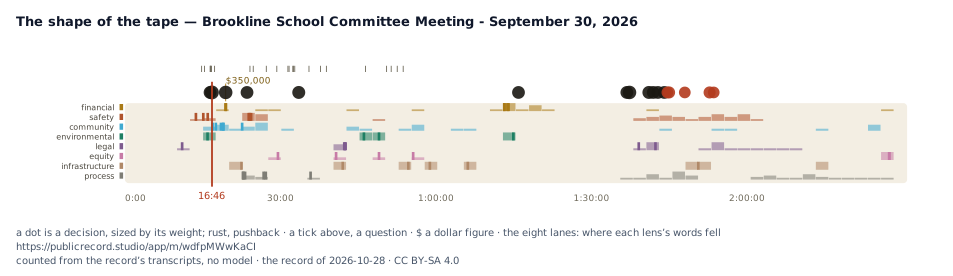
Cut from the analyzer’s scored moments — a measurement, not a choice made for you. Open a reel and press make this reel yours to re-cut it; tick any moment or transcript line below to cut your own.
At the September 30, 2026 Brookline School Committee meeting [10:20], the committee approved the consent agenda [16:19] before receiving public comments regarding class size data and staff cuts [18:01] as well as playground heat safety [21:38]. District leaders presented updates on the K-12 science review process [28:32] and detailed findings from an external district review [39:55]. During policy updates, the committee voted to adopt a policy governing school interaction with civil law enforcement [2:20:19], updated district policy on physical restraint and emergency seclusion [1:51:41], and approved revisions to student discipline policies [2:02:03]. Following liaison and subcommittee reports [2:24:38], the committee voted to enter executive session to discuss collective bargaining strategy [2:29:12].
What it means: The committee approved its consent agenda [16:49] and heard public comments regarding kindergarten class size cuts [17:40] and excessive heat on the Driscoll school playground [21:43]. District leadership announced that a missing student was safely located [25:21] and reviewed a district-wide science curriculum evaluation [28:32] alongside findings from a comprehensive state review [39:02]. To update local policies, the committee approved a policy responsive to the state Protect Act regarding law enforcement access [1:40:31], updated its seclusion and restraint guidelines [1:51:57], and revised the student discipline policy to align with state regulations [2:02:46].
Who moved it: An unidentified speaker moved to approve the consent agenda [16:28]. Laura moved to adopt the policy responsive to the Protect Act [1:51:08]. An unidentified member moved to pass the seclusion policy [2:01:26], which was seconded by Jesse [2:01:30]. Carolyn moved to approve the updated student discipline policy [2:16:10], seconded by Val [2:16:16]. Jesse moved to enter executive session to discuss collective bargaining and legal services [2:29:13] to [2:30:10], seconded by an unidentified member [2:30:14].
What to watch: The committee postponed action on removing outdated philosophy statements from the policy manual to October 14th [2:24:08] to [2:24:16]. Residents can look for continued reports on union negotiations [2:28:05] and the rollout of new science curriculum recommendations [31:42] to [32:39]. The transcript does not settle what specific funding additions will be necessary for the district's future professional learning plan [1:12:47] to [1:13:00].
Scored, not chosen for you — the salience bar is a measurement, and every moment is a receipt into the transcript below. With JavaScript on, tick moments to compose a reel — and tick moments on other meetings too; a reel can span the record.
→ the publish kit for this meeting — the clips worth cutting and draft copy, for a producer.
Counted, not modeled — each lens is a word list; drift compares the first half to the second.
the same, as a table
| word | mentions |
|---|---|
| work | 91 |
| policy | 78 |
| data | 70 |
| school | 65 |
| thinking | 63 |
| district | 61 |
| student | 60 |
| part | 48 |
| students | 47 |
| plan | 36 |
| curriculum | 34 |
| people | 32 |
| many | 32 |
| building | 32 |
| review | 32 |
| learning | 31 |
| little | 31 |
| clears | 30 |
| throat | 30 |
| support | 30 |
| use | 30 |
| across | 30 |
| first | 29 |
| teachers | 29 |
| something | 29 |
| place | 29 |
| different | 29 |
| sure | 29 |
| together | 28 |
| still | 27 |
| move | 27 |
| last | 26 |
| professional | 26 |
| process | 24 |
| policies | 24 |
| terms | 24 |
| systems | 24 |
| within | 23 |
| number | 23 |
| focus | 22 |
| using | 22 |
| philosophy | 22 |
| working | 21 |
| talk | 21 |
| science | 21 |
| subcommittee | 20 |
| report | 20 |
| seclusion | 20 |
| team | 19 |
| parents | 19 |
| able | 19 |
| mtss | 19 |
| section | 18 |
| understand | 18 |
| piece | 18 |
| already | 18 |
| teams | 18 |
| take | 17 |
| sometimes | 17 |
| suzanne | 17 |
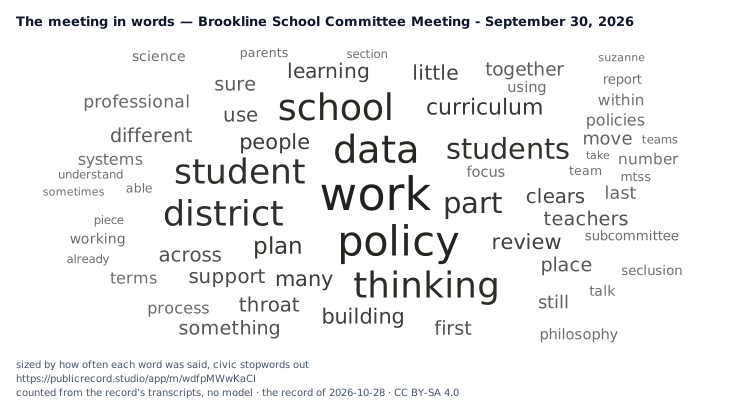
“work” came up 91 times. Sized by how often; civic stopwords out. With JavaScript off, a word opens the tape at its first mention.
2:32 [music]
8:50 Hey,
9:02 hey, hey.
9:22 [music]
9:59 Recording
10:15 in progress.
10:16 All right. Welcome everybody.
10:18 [clears throat] I here hereby convene
10:20 the September 30, 2026 Brookline School
10:24 Committee meeting, regular meeting.
10:27 um [clears throat] try to make it short
10:29 tonight so people can get back to watch
10:31 the Red Sox Yankees perhaps.
10:35 No, come on Carolyn.
10:38 Anyway, okay, we begin with um public
10:42 school of Brooklyn moments of
10:43 inspiration and I have the honor and
10:46 pleasure to do that right now. And
10:50 so [clears throat] when I was the head
10:51 of Brookline High School
10:53 on at the first MA faculty meeting of
10:55 the year, uh we had um teachers and
11:00 administrators and custodians and
11:02 secretaries and counselors um present
11:05 their stories that would hopefully
11:07 inspire the entire faculty and staff.
11:11 And so what I'm going to read tonight is
11:15 a story told by Gretchen Tucker
11:17 Underwood who was a teacher and a metco
11:20 director dean of students um at Brooklyn
11:23 High School from 1971
11:26 to 2007
11:29 29th
11:30 30 something years. Okay. So this is
11:33 this is the story that she told to the
11:35 entire faculty and staff.
11:38 Josiah had the kind of eyes that made
11:40 you wonder whether he was just waking up
11:42 or ready to take a nap. And just under
11:45 them was a smile that could light up any
11:48 room. He [snorts] was the kind of
11:50 student who just brightened your day,
11:52 not by anything extraordinary, but
11:54 through his day-to-day attention to his
11:57 surroundings. A selfless student athlete
12:01 who deeply believed in team. A student
12:04 with some learning deficiencies and a
12:06 strong work ethic. A gentleman with
12:08 students and faculty alike. This was
12:12 Josiah.
12:14 I had been a high school teacher and
12:16 administrator for several decades.
12:18 Students like Josiah would reappear
12:20 years after graduation just to check in,
12:23 telling us about their accomplishments
12:25 or seeking some help from a familiar
12:27 school figure from the past. As dean of
12:30 students, my days were busy responding
12:33 to the complex lives of 800 adolescents,
12:36 their sometimes demanding parents, and
12:39 their hard-working teachers. The day
12:41 that Josiah appeared was a particularly
12:44 hectic day for me. I had finished one
12:47 stressful conference and was preparing
12:49 for another stressful conference. I
12:51 stepped out of my office to catch some
12:53 air and there he was, Josiah.
12:56 [clears throat]
12:58 Of course, I was glad to see him. We had
13:00 some predictable banter. I stretched to
13:03 remember which college he attended, what
13:06 major, his siblings. He gave me that
13:09 trademark smile and proceeded to tell me
13:12 what was going on in his life. I thought
13:15 about the meeting to come. I wondered
13:18 how much time I could give him and still
13:21 remain on schedule.
13:23 He began a story about going to a night
13:26 spot just outside of Boston. As he was
13:30 leaving, some thugs jumped him and beat
13:34 him senseless as they robbed him of his
13:37 possessions.
13:39 I looked closely at Josiah.
13:42 No visible injuries, so I assumed this
13:45 story had to have a happy ending. "Did
13:48 they catch them?" I asked Josiah.
13:50 "Yeah." "Are you okay?" I continued.
13:54 Josiah paused and said he couldn't
13:56 remember a whole lot about that night
13:59 because he had been in a coma for
14:01 several weeks after the incident.
14:04 Josiah now had my full attention. He
14:07 said he had remained hospitalized for
14:09 over a month, then to rehab and finally
14:13 home. Home was not what his parents had
14:17 expected. Josiah was bedridden due to
14:20 his physical condition and he was in a
14:22 deep depression.
14:24 He couldn't get himself to leave his
14:26 room or his bed. Finally, after
14:28 extensive treatment, he was able to
14:30 leave his room and walk around his
14:33 house. But his recovery came to an end
14:36 there. His body had healed with no
14:39 significant medical issues. His mind and
14:42 spirit, however, would not allow him to
14:44 continue with his life.
14:47 So then what? I asked. My mother found a
14:51 psychiatrist who was willing to work
14:52 with me at home. I made some progress. I
14:56 could get to the door of my house but go
14:58 no farther. After many weeks, my doctor
15:02 said to me, "I want you to visualize a
15:05 place where you feel where you felt
15:07 safe, a place where you have good
15:10 memories, a place where you were
15:12 valued." Can you picture that in your
15:15 mind?
15:16 Josiah spent cons considerable time
15:19 working on his image on this image he
15:21 told me. So what happened next? I asked
15:25 him. He said simply I went to that place
15:29 and here I am.
15:33 I still get emotional about this. There
15:35 were so many things I had to do that
15:37 day. I almost missed this encounter. Yet
15:40 it is the single most compelling reason
15:42 I stayed in education for 40 years.
15:45 Josiah, this gem of a person, this
15:47 ordinary manchild, to find what it is
15:50 that we can only hope to achieve with
15:53 each of our students. Create an
15:56 environment within which every student
15:58 can feel safe to grow and to learn.
16:04 Thank you.
16:06 [snorts]
16:07 I cried then, I started crying now.
16:11 Uh it's an amazing story.
16:13 Okay, we have a consent agenda. Past
16:17 records, past records, accounts payable.
16:19 Are there any questions on the consent
16:22 agenda?
16:25 Can I have a motion to accept the
16:26 consent agenda? Suzanne,
16:28 so move.
16:29 Jesse second.
16:30 Seconds it.
16:31 FISA, how do you vote?
16:34 Yes.
16:34 Jesse, how do you vote?
16:35 Yes.
16:36 Suzanne,
16:37 yes.
16:38 Um, Donna,
16:39 yes.
16:40 Carolyn,
16:40 yes. Laura.
16:42 Yes.
16:43 Is anybody online?
16:44 Val.
16:45 Yes. Yes.
16:46 And I vote yes. Consent agenda is
16:49 approved.
16:50 And now we have public comment. As you
16:53 probably know, community members are
16:55 invited to be here. Comment about
16:58 whatever um whatever you're concerned
17:00 about, whatever you're happy about,
17:02 whatever. You have three minutes at the
17:04 most. Betsy will keep track of the time.
17:08 And our first speaker is
17:10 uh Mike Lions.
17:11 Mike Lions.
17:12 First speaker.
17:12 Thank you. Welcome.
17:13 Try to keep it real.
17:17 Okay. Can you hear me? Okay.
17:19 Yeah.
17:20 Hi, I'm Mike Lions, parents of two kids
17:22 at FRR. I spoke here in June and I'm
17:26 also one of the people who organized the
17:27 petition about the F FR kindergarten cut
17:30 signed by roughly 175 members of the
17:32 community or approximately 20% of FRR
17:35 parents. This was one of many goodfaith
17:38 attempts by parents to reverse an
17:40 inequitable cut or at least to get some
17:43 data that would support the decision. As
17:45 of yet, Superintendent Wong has yet to
17:47 respond to the specific questions we've
17:49 asked while responding to several we
17:51 haven't at the last school committee
17:53 meeting. I'm here tonight to discuss
17:55 several things said that I found
17:57 surprising.
17:59 I was surprised when Superintendent Wong
18:01 justified the decision to cut an F FR
18:03 section by framing it as a decision
18:05 between FR and Baker and Hayes, two
18:08 sections that clearly or sorry, two
18:10 schools that clearly could not weather a
18:11 cut and remain under the 22 line while
18:14 omitting any mention of the schools that
18:16 could and that we have been asking
18:18 about. I found this surprising given
18:20 that the district's own data in June
18:23 showed that if this cut was made to
18:24 Lawrence, for example, three other
18:27 schools in the district would still have
18:29 larger classes. And today, even after
18:32 relocating out of zone families out of
18:34 FRR, Lawrence would still have lower
18:36 class sizes if they had lost the section
18:39 than FRR kindergarteners have today.
18:42 I was also surprised when Superintendent
18:44 Wong claimed that she had added a new
18:46 fifth grade section to FRR when that
18:48 same section had been cut only a few
18:50 months earlier.
18:51 But I was most surprised by what I
18:53 didn't hear. Any mention of the data 175
18:56 members of the community have asked for.
18:59 I heard no mention of how many out of
19:01 zone families were silently displaced
19:02 from FR by forced transfers in order to
19:05 keep the F FR section sizes narrowly
19:07 below the 22 guidance.
19:10 I heard no mention of why Lawrence was
19:12 not considered by for the cut. And to be
19:15 clear, I'm sincerely not suggesting we
19:17 go cut Lawrence instead. In fact, I was
19:19 surprised to hear no mention of why this
19:21 cut was necessary given that it was made
19:23 after the budget was set, the override
19:26 passed, and now that $350,000 of
19:29 additional Title One funds has been
19:31 obtained by BPS.
19:34 But I shouldn't I suppose I shouldn't be
19:35 surprised that the district continues
19:37 ignoring parents, ignoring our
19:39 reasonable and respectful questions
19:41 since June, ignoring our pleas for
19:43 response at the latter June school
19:45 committee meeting, ignoring our
19:47 petition, ignoring our freedom of
19:49 information request to see the data that
19:51 might explain these cuts, and ignoring
19:54 an order from the Secretary of the
19:55 Commonwealth to respond to the foyer
19:57 request.
19:58 So tonight, I suppose the people I'm
20:01 trying to reach are my fellow parents.
20:04 Regardless of which schools your
20:05 children go to, if we as parents do not
20:08 push back on these cuts made purely for
20:10 austerity's sake, they will continue and
20:12 they will affect you. You'll learn what
20:15 me and many FR parents have learned over
20:17 the past few months. Decisions that
20:19 affect your child will be made quietly
20:21 in private. They very well may
20:23 contradict the district's own data. And
20:25 when you ask in good faith why, you will
20:27 be ignored with the hope that you give
20:29 up.
20:30 Thanks.
20:33 Thank you.
20:35 Next [clears throat] up,
20:36 uh, next up is Nicole Mlullen.
20:38 Welcome, Nicole.
20:50 Hi everyone. I'm Nicole Mlen. I'm a
20:53 Driscoll parent and site council member.
20:55 Thanks for your time today. Um I'm here
20:58 to talk about the Driscoll playground
20:59 and shade issue which I know has been
21:01 making progress. Um I want to start by
21:04 thanking you, Superintendent Wong, for
21:06 taking this up and this current school
21:08 committee. I know this is a problem you
21:10 all inherited, which is never fun. Um
21:14 but it's really important. It's going to
21:15 continue to be a problem. So I
21:16 appreciate the work you're doing and
21:17 other town departments and I want to
21:19 start with that. Um, just a reminder to
21:23 set the context, our playgrounds at
21:25 Driscoll, we have an upper rooftop
21:27 playground that serves the little kids,
21:29 beep, and sometimes kindergarten, and
21:31 then a lower playground that serves the
21:33 rest of the school. And both of these
21:35 playgrounds are exceedingly hot when
21:38 it's warm and sunny outside. Um, even
21:41 some days in April on the rooftop
21:43 playground were too warm for the kids,
21:45 believe it or not. If it's 72 degrees on
21:48 the upper playground, it can be close to
21:50 100 degrees on the rooftop playground.
21:52 So, you've probably seen the pictures of
21:54 the temperatures I've taken, but just to
21:56 remind everyone just how warm it is.
21:58 It's pretty uh unusable for a lot of the
22:01 school year. Um,
22:04 I appreciate that we're focused on the
22:07 upper playground, but I want to keep the
22:08 lower main playground in focus as well.
22:11 It's also very, very hot for the kids. I
22:14 was there um at the in June and on the
22:18 playing field it was about 125° when the
22:20 kids were out at recess.
22:23 Um parents have been raising this issue
22:26 for about four maybe five years now when
22:29 the site was still under construction.
22:32 So while it's kind of a new pro issue
22:35 you all have inherited for the Driscoll
22:37 community, it's been ongoing for quite a
22:39 long time. So I'm here for two reasons
22:42 tonight. Um, one is to request that a
22:46 school committee subcommittee, probably
22:48 the capital subcommittee, take this up
22:51 sort of as a charge to ensure that we're
22:55 figuring out what happened. Um, I think
22:56 that's very important. Following the
22:59 process, keeping the process moving,
23:01 helping, you know, facilitate a solution
23:04 and an implementation timeline because
23:06 it's just been dragging on so long. I
23:08 think if we can officially have a
23:10 subcommittee charged with that, that
23:11 would be really helpful. Um, and I also
23:14 think it's very important to understand
23:17 more of how this happened. Like we've
23:19 talked about, it shouldn't have happened
23:21 this way. I think there's a flaw in the
23:24 process and understanding that could go
23:27 a long way to sort of rebuilding
23:29 community trust. you know, we need the
23:31 community to believe us when we tell
23:33 them to vote for overrides and debt
23:34 exclusions because we're going to
23:36 responsibly spend their money. And I
23:39 think figuring out what happened and
23:41 being able to reure the reassure the
23:42 public that we have a sound process is
23:44 really important. Uh my second ask is
23:48 for the school committee to consider
23:50 helping oversee the development of a
23:52 heat safety policy. I don't think we
23:55 have that as far as I could tell in
23:56 Brooklyn. we've asked many many times
23:58 and none has been articulated. So I'm
24:01 assuming we don't have a policy on heat
24:04 safety for school use. Um can I have 30
24:07 more seconds? Thank you.
24:09 So you know it's 2026. Our playgrounds
24:12 are hot. We have hot school days. We're
24:16 building playgrounds that have um a lot
24:19 of plastic and rubber, not a lot of
24:20 shade. I think we need a heat safety
24:22 policy. Kids are especially vulnerable
24:25 to heat exhaustion, heat effects. Um, we
24:29 have policies on when it's too cold,
24:31 what we do, but not when it's too hot,
24:33 and it really is often too hot, and
24:35 that's actually arguably more dangerous
24:37 for these kids. So, I'd also love to see
24:39 the school committee take this up as an
24:41 issue. Can we have a heat safety policy
24:44 districtwide?
24:46 Um, that's all. I just wanted to keep
24:49 this on the radar. Thank you all for
24:50 everyone who has, you know, kept us at
24:53 the forefront and I hope we can see
24:55 progress while it is cool in time to
24:58 have usable, safe playgrounds in April.
25:01 Thank you.
25:03 Thank you, Nicole.
25:05 [clears throat]
25:06 Okay, moving right along.
25:07 Superintendent's report.
25:08 Thank you. Um, I have just a few short
25:12 updates and um, comment. One is a
25:15 statement of appreciation.
25:17 Um, last week we had a student that um
25:21 that we reported missing and I my
25:24 appreciation is for the response of all
25:27 the safety officers in town,
25:29 particularly the police department. I
25:32 know um police cars were were driving
25:36 through the neighborhoods. I know a lot
25:38 of community members and appreciation
25:40 for community members that reached out
25:42 were also um out in the neighborhoods
25:45 and just with tremendous relief that um
25:48 our student was was found and returned
25:51 home. Um but it was really the it was in
25:54 addition to all the local support but
25:56 the extensive network of police
25:59 departments across many towns and the
26:01 MBTA
26:02 and um it was I will say um it was
26:06 scary. Um and and um but we but we
26:12 remained hopeful um that Amber Alert did
26:14 work and um and just everyone being out
26:17 there and and finding him. So just thank
26:19 you. Um I did have a brief mention for
26:24 the disco play structure. There was
26:27 another meeting today with some of um an
26:29 appreciation with the building
26:31 department with parks um and also with
26:35 our deputy superintendent Erin Osborne
26:38 um working together on this. So, I just
26:40 want to remind everyone on 107 there
26:43 will be a presentation to the capital
26:45 finance subcommittee
26:47 um the cost is refined
26:51 um but with still an assurance that
26:53 what's being proposed um will be
26:56 effective, more costefficient and still
26:59 safe. Um and so what remains a challenge
27:03 for us to see if we can find funding
27:05 this year or if we're going to have to
27:06 put it through a process to right. So
27:10 it'll go to the subcommittee for you to
27:12 consider and make a recommendation. I'm
27:14 looking at you Jesse, but who else is on
27:16 the committee?
27:17 FISA and Carol.
27:18 Okay. So So it'll go to you and um and
27:23 just a just acknowledgement that MCCAST
27:26 data is out public. Um it's out there
27:28 and we are we're still we're still
27:32 analyzing it by school. So, right now,
27:36 um it's scheduled for presentation in
27:38 December. We're going to see if we can
27:39 push it earlier. Um if we can that our
27:42 agendas, the school committee agendas
27:44 are really full for this first half of
27:47 the year and that's without the budget
27:48 process starting. So, we're going to try
27:51 to see if we can move it forward. Um but
27:53 just to let you know that we're not
27:54 really ready to make any statements
27:56 about any particular part of it until we
27:59 finish um looking at the data all
28:01 together. So, thank you. And then Then
28:04 last thing, science and technology
28:07 curricular review. Our deputy
28:09 superintendent for teaching and
28:10 learning, Roboy, is just going to give a
28:14 just like a brief overview. Yeah.
28:17 Update.
28:23 Hi. So, um, this was mentioned last
28:26 spring kind of as we were building the
28:28 the budget for the year and some of the
28:30 things that we may need. So, we are
28:32 starting a K12 science review. And so,
28:35 you know, that's a that's a pretty big
28:37 deal for us. I don't know how many um
28:39 curriculum reviews that we've done in
28:41 recent years that have spanned the K12
28:44 um process. The we have a steering
28:47 committee that has met a couple weeks
28:49 ago for the first time. Um we put out
28:52 interest to educators for different
28:54 levels of involvement in the spring. So
28:57 we know we'll have we have some interest
28:58 in people wanting to look at different
29:00 programs and give feedback. We have um
29:03 potential to pilot some programs
29:04 particularly at the K5. So different
29:07 levels um of teacher engagement. And I
29:10 think really the goal for us in this
29:12 work is thinking about
29:14 both cohesion and consistency. So what's
29:17 the cohesion of our K12 science program?
29:20 So what is the journey of a student um
29:22 throughout our district in terms of
29:24 science education and that consistency
29:27 across the grade level and across
29:28 classrooms to make sure that we are
29:31 working toward equitable outcomes for
29:33 our students. Um there's particular
29:34 attention in some of the goals that
29:37 we're looking at at that transition from
29:39 8th to 9th grade because we know that
29:41 that's been a particularly challenging
29:43 transition for our students. So we're
29:44 we're looking to make that um a little
29:47 more seamless. Um so we will be engaging
29:50 K5 starting to think about um curriculum
29:54 that aligns with the 2016 standards
29:56 because that is not necessarily um the
29:59 case for all of our units within K5 at
30:02 the moment. Um 68 has begun um scope and
30:07 sequence work and so they they had
30:09 started that so they're going to
30:10 continue with that work. Part of that
30:12 might be considering new materials or
30:13 new units as part of that um scope and
30:16 sequence work and the high school will
30:18 be enga start by engaging in a
30:20 self-study and looking for some peer
30:21 review and looking at their courses
30:23 holistically. Um so it's really exciting
30:25 work. It's going to be led by our two
30:27 coordinators um Emily Spec who is our
30:31 coordinator and Briana Brown who is our
30:32 912 coordinator along with myself and
30:35 Joel Peterson is our senior director of
30:38 teaching and learning. So we will we'll
30:40 be kind of guiding that work. Um as part
30:42 of it we're also participating in um an
30:46 implement network through DESIE and so
30:48 that is part of their curriculum review
30:51 process and um it will allow us to
30:55 access resources and other districts
30:57 that might also be going through the
30:59 same process that we are at the same
31:00 time for science. So some of that peer
31:03 um thinking as we go through our
31:04 process. So we'll be updating throughout
31:07 the year. Um, but just wanted to put
31:08 that on your radar that it started and
31:10 we're really excited about the work and
31:12 we have a great group of educators that
31:14 are going to help us lead our steering
31:15 committee that represent elementary,
31:18 middle, high school and across um a
31:21 number of our other educators getting
31:22 input. So very excited.
31:24 Thank you, Robin. Are there any comments
31:26 or questions for Robin?
31:28 Donna,
31:29 um, thank you so much, Robin. You might
31:31 have mentioned this. Um can you talk a
31:34 little bit about the timeline and and
31:36 what what the deliverables might be at
31:39 the at the end?
31:40 Um yes. So there the deliverables may
31:42 deliverables may look a little bit
31:44 different at each level just because
31:45 they're in different stages of where
31:47 their curriculum at is at currently and
31:49 the resources they're using. Um so a
31:51 goal would be for us by the end of the
31:53 year in K5 to be able to recommend um a
31:57 core science curriculum for our K5
32:00 classrooms. So, um, we'll be looking at
32:03 that, um, for R 68 because they're in a
32:06 little bit of a different place. They've
32:07 been doing some work. We're going to
32:08 continue the scope and sequence work and
32:10 look for places where there are gaps
32:12 where we might need to update a unit or
32:14 make sure that we have consistency. Um,
32:16 and then at the 912, we're going to be
32:19 really looking at our courses
32:21 holistically. What is the program at the
32:22 high school? And from that, we'll be
32:24 thinking about an action plan of of, you
32:27 know, are there courses that have been
32:29 more recently reviewed? and our um
32:32 materials are up to date. Are there
32:33 courses that we want to be taking a look
32:35 at that might need new materials or or
32:38 redesign? So
32:39 Carolyn,
32:42 um so is it correct that the current
32:45 curriculum is open sigh ed? Not
32:48 consistent. We don't use a single
32:50 consistent um curriculum across our K8s.
32:54 So we have some units that I think that
32:57 we're using for open sed. I have some
32:59 that we're using amplify some that are
33:02 self-created. Um when you were talking
33:05 about amplify or open sad, those are
33:07 more recent units and so those are in
33:09 alignment with the current state
33:10 standards. Some of our self-designed
33:12 ones may not be. And so thank you.
33:15 That's I understand what you're saying.
33:17 And so I just given what you just said I
33:22 think what you're saying is that the you
33:25 the anticipated result will be the
33:31 adoption of some new
33:35 curriculum
33:36 that's out there.
33:38 Yes. and then the the
33:42 implementation hopefully would be would
33:45 begin
33:45 cohesive and consistent.
33:47 Yes. And
33:48 that's that's what you're looking at.
33:50 I understand. And
33:54 do we currently currently like I guess
33:59 the answer is unknown like what
34:02 mechanisms do we have as a district to
34:05 try to ensure consistency
34:09 if we don't have consistency but we want
34:12 it are you thinking about in the
34:13 implementation I think one of or the
34:16 now
34:17 I mean if there's
34:20 well
34:20 I think that's one of the things that we
34:22 need to work towards as a district and
34:25 science is one of those areas that we're
34:28 just not there at the moment.
34:29 Okay. Thank So I think in our work with
34:32 MTSS, we are we're we're putting
34:35 structures in place to
34:38 to support um consistency across the
34:42 grade levels across the K8 schools and
34:45 um and science and technology is the
34:48 first next curriculum that we are taking
34:51 to review
34:53 and and that is part of the purpose of
34:55 the review as well. So I think we are
34:58 we're moving through
35:01 subject by subject.
35:04 Welcome Sarah. Nice to see you. Laura,
35:06 and then FISA.
35:08 Thank you. And I'm excited about the
35:09 work that's about to be done. And you
35:11 know, you talked about trying to create
35:13 sort of consistency and cohesion across
35:15 all of our especially our K to8s. And so
35:18 I guess when we're thinking about the
35:19 science curriculum and creating that
35:20 cohesion, are we also thinking about
35:22 opportunities like science fair, which
35:24 some schools have and some don't, but
35:26 are really important in energizing young
35:28 scientists? Is that part of the
35:29 conversation?
35:30 That's not necessarily part of the
35:31 review because it's not but it might be
35:34 a discussion of what opportunities do
35:35 our students have beyond the classroom
35:37 to engage in science.
35:40 FISA,
35:41 thank you. So it so happens that I was
35:44 at the Desi meeting today all day uh you
35:48 know hearing about many different
35:50 aspects. There was one I'm sure you know
35:52 about it and um today they talked about
35:55 implement. So I I'm definitely here to
35:59 admit that science is one of the tougher
36:02 curriculums to get a handle on because
36:05 there is like so many open you know
36:08 resources out there and teachers tend to
36:10 use it to make sure that they do the
36:12 best in the classroom. Um so that's
36:14 number one. Um it's going to be a lot of
36:17 work. Thank you for taking it on. And
36:20 the other thing is that once I'm
36:22 thinking once you um you know go through
36:25 that ladder of K through 12 or that
36:27 progression uh and you use implement
36:30 then that will bring cohesion to
36:33 everything because everything will
36:35 comply with that five um step cycle that
36:38 is listed in implement.
36:40 Yes. So we are we have um articulated as
36:43 we've articulated our process we've
36:44 aligned it with the implement framework
36:46 which is a really a leadership framework
36:48 for thinking about um curriculum review
36:51 and implementation and selection of
36:53 resources that are of high quality. Um
36:56 and so that is part of the network that
36:58 we're participating in. We're in their
37:00 um evaluate and select network which
37:01 [clears throat] is the first part of the
37:02 framework. um we could choose to
37:05 continue on in the um implement and moni
37:09 monitoring cohort next year.
37:11 Right. Thank you. And also you'll be
37:13 using curate probably to look at that.
37:15 So yes. So thank you. Thank you for all
37:17 this work
37:20 Carolyn.
37:22 I meant to ask before. Um, so I notice
37:26 and Bella reminded me that this has
37:29 science and technology and I'm not sure
37:32 that's how it's framed currently. So I'm
37:35 interested in that and maybe it's too
37:38 early but like can you just talk a
37:40 little bit about how you're envisioning
37:42 those together? So I can talk a little
37:45 bit about it from the standpoint of the
37:46 framework and so the framework is the
37:48 science and technology engineering
37:50 framework. Okay. Um, so that technology
37:52 piece is focused on that, but we've also
37:54 had conversation about we really need to
37:56 be thinking about our computer science
37:58 offerings, our robotics offerings. And
38:00 so I I would imagine that some of that
38:02 will be an outcropping of thinking about
38:04 how what else we need for our students.
38:06 Um, because
38:08 that that is something that we we don't
38:10 see consistently. But to your point
38:11 about the engineering piece that that
38:14 technology engineering piece is a
38:16 question that I have about how are we
38:18 making sure that those components of the
38:20 standards are being you know implemented
38:22 within our classrooms because those
38:24 standards do run K through 12. So it's
38:27 not just about offering computer science
38:29 courses.
38:30 So that's what's special about the 2016
38:32 standards is the engineering component.
38:35 So I think this is so this is it's
38:38 pretty exciting to see what we could do
38:40 and um the engineering part will
38:44 probably affect more um middle school
38:46 and high school.
38:51 Awesome.
38:52 Anything else? If not, we move on to
38:55 item number five, presentations and
38:58 discussions of current issues and 5A,
39:01 Department of Elementary and Secondary
39:02 Education District Report presentation
39:06 and discussion. Superintendent one.
39:08 So, actually Robin is going to take this
39:11 one as well. Um, [clears throat]
39:15 there was a team that came in and they
39:17 they actually gave Robin and myself and
39:19 Kieran a lot of time to work with them.
39:21 And so Robin's gonna go ahead and
39:23 present on our behalf.
39:25 Okay, here we go. Here you get double
39:27 dose. Um, all right. So again, I I'm
39:30 going to repeat some things that I
39:32 shared with you last year earlier in the
39:35 year when we first announced that we
39:36 would be going through this review when
39:38 we have new members of our committee and
39:40 also just kind of remembering, you know,
39:43 why what this is and why it was done. So
39:46 um this first slide is really an
39:48 overview and really thinking about what
39:51 the Desi review is and this was a
39:53 comprehensive review that we went
39:55 through. There are a couple of different
39:56 kinds. It's one that we didn't it's not
39:58 one that's done on a cycle like some of
40:00 our tiered focus monitoring is done on a
40:02 cycle. Um we were selected and it was
40:04 one that we didn't get to say no.
40:06 [laughter] Um so we didn't so if you
40:08 remember Superintendent Wong asked could
40:10 we wait till a year when we're settled a
40:14 little bit.
40:15 um and um that was not an option. So we
40:19 prepared throughout the fall for this
40:21 review. It's um it's an external review.
40:24 It's conducted through Desi um and then
40:26 outside they use an outside um research
40:29 firm to help with the interviews and the
40:31 structure of it. Um it is grounded in
40:34 the district standards. So there are
40:35 standards and indic indicators that
40:37 really focus on all um elements of the
40:40 school district and really the focus is
40:43 on ensuring equitable outcomes and
40:45 continuous improvement. So right
40:47 thinking about is your system how are
40:49 your systems working together to think
40:51 about how we support students. So it's
40:53 not just about curriculum although
40:55 curriculum and teaching and learning is
40:56 obviously a large part of it. It's also
40:59 thinking about your finances and your
41:01 policies and how your you know the parts
41:03 of your system work together. So in that
41:05 way it's this kind of 360 review. Um
41:08 some of you participated in a focus
41:10 group as did some of our parents and
41:12 many of our teachers and various focus
41:13 groups throughout. Um why it matters is
41:17 it does give us a snapshot of that that
41:19 systems view and help us think about it
41:21 all together. Um what I would say is it
41:24 is a snapshot of our district as we were
41:27 leading up to the review and then the
41:29 on-site portion in March. So it's it's
41:32 capturing if you remember many of the
41:34 documents and things might have been
41:36 even from the 2024 or 25 they might have
41:40 even been older. They ask for documents
41:41 over the past number of years. There
41:44 specific things they ask us to so that
41:45 they can review and look at. Um the
41:47 on-site portion of our review happened
41:50 in late March. Um and they were on on
41:55 campus on our campuses for about a week.
41:58 Um we did have I think our parent forum
42:01 was about a week later so it it bridged
42:03 the end of March, beginning of April. Um
42:05 and really the you know it can help us
42:09 think about district planning
42:12 improvement really kind of aligning our
42:14 efforts the how it's different than say
42:16 a tiered focus monitoring where you're
42:18 looking for compliance and then there
42:20 might be action items that you you know
42:23 there that you you need to do to bring
42:25 yourself into compliance. This is really
42:28 um thinking about our current strengths
42:30 as a district, some places to grow and
42:32 some recommendations. Now, some of those
42:34 may have compliance elements of it, but
42:36 it's a little bit different than that
42:37 tiered focus monitoring piece. So,
42:40 thinking about things we should be doing
42:41 and making sure that we're doing some of
42:43 our how our systems work. The next
42:45 slide.
42:49 So, this is just a slide that shows the
42:51 six areas of standards. And I I'm not
42:53 going to read through all of the bullets
42:55 underneath, but again, it's just to
42:56 emphasize that it really looked at
42:58 leadership and government, our finance
43:00 and asset management, curriculum and
43:02 instruction, student supports, and so
43:05 they, you know, that covers a lot of
43:06 things. Assessment, what are assessment
43:08 practices, how are we using them, and
43:10 then human resources and professional
43:12 development. So if we think about these
43:14 in terms of the structure of our
43:17 district and the way that that we're set
43:18 up, it really crosses,
43:21 you know, all of these kind of cross
43:22 many of the four corners and our
43:24 relationship with the town and with the
43:25 community um and our parent community.
43:28 Okay, next slide, please.
43:33 And the other thing I just wanted to
43:35 remind people of is as the data was
43:38 collected. It wasn't, you know, like
43:40 people tended to, you know, you remember
43:41 the part that maybe you participated in.
43:43 So for many of our teachers, that might
43:45 have been a focus group that was geared
43:47 toward, you know, the grade level they
43:49 teach or the content area or their role
43:51 within the district. Our parents
43:54 participated in a focus group. There
43:56 were interviews with a number of people
43:58 within the district. school committee
43:59 was a focus group or subset of school
44:01 committee. Um but alongside that there
44:05 were a number of it was a a huge amount
44:07 of documents actually that we had to
44:09 provide ahead of time and think about
44:11 and actually in a I mean it was a lot to
44:13 compile but in some ways it also was
44:17 helpful to me as a first year person of
44:20 kind of bringing all of these things
44:21 together for my own information as well.
44:24 So in in a strange way it was actually
44:26 kind of helpful um in gathering all of
44:28 those pieces. So you know they looked at
44:30 our strategic plan, they looked at
44:32 meeting agendas and organizational
44:34 charts, our budgets over many years, our
44:36 capital planning, um any audits that
44:39 have been done of the district. They had
44:41 reports of those. um any of our
44:44 evaluation documents and this was a you
44:46 know so thinking about what are we using
44:48 to evaluate our teachers what are our
44:50 practices around evaluation how
44:51 consistently is that happening and so
44:54 they um our PD plans our mentoring
44:56 program and our mentor you know like how
44:58 we mentor new teachers into our district
45:00 and support them um they looked at how
45:03 we review curriculum NEAS reports
45:06 classroom observations they did 94
45:08 classroom observations in every school
45:11 in our district the lens was primarily
45:14 on ELA and math. So that you know when
45:17 they went in to look at at um classrooms
45:21 and again when they visited classrooms
45:22 they weren't looking to see you know how
45:25 is Dr. Dr. Benoy doing in her classroom
45:28 and I'm going to they're looking
45:30 consistently for what are the practice
45:31 there practices they're seeing across
45:33 grade bands right so they're not they
45:35 weren't like noting teacher names but
45:37 they're what does instruction look like
45:39 at different in across different
45:41 buildings in different grade bands so K2
45:44 35 68 912 so patterns of what they were
45:47 seeing
45:49 um student supports so they're looking
45:51 they were looking at our documents
45:52 related to MTSS which you've heard a lot
45:55 about in the last year and we were you
45:57 really in the process of building. They
45:58 looked at our DECAP um which is our
46:01 district curriculum accommodation plan
46:03 we should be using to guide some of our
46:05 work with students um climate surveys,
46:08 family engagement reviews, reviews, any
46:11 reviews that we've done and classroom um
46:14 observations also looked at student
46:16 support um and then when they looked at
46:18 assessment was another major area for
46:20 them. They're looking at assessment
46:21 structures like what are the structures
46:23 we have in place? what are the
46:24 structures and practices we have to look
46:26 at data um and um you know anything that
46:31 we had in writing along those lines.
46:33 They also looked at anything publicly
46:34 available
46:37 through Desi. So any of our
46:38 accountability data and things like that
46:41 that were that are part of the DESIE
46:42 site. Um and then just that last piece,
46:45 questionnaires, observations, district
46:48 documents, desi data and stakeholder
46:50 interviews were a large part of the la
46:52 the last part of the review.
46:56 Okay, so next slide. So
47:00 as promised in our review and it was
47:02 quite lengthy. I know you guys got a
47:03 full report of it. Um I don't know if
47:06 you were able to get through all of it
47:07 before this meeting but thinking about
47:09 there were there was some recogni
47:10 recognition of strengths and so the
47:13 report is really written from the
47:15 perspective of the six
47:17 um the six elements that they're looking
47:19 those six strands and in each one
47:21 they're thinking about what are their
47:22 strengths what are some areas for growth
47:24 and what are some recommendations that
47:26 they might have for how we approach
47:28 those areas of growth. So really under a
47:31 number of different places they you know
47:33 the the progress toward rebuilding trust
47:35 and strengthening relationships during a
47:37 period of leadership transition came out
47:40 across many interviews across the
47:43 district. So that idea that there's been
47:45 leadership turnover for a number of
47:46 years. We were in a year of a new
47:49 leadership team and that rebuilding of
47:52 trust and um consistency.
47:55 Um in terms of curriculum and
47:58 instruction, it was a strength that we
48:00 are we were in the process of
48:01 implementing a new ELA curriculum K8
48:06 um and that we were in the development
48:08 of a consistent district curriculum
48:10 review process. So we are in we we have
48:12 that at this point and then um
48:17 rigorous academic opportunities,
48:19 comprehensive supports um we h the our
48:23 mentoring program. So despite turnover
48:26 and change that's happened over a number
48:27 of years, our mentoring program has
48:29 remained consistent and strong and that
48:32 was an area of commenation. So the way
48:34 that we support new teachers as they
48:35 come into the district. Um and I would
48:38 agree with that. Um and then we have
48:41 growing district capacity for data
48:43 collection and benchmark assessments. So
48:45 it's a place where we are they saw it as
48:47 a strength that we were growing in that
48:49 area and we had a commitment to it. Um,
48:51 we were building common assessment
48:53 practices across grade bands and grade
48:55 levels and across classrooms. Um, we
48:59 have a commitment to safe and supportive
49:00 and inclusive learning environments and
49:02 certainly that's something that you have
49:04 heard a lot about in the last year.
49:06 Certainly as Matt Matt Dubois presents
49:08 our data that we're on belonging and
49:10 some of the the work we've done toward
49:13 um supporting students and then renewed
49:16 communication and collaboration with the
49:18 town. So just that idea that there seems
49:21 to be greater communication that's
49:22 happening and collaboration
49:25 um in terms of areas for growth. So the
49:29 next slide. So as we looked at these
49:32 instead of going you know strand by
49:35 strand standard by standard I decided to
49:38 take them in terms of looking at three
49:40 major themes and some of the findings
49:42 the places where we can grow really are
49:45 across a number of of those strands. So
49:48 at the bottom of each of these slides
49:49 you'll see related strands and some of
49:52 the um recommendations here some of the
49:54 things that we're looking at really
49:56 cross a number of places. So in terms of
49:59 building organizational capacity that's
50:01 a place of growth for us. So thinking
50:04 about the capacity that we have to
50:06 actually implement district priorities.
50:09 Um dedicated time for district and
50:12 school leaders to collaborate around
50:13 teaching and learning. That was a necess
50:16 that was a place where we um were
50:17 looking to strengthen. They recommended
50:19 we strengthen um monitor our progress
50:22 towards district goals. So not just
50:23 setting district goals, but how are we
50:25 thinking about the work we're doing
50:27 towards them? And then systematic review
50:30 and use of district-wide data. So while
50:32 it's a strength that we're building that
50:34 capacity, we have a commitment to it,
50:36 just making it systematic, thinking
50:38 about the structures that we put in
50:40 place and the systems that we put in
50:41 place to be able to use it um and review
50:44 it. So next slide.
50:48 Strengthening teaching and learning. So
50:50 again, you know, there's a strength here
50:53 in that there's this commitment to
50:55 rigorous ac academics and supportive
50:57 classrooms. You can see that um in can
51:01 be seen in our classroom observations
51:03 and in our documents, but there are
51:05 places to grow and strengthen within our
51:07 teaching and learning. And so thinking
51:09 about how we develop a shared
51:10 instructional vision. So really it it it
51:14 comes across in a number of ways as we
51:16 start to think about you'll hear us say
51:18 cohesion and that consistency like how
51:21 do we work together? How do we make sure
51:23 our K8s are working together as part of
51:26 a system and along with our high school
51:28 um for students that we're all working
51:30 as one? Um curriculum alignment and
51:33 implementation across the K8. So that
51:35 recognition that um it our while we may
51:41 have strong teaching and learning
51:42 happening, it's not consistent across
51:44 our classrooms. The same um curriculum
51:46 isn't being used, the same things may
51:48 not being taught at the same time. And
51:50 so thinking about um what that means in
51:53 terms of our K8s and as they transition
51:55 to our high school. So when we call out
51:57 in the science review, we really want to
51:58 look at that 8 to ninth grade
52:00 transition. We want to make sure that
52:02 that it's not just about science. It's
52:03 really about how do we as a system
52:06 support our students through strong
52:07 learning experiences. Um regular
52:10 instructional observation and meaningful
52:12 feedback. So, our administrators in
52:17 classrooms seeing teaching and learning
52:19 and giving feedback to teachers. Um, so
52:22 that's that's really twofold. That's
52:23 like thinking about evaluation, but
52:25 that's also just thinking about the
52:26 instructional practice of instructional
52:28 walks and things like that. How are we
52:30 how are we engaging in conversation
52:31 about teaching and learning? Um, the
52:34 timeliness, quality, and alignment of
52:36 educator evaluation. So, this was I I
52:39 call this out specifically because it
52:41 was an area was one of the areas that
52:44 they said very pointedly that um we were
52:48 still using the 2012 rubric in our
52:51 evaluation practices and our systems
52:54 weren't really aligned um well,
52:57 consistent practices. So, you know, that
53:00 is something that um we knew a lot of
53:02 these were things we know we know we
53:03 need to strengthen and work on. Um but
53:05 they also echoed that back to us. Um,
53:08 and we'll talk a little bit about that
53:09 when we talk about what's next and what
53:11 we're in the process of. And then
53:14 coherent district informed data wide
53:16 professional learning plan. So thinking
53:18 about
53:19 um
53:21 the development of our like a holistic
53:23 professional learning plan. We hear a
53:24 lot about professional development. Um
53:27 certainly it's happening in places. I
53:29 would say we have a number of people
53:32 committed to thinking about professional
53:34 learning and for their pockets. Um, but
53:38 we are we haven't been really thinking
53:40 cohesively about like what's the plan?
53:42 How are we capturing it all? How are we
53:44 thinking about professional learning as
53:45 a way to move toward our district goals
53:47 and support teachers um as we're, you
53:51 know, working together. So, it's that
53:53 cohesion of it and that comprehensive
53:55 plan as a district. Um, all right, next
53:59 slide. Um, and the last is using
54:01 evidence to improve student outcome. So
54:04 really thinking about building a shared
54:06 understanding in the of and
54:08 implementation of MTSS.
54:10 So we've been working towards that.
54:13 You'll hear throughout the year like
54:14 this is our you know we're launching
54:15 across the district. We've been doing a
54:17 lot of work over the last number of
54:18 years and it is exciting to be at the
54:20 point where we are moving forward um
54:22 with it. Um but it's this recognition of
54:24 needing to build make sure that we're
54:26 building a shared shared understanding
54:28 of that um intervention systems.
54:33 Oh, district-wide collection, review,
54:34 and use of student data to inform
54:36 instruction. So, again, like this comes
54:38 up in a number of places. It's a place
54:39 we're on the road with. There's
54:41 recognition of that and that commitment
54:43 to it, but it's also a place that we
54:45 need to continue to do work um
54:48 intervention systems and expectations
54:49 for the differentiation of instruction.
54:51 So what does that look like for students
54:53 and making sure that that is um
54:55 something that we can provide with
54:57 consistency
54:59 um across our schools assessment
55:01 practices that support the monitoring of
55:03 student progress. So how are we again
55:05 it's like how are we using assessment to
55:07 think about informing instruction and
55:09 thinking about the progress our students
55:11 are making. So it's it's targeted. It's
55:13 from that lens of how can we use that to
55:15 support the work that we're doing. Um
55:18 and then communication with families
55:19 about student progress. So this is just
55:21 a place I think is always a good one for
55:23 for growth of thinking about the ways in
55:25 which we communicate with families about
55:28 how their students are um how they're
55:30 doing how they're um and making sure
55:33 that our communications with families
55:35 are accessible to families. Okay, so
55:37 those are our three large buckets. So
55:39 thinking about building organizational
55:40 capacity, strengthening teaching and
55:42 learning and using evidence to improve
55:44 student student outcomes. So our last
55:46 slide um is really thinking about the
55:48 work that's underway and this was just
55:50 capturing in these areas that related to
55:53 growth were work we were in many ways
55:57 already like projecting and beginning to
55:59 work on. So again this is a snapshot you
56:02 know of what was happening in March and
56:05 leading up to March of last year. Um and
56:08 so it does give us the opportunity to
56:10 think about how the work we are already
56:12 engaged in really aligns with the work
56:15 that um we've received feedback on
56:17 because feedback is always an
56:18 opportunity for reflection right and so
56:21 um so in terms of building
56:23 organizational capacity. So two you know
56:26 big things and these were on the horizon
56:28 as we were meeting because they were
56:30 part of our budgeting process was the
56:32 reorganization of administration and
56:34 finance. So that was underway in the
56:36 spring. So thinking about who's doing
56:38 what like the roles within
56:39 administration and finance that
56:41 reorganization was already happening. Um
56:43 the restoration of our data director. So
56:45 we had been without a data director. Um
56:48 and so we have now hired a new data
56:51 director and I'm very glad that she is
56:53 here um and to be working with her as a
56:56 partner as we think about particularly
56:58 data from the perspective of teaching
56:59 and learning and the addition of the um
57:02 information systems manager. So that was
57:04 another position that we were able to
57:07 construct within our data team and
57:10 really that position has helped us think
57:11 about the integration of our technical
57:14 systems making sure that they're
57:16 speaking to each other right like that
57:18 you know that our that Aspen is pulling
57:21 from the right places that we're
57:22 reporting the correct data that our you
57:24 know our teachoint systems are aligning
57:27 and up to date and all of those things.
57:28 It helps helps bring all of those things
57:30 together. Um and so we are very
57:33 fortunate to have those two positions
57:34 and we are already seeing the impact of
57:36 that and the work that we're able to do
57:38 in terms of strengthening teaching and
57:40 learning. So the development of a
57:42 curriculum review process aligned with
57:44 DESIE guidance as Fazia said is really
57:47 aligned with that implement framework
57:49 and with our policies um that we have in
57:52 Brookline and practices that we've used
57:53 in the past. We've pulled from a number
57:55 of places to think about these are the
57:56 steps that we go through. These are the
57:58 kinds of information we look at. this is
58:00 how we involve others in our process. Um
58:03 curriculum areas in various stages of re
58:05 review and so this is work that was is
58:08 you know we're still trying to capture
58:11 all of it. Um we have a draft of
58:13 thinking about where everything is. So
58:15 if you think about like that nice neat
58:17 curriculum review cycle that you
58:19 sometimes see like science goes this
58:21 year, math goes this year and we're
58:22 going to project it out. Um, like a lot
58:25 of districts, cycles were thrown off by
58:28 COVID in one thing. You know, like that
58:30 just threw everybody for a loop for a
58:31 while. New information comes into play.
58:33 We look at ELA before we had
58:35 anticipated. So, another area gets moved
58:38 to a little bit later. Those types of
58:40 things. So, it's really kind of
58:41 recapturing where are we kind of like
58:43 taking stock and where do we need to
58:45 think about work we need to do next?
58:48 What work is on the road? What do we
58:50 need to be monitoring? And so thinking
58:52 specifically about not just our core
58:55 academic areas but also within
58:57 performing and visual arts and are we
58:59 looking at you know what our experiences
59:00 are for students in computer science and
59:03 robotics and our CTE programming like so
59:05 how are we looking at our programs um
59:07 and do we have a way of capturing that
59:09 so just getting back on the same page
59:11 around some of those things that's work
59:13 that we've been doing we have updated
59:16 all of our evaluation plans um which has
59:19 been a huge huge undertaking over the
59:22 last couple of years and certainly
59:24 having um the information systems
59:27 manager join us um because for a variety
59:31 of reasons our teach point wasn't always
59:34 accurately updated in terms of and
59:36 that's the system that helps guide the
59:38 PRA our practice like where we um and
59:40 then also transition to the 2024
59:43 rubrics. So, this is a place that we
59:45 were able to partner with the BEu and
59:47 really think about like we we need we
59:50 need to, you know, update to the most
59:52 recent rubric. How do we do that? What
59:54 are some focus indicators that we're
59:56 really going to look at as a district to
59:57 help our transition to that new rubric?
59:59 How do we support evaluators and
1:00:01 educators in that transition? Um, so
1:00:03 that's been great to have that
1:00:04 partnership and that work is underway.
1:00:06 So, we're using those updated rubrics.
1:00:08 Um, and then development of a district
1:00:10 professional learning plan. And so
1:00:12 thinking about a comprehensive plan for
1:00:14 the district and where are we capturing
1:00:16 all the places that we are providing
1:00:17 professional learning and how do we
1:00:20 think about that systemically to move
1:00:22 toward our goals. So that is a it's a in
1:00:25 progress. Um
1:00:28 I was gonna just stay on this one before
1:00:30 you go to the next one.
1:00:32 So um we've Oh thank you.
1:00:36 Um we've
1:00:38 it was not a surprise that we would be
1:00:41 highlighted on supervision evaluation
1:00:43 the fact that we were not at the 2024
1:00:45 rubrics. Um I just say that actually
1:00:48 last year we attempted to move to the
1:00:51 2024 rubrics and we engaged um an
1:00:55 outside party to help us do that
1:00:58 transition. Honestly it didn't gain
1:01:00 traction. So and also our our teachoint
1:01:04 system was um
1:01:07 made it cumbersome. So
1:01:11 so we revisited the process this year in
1:01:14 anticipation of so everything they
1:01:17 highlighted isn't anything we disagreed
1:01:20 with. Um but this year what we did is we
1:01:22 looked at the 2024 rubrics and we said
1:01:26 let's just agree on focus indicators
1:01:29 like not the whole thing but let's agree
1:01:32 on pieces that we want to focus on
1:01:34 because there's a there's there's a
1:01:36 gazillion indicators and we wanted to
1:01:39 highlight the ones that would support
1:01:40 the MTSS implementation.
1:01:43 So going into this year, it was an
1:01:46 effort to integrate these different
1:01:49 lines of things that we wanted to do so
1:01:52 it would feel redundant but also not on
1:01:55 top of each other but actually
1:01:57 interwoven.
1:01:59 And so I do appreciate that when we
1:02:02 shared the focus indicators with the BEu
1:02:05 leadership what they thought they were
1:02:07 supportive. Right. So this feels
1:02:10 different than our attempt the year
1:02:12 before when we said here's the 2024
1:02:15 Rubik's. Let's go and it was too
1:02:17 overwhelming. It didn't work. So it I
1:02:20 just want to say we it's not we did try
1:02:23 before and I just want to site that
1:02:25 sometimes it doesn't work and so this is
1:02:27 coming back at it in in a different way.
1:02:30 Um, so what so I'm really excited
1:02:33 because it's together we worked on what
1:02:37 those indicators might be and came to an
1:02:39 agreement on that and that's that will
1:02:42 be the focus of supervision and
1:02:44 evaluation this year.
1:02:46 Yes. So that is something we're all
1:02:48 working on together. Um, and
1:02:51 you want
1:02:53 what is Teach Point? So, Teach Point is
1:02:56 this, it's the basically the storage
1:02:59 system for all of the parts of the
1:03:01 evaluation. So, when you write an
1:03:02 observation, it goes in, it's part of an
1:03:05 educator's file.
1:03:07 It's really [clears throat] the it's the
1:03:09 holding system for it.
1:03:15 You've mentioned rubrics whether it's
1:03:17 2012, 2016, 2024 a couple of times and
1:03:20 I'm just thinking about the people who
1:03:21 are watching at home not knowing exactly
1:03:23 what that means or understanding why
1:03:25 it's crucial to move to a 2024 rubric or
1:03:28 like what are some of the key
1:03:29 differences that we're hoping to see. So
1:03:31 just I'm thinking about the folks at
1:03:32 home making sure that they know.
1:03:34 So um within the rubrics there are four
1:03:36 standards four standards. The first one
1:03:39 is um is is instructional practice. So
1:03:43 all the elements of instructional
1:03:44 practice. Standard two is teaching to
1:03:46 all students. The third standard is um
1:03:51 engagement with families.
1:03:53 And then the fourth one is professional
1:03:55 culture. So four standards. Within each
1:03:58 standard there's a part a sometimes
1:04:01 there's a part ABC. Sometimes there's a
1:04:03 A and B and sometimes there's just an A.
1:04:05 And with each of those subsets there are
1:04:08 sometimes just a one or a two or a
1:04:10 three. So there's so it multiplies and
1:04:13 and those are um the indicators um
1:04:17 within. So we agreed to focus on
1:04:20 standards one and two instructional
1:04:23 practice teaching all students which is
1:04:25 what MTS is all students. We agreed on
1:04:29 focusing on some within that and um so
1:04:32 that we narrowed it down. And the
1:04:35 significant thing about moving from the
1:04:38 2012 every updated rubrics after 2012
1:04:43 2015 is the first major one um really
1:04:47 integrated elements for cultural
1:04:49 proficiency.
1:04:50 2012 it 2015 is when it starts. So I
1:04:54 think everyone realized that it was
1:04:56 important to move to the next set of
1:05:00 rubrics because of the cultural
1:05:02 proficiency elements. they are not in
1:05:04 the 2012 they start with 2015
1:05:08 and I and I think just to add to that
1:05:11 even in that progression what's most
1:05:14 it's more integrated in terms of that
1:05:16 it's not like standalone and called out
1:05:17 it's really thinking about um the
1:05:20 instructional moves that we make the way
1:05:22 our classrooms are structured and the
1:05:23 way we communicate with families and
1:05:24 each other right so that's integrated
1:05:27 within the indicators of those standards
1:05:29 of professional practice which is you
1:05:31 know how we refer would refer to them.
1:05:33 So really, as I look at it, like the
1:05:36 2024 for me is very aligned with our
1:05:39 values. And so to me, it's a it's a
1:05:42 rubric that is more aligned with what we
1:05:44 say our values are as a district and
1:05:46 what we're working toward.
1:05:52 Sarah, you have a question.
1:05:54 So are you done and we're one last part,
1:05:57 but my question?
1:05:58 Yeah. Okay. Um the last part is using
1:06:01 evidence to improve student outcomes. So
1:06:02 some of the things that we've been
1:06:04 working toward and again these are just
1:06:06 representatives some of the places that
1:06:08 we are we're on the road we are already
1:06:10 doing work um you'll hear about
1:06:12 throughout the year. So our continued
1:06:14 focus on our district MTSS
1:06:16 implementation across all schools. So if
1:06:19 you remember last year we presented our
1:06:21 framework the work we've been doing as a
1:06:23 district. We had a focus launch at one
1:06:24 of our schools. This year we've done a
1:06:27 lot of work think working with our
1:06:28 principles and working with our district
1:06:30 MTSS team um to think about what are the
1:06:33 conditions they need they need to
1:06:35 support this work in their schools and
1:06:37 how do they build teams within their
1:06:38 schools and because each school is a
1:06:40 little bit different and they're in
1:06:41 different places of um you know
1:06:43 readiness and also that's about building
1:06:45 that shared understanding
1:06:47 right so when we talk about that um that
1:06:51 that piece one of the pieces in in um
1:06:54 surveys that we did with teachers as we
1:06:56 were kind of thinking about what they
1:06:57 needed, um, a survey question was like,
1:07:00 "Oh, yeah, I understand it." Right? Like
1:07:02 through the roof. Everybody's like,
1:07:03 "Yeah, I understand it. Do I think my
1:07:05 colleagues do?" No, I'm not so sure they
1:07:07 do. But so like that's that idea that
1:07:09 like I'm sure I do, but I'm not sure
1:07:10 others do, but everybody thinks they
1:07:12 understand it themselves. So that might
1:07:15 building a shared understanding. So we
1:07:16 all know that we understand what we're
1:07:17 talking about and what are the
1:07:18 structures and practices we should have
1:07:20 in our classrooms and across our schools
1:07:22 to support students.
1:07:24 Um we have an updated district
1:07:26 curriculum accommodation plan. So that
1:07:28 is now on our website. Um so that is
1:07:31 thinking about a plan. The curriculum
1:07:34 accommodation plan is something that we
1:07:35 use as we think about like how we
1:07:37 support students in our classrooms. It's
1:07:39 not tied to special education. It's tied
1:07:41 to general practice and thinking about
1:07:44 um things we can offer students even
1:07:45 within a general ed setting. Um, so our
1:07:48 last district curriculum accommodation
1:07:50 plan,
1:07:52 Karen may know, I think I think it was
1:07:54 it was like 2014, 2015. It was it was
1:07:57 Yes. So over a decade. And I want to
1:07:59 shout out to to Joelle.
1:08:01 Joel and Matt Dwis. Matt Duba had been
1:08:03 doing a number of had been doing work on
1:08:06 this over a number of years. Um, and
1:08:08 Matt and Joelle together as part of
1:08:10 their work with the MTSS team was ready
1:08:12 to bring that to publication. So it is
1:08:14 now live on our website. is updated and
1:08:16 aligned with the work that we're doing.
1:08:18 Um
1:08:18 something like that also supported by
1:08:21 our our um improved data team.
1:08:23 Yeah.
1:08:23 To facilitate that.
1:08:25 Yes.
1:08:26 Um continued focus on common
1:08:29 assessments. So thinking about not just
1:08:32 our you know our MCCAST data, our
1:08:35 Dibbles data, that benchmarking data,
1:08:36 but what are the assessments that we're
1:08:38 using organically in our classrooms and
1:08:40 are there places that we are using
1:08:41 shared shared um assessments that we can
1:08:44 then look at student work together. Um
1:08:46 and that's happening across
1:08:48 K8s and at the high school. The high
1:08:50 school has been within their courses
1:08:52 looking at common assessments um so that
1:08:55 they can look at student work and
1:08:56 outcomes together. Um and that's been
1:08:59 work that's been ongoing. Um it's not
1:09:01 brand brand new. Um and then the
1:09:04 implementation of structures and
1:09:06 building capacity for reviewing st
1:09:08 student data that informs our
1:09:09 instruction. So part of that is making
1:09:11 sure that we have times that teachers
1:09:14 can um collaborate with one another
1:09:17 around student data and student work and
1:09:19 think about what it means next for that
1:09:22 particular student or for a group of
1:09:23 students or for their class together. um
1:09:26 to think about what our instruction is,
1:09:28 but it's about building the time within
1:09:29 our schedule and the structures, the
1:09:31 protocols for them to do that and the
1:09:32 capacity to look at that together in a
1:09:34 systematic way. So,
1:09:36 so if I could um extend what Robin said
1:09:40 before the district was limited, we had
1:09:43 open architect but we're limited in
1:09:45 capacity to go beyond
1:09:48 maybe dis like group data and so what
1:09:52 the big change will be able to look at
1:09:55 indep individual student data better and
1:09:58 being able to talk in teams about
1:10:00 individual student data and about
1:10:02 interventions and and whether we you
1:10:05 know we do something different. So this
1:10:08 so this is this is the personalization
1:10:11 that looking at data utilizing your
1:10:14 technology that enables us to do that.
1:10:17 So, this is this is a really significant
1:10:20 step forward.
1:10:23 More to come as we go through the year,
1:10:24 but um
1:10:26 that's our review. Um and where we're
1:10:28 where we're going now. I don't know if
1:10:29 there are any other questions. I know
1:10:31 some of you asked questions along the
1:10:32 way.
1:10:32 I know Sarah has a question. I before we
1:10:34 entertain other questions and comments,
1:10:36 uh I just want to add a little context
1:10:38 to this report.
1:10:39 I remember last f fall a year ago,
1:10:43 Bella had just arrived. She was just in
1:10:45 the early stages of building her
1:10:47 leadership team and we got notice from
1:10:50 the state that they wanted to do this
1:10:53 evaluation of of the system and so
1:10:57 superintendent Wong said not the
1:10:59 greatest not the greatest moment as we
1:11:02 you know are in a transitional period
1:11:04 here. Um but
1:11:07 having been on the receiving end of
1:11:10 these kind of visits, evaluation visits
1:11:13 and also been being on the visiting
1:11:15 teams um number of times in my career.
1:11:19 Um I know how intense this is and I know
1:11:22 how challenging it is to bring all the
1:11:24 people together and arrange you know the
1:11:27 logistics of of these kinds of visits.
1:11:30 um visiting classrooms, visiting
1:11:32 meetings, v you know meeting with
1:11:34 parents. It's really an intense process.
1:11:37 And so I just want to start out by
1:11:39 commending
1:11:40 Superintendent Wong and her team for
1:11:43 actually getting this done and Robin.
1:11:46 The presentation tonight is impressive
1:11:49 in terms of elucidating what what has
1:11:52 been done, what needs to be done, and
1:11:54 there's real clarity here. And so I'm
1:11:56 just I'm impressed and I want to thank
1:11:58 you for the work in the context of how
1:12:02 challenging it actually was. So thank
1:12:04 you.
1:12:04 Thank you.
1:12:05 Sarah, you have a question.
1:12:07 And I'll add to that that um I'm also
1:12:10 impressed by the decision to of your
1:12:13 outlook that you've decided that okay,
1:12:14 we have to do this work. So how can we
1:12:17 benefit from it? And so that was that's
1:12:19 the for me the most impressive part is
1:12:21 that you just took it on as something
1:12:22 that could benefit the system. So that
1:12:25 was great. Um my question has to do with
1:12:28 u professional learning
1:12:29 and budget implications about that. I've
1:12:32 kind of lost my way in terms of keeping
1:12:35 track of um if you are going to continue
1:12:38 to develop a district professional
1:12:40 learning plan. Um do you already have
1:12:44 the budget for that? So basically you
1:12:45 have some learning going on already.
1:12:47 when the budget renews for the following
1:12:49 year, you can reallocate it to something
1:12:51 else or to what degree do we need to um
1:12:55 add to the budget in order to make that
1:12:57 happen?
1:12:58 I don't have the exact answer for that
1:13:00 right now, but I will say that having a
1:13:03 like a comprehensive view of it, a clear
1:13:05 view of the plan helps us think about
1:13:07 what we may need, where we can use our
1:13:09 grant funding, where we maybe need to
1:13:11 ask for um funds within the budget
1:13:14 itself. And so it it just it helps us
1:13:16 with that that forecasting that planning
1:13:20 for um to look ahead in that way. And
1:13:23 also so that we're not scrambling to put
1:13:25 things in place. And what I have come to
1:13:27 find out is over the last year is you
1:13:29 know there are these pockets there, you
1:13:31 know, like a coordinator might be
1:13:32 arranging something for their department
1:13:35 and they might have gotten a grant
1:13:37 somewhere and something else is
1:13:39 happening over the here. the high school
1:13:40 might be working on a plan on their own
1:13:43 and they're chugging along and they're,
1:13:44 you know, like they might be using funds
1:13:46 from the budget, but they also might be
1:13:47 getting grant funding. And so it's kind
1:13:48 of bringing all that together, thinking
1:13:50 about what we have, what we need to move
1:13:53 forward to, you know, with our goals and
1:13:55 also thinking about what are the funds
1:13:56 we need to pay for it, like where does
1:13:57 that come from? Sometimes it does come
1:13:59 from grant funding and sometime and so
1:14:01 we're using it effectively and then also
1:14:02 thinking about what additional funds do
1:14:04 we need in the budget to support the
1:14:05 work we need to do. And when you set the
1:14:08 um you know when you're thinking that
1:14:10 through do you set bench benchmarks like
1:14:12 we would like x percentage of our
1:14:14 overall professional learning to address
1:14:17 MTSS and x percent like is is that the
1:14:20 way that we think about it or
1:14:21 I think we're we're not there yet. So
1:14:23 the the
1:14:25 we're required to have a professional
1:14:28 district learning plan and PSB doesn't
1:14:31 and so when we arrived it didn't. It
1:14:33 still doesn't. So, we are right now
1:14:37 we're sort of building our transition
1:14:40 from the strategic plan that's in place
1:14:43 to building a new one. And um we
1:14:47 determined that we weren't going to
1:14:48 launch into building a strategic plan
1:14:50 because there were too many systems.
1:14:54 It takes a lot of energy to put the
1:14:55 systems in place. So, this year we're
1:14:57 putting So, last year it was finances.
1:15:00 This year it's our systems of support
1:15:03 teaching and learning. And so while
1:15:06 we're doing like just getting everyone
1:15:07 to agree to move toward the new rubrics,
1:15:11 um implementation of systems like MTSS,
1:15:14 being able to look at student data to
1:15:16 inform our practice. So getting those
1:15:18 systems in place and then in the spring
1:15:22 we're planning to re-engage
1:15:25 um with
1:15:27 uh Ruth
1:15:29 Whitner and I'm I can't remember the
1:15:31 last part of her name. Um she worked
1:15:33 with PSP before to transition to a new
1:15:36 plan. All right. So a professional
1:15:39 development plan should be informed by
1:15:43 the strategic plan but there are things
1:15:46 that are happening that are going to
1:15:47 inform that strategic plan. The vision
1:15:49 of a learner. We had always said you
1:15:52 know do the vision of a learner and when
1:15:54 upon that adoption will be the grounds
1:15:57 for how do you make that happen. All
1:15:59 right. So that will be part of the
1:16:01 premise for the strategic plan. Okay. Is
1:16:04 this what we want kids to be able to do?
1:16:06 How are we going to do that? How are we
1:16:07 going to build that? There is a
1:16:09 curriculum and tech science curriculum
1:16:11 and technology review going underway
1:16:15 that will likely lead to some new ideas
1:16:19 and need for professional development
1:16:22 and it will be so that's how like when
1:16:24 you do those cyclical goal reviews they
1:16:26 kind of enter into your professional
1:16:28 development plan and you go you go
1:16:31 through the other um curriculum reviews.
1:16:35 One thing that we did not
1:16:37 identify
1:16:39 um in the goal setting um but we intend
1:16:42 to look at is um curriculum for our
1:16:45 libraries and curriculum for our
1:16:48 instructional technology. So digital
1:16:50 literacy and informationational
1:16:52 literacy. So those are things I think
1:16:54 that will also inform what should go
1:16:57 into the plan. Um, so we don't have we
1:17:01 don't have the district professional
1:17:02 development plan yet and so that has to
1:17:05 be vetted out. So the questions that you
1:17:07 have about how much will be dedicated to
1:17:10 this or that it's we
1:17:14 we still have to figure it out
1:17:16 and I really I really like the way of
1:17:18 thinking about the systems. I think that
1:17:19 that's that's what it was apparent that
1:17:22 we lost with the turn such frequent
1:17:24 turnover in leadership. And I I hear you
1:17:27 talking about that all the time. So, I
1:17:28 really think it's very smart that you
1:17:30 set a goal of a system that you're going
1:17:32 to put in place. You match the year.
1:17:34 That works for me. Um, but I don't want
1:17:36 to assume that during this time when
1:17:38 we're trying to answer these questions,
1:17:40 we've left left aside completely
1:17:43 professional development. And so I guess
1:17:45 I'd go back to your answer before where
1:17:47 you're saying that professional
1:17:48 development lives in different people's
1:17:50 budgets and sometimes it's grant funded
1:17:52 and it might be a little bit hard to
1:17:54 capture at the you know central office
1:17:57 level but I think that I can assume that
1:18:00 we're still doing professional
1:18:01 development. It just might not have a
1:18:04 systemic goal at this point. Is would
1:18:06 that be accurate? So the district um PS
1:18:10 so the school committee committed to the
1:18:12 support of the literacy implementation.
1:18:15 So that's their MTSS. We've been
1:18:17 cobbling together
1:18:19 through um grant funding
1:18:21 at what level?
1:18:22 Well, it could be BEF that helps support
1:18:25 at some of the title two
1:18:27 and title two
1:18:28 but is that throughout K to 8 or is that
1:18:30 K to five or
1:18:31 it's throughout? Yes.
1:18:34 Okay.
1:18:34 Yes. So BEF was a big help and the title
1:18:38 two funding and and we were quite
1:18:39 worried because there was a time when it
1:18:41 looked like title two was going away but
1:18:43 they restored that so that was critical
1:18:45 for us. It's not I will say a lot of
1:18:48 it's not built into the budget
1:18:51 right so we have been drawing from
1:18:53 available grant funding and so sometimes
1:18:56 I do feel we're scrambling a little bit
1:18:59 and that was this body that cut some of
1:19:02 that prof professional development so
1:19:04 I'm not surprised by that. Right. I I
1:19:06 think that um we saw that cut happen.
1:19:08 So with the override we restored
1:19:11 you restored.
1:19:12 Yes, we restored but really more in the
1:19:14 departmental budget. So what was cut was
1:19:17 everything
1:19:18 right. So the departments lost their
1:19:20 regular sort of training. Um that was
1:19:24 cut and so we restored it in the FY27
1:19:28 budget to the levels that were there
1:19:30 before. But those are the departmental
1:19:33 budgets. That should not be for system
1:19:38 implementations like literacy and also
1:19:41 MTSS and again um this this body
1:19:45 protected the money for the literacy
1:19:46 implementation but the MTSS we've drawn
1:19:49 from other grant funding
1:19:51 Bella can I ask you a favor there are
1:19:54 [clears throat] probably thousands and
1:19:55 thousands of people watching us
1:19:57 yes so MTSS um is used all the time so
1:20:00 just explain that quickly please
1:20:02 I'm going to let you do it
1:20:03 multi-tered systems of support.
1:20:05 So, it's really thinking about our whole
1:20:07 instructional,
1:20:09 you know, ecosystem for students, right?
1:20:12 So, thinking about what happens for all
1:20:15 students, what happens for some students
1:20:18 at tier two,
1:20:19 tier one, tier three,
1:20:20 tier one is really what's happening for
1:20:21 all students
1:20:22 in the classroom.
1:20:22 In the classroom, okay, um
1:20:24 just people
1:20:25 and that they have access to. Tier two
1:20:26 might be in the classroom, might be out
1:20:28 of the classroom, but thinking about
1:20:30 either support or extension. It could be
1:20:32 both, right? like what does a child need
1:20:34 that might be slightly different than
1:20:36 that could be a small group within a
1:20:37 classroom that could be pulling on
1:20:38 something and then tier three thinking
1:20:40 about more intensive support that a
1:20:42 child might need. Um
1:20:44 thank you Suzanne.
1:20:47 Thank you. Thank you Robert for this.
1:20:49 Um, so I kind of want to continue a
1:20:51 little bit with Sarah on this
1:20:52 professional um, district professional
1:20:55 learning plan and and I'm also thinking
1:20:58 about our new data uh, people, our data
1:21:01 director and our systems manager. But so
1:21:06 I'm wondering how the data So the data
1:21:08 director is going to have all this data,
1:21:10 right? That's how they he or she spends
1:21:12 the time.
1:21:13 They they create the systems for us to
1:21:15 be able to look at the data. Yes. So I'm
1:21:17 wondering if when we talk about funding
1:21:19 for this if if that department the data
1:21:24 department which is two people is it are
1:21:26 the two four
1:21:27 four
1:21:30 well there because there were two people
1:21:32 there were two that were
1:21:34 so you lost your data director but there
1:21:36 were two supports okay
1:21:38 yes and so they're still there but they
1:21:41 didn't have a data director
1:21:43 well I'm thinking again uh that
1:21:45 I'm sorry so they're the ones that
1:21:47 continued to submit our SIMS, our
1:21:49 student information system, and our
1:21:51 staff. Like, we still had to do those.
1:21:53 So, they
1:21:53 they're the the ones we've kept. And
1:21:55 then we added
1:21:56 two additional people to
1:21:59 Well, we added a data director and we
1:22:01 carved out um information systems from
1:22:04 other information manager.
1:22:07 Yes.
1:22:08 So my thoughts are [laughter]
1:22:11 uh that we have the staff who's really
1:22:15 looking at the data and can they not
1:22:18 then be a part of that kind of a
1:22:21 district professional learning plan
1:22:22 which we don't have yet but we will it
1:22:25 in a sense that they could share what is
1:22:27 necessary for our planning our common
1:22:30 planning teams professional learning
1:22:32 teams whichever we're calling them to
1:22:34 focus on the MTSS so that they could
1:22:36 actually go to the schools sit with the
1:22:39 principles administration meet with
1:22:42 different grade level teams and say this
1:22:45 is what we found here's some data here's
1:22:48 what you know I have to present and then
1:22:52 and then the teachers that's not their
1:22:54 role
1:22:55 their skill set is more creating the
1:22:56 systems
1:22:57 yeah it's more that we can access the
1:22:59 data
1:23:00 but they but you know to that point they
1:23:02 are able to help us think about um how
1:23:06 do we build a dashboard board like that
1:23:08 looks at what we want to look at, right?
1:23:09 How could they help in educators that
1:23:13 can look at the data and then use that
1:23:16 to decide what the intervention should
1:23:18 be?
1:23:19 That's what I'm wondering. Who's going
1:23:20 to help the educators look at that data?
1:23:23 That's what we're That's
1:23:24 that's the system and that's really
1:23:26 thinking about the work of our um
1:23:28 student intervention teams and our MTSS
1:23:30 teams at the building. That's a lot of
1:23:32 the work that we've been doing with our
1:23:33 district team to think about the the
1:23:35 leadership of that and how do we build
1:23:37 capacity to to do that data review in
1:23:40 those groups, how to use a protocol and
1:23:44 teach it to others. So it becomes a
1:23:45 practice. So that's capacity we're
1:23:48 building within our staff.
1:23:49 Yeah. I mean that capacity is really
1:23:50 important. Without that um MTSS won't
1:23:54 fly.
1:23:54 So the faculty meetings have been mapped
1:23:57 out for the year.
1:23:58 Yes.
1:23:59 Okay.
1:23:59 Yes.
1:24:01 FISA and then Carolyn.
1:24:09 Thank you. Um it's definitely a very
1:24:12 lengthy report 16ome pages, right? Yeah.
1:24:16 And that air air report, right? That's
1:24:18 the that's what the
1:24:19 that's the that's from Jessie.
1:24:21 Yes. So I uh I guess uh Suzanne I think
1:24:25 kind of touched upon my question is that
1:24:28 um how are we going to share this this
1:24:30 report and the findings of this report
1:24:33 with our educators because I think
1:24:35 that's sometimes a major leverage um is
1:24:39 like we can we can discuss this with
1:24:41 them talk to them about it. So I'm sure
1:24:44 um you have a plan and so would love to
1:24:47 hear more about that and that's my one
1:24:50 question. So I said how are we going to
1:24:52 share with the with our teachers um who
1:24:55 and when and yes that this can be part
1:24:57 of the feedback you know non-evaluative
1:25:00 feedback um that already you know the
1:25:02 the company has done for us and the
1:25:05 other one is a question is basically are
1:25:08 we still using open architects I'm
1:25:10 assuming we still have it so open
1:25:12 architects has this new feature that I'm
1:25:14 sure we are very familiar with the key
1:25:16 insights
1:25:18 so you know the I think that can be used
1:25:21 in your meetings if if you are not
1:25:23 already using that feature. So I I'm not
1:25:27 sure if the if the the district's uh
1:25:29 data uh director will help you know uh
1:25:34 identify those key insights so that we
1:25:36 can do it or that will fall under you
1:25:39 Robin. Just some more clarity would be
1:25:41 great. I think it's shared work, right?
1:25:43 Like it's shared work together
1:25:45 um across all of our departments and
1:25:47 it's also about building the capacity of
1:25:49 our teachers. So they need opportunity
1:25:51 to learn and practice and use various
1:25:54 dashboards um to think about how they
1:25:56 can how it can be a tool for them.
1:25:58 Right? So I think that's the the next
1:26:00 step alongside some of this is that
1:26:03 while we've had open architects in the
1:26:05 district and we've had some folks know
1:26:07 how to use it. We haven't necessarily
1:26:10 built that capacity across all of our
1:26:12 teachers and I think that is part of the
1:26:14 next step as we work together around
1:26:16 looking going through a data protocol
1:26:18 looking at some of the data that we have
1:26:19 together and acquainting ourselves with
1:26:21 that tool. So it's it's about it'll be
1:26:23 building capacity.
1:26:24 Perfect. Thank you. And this report that
1:26:26 you presented, will that be shared with
1:26:28 the teachers or the data from the air
1:26:30 report?
1:26:30 It's um it's out.
1:26:32 It's a public report.
1:26:33 It's published. And so we've been
1:26:34 talking about we've talked about the
1:26:36 report since opening day.
1:26:39 Um and it's been part of our summer work
1:26:41 because even though it wasn't in final
1:26:43 form, we had seen the draft. We knew the
1:26:45 gist of it, but the gist of it was what
1:26:49 we already knew. So it just affirmed
1:26:52 it just affirmed that these were things
1:26:54 that we had to work on. So the summer
1:26:56 work with the principles and then the
1:26:58 summer work with all the administrators
1:27:00 and then the opening day message
1:27:03 um highlighted that these would be the
1:27:05 priorities for the year. So my district
1:27:08 goals actually said I did a placeholder
1:27:12 but it was pretty much stuff that we had
1:27:14 identified which was supervision and
1:27:16 evaluation looking at data MTSS. So it
1:27:20 just it's it's good. It wasn't something
1:27:23 new. It was already there but we we set
1:27:26 it on opening day and then now we are
1:27:29 we're implementing it across the board.
1:27:32 And as I all the faculty meetings have
1:27:34 been
1:27:36 committed.
1:27:37 So it's [clears throat]
1:27:40 Yes. Do and and they're welcome to read
1:27:42 the report. It's not a requirement they
1:27:44 read the report. They can but it's it's
1:27:47 a it's a hard read.
1:27:48 It is.
1:27:49 Yes. Because it's really long.
1:27:51 Yes.
1:27:52 and and is there any cohesion between uh
1:27:55 the department meetings and the school
1:27:57 meetings to be everybody focusing in on
1:28:00 the data that's coming uh through this
1:28:03 report like all these findings
1:28:06 it's uh trainings and how to in the
1:28:09 first faculty meetings um but this is
1:28:11 why we're looking for more time for
1:28:14 teachers to be able to look at the data
1:28:16 but you can
1:28:17 and I think it's also about how we we're
1:28:19 trying to articulate our Tuesday times
1:28:21 for teachers um and ensure that how
1:28:24 we're using those at different grade
1:28:26 levels um and grade bands and so it's
1:28:28 both faculty meeting it's the department
1:28:30 meetings it's the grade band work that
1:28:32 happens and that's part of building that
1:28:34 that plan so right now we're in the
1:28:36 process of capturing it all
1:28:38 okay thank you Suzanne thank you FISA
1:28:40 thank you Robin thank you Bella Carolyn
1:28:45 um [clears throat] thank you this is
1:28:48 this is great because we're really
1:28:49 covering a lot of sort of nuts and bolts
1:28:52 and um
1:28:55 so I think what you're this wasn't my
1:28:57 question but I'm just going to quickly
1:28:59 touch on Bella you were just saying the
1:29:01 Tuesday faculty meetings are mapped out
1:29:04 so I think you're saying to sort of be
1:29:06 responsive to this and all of your goals
1:29:08 so um that's great and it's great that
1:29:12 our professionals have the opportunity
1:29:15 um to engage um as a group in those
1:29:19 Tuesday faculty meetings. Um, so thanks
1:29:21 for working on that.
1:29:24 Quickly, just again another acronym or
1:29:27 maybe you didn't use the acronym,
1:29:29 student intervention teams. Um I just
1:29:32 would learn love to learn briefly a
1:29:35 little more about sort of what those
1:29:38 teams are and am I remembering right
1:29:40 like is that is that are those teams
1:29:44 that are teachers engage in voluntarily
1:29:48 and they're stipended?
1:29:51 Um, and is there a way
1:29:55 um that the district is able to like
1:29:58 ensure that each school uh that there's
1:30:02 consistency across schools in terms of
1:30:05 those and what they do and I don't want
1:30:06 to digress a ton, but that sounds
1:30:08 important and I'd love
1:30:09 you can take it or you can punt to car.
1:30:11 Well, I I think we can both we do have
1:30:13 student intervention teams at each of
1:30:15 our schools. Um, they generally meet on
1:30:18 one end of the school day. Um, and those
1:30:21 that do are, you know, like there's
1:30:23 stipens for that time
1:30:24 every day.
1:30:25 No, not every day. So, it's on a on a
1:30:27 cycle. And when we think about the
1:30:28 intervention team, it might be that a
1:30:31 student has been talked about at their
1:30:33 grade level team and they're bringing
1:30:34 them forward because they need
1:30:36 additional problem solving of the
1:30:37 intervention team to think about what
1:30:39 what other supports we could put in
1:30:41 place or try out for the student, what
1:30:42 comes next, right? So, that's really
1:30:44 what that is. And part of our MTSS
1:30:46 framework and the work that we've been
1:30:48 doing um as a district is bringing
1:30:50 consistency to the practices of all of
1:30:52 those systems and those teams that exist
1:30:54 in our schools. So, and I don't know if
1:30:56 Karen wants to say anything else.
1:30:58 I also can I just mention that the the
1:31:00 the intervention teams were formerly
1:31:03 known as child study team.
1:31:04 Okay. Okay. Okay. That's a term that's a
1:31:08 little more familiar.
1:31:09 Just to speak to your question about
1:31:10 consistency. So there's a student
1:31:12 intervention team lead and those team
1:31:14 leads meet monthly um with both Matt
1:31:17 Dwis and Joel and have met for many many
1:31:20 years with Matt in terms of training
1:31:22 consistency protocols for those
1:31:24 meetings. Um, so that's that's another
1:31:27 part of it. And those leads are also are
1:31:28 all staffended roles.
1:31:31 And is it usually
1:31:33 are the student intervention teams
1:31:35 usually addressing
1:31:38 um the needs of students who
1:31:42 um are don't seem to be performing and
1:31:46 and learning the way that we hope they
1:31:50 would? Are there also interventions
1:31:53 around students who need more who are
1:31:56 demonstrating such high performance that
1:31:59 we say like we got to do more for these
1:32:01 kids? Just curious.
1:32:05 I think more often than not they're
1:32:07 they're looking at students that need
1:32:09 yeah
1:32:09 additional intervention. But as we think
1:32:11 about FTSS, we we just want to stress
1:32:13 that it's really not thinking about just
1:32:15 interventions for students. But it's
1:32:17 also thinking about extensions for
1:32:18 students and where are the opportunities
1:32:19 that those can happen as well.
1:32:21 In our in our conversations with um the
1:32:24 administrators this summer, we we
1:32:26 acknowledge that it's the full scope of
1:32:28 it and um and I'm listening to FISA say,
1:32:32 you know, did you know about this and
1:32:34 that um some of our
1:32:37 it's not part of our culture across the
1:32:40 board in an even way the way you can
1:32:42 look at data and use it. what Karen
1:32:45 described those are established teams
1:32:47 those those have been in place but this
1:32:50 stage where all teachers are going to be
1:32:53 they couldn't do it before because it
1:32:55 wasn't easy there wasn't a way to do it
1:32:58 and that's where having a data team
1:33:01 creates the way so it's now easy to
1:33:03 access it um we've always had open
1:33:06 architect but it was clunky for people
1:33:09 to find time to make that work for them
1:33:13 so that So [clears throat]
1:33:18 there people are going to need to
1:33:19 practice this before they become experts
1:33:23 at it. And so I think to realize the
1:33:26 full scope of MTSS
1:33:29 will will at least take more like maybe
1:33:33 more toward the end of the year to see
1:33:35 the potential for what you just asked
1:33:37 for. But I would say in the beginning
1:33:39 it's it people are going to have to get
1:33:41 into the practice of doing it.
1:33:44 And sorry, just to be super clear, I
1:33:47 wasn't necessarily asking for it, but
1:33:50 just whether that's sort of part of,
1:33:52 but that would be great. I'd love your
1:33:54 answer.
1:33:54 Scope of it. Yes.
1:34:01 Anything else,
1:34:02 Jesse?
1:34:04 Sarah. So, um, when teachers get
1:34:06 together, we usually have this piece of
1:34:08 chart paper on the wall that says
1:34:10 parking lot, and it's for something that
1:34:11 we need to come back to. And I really
1:34:13 need a parking lot right now. Um,
1:34:15 because I'm having a little bit of
1:34:16 trouble. We often say data, and we use
1:34:20 it interchangeably between looking at
1:34:22 student data, which to me is like
1:34:25 student work performance, and then we
1:34:27 talk about having teachers look at data.
1:34:30 And I um try to follow the the thread
1:34:33 when we talk about it, but I thought
1:34:35 that we held the value that we didn't
1:34:37 want teachers to get together and look
1:34:39 at like reports and data that the data
1:34:43 that we talked about having teachers
1:34:45 look at is usually how their students
1:34:47 are performing and how they can change
1:34:49 their practices to better help students.
1:34:52 So could we put that into the parking
1:34:53 lot as something to
1:34:54 it's
1:34:55 so we we often have been saying student
1:34:58 work. So you say student student work
1:35:00 when you mean that
1:35:00 student work it could be their essays
1:35:02 it's the right
1:35:03 right whatever
1:35:04 yeah it's it is student work
1:35:06 and so that's that will as a body we'll
1:35:08 try to refer to as student works
1:35:10 separately from having teachers look at
1:35:13 data because I don't really understand
1:35:15 well that's to that's the data they're
1:35:17 looking at
1:35:18 yeah is always it's always student work
1:35:20 when we're talking about teachers
1:35:21 not always but it's both and because
1:35:23 right like so if you're a second grade
1:35:26 you know teacher and you've just given
1:35:29 dibbles and you want to look at how
1:35:30 second graders are doing or the students
1:35:31 in your class. You might be looking at a
1:35:34 data report, right? That helps you
1:35:36 understand that and you might be looking
1:35:38 at their most recent essay like and
1:35:41 looking at that together.
1:35:42 That's the way I understand.
1:35:43 So, it's it's a both and and I think
1:35:44 that sometimes we get stuck on like the
1:35:46 quantitative or the number, but like I
1:35:48 think there's there are many types of
1:35:49 student data that we talk about like we
1:35:52 talk about anecdotal data, right? Like
1:35:53 what do we know about the student's
1:35:54 history? What do we like? So, it's it's
1:35:56 it's broader. So, but but to your point,
1:35:59 it's important to acknowledge that we're
1:36:02 not just talking about looking at MCCAST
1:36:03 data or test scores or, you know, end of
1:36:06 unit things. We're talking about
1:36:07 formative work and student work samples
1:36:10 and the broad, you know,
1:36:13 yeah. Okay.
1:36:13 Thank you.
1:36:15 Anything else? This is good.
1:36:17 Thank you, Robin.
1:36:19 You okay? Okay. Um,
1:36:24 we're about 15 minutes ahead of
1:36:26 schedule.
1:36:28 We need to be more than 15 minutes ahead
1:36:30 of schedule. Who's pitching for the Red
1:36:32 Sox tonight?
1:36:35 Nobody here knows who's pitching.
1:36:38 I didn't know there was a guy.
1:36:40 Who are you? Who are you people?
1:36:43 Okay. Okay. We're now going to um maybe
1:36:46 take some action. school committee is
1:36:48 gonna perhaps take some votes um on some
1:36:51 on stuff from the policy manual and
1:36:54 Suzanne is going to be chairing this
1:36:56 part of the meeting.
1:36:57 Well, I don't not necessarily chairing
1:36:58 this part of the meeting, but I did if
1:37:00 it's okay, I'd like to take a few
1:37:01 minutes just to put a little context
1:37:02 around what we're doing so that people
1:37:05 understand.
1:37:06 So, there's four items, right?
1:37:08 There four items. Um and uh three of
1:37:11 them are definitely time urgent,
1:37:13 timesensitive. So we actually are going
1:37:15 to ask possibly uh that this will be the
1:37:18 first reading and then we will vote and
1:37:20 I will tell you that the subcommittee
1:37:22 voted on all four to zero to bring to
1:37:25 the full committee.
1:37:26 Okay.
1:37:27 Okay. Okay, so you've got that
1:37:28 background, but I want to give you
1:37:29 another little piece of the background,
1:37:30 which is to say that several years ago,
1:37:33 Stephen Arinberg tried really hard as
1:37:35 policy chair to get through that policy
1:37:38 manual and he worked with MASC,
1:37:41 Massachusetts Association of School
1:37:43 Committees, and they did a little bit of
1:37:45 work and then they suspended it and MASC
1:37:49 said to us, "Let us know when you want
1:37:52 to kick it in again and we'll do that.
1:37:53 We'll we'll we'll continue the work."
1:37:55 And so we've been in touch with them and
1:37:58 we heard today in fact that they could
1:38:01 just set it up again. They've got some
1:38:03 of the work already uh and we can
1:38:06 continue on our way for at least another
1:38:08 two years. I mean that's kind of the
1:38:10 agreement. It's a three-year deal. So
1:38:13 all that to say is that many of our
1:38:15 policies are from the late 70s. 1981
1:38:20 seemed to be a really big year for
1:38:21 policies. Some are back as far as 67,
1:38:25 1967. So, they're a little old and some
1:38:28 of them are outdated. Some of them are
1:38:30 probably not in alignment or following
1:38:33 the guidance or even the laws of the
1:38:35 1993
1:38:37 uh ed reform act. All again to say that
1:38:40 we need to do this work.
1:38:41 There were no cell phones.
1:38:42 Yeah, no cell they didn't have any of
1:38:45 that. Um, so, uh, just to let you know
1:38:49 that, um, MASC often provides model
1:38:54 policies. And so that's what you're
1:38:56 going to hear tonight. We, they are
1:38:58 vetted. They write them. They're vetted.
1:39:00 We know that they have been seen by the
1:39:03 people who need to see them to say
1:39:04 they're okay. They follow the
1:39:06 guidelines, the regulations, the law.
1:39:08 And so, you'll hear some of that
1:39:09 tonight. And uh just to let you know,
1:39:12 we'll probably be back a lot this year
1:39:14 because we're really going to try and
1:39:16 see what we can do with that policy
1:39:18 manual. So I just ask everyone's
1:39:20 indulgence and patience and um we'll try
1:39:24 and try our best to to do what we can
1:39:26 do. Okay. I just
1:39:28 And now we I just wanted to set that see
1:39:30 if there were any questions about that
1:39:32 piece.
1:39:32 Great explanation. Thank you,
1:39:34 Donna. It's it's not a question,
1:39:36 but I'll say as somebody who has read
1:39:39 the PSB policy manual probably over the
1:39:43 past decade like three times from cover
1:39:46 to cover, I refer to it often like I and
1:39:50 I have for a decade. I um want to
1:39:53 commend you on this work and I I I do
1:39:56 think it's really important um that we
1:39:59 start to like move into the
1:40:01 [clears throat] at least like 2020s.
1:40:03 Yes. So, thank you.
1:40:07 Okay. You want to do the you gonna do
1:40:09 the first one?
1:40:10 Um, so I've been asked to present the
1:40:12 first one on behalf of the policy
1:40:15 subcommittee. The first one interacting
1:40:17 with law enforcement officers engaged in
1:40:19 civil law enforcement. This is
1:40:22 responsive to the Protect Act. So, the
1:40:25 Protect Act. On August 5th, 2026,
1:40:28 Governor Mora Healey signed the Protect
1:40:31 Act. It is now the law in Massachusetts
1:40:33 that except as required by state or
1:40:36 federal law or as required for the
1:40:38 Commonwealth or its subdivisions to
1:40:40 administer a state or federally support
1:40:42 funded program, civil arrests, including
1:40:44 for federal immigration enforcement are
1:40:47 not allowed in the following non-public
1:40:51 areas. School grounds during operating
1:40:53 hours without a judicial warrant or
1:40:56 judicial order. Right? So, this policy
1:41:00 that you're being asked to um this is a
1:41:03 first reading and for a possible vote as
1:41:05 Suzanne described that there are some
1:41:08 here that you're to go um to go ahead
1:41:11 and and and vote support even though
1:41:13 it's a first reading. This went into
1:41:15 effect in August. There was a request
1:41:18 that all districts enact a policy. So
1:41:21 this act requires that school committees
1:41:24 enact a policy with this required seven
1:41:27 elements and um the recommendation was
1:41:30 to do it by September one. So I don't
1:41:32 think any most districts were not able
1:41:35 to meet that deadline but I think they
1:41:37 were just establishing a target date for
1:41:39 all districts. So um so while it's
1:41:42 urgent just for people to understand
1:41:44 it's because it's a new law that went
1:41:45 into effect. So, it's not anyone's fault
1:41:48 that we're hearing this now and that
1:41:50 we're also requesting um if if you're
1:41:53 okay with it to vote. Um you are asked
1:41:57 to adopt the MASC um response to the
1:42:02 Protect Act that embeds the seven um
1:42:04 required elements. And so that that was
1:42:08 all I was going to say. But but these um
1:42:10 protocols or procedures or
1:42:13 recommendations for protocols are
1:42:14 actually consistent with what we were
1:42:16 already doing in the town of Brooklyn.
1:42:19 in collaboration with legal counsel, the
1:42:22 um town council's advice, and with our
1:42:25 police department, we were already in
1:42:28 agreement that if um if if officers
1:42:31 showed up on campus that they would call
1:42:34 the district offices and police and that
1:42:38 district offices would call legal
1:42:39 counsel. So, that that was already our
1:42:42 practice. Um but we still but we still
1:42:45 need to establish the written procedures
1:42:48 and when you vote the policy, we will
1:42:50 make sure to do that to follow with
1:42:52 that.
1:42:56 Carolyn, excuse me, Carolyn,
1:42:59 um, thank you for pushing this forward.
1:43:02 Um, bringing this forward. Um,
1:43:06 in our town, some of our school grounds
1:43:11 are also playgrounds. So, I'm wondering
1:43:13 how broadly can we
1:43:18 define school grounds?
1:43:20 So, that's a good question. I'm going to
1:43:22 need to consult with council about um
1:43:26 so we don't get into trouble that we
1:43:27 know exactly
1:43:29 what what constitutes school grounds
1:43:31 because
1:43:33 some of our school grounds here are
1:43:35 really t not school.
1:43:37 Val, you have a question?
1:43:40 uh sort of Bella when we talked about
1:43:42 this at um policy the um our our piece
1:43:47 of this is actually rather limited the
1:43:49 school committee piece it's yes it's
1:43:51 this policy but um what the act requires
1:43:54 are for the district to do many things
1:43:57 and then for the policy that school
1:44:00 committee votes and those many
1:44:02 procedures
1:44:04 um to become the emergency plan and so I
1:44:08 I guess I'm wondering
1:44:09 where um the district is and what you
1:44:12 think the roll out is for things like
1:44:15 asking for uh additional contacts for
1:44:18 students and identifying the building
1:44:20 leads and and that I'm I'm thinking
1:44:24 particularly about the IT
1:44:26 um pieces given that we have so many
1:44:28 students and figuring out how we're
1:44:30 going to capture and where we're going
1:44:32 to keep those additional um contacts,
1:44:36 emergency contacts. So, um, most of the
1:44:39 items here I said are consistent with
1:44:42 what we've been doing and in agreement
1:44:44 with the police department.
1:44:46 [clears throat] What Val is highlighting
1:44:47 is something that it's a good thing.
1:44:50 It's great. I'm so grateful that we have
1:44:52 a data team. So, it says uh a plan to
1:44:56 confirm and update students emergency
1:44:59 contacts and allow for more than one
1:45:01 person to be listed.
1:45:04 most many of the information that we
1:45:07 have is one person and so this is so
1:45:11 this has been a focus on how we're going
1:45:13 to be able to do that and it's a
1:45:15 communication with families and also
1:45:17 making sure there's a field for it and
1:45:20 so we've been working with McKenna about
1:45:22 how to make that happen so so that
1:45:26 you're right that is a that has been
1:45:29 that's a technical thing that we've been
1:45:31 focused on um and we haven't started
1:45:34 collecting it yet. We're still working
1:45:36 on how to make that work.
1:45:39 I look up because Val's voice is up
1:45:41 there.
1:45:42 Thank Thank you. Thank you.
1:45:45 Oh, and sorry. And we have d we started
1:45:47 drafting the [clears throat] procedures
1:45:49 and we're that's where we're at. We're
1:45:51 at the draft stage, but we've been
1:45:52 focusing on um that that specific item.
1:45:58 Jesse?
1:45:59 Yes. on I was going to ask the question
1:46:01 about the procedures and my question was
1:46:03 the way that the policyy's written
1:46:04 there's no hook to the procedures it
1:46:06 just says no timeline no milestones so
1:46:10 I'm just wondering if we were to vote
1:46:11 this now the first seven talk about
1:46:14 procedures but we don't know as a
1:46:15 committee which ones we have now which
1:46:18 ones we're working on and we plan to
1:46:21 have and which ones we're not haven't we
1:46:22 haven't even started on yet unless
1:46:24 they exist already. Yeah, I think that's
1:46:26 okay because it's your it's the
1:46:28 committee's job to vote the policy that
1:46:30 authorizes us or compels us to do it and
1:46:33 then we will follow through. Um
1:46:37 like some of this is what are the
1:46:40 procedures like who who's who's the
1:46:43 building person and if the principal is
1:46:46 not there who else is next and so forth.
1:46:49 Who's the district person they call?
1:46:51 Who's who's town council? like what
1:46:54 which one of town council is designated.
1:46:57 So it's those kinds of things that you
1:46:59 have to they're saying you need to spell
1:47:01 it out.
1:47:02 Right. So my question like on number
1:47:03 five procedures for documenting all
1:47:05 interactions with law enforcement agents
1:47:07 engaged in civil law enforcement while
1:47:09 on school grounds that needs an
1:47:11 architecture
1:47:13 you know in McKenna's group. It needs an
1:47:15 implementation building design
1:47:17 implementation and then a way to look at
1:47:19 it and do are we doing it in a Google
1:47:21 sheet right now? I is are we compliant
1:47:24 at this point or we're
1:47:25 or we're hope you know we have it in a
1:47:27 plan to do in the future.
1:47:28 We have a plan to put it in place.
1:47:30 Thank you.
1:47:30 So um so the seven elements it's part of
1:47:34 it is like who's identified the building
1:47:36 administrator district and town council
1:47:39 have all the contact information
1:47:41 available. The next part of it is like
1:47:44 um communication. Who are you telling in
1:47:46 what order? and then communication to um
1:47:51 to the school. Yes. And so in that order
1:47:55 and then the thing that that um that Val
1:47:58 highlighted is um the emergency contact
1:48:00 information.
1:48:03 So I have my my understanding of this
1:48:07 which I strongly support um is that we
1:48:12 are protecting our students during the
1:48:14 school hours. Is that what I heard?
1:48:17 First of all,
1:48:18 they're not allowed to be on campus um
1:48:21 during when school is in operation.
1:48:23 And what if they have a warrant?
1:48:26 Yes. So, we have to have a pro we even
1:48:29 if they have a warrant um or a judicial
1:48:32 order, we're going to still say you need
1:48:34 to do all those contacts. Um and we're
1:48:37 not going to expect the principal to
1:48:39 interface with the um the officers that
1:48:43 show up. And so, so district office,
1:48:46 police, everyone will come. So whether
1:48:48 they have an order or not, everyone will
1:48:51 come.
1:48:51 So I'm just trying to envision
1:48:53 [clears throat] how this thing looks on
1:48:54 the ground. So it's 1:00 in the
1:48:57 afternoon. All of a sudden, a black van
1:49:00 shows up at the school.
1:49:02 They ring the bell, come into the if
1:49:06 they're allowed to come into the school,
1:49:08 and they
1:49:10 they don't have a warrant. What do we
1:49:12 do?
1:49:14 You mean if they claim to be there as a
1:49:17 federal officer to
1:49:18 Yeah.
1:49:19 So we would we would keep them up front.
1:49:21 They would call us.
1:49:23 So the the building would call district
1:49:25 offices. We would call council.
1:49:26 So they they're not allowed to just show
1:49:28 up and look for a child.
1:49:31 No. No. No. No.
1:49:33 Okay.
1:49:33 No. So Okay.
1:49:36 They would also have to identify
1:49:37 themselves.
1:49:39 Yeah.
1:49:40 Um
1:49:44 This is um just technically what do you
1:49:46 are you looking for can you remind me
1:49:49 we're looking to do a are we going to go
1:49:53 policy by policy and vote or you want us
1:49:55 to policy yeah they're quite different
1:49:58 so when we're ready
1:50:00 so I can move I can move this
1:50:02 yes
1:50:03 and so I will move this
1:50:04 okay
1:50:05 sorry can I just answer Caroline's
1:50:07 question before we move it
1:50:09 Carolyn
1:50:10 yeah her question earlier about
1:50:11 playgrounds I meant to raise my hand.
1:50:14 Okay. Yeah.
1:50:14 The guidance that Desi put out does
1:50:16 include playgrounds, fields, parking
1:50:18 lots, wreck areas, athletic fields,
1:50:20 courts, competition areas, and other
1:50:23 locations owned or controlled and used
1:50:25 for school related purposes whether or
1:50:26 not physically connected to the main
1:50:28 school building.
1:50:29 Owned or controlled.
1:50:31 So hopefully we can define
1:50:34 we use them.
1:50:34 We control them. Sidewalks. Val,
1:50:40 does it end? Uh it doesn't say sidewalk,
1:50:43 but
1:50:44 Okay. Thank you so much.
1:50:45 Yeah.
1:50:48 So, I'll move that uh we vote for the uh
1:50:52 MASC uh draft model policy for um
1:50:57 interacting with law enforcement
1:50:58 officers engaged in civil law
1:51:00 enforcement.
1:51:01 Is there a second to the motion?
1:51:03 I'll second.
1:51:04 Who Laura?
1:51:05 I'll second. Yeah. Sorry. Can you
1:51:06 clarify? We're [clears throat] voting on
1:51:08 adoption.
1:51:09 Yes. Got it.
1:51:11 So, we're voting in support of the pro
1:51:13 of the protect Act.
1:51:15 Correct.
1:51:15 You are voting in support of the policy
1:51:18 responsive to the Protect Act.
1:51:20 Okay. Are there any comments before we
1:51:21 vote?
1:51:23 Visa, how do you vote?
1:51:25 Yes.
1:51:25 Jesse, how do you vote?
1:51:26 Yes.
1:51:27 Suzanne,
1:51:27 yes.
1:51:28 Donna,
1:51:29 yes.
1:51:30 Sarah,
1:51:30 yes.
1:51:31 Carolyn,
1:51:32 yes.
1:51:32 Laura,
1:51:32 yes.
1:51:33 Val,
1:51:34 yes.
1:51:34 Bob, [clears throat] yes. Unanimously
1:51:36 passes. Thank you.
1:51:38 Okay, now we're going to um time out
1:51:41 seclusion and Karen's gonna help us with
1:51:43 this one.
1:51:43 Great.
1:51:49 Okay. Um so, as uh Suzanne set the stage
1:51:53 for um so as many of you know because we
1:51:57 did look at this in the spring um there
1:51:59 is a new there are new restraint
1:52:01 guidelines that are in effect as of
1:52:04 August the 17th. Um, at the time that we
1:52:07 looked at our policy, um, we looked at
1:52:10 the seclusion criteria that were in a in
1:52:12 our policy and we updated them. Mask had
1:52:15 not come out with a policy, um, at that
1:52:18 point. They did come out with a policy
1:52:20 over the summer. Um and so we're
1:52:23 recommending that in um and this is
1:52:26 actually the the DESIE policy is a very
1:52:29 straightforward comprehensive policy in
1:52:31 terms of looking at both the um new
1:52:33 seclusion rags. Um the restraint regs
1:52:35 were not um altered. There was one word
1:52:37 changed in the definition. Um there's no
1:52:40 change to the restraint regs but there
1:52:42 are changes to um seclusion
1:52:45 um or emergency seclusion. And so the
1:52:48 recommendation is that we adopt um the
1:52:52 the mask policy in its totality uh in
1:52:56 terms of um this [clears throat] new
1:52:58 regulation by Desi that is already in
1:53:01 effect and I'm happy to take question
1:53:02 Karen can you give a quick summary of it
1:53:04 can you is that possible
1:53:06 yeah sure um so seclusion has actually
1:53:09 been prohibited in the state uh since
1:53:12 2014 but it it it had no oversight or
1:53:15 accountability and so this was over a
1:53:17 period period. Um Desi met with parents
1:53:20 and community members and over a period
1:53:23 of about 18 months um brought in the new
1:53:27 regulation around seclusion which says
1:53:29 seclusion is still prohibited except in
1:53:32 emergency circumstances where there's
1:53:34 imminent threat. All other interventions
1:53:37 have failed and there are a number of
1:53:39 emergency provisions that need to be in
1:53:41 place in order for a school to use
1:53:43 seclusion. And the emergency uh
1:53:46 provisions that need to be in place is
1:53:48 the child's pediatrician has to have
1:53:50 signed off on it. A mental health
1:53:52 clinician has to have signed off on it.
1:53:54 A parent, the child's parent or parents
1:53:57 have had have to have signed off on it.
1:53:58 And the principal has had to sign off on
1:54:01 it. Desi's intent is to phase out
1:54:04 seclusion completely. Um but but again
1:54:07 it is only
1:54:09 allowed to be used in these emergency
1:54:11 circumstances and only if all of those
1:54:14 four consents have been provided. So
1:54:17 that was really the most substantial
1:54:19 change. And I think in the in the former
1:54:22 um regulations there was something
1:54:24 called exclusionary timeout. And I think
1:54:27 what the state realized is that
1:54:30 exclusionary timeouts were become were
1:54:33 de facto seclusion which is why they
1:54:36 then um brought in these new
1:54:38 regulations. It is very much in keeping
1:54:41 with um what's happening at the federal
1:54:43 level and the department of justice in
1:54:45 terms of the definition of seclusion um
1:54:48 and the amount of seclusion that's that
1:54:51 has happened in many states across the
1:54:53 country. Um certainly you know I think
1:54:55 Massachusetts has always had very um
1:54:58 strict regulations. We've you've always
1:55:00 had to report restraints. So none of
1:55:02 that's changed and the reporting
1:55:04 requirements for emergency seclusion are
1:55:06 the same as those for restraint which
1:55:08 hadn't been. So actually the most
1:55:10 prohibited
1:55:12 thing up until this point actually had
1:55:14 no regulatory or accountability
1:55:16 component to it and so that was De's
1:55:18 intent was to change that.
1:55:22 questions, comments. Karen,
1:55:26 Carolyn,
1:55:28 sorry, I always have a lot of questions
1:55:30 [clears throat] because I like to
1:55:31 understand this. Um,
1:55:34 so one is just sort of speaking also to
1:55:38 one of the other ones we're going to
1:55:39 look at where we're taking out
1:55:41 philosophy statements.
1:55:43 This is the mass policy
1:55:46 with no additions from us. This is Okay.
1:55:49 Thank you. Y
1:55:50 and
1:55:52 Um
1:55:54 I'm not trying to be controversial or
1:55:56 but I sometimes this has come up and I
1:55:59 don't really understand it. Um,
1:56:02 so
1:56:05 for example, when the new Driscoll
1:56:07 School was built,
1:56:09 some community members were surprised to
1:56:12 learn that there was a room
1:56:16 built
1:56:18 for what appeared
1:56:21 um to be like a seclusion kind of room.
1:56:25 Um, so is that
1:56:29 a timeout room?
1:56:31 And are we going to continue to create
1:56:34 those kinds of spaces because that's
1:56:37 time out which which it looks from here
1:56:41 is
1:56:42 is a support strategy.
1:56:46 Yep.
1:56:46 Yeah.
1:56:48 That's actually a really good question
1:56:49 because one of the one of the
1:56:50 definitions and the change in the
1:56:52 division definition of seclusion which
1:56:54 is different from timeout
1:56:56 is that seclusion is when a student is
1:56:59 not permitted to leave the space right
1:57:02 and so one of the things is in in terms
1:57:05 of timeout. So to your question, yes, we
1:57:07 have timeout spaces or reset spaces in
1:57:10 our buildings. Um, but students can
1:57:13 voluntarily use a space. They might be
1:57:16 directed to the space. It is considered
1:57:17 a timeout, right? So not students may
1:57:21 move it to the back of the classroom and
1:57:23 take a break with a per or take a break
1:57:25 with a group of students. That would not
1:57:27 be considered timeout, but the student
1:57:29 using the timeout space. Students have
1:57:31 to be in a space in which they are
1:57:33 permitted to leave. And so that's really
1:57:35 the
1:57:36 between timeout and emergency seclusion.
1:57:39 Emergency seclusion, if you use it and
1:57:41 it's an emergency and you have all those
1:57:43 permissions, it would be a space in
1:57:45 which a student is so disregulated that
1:57:48 they're at imminent risk of harm to
1:57:50 themselves or other and they're not
1:57:52 permitted to leave. So that's really the
1:57:54 critical difference. So yes, we would
1:57:56 still um we would still have timeout
1:57:59 spaces. There is in the new regulation a
1:58:02 requirement for weekly checks. So, I
1:58:04 think I mentioned to you in the spring,
1:58:06 um, our operations director met with all
1:58:09 our principles and our special air
1:58:11 directors. They walked through all of
1:58:12 the buildings, timeout spaces, making
1:58:14 sure that they were compliant with all
1:58:17 of the regulations. Um, there's still
1:58:19 work on two of these spaces in two of
1:58:21 our buildings. Um, and then principles
1:58:24 and teams have to do a weekly check on
1:58:27 the timeout space, just making sure
1:58:28 everything's safe, nothing's broken,
1:58:31 there's nothing in there. um and as well
1:58:34 as weekly reviews of restraint um which
1:58:37 principles are required to do and weekly
1:58:39 reviews of seclusion.
1:58:41 Thank you. Um and just to clarify about
1:58:44 the question I asked I'm not an expert
1:58:49 at all and and to be clear the kinds of
1:58:51 questions that the conversation at that
1:58:54 time was some people saying like oh
1:58:55 what's this and other people saying this
1:58:57 is something that my child needs and I
1:58:59 welcome this space. So I was not being
1:59:02 implicitly critical. But I am curious
1:59:05 too where you're talking about the
1:59:06 emergency and the four people who need
1:59:10 to sign off. Do you mean in real time or
1:59:13 that's a standing?
1:59:14 It's a standing.
1:59:15 Okay. Thank you.
1:59:16 Standing.
1:59:22 Donna,
1:59:24 thank you. Um Karen, can you talk a
1:59:26 little bit about the um training that we
1:59:29 do for restraint? Sure. Um so we use QBS
1:59:33 safety care uh which is a the initial
1:59:36 training is a nineh hour training three
1:59:38 of it is uh you can we can do virtually
1:59:41 we've just started to do that and then
1:59:43 six [clears throat] hour six hours of it
1:59:44 is in person um and and then everyone
1:59:49 needs to get trained and then people who
1:59:50 are trained also have to get reertified
1:59:53 um and that's a six-hour training and so
1:59:55 we train um all of our staff and
1:59:58 educators uh certainly in our
2:00:00 specialized programs um as well as
2:00:03 student staff and educators who might be
2:00:05 working onetoone with students where
2:00:07 there's a history of behavioral
2:00:09 dysregulation. Um we also have safety
2:00:11 care teams in our buildings and so the
2:00:14 goal is that every building has a safety
2:00:16 care team and everyone is required to be
2:00:19 trained using QBS
2:00:22 and we have it's a train the trainer
2:00:23 model. Um, so we have a a group of
2:00:27 educators who are trained to be trainers
2:00:29 and then they train fellow educators.
2:00:32 I'm surprised I didn't hear you say that
2:00:33 it's a preventative
2:00:35 um
2:00:37 yes
2:00:37 approach.
2:00:38 Yes. So restraint is always the very
2:00:40 last end of when all else all other
2:00:43 prevention thank you Sarah all other
2:00:45 prevention and inter measures have
2:00:46 failed. So the majority of the training
2:00:49 is around all of the ways that you can
2:00:51 prevent a student or a student is
2:00:52 starting to disregulate. What are all of
2:00:55 the things that we can do to deescalate
2:00:57 to stabilize? Restraint is also only to
2:01:00 be used in an emergency when all other
2:01:02 measures have failed.
2:01:04 So this recommendation from the policy
2:01:06 commit subcommittee is basically
2:01:07 adopting state-of-the-art Massachusetts
2:01:10 Association of School Committee reh
2:01:12 policy and
2:01:14 substituting that for the one that's in
2:01:16 our policy manual. Okay.
2:01:20 Any f final questions?
2:01:23 You have a question?
2:01:24 No, I'm I'm prepared to move this. You
2:01:26 can move it
2:01:27 um for
2:01:28 for adoption if I have a second.
2:01:30 Is there a second, Josie? Okay. Laura,
2:01:33 how do you vote?
2:01:35 Yes. [clears throat]
2:01:36 Carolyn,
2:01:36 yes.
2:01:37 Sarah,
2:01:38 yes.
2:01:38 Val,
2:01:40 yes.
2:01:40 FISA,
2:01:42 yes.
2:01:42 Jesse,
2:01:43 yes.
2:01:44 Suzanne,
2:01:44 yes.
2:01:45 Did I call on you?
2:01:46 No.
2:01:46 Donna,
2:01:47 yes.
2:01:48 Bob, yes. Passes unanimously. Thank you
2:01:50 very much.
2:01:51 Thank you.
2:01:52 Next one.
2:01:53 Okay. And Suzanne, jump in. So, the next
2:01:56 one's a little more complicated. Um, so
2:01:59 let me give you some context as to why
2:02:01 you're looking at it and then I'll talk
2:02:03 through why you're looking at a um a
2:02:06 track edited version of it versus the
2:02:09 potential to move to mask. So um we've
2:02:12 been doing a lot of work looking at our
2:02:14 processes and procedures and looking at
2:02:16 our handbooks which we which we revise
2:02:19 annually and as we've been looking
2:02:21 through handbooks we did a parallel look
2:02:23 at well what's our what's our policy
2:02:25 right and uh to Donna's point many
2:02:27 parents this is one of the policies that
2:02:29 parents look at frequently because it's
2:02:32 regards discipline and so when we went
2:02:35 and looked at the policy um there were a
2:02:37 number of things that are actually not
2:02:39 current and not in line with the current
2:02:41 regulations um particularly in the
2:02:43 discipline section um and also that are
2:02:46 not aligned with current practices in
2:02:48 our schools and with our handbooks. And
2:02:50 so obviously it's really important that
2:02:52 our handbooks are in line with the
2:02:54 policy and the policy is in line with
2:02:56 the law and we're all we're all aligned
2:02:58 in terms of regulatory frameworks. So
2:03:01 that was that was the so that's the
2:03:03 context for why we're looking at the
2:03:05 student code of conduct. Um obviously
2:03:08 from a time perspective it's very
2:03:10 important that it does align because our
2:03:12 principles use our handbooks and the
2:03:14 code of conduct. Our parents use the
2:03:17 handbooks and our code of conduct. Um so
2:03:19 that's sort of the timesensitive piece
2:03:21 to it. When we looked at it our policy
2:03:25 actually covers three separate mask
2:03:27 policies. So it felt as the policy
2:03:31 subcommittee is embarking on this shift
2:03:33 to mask and certainly the question came
2:03:35 up in the policy subcommittee meeting as
2:03:38 to why we don't just adopt the three
2:03:42 mask policies
2:03:44 um that would be in place of this one
2:03:47 policy. Uh there were two reasons. One,
2:03:49 it felt like maybe a bit of a too much
2:03:51 of a leap right now in this process. But
2:03:54 also there is a section in the code of
2:03:56 conduct with the levels um which is not
2:03:59 part of any of the mask policies and we
2:04:02 could certainly take that section and
2:04:04 put it in the mass policies but the
2:04:07 level the level systems that are laid
2:04:09 out in terms of level one level two
2:04:11 level three level four and five and what
2:04:13 interventions is something that our
2:04:16 principles use because it's been in the
2:04:18 policy. So, so that's really why at this
2:04:21 point it was felt we should do this
2:04:24 track edited. So, not change not change
2:04:28 this policy and move it to the three
2:04:29 separate mass policies. Now, it's only a
2:04:33 recommendation to do that in the future
2:04:35 potentially this year or beyond when you
2:04:37 tackle um some of the most you know
2:04:40 pressing policies when you do do the
2:04:42 mask work. So, I'm going to pause just
2:04:44 if there are any questions on process
2:04:46 and procedure.
2:04:54 Okay. Yes.
2:04:57 Um
2:04:59 is
2:05:01 is there anywhere in this policy where
2:05:04 we're departing from current
2:05:07 policy
2:05:10 current
2:05:12 current? I was going to say practice,
2:05:13 but is there anything
2:05:16 that's a change? That's a change.
2:05:19 Um, yes, there there are a couple of
2:05:20 things. I mean, a lot of the track edits
2:05:22 are actually just corrections to
2:05:24 regulations. Um, so that's what you're
2:05:26 seeing. And as you can see, for those of
2:05:28 you who are looking at the track edited
2:05:30 version, we worked with our council.
2:05:33 Oh, sorry.
2:05:36 Sorry. Yeah, it's hard. Yeah,
2:05:38 it would.
2:05:40 It was sent to us, but I couldn't open
2:05:42 it.
2:05:44 Do you mind putting it up on the screen?
2:05:46 Okay. Sorry about that.
2:05:52 So what we have is just is the current
2:05:56 Yeah. Is the propos
2:06:00 the clean version, right? And so I can
2:06:03 walk you through but to your to your
2:06:05 question um so a lot of the track edits
2:06:07 are just um I have
2:06:09 Yeah. Yeah. I have it I have it on on
2:06:11 the computer. Um the track edits are
2:06:14 corrections. So for example, if you can
2:06:15 see the first one there, it says prek
2:06:17 through two and actually the regulation
2:06:18 is prek through three.
2:06:20 Yeah. I don't need you to walk us
2:06:21 through everything.
2:06:22 No, no, no. Just as an example, the the
2:06:24 most substantive change is the entire
2:06:27 discipline section was replaced with an
2:06:30 insert that is also an insert that's
2:06:33 going into the handbooks. And that's
2:06:35 because the three discipline frameworks
2:06:37 37H, 37H and a half and 37H and
2:06:41 threequarters were actually confused and
2:06:44 were not correct. And those are really
2:06:46 the things particularly at the high
2:06:48 school around discipline that it's
2:06:50 critical that that's correct. So that's
2:06:52 the most substantive change is this
2:06:54 entire discipline section is a
2:06:57 replacement of the prior discipline
2:06:59 section.
2:07:01 And given that, sorry, I'm just going to
2:07:02 jump in.
2:07:03 No, go ahead. Given that
2:07:06 it sounds like the subcommittee
2:07:09 determined
2:07:11 at least for now to retain this piece
2:07:16 that is not part of mass.
2:07:19 Is this piece consistent with
2:07:23 these levels of discipline
2:07:27 or are we going to have inconsistency
2:07:30 well
2:07:30 within the policy?
2:07:31 Yeah, we so we haven't done that yet.
2:07:33 We're gonna ask our field director to
2:07:35 help us because again, this refers to
2:07:37 three different policies from MASC.
2:07:40 Okay.
2:07:40 So, it's it's a little it's a little
2:07:43 hard to know.
2:07:43 So, this this one's been reviewed by
2:07:45 council. It might feel you might feel
2:07:48 okay to just say this one's done.
2:07:50 Yeah. Yeah. So in in terms of from a
2:07:53 regulatory perspective, no, there would
2:07:54 not be inconsistencies now with the new
2:07:57 clean version of our student code of
2:08:00 conduct and the mask policy which
2:08:04 follows the regs and this policy will
2:08:06 now follow the regs as well.
2:08:08 Okay, that part I get that this brings
2:08:11 us into consistency with the
2:08:13 regulations, but I my question and I'm
2:08:16 I'm revealing that I didn't read this in
2:08:18 enough detail before the meeting. My
2:08:21 question is whether the thing that we're
2:08:23 retaining that isn't mask recommended is
2:08:27 consistent with
2:08:31 what's
2:08:32 being inserted like by not taking
2:08:36 something out and inserting something do
2:08:39 we now have inconsistency within
2:08:42 I don't think it's it's not inconsistent
2:08:44 it's you for example this this piece is
2:08:46 really the piece that is not in any of
2:08:48 the mass policies this would be
2:08:50 something that you know even when
2:08:52 districts sometimes adopt the mass
2:08:54 policy you might insert something that's
2:08:56 not there but that you particularly want
2:08:58 right so this might be one of those
2:09:00 areas so you wouldn't find this in the
2:09:02 mass policy but there's nothing
2:09:03 inconsistent
2:09:06 it would be more of a choice
2:09:08 okay and and can anybody talk a little
2:09:13 bit about what the conversation was
2:09:15 around the desire to potentially
2:09:19 not [clears throat]
2:09:21 take out this piece. And also, is it is
2:09:26 it just these two sheets that are level
2:09:29 one through five, or is it also this
2:09:32 table with check [clears throat] marks?
2:09:34 That's that's PSB and not mass.
2:09:39 Those are both PSB.
2:09:41 Okay.
2:09:41 Yeah.
2:09:42 So, so it's on these one, two, three,
2:09:46 four and a half pages. Okay. Thank you.
2:09:53 Um
2:09:55 so in
2:09:58 what the policy subcommittee is
2:10:00 recommending are we keeping these this
2:10:03 chart? Okay.
2:10:04 Um
2:10:06 I'm just going to go on record as saying
2:10:08 I would like to move to the mask
2:10:10 policies. I was actually part of
2:10:14 like I was I was involved in the
2:10:16 creation of the code of conduct and I
2:10:19 remember
2:10:20 Yeah. Yeah. And I remember when our we
2:10:22 did this work um with Casey No Miller.
2:10:25 Um,
2:10:27 but it's
2:10:29 really um
2:10:32 sort of dense and I'm and and I agree
2:10:34 there's a lot of inconsistencies and I
2:10:37 would rather have a policy that's
2:10:39 accurate and that we're able to
2:10:42 follow
2:10:43 um throughout our buildings than have
2:10:46 one that's I mean this is this is there
2:10:50 was a tremendous amount of work that
2:10:51 went into this but there's a lot here
2:10:53 and it doesn't belong in the policy in
2:10:55 my opinion.
2:10:56 So, I'm I just want to I will I'm happy
2:10:58 to I would [clears throat] be happy to
2:11:00 vote for whatever the policy
2:11:01 subcommittee recommended, but in an
2:11:04 ideal world, I would my my I I I would
2:11:07 um have loved to just move to the mask
2:11:09 policy
2:11:10 and we had that conversation in the
2:11:11 subcommittee. We that and and there was
2:11:14 some different thoughts about it, but we
2:11:16 thought we needed to go with this right
2:11:19 now because we need it's it's timely. So
2:11:22 we need to have something that is
2:11:23 consistent right now and then we can go
2:11:26 back and revisit.
2:11:27 Is it possible that we would consider
2:11:28 taking out that
2:11:30 this chart or you feel strongly that it
2:11:33 needs to stay in for the time being?
2:11:36 Um so I think it was one of the reasons
2:11:39 why we went with this version in that it
2:11:42 is currently used. Okay. Um Okay. And so
2:11:44 yeah, that was one of the reasons I, you
2:11:47 know, I don't feel strongly. I think we
2:11:49 could,
2:11:50 you know, we could do something
2:11:51 different and train people and, you
2:11:53 know, do all of that. Um, but
2:11:57 yeah,
2:11:58 but operationally it makes more sense to
2:12:00 keep this
2:12:01 operate from a time perspective. I mean,
2:12:02 I think the going through three mass
2:12:04 policies might have taken multiple. So I
2:12:07 think that was really the discussion at
2:12:08 I think everyone's in agreement we
2:12:10 should move to the mass policies. It was
2:12:12 very much more both a a time frame
2:12:15 perspective.
2:12:17 For me, it was really that it's being
2:12:19 used, that the levels are being used,
2:12:20 and I was relying on Karen for that
2:12:22 information. I don't have that
2:12:23 information myself.
2:12:25 Um, but I felt like I didn't want to
2:12:27 take something away that was a tool that
2:12:29 educators
2:12:31 um rely on. Um, but I'm, you know, open
2:12:34 to hearing otherwise if we find out
2:12:36 otherwise.
2:12:40 I agree. I had a similar reaction during
2:12:41 our sub policy committee meeting.
2:12:46 So I mean just to let you know I should
2:12:47 have said this earlier, Lauren, Sarah
2:12:49 and Val were also on the subcommittee so
2:12:52 they were part of that discussion.
2:12:54 I guess my question on on this given
2:12:57 that it sounds like there was sort of
2:13:00 like oh maybe we should revisit this and
2:13:02 Donna is saying I think what you're
2:13:04 saying Donna is that your preference
2:13:06 would be to remove
2:13:09 the when you say I want to go to the
2:13:11 mask you mean exclusive of these parts
2:13:15 that are being proposed to stay in
2:13:18 I I'm I'm not sure I'm understanding you
2:13:21 correctly my preference as someone who's
2:13:24 much more focused on like efficiency and
2:13:26 like
2:13:27 y
2:13:27 I'm kind of transactional in that way.
2:13:29 Um
2:13:30 I would have I would like to like skip
2:13:32 ahead to the part where we just do the
2:13:34 mask policies, but I also understand
2:13:36 that we need to be incredibly thoughtful
2:13:38 and maybe there's some utility in in a
2:13:42 lot of this and whether or not it
2:13:44 belongs in a policy.
2:13:46 So,
2:13:47 um I'm happy to
2:13:49 Suzanne,
2:13:50 sorry just for people to
2:13:54 policy
2:13:57 student
2:14:00 conduct policy, the student discipline
2:14:01 policy and the student rights policy. So
2:14:04 our policy, it would require adopting
2:14:06 three mask policies
2:14:09 in place of this policy just so people
2:14:11 have sort of the the mask framework.
2:14:15 And would the levels rem you're
2:14:18 suggesting the levels would remain in
2:14:19 the policy.
2:14:21 Is there an option if there was
2:14:23 discomfort
2:14:25 or conversation leads [clears throat] to
2:14:27 the conclusion that these could remain
2:14:30 useful in handbooks but the policy might
2:14:34 not be
2:14:34 correct.
2:14:35 Yeah.
2:14:36 And I'm not against that. I'm just want
2:14:38 to understand sort of the full
2:14:39 conversation. And then my other question
2:14:42 is so I hear you saying this is what's
2:14:44 being used. Do we feel this is does this
2:14:47 work? like is this working well for our
2:14:51 building leaders, teachers? That might
2:14:54 be a bigger question. Um maybe that's a
2:14:56 rhetorical question, so no pressure to
2:14:58 answer right now.
2:15:00 Um
2:15:03 yeah, I mean I think I think it's being
2:15:05 used. Is it, you know, is it the best
2:15:08 level system? Probably not. Um but it is
2:15:11 it is being used and it is it is a
2:15:13 guideline and it is a
2:15:14 it's so simple. It is a framework that
2:15:17 um it is helpful and clear for both
2:15:20 families and and principles in terms of
2:15:23 this is an offense and here's why it's
2:15:25 over here. So it it does provide that
2:15:27 clarity in a area that's you know is
2:15:30 often very seems very subjective and
2:15:33 nuanced. Um so I think that's where it's
2:15:35 helpful. Um would it have to remain no
2:15:38 because to your point it could be in a
2:15:39 procedural guideline right in terms of
2:15:42 should it be in it's the question I
2:15:44 think a lot of our policies have a lot
2:15:45 of process and procedure in them I think
2:15:48 that's pretty much across the board and
2:15:50 so to the point of efficiency it doesn't
2:15:52 need to be in the policy
2:15:55 thanks
2:15:58 so again [clears throat] the policy
2:16:01 subcommittee unanimously voted to
2:16:03 support this
2:16:04 yes
2:16:04 I think we may be ready for a motion.
2:16:08 Do you want to move?
2:16:10 I'll move it.
2:16:10 Okay.
2:16:11 Jesse moves it. Laura seconds it.
2:16:12 Sure. [laughter]
2:16:14 Exactly.
2:16:15 Okay.
2:16:16 Uh Val, how do you vote?
2:16:19 Yes.
2:16:19 Laura,
2:16:20 yes.
2:16:21 Carolyn,
2:16:22 yes.
2:16:22 Sarah,
2:16:23 yes.
2:16:23 Donna,
2:16:24 yes.
2:16:24 Fisa,
2:16:25 yes.
2:16:26 Jesse,
2:16:26 yes.
2:16:26 Suzanne,
2:16:27 yes.
2:16:28 Bob, yes. Unanimously approved that new
2:16:30 policy. Thank you very much. Actually,
2:16:33 Val,
2:16:33 thank you. Val texted me something I
2:16:35 want to share with you. Hold on.
2:16:37 Okay,
2:16:38 one second.
2:16:41 Um,
2:16:43 breaking news.
2:16:44 So, Val Val said that um, Sunny Gay is
2:16:47 pitching for the Red Sox [laughter] and
2:16:49 Max Freed is pitching for the Yankees.
2:16:52 Just want everybody to know that.
2:16:56 Okay.
2:16:57 So, that means you have one normal
2:16:58 member in your definition of normal.
2:17:00 You've got one friend here.
2:17:05 Okay. Um,
2:17:08 la dah.
2:17:09 We're on 6D.
2:17:10 We're on 6D. Remove.
2:17:12 We are. So, we're going to talk about
2:17:13 removal of philosophy statements. Uh,
2:17:15 this isn't quite as urgent. So, we could
2:17:18 do this as a first reading if we so
2:17:20 desire and do a second reading next
2:17:22 meeting if it works that way.
2:17:24 So, um, as you if you noticed on, um,
2:17:29 the student code of conduct. So, it
2:17:31 turns out there these long philosophy
2:17:33 statements in front of many sections and
2:17:37 they're old, really old um and uh old
2:17:42 English.
2:17:42 They just uh it's not necessary. Masc
2:17:46 [clears throat] does not have any
2:17:47 philosophy statements in front of theirs
2:17:49 uh sections. And so um we would suggest
2:17:53 removing the philosophy statements
2:17:55 except for two that you have here which
2:17:59 is 4B on um student school technology
2:18:03 use policy and the other one is um
2:18:08 what's the other one?
2:18:10 The selection of books.
2:18:12 Yeah, that was the for the selection of
2:18:13 books.
2:18:16 Yeah.
2:18:17 Selection of books. So, we could keep
2:18:21 those. That's not quite the same as
2:18:22 philosophy, but um that's what we would
2:18:26 keep in those sections. Otherwise, we
2:18:28 would say we're not going to have
2:18:30 philosophy sections.
2:18:32 Donna.
2:18:33 Okay. So, again, as an avid reader of
2:18:36 our policy manual,
2:18:38 I love that. Um are we thinking that
2:18:41 that entire sort of like first section
2:18:44 of the policy manual where we talk about
2:18:46 our core values and um some of that is
2:18:49 that so to me like
2:18:51 that's what I'm thinking. We haven't had
2:18:53 that conversation as a subcommittee yet
2:18:56 what the whole package will look like
2:18:58 but I would expect that that would be
2:19:00 the case.
2:19:00 Okay. So you'd have a core values,
2:19:02 vision, mission,
2:19:04 what you know the stuff we usually have,
2:19:06 right? And then so
2:19:07 so that drives the whole
2:19:09 Exactly. I was just going to say when
2:19:10 you're thinking about it that way, like
2:19:12 these individual philosophy statements
2:19:14 on the policies
2:19:15 are sort of superfluous, right? Because
2:19:18 we've already mapped out what our core
2:19:20 values are as a district.
2:19:24 Laura,
2:19:24 and I would kind of jump on that and say
2:19:26 a lot of the information, and I think
2:19:27 Suzanne prefaced this, was out of date.
2:19:30 There's a whole sent there's a whole
2:19:31 thing about how computers were no longer
2:19:33 the size of rooms
2:19:35 anymore. There was points about girls
2:19:38 should play sports too. Um there was,
2:19:41 you know, a reference to a specific
2:19:43 grammar book that ninth graders use that
2:19:45 nth graders do not use. So a lot of
2:19:48 these philosophy statements were my age
2:19:50 or older. So it's it's probably time to
2:19:53 clean house a little bit and and not
2:19:56 have that as part of our manual.
2:19:59 Yeah. And if I can just like piggy back
2:20:02 on what you said again as someone who
2:20:04 read the policy manual as a parent, it
2:20:08 actually is a little bit more confusing
2:20:10 because then you if you're finding
2:20:12 philosophy statements in front of each
2:20:15 individual policy.
2:20:17 They like may or may not represent the
2:20:19 core values and it just be it just is
2:20:22 it's it just it's too much.
2:20:26 Jessie
2:20:26 Jesse Yeah. I just wanted to understand
2:20:29 the fourth line at the top says removal
2:20:32 of philosophy statements section I4
2:20:34 except for I4B and I41.
2:20:38 So,
2:20:40 are you saying that there's going to be
2:20:42 a philosophy statement in I4B
2:20:44 because you're saying accept?
2:20:45 No, this would be.
2:20:46 So, yeah. No, what I'm saying is I don't
2:20:49 this little piece here that talks about
2:20:51 except these guys, but Okay. All right.
2:20:54 I got it. So, it'll be as it's it'll be
2:20:57 as it's written here on the left without
2:20:59 the tracking. Perfect. So this
2:21:04 would wipe out this would just if we
2:21:07 vote this then anything that says
2:21:09 philosophy statement will be removed.
2:21:13 Are there preamles that don't have the
2:21:16 title philosophy statement?
2:21:20 I read this section experience there are
2:21:22 there are where it's like oh my god when
2:21:25 are we going to get to
2:21:26 well in the code of in the student code
2:21:28 of conduct there's guiding principles
2:21:30 which is essentially
2:21:32 so a whole section
2:21:33 I mean I'm all for
2:21:35 but we're starting
2:21:36 start here
2:21:37 we're starting here
2:21:38 got it [laughter]
2:21:39 because this manual is this thick and
2:21:42 they're just going to be chunks at a
2:21:44 time. So
2:21:45 you know we can vote on this tonight if
2:21:46 you want. Uh
2:21:48 um I'm sorry I only posted as a first
2:21:50 reading. So think that that may have
2:21:52 been my error. I apologize.
2:21:54 Okay, then that's
2:21:54 again again I'm just still asking the
2:21:56 question. I mean why does it say except
2:21:58 for I4B? That that suggests that we're
2:22:01 keeping the philosophy statement for
2:22:02 I4B.
2:22:03 Well, I I'll just interject. So um
2:22:05 sometimes it helps to look here at the
2:22:07 table of context contents for a section
2:22:09 I. So I4B, the student school technology
2:22:13 use form got plunked in here at some
2:22:16 point. We need to keep that. It's
2:22:18 actually going to be revised for MASC
2:22:20 and it'll be in section J, but we didn't
2:22:22 want to lose it for now. Um, and the
2:22:24 same with the selection of books and AV
2:22:26 equipment. There are MASC policies, but
2:22:29 so we're keeping it there pending
2:22:31 additional policy subcommittee work, but
2:22:33 that that 4E1 got plunked in here. It
2:22:36 really is it's not a philosophy
2:22:39 statement. It's
2:22:40 right. So that's why I don't understand
2:22:42 the word except. Uh, well, we're
2:22:44 removing everything except for those
2:22:47 except for those numbers. Except for
2:22:48 those items.
2:22:49 Got it.
2:22:50 So, we're getting rid of like 4 A, but
2:22:52 not for B.
2:22:53 It has nothing to do with philosophy
2:22:54 statements,
2:22:55 right? They got put in there, but
2:22:57 they're really not philosophy
2:22:58 statements.
2:22:59 Thank you.
2:23:01 So,
2:23:02 oh,
2:23:05 I was done. Um I was going to say that
2:23:09 um I think it's really important work
2:23:11 that we remove the philosophy statements
2:23:14 from there uh because less is more and
2:23:19 sometimes we try to explain things too
2:23:21 much and it really kind of you know
2:23:25 takes away from the gist of the policy.
2:23:28 So take out the extra words from it
2:23:31 which is philosophy. let people figure
2:23:33 it out themselves as well as to which
2:23:36 philosophy will apply to what policy. So
2:23:39 I'm in favor of removing the philosophy
2:23:42 statements and happy to vote when when
2:23:44 we are ready. Sorry.
2:23:45 Thank you FISA.
2:23:47 Anything else? Anybody any other
2:23:49 comments, questions? It feels like we're
2:23:52 in favor of this. So let's have a motion
2:23:54 to vote.
2:23:55 No, we can't.
2:23:56 It's not.
2:23:57 It wasn't posted as a vote.
2:23:58 Oh,
2:24:00 just as a first reading. this first
2:24:01 reading impossible vote.
2:24:02 Oh, on your note, but on this one
2:24:04 Oh, they changed it. Okay.
2:24:05 Well, on this one it doesn't.
2:24:07 Okay. I'm sorry.
2:24:07 So, we'll come back to
2:24:08 So, okay. So, we just had a first
2:24:10 reading conversation.
2:24:13 We will move on and we'll get back to
2:24:16 that on September on October 14th.
2:24:21 Okay.
2:24:23 [clears throat]
2:24:24 How we doing?
2:24:26 Great.
2:24:26 Everybody okay?
2:24:27 We are 30 minutes ahead. Even better
2:24:31 started.
2:24:32 Yeah, I'm not worried.
2:24:33 I mean, yeah. Okay. Now, we have
2:24:36 subcommittee and liaison reports. I know
2:24:38 that FISA has a liazison report on EL.
2:24:41 So, you can go first.
2:24:45 Thank you.
2:24:45 Yes.
2:24:46 I don't want to forget.
2:24:47 Yeah. No, thank you, Dr. Bob. So, uh,
2:24:49 today I attended the EL, uh, picnic for
2:24:53 English language education. I'm assuming
2:24:56 E, the last E is for education.
2:24:58 um u picnic and I saw Mindy Paulo, the
2:25:03 EL director for uh from preK through 12
2:25:06 and Betsy Davis um uh who is the family
2:25:09 and community engagement coordinator
2:25:12 again prek through um 12. It was really
2:25:16 a wonderful place to be. I enjoyed my 45
2:25:19 minutes before I headed here. Uh many
2:25:22 parents and families and and kids showed
2:25:24 up. Um the BHS um ambassadors were
2:25:28 helping out and it was good to see the
2:25:30 high schoolers there. Um and um there
2:25:34 was face painting happening, tattoos,
2:25:36 games and the ambassadors were helping
2:25:38 with all of that. I had a brief
2:25:40 conversation with Mindy Paulo who um uh
2:25:44 mentioned that um the star academy that
2:25:47 uh eel and metco um in partnership with
2:25:50 each other ran over the summer. It was a
2:25:53 3-week in intensive program. 318
2:25:56 students attended. Um it basically
2:25:58 replicated a school day. There was um
2:26:02 academics um during the day and uh they
2:26:06 provided breakfast and lunch. Um and
2:26:08 there's a huge weight list every year.
2:26:10 So it's a very popular program star
2:26:13 academy over the summer. So I want to
2:26:16 say thank you to the staff for that. I
2:26:18 met um with some EL teachers from FRR
2:26:22 Pierce Lincoln and it was a pleasure.
2:26:24 So,
2:26:25 thank you very much. Are there any other
2:26:27 liazison reports? As long as we're on
2:26:28 that.
2:26:32 Yes. I'd like to remind everybody that
2:26:33 the innovation fund is having their
2:26:35 Galarama um uh celebration on November
2:26:40 5th at 7 from 7 to 10 p.m. So, look out
2:26:43 for that.
2:26:45 Thank you, Sarah.
2:26:49 Okay. Curriculum Carolyn
2:26:54 curriculum subcommittee um did not have
2:26:56 a meeting in September. Um but Robin and
2:27:01 I have started putting our heads
2:27:02 together about potential um agenda items
2:27:07 for the future. I'll leave everybody
2:27:09 wondering for now um some of the
2:27:12 wonderful and interesting topics we're
2:27:14 going to cover. Um, we'll see whether
2:27:16 our next meeting is in October or
2:27:18 November. Um, and I'll have more then.
2:27:23 Thank you, Carolyn. Diversity, equity,
2:27:25 inclusion, justice Sarah.
2:27:26 We met on Monday the 28th. Um, of
2:27:29 course, all of those materials are
2:27:30 online, so you can watch the video, but
2:27:33 um the reporting of the annual civil
2:27:36 rights um is online from connected to
2:27:40 that date and so I encourage people to
2:27:42 read it.
2:27:44 Thank you, Sarah. Finance, capital,
2:27:46 Jesse.
2:27:47 Uh, we haven't met since my report at
2:27:49 the last meeting. We are going to be
2:27:50 meeting before the next school committee
2:27:52 meeting.
2:27:53 Uh, we are we're meeting October 7th.
2:27:55 Yes.
2:27:57 Thank you. Negotiations.
2:28:00 I'm chairing that. Um, we're going back
2:28:03 and forth. We've agreed on some language
2:28:05 issues and we've exchanged finance
2:28:09 proposals.
2:28:11 I'm feeling I'm feeling pretty good
2:28:13 about where we're headed and um
2:28:16 optimistic that we'll have a contract
2:28:19 one of these days.
2:28:21 Bella, what do you think?
2:28:22 Yeah, I hope so.
2:28:24 We hope so. No, it's been I mean it's
2:28:26 been productive. Very It's complicated
2:28:28 as everybody knows, but um we're meeting
2:28:32 again next week, I believe. So, we'll
2:28:35 keep you up to date.
2:28:36 Next week after
2:28:38 week after
2:28:38 October 15th.
2:28:40 15th. That's right. Yeah. Week after
2:28:43 and policy. Suzanne.
2:28:46 Uh we talk about all these four
2:28:48 policies. [laughter]
2:28:50 We did a lot of work. Again, a shout out
2:28:52 to Val and Laura and Sarah for great
2:28:55 serving on the committee.
2:28:56 No, that's incredible what we just did.
2:28:58 That's great. Okay. Um
2:29:01 new business. Anybody have some new
2:29:02 business?
2:29:06 No new business. Okay, then I need a
2:29:09 motion for an executive session. I need
2:29:12 a motion to meet in executive session
2:29:13 pursuant to Massachusetts General Law,
2:29:16 Chapter 3A, Section 21A, for the
2:29:19 following purposes. Purpose three, to
2:29:20 discuss strategy with respect to
2:29:23 collective bargaining with the Brooklyn
2:29:25 Educators Union. Unit A, unit B, pair of
2:29:29 professionals.
2:29:31 Hold on.
2:29:35 I got
2:29:38 par professionals because an open
2:29:40 meeting will have a detrimental effect
2:29:41 on the bargaining position of the
2:29:42 committee and the chair so declares and
2:29:45 purpose seven to review and approve
2:29:46 minutes from the September 16th, 2026
2:29:50 executive session meeting. Do I have a
2:29:52 motion?
2:29:53 Uh can I just interject? There's one
2:29:55 more reason. Um uh purpose three to
2:29:57 discuss strategy with respect to
2:29:58 collective bargaining with ask me food
2:30:01 services because an open meeting will
2:30:03 have a detrimental effect on the
2:30:04 bargaining position of the committee and
2:30:06 the chair so declares.
2:30:07 Thank you Betsy. Do I have a motion?
2:30:09 So moved.
2:30:10 Jesse moves it.
2:30:11 Second.
2:30:12 Suzanne and Donna share the seconding.
2:30:14 Thirding.
2:30:15 Laura, how do you vote?
2:30:18 Yes.
2:30:19 Carolyn, how do you vote?
2:30:20 Yes.
2:30:20 Val, how do you vote?
2:30:22 Yes.
2:30:23 Sarah, how do you vote?
2:30:24 Yes. Yes.
2:30:24 Donna, how do you vote?
2:30:25 Yes.
2:30:26 Fisa, how do you vote?
2:30:27 Yes.
2:30:27 Jesse, how do you vote?
2:30:28 Yes.
2:30:28 Suzanne,
2:30:29 yes.
2:30:30 Bob, yes. Unanimously. And we will not
2:30:32 be coming back to um public.
2:30:34 I found this on the web.
2:30:48 [music]
AI-touched surfaces are labeled; verify against the official record. The tape is embedded from YouTube, never rehosted.