Boston School Committee Meeting 10-14-2026
words this meeting uses School Committee · superintendent · City Council · collective bargaining · appropriation · fiscal year (FY) — the glossary says what they mean
 tap to load the tape · nothing plays until you do
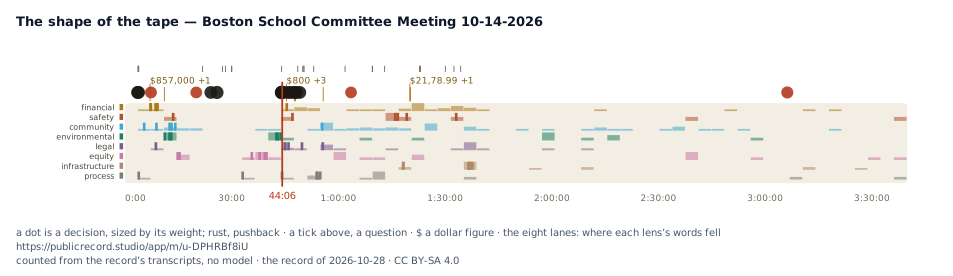
the same, as a table
| time | kind | the moment |
|---|---|---|
| 3:34 | decision | We will begin with the approval of minutes. I will now entertain a motion to approve the minutes of the September 16th… |
| 3:49 | decision | Is there any discussion or objection to the motion? |
| 7:19 | pushback | While the more than $857,000 identified in non-compliant spending represents a small fraction of our 1.635 billion… |
| 20:03 | pushback | important for me for too many parent to use depend the transportation waiting for transportation for go to to work and… |
| 24:09 | decision | Um thank you, Superintendent. Just um for clarity on the cell phone policy, um the actual policy itself would come… |
| 25:52 | decision | sometimes they um are having the students just keep it in their backpack and out of sight. Uh, so it really ranges and… |
| 43:57 | decision | So, if there is nothing else, um I'll now entertain a motion to receive the superintendence report. Is there a motion? |
| 44:06 | decision | Is there any discussion or objection to the motion? Is there any objection to approving the motion by unanimous… |
| 44:20 | decision | We'll begin with one report before moving on to public comment. This item will be brought forward for a vote later… |
| 45:45 | decision | employees paychecks and added to the base salary effectively. Uh he will also explain our request to the Boston City… |
| 46:26 | decision | adviser, but I was actually um able to participate on the negotiating team for this this collective bargaining or this… |
| 47:35 | decision | Uh the financial package um of the 2% plus the $800 that's going to be spread across every paycheck carries a one-year… |
| 48:13 | decision | Um I want to thank uh our partners in the city finance team. I want to thank uh the superintendent and thank our union… |
| 49:10 | decision | So um the city keeps funds for these types of contract um increases in a in a collective bargaining reserve that they… |
| 1:03:32 | pushback | Good evening. My name is Dear Dra Manning. I'm a single parent of two public school children and uh we live in… |
| 3:06:10 | pushback | to address gaps through the ways that we share data and talk about data. Um so that that's some of my thinking that I… |
| 7:03 | money | $857,000 — said 1 time |
| 11:05 | money | $125,000 — said 1 time |
| 45:23 | money | $800 — said 4 times |
| 47:38 | money | $787,51 — said 1 time |
| 47:57 | money | $934,269 — said 1 time |
| 55:43 | money | $450,000 — said 1 time |
| 1:20:03 | money | $21,78.99 — said 1 time |
| 1:20:15 | money | $82 — said 1 time |
Cut from the analyzer’s scored moments — a measurement, not a choice made for you. Open a reel and press make this reel yours to re-cut it; tick any moment or transcript line below to cut your own.
The school committee approved prior meeting minutes [3:57] and heard reports proposing a bell-to-bell ban on personal devices [4:38], transportation route updates [9:32], and procurement policy reforms following an Inspector General review [6:42], [31:20]. Members heard public testimony [51:35] addressing student homelessness [55:16], testing accommodations [57:36], state assessment scores [1:00:16], and busing issues [1:16:39]. The committee voted to approve federal and state grants [1:20:22], in-kind donations [1:35:59], a Memorandum of Agreement regarding Horace Mann charter status for the Dudley Street Neighborhood School [1:36:26], [1:40:44], and collective bargaining agreements for district custodians [1:41:11], [1:42:13]. District staff then presented data on state MCAS scores, English learner progress, chronic absenteeism, and targeted support strategies for low-performing schools [1:52:50], [2:05:29], [2:17:02], before the meeting closed with a motion to adjourn [3:39:27].
What it means: The school committee approved the minutes from its October 16th meeting [3:41], [3:57] and reviewed a proposed technology policy restricting personal devices for kindergarten through grade 12 students [4:32], [4:44]. District leadership reported on financial oversight steps to correct non-compliant spending through centralized purchasing under the Chief Financial Officer [7:06], [8:33]. The committee voted to approve a collective bargaining agreement with Painters and Allied Trades Local Union 1952 running through August 31, 2027 [44:32], [1:41:54], approved grant packages totaling over $82 million [1:19:55], [1:36:14], and approved a memorandum of understanding with Dudley Street Neighborhood Charter School [1:36:35], [1:41:00]. Administrators also presented state MCAS assessment and district accountability data detailing student growth, chronic absenteeism, and academic performance metrics [1:52:50], [1:55:39], [1:57:32].
Who moved it: Chairperson Jerry Robinson convened the meeting [1:20]. An unidentified speaker requested a motion to approve the October 16th meeting minutes, which passed without recorded objection [3:41], [3:57]. Superintendent Skipper presented the superintendent's report [4:06] and detailed administrative recommendations alongside Chief Bloom [45:02], [1:22:21]. Votes on the charter school memorandum of understanding [1:40:41], [1:41:00], the painters union contract [1:41:32], [1:41:54], and grant actions [1:35:45], [1:42:22], [1:42:44] were carried out by committee members including Dr. Alkins, Mr. Tran, Ms. Peralta, Ms. Torres, and Ms. Garrett [1:40:48], [1:42:33], though the transcript does not specify the individual names of every mover or seconder [1:40:41], [1:41:32]. The final motion to adjourn was made and seconded, but the specific movers were not identified in the text [3:39:27], [3:39:32], [3:39:40].
What to watch: Public engagement will continue regarding the proposed cell phone policy ahead of a full rollout planned for the first day of the 2027-2028 school year [6:07], [6:17]. The committee expects quarterly updates on procurement and internal fiscal controls beginning around January [28:07], [29:16]. City Councilor Weber invited committee members to a city council hearing scheduled for Thursday, November 19th at 2 p.m. regarding legal service programs for families experiencing housing instability [53:11], [53:57]. District officials and school leaders plan to implement targeted instructional supports and monitor ongoing student performance data for multilingual learners and special education students [2:37:45], [2:42:06], [3:29:54].
Scored, not chosen for you — the salience bar is a measurement, and every moment is a receipt into the transcript below. With JavaScript on, tick moments to compose a reel — and tick moments on other meetings too; a reel can span the record.
→ the publish kit for this meeting — the clips worth cutting and draft copy, for a producer.
Counted, not modeled — each lens is a word list; drift compares the first half to the second.
the same, as a table
| word | mentions |
|---|---|
| school | 217 |
| students | 152 |
| schools | 123 |
| student | 76 |
| district | 71 |
| work | 69 |
| bps | 62 |
| multilingual | 58 |
| progress | 58 |
| data | 55 |
| boston | 50 |
| every | 50 |
| support | 47 |
| accountability | 46 |
| team | 45 |
| working | 43 |
| years | 43 |
| city | 39 |
| learners | 39 |
| high | 38 |
| mccast | 37 |
| superintendent | 36 |
| much | 36 |
| bus | 35 |
| good | 34 |
| first | 34 |
| across | 34 |
| grades | 33 |
| kids | 33 |
| state | 32 |
| plan | 32 |
| principal | 32 |
| last | 31 |
| many | 31 |
| learning | 31 |
| education | 31 |
| program | 31 |
| instructional | 31 |
| language | 30 |
| sure | 30 |
| able | 30 |
| math | 30 |
| groups | 30 |
| percentage | 30 |
| community | 28 |
| important | 28 |
| classroom | 28 |
| results | 28 |
| grade | 27 |
| day | 27 |
| point | 27 |
| making | 27 |
| success | 27 |
| policy | 26 |
| use | 26 |
| blackstone | 26 |
| teachers | 26 |
| evening | 25 |
| title | 25 |
| great | 24 |
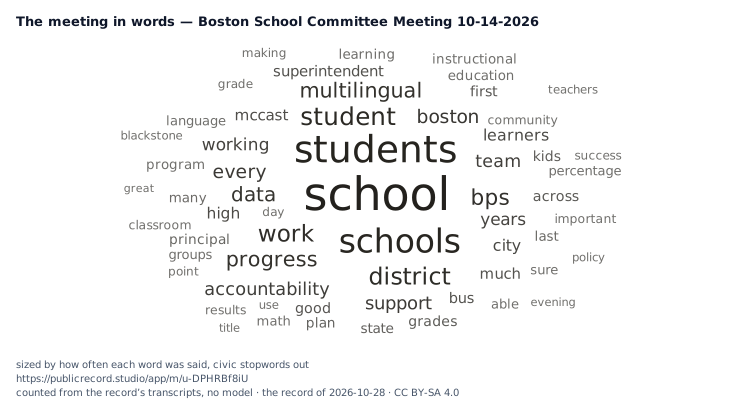
“school” came up 217 times. Sized by how often; civic stopwords out. With JavaScript off, a word opens the tape at its first mention.
1:09 Good evening and welcome to this meeting
1:12 of the Boston school meeting. I'm Chair
1:15 Robinson Jerry Robinson.
1:17 I'm chairperson. Excuse me. I'm not
1:20 meeting. I'm chairperson Jerry Robinson.
1:22 We'll begin with the pledge of
1:24 allegiance. I don't think it's working.
1:26 I don't think they are.
1:31 I pledge algiance to the flag of the
1:34 United States of America and to the
1:37 republic for which it stands. One nation
1:40 under God, indivisible, with liberty and
1:43 justice for all.
1:54 I want to welcome everyone who is
1:56 joining us tonight in person on Boston
1:59 City TV and on Zoom. I'm going to ask
2:03 everyone here in the chamber to please
2:06 turn off the volume on your laptops or
2:09 other devices so it does not interfere
2:11 with the audio for tonight's meeting.
2:14 Thank you for your cooperation.
2:16 Tonight's meeting documents are posted
2:18 on the committee's web page,
2:20 bostonschools.org/schoolcommittee,
2:24 under the October 14th meeting link. For
2:28 those joining us in person, you can
2:30 access the meeting documents by scanning
2:33 the QR code that's posted by the doors.
2:36 The meeting documents have been
2:38 translated into all of the major BPS
2:41 languages. Any translations that are not
2:44 ready prior to the start of the meeting
2:47 will be posted as soon as they are
2:48 finalized.
2:50 The meeting will be rebroadcast on
2:52 Boston City TV and posted on the school
2:55 committee's web page and on YouTube.
3:00 The committee is pleased to offer live
3:02 simultaneous interpretation virtually in
3:05 Spanish, Haitian, Creole, Cverian,
3:09 Cantonese, C Mandarin, Vietnamese, and
3:12 American Sign Language. The Zoom
3:15 interpretation feature has been
3:18 activated.
3:19 Zoom participants should click the globe
3:22 icon at the bottom of your screen to
3:25 select your language preference. I'd
3:27 like to remind everyone to speak at a
3:29 slower pace to assist our interpreters.
3:34 We will begin with the approval of
3:36 minutes. I will now entertain a motion
3:38 to approve the minutes of the September
3:41 16th meeting. Is there a motion?
3:44 So move.
3:45 Thank you. Is there a second?
3:46 Second.
3:47 Is there any discussion or objection to
3:49 the motion?
3:51 Is there any objection to approving the
3:53 motion by unanimous consent? Hearing
3:57 none, the minutes are approved. We'll
4:00 now move on to the superintendence
4:02 report. I present to you our
4:04 superintendent, Mary Skipper.
4:06 Uh, good evening, chair. Oh, it is
4:08 working. Okay.
4:09 Good evening and good evening to school
4:11 committee members as well as to the
4:13 public that's joining us here tonight
4:15 and virtually. I'd like to begin tonight
4:17 with a brief update on the district's
4:19 proposed cell phone policy. School
4:22 committee members are in receipt of a
4:24 memo which previews the proposed
4:26 personal electronic device use policy
4:30 for all BPS students in grades pre
4:32 kindergarten through grade 12. The
4:35 researchbased policy is our preliminary
4:38 recommendation for a bell-to-bell ban on
4:41 all personal devices including cell
4:44 phones, tablets, smartwatches, Bluetooth
4:48 devices, and personal computers.
4:51 The purpose of the memo is to give
4:52 members and the public a preview of the
4:56 proposed policy ahead of its formal
4:58 submission to the school committee for
5:01 consideration and action in January of
5:04 2027.
5:06 This will allow the members to review
5:07 the policy, understand how it aligns
5:10 with state guidance, and provide
5:12 feedback to the district team. We are
5:15 currently working to create
5:17 implementation guidance that will
5:19 provide schools with a menu of
5:21 implementation choices so that they can
5:23 select the method that's right for their
5:25 school community.
5:28 Over much of the past year, the district
5:30 has engaged in robust conversations with
5:33 students, educators, and parents to
5:36 understand their perspectives and
5:38 experiences regarding personal devices
5:41 in schools. Among these conversations,
5:45 we've met with members of Associad
5:47 Latina and the Boston Student Advisory
5:50 Council, which we call BSAC. I want to
5:52 take a me a moment to thank executive
5:55 director Alex Oliver de Dilla for her
5:59 leadership on this issue and the
6:01 students from Associated Latina and BSAC
6:04 who helped shape this policy.
6:07 We plan to continue stakeholder
6:09 engagement over the next few months as
6:11 we finalize the policy. Our goal is for
6:14 the policy to be in place for the first
6:17 day of the 2027 2028 school year. A
6:21 survey will be available in the near
6:23 future where the public can contribute
6:25 their thoughts and help guide our
6:27 implementation.
6:28 The memo is publicly available with
6:31 tonight's meeting materials on the
6:33 school committee's website at
6:34 bostonschools.org/ org/schoolcommittee.
6:39 I would also like to provide an update
6:42 on the Office of Inspector General's
6:44 report that was released in August
6:47 covering procurement practices that
6:49 outlined internal control failures,
6:52 improper workarounds, and gaps in
6:54 oversight.
6:56 As I mentioned in the last meeting, we
6:58 welcome independent oversight because it
7:00 makes our district stronger.
7:03 While the more than $857,000
7:06 identified in non-compliant spending
7:09 represents a small fraction of our 1.635
7:13 billion operating budget, falling short
7:16 of the highest standard of fiscal
7:19 stewardship is completely unacceptable.
7:22 In a letter I sent to the inspector
7:24 general on Friday, October 9th, I
7:26 highlighted past reforms that had been
7:28 underway since 2023, like strict limits
7:32 on soul source procurement, digitizing
7:35 facil uh facilities work orders through
7:38 asset essentials, that's our management
7:40 tool, mandating procurement and conflict
7:43 of interest trainings for our staff and
7:46 engaging an external auditor for an
7:48 internal procurement audit of our
7:50 functions.
7:52 We also took the OIG's recommendation to
7:55 immediately institute a 10-day pause
7:58 which was effective August 31st to
8:00 September 18th on all payments and audit
8:04 audit all invoices.
8:06 During this pause, BPS central office
8:09 finance teams thoroughly reviewed 95
8:12 pending invoices across all impacted
8:15 departments
8:17 as recommended by both the inspector
8:19 general and the finance commission. We
8:22 are completing a comprehensive plan to
8:24 realign all district procurement and
8:27 accounts payable functions under the
8:29 chief financial offices office.
8:33 Centralized purchasing removes isolated
8:36 department workflows, establishes a
8:39 single point of fiscal accountability,
8:42 unifies compliance, and ensures strict
8:46 fiscal controls across the entire
8:48 district.
8:49 I want to reassure this committee, our
8:52 families, and our schools that we're
8:54 going to continue to fix these
8:56 historical vulnerabilities
8:59 through central leadership, automated
9:01 controls, and direct accountability
9:04 under the CFO. We are ensuring that the
9:06 BPS operates with the operational
9:09 integrity our students and taxpayers
9:11 deserve.
9:13 This memo will also be publicly
9:15 available with tonight's meeting
9:16 materials on the school committee's
9:18 website. again, bostonschools.orgschool
9:22 committee.
9:24 I also just want to say on
9:26 transportation that we're regularly
9:28 reviewing all of the worst performing
9:32 routes and at this point still trying
9:35 direct interventions to improve them.
9:38 We're also um you know making daily
9:42 route changes that we need to do to
9:44 accommodate new students to the district
9:47 or students that require rerouting
9:49 because of address changes or IEP
9:51 changes. Performance so far in October
9:54 is averaging 90% in the AM and 85% in
9:58 the PM with uh 0.05 uncovered trips. to
10:04 give you comparison to last year. Last
10:07 year we were at this time uh through
10:09 from September through this point of
10:11 time 84% in the AM 82% in the PM and we
10:16 had.14 uncovered trips. So you can see
10:19 that the transportation department
10:21 continues to make substantial
10:23 improvements year-over-year. Most
10:25 importantly, for a parent that's facing
10:28 a route that's disruptive, but because
10:30 it's one of those ones that is
10:32 continually late, the transportation
10:34 department is constantly working to
10:36 reroute those buses. Uh, and so I know
10:40 Dan does it, uh, Dan Rosenard does it so
10:42 that it's a Wednesday implementation.
10:44 So, uh, every Wednesday they're sending
10:46 those new routes out. I wanted to share,
10:50 uh, many of the bright spots, uh, as we
10:52 started the school year and continued.
10:54 Uh first of all, um last month I joined
10:57 the Red Sox Foundation at the Blackstone
11:00 Elementary School. Uh Principal Shepac
11:02 is here in the South End to celebrate
11:05 $125,000
11:06 in improvements to the school's
11:08 gymnasium and schoolyard, which now
11:10 includes a newly painted baseball
11:12 diamond and the Green Monster inspired
11:15 wall and stairs.
11:17 Thank you to
11:20 Thank you to Linda Henry, Fenway Sports
11:23 Group partner, and the Red Sox
11:24 Foundation board member and the entire
11:26 Red Sox organization for their continued
11:28 support of BPS. Uh we had member Palano
11:32 Garcia who was there. Um longtime
11:34 supporter of Blackstone School. Um
11:37 again, uh Principal Shepac and assistant
11:40 principal Felix Carabalo was also there
11:42 making sure that the event was fantastic
11:44 and a great experience for students.
11:47 students participated in a play ball
11:49 clinic that was led by the Red Sox
11:51 Foundation staff. As you can see from
11:53 this photo, I dusted off my glove and I
11:56 had a chance to put my own skills to
11:58 work. Um, it's always just a really
12:01 great occasion to be able to have fun
12:03 with the kids and Wall-E as usual
12:05 stopped by and was a big success with
12:07 the kids. Uh, so thank you to the Red
12:09 Sox Foundation. October also marks
12:13 several important and notable occasions
12:15 in our BPS calendar. Uh on October we
12:18 first uh kicked off National Principles
12:20 Month when we recognized the outstanding
12:23 BPS principles and heads of school who
12:26 support and develop children's academics
12:28 and social, emotional, and physical
12:30 well-being by creating welcoming
12:32 learning environments for all students
12:34 and families. uh pictured here, a
12:37 district's newest principles who took on
12:39 the role of school leader in school year
12:41 2026 2027. Um we're thrilled to just
12:45 have them. They're such a talented uh
12:46 cohort. Uh Katie Beagano of the Otis
12:49 Elementary, Kiki Michella of the Elliot
12:52 K to8 Innovation School, Holly uh
12:56 McParlton who's uh also at the Elliot
12:59 Kaid in uh Innovation School. Dr. Darius
13:02 Green at the Matah Hunt Elementary. We
13:04 were with him today um doing a
13:06 celebration of community hub schools at
13:09 the Matah Hunt. McKenzie Powers at the
13:11 Bradley Elementary, Deian Cesaro who's
13:14 at the Tinen Elementary, Jacquellyn
13:17 Carolyn at the uh Lion Elementary that
13:20 we had a nice visit the first day of
13:22 school. Uh and Amelia Massu Tastor who's
13:25 at the Holland Elementary. Our
13:27 principles and heads of school work
13:28 incredibly hard to ensure that every
13:31 student is academically challenged while
13:34 also feeling seen, included, and safe at
13:37 school. So, please join me in thanking
13:39 our school leaders for their dedication
13:41 to our school communities this month and
13:43 all year.
13:45 September 15th marked the beginning of
13:48 National Hispanic Heritage Month, which
13:50 continues through October 15th. During
13:52 this month, we honor the contributions
13:54 and achievements of members of our
13:56 Latina, Latino, and Latin X communities
13:59 throughout the district. Last month,
14:01 Otis Elementary students enjoyed a very
14:04 special visit with five Boston Red Sox
14:06 players who stopped by the school to
14:08 celebrate Hispanic Heritage Month with
14:10 the community. We're again grateful to
14:13 our Red Sox for making this visit
14:15 happen. and we appreciate the players
14:17 for helping our students celebrate
14:19 Hispanic Heritage and the richness,
14:21 pride, and joy of our school community.
14:24 Uh, also pictured here is the 6th annual
14:27 Hispanic Heritage Month celebration at
14:29 the O'Brien School of Math and Science,
14:32 which featured music, dancing, and guest
14:34 speakers. I want to thank city councelor
14:36 Enrique Pebbin for being part of this
14:38 special event. The Otis and the O'Brien
14:41 are just two of the schools that held
14:43 and continue to hold special
14:45 celebrations recognizing Hispanic
14:47 Heritage Month. As BPS continues to
14:50 implement inclusive education across the
14:52 district, National Learning Disabilities
14:54 Awareness Month uh is is this month. Uh
14:58 this gives us an opportunity to
14:59 recognize the perseverance and
15:01 achievement of our neurode divergent
15:03 students while raising awareness about
15:06 the importance of advocacy and
15:08 resources. This month we pause to shout
15:11 out our schools for their success in
15:13 putting that model into practice. The
15:15 Conley Elementary School in Roslandale,
15:17 which is pictured here, is a great
15:19 example of a BPS school that has created
15:22 a culture of inclusion, belonging, and
15:25 empathy by involving the entire school
15:27 community. You can learn more about
15:29 Conley's journey at bostonschools.org.
15:33 Special thanks to our entire BPS Office
15:35 of Specialized Services and all of our
15:38 educators and staff who work tirelessly
15:40 to make sure that all of our students
15:42 feel welcomed and supported. On October
15:45 2nd, we honored the hard work of our
15:47 school's unsung heroes on school
15:50 custodian appreciation day. Often
15:53 working behind the scenes, our
15:54 custodians ensure that our schools are
15:56 clean and healthy. I participate in a
15:59 very special event at the Boston Arts
16:01 Academy recognizing the work of school
16:04 custodians, including Andy Allen, who's
16:06 holding up the Allen jersey, uh, who was
16:09 honored with the Unsung Hero Award. Andy
16:13 formed a friendship with a colleague,
16:15 geometry teacher Tom Thermodor.
16:18 Upon learning that Tom's younger brother
16:20 was in critical need of a kidney
16:22 transplant, Andrew made the remarkable
16:25 decision to step forward as a donor.
16:27 Through a paired kidney donation
16:29 program, Andrew ultimately donated his
16:31 kidney to a stranger, enabling Tom's
16:34 brother to receive a lifesaving
16:36 transplant.
16:38 Andrew's selfless act not only saved a
16:40 life, but it also reflects the
16:42 compassion, courage, and humanity that
16:44 defined the Boston public schools
16:45 community. And it was incredibly sweet
16:47 to see the custodians uh at Boston Arts
16:52 Academy and how close they were like a
16:54 family and how much the staff the staff
16:57 really showed up to the event after
16:58 school um to really honor all of the
17:01 custodians, but to really honor Andy um
17:04 for for what he did. Uh October is also
17:08 the 20th anniversary of college and
17:10 career month in the Boston public
17:11 schools. This is a time when we launched
17:14 the post-secary planning process as a
17:16 shared responsibility. Pictured here are
17:19 staff from around BPS who participated
17:21 in BPS's annual college and career pride
17:24 day representing the alma mad part of an
17:28 effort to share multiple post-secondary
17:31 paths with students across Boston. And
17:33 you'll actually see school committee has
17:36 uh in front of each of us the college or
17:38 university that we attended. There's a a
17:40 sign. Um this year 25 student
17:44 ambassadors will spread the word about
17:46 events in their schools and on social
17:48 media. Students can also take the PSAT
17:51 and the SAT for free during the school
17:54 day at their own schools. Other
17:56 opportunities include college tours,
17:58 fairs, uh FASA and MAFA support, career
18:02 exploration and training programs. We
18:05 also launched the BPS college and career
18:07 hub which is a new online resource that
18:09 brings these resources together in one
18:12 place yearround. You can find this at
18:14 bostonchools.org/careermonth.
18:19 I want to thank the Boston Foundation
18:21 and Success Boston Completion Initiative
18:23 for providing the resources for the
18:25 College and Career Month initiative.
18:27 They've certainly been tremendous
18:29 supporters for the past 20 years. Um,
18:32 many thanks to the BPS Office of
18:34 College, Career, and Life Readiness for
18:37 the campaign. I could go on and on with
18:39 more bright spots um because it really
18:42 has been a wonderful start to the school
18:43 year and a very busy month and a half.
18:46 So, uh, cheer, I'll turn it back to you.
18:48 Thank you, Superintendent. I'll now open
18:50 the floor for questions and discussion.
18:53 I'd like to remind my colleagues about
18:54 our agreed upon norm that we each have
18:57 five minutes per member per round, not
18:59 including district response. Please make
19:02 sure your questions are on topics
19:04 related to the items in the
19:05 superintendent report. Other topics not
19:08 related to the superintendent report can
19:10 be raised during new business later in
19:12 the meeting. BPS staff, please keep your
19:15 responses brief and speak slowly to
19:18 support our interpreters. Thank you.
19:24 Thank you, Madame Chair. Um, thank you,
19:26 superintendent, for the report. I want
19:28 to talk to about the transportation
19:30 issues. Too many parents contact to me
19:34 about the transportation.
19:36 Um I appreciate that when you say the
19:40 BPS know the transportation issues. is
19:44 important for me for too many parent to
19:48 use depend the transportation
19:52 waiting for transportation for go to to
19:55 work and when the transportation is
19:58 delayed is delay the parents the teacher
20:03 is is big problem because I know um uh
20:09 too many family use transportation and
20:12 then part of My job
20:15 a school committee is
20:18 um try in this meeting that
20:20 preoccupation the family and the teacher
20:23 too because the teacher say when the the
20:26 transportation or coming on time
20:29 by my day is not on time. the the
20:35 students need a staying time for more
20:38 morning meeting the teacher for
20:40 breakfast the students it all esod delay
20:45 then my question is about the issues I
20:50 know you say that try the better
20:53 solution for that but it's important the
20:55 family know what the district right now
20:58 say or try about that
21:01 yeah yeah no I think it's a really
21:03 important point. Um, memo Palanka
21:04 Garcia, I think what we're looking for
21:07 is two things. We're looking to make
21:08 sure overall transportation it continues
21:11 to improve, which I think we're seeing.
21:14 We were specifically looking at the
21:16 start of the school year to have far
21:18 fewer uncovered routes because what we
21:21 find is that that there's one thing when
21:23 the bus is late but when the bus doesn't
21:25 come at all then a parent has to figure
21:28 out how to get the child to school
21:30 either to get to school or to get from
21:33 school. So we really have worked very
21:35 closely with transdev to ensure far
21:38 fewer uncovered routes and I think we've
21:41 been successful on those two sides. The
21:43 other layer to this is when uh the bus
21:46 is late for a reason. And that can
21:49 range, right? Like it can range because
21:51 of the traffic, the weather. It can also
21:54 be that when we plan the route, a
21:56 student, there's too many stops on it
21:59 and we have to reroute that. Or it can
22:02 also be new students join because we're
22:05 constantly taking new kids in and they
22:08 have to be routed. Or a student changes
22:10 schools and they have to be rerouted.
22:12 And so the routes are very fluid and the
22:14 team is constantly looking at the routes
22:17 that are regularly late. And so that is
22:20 the work they do Wednesday to Wednesday
22:22 where they make the change and it takes
22:24 them that week for that next set of
22:26 changes to go in. Uh and they they do
22:29 they tend to have dates that are bigger
22:31 updates. Uh and the one that they just
22:34 did will go into effect for Wednesday.
22:37 So, we should see some relief on uh the
22:40 routes that uh are late more often than
22:44 we would ever want. Um I think part of
22:47 the GPS is to try to keep parents
22:51 informed on the bus and like where the
22:53 bus is. Uh but we all know that there's
22:56 going to be situational things. Drivers
22:58 get sick, they they call in, we have to
23:01 get a coverage driver um particularly in
23:04 the afternoons. So any of those things
23:06 can make the the buses run later than we
23:09 want. The main thing is communicating
23:11 with the parents so that they know
23:13 what's happening and then us trying to
23:15 work when we see it be a pattern. So I
23:18 think that is the commitment. Um I will
23:21 uh we'll talk with Dan and try to get
23:23 from uh Dan Rosenard uh the number of
23:26 what they call problematic routes and
23:28 try to show how we're reducing those as
23:30 well. But we definitely know we want
23:33 every bus to run on time. That is the
23:34 goal. Um and so anytime it doesn't, our
23:37 transportation department takes it
23:39 really personally to try to make it
23:40 better either through the rerouting or
23:42 through the work with the contract.
23:44 Yeah. Thank you so much.
23:45 Absolutely.
23:52 Let me see if anybody else has any
23:54 responses.
23:56 Go ahead.
23:56 Um
23:57 thank you, Superintendent. Just um for
23:59 clarity on the cell phone policy, um the
24:04 actual policy itself would come before
24:06 us formally in the new calendar year for
24:09 a vote. There may be some modifications
24:12 to the policy in light of the engagement
24:15 that's happening between now and then.
24:17 And then I also think I heard you say
24:19 kind of the devil's in the details. So
24:21 there would be more implementation
24:23 guidance that comes with that policy
24:26 when we see it again.
24:28 Great. Yes. Um, appreciate both both of
24:30 those clarifications. Uh, so, uh, we we
24:34 wanted to get it before all of you and
24:36 the public so that they can see the work
24:38 we've done over the last year. There's
24:40 been a tremendous amount of outreach and
24:42 feedback. Um, Denise, Rory, BSAC, uh,
24:45 and other uh, advocacy groups have been
24:49 um, part of that conversation, parents,
24:51 staff. So I think what you see in what
24:54 we're recommending is something that has
24:56 a lot of agreement. But with any policy
24:58 there will be critique or there will be
25:00 things that people suggest. Uh we will
25:03 continue to keep open um from now until
25:06 January when we bring it before you more
25:08 formally. Um we'll continue to seek
25:11 feedback and then what we bring to you
25:13 in January will reflect that. Uh in
25:16 terms of the implementation, we are now
25:18 in that process. Many many of our
25:20 schools already have some form of ban
25:23 with the cell phones.
25:24 Um, sometimes they're using pouches,
25:28 sometimes they're using shoe holders,
25:30 sometimes they um are having the
25:33 students just keep it in their backpack
25:34 and out of sight. Uh, so it really
25:37 ranges and I think what we want to get
25:39 to is flexibility for the schools, but
25:42 also a menu of two or three ways to
25:46 implement the policy. And that's what we
25:48 will also be giving to you at the time
25:50 that we put the policy forward to you
25:52 for vote because midyear implementation
25:56 of any policy um is often difficult. We
26:00 will not start the policy formally if it
26:03 passes in school committee until the
26:05 next school year. So it'll begin in
26:08 September on the first day. That also
26:11 allows schools that even if they're very
26:13 seasoned and some of our schools,
26:14 particularly high schools, have been
26:16 doing a phone policy for a while now.
26:18 However, we have found that smart
26:20 watches are also very distractive. Um we
26:24 found there's other devices that
26:26 students carry on them uh that are
26:28 distract and distracting and so the even
26:31 for those schools the idea of taking and
26:35 keeping a watch or other kinds of
26:37 personal devices is an extra layer to
26:40 what they're currently doing. So that's
26:42 why we want to wait to fully implement
26:44 until the beginning of next year.
26:47 Um I think with you're saying that some
26:50 uh schools already have components in
26:52 place. It might be helpful when it comes
26:54 before us in January to hear about some
26:57 schools that are implementing some of
26:58 the models that you recommend and what
27:00 some of the the challenges and you know
27:03 successes have been with that just to
27:05 give a little bit of line of sight into
27:07 the operations which can be um really
27:09 challenging. Um uh thank you for the
27:13 update um on the IGR report. Just a
27:15 question around um moving everything
27:18 under the CFO. Does that change staffing
27:22 levels um in either of the offices
27:26 affected by that shift?
27:27 I think that's something we're looking
27:29 at right now. Um you know, it's a big
27:31 undertaking. Uh previously, you know,
27:34 transportation, food service, um and uh
27:38 facilities all had a separate process.
27:40 Uh this is something we've recognized
27:42 and I think rightly so. the OIG report
27:45 pointed out, Fincom pointed it out and
27:47 so it's, you know, we agree it's time to
27:49 move on it, but we do need to be
27:50 thoughtful in the planning of it. So,
27:52 it's early to say what implication it
27:54 would have. Um, other than that, we will
27:56 come up with a timeline and plan for how
27:59 to be able to take those under one
28:00 umbrella within uh the uh the CFO. And
28:04 when will that next update um should we
28:07 expect quarterly updates to some of that
28:09 future planning or what will the the
28:11 cadence be uh in terms of um how we get
28:14 updates from this point?
28:16 Yeah, it's great. So I think uh Dr.
28:18 Deina might have a better sense since
28:20 he's helping to spearhead.
28:23 Sure.
28:25 Good evening everyone. Uh so the
28:27 planning has been underway uh and we're
28:29 really looking at a dynamic where we
28:31 have to keep in mind that there are
28:33 direct oversight responsibilities that
28:35 currently exist and how we shift those
28:37 to under the CFO's office is going to
28:40 need to be a fine orchestrated uh
28:43 situation because we also have the
28:44 day-to-day operations that we have to
28:46 consider. So we have to balance the
28:48 oversight from the CFO's office with the
28:49 day-to-day operations of the department.
28:51 So that's the conversations that
28:52 happening now. We're looking at
28:54 workflows, making sure the CFO's office
28:55 is clearly understanding uh the
28:57 dynamics, the staffing levels, the
28:59 responsibilities, and what's going on
29:01 currently so that we can figure out the
29:03 right balance of how that actually
29:04 happens in play. So until we do that, um
29:07 our plan is to have an update in a
29:09 couple weeks and then from there engage
29:11 the staff more fully and then plan that
29:13 out and bring recommendations to
29:14 superintendent.
29:15 Yeah, I would say it's reasonable that
29:16 in the January meetings that we could
29:19 provide an update to school committee. I
29:20 think at that point we will have been
29:22 able to look at the breath of it.
29:23 That's right.
29:24 Thank you. Um and just um building off
29:28 of member Palano Garcia's um questions
29:31 around transportation, I think we must
29:34 have a quarter one um update on
29:37 transportation coming
29:40 soon or next meeting. uh and wondering
29:42 if that like problematic route piece
29:45 could be outlined in a little more
29:47 detail um to speak to what you were
29:49 describing.
29:50 Yeah, absolutely. I believe it's the
29:51 next school committee meeting that we'll
29:53 be presenting or at least giving you in
29:55 memo form. Yes.
29:56 Thank you.
29:58 And Andy Allen is amazing.
30:00 I know, right?
30:02 Mr. TR, do you have anything?
30:04 I'll let you go first.
30:07 Yes.
30:08 Oh, I see.
30:09 Okay.
30:12 Uh yes, I not not not so much as a
30:16 question but some concerns regarding the
30:19 uh the OIG report.
30:28 The according to your memo the
30:30 procurement procurement reform commenced
30:34 in 200
30:37 in 2023.
30:40 We are now in 2026
30:43 and the report comes out
30:47 uh sometimes um
30:52 around that time as well.
30:55 um these the the uh improvement
31:01 have been implemented for the last 3
31:04 years.
31:06 So I
31:08 gather that um I have two questions but
31:11 you know I gather that the
31:14 the uh improvements are
31:18 going to meet the the the expectation of
31:20 the OIG.
31:22 Uh correct that is that is the goal
31:25 right we looked um very much at the
31:27 recommendations uh we also intend to
31:30 have on ongoing dialogue around it um I
31:33 think what we had in the BPS was
31:36 historical practice of decades and uh in
31:39 2023
31:41 um the team uh we began to implement
31:46 many of the reforms some of them take
31:48 longer to implement because it's a big
31:50 system Um, however, I think rightly so,
31:54 as the OIG report indicated, there were
31:57 still holes in our processes. And so,
32:00 that is what we're attempting to shore
32:02 up. I think our recommendation to fold
32:05 under one umbrella uh within underneath
32:08 the CFO is what we see as probably the
32:11 most important significant step we can
32:14 take because it will in essence uh
32:17 ensure that many of the holes we found
32:20 uh won't happen as they have. when you
32:22 have three branches all doing their own
32:25 form of procurement oversight uh you we
32:29 just allow an opening for uh people to
32:33 do things differently and it's harder to
32:35 track it so I think that particular
32:38 recommendation is going to be difficult
32:40 to implement for sure which is why in
32:43 the past it never has been
32:45 um like many things right but um but we
32:47 see it as really necessary
32:49 okay
32:50 yeah
32:51 Another minor question I I guess the
32:55 competitive bidding process the
32:57 procurement
33:00 I'm quite sure that that we are
33:02 following with we are complying with the
33:05 MWBE procedure.
33:09 Yes. So I think um I think the field in
33:12 particular has gone through a lot of
33:15 this training and change over the last
33:16 several years
33:18 uh where we had a historic habit of
33:21 schools themselves entering into
33:23 procurement and contract. Uh and what
33:26 and by doing that when you had three or
33:28 four schools enter with the same vendor
33:30 we would all of a sudden go above the
33:32 threshold of what we were supposed to.
33:35 And so we have since over the last two
33:38 years done a lot of work with our
33:39 partner organizations and with our field
33:42 with our schools to explain why we
33:44 cannot do that any longer
33:46 and so we have done a lot of shing up on
33:48 that
33:49 but I do think that's an area that we
33:51 continue to need to do training and
33:53 oversight to ensure it doesn't happen.
33:55 Right. So just just a a a little request
33:59 um
34:01 regarding the competitive uh procurement
34:04 process.
34:05 You mentioned that uh we are right now
34:09 as have always been complying with the
34:11 MWBE requirement.
34:14 May I uh ask for uh a breakdown on
34:21 the vendors uh MW MWB status because
34:29 I like to see
34:33 minorities
34:34 uh
34:36 uh biders especially the linguistic
34:39 minority uh biders
34:43 uh are included Ed, I
34:46 have
34:49 somehow believed that uh that has been
34:53 pretty much remiss for the last few
34:55 years.
34:58 So, I might have to ask David to maybe
35:00 or Mike to be able to respond to that.
35:04 Okay. Okay.
35:04 About what we're able to provide and
35:06 not.
35:13 Yes. Um, thank you. We can certainly um
35:18 provide information about the suppliers
35:20 we're currently contracting with and
35:22 their status. Um, this is all
35:25 self-reported. They have to register
35:27 with the city officially. Um, so we
35:30 could certainly say uh who has
35:32 registered with the city. um as a
35:35 certified business. I will say for every
35:38 procurement we do, we go through the
35:40 city's equitable procurement process. So
35:43 before we enter into any contracts,
35:46 there are two databases we use to
35:48 identify potential MWBE uh businesses
35:52 that might be available um for
35:54 procurement. There is a city database
35:56 and a state database. And so that way we
35:58 can ensure that as part of our
36:00 advertisement for contracts that we're
36:02 reaching out to businesses
36:04 um of all uh statuses to be able to
36:08 support support the work. Um ultimately
36:11 we are not able to uh
36:14 we have to follow the procurement law in
36:17 terms of the order of uh selecting the
36:19 biders. But um what we're trying to do
36:23 as much as possible is ensure that uh
36:26 those biders have a fair shake at the
36:28 contracts. They know about the
36:29 contracts. They're aware of the
36:31 opportunities and we're working to get
36:33 more with the city to get more biders
36:35 registered um in the city system. So we
36:38 can work with them.
36:40 Just uh one recommendation.
36:44 So regarding the uh registration of uh
36:48 linguistic minority biders
36:51 and companies that are serving you know
36:53 that are owned by minority
36:57 um and people with disability.
37:01 I would suggest that um your office or
37:05 whichever office that is uh
37:09 uh responsible for all these uh
37:11 procurement process
37:13 um somehow reach out to them encouraging
37:16 them to
37:19 register. As a matter of fact,
37:23 many of them don't even know the process
37:26 and many of them are not very aware that
37:29 there is a there is a pro procurement
37:33 process available with the city and um
37:37 they are not
37:40 for
37:42 they are not informed. So if there is a
37:46 way to outreach uh to them, that would
37:49 be great.
37:50 Yeah, for sure. Uh we work closely with
37:52 the city's office of supplier diversity,
37:54 so I can reach out to them and we can
37:56 talk about ways to do that.
37:58 Thank you.
38:04 You have a shout out, too. All right.
38:06 So, we have some shout outs. So, we'll
38:07 shout and then we'll shout some more.
38:13 Um, thank you chair, superintendent, and
38:16 all school committee members and members
38:18 of the public. This past month, I had
38:21 the opportunity to visit three schools
38:23 and each finding pockets of greatness,
38:26 real teaching and learning happening
38:28 every day in Boston public school. every
38:31 school, our scholars, educator, par
38:34 educators, family liaison and leaders in
38:38 front office says were excited to answer
38:41 my questions.
38:43 Um I don't know I don't know if you
38:45 remember that you said to ask about what
38:48 gap are they working on.
38:50 Okay,
38:51 so I did.
38:54 So they were happy to answer but they
38:56 were listen they were eager to ask and
38:59 listen to feedback. They wanted to know
39:01 how to keep meeting high expectations
39:04 and to build the structures that support
39:07 learning for every students.
39:10 I visit the Oliver Wendell Home
39:12 Innovation School um grades kinder prek
39:16 to sixth grade where I had the
39:18 opportunity to visit two inclusion math
39:20 classrooms where students were working
39:22 on fractions and diagrams turning and
39:25 talking to discuss their thinking with
39:27 their partners and then sharing their
39:30 answer with the larger group. This was a
39:32 real mathematician discourse look and
39:35 sound like homes. You are some great
39:38 mathematicians in the making.
39:41 Next, I went to the Henry Grew
39:43 Elementary School, grade prek to sixth
39:46 grade in the kinder and K2 inclusion
39:50 classroom where scholars and educators
39:53 working side by side to make sure every
39:56 friend was engaged in the task at hand.
39:59 Talking about support, everybody was
40:01 supported and everybody was included in
40:04 the teaching and learning. Also visited
40:07 a math classroom where students were
40:08 working in small group discussing volume
40:12 of a complex shape which I don't know
40:13 what that was but then practicing and
40:16 explaining their thinking to their peers
40:19 and then to the whole class. Uh and
40:22 let's talk about the librarian in the
40:24 library. When I think about access to
40:27 all, this is the library to visit. They
40:30 have a book vending machine. I don't
40:32 know if you've seen it. Yes, it's
40:34 excellent. You put you you find your
40:37 book, you put money, you or whatever
40:39 they give them, tokens, and they can
40:41 find their books and books that read out
40:43 loud. The library supports, engages, and
40:46 promotes reading for all scholars. Thank
40:49 you for making reading joyful. And
40:52 finally, my last visit. Well, I have one
40:55 last today. My last visit was to the Dr.
40:58 Katherine Ellison Rosa Park Early
41:00 Education School. I was honored to be
41:03 invited to celebrate Hispanic Heritage
41:06 Leader Day. Thank you for thinking of
41:08 me. I was impressed with from the moment
41:10 I walked in the welcome, the educators,
41:13 the para educators and family as the
41:16 school leader walked us through the
41:19 school data growth on priority one
41:22 action plan. the math fluence every
41:24 song. He say he had to do it because he
41:26 needed somebody to listen to it and and
41:30 for K through three um growth and
41:33 keeping and keep being the best. It was
41:36 a h aha moment for me. You um I had the
41:39 the um the opportunity to visit uh a
41:42 kinder classroom inclusion. you they
41:45 fill my heart with the happiness when
41:47 they let me join friends with their
41:49 learning centers working on their motor
41:52 skills. So I wanted to thank all the
41:56 scholars for opening their doors and all
41:58 their hard work work they are doing
42:01 every day for all our scholars and
42:03 student. Thank you. And today I was
42:06 invited by the central office here to
42:08 celebrate the Spanish heritage month.
42:11 great food, karaoke,
42:14 uh, dancing and a special cake from
42:17 Dominican.
42:19 So, we everybody had to taste that. So,
42:21 thank you for inviting me.
42:22 That's great.
42:24 Thank you.
42:27 Thank you so much. I just wanted to do a
42:29 shout out to the principal of my family
42:34 Alma M school, the Sarah Greenwood,
42:36 principal Antonelli Mahia, who was
42:39 recently recognized
42:42 uh among a group of Latino and Latina
42:44 leaders in the state of Massachusetts in
42:47 company of people like our secretary of
42:50 education and and our commissioner of
42:52 education. Um Antonelli is doing a great
42:56 job. He has an A team at the Sarah
42:58 Greenwood and clearly the man is
43:01 brilliant. You can see his resume is
43:03 full of uh leadership position and a
43:06 very impressive formal education. But he
43:09 came here two decades ago as a teenager
43:12 with no English.
43:14 So he is a proof of what is possible.
43:17 Uh but he will be the first one to tell
43:19 you if you ask that opportunity is not
43:22 enough. Like even if we close the
43:24 opportunity gap, he will say we need
43:26 investment on our student re things like
43:29 you know summer jobs, pay internships,
43:32 the things that we need to level the
43:35 playing field in order for our student
43:38 to be able to really
43:41 reach all their potential. Um so thank
43:43 you so much to um Principal Mahia and to
43:46 the entire team at the Sarah
43:47 Green.
43:49 Thank you.
43:51 Great. Great.
43:54 So, if there is nothing else, um I'll
43:57 now entertain a motion to receive the
43:59 superintendence report. Is there a
44:01 motion?
44:01 So moved.
44:02 Thank you. Is there a second?
44:03 Second.
44:04 Is there any discussion or objection to
44:06 the motion? Is there any objection to
44:08 approving the motion by unanimous
44:10 consent? Hearing none, the
44:12 superintendent's report is approved.
44:15 We'll begin with one report before
44:17 moving on to public comment. This item
44:20 will be brought forward for a vote later
44:22 during the action item portion of the
44:24 meeting. This report is a tenative
44:27 collective bargaining agreement between
44:29 local union 1952
44:32 painters and allied trade district
44:34 council number 35 representing
44:37 custodians and the Boston school
44:39 committee effective September 1, 2026
44:43 through August 31st, 2027. Let's aim to
44:47 keep the presentation within five
44:49 minutes. Superintendent Skipper will
44:51 share introductory remarks.
44:53 Great. Thank you. And uh for our
44:55 committee to introduce uh BPS legal
44:57 adviser, Mike Ryan. Uh we're very happy
45:00 to have Mike in this position. Uh he's
45:02 also served on the bargaining team uh
45:05 while in his previous role of labor
45:07 counsel. Uh tonight he's going to
45:09 present the tenative agreement with
45:10 local union 1952 painters and allied
45:13 trades district council number 35. our
45:16 school custodians on behalf of the
45:18 district's bargaining team. The tenative
45:20 agreement includes a year 1 base wage
45:23 increase of 2% plus $800 spread across
45:26 employees paychecks and added to the
45:29 base salary effectively. Uh he will also
45:32 explain our request to the Boston City
45:33 Council for a supplemental appropriation
45:36 for FY27 of 787,000
45:40 approximately. Uh this tenative
45:42 agreement is consistent with our other
45:43 collective bargaining units and tonight
45:45 we ask the committee to approve the
45:47 tenative agreement which will happen
45:48 later in tonight's meeting. So at this
45:50 point I'll turn it over to Mike.
45:53 Thank you superintendent. Um good
45:55 evening and thank you to Chair Roberts
45:56 and to the rest of the committee
45:57 members. As the superintendent
45:59 introduced myself, I'm now the legal
46:02 adviser, but I was actually um able to
46:06 participate on the negotiating team for
46:08 this this collective bargaining or this
46:10 tenative agreement that I'm presenting
46:12 tonight. Um we have reached the
46:15 agreement with our union partners at
46:16 local union uh number 1952, painters and
46:20 allied trades district council number
46:23 35. there are custodians union and we
46:26 recommend that you vote in favor of this
46:28 agreement. Uh the district has built a
46:31 very strong relationship with this with
46:33 the custodians over the years and we
46:36 appreciate all the work that their
46:37 bargaining team did and to all the
46:40 members for all the work that they do
46:41 for us every day. The custodians
46:44 represent approximately 410 full-time
46:46 employees and 65 part-time employees who
46:50 oversee custodial services,
46:52 groundskeeping at our schools, and other
46:54 operational services. Um, as the
46:58 superintendent told you, we had uh
47:00 custodian appreciation day last week.
47:03 Um, they literally do all the dirty work
47:05 at the school to keep it clean, a safe
47:07 environment for our children and our our
47:09 students to to learn.
47:12 Uh, the parties reached a tenative
47:13 agreement with the union on a one-year
47:15 wageonly contract from September 1st,
47:18 2026 to a August 31st, 2027.
47:23 the financial package.
47:28 Uh the financial package um of the 2%
47:32 plus the $800 that's going to be spread
47:35 across every paycheck carries a one-year
47:38 cost of $787,51
47:41 for fiscal year uh 27. And that's what
47:45 we'll be asking for the supplemental
47:47 appropriation um with the uh city
47:50 council. Um the annualized number would
47:54 be in FY28 if no other agreements
47:56 reached would be $934,269.
48:01 Um I want to thank uh our partners in
48:03 the city finance team. I want to thank
48:06 uh the superintendent and thank our
48:08 union partners um and thank all the
48:11 school committee members. And we ask
48:13 that you vote in favor of this tenative
48:15 agreement and supplemental
48:16 appropriation.
48:17 Great. Thank you.
48:19 And I'll open it up to questions and
48:21 comments from the committee.
48:24 Anyone?
48:26 Just if you can explain mostly for the
48:29 benefit of the public one more time, how
48:32 is it that we do have money to uh pay
48:35 those races to our staff?
48:39 So this is the actual this money was the
48:43 uh city package that we have. It's
48:46 across all the different city unions.
48:47 this was what was um you know agreed to
48:51 by the city. Um I think David Bloom
48:54 might have a more information on that.
48:57 So um the city keeps funds for these
49:01 types of contract um increases in a in a
49:06 collective bargaining reserve that they
49:08 keep at the city. We work closely with
49:10 them. Um, so if you were to approve uh
49:14 this uh supplemental appropriation
49:16 request, it would then go to the city
49:18 council uh who would effectively
49:21 transfer funds from that reserve to our
49:24 appropriation to support this work. Um,
49:27 as um like I said, this is consistent
49:32 with uh the raises we've been giving to
49:34 other members of other unions across the
49:36 city.
49:39 Thank you. Uh, I asked because my city
49:42 councelor Weber is in is in the
49:44 audience. So, thank you in advance,
49:45 counselor.
49:48 Great. Just I just had one.
49:51 Go ahead. One. Oh, sorry.
49:53 No, no, you go ahead.
49:54 Oh, apologies for me.
49:55 Just a question. This um goes through
49:58 just through this existing school year,
50:01 2627, correct?
50:03 Yes. So, will the the custodians
50:05 actually work full year? So, they would
50:08 be working over the summer. So this
50:09 would go all the way until August of
50:11 August 31st, 2027.
50:14 And what does that um imply or suggest
50:17 for uh what comes next for bargaining in
50:21 subsequent years?
50:23 So you know, our work never stops. We're
50:25 always um in conversation with our union
50:28 partners. So I mean I think the
50:31 bargaining will start, you know,
50:33 tomorrow. you know, we we'll be ready
50:35 for next uh the next session and next
50:37 negotiations.
50:40 You okay?
50:42 Yeah.
50:43 Uh no thing. I I just this is just my
50:47 shout out to to you and to your your
50:50 your team. I do uh appreciate the fact
50:54 that you add
50:56 $800
50:59 to spread ac all paycheck for custodian
51:02 given the fact that 2% increase is not a
51:05 heck of a lot. That $800 added into the
51:08 base salary will help in the long run
51:12 and that deserve a shout out. Thank you.
51:15 Well,
51:15 thank you. I appreciate your shout out.
51:22 All right. Thank you. And um we'll vote
51:24 on this later in the evening.
51:26 All right. Thank you.
51:27 Okay. We will now move on to general
51:30 public comment. Miss Prax.
51:32 Thank you, Chair.
51:35 The public comment period is an
51:37 opportunity for individuals to address
51:39 the school committee on school related
51:40 issues. Questions about specific school
51:43 matters would be referred to the
51:44 superintendent and BPS staff. Policy
51:47 questions may be discussed by the
51:49 committee at a later time. We have two
51:52 public comment periods. The first is
51:54 limited to one hour. Anyone who has not
51:56 spoken by then will have the opportunity
51:58 to do so at the end of the meeting. We
52:01 have eight speakers this evening. Each
52:03 person has three minutes to speak and I
52:05 will remind you when you have 30 seconds
52:07 remaining. Speakers may not reassign
52:10 their time to others. The time that an
52:12 interpreter uses for English
52:13 interpretation will not be deducted from
52:15 a speaker's allotted time. You may also
52:18 email comments for distribution to the
52:20 committee. Please direct your comments
52:22 to the chair and refrain from addressing
52:24 individual school committee members or
52:26 district staff. Please note the comments
52:29 of any public speaker do not represent
52:31 the Boston public schools or the Boston
52:33 school committee. Please start with your
52:36 name, affiliation, and where you live.
52:38 Zoom speakers, please be ready to unmute
52:40 and turn on your camera when called. To
52:43 support interpretation, please speak
52:44 slowly and clearly. We will start with
52:47 our in-person speakers.
52:51 Our first group is councelor Ben Weber,
52:54 Gada Alib, John Mud, Dedra Manning, and
52:59 Muhammad Burhan. Councelor Weber,
53:03 could I just ask it? It is uh very hard
53:06 to hear. It sounds like the microphones
53:09 are set lower. I have a loud voice. So,
53:11 hi.
53:12 So, either uh just make sure to speak
53:14 close and maybe in the meantime we can
53:17 adjust it up a little bit.
53:20 Okay. Thank you very much. Uh and member
53:23 Peralta, uh the CFO got that question
53:26 right. Uh there's a collective
53:27 bargaining reserve that, uh you know,
53:29 the city council, if we approve the
53:31 appropriation, the money comes out of
53:32 there. we don't have to take it from
53:34 somewhere else. Um,
53:37 okay. And, uh, so good evening. Um, as
53:41 the chair of the, uh, city council's
53:43 Ways and Means Committee and as a BPS
53:45 parent, uh, you know, I'm continuing our
53:48 practice on the city council seeking to
53:50 get involved in the BPS budget process
53:52 early. And I'll be chairing our first
53:54 fiscal year 28 BPS budget hearing on
53:57 Thursday, November 19th at 2 p.m. at
54:00 city hall. I hope we can collaborate
54:02 while the budget is still on the drawing
54:04 board and I urge the members of of this
54:06 committee to either attend the hearing,
54:08 watch it afterward, or reach out to me
54:10 if you have any questions. Uh based on
54:13 my conversations with Chair Robinson,
54:15 you know, I think we both agree that the
54:17 school committee and the city council
54:18 should work to complement each other.
54:21 The school committee uh you know I
54:23 believe uh should put its expertise to
54:26 good use by focusing on issues around
54:28 learning making sure every BPS dollar
54:30 goes directly toward classroom models
54:32 that serve our students highquality
54:34 curriculum and strong classroom
54:36 staffing. The city council meanwhile
54:38 should focus on broader systems
54:40 surrounding students families and
54:42 families ensuring the broader city uh
54:45 budget builds a stable foundation
54:47 students need outside of school.
54:49 Classroom investments are undermined if
54:51 a student's basic needs aren't met. For
54:54 example, we recently held a hearing on
54:55 the city council about the impacts of
54:57 homelessness on BPS students. Studies
55:00 have shown that students who have even a
55:01 single episode of homelessness by the
55:03 age of nine, can lead to measurably
55:06 lower uh achievement levels at 15, even
55:09 when compared to other students from
55:12 lowincome families who have not
55:13 experienced homelessness.
55:16 We have around 5,000 kids in BPS every
55:19 year that experience homelessness. So,
55:21 it seems obvious that addressing this
55:22 issue outside the classroom is one way
55:25 we can help families, not only families,
55:28 but help kids in the classroom. That's
55:30 why I've pushed so hard for and my
55:32 council colleagues have supported the
55:34 access to council pilot program, which
55:36 provides an attorney to families with
55:37 kids in school who receive an eviction
55:39 notice. It's become apparent, however,
55:42 that while we have set up a program with
55:43 $450,000,
55:45 not all families even know the program
55:47 exists. We have uh already helped dozens
55:50 of families, but we can help many more
55:51 once we establish
55:53 seconds
55:53 a pipeline. I'm hoping you can help us
55:56 improve notice of the program to
55:58 families who can then work with BPS
56:00 family liaison and homeless homeless uh
56:03 liaison who can then connect them to
56:06 legal services we have waiting for them
56:07 at Greater Boston Legal Services. I look
56:10 forward to working closely with all of
56:11 you starting this November so we can
56:14 align our shared goals and secure the
56:16 future our students deserve. Thank you
56:18 very much.
56:19 Thank you very much. Our next speaker is
56:22 GAhatim.
56:32 Good evening madame chair,
56:34 superintendent skipper and members of
56:35 the school committee. My name is Ga
56:37 Alcatib. I am here as the legally
56:40 authorized representative for my son
56:42 Omar Ramadan, a recent Jaziah Quincy
56:44 upper school graduate. Omar publicly
56:46 praised his teachers at the state of the
56:49 school's address because he truly loved
56:51 them and loved the school community.
56:52 This matter is not a failure of our
56:54 classroom teachers. This is a failure of
56:57 a leadership. Behind closed doors, this
57:00 administration committed a documented
57:02 pattern of negligence. failing to submit
57:05 my son's accommodation for three SATs
57:09 and PS his PSAT. Furthermore, despite
57:12 notice of his overseas program timeline
57:15 since June 24th, they left his ACT
57:18 portal undocumented for 27 days this
57:21 summer, missing critical deadlines. They
57:23 then claimed they have never done the
57:25 ACT and don't know how it works. A
57:28 student should never pay the price
57:29 because administrators failed to
57:31 navigate a portal required to secure
57:34 their accommodation. When I filed a
57:36 compliance grievance on September 1st,
57:38 they chose active retaliation. On
57:41 September 16, the principal confirmed in
57:44 a written email that he explicitly
57:46 instructed the guidance counselor to
57:48 freeze my son's recommendation letter
57:50 for his program in Jordan that already
57:52 started on September 2nd until receiving
57:55 permission from the BPS legal office. To
57:58 deliberately place a student in fear of
58:01 losing enrollment by withholding
58:03 credentials is an act of pure
58:05 retaliation designated to conflict to
58:08 inflict maximum harm. A student leader
58:12 honored by the mayor for his civic
58:14 engagement and storytelling here on this
58:16 stage cannot have his story silenced
58:19 behind closed doors by an abusive
58:21 administration.
58:23 Madame Chair, you famously stated,
58:25 "Student outcomes don't change until
58:27 adult behaviors do." Does BPS have an
58:31 official policy that allows a head of
58:33 school to freeze a student's credential
58:35 standard credentials just because their
58:37 family asked for civil rights
58:39 compliance? Superintendent Skipper was
58:41 explicit explicitly
58:44 um CCD on both my September 1st and
58:46 September 18th notices. I am handing
58:51 this committee formal accountability and
58:53 record release statement. I call upon
58:56 chair Robinson to immediately instruct
58:58 the superintendent cabinet to overrule
59:00 this act of retaliation and execute an
59:03 immediate
59:05 release of Omar recommendations letter
59:08 and order the unrestricted release of
59:10 his legally mandated IB Proctor
59:13 log logs and porter records. Tonight I
59:17 insist on a formal letter for his
59:19 academic transition notorized from the
59:22 superintendent office establishing full
59:24 accountability for all violation
59:26 included those in addressed in my
59:28 September formal grievance. Thank you.
59:31 Thank you.
59:36 Our next speaker is John Mud.
59:58 Good evening. My name is John Mud. I'm a
1:00:00 resident of Cambridge and a longtime
1:00:02 education advocate in Boston.
1:00:05 Overall, there is not much good news in
1:00:08 the BPS MCCAST 2026 data on the percent
1:00:12 of subgroups of students achieving state
1:00:16 grade level content standards. The
1:00:19 pattern continues a decline in MCAST
1:00:22 MCCAST scores and increases in
1:00:25 achievement gaps both since before COVID
1:00:29 and during the last year. The only
1:00:32 exceptions seem to be a small recovery
1:00:34 in white scores for grades 3 to 8 in ELA
1:00:38 and math and a reduction in achievement
1:00:40 gaps in 10th grade which is entirely the
1:00:43 result of a dramatic reduction in white
1:00:45 scores. While black, Latino,
1:00:48 multilingual learner scores continue
1:00:50 their decline.
1:00:52 The passing proficiency rates for
1:00:54 marginalized groups remains
1:00:58 much too small.
1:01:01 The simple chart which I think is in
1:01:04 front of you for MCCAST results for
1:01:06 grades 3 to 8 in reading illustrate this
1:01:10 pretty clearly. For whites, 65%
1:01:14 meet or exceed the MCCAST standards.
1:01:16 That means they pass. For black
1:01:18 students, only 18% pass. A 14 percentage
1:01:23 point difference with whites. Similarly
1:01:26 for Latino students, 18% pass, 47%
1:01:32 difference with whites. And for English
1:01:35 learners, it's astounding. Only 4% meet
1:01:39 or exceed their MCCAST standards while
1:01:43 that leaves a gap of 61 percentage
1:01:46 points with whites. This pattern is
1:01:50 repeated in every measure in the MCRAST
1:01:53 2026 results. What are the lessons?
1:01:57 The implementation of current
1:01:58 educational strategies is not producing
1:02:01 adequate student outcomes according to
1:02:04 MCCAST. Whatever that strategy,
1:02:08 whether it's inclusion, equitable
1:02:10 literacy, highquality instructional
1:02:13 materials, or highquality educational
1:02:15 experience.
1:02:17 What will BPS do to change in order to
1:02:20 improve these educational outcomes for
1:02:22 kids? We don't know. We are waiting to
1:02:26 see what the strategic implementation
1:02:29 plan proposes for smart goals and what
1:02:32 changes in education strategies will
1:02:35 help students reach these goals.
1:02:39 Given the state data, for BPS to say, as
1:02:42 was reported in the press, the latest
1:02:46 state data shows steady progress is
1:02:48 simply not true. To deny reality does
1:02:52 not change reality. I urgently plead
1:02:54 let's face the facts together and do
1:02:58 something together to benefit all our
1:03:00 students. Thank you.
1:03:02 Thank you.
1:03:05 Our next speaker is Ste Manning.
1:03:24 Good evening. My name is Dear Dra
1:03:25 Manning. I'm a single parent of two
1:03:27 public school children and uh we live in
1:03:30 Dorchester. Um there's been quite a bit
1:03:32 mentioned about problems with BPS buses
1:03:36 over the years. I completely agree. The
1:03:38 most important issue is the loss of
1:03:40 academic instruction and idle time after
1:03:42 school due to late buses. My daughter's
1:03:46 younger friends are impacted. One boy
1:03:48 who attends the Laya Frederick is late
1:03:50 almost every day. But today I wanted to
1:03:53 tell you about a different problem with
1:03:55 buses and that relates to buses for
1:03:57 students who participate in athletics.
1:04:00 On September 9th of the first game of my
1:04:03 daughter's soccer season, uh the bus did
1:04:05 not show up. Parents put miners in
1:04:09 multiple Ubers so that they would not
1:04:11 miss the game. at a swim meet in
1:04:14 Duxbury, I like to say Deluxeberry,
1:04:16 Massachusetts on September 9th, the
1:04:19 first meet of the season. Um, sorry, the
1:04:22 second meet of the season. Um, the team
1:04:24 arrived 1 hour late. There was only one
1:04:27 heat per event possible because another
1:04:30 event was scheduled at the facility at
1:04:32 6:00 p.m., depriving both teams of
1:04:34 opportunities to compete. The bus not
1:04:36 only left late, but the driver was lost.
1:04:39 Parents were tracking their children,
1:04:40 watching them drive um all over the
1:04:42 Southshore. Last year, a bus taking the
1:04:46 swim team to Denim never showed up. The
1:04:48 coach called the Urseline coach who
1:04:50 called Zarian, which sent a bus to
1:04:52 Boston to pick up the team. Kind of
1:04:54 crazy, I think. With 1.7 billion spent
1:04:58 on busing annually, BPS should provide
1:05:00 good service to BPS students. BPS
1:05:03 athletes have not had access to a diving
1:05:05 board this season. and swim teams give
1:05:07 away all 13 diving points at the
1:05:09 beginning of all swim meets because BPS
1:05:12 athletes cannot practice, making it
1:05:14 difficult or impossible to compete. The
1:05:16 issue is similar to BPS track athletes
1:05:19 who train in hallways because they don't
1:05:22 have access to athletic facilities. I
1:05:24 understand that funds have been raised
1:05:26 to purchase a diving board, but BPS
1:05:28 won't provide the funds for the
1:05:29 installation at Madison Park.
1:05:32 Mismanaging and underfunding services
1:05:33 that directly impe impact students are a
1:05:36 big factor in the district's declining
1:05:38 enrollment. My 12-year-old, who wants to
1:05:40 be a kindergarten teacher, is so sad
1:05:42 that our three-year-old neighbor is
1:05:44 moving to Marshfield. His father is a
1:05:46 city employee, a lifelong resident who
1:05:48 is a graduate of BLA. They are leaving
1:05:50 just like other members of our
1:05:52 community, primarily because the
1:05:53 district schools are not wellrun.
1:05:55 30 seconds. I'd like to end my time with
1:05:58 you by saying how wonderful it was to
1:06:00 read the Globe article on the heroic
1:06:02 efforts of Mr. John Mud. School
1:06:04 committee members, please act on his
1:06:06 suggestions to help the most vulnerable
1:06:08 members of our community. Listening is
1:06:11 not enough. Implementing his
1:06:13 recommendations is your duty. Thank you.
1:06:16 Thank you. Our next speaker is Muhammad
1:06:18 Burhan.
1:06:32 Dear school committee, good evening. I
1:06:35 am Burhan, a Dorchester resident and
1:06:37 founder and executive director of
1:06:39 intersectional innovation and impact
1:06:41 labs, a social enterprise addressing
1:06:43 interconnected social, digital, and
1:06:45 climate challenges.
1:06:47 I'm here to support a comprehensive
1:06:50 personal finance graduation requirement
1:06:52 for Boston public school. But first, let
1:06:55 me start with a quick story. I became
1:06:58 financially independent in my teenage
1:07:00 years. I grew up in Pakistan. I remember
1:07:03 when applying for my SATs,
1:07:06 I did not know what a credit card was.
1:07:08 Neither did my parents. It was a process
1:07:10 for me to just get a credit card to pay
1:07:13 for SATs.
1:07:16 Now I also came to United State as a
1:07:19 teenage scholar in 2017 and I arrived to
1:07:22 Boston in 2021 with two suitcases and
1:07:24 built a life here including a husband
1:07:28 who lives in Boston and is a K12
1:07:30 teacher. Throughout my life I had to
1:07:33 teach myself financial skills often
1:07:36 through difficult experiences and then
1:07:38 share that knowledge with my family and
1:07:40 my communities that I work with in
1:07:42 Boston. communities that are deeply
1:07:45 underrepresented in many ways. In a city
1:07:48 where roughly 28% of our population is
1:07:51 foreignb born, accessible financial
1:07:53 education should be essential.
1:07:57 Students deserve a chance to not just
1:08:00 understand their paycheck, but navigate
1:08:02 banking, credit, recognize predatory
1:08:04 lending, and evaluate college costs
1:08:07 before facing consequential financial
1:08:11 decisions.
1:08:13 Massachusetts recently received an F in
1:08:16 2026 national financial literacy report
1:08:19 card, but Boston has an opportunity to
1:08:21 lead. On September 16, the city council
1:08:24 unanimously endorsed a graduation
1:08:26 requirement through a resolution led by
1:08:29 councelor Flynn, Santana, and Mahia. So
1:08:32 my question to you all is what barriers
1:08:36 stands between that support and
1:08:38 implementation and how can we help
1:08:39 address them during national economic
1:08:43 education month which is this month. I
1:08:46 urge you to schedule this proposal for a
1:08:48 future agenda. invite us and our
1:08:51 coalition
1:08:53 and work with BPS on an implementation
1:08:55 plan with a timeline, funding, teacher
1:08:58 trainings, and access for multilingual
1:09:01 learners and students with disabilities.
1:09:03 30 seconds.
1:09:04 Please involve students, families, and
1:09:06 educators in shaping that plan. Thank
1:09:08 you.
1:09:10 Thank you.
1:09:13 We will now transition to public
1:09:16 testimony on Zoom. Our first speaker is
1:09:19 councelor Julia Mahia.
1:09:25 Please accept the prompt.
1:09:31 Hi. Can you guys hear?
1:09:34 Can you hear me?
1:09:35 Yes.
1:09:37 Would you be able to turn on the Oh,
1:09:38 there's
1:09:39 I don't have a light. I'm I'm I'm at a
1:09:42 Yes, sir. It's your light.
1:09:43 Yes, please. You're on.
1:09:44 Oh my god.
1:09:47 Good evening um school committee. I am
1:09:50 Boston city council at large.
1:09:54 You're muted first and foremost
1:09:57 muted
1:09:58 now we can hear you.
1:10:00 I was I'm starting over my three minutes
1:10:02 start now. I'm city council at large and
1:10:06 I'm the chair of education um the
1:10:08 committee on city council. First and
1:10:10 foremost, I'd like to thank the
1:10:11 administration for their presence um and
1:10:14 thoughtful responses at yesterday's
1:10:16 follow-up hearing on docket 0276 on
1:10:20 transparency and accountability in
1:10:22 service provisions and spending for
1:10:25 English learners. I also wanted to thank
1:10:27 the Multilingual Learners Alliance's
1:10:30 hard work in holding BPS to the highest
1:10:32 standards and ensuring that we are doing
1:10:35 all that we can to make sure that our
1:10:38 students can thrive. We first held this
1:10:40 hearing um docket back in March and uh
1:10:44 passed a resolution over the summer
1:10:46 affirming the city's commitment to
1:10:48 supporting our most vulnerable learners
1:10:50 and creating a comprehensive
1:10:52 district-wide plan. And yet MCCAST
1:10:55 scores show that only 1% of 10th graders
1:10:59 eels are meeting expectations. This
1:11:02 directly contradicts our commitment to
1:11:04 supporting our highest need students. We
1:11:07 need to increase equitable access to
1:11:10 multilingual education and a
1:11:12 comprehensive plan would mean every
1:11:14 multilingual learner would have access
1:11:17 to the same curricular resources and
1:11:19 support regarding um regardless of the
1:11:22 school that they attended. As discussed
1:11:24 at the hearing um yesterday, we made a
1:11:27 commitment to work well and the
1:11:29 administration did say yes that they
1:11:31 were going to work alongside the council
1:11:34 community, the alliance and educators
1:11:37 and parents to develop a citywide plan
1:11:40 that is centered in community. So, I
1:11:43 want to thank the administration for
1:11:45 showing up and understanding that this
1:11:47 moment is calling for true collaborative
1:11:49 work um and not contradicting and always
1:11:53 in conflict with each other. So I look
1:11:54 forward to facilitating that alongside
1:11:57 the school committee and other
1:11:59 stakeholders to ensure that our budget
1:12:02 reflects the comm the committing the
1:12:05 commitments of to helping our most
1:12:07 vulnerable learners and that it's really
1:12:09 vital v vital for parents, advocates,
1:12:12 and educators and district leaders to
1:12:14 work in partnership to support our
1:12:16 students. And if the public would like
1:12:18 more information about yesterday's
1:12:20 hearing, uh, please, uh, get in touch
1:12:22 with the Multilingual Learners Alliance
1:12:24 and please reach out to our office at
1:12:26 julia.meia
1:12:29 boston.gov. Thank you so very much for
1:12:31 the time and I appreciate the
1:12:33 opportunity. Thank you.
1:12:34 Thank you very much.
1:12:36 Our next speaker is Alexandra Oliver
1:12:39 Davila followed by Rebecca Ostapuk.
1:12:44 Alexandra Oliver Dala Davila.
1:12:59 Hello.
1:13:00 Sorry. Yes. Sorry. Can you hear me?
1:13:02 Yes, we can hear you.
1:13:04 Thank you. Sorry about that. Um, good
1:13:06 evening school committee members and
1:13:08 Superintendent Skipper. My name is
1:13:09 Alexandra Oliver Davila. I am a resident
1:13:12 of Rosundale and I'm also the executive
1:13:14 director of Soci Latina. Um I want to
1:13:18 start off first by thanking the district
1:13:20 for supporting a bell-to-bell policy and
1:13:24 creating a distraction-free school day.
1:13:26 This is going to go a long way towards
1:13:28 building community, helping students
1:13:30 connect with one another, reducing
1:13:33 conflict, increasing well-being, and
1:13:35 improving focus. As we have asked
1:13:37 before, we urge that phones be off and
1:13:40 away from the body, which is the
1:13:42 recognized best practice, and that
1:13:45 consequences be supportive rather rather
1:13:47 than punitive. And finally, a policy is
1:13:50 only as strong as the culture behind it.
1:13:53 This is only going to work if it's
1:13:54 consistent and um there's accountability
1:13:57 across every school classroom and with
1:14:00 adults um modeling healthy device use
1:14:02 themselves. I also want to thank all of
1:14:04 the young people from Sociad Latina and
1:14:06 the staff who've been advocating for
1:14:08 this for many many years and also um
1:14:11 counselors Pep and Weber and Santana um
1:14:14 and Mahia who also helped to advocate
1:14:16 and promote our the work that we were
1:14:18 doing around this. Um I am here to
1:14:20 propose a technology advisory committee
1:14:23 a standing body with formal recommending
1:14:26 recommending authority not an informal
1:14:29 feedback group. The TAC would include
1:14:31 parents and caregivers alongside
1:14:33 students, educators, and administrators
1:14:35 with disability and IEP representation
1:14:38 built in. It would meet quarterly and
1:14:40 report publicly to the school committee.
1:14:43 Its scope would cover device policies,
1:14:46 social media, classroom, screen use, AI
1:14:48 tools, emerging technologies, and
1:14:50 community education. A core function
1:14:52 would be transparency, regular reporting
1:14:55 on how devices are actually used during
1:14:57 the school day across all grades. The
1:14:59 TAC would also work proactively building
1:15:02 shared community norms and helping
1:15:03 families with emerging issues before
1:15:05 they become a crisis. One principle
1:15:08 should guide all of this work that
1:15:10 technology companies are not our
1:15:12 partners in education. They are vendors
1:15:14 selling a product and their interests
1:15:16 are not the same as those that we have
1:15:18 for our students. Most importantly, the
1:15:20 TAC would develop and vote on policy
1:15:22 proposals that come before this body for
1:15:24 action. We're asking for a real seat at
1:15:27 the table as technology in our schools
1:15:29 changes rapidly. I'm also asking the
1:15:33 district to pause student facing AI in
1:15:35 our schools.
1:15:37 Uh we've seen this before. Social media
1:15:39 was introduced with promises of
1:15:41 connection and we later learned about
1:15:43 their harm. And we know that uh New York
1:15:46 City, the largest school system in the
1:15:48 country, has just put a one-year
1:15:49 moratorum on student facing generative
1:15:52 AI and high school students are learning
1:15:54 to think critically and there's only
1:15:56 limited pilots. So if New York can do
1:15:58 that and put student safety and human
1:16:00 instruction first, then we can too. So
1:16:03 if we're asking for the same for a pause
1:16:05 to AI for a year, thank you so much.
1:16:07 Thank you very much. Our next speaker is
1:16:11 Rebecca Ostepshuk.
1:16:21 Please unmute and turn on your camera.
1:16:23 Thank you.
1:16:25 Um, hi. My kids have been with BPS for
1:16:28 four years. Transportation has lost my
1:16:31 kids on multiple occasions. They haven't
1:16:34 followed doortodoor correctly, had
1:16:36 bullying issues that they let go
1:16:39 unresolved, and bus monitors and bus
1:16:41 driver issues with following safety and
1:16:44 driving protocol. My two boys at the
1:16:46 beginning of the year had what I would
1:16:49 call a rare gem for transportation. A
1:16:51 bus driver that this wasn't just a job
1:16:54 for him, but actually cared for the kids
1:16:56 and what he did. The kids every morning
1:16:59 were greeted with a cheerful hello and
1:17:01 reassured that they would never be late
1:17:03 to school while he was their driver. He
1:17:05 set the bar high and he kept that
1:17:07 promise to my boys. Unfortunately, their
1:17:10 bus driver's last day was this past
1:17:12 Friday, October 9th. On Tuesday, the bus
1:17:15 showed no bus on the Zoom app. I called
1:17:17 the bus company and they said that the
1:17:19 bus driver was just getting in and
1:17:21 leaving the yard. 30 minutes later, the
1:17:23 bus was still there. I called and was
1:17:25 told that the bus was having mechanical
1:17:27 issues, but they fixed it and sent it on
1:17:30 the way. They didn't fix it. They put a
1:17:32 band-aid on the problem and the bus
1:17:34 broke down before it reached the first
1:17:36 stop. We waited 2 hours for their bus.
1:17:39 And when the bus driver arrived, it
1:17:41 wasn't a cheerful hello. There wasn't
1:17:43 any kind of greeting. Before my kids got
1:17:45 on the bus, I asked if he was going to
1:17:47 Troder, which he told me no. And the bus
1:17:49 monitor had to correct him and said yes,
1:17:52 he was going to Troder. That day, my two
1:17:54 sons on IEPs missed half the day because
1:17:57 of the bus. Today, my sons went out at
1:18:00 6:30 and their bus never came to pick
1:18:02 them up. I called transportation where
1:18:05 the bus driver tried to say that he
1:18:07 drove by and we weren't out. However, we
1:18:09 were outside since 6:30 a.m. and we saw
1:18:11 him drive down the hill two streets away
1:18:14 from us, never once, in other words,
1:18:16 stepping foot on our street. I asked for
1:18:18 them to turn around and service our door
1:18:20 to door stop. The new bus driver refused
1:18:23 to come back. I asked for a replacement
1:18:26 bus which never showed. I asked for two
1:18:29 days for supervisors to call back which
1:18:31 they haven't. Last time the only way I
1:18:33 received any call back was coming to the
1:18:35 school committee meeting. So I am back
1:18:37 again asking for not only the bus
1:18:39 drivers but the bus company and BPS to
1:18:42 be held to some accountability for the
1:18:45 unsafe buses, no show buses, and the bus
1:18:47 delays to and from school. I have
1:18:49 experienced repercussions at my job and
1:18:52 loss of wages due to no show buses and
1:18:54 buses arriving late both the morning and
1:18:56 afternoon buses. And I am not the only
1:18:59 parent. So today I'm coming here as a
1:19:01 last resort for the ongoing bus issues
1:19:02 to be heard and changes to be made to
1:19:05 receive a call back from a supervisor at
1:19:07 BPS Transportation and hoping that BPS
1:19:09 will start to think about using a
1:19:11 different bus company to get our kids to
1:19:13 and from school safely and on time.
1:19:15 Thank you.
1:19:17 Thank you very much.
1:19:19 Chair, that concludes public comment.
1:19:20 Yeah.
1:19:21 Thank you, Miss PraVox, and thank you to
1:19:23 those of you who spoke this evening and
1:19:26 shared your perspectives. Your
1:19:28 testimonies and feedback are very
1:19:29 important to us. I want the community to
1:19:32 know that when parents and community
1:19:34 members come forward and testify about
1:19:37 specific issues, BPS staff follows up
1:19:40 with them. This often happens the same
1:19:42 night with those that are here in
1:19:44 person. So you are being heard and we
1:19:46 take your concerns seriously. Thank you.
1:19:50 Our first two action items this evening
1:19:52 are the grants for approval totaling
1:19:55 82,289,934
1:20:01 and the inind donations with a total
1:20:03 estimated value of $21,78.99.
1:20:09 Now I'd like to turn it over to the
1:20:10 superintendent for any final comments.
1:20:12 Wonderful. Thank you, chair. So tonight
1:20:14 there are 13 grants for your
1:20:15 consideration totaling uh more than $82
1:20:18 million. The largest group are the
1:20:20 federal entitlement grants for this
1:20:22 school year. Uh and next which includes
1:20:26 just over $40 million in title one
1:20:28 funding for districts and public schools
1:20:31 with high percentages of children from
1:20:33 lowincome families serving more than
1:20:35 41,000 students and 4,000 teachers
1:20:38 districtwide. There's also more than 2.6
1:20:41 6 million in title 2 funding to provide
1:20:44 supplemental resources to support
1:20:46 systems of support for excellent
1:20:48 teaching and leading districtwide.
1:20:50 There's nearly 2.2 million of title 3
1:20:53 funding to support our approximately
1:20:55 14,900 multilingual learners and 1,000
1:20:59 bilingual education teachers
1:21:01 districtwide and nearly 3 million in
1:21:04 title 4 funding supporting wellness and
1:21:06 technology programs districtwide.
1:21:09 The next largest grant is the more than
1:21:12 $32 million Commonwealth Special
1:21:14 Education Reimbursement Program. We call
1:21:17 this circuit breaker. This is
1:21:19 reimbursing the cost serving 489
1:21:22 students with disabilities. The
1:21:24 remaining approximately 2.2 million will
1:21:27 support a combination of things. College
1:21:29 and career readiness, health and
1:21:31 wellness, special education, food,
1:21:33 nutritional services, facilities, and
1:21:36 three transformation schools. the Ellis
1:21:39 Elementary Higginson Lewis K to8 and
1:21:42 Young Achievers.
1:21:44 There's also before you uh in two in
1:21:46 kind donations. The first donation is
1:21:48 from Kingsington investments for an
1:21:51 outdoor storage shed, tables, stools,
1:21:55 and a greenhouse kit and inind labor for
1:21:58 the Higginson K2 inclusion school worth
1:22:00 nearly $21,000.
1:22:02 The second donation is $250 in office
1:22:06 supplies to succeed Boston from the
1:22:08 Bostonbased IE partners private equity
1:22:11 firm. Uh we would ask for the
1:22:14 committee's granting or acceptance of
1:22:16 these grants affirmative approval um and
1:22:19 vote in favor of tonight's grants
1:22:21 package. I also know that uh Chief Bloom
1:22:23 is here where there be any questions.
1:22:26 Great
1:22:28 questions.
1:22:31 Thank you madam chair. Um I want to ask
1:22:34 you about the title one title three
1:22:37 money federal money you suppose that
1:22:39 title three used for multilingual
1:22:43 student part that the money used for
1:22:45 multilingual students.
1:22:47 I need to know the last fiscal year what
1:22:51 is the result? How many school use that
1:22:54 money for multilingual student? What is
1:22:57 the result the the last fiscal year
1:23:01 compared
1:23:02 this year the money how how how much?
1:23:08 So um
1:23:11 thank you for that question. I would say
1:23:15 um each of our schools is required to
1:23:17 prepare a plan for the use of that
1:23:20 funding and then at the end of the year
1:23:23 we go through sort of a review and
1:23:25 checklist with them. Um we can we can
1:23:28 send you all of those plans um and or
1:23:32 and give you a summary of them. The
1:23:35 amount of funding for title one is down
1:23:38 slightly for the current year. So most
1:23:40 schools that amount is down slightly in
1:23:43 accordance with the amount of federal
1:23:44 funding we're receiving. Um
1:23:48 but the vast majority of that money is
1:23:50 spent in the first year of the grant and
1:23:53 any money that isn't spent in f the
1:23:55 first year is spent on additional summer
1:23:58 programming for multilingual learners um
1:24:00 in the second year.
1:24:03 Thank you. Um
1:24:06 uh I understand your point. You say I
1:24:09 pass the information but I think my
1:24:12 follow my question again is so far what
1:24:16 happened with the money for the h for
1:24:19 the multilingual student what is the
1:24:21 result you say the result how many
1:24:25 school use how many school not use the
1:24:28 money what is the result for this
1:24:32 particular student
1:24:35 today you can share with the the
1:24:38 community, with the family.
1:24:41 So, we can certainly for every
1:24:43 individual school, we could give you
1:24:45 information on their allocation,
1:24:48 uh what types of supports they um bought
1:24:51 and the amount that they ended up fully
1:24:53 spending and any amount that was
1:24:55 unspent. Um the thing we don't
1:24:58 necessarily have is the connection to
1:25:00 each individual student in the school um
1:25:03 and the outcome of that program, but I
1:25:06 think we can tell you a little bit more
1:25:07 about what those specific programs are
1:25:09 at each school. Um so Marcela and I and
1:25:12 her team will work together um to give
1:25:15 you sort of a summary of each school's
1:25:18 programming.
1:25:19 Yes, please. It's important for the
1:25:22 family involved to the family because
1:25:24 the mo the federal money is supposed for
1:25:27 that when the family say part that they
1:25:30 make a decision in the school is
1:25:32 important because sometime the the
1:25:34 student needed tutoring.
1:25:36 Right.
1:25:36 Is supposed to use that money for
1:25:38 tutoring. Right.
1:25:39 Right. For help the title one for
1:25:42 example help the um student loan income.
1:25:47 Yes.
1:25:47 And support.
1:25:49 Yes. It's important the information the
1:25:53 family uh collect.
1:25:56 Yes,
1:25:57 I think that there's I think two things
1:25:59 that member Polano Garcia has been very
1:26:01 consistently asking for year to year if
1:26:03 I remember. Uh so one is to make sure
1:26:06 that uh on the title three dollars that
1:26:09 it's being directed appropriately to our
1:26:10 multilingual learners. And so I think
1:26:13 having the schools be able to give
1:26:15 examples of the kinds of programs that
1:26:16 they're doing specifically for our
1:26:19 multilingual learners. I think the
1:26:20 second is that there was one year I want
1:26:23 to say it was like three years ago where
1:26:25 there was um a cons an an amount of
1:26:28 unspent money uh by a certain portion of
1:26:31 schools and we ended up funding the
1:26:34 summer programming for multilingual
1:26:36 learners specifically for that. And so I
1:26:38 think that's the other piece like I
1:26:41 think member Palano Garcia also wants us
1:26:43 to make sure we're educating the schools
1:26:46 to use the money because that's what
1:26:47 it's there for. Right.
1:26:48 That's that's a a a great point. And I
1:26:50 think the other thing um that uh Marcel
1:26:54 is working on. I won't make her give you
1:26:55 all the details now because I know she
1:26:57 doesn't want uh to to talk you through
1:26:59 all of it publicly, but her team's doing
1:27:01 some great work working in collaboration
1:27:03 with the Office of Family and Community
1:27:05 Advancement on the education we're
1:27:08 providing to families about what's
1:27:10 available in the Title One programs for
1:27:13 their schools. Um there's actually some
1:27:15 specific guidance she's worked
1:27:17 collaboratively with that team to
1:27:19 provide to all schools in the district.
1:27:22 Um it's very exciting work that they're
1:27:24 doing, Marcela and her team are doing
1:27:25 this year.
1:27:27 Thank you.
1:27:28 And title three is managed centrally a
1:27:31 different than title one. So for title
1:27:34 one is what David was um referring that
1:27:37 the schools create the plan and then we
1:27:40 follow up through the year and we make
1:27:41 sure that um they spend um 100% of their
1:27:45 their allocation and if they don't then
1:27:48 we
1:27:49 use it in the second year. I I will say
1:27:51 the other thing that Marcela and her
1:27:54 team have been working on is uh having
1:27:56 improved goals and outcomes in the um
1:28:01 for each of the grants. So if you look
1:28:03 at tonight's package for you for title
1:28:05 three, there are some more specific
1:28:08 goals for that spending for multilingual
1:28:10 learners listed than we've had in prior
1:28:12 years. And at the end of the year next
1:28:15 fall, we'll be able to come back to you
1:28:17 and talk to you a little bit more about
1:28:18 the results for those outcomes.
1:28:20 Thank you.
1:28:27 I just briefly want to say thank you. I
1:28:29 mean the public probably cannot see this
1:28:31 but we did receive a bunch of
1:28:33 information about each of these grant is
1:28:36 um unfortunately that for personal
1:28:40 reasons member um Stephen Arin is not
1:28:43 here but he will be very happy. I know
1:28:45 he's been asking for this for for a long
1:28:48 time. So thank you so much. it. We
1:28:50 definitely have a better understanding
1:28:51 of what we are voting when we approve
1:28:53 these grants. Thank you.
1:28:55 Thank you. And definitely a shout out to
1:28:57 member Alkins for his partnership in
1:28:59 helping to design some of this paperwork
1:29:01 so we so we did it right.
1:29:08 Same question around the uh how the
1:29:10 money is used. How do you know that they
1:29:12 are using? because I see smart goals
1:29:14 usually smart go have a measurement
1:29:16 piece there and how do that's how does
1:29:19 it come back so we'll know that they are
1:29:23 using the money for what they say
1:29:25 have it
1:29:26 so um this fall we're launching our
1:29:30 redesigned ground grant outcomes
1:29:32 reporting process um where we'll be
1:29:36 reporting back on those specific
1:29:38 outcomes unfortunately this fall's
1:29:41 report is the last year's goals, which
1:29:43 are still the old format of goals, so
1:29:46 they're a little bit less specific than
1:29:48 what the committee's been looking for.
1:29:50 But with these specific smart goals that
1:29:53 Marcela and her team have developed this
1:29:55 year, um we are going to be in a really
1:29:58 good place next year to come back and
1:29:59 say, you know, um if just looking at
1:30:03 title, what was this? Title four.
1:30:06 Um, we have an inc a proposal for an
1:30:09 increased percentage of students who are
1:30:11 participating in at least two career
1:30:13 exploration activities within their my
1:30:15 cap from 55% to 68%. We'll be able to
1:30:18 come back and tell you did we hit that
1:30:21 68% goal um using this funding for next
1:30:24 year.
1:30:28 Thank you.
1:30:31 uh just for my uh education
1:30:37 cross funding
1:30:40 given the concern of the OIG
1:30:43 let's I this is just an assumption
1:30:48 say you have a big amount of money for
1:30:53 of grant for curriculum and instruction
1:30:57 um curriculum and instruction uction
1:31:02 and then you also have money for
1:31:04 bilingual
1:31:06 uh English language acquisition. Let me
1:31:09 just give you a a scenario that I had
1:31:14 encountered way back when I worked for
1:31:15 this school committee. I mean for for
1:31:17 the Boston school way back when title 7
1:31:20 was not the title one.
1:31:23 say if uh
1:31:26 in in developing
1:31:31 uh what's the word again um high quality
1:31:35 uh curriculum
1:31:37 high quality uh education curriculum
1:31:41 that is used for
1:31:43 uh the the standard uh classroom
1:31:48 and then there are
1:31:52 bilingual students, linguistic minority
1:31:55 students who are now
1:31:59 in a sense immersed into those schools.
1:32:03 um
1:32:05 the curriculum development uh budget
1:32:10 from uh title one
1:32:13 uh from title three.
1:32:16 Can it be somehow infused into into
1:32:21 title one for
1:32:25 a better curriculum that would fit the
1:32:29 needs of the linguistic minority zones?
1:32:32 That's one that's that's a question. The
1:32:34 second question is given the fact that O
1:32:36 a
1:32:38 has identified problematic issues
1:32:43 with
1:32:46 these kind of um transactions.
1:32:50 Uh I know that back then that is a
1:32:53 process that is allowable. I don't know
1:32:55 what now whether it is allowable or not,
1:32:58 permissible or not but uh but if if it
1:33:04 is if it is that's great and and there
1:33:06 there of course are safeguards to ensure
1:33:10 that whatever the cross funding you know
1:33:14 gear forward toward helping students are
1:33:18 in line with the compliance requirement.
1:33:21 So um certainly there are possibilities
1:33:24 there. We work closely with DESIE to
1:33:27 ensure um that any crowfunding we're
1:33:30 doing is allowable. Um most of the time
1:33:34 though, we actually don't require
1:33:37 specialized crossf funding to be able to
1:33:39 accomplish what you're suggesting. So
1:33:42 for Title 3 funding, for example, um if
1:33:45 we're supporting curriculum initiatives,
1:33:47 even if they're in the general education
1:33:49 setting or a sheltered immersion
1:33:51 setting, um we can still use Title 3
1:33:54 funding for that without crossf funding
1:33:58 um as long as it's still in support of
1:34:00 multilingual um education. So and
1:34:03 multilingual learners. So, uh, we work
1:34:05 closely as we're developing the grant
1:34:07 budgets with our colleagues at the
1:34:09 Department of Elementary and Secondary
1:34:10 Education to ensure that everything's
1:34:13 allowable and if cross funding is
1:34:15 required, there is a mechanism for us to
1:34:17 do that.
1:34:18 Thank you.
1:34:23 Anything else?
1:34:27 Just a question. When will we be getting
1:34:29 our updated report on the grant
1:34:32 outcomes?
1:34:34 Um, I think it's I I'm not uh totally
1:34:38 sure with the agenda um for the next few
1:34:41 meetings, but it it's in in the fall in
1:34:44 this fall,
1:34:45 right? I also think it's what we talked
1:34:47 about was embedding it as part of
1:34:49 presentations like depending on what
1:34:51 something was being funded. So if we for
1:34:54 instance um you know if we're if we're
1:34:57 talking about uh chronic absenteeism and
1:35:00 student support you know we can refer to
1:35:02 the grants that are supporting that. I
1:35:04 think Marcela's tool I've caught a
1:35:06 glimpse of it. Um, it's really
1:35:08 impressive because I do think it'll
1:35:10 allow us to be able to better report to
1:35:13 you the individual like as we file um
1:35:17 with the grantee with the grtors when we
1:35:19 file those reports. We'll be able to
1:35:21 link those so that you can see that
1:35:24 because we're constantly updating the
1:35:25 grtors on all of these grants including
1:35:28 the title grants and so we'll be able to
1:35:30 link to that and that will just make it
1:35:32 much easier for you guys to be able to
1:35:34 track the outcome.
1:35:36 Great. Yeah. Thank you. Thank you. So,
1:35:38 if there are no further questions, I'll
1:35:40 entertain a motion to approve the grants
1:35:42 as presented. Is there a motion?
1:35:45 So, move.
1:35:45 Thank you. Is there a second?
1:35:46 Second.
1:35:47 Is there any discussion or objection to
1:35:49 the motion? Is there any objection to
1:35:51 approving the grants by unanimous
1:35:53 consent? Hearing none, the grants are
1:35:56 approved. We'll now continue with the
1:35:59 inind donations. If there's no further
1:36:01 discussion, I'll now entertain a motion
1:36:03 to approve the inind donation as
1:36:06 presented. Is there a motion?
1:36:08 Thank you. Is there a second?
1:36:10 Second.
1:36:10 Thank you. Is there any discussion
1:36:11 objection to the motion? Is there any
1:36:14 objection to approving the grants by
1:36:15 unanimous consent?
1:36:18 Hearing none, the inind donations are
1:36:20 approved. Thank you.
1:36:26 Okay. Our third action item this evening
1:36:28 is the approval of the Horus man charter
1:36:31 governing update for the Dudley Street
1:36:33 Neighborhood Charter School,
1:36:35 specifically the memorandum of
1:36:37 understanding a that was presented at
1:36:39 the September 16th meeting. I would like
1:36:42 to turn it over to the superintendent
1:36:44 for any final comments before opening it
1:36:46 up to the committee for any questions or
1:36:48 comments.
1:36:49 Great. Thank you, Chair. So tonight
1:36:50 we're asking the school committee to
1:36:52 vote to approve the Dudley Street
1:36:54 Neighborhood Charter School MOUA.
1:36:57 At the last school committee meeting on
1:36:58 September 14th, uh you heard assistant
1:37:00 superintendent of autonomous schools,
1:37:02 Dr. Irv Ano, who presented on the MOA on
1:37:06 the MOOA for the Dudley Street
1:37:08 Neighborhood Charter School. As a
1:37:10 reminder, Horus man indistrict charter
1:37:13 schools are independent public schools
1:37:15 that operate under five-year charters
1:37:17 granted by the Commonwealth Board of
1:37:19 Elementary and Secondary Education. Each
1:37:22 of the Horus man charter schools must
1:37:25 operate under a memorandum of
1:37:26 understanding with us, which we call
1:37:30 MOUA.
1:37:31 The MOUA aligns with Horus man schools
1:37:34 that have come before the school
1:37:36 committee with some provisions that are
1:37:38 specific to the Dudley Street
1:37:40 Neighborhood Charter School, including
1:37:42 the district's commitment to collaborate
1:37:45 with the school to establish a K12
1:37:48 academic pathway to Dearborn STEM
1:37:50 Academy. Uh Irvy is here to answer any
1:37:53 additional questions where you to have
1:37:55 them. But again, we would ask for a
1:37:57 favorable vote.
1:38:00 Okay. Anyone have any questions,
1:38:03 concerns?
1:38:05 Yeah.
1:38:05 I just have one quick question that
1:38:07 bridges um this vote and our next
1:38:10 presentation on accountability uh in
1:38:12 light of Horus man charters. Just can
1:38:14 you clarify uh how they factor into our
1:38:18 accountability data?
1:38:20 Yeah. So, they currently don't um they
1:38:22 are literally standalone LEAs. Uh nor do
1:38:25 they count toward our enrollment.
1:38:27 However, there was a change of law which
1:38:30 will uh enable beginning July 1st for
1:38:32 them to count both in accountability and
1:38:34 enrollment formally for the district. We
1:38:37 are the only ones that have horse mans
1:38:40 in the state.
1:38:41 The only district in the state
1:38:42 the only district in the state that has
1:38:43 horse mans.
1:38:46 Thank you.
1:38:48 My understanding is that the W Street
1:38:50 Neighborhood Charter School is a school
1:38:52 of recognition. So congratulations
1:38:56 and what are what are you doing there?
1:38:59 How are you getting those results?
1:39:01 So Irv is assistant superintendent uh
1:39:04 for the autonomous schools in general.
1:39:06 Um the principal isn't here for the
1:39:10 Dudley um K uh K invite them to come.
1:39:14 Correct. Yeah. But they are an
1:39:16 outstanding school and um very you know
1:39:19 we're very supportive of them much like
1:39:21 the rest of our horse mans. We work
1:39:22 exceptionally close with them. They're
1:39:24 part of our fabric, which is why now
1:39:26 they formally will count in enrollment
1:39:28 and accountability. Um, but I think if
1:39:30 you were to go in there, uh, you would
1:39:33 find it's, uh, it's a small school, but
1:39:35 it's very intimate. Uh, teacher, the
1:39:37 educators know each of the kids, the
1:39:39 principal knows the kids, they use their
1:39:42 autonomies, uh, in ways with the
1:39:44 curriculum, uh, but also with, uh,
1:39:47 schedule to be able to maximize resource
1:39:49 to schedule. Um they're just a very high
1:39:52 functioning school.
1:39:54 Thank you.
1:39:55 And jump in. I know you're you're new to
1:39:58 to the to the role, but if you want to
1:40:00 add anything.
1:40:01 No. Uh what what I wanted to say is you
1:40:04 you said it so well. Uh Superintendent
1:40:06 Skip Skipper. uh I I think the smallness
1:40:11 of the school that is geared to change
1:40:14 or create the conditions so that every
1:40:16 student is able to maximize their
1:40:18 learning is the key of their success.
1:40:21 Thank you.
1:40:24 Anyone else?
1:40:27 Okay. If there are no further questions,
1:40:29 I will entertain a motion to approve the
1:40:31 least neighborhood charter schools
1:40:33 memorandum of understanding a as
1:40:35 presented. Is there a motion?
1:40:38 So moved.
1:40:38 Thank you. Is there a second?
1:40:40 Second.
1:40:41 Thank you. Is there any discussion or
1:40:42 objection to the motion? Miss Pavix,
1:40:44 will you please call the role?
1:40:46 Thank you, Chair. Dr. Alkins, Mr.
1:40:48 Peralta,
1:40:49 yes.
1:40:50 Miss Palanka Garcia,
1:40:51 yes.
1:40:52 Miss Torres,
1:40:54 yes.
1:40:55 Mr. Tran,
1:40:56 yes.
1:40:57 Miss Garrett,
1:40:58 yes.
1:40:58 Miss Robinson,
1:40:59 yes.
1:41:00 The motion is approved.
1:41:01 Thank you.
1:41:05 Right. Our next one. Okay. Our next vote
1:41:09 is the tenative collective bargaining
1:41:11 agreement local union 1952 painters and
1:41:14 allied trades dis district council
1:41:17 number 35 representing custodians and
1:41:19 the Boston school committee effective
1:41:21 September 1st, 2026 through August 31st,
1:41:25 2027. That was presented earlier
1:41:28 tonight. If there are no further
1:41:29 questions, I will entertain a motion as
1:41:32 presented. Is there a motion? So moved.
1:41:35 Thank you. Is there a second?
1:41:36 Second.
1:41:37 Is there any discussion or objection to
1:41:39 the motion?
1:41:41 Miss Prax, will you please call the
1:41:42 role?
1:41:42 Thank you, Chair. Dr. Alkins, Mr.
1:41:44 Peralta,
1:41:45 yes.
1:41:46 Miss Panco Garcia,
1:41:47 yes.
1:41:48 Miss Torres,
1:41:49 yes.
1:41:49 Mr. Tran,
1:41:50 yes.
1:41:51 Miss Garrett,
1:41:52 yes.
1:41:52 Miss Robinson,
1:41:53 yes.
1:41:54 The motion is approved.
1:41:55 All right. Thank you. Our last vote
1:41:57 tonight is the fiscal year 27
1:41:59 supplemental appropriation request
1:42:02 totalingly $787,5001
1:42:06 to support the collective bargaining
1:42:08 agreement between local union number
1:42:10 1952 painters and allied trade district
1:42:13 council number 35 custodians and the
1:42:16 school committee of the city of Boston
1:42:18 that was presented earlier tonight. If
1:42:20 there are no further questions I will
1:42:22 entertain a motion as presented. Is
1:42:25 there a motion? So moved.
1:42:26 Thank you. Is there a second?
1:42:28 Second.
1:42:28 Is there any discussion or objection to
1:42:30 the motion?
1:42:31 Miss Pavix, will you please call the
1:42:33 role?
1:42:33 Thank you, Chair. Dr. Alkins. Mr.
1:42:35 Peralta.
1:42:36 Yes.
1:42:37 Miss Palanka Garcia.
1:42:38 Yes.
1:42:38 Miss Torres,
1:42:39 yes.
1:42:40 Mr. Tran,
1:42:41 yes.
1:42:41 Miss Garrett,
1:42:42 yes.
1:42:42 Miss Robinson,
1:42:44 yes.
1:42:45 The motion's approved.
1:42:46 Thanks. Um, we will be shortly
1:42:48 transitioning to our report, but we're
1:42:50 going to give everyone a quick fivem
1:42:52 minute break. So,
1:42:53 thanks. Y
1:42:57 Five minutes.
1:42:58 Five minutes. Quick.
1:42:59 Yes.
1:52:43 Yeah, that was terrible.
1:52:47 Our only report this evening is the 2026
1:52:50 state assessment and accountability
1:52:53 results. Now I'd like to turn it over to
1:52:55 the superintendent for introductory
1:52:57 comments.
1:52:58 Wonderful. Thank you.
1:53:02 Uh on September 22nd, the Department of
1:53:04 Elementary and Secondary Education or
1:53:07 what we call DESIE released the 2026
1:53:10 accountability results and MCCAST data
1:53:13 for schools and districts across the
1:53:14 state. As a reminder, students in grades
1:53:17 3 through 8 and grade 10 took the MCCAST
1:53:20 in the spring of 2026 in ELA, math,
1:53:24 science, and civics. Also, a reminder
1:53:27 that the MCCAST is no longer a
1:53:29 graduation requirement.
1:53:31 I'll keep my comments brief because
1:53:33 tonight's presentation is long um but
1:53:35 thorough. Um shortly, I'll turn it over
1:53:37 to the team. Deputy Superintendent of
1:53:39 Academics, Dr. Simone Wright, chief of
1:53:42 data information and systems
1:53:43 improvement, Monica Hogan, Andrew
1:53:46 Rollins, the executive director of
1:53:47 school and district transformation, and
1:53:50 Courtney Sheff, the principal of
1:53:51 Blackstone Elementary School. Uh we also
1:53:54 have um one of our leaders is under the
1:53:57 weather. So we have the regional school
1:53:59 soup, Christine Landry, um of uh region
1:54:03 4, who will represent the Raphael
1:54:04 Hernandez School. Um each of them will
1:54:07 discuss school's growth and achievement.
1:54:10 The team will also provide aggregated
1:54:12 and disagregated data updates on three
1:54:14 of the proposed success measures, grades
1:54:16 3 to six, 3 to8 MCCAST achievement for
1:54:20 ELA and math, progress in English
1:54:23 language proficiency for multilingual
1:54:25 learners, and chronic absenteeism.
1:54:28 Although the success measures have not
1:54:29 been approved by the school committee
1:54:31 yet, this is the first set of measures
1:54:33 that will be used as a baseline going
1:54:35 forward. These results reflect progress
1:54:37 across the district while reminding us
1:54:39 that we cannot shift our focus from the
1:54:42 goal of improving student academic
1:54:43 performance and accelerating learning
1:54:46 for specific student groups. I'm proud
1:54:49 that we met our target for four-year
1:54:51 cohort graduation rate and are
1:54:53 continuing to reduce chronic absenteeism
1:54:56 while exceeding our targets for students
1:54:58 completing advanced coursework before
1:55:00 graduation and dropout. At the same
1:55:02 time, we recognize the need to improve
1:55:05 proficiency levels across the district
1:55:07 and ensure each student is prepared for
1:55:09 success beyond the classroom. We will
1:55:12 continue to invest in resources that
1:55:14 support instructional improvements,
1:55:16 expanding access to advanced and
1:55:18 rigorous academic programs, and creating
1:55:20 more learning opportunities to move this
1:55:22 work forward. At this point, I will turn
1:55:24 it over to Dr. Wright.
1:55:27 Thank Thank you, Superintendent. Good
1:55:30 evening, Chair Robinson, Vice Chair
1:55:32 Scared, and members of the Boston School
1:55:34 Committee. I am here with leaders from
1:55:37 across the academics team to share how
1:55:39 BPS performed on state assessments and
1:55:42 the accountability framework during the
1:55:45 2526 school year.
1:55:48 We do want to acknowledge that there is
1:55:50 quite a bit of summitive data available
1:55:53 as it pertains to the student experience
1:55:56 interconnected to the accountability
1:55:58 framework.
1:56:00 For the purpose of today, we will
1:56:03 primarily focus on the data related to
1:56:06 the proposed district success measures,
1:56:08 district and school trends specific to
1:56:11 the accountability framework and the
1:56:13 performance of transformation schools.
1:56:16 We will then close with commitments to
1:56:19 support increased student performance
1:56:21 across BPS.
1:56:25 I do want to connect a few dots.
1:56:29 Building on the presentation in
1:56:30 September about the strategic roadmap
1:56:33 and the district success measures. Much
1:56:36 of the data shared today will be
1:56:38 disagregated and fulfills the spirit of
1:56:42 the updated opportunity and achievement
1:56:44 gap policy. our northstar for the
1:56:47 district.
1:56:48 In addition, I do want to acknowledge
1:56:50 that the data for MCCAST access and
1:56:54 chronic absenteeism will serve as the
1:56:58 district baseline for the five-year
1:57:00 targets that will be shared later this
1:57:02 fall.
1:57:03 I will now transition the presentation
1:57:06 to Chief Hogan to continue to frame the
1:57:08 district success measures and share
1:57:11 bright spots and opportunities.
1:57:15 Thank you, Dr. Wright. Um, as you may
1:57:18 remember, Dr. Rose and I shared this
1:57:19 slide in September's presentation
1:57:21 outlining the proposed success measures
1:57:24 and the expected data release calendar.
1:57:26 As Dr. Wright shared, tonight's
1:57:28 presentation includes three of the four
1:57:30 success measures listed in October,
1:57:32 MCCAST achievement for grades three
1:57:34 through eight, progress towards English
1:57:36 language proficiency, and chronic
1:57:38 absenteeism.
1:57:40 As a reminder, the high school
1:57:42 achievement measure included as part of
1:57:43 the district's success measures remains
1:57:45 under development as we await more
1:57:47 clarity on the statewide graduation
1:57:49 requirements.
1:57:53 So, we'll start briefly with a slide
1:57:55 comparing Boston's performance on the
1:57:57 district success measures to our urban
1:57:59 district peers within Massachusetts as
1:58:02 well as the state overall.
1:58:04 The set of columns in blue include the
1:58:06 percentage of students meeting and
1:58:07 exceeding expectations on the MCCAST for
1:58:09 grades three through eight. In ELA,
1:58:12 Boston's performance was stable, while
1:58:14 peer districts and the state experienced
1:58:16 declines.
1:58:18 In math, Boston saw a 1 percentage point
1:58:21 increase while most of our peers in the
1:58:22 state had no change.
1:58:25 The green columns include the percentage
1:58:28 of multilingual learners who are making
1:58:30 progress towards English language
1:58:31 proficiency as measured by the access
1:58:34 assessment. Boston saw an increase for
1:58:37 2026, but it was smaller than most of
1:58:39 our peer districts.
1:58:41 And the final columns in purple show the
1:58:43 percentage of students who are
1:58:44 chronically absent. Boston saw one of
1:58:47 the larger declines in chronic
1:58:48 absenteeism, which as a reminder is
1:58:50 positive. We want to see this measure go
1:58:52 down. Um, but we also have a higher rate
1:58:55 of chronically absent students than our
1:58:57 peer districts.
1:59:00 So, we'll now transition into looking at
1:59:02 the 2026 MCCAST results for the
1:59:04 district. As part of the presentation,
1:59:07 I'll go into detail on the grades 3
1:59:09 through 8 MCCAST results in ELA and
1:59:11 math. In the appendex of this
1:59:13 presentation, you will find data slides
1:59:15 for grades 10 ELA and math, high school
1:59:18 science, grades five and eight science,
1:59:21 and grade 8 civics. And as a reminder,
1:59:24 data for the district in this
1:59:26 presentation does not include results
1:59:28 for our five Horus man charter schools
1:59:30 as they are considered their own LEA.
1:59:34 So we'll start tonight with grades 3
1:59:36 through 8 ELA. Um before I get into the
1:59:39 results, I want to take a moment to
1:59:41 explain the data points that we talk
1:59:43 about. For achievement, we look at
1:59:45 scaled scores on the assessment. Scaled
1:59:48 scores range from 440 to 560 and are
1:59:52 grouped into four categories that we
1:59:54 refer to as performance levels.
1:59:56 Exceeding expectations, meeting
1:59:58 expectations,
2:00:00 partially meeting expectations, and not
2:00:02 meeting expectations. A score of 500 is
2:00:05 considered proficient and on grade
2:00:07 level.
2:00:10 On the left hand side of this slide, you
2:00:13 will see the green table that includes
2:00:15 the percentage of students meeting and
2:00:17 exceeding expectations over the last
2:00:19 four years, disagregated by major
2:00:22 student groups.
2:00:24 Compared to 2025, the percentage of
2:00:26 students meeting or exceeding
2:00:28 expectations was stable with all student
2:00:30 groups seeing results between plus or
2:00:32 minus two percentage points.
2:00:35 The graph on the right shows the average
2:00:38 composite scaled score by student group.
2:00:41 The green dotted line is at 500, which
2:00:44 is that proficiency score line. Only two
2:00:48 student groups have an average scaled
2:00:49 score over 500 are Asian and white
2:00:52 students.
2:00:57 When we look at MCCAST results, we also
2:00:59 look at growth. Um, so the MCCAST
2:01:01 measures growth using what is called the
2:01:03 student growth percentile or SGP.
2:01:06 Every student with at least two years of
2:01:08 MCCAST results receives an individual
2:01:10 SGP.
2:01:12 This number compares their performance
2:01:14 in the second year to the performance of
2:01:16 their academic peers or in other words
2:01:19 to students who had the same score as
2:01:22 them the previous year.
2:01:24 This ranking determines their percentile
2:01:26 which is then averaged to aggregate for
2:01:28 different groups.
2:01:30 This calculation does not take any
2:01:32 demographics into account. Students are
2:01:34 compared to other students with the same
2:01:36 score regardless of race, disability,
2:01:39 income, or language status.
2:01:42 Typical growth is defined as between 40
2:01:45 and 60. So when we look at the grades 3
2:01:48 through 8 ELA MCCAST data, average SGP
2:01:51 for all students and across groups, we
2:01:54 see that all groups at the district
2:01:55 level attained an average SGP in that
2:01:58 typical range.
2:02:02 So, we'll now move to talk about grades
2:02:04 three through eight math.
2:02:10 This slide is the same format as ELA um
2:02:13 but shows achievement data for grades 3
2:02:14 through 8 math. When you look at the
2:02:16 slides in the appendex, they will all
2:02:18 also follow similar formats.
2:02:21 Um, in math, the percentage of all
2:02:24 students meeting or exceeding
2:02:25 expectations increased by 1 percentage
2:02:28 points. Um, and most student groups saw
2:02:30 changes within plus or minus two
2:02:33 percentage points. Um, we also saw
2:02:35 particularly larger increases in grades
2:02:38 six and eight in the percentage of
2:02:39 students meeting or exceeding
2:02:41 expectations.
2:02:48 Um and so this is the slide looking at
2:02:51 grades three through eight math for
2:02:53 growth. Um so again that's the student
2:02:55 growth percentile. Um all student groups
2:02:58 in math again remained in the typical
2:03:00 range of 40 to 60 and we did have three
2:03:04 grade levels with an SGP over 50. Grades
2:03:06 five, six and eight.
2:03:15 So we'll now transition to talk about
2:03:17 the 2026 Access for ELLL's assessment.
2:03:20 This is the required assessment for all
2:03:22 multilingual learners that is focused on
2:03:24 English language proficiency.
2:03:27 In 2026, WEDA, which is the organization
2:03:30 that creates the assessment, um rolled
2:03:32 out a new assessment to reflect the
2:03:34 increased rigor of the 2020 WEDA English
2:03:38 language development framework, which
2:03:39 BPS teachers use in instruction.
2:03:42 The 2026 results are a new baseline for
2:03:45 measuring student growth and the
2:03:47 proficiency levels released in 2026 were
2:03:49 aligned to the 2025 assessment by WEDA
2:03:53 for instructional use and for
2:03:54 determining if students met progress
2:03:56 targets andor if they met exit criteria.
2:04:04 So making progress is the measure that
2:04:06 we look at on access and that means that
2:04:09 a student is on track to attaining
2:04:11 English language proficiency within six
2:04:13 years of entering a Massachusetts
2:04:15 school. A student has made progress if
2:04:18 they met or exceeded their individual
2:04:20 progress target.
2:04:22 This slide shows the longitudinal trend
2:04:24 at the district level. Um, the
2:04:26 percentage of students making progress
2:04:28 has increased eight percentage points
2:04:29 since 2023 with students in grades 1
2:04:32 through 8 having higher rates than
2:04:34 students in grades 9 through 12.
2:04:41 The next slide shows disagregated data
2:04:43 for making progress um by race and for
2:04:46 multilingual learners with disabilities.
2:04:49 um all students all student groups have
2:04:51 seen an increase in this in the
2:04:53 percentage of students making progress
2:04:54 since 2023.
2:05:00 We also look at meeting exit criteria on
2:05:02 the access assessment. Um so this is
2:05:05 defined as earning an overall composite
2:05:07 score of 4.2 or higher and a literacy
2:05:11 score of 3.9 or higher.
2:05:14 Um, this slide shows disagregated data
2:05:16 for meeting exit criteria. Um, and all
2:05:19 student groups have seen an increase in
2:05:21 students meeting exit criteria since
2:05:22 2023 as well.
2:05:29 We'll now move into chronic absenteeism.
2:05:32 So, as a reminder, chronic absenteeism
2:05:34 is defined as missing 10% or more of
2:05:36 days enrolled. A chronically absent
2:05:38 student enrolled for the entire school
2:05:40 year would miss 18 or more days of
2:05:42 school.
2:05:45 We'll start with looking at chronic
2:05:47 absenteeism for our non non- high school
2:05:49 grades, specifically grades 1 through 8,
2:05:52 which is what is included in the
2:05:54 accountability system. Um, all groups
2:05:56 have seen a one-year and fiveyear
2:05:58 decrease in chronic absenteeism, which
2:06:01 again is a positive thing.
2:06:07 And moving into high school grades, um
2:06:09 this slide shows the same disagregated
2:06:11 data for specifically grades 9 through
2:06:13 12 as part of the accountability system.
2:06:16 Um almost all of our student groups saw
2:06:18 a decline um in chronic absenteeism
2:06:20 compared to last year.
2:06:26 We know that attendance is critical for
2:06:28 student achievement. This slide displays
2:06:31 the difference in MCCAST scores between
2:06:32 chronically absent students and students
2:06:35 who are not chronically absent. The
2:06:38 difference column shows what that gap in
2:06:40 scores is. Um, and the gap is actually
2:06:44 larger in math. Um, so chronically
2:06:47 absent students do worse in math
2:06:50 compared to their not chronically absent
2:06:52 peers than they do in ELA.
2:07:00 So we'll now transition to talking about
2:07:02 the accountability system.
2:07:08 Before I go into the accountability
2:07:10 system results, I want to share more
2:07:13 information about how the state
2:07:14 accountability system works. So there
2:07:16 are two components of the state
2:07:18 accountability system. The first is the
2:07:20 criterion reference component which
2:07:22 measures a district's or school's
2:07:24 progress relative towards their
2:07:26 individual improvement targets.
2:07:28 This gets reported as a target
2:07:30 percentage.
2:07:33 The second component is what we call the
2:07:35 normative component which measures the
2:07:37 performance of a school compared to
2:07:39 other schools across the commonwealth
2:07:41 that serve similar grades.
2:07:43 This is reported as a percentile.
2:07:47 All schools and districts are then
2:07:49 placed into two broad categories, either
2:07:51 requiring assistance or not requiring
2:07:53 assistance. Um the spectrum at the
2:07:56 bottom shows the groups within those
2:07:57 categories. The five groups in blue are
2:08:01 the not requiring assistance and the two
2:08:03 groups in red are the requiring
2:08:05 assistance category.
2:08:11 So we'll start with the district's
2:08:12 overall accountability classification.
2:08:15 Boston was classified as not requiring
2:08:17 assistance or intervention and making
2:08:20 moderate progress towards targets. Our
2:08:23 target percentage was 49%.
2:08:26 Which is similar to previous years.
2:08:30 The table at the bottom shows the
2:08:31 distribution of districts by
2:08:33 accountability classification.
2:08:35 The orange line represents the category
2:08:37 Boston is in with 180 other districts
2:08:40 across the Commonwealth.
2:08:45 Um, this slide shows the detail behind
2:08:47 the district's target percentage. So,
2:08:49 how did we do relative to our targets at
2:08:52 the district level? When you look up a
2:08:54 school or district accountability
2:08:56 results on the DESIE website, you will
2:08:58 see a visual that looks like this.
2:09:02 Highlighted in green are the areas where
2:09:03 the district met or exceeded our target
2:09:06 and earned three or four points,
2:09:08 respectively. This includes math growth
2:09:11 for grades three through eight, ELA and
2:09:13 math growth for high school, graduation
2:09:16 and dropout rates, English language
2:09:18 proficiency progress for non- high
2:09:20 school grades, chronic absenteeism for
2:09:23 all grades, and advanced coursework
2:09:25 completion for high school students. I
2:09:28 particularly want to highlight the
2:09:29 advanced coursework data for this past
2:09:31 year. The percentage of students in
2:09:33 grades 11 and 12 completing advanced
2:09:35 coursework increased to 74.9% in 2026,
2:09:40 meaning that three out of four high
2:09:41 school students participated in advanced
2:09:43 coursework.
2:09:46 Highlighted in red are the areas where
2:09:48 the district's performance declined and
2:09:50 we earned zero points in the
2:09:51 accountability system. This includes
2:09:54 achievement in all subjects for high
2:09:56 school grades as well as English
2:09:58 language proficiency progress for high
2:10:00 school.
2:10:01 We did not go through the slides for
2:10:02 MCCAST high school data tonight, but it
2:10:04 is all available in the appendix.
2:10:07 Following the change in mass general law
2:10:09 after the 2024 election, the MCCAST is
2:10:12 no longer part of the graduation
2:10:13 requirement for high school students.
2:10:16 The declines in performance we saw in
2:10:17 Boston are similar to statewide trends
2:10:20 and likely reflect a change in
2:10:21 graduation requirement rather than a
2:10:23 decrease in proficiency.
2:10:28 We'll now transition to talking about
2:10:30 school level accountability data. This
2:10:33 slide shows the number of schools in
2:10:34 each classification category. I want to
2:10:37 highlight the increase in the number of
2:10:38 schools making substantial progress
2:10:40 towards targets from 17 in 2025
2:10:44 to 25 in 2026.
2:10:47 These schools earned between 50 and 75%
2:10:50 of their target percentage points.
2:10:53 I also want to call out two schools
2:10:55 exiting the broad comprehensive support
2:10:57 category. This reflects the Dearborn
2:10:59 exiting what is known as underperforming
2:11:01 status and UPAC Academy Holland exiting
2:11:05 what is known as chronically
2:11:06 underperforming status. Um UP Academy
2:11:09 Holland has now transitioned back into
2:11:10 the district out of receiverhip as the
2:11:12 Holland Elementary.
2:11:18 Uh in 2026, we also had four schools
2:11:20 named as schools of recognition. This
2:11:22 includes Boston Latin School, the Grrew
2:11:25 Elementary, Dudley Street Neighborhood
2:11:27 Charter School, and the Edward M.
2:11:29 Kennedy Academy for Health Careers.
2:11:31 Since Dudley Street and EMK are both
2:11:34 Horus man charter schools, their data
2:11:35 was not included in the previous slide,
2:11:37 but we wanted to ensure they were
2:11:39 recognized tonight.
2:11:44 Um, this slide displays the one-year
2:11:46 change in accountability percentile for
2:11:48 schools. Um, in the graph, each bar
2:11:51 represents a school. You can see that
2:11:54 roughly half of schools saw an increase
2:11:56 and roughly half saw a decline.
2:11:58 Since the percentile is a comparative
2:12:00 measure, changes from year to year are
2:12:02 dependent on performance of schools
2:12:04 across the state.
2:12:07 The bar all the way on the right
2:12:08 represents an increase in accountability
2:12:10 percentile of 29 points. That bar is for
2:12:13 the Hernandez elementary school. In
2:12:16 addition to seeing an increase in their
2:12:17 accountability percentile, the Hernandez
2:12:19 increased the percentage of students
2:12:21 meeting and exceeding expectations by
2:12:23 more than 15% compared to 2025 in both
2:12:26 ELA and math.
2:12:28 Um, and they also decreased their
2:12:30 chronic absenteeism by 5.5% compared to
2:12:33 2025.
2:12:34 Um so tonight we are joined by Dr.
2:12:36 Christine Landry, region 4 school
2:12:38 superintendent who is joining us in
2:12:40 place of the school leader for the
2:12:41 Hernandez who is not able to be here. Um
2:12:44 the Hernandez is one of our dual
2:12:45 language schools serving grades K1 to
2:12:47 six and Dr. Landry will share a little
2:12:49 bit more about the strategies and
2:12:51 support that led to this growth and
2:12:52 success.
2:12:53 Thank you. Thank you Monica. Good
2:12:55 evening everyone and thank you
2:12:57 superintendent, chair, vice chair and
2:12:59 and members of the school committee. Um
2:13:01 it's my pleasure to be here to speak on
2:13:03 behalf of uh Principal Costello or
2:13:06 Danielle um to school families who are
2:13:10 listening in um and on behalf of the
2:13:13 Hernandez community. The Hernandez dual
2:13:16 language school's remarkable 29 point
2:13:18 increase in accountability
2:13:21 is a powerful example of what happens
2:13:23 when strong instructional leadership, a
2:13:26 deeply committed staff and coherent
2:13:29 systems of support come together.
2:13:32 In speaking with Danielle about what
2:13:34 drove this success, um, two things
2:13:37 emerged for us that I wanted to share.
2:13:40 So number one, at the Hernandez, dual
2:13:42 language education isn't simply a
2:13:45 program. Um it is a shared mission.
2:13:49 Teachers are skilled professionals who
2:13:51 do the complex work of planning,
2:13:53 differentiated learning, teaching,
2:13:56 assessing, and adjusting support for
2:13:59 students each day in two languages.
2:14:03 Principal Costello has built a culture
2:14:05 that honors that expertise while
2:14:08 intentionally growing the next
2:14:10 generation of bilingual teachers
2:14:14 through university partnerships and the
2:14:16 primaris program that she started when
2:14:20 she was the operational leader at the
2:14:21 school many years ago.
2:14:24 Um that trains community members to
2:14:26 become bilingual paras. The Hernandez is
2:14:28 developing an educator pipeline for both
2:14:31 the Hernandez and for the broader Boston
2:14:33 community.
2:14:35 Today there are 14 participants in the
2:14:38 primaris measures program and the
2:14:41 graduates have been hired across six
2:14:43 schools and BPS um as well as early
2:14:46 childhood programs throughout the city.
2:14:49 This investment brings additional
2:14:51 skilled adults into classrooms at the
2:14:53 Hernandez, expands opportunities for
2:14:55 targeted student support, and broadens
2:14:58 the broader bilingual educator workforce
2:15:01 in the city.
2:15:03 Secondly, the Hernandez builds systems
2:15:06 that ensure that every student gets what
2:15:08 they need. The Hernandez has been very
2:15:11 intentional about strengthening its
2:15:13 multi-tered system of support with a
2:15:17 relentless focus on high quality tier
2:15:19 one instruction.
2:15:21 The team understands that reaching 80%
2:15:24 of students through strong core
2:15:26 instruction requires continuous
2:15:28 improvement,
2:15:30 careful examination of individual
2:15:32 student data and consistent schoolwide
2:15:35 cycles of class reviews for by each
2:15:39 priority. So instruction
2:15:42 um a sense of belonging through climate
2:15:44 and culture and attendance.
2:15:48 Importantly, intervention is additive at
2:15:51 Hernandez. It's not a replacement for
2:15:53 highquality core instruction and it
2:15:55 happens in two languages. Further
2:15:58 developing academic language and
2:15:59 literacy in both.
2:16:02 So the MTSS approach also extends beyond
2:16:05 academics to attendance, culture, family
2:16:08 engagement and to support students basic
2:16:11 needs as well.
2:16:13 So I believe that the broader lesson
2:16:15 here is this uh that the Hernandez's
2:16:17 success is not about a single strategy
2:16:20 or a quick fix. It reflects leadership
2:16:22 that trusts educators.
2:16:25 It builds coherent and collective
2:16:27 capacity and creates systems that
2:16:29 respond to every learner through steady
2:16:31 and consistent work. So thank you for
2:16:34 giving me an opportunity to talk about
2:16:35 the Hernandez success.
2:16:39 Thank you Dr. Landry.
2:16:43 Uh so we're now going to transition to
2:16:45 talking about our transformation
2:16:46 schools. Um and so I'll introduce my
2:16:48 colleague Andrew Rollins who's the
2:16:50 executive director of the transformation
2:16:52 office. This next portion,
2:17:00 good evening. Um it's been a while since
2:17:02 I've been here in this space, so I'll
2:17:04 start with a quick introduction or
2:17:06 reintroduction. My name is Andrew
2:17:08 Rollins leading the transformation team
2:17:10 and this is my 23rd year in BPS. I
2:17:13 served as the principal at the Mildred
2:17:14 Avenue K to8 for eight years and at the
2:17:16 Perry Elementary for three years prior
2:17:19 to coming into this work this summer. At
2:17:21 the Mildrid, we were able to come
2:17:23 together as a team around a very clear
2:17:25 and narrow instructional and school
2:17:27 climate focus. And we were able to
2:17:30 elevate from being named the lowest
2:17:31 performing school in the state to the
2:17:33 24th percentile in just a matter of two
2:17:36 years.
2:17:37 We remained at level one at the time uh
2:17:40 for the next six years despite a full
2:17:43 accountability reset at one point and
2:17:45 then working our way through co as well.
2:17:48 We are trying to harness similar
2:17:50 momentum in our current transformation
2:17:53 schools and we are excited to have seen
2:17:55 accelerated progress in a number of our
2:17:57 schools this past year.
2:17:59 Before we get to that, we want to first
2:18:01 align on the term transformation.
2:18:04 Transformation is a BPS specific term
2:18:06 for schools that fall at the 10th
2:18:08 percentile or below. This designation
2:18:11 remains in place until a school has
2:18:13 emerged at the 11th percentile or above
2:18:15 for multiple years. We require two years
2:18:19 of data above the 11th percentile in
2:18:21 order to truly ensure that the school is
2:18:24 on an upward and sustaining trajectory.
2:18:28 Additionally, as noted at the bottom of
2:18:30 the slide, the accountability percentile
2:18:32 percentile is just one of the two
2:18:34 components of the accountability system.
2:18:36 We do see schools that do relatively
2:18:38 well in the progress towards targets
2:18:40 component
2:18:42 but have not yet moved in the
2:18:44 accountability percentile. For example,
2:18:46 the King Elementary and Ruth Batson this
2:18:49 year made uh had much better progress
2:18:53 towards targets but have not seen the
2:18:56 lever move in terms of accountability
2:18:57 percentile yet. This is often an initial
2:19:00 indicator that the school is turning
2:19:02 around. They are starting to make
2:19:03 progress in a lot of areas and have laid
2:19:05 the foundation to continue to grow.
2:19:10 As mentioned, we are excited to uh
2:19:12 highlight accelerated moves amongst many
2:19:14 of our transformation schools, including
2:19:16 a number of schools that had been
2:19:17 stagnant for some time. In total, 12
2:19:21 transformation schools recorded
2:19:23 percentiles at the 11th or above,
2:19:26 including four that met the exit
2:19:28 criteria for transformation to leave
2:19:31 transformation status.
2:19:33 The percentage of schools with increased
2:19:35 percentiles grew in this past year while
2:19:38 the number of schools that experienced
2:19:39 declining percentiles shrank.
2:19:46 Amongst the success stories, the Kenny,
2:19:49 the Mason, Tech Boston, and Troder have
2:19:52 met the criteria to exit transformation.
2:19:55 I'll briefly note here the Mason as the
2:19:58 last time they exceeded the 11th
2:20:00 percentile in back-to-back years was
2:20:02 2013 and 2014.
2:20:05 Amongst our uh schools that accelerated
2:20:08 above the 10th percentile, I'll
2:20:10 highlight highlight the LS who elevated
2:20:13 the above the 11th percentile this year.
2:20:17 They had not been above the fourth
2:20:18 percentile since 2017 and had not
2:20:22 exceeded the 11th percentile previously
2:20:24 since 2012 when percentiles were
2:20:27 initiated by Desi. For the Ellis, this
2:20:30 is truly a transformative moment,
2:20:32 excelling to a point that they have not
2:20:34 reached in nearly a generation.
2:20:37 Likewise, the Blackstone ascended to
2:20:39 their highest point since 2018. Their
2:20:42 progress has been driven primarily by
2:20:44 very high growth in both ELA and math.
2:20:49 Notably, they ranked in the top 25 in
2:20:51 the state in math growth amongst the
2:20:53 black or African-American subgroup and
2:20:55 top 50 in the state in math growth
2:20:58 amongst the Hispanic subgroup.
2:21:02 What do our ascending schools have in
2:21:04 common in their stories of acceleration?
2:21:08 clear, concise 90-day plans with a
2:21:11 focused, high lever instructional
2:21:13 strategy that is solicited by and
2:21:15 throughout the school community. These
2:21:18 plans elevate rigor, access, and
2:21:20 engagement instruction. And at the same
2:21:22 time, they strengthen professional
2:21:24 culture. We start to see true
2:21:26 collaboration in team meeting spaces,
2:21:29 professional development, and beyond.
2:21:32 These schools have been supported by
2:21:33 effective deployment plans that
2:21:35 strategically integrate liaison and/or
2:21:38 transformation team supports.
2:21:40 Finally, there is at the same time a
2:21:42 strategic focus on building student
2:21:44 connection, sense of belonging and
2:21:46 attendance.
2:21:48 The Blackstone is a school where we see
2:21:50 many of these practices emerging and we
2:21:52 saw accelerated outcomes this past year.
2:21:55 In that respect, we are very fortunate
2:21:56 to have principal Courtney Shepek from
2:21:58 the Blackstone with us today. She's in
2:22:01 her 13th year as principal. We started
2:22:04 together, but she outlasted me. And
2:22:08 third year at the Blackstone. Uh, and
2:22:10 she's going to show share a little bit
2:22:12 about the Blackstone story that will
2:22:14 further illuminate what specifically is
2:22:15 working to accelerate schools in our
2:22:17 transformation space.
2:22:19 Well, thank you, Director Rollins, for
2:22:21 the introduction. Um, it's exciting to
2:22:23 have you in this new capacity. Uh, thank
2:22:26 you all for having me here tonight. I'm
2:22:28 extremely grateful to lead a school in
2:22:30 the city of Boston that I love so much.
2:22:33 Like Andrew said, this is my 13th year
2:22:35 as a BPS principal, my 26th year in the
2:22:38 district. I'm also a BPS graduate and a
2:22:41 very proud mother of a recent BPS
2:22:43 alumni. To name it plainly, um this is
2:22:46 my life's work. I'm always honored to
2:22:49 shine a light at the brilliance of the
2:22:51 Blackstone School and I will do my best
2:22:53 today to share the action steps and
2:22:56 highest leverage moves we made as a team
2:22:58 to move the needle on transformation.
2:23:01 To begin, I will name some of our recent
2:23:03 accomplishments and celebrations.
2:23:06 Uh we demonstrated meaningful progress
2:23:08 and moved our accountability rating from
2:23:10 three to eight. As director Rollins
2:23:13 pointed out, we're at the highest
2:23:14 accountability point since 2018, and we
2:23:17 saw strong success in both math and ELA.
2:23:21 We ranked in the top 25 in the state for
2:23:23 MAP um excuse me, math growth amongst
2:23:26 our black and African-American student
2:23:28 groups and the top 50 in the state and
2:23:30 MAP, I mean, math growth among the
2:23:33 Hispanic, Latino student groups.
2:23:36 This growth shows the collective effort
2:23:38 to close historical achievement gaps and
2:23:40 accelerate student learning. It also
2:23:43 demonstrate the creation of foundational
2:23:45 schoolwide systems to cultivate our
2:23:48 students potential or what we call their
2:23:50 Blackstone brilliance.
2:23:52 Blackstone earned 93% of possible
2:23:56 accountability points for the category
2:23:58 of lowest performing students,
2:24:00 demonstrating significant progress
2:24:02 towards proficiency.
2:24:05 We believe and we want our students to
2:24:06 believe that we are turning the tide. A
2:24:09 major turning point came during our
2:24:11 second 90day cycle when we paused and
2:24:16 revisited our quality school plan and
2:24:19 made a deliberate decision to reset our
2:24:21 approach. Rather than adding more
2:24:24 initiatives, we streamlined and
2:24:26 clarified on four high impact levers.
2:24:30 First, we increased our consistency of
2:24:32 instructional coaching. We laid the
2:24:35 foundation for intentional, focused,
2:24:38 multi-tered systems of support. And we
2:24:41 strategically deployed our BPS
2:24:43 instructional liaison and supports. And
2:24:47 we created a culture of buyin so that
2:24:49 all our educators had clear commitment.
2:24:53 We understood that in order to create
2:24:55 access for all students, we needed
2:24:56 highquality instructional materials. as
2:24:59 the instructional foundation. These
2:25:01 included illustrative math,
2:25:03 expeditionary learning, foundations, and
2:25:05 BPS focused curricula. Then we supported
2:25:09 the use of these HQIM
2:25:11 with more intentional and coordinated
2:25:13 adult actions.
2:25:15 We also began using data trackers to
2:25:18 note trends and better understand how
2:25:21 students were performing on grade level
2:25:23 tasks on a routine basis to progress
2:25:26 monitor rather than wait for our
2:25:28 summitive benchmarks.
2:25:31 This work is ongoing. As a result,
2:25:34 Blackstone demonstrated high growth in
2:25:36 ELA and exceeded typical growth in
2:25:38 mathematics.
2:25:40 Particularly encouraging was the
2:25:42 progress among student groups.
2:25:44 Multilingual learners and former
2:25:45 multilingual learners earned 84% of
2:25:48 possible target points. Black or
2:25:51 African-American students earned 84%.
2:25:55 Hispanic or Latino students earned 79 of
2:25:57 the possible points. We also saw chronic
2:26:00 absenteeism decline from 42% to 34%, an
2:26:05 8 percentage point improvement.
2:26:08 These results is reinforced with
2:26:09 instructional strategies are targeted
2:26:11 and consistently implemented, we can
2:26:14 begin to close gaps to reach
2:26:16 proficiency.
2:26:18 One of my most important leadership
2:26:20 lessons this past school year was
2:26:22 embracing distributed leadership by
2:26:25 leveraging the expertise of coaches,
2:26:27 liaison, and teachers. I was able to
2:26:30 increase the my touch points in
2:26:32 classrooms, strengthen instructional
2:26:34 monitoring and respond more effectively
2:26:36 to the emerging needs. This experience
2:26:39 reinforced that school leadership is not
2:26:41 about doing everything by ourselves but
2:26:43 about creating the conditions for others
2:26:45 to lead effectively and leveraging our
2:26:47 regional model. Our region 2 liaison
2:26:50 play a huge role in our growth and
2:26:52 outcomes. Finally, Blackstone's progress
2:26:55 is not simply about approved
2:26:57 accountability numbers. It is a story
2:26:59 about what becomes possible when we
2:27:01 align our vision, focus our resources,
2:27:04 and build collective ownership for
2:27:06 students success.
2:27:07 We do recognize that we have still much
2:27:10 more work to do to get all students to
2:27:12 proficiency. Our next challenge is to
2:27:15 sustain this momentum and translate this
2:27:17 growth into lasting proficiency so that
2:27:20 every student can demonstrate their
2:27:22 Blackstone brilliance. So, thank you for
2:27:24 this opportunity.
2:27:29 I'm going to give it back to director
2:27:31 Rollins.
2:27:32 Thank you. Uh the Blackstone is a school
2:27:35 that continues to receive supports
2:27:36 directly from transformation in the form
2:27:38 of an academic director. They have
2:27:40 multiple transformation coaches and the
2:27:42 school as Courtney pointed out is also
2:27:44 supported by a strong coordinator
2:27:46 approach at the regional level with
2:27:47 thoughtful deployment.
2:27:49 With this in place and a very strong
2:27:51 school team in place, we are very
2:27:53 excited to see where Principal Shep and
2:27:55 the Blackstone are headed in this coming
2:27:57 year. Thank you for sharing your
2:27:59 experiences with us. With that, it's my
2:28:02 pleasure to turn it back over to Dr.
2:28:03 Wright.
2:28:20 I just want to acknowledge Principal
2:28:22 Sheep again. Um, this slide has a lot of
2:28:25 information on it, but she spelled out
2:28:27 what it is that we want to be true
2:28:29 across every school in BPS. So, just
2:28:32 want to acknowledge her leadership.
2:28:35 Um yeah,
2:28:37 thank you everyone that spoke for
2:28:40 highlighting our bright spots and and
2:28:43 the opportunities um as we look at this
2:28:45 data. Um as you heard from Principal
2:28:48 Shepik, Dr. Landry and Andrew, there are
2:28:52 a number of instructional practices and
2:28:54 strategic supports that are
2:28:57 strengthening the quality of instruction
2:28:59 in service of increased student
2:29:01 achievement across our schools.
2:29:05 And we still feel a sense of urgency as
2:29:09 it pertains to increasing the percentage
2:29:12 of students achieving at grade level
2:29:15 both aggregated and disagregated.
2:29:19 This slide outlines where we believe we
2:29:23 need to go deeper um and I would say
2:29:26 scale um as it pertains to existing
2:29:29 instructional priorities and necessary
2:29:32 systemic pivots to strengthen the
2:29:35 instructional experience for our kids.
2:29:38 In summary, we must continue to build
2:29:42 educator capacity to utilize highquality
2:29:45 instructional materials to prepare to
2:29:48 facilitate rigorous and culturally
2:29:50 affirming learning experiences.
2:29:53 Emphasize the necessity for academic
2:29:57 language supports across all learning
2:29:59 spaces, especially in the content areas.
2:30:04 These two items paired with our focus on
2:30:07 increased progress monitoring of student
2:30:10 learning and supporting educators to use
2:30:13 various data inputs to inform their
2:30:15 instructional practices and provide
2:30:18 targeted supports to each student will
2:30:21 continue to be the levers that we
2:30:23 prioritize to support educators with
2:30:26 ensuring highquality instruction happens
2:30:29 across BPS in every classroom every
2:30:33 single day.
2:30:36 I do not want to minimize
2:30:39 the necessary supports for each school
2:30:42 community to ensure standards aligned
2:30:45 and pedagogically sound instruction is
2:30:48 happening every single day. Much of our
2:30:51 efforts this year continue to build the
2:30:55 capacity of our school leaders to be
2:30:57 instructional leaders. Whether that is
2:31:00 through the regional school
2:31:01 superintendent or content focused
2:31:03 support.
2:31:05 Before we take questions, I do want to
2:31:07 close with gratitude.
2:31:09 Students and educators are working
2:31:11 really, really hard to ensure that our
2:31:14 students are equipped with the skills
2:31:16 and experiences to write their success
2:31:18 narratives.
2:31:20 I have not been in a classroom this year
2:31:23 where I did not see intentional effort
2:31:26 from either a teacher, a parah or
2:31:29 students to actively engage in learning.
2:31:33 While we still have quite a bit of work
2:31:35 to do, the effort and desire for BPS to
2:31:38 be the best is there. Thank you. And we
2:31:42 will now take your questions.
2:31:44 Thank you.
2:31:46 Who would like to begin?
2:31:52 Thank you. Thank you everyone for the
2:31:55 report.
2:31:57 Um yes, thank you Monica.
2:32:01 The Blaston School is the school very
2:32:03 close my heart because um my first
2:32:08 connection with BPS is Blaststone. My
2:32:11 song when Aria Boston in 2015. My song
2:32:15 is four year and
2:32:19 the the the
2:32:22 whole
2:32:23 the endor when I walking in the school I
2:32:28 receive that inspiration for myself
2:32:32 involved in education system.
2:32:37 Um
2:32:39 I want to say congratulation
2:32:41 principal the blast principal shipping.
2:32:44 You are really really good job and you
2:32:47 staff too.
2:32:50 important very important too is the
2:32:52 teachers
2:32:54 the blaststone teacher working very hard
2:32:58 for the school with love we involve
2:33:04 with passion passion
2:33:07 allar
2:33:09 I know some teacher in blast
2:33:12 sometime buy the material for the
2:33:15 student for her money.
2:33:20 No waiting for district to provide
2:33:23 because the the teacher have a lot of
2:33:25 love for the students.
2:33:29 I recognize too many teacher in Blasto
2:33:33 working very hard. Right now Blaston now
2:33:37 is more grown up efficient is because
2:33:42 the teacher and principal and staff is
2:33:45 the same
2:33:48 hard working for the better result for
2:33:51 the students.
2:33:54 Congratulation. Thank you for your job.
2:33:56 I want to say Rafael Hernandez. I
2:34:01 uh I have been to the Rafael Hernandez
2:34:04 school before. I know the first teachers
2:34:06 program is really really good because
2:34:09 the parents involved in working with uh
2:34:14 urban college some uh urban college uh
2:34:18 working very close with the program is
2:34:22 inspirational. So I say thank you e
2:34:27 congratulation
2:34:29 um thank you so much but I have a
2:34:32 question about the income's result
2:34:36 now is the good part I wanted the
2:34:40 critical part
2:34:43 I think the uh multilingual students
2:34:48 and the result the multilingual student
2:34:50 I want to say that these three how You
2:34:54 learning about the result?
2:34:57 How the district learn about the result?
2:35:02 The multilingual students because the
2:35:05 multilingual student
2:35:08 year per year per year the result is
2:35:11 very low.
2:35:17 How you learning about it?
2:35:34 Good evening, Chair Robinson and Vice
2:35:37 Chair Scarret and school committee
2:35:40 members. Um, thank you for the question.
2:35:44 It's very important for us to be very
2:35:46 reflective of the work that we do and um
2:35:52 when we look at the results,
2:35:54 we are not complacent with results. We
2:36:00 look and we do highlight the bright
2:36:02 spots that we have, but we're also
2:36:04 reflective of what we can do um
2:36:08 instructionally
2:36:10 to help support our multilingual
2:36:12 learners, what we can do through
2:36:14 professional development to support our
2:36:16 educators, what we can do communitywise
2:36:20 to work with our families and the
2:36:23 community. Um there's lots of
2:36:26 conversations that we've had. Um even
2:36:29 today I was speaking to um John Mud and
2:36:33 um many members of my team have been
2:36:35 going to organizations like St. Stevens
2:36:38 and the Massachusetts Haitian um parents
2:36:41 association uh IFC which is immigrant
2:36:44 family services because you know we sit
2:36:47 in offices and we make decisions and we
2:36:50 go to classrooms and we see things but
2:36:52 we also need to in involve the community
2:36:56 um which we have been doing and will
2:36:58 continue to do but in the reflection of
2:37:01 our data we're looking to see the bright
2:37:03 spots where can we leverage those bright
2:37:07 spots where do we see the small gains
2:37:08 and how do we continue to build on those
2:37:12 gains like for example for the
2:37:14 Blackstone uh principal sheep has gone
2:37:17 there they have continuously be been in
2:37:20 transformation but really leveraging
2:37:22 those gains and those moves that
2:37:24 principal Shepek at the Hernandez uh
2:37:28 schools like that how how have they
2:37:30 leveraged and how can we scale that
2:37:32 district-wise when we look at the
2:37:34 Margarita Munes this year they've made
2:37:36 gains as well and so how do we look at
2:37:39 that and leverage and build the capacity
2:37:42 across the district in our opportunity
2:37:45 achievement gap one of the points is
2:37:48 really about enabling conditions how do
2:37:51 we set conditions across the district to
2:37:54 ensure that we have success for all of
2:37:56 our students but particularly our
2:37:57 multilingual learner students. Um you
2:38:00 know we talked about equity centered
2:38:01 cultural practices embedding that in
2:38:04 practices for our teachers in our
2:38:07 schools having inclusive schools
2:38:10 shifting mindsets as well. We have a lot
2:38:12 of work to do with mindset. Um we have
2:38:14 brilliant students who are working
2:38:16 really hard to get into um key schools
2:38:19 and we have to ensure that we set the
2:38:22 conditions when the students walk in.
2:38:25 One of my colleagues um said something
2:38:27 that to me was very profound and she was
2:38:30 talking about
2:38:32 it's about setting the conditions. It's
2:38:34 for to create a culture of inclusion for
2:38:37 our students. Who is learning at the
2:38:39 school and who's not?
2:38:43 who feels welcomed and affirmed and who
2:38:45 doesn't,
2:38:47 who comes to school and who does not.
2:38:50 And those are rooted in our three
2:38:52 priorities of really creating
2:38:54 highquality instruction for students,
2:38:57 safe, welcoming schools, and looking at
2:38:59 our chronic absenteeism. And those
2:39:02 conditions when we set them correctly
2:39:05 and leverage moves like at the
2:39:07 Blackstone Munes or Hernandez and scale
2:39:11 them across the district, we will see
2:39:14 better um outcomes for our students,
2:39:17 stronger outcomes, I should say. There
2:39:19 are pockets in areas where we have seen
2:39:22 it but we can leverage it and make it
2:39:23 scale it on a greater basis. So
2:39:28 uh you recognize that
2:39:33 the districtto program the program
2:39:36 provide district is not enough right
2:39:40 needed more support for the English
2:39:45 students English learning student right
2:39:48 you recognize
2:39:50 I do recognize that we as a district
2:39:53 need to ensure that we are centering our
2:39:55 multi multilingual multilingual
2:39:57 learners. But when you're saying the
2:39:58 programs, which ones in particular are
2:40:01 you talking about
2:40:03 that the pro the program that this
2:40:06 provide is the program ELLL, ESL that
2:40:10 program you know the data about what is
2:40:13 the result for each program? What
2:40:16 program working the the best program
2:40:19 working? are working. You know the
2:40:22 result the result about the each program
2:40:26 if it's important if you you um if you
2:40:31 you sharing the different program what
2:40:36 is the result the different program you
2:40:38 know why because you see what is real
2:40:42 situation what program working better
2:40:45 what program know it's good
2:40:47 results absolutely and that is part of
2:40:49 the reflective process and so we are
2:40:51 viewing program evaluations. And so the
2:40:54 our department has just done we just a
2:40:57 comprehensive program evaluation of our
2:40:59 dual language programs went into each
2:41:01 dual language school. We got surve
2:41:05 survey and feedback from school leaders,
2:41:07 from teachers, looking at student data
2:41:11 um grade by grade looking at achievement
2:41:14 results um where there are discrepancies
2:41:18 in data or where we can improve
2:41:20 ourselves. Um we're we're doing that
2:41:22 comprehensively yearbyear. Um right now
2:41:25 we're working on the SEI where the
2:41:27 majority of our multilingual are and
2:41:29 we're looking at um the data for the
2:41:32 students receiving feedback from
2:41:34 teachers where we need to do more
2:41:36 intense professional development right
2:41:38 because teachers when they feel equipped
2:41:41 then they feel more empowered to help
2:41:44 support the students. And so that's part
2:41:47 of the program evaluations. We're doing
2:41:49 extensive program evaluations
2:41:51 um for our different programs. In
2:41:54 addition, we're also working on a
2:41:56 strategic plan that is aligned to the
2:41:58 district's strategic plan that will have
2:42:01 yearby-year outcomes and measur
2:42:04 measurable outcomes for our students and
2:42:06 looking at that data and then also
2:42:08 working with the community. Um community
2:42:10 has asked us for data grade by grade by
2:42:13 student groups, language groups. Um that
2:42:16 is part of the work that we're going to
2:42:18 be doing and work that we are doing.
2:42:20 Yeah.
2:42:21 Yeah. I would also add because I think
2:42:23 this is really important question um
2:42:27 when we we think about our multilingual
2:42:28 learners there's the language attainment
2:42:31 and that's the access and so I think
2:42:34 what you see on access is you see a
2:42:37 pretty steady uh improvement for our
2:42:40 multilingual learners with attaining
2:42:42 English and then there's the MCCAST
2:42:45 which is testing content for many of our
2:42:48 many of our multilingual learners it's
2:42:50 also testing language
2:42:52 uh whether everybody acknowledges that
2:42:55 or not at the state level, it's also
2:42:57 testing language. And I think what I've
2:43:01 seen as I go out into the classrooms and
2:43:03 I'll use Blackstone as a good example,
2:43:06 you know, most of the multilingual
2:43:08 learners when you look at their
2:43:09 accountability made terrific progress.
2:43:12 And so it's everything from going into
2:43:15 classrooms where there is an explicit
2:43:17 language objective
2:43:20 because the teacher is designing that
2:43:22 unit and that lesson plan with a
2:43:25 multilingual learner in mind. uh it is
2:43:28 hiring staff that speak the languages of
2:43:32 the students in the school and having
2:43:35 paraprofessionals which we see at the
2:43:37 Blackstone who are engaged supporting
2:43:39 and scaffolding the instruction with the
2:43:42 students. So I think it's we are
2:43:46 learning from the schools like
2:43:48 Blackstone and others who are doing a
2:43:51 really good job helping to support our
2:43:54 multilingual learners. We need to a big
2:43:57 piece of the work of the regional
2:43:59 network this year is to scaff is to
2:44:01 actually like expand those best practice
2:44:04 right so that more schools can see what
2:44:07 Courtney's doing and what other schools
2:44:09 that really hit it out of the park for
2:44:11 our multilingual learners are doing.
2:44:13 Additionally, we invested a lot the last
2:44:15 two years in ESL curriculum because we
2:44:18 recognized it was outdated and it was
2:44:20 not giving our multilingual learners the
2:44:22 supports and that's been under Joelle's
2:44:24 leadership, right, that she came in and
2:44:26 said, "We need to revamp this." I think
2:44:29 the regional liaison
2:44:32 work directly from the office with the
2:44:36 coaches and with the school leaders and
2:44:39 they're looking particularly at our
2:44:41 multilingual learners. what's working,
2:44:43 what's not, where can we take best
2:44:45 practice. That's the conversation in the
2:44:48 walkthroughs that's happening at levels
2:44:50 that never happened in BPS before.
2:44:54 Most importantly, I think the OAG policy
2:44:58 is our northstar and the strategic plan
2:45:02 command us
2:45:05 to look at the data and to ask the very
2:45:08 questions you're asking Rafa, which is
2:45:10 how is what our strategies and
2:45:13 implementation of them working for each
2:45:16 group of kids that historically is not.
2:45:20 So I'm glad you asked the question
2:45:21 because I think our team is constantly
2:45:23 talking about this and I think at the
2:45:26 regional level it's making sure that all
2:45:28 the liaons
2:45:30 are in sync and thinking about a
2:45:33 multilingual learner, a multilingual
2:45:34 learner with disabilities, a student
2:45:36 with disabilities in every single
2:45:39 classroom in the district.
2:45:41 I just want to add one more thing as
2:45:43 well too is I think um well I know under
2:45:46 Superintendent Skipper's leadership and
2:45:49 um Dr. Wright's leadership I don't feel
2:45:52 alone anymore. Um I do feel supported by
2:45:55 my colleagues um working through
2:45:59 academics, working with operations,
2:46:02 working um with the family with AFKA, I
2:46:05 really feel supported um so that when
2:46:07 we're thinking and creating initiatives
2:46:10 for multilingual learners, it's not just
2:46:12 the ownership of our office, the office
2:46:14 of multilingual and multicultural
2:46:16 education. It's really an onus. The same
2:46:19 way that we're saying to schools that
2:46:20 you need to have ownership over your
2:46:22 multilingual learners from this parah to
2:46:25 this teacher to the math teacher science
2:46:27 that we're doing that collectively from
2:46:29 a central office and I've definitely
2:46:32 seen that shift from me coming in to now
2:46:36 um working collaboratively and crossf
2:46:38 functionally.
2:46:40 Thank you so much. Thank you.
2:46:44 Thank you. Um, thank you for the
2:46:46 presentation and congratulations to the
2:46:48 Hernandez and and the Blackstone.
2:46:51 Um, at the beginning of the
2:46:53 presentation, you compare the Boston
2:46:56 school district to similar um districts,
2:47:01 including districts like Lean and
2:47:04 Lawrence.
2:47:08 with with all due respect to our sister
2:47:13 cities of Lyn and Lawrence, they can
2:47:15 just dream of having the per student
2:47:19 investment that the district of Boston
2:47:21 has.
2:47:25 These results,
2:47:28 we are we are a $1.7 billion system.
2:47:32 These results needs to be better at
2:47:35 seven eight% 7% of our multilingual
2:47:39 learners our
2:47:41 meeting or exceeding expectation is just
2:47:43 not acceptable and superintendent
2:47:46 I trust you and and I trust your team
2:47:50 but you're not new anymore.
2:47:52 Oh absolutely.
2:47:53 Yeah. Like we need to start when are we
2:47:55 going to close these gaps?
2:47:56 Yeah. Yeah. I think for us um
2:48:00 with a system like well first of all I
2:48:02 think on the comparison question um
2:48:05 member paralta the reason we do that
2:48:08 that's like a very standard comparison
2:48:10 that both DESI does and we do and the
2:48:14 comparison there is really looking at
2:48:16 populations of students served percent
2:48:18 of multilingual percent of special
2:48:20 education so that is just a very typical
2:48:22 way that we sort of look and guide at
2:48:26 who we serve and how the performance is.
2:48:29 Certainly for us, we have said very
2:48:32 clearly this year, all means all. We
2:48:35 don't hold a lower standard for our
2:48:37 multilingual learners for special
2:48:38 education regardless of what happens in
2:48:40 the rest of the state. I think for us um
2:48:45 when we came in at different stages,
2:48:49 we needed to build a foundation on which
2:48:52 you could lay a lot of the improvement
2:48:56 and acceleration that we are now in the
2:48:58 process of. In a district our size, that
2:49:02 does take time. Even though we all feel
2:49:05 that sense of urgency, myself at the top
2:49:10 now that we have high quality
2:49:11 instructional materials and teachers
2:49:13 know how to use them, which is a process
2:49:16 in itself. And one can ask how in a $
2:49:20 1.5 billion budget four or five years
2:49:23 ago was that not the case. I don't have
2:49:26 your answer for that. But I can tell you
2:49:28 now with a 1.7, we have high
2:49:30 instructional quality materials in every
2:49:32 classroom. The teachers know how to use
2:49:34 them. There is a calibration of
2:49:37 instructional practice classroom to
2:49:39 classroom. We know this because when we
2:49:42 do our rounds, we see it and we see the
2:49:44 students doing the heavy lift that did
2:49:46 not exist four or five years ago. There
2:49:49 are certain elements we have to have in
2:49:51 place that as we accelerate literacy,
2:49:54 we accelerate it on that foundation. And
2:49:57 I think that's a big part of what Dr.
2:49:59 Wright has spoken to. It's certainly
2:50:01 what you're going to hear from Joelle or
2:50:03 you're going to hear in special
2:50:05 education is there were pieces we that
2:50:07 were missing that had to be put there in
2:50:10 order to now accelerate
2:50:12 part of the OAG and part of I mean
2:50:16 frighteningly when you look at the
2:50:19 history of MCCAST and the history of
2:50:22 Boston or many districts it's been very
2:50:25 flat and stagnant for two decades. So
2:50:28 the same question you're asking has
2:50:30 helped you over time. The difference now
2:50:32 is we have that foundation. We have the
2:50:36 people leading it correctly. We have a
2:50:38 mission with our OAG policy and with our
2:50:42 strategic plan that for the next 5 years
2:50:45 looks to do that acceleration you're
2:50:47 speaking to. So I don't think there's
2:50:48 anyone on our team that would disagree
2:50:50 at all that mediocrity is not what we
2:50:54 strive for here in Boston. Right. We
2:50:56 always assume we're going to be the
2:50:58 best, but assumptions have not worked in
2:51:00 the past. You actually need a concrete
2:51:02 plan. You need training. You need to
2:51:05 hire staff that can deliver. And you
2:51:07 need to have everybody on the same page.
2:51:10 And that is actually I think the hope
2:51:12 that we now have.
2:51:13 Thank you. What I hear you saying is
2:51:15 that you've been putting the bases that
2:51:18 you need.
2:51:18 Yes.
2:51:19 For the last three, four years.
2:51:21 Yes.
2:51:21 So is your commitment that these are not
2:51:23 going to be the numbers next year? Well,
2:51:25 actually you're going to hold us to that
2:51:27 commitment because you are creating
2:51:29 metrics, right? Which is the first time
2:51:31 that we will have solid metrics to say
2:51:34 this is the acceleration plan.
2:51:37 Thank you.
2:51:37 You're welcome.
2:51:41 I'll take a crack at the whole thing.
2:51:44 First of all,
2:51:47 thank you.
2:51:49 And looking at all of you,
2:51:53 I have to say that with the collective
2:51:56 uh experience, knowledge and
2:51:58 intelligence of this group,
2:52:02 um
2:52:04 you are and commitment of course you are
2:52:07 doing a heck of a job despite the fact
2:52:10 that I do recognize as other members
2:52:13 here
2:52:15 that the uh improvement
2:52:19 uh are
2:52:21 are not up to the kind of expectation
2:52:24 that that we we like to see.
2:52:28 But at the same time, I'll I I'll I'll
2:52:32 put aside my lens of uh perfectionism
2:52:35 because I don't I don't think that is
2:52:37 applicable given all these uh social
2:52:41 factors and social uh
2:52:44 and family uh um situations among
2:52:49 students that contribute to all these uh
2:52:53 issues. And I know that
2:52:56 you all are doing a heck of a job. Uh
2:53:01 you provide
2:53:04 ample
2:53:06 uh instructional u material, curriculum,
2:53:11 uh teacher training, um
2:53:15 everything that that that are needed to
2:53:19 improve
2:53:21 the student um achievement gap. I
2:53:24 recognize that. But I at the same time I
2:53:27 also recognize that the
2:53:30 despite everything that we are doing the
2:53:33 uh improvement is slowly coming. So
2:53:38 I'm not going to hold you liable for for
2:53:41 for this because I was a teacher 40
2:53:43 years ago and I know it it how how it
2:53:46 takes. I understand
2:53:49 one one thing that comes to mind
2:53:54 when it comes to
2:53:57 the percentage
2:53:59 of achievement between multilingual
2:54:02 students, students with disability
2:54:06 and
2:54:07 white students
2:54:10 and you know monolingual students.
2:54:15 I think
2:54:18 may result from
2:54:22 them having taking the same exams, same
2:54:25 tests.
2:54:27 U not so much cultural um
2:54:34 not so much culture was added into into
2:54:37 into it.
2:54:40 a student uh who is struggling with
2:54:43 English sitting in front in front of you
2:54:46 taking the same ELA exam as as his white
2:54:52 counterpart.
2:54:53 Apparently, he he or she won't do as
2:54:56 well as we we would expect them to do. I
2:54:59 understand that. So maybe with all these
2:55:03 uh
2:55:05 with all these um
2:55:08 supports that you are providing
2:55:10 teachers,
2:55:12 maybe we should also take a look at the
2:55:14 the testing system, the MCAST out of the
2:55:17 way. and and we know that the MCCAST was
2:55:19 was was a a a horrible horrible
2:55:24 um technique to to to
2:55:27 measure the the students achievement. So
2:55:31 uh
2:55:33 I just I just hope that now we have
2:55:39 ample of uh
2:55:42 uh supports for everything from teaching
2:55:45 to curriculum uh to all these
2:55:52 extraneous u criteria.
2:55:56 Maybe we should also look at how the
2:55:58 testing system is to be uh to be
2:56:01 developed
2:56:03 between mainstream, you know, mainstream
2:56:06 students and students with uh given the
2:56:09 fact that we are now inclusion
2:56:11 and students with multilingual um
2:56:15 learners.
2:56:17 I uh
2:56:20 I think that that that may help. I I
2:56:23 don't know. But um uh you know uh
2:56:29 the way I look at it is
2:56:33 by providing a different means of
2:56:38 testing
2:56:40 students with disability and students
2:56:42 with uh multilingual um
2:56:47 uh ability. Maybe
2:56:51 that would be the kind of accommodation
2:56:54 that would bring them toward meeting the
2:56:57 same level as their monol language
2:57:00 students. So that that that's the only
2:57:03 thing I can see. Hoping that next year
2:57:06 we'll see some some more increase. Okay.
2:57:09 Thank you.
2:57:12 Thank you for that, Member Tran. Um we
2:57:15 appreciate um your thoughts and
2:57:17 reflections. Um, and I I do want to just
2:57:20 name this. We we are working to be a
2:57:22 system where culture, race, language,
2:57:25 and ability are no longer predictors of
2:57:27 performance. Um, so we received the
2:57:29 challenge. Um, we have a lot of work to
2:57:32 do. Um, and we will continue to to
2:57:35 strengthen how we progress monitor
2:57:37 student learning and we are responsive
2:57:39 to each student.
2:57:43 Yeah. I I just have one recommendation.
2:57:48 So um according to slide 27 um 86
2:57:53 schools were present. So 39 improve
2:57:57 uh 49 decline and seven flats stay flat.
2:58:00 You know where they are right. So, I was
2:58:03 wondering, can we think about being
2:58:06 proactive
2:58:08 in catching the schools before they go
2:58:12 either lower to the present or
2:58:16 so we can support them before they just
2:58:22 be there?
2:58:23 Yeah.
2:58:24 Where they need that extra support.
2:58:26 Yeah. Uh, thank you for that, Member
2:58:28 Torres. Um I do want to acknowledge um
2:58:33 what principal sheep shared. I think she
2:58:36 modeled our continuous improvement
2:58:39 cycle. Um and
2:58:42 um I I mean just to like distill down
2:58:45 what she she shared, every school
2:58:47 develops a quality school plan. It's
2:58:50 grounded in three priorities. High
2:58:51 quality instruction, culture, and
2:58:53 climate attendance. Each of those
2:58:55 priorities have measures with specific
2:58:58 targets. Um there are opportunities
2:59:00 throughout the school year where we are
2:59:03 as a district looking at that data
2:59:06 deeply and having the conversation led
2:59:09 by the regional school superintendent to
2:59:12 support continuous improvement efforts.
2:59:15 So I just I want to articulate that
2:59:17 broadly. Um, I think the other thing I
2:59:21 do want to add, um, in alignment to the
2:59:24 charge the superintendent gave our
2:59:25 school leaders, we're pushing on
2:59:27 proficiency. If we're focused on
2:59:30 proficiency, students will grow and the
2:59:32 accountability percentile will take care
2:59:34 of itself. And I don't want to minimize
2:59:37 the culture shift around having a
2:59:40 conversation around who is proficient
2:59:42 and who is not and what are we doing
2:59:44 about it.
2:59:47 Yeah, I would also say amen to so on
2:59:50 slide 27 I think just one of the things
2:59:53 to point out is different from past
2:59:56 years the schools that saw a decline
2:59:59 while the overall number may have been
3:00:02 similar it was not as deep of a decline
3:00:06 and that does matter because a school
3:00:08 that is consistently in the bottom five
3:00:11 or the bottom you know eight as Courtney
3:00:14 said is very hard to turn that school
3:00:17 around. So, what Blackstone did by going
3:00:19 from 3 to 8 is actually fairly
3:00:21 unprecedented. It's making those kinds
3:00:24 of gains. Madison Park is another one
3:00:26 I'll use as an example. Madison Park in
3:00:29 this district before
3:00:31 two years ago was always at the 1
3:00:34 percentile.
3:00:36 Always
3:00:38 at the one
3:00:39 at the one.
3:00:41 And it is now made progress every year.
3:00:44 and we no longer have a school at that
3:00:47 one, whereas in past years we've had
3:00:48 multiple schools in the one. Um, and I
3:00:52 can give you other examples, but the the
3:00:54 point is that what we're trying to do is
3:00:57 take every school and move it in a
3:01:01 positive direction.
3:01:02 And sometimes that means that they don't
3:01:05 decline as deeply as they previously
3:01:07 had. And so that is a sign of at least
3:01:10 turning. like schools have to turn in
3:01:13 order to gain. Brighton High is another
3:01:15 example um where Brighton High is
3:01:18 consistently we just made a visit with
3:01:19 the commissioner into the classrooms.
3:01:21 Chair Robinson was there as well. And
3:01:23 what we saw was language objective in
3:01:25 every classroom,
3:01:27 which is important. And being able to
3:01:30 see just really good engagement by the
3:01:33 students with the materials that were
3:01:36 high quality, asking questions, engaging
3:01:38 in the lesson, and doing the lifting.
3:01:41 And that's the calibration across the
3:01:43 district that has to happen in every
3:01:45 classroom. When we see that, we see
3:01:48 schools move. And so that's the work
3:01:51 Tanya and the schools division does
3:01:53 doing the walkthroughs going in. So if a
3:01:56 school did go down,
3:01:59 the QIP for that school is reflecting
3:02:01 it. There's a reflection component that
3:02:04 the principal and the staff are talking
3:02:06 about as to why that happened and more
3:02:08 importantly their plan for that next for
3:02:11 this current year is to react to that so
3:02:14 that they have an action plan.
3:02:16 It's that level of just deep
3:02:18 accountability. school to school. And
3:02:21 for the schools that have been stagnant,
3:02:23 which we know there's fewer of them, but
3:02:25 the ones that we have, Tanya and her
3:02:27 team are going in and doing additional
3:02:30 walkthroughs to help the principal so
3:02:32 that they can go into classrooms, see
3:02:34 what's happening, give feedback to the
3:02:36 to the instructors, give feedback to the
3:02:38 teachers, uh so that the the principal
3:02:40 isn't the only one that has to do that
3:02:43 lift, right? and you know from your past
3:02:45 coaching
3:02:46 that's such like that is the incredibly
3:02:49 important work right but now that now
3:02:52 that we have the materials we have the
3:02:54 training and the PD in place the next
3:02:57 piece to this is that consistency and
3:03:00 accountability in every classroom that's
3:03:02 what we have to have for our kids
3:03:04 so we're being proactive
3:03:05 we have to be proactive
3:03:07 that's what
3:03:08 we have to be proactive I mean we
3:03:11 Tanya Simone and I started with a list
3:03:13 of schools that We know have we have to
3:03:15 be in every how often Tanya?
3:03:18 Every week.
3:03:20 Every week. Because that's that's how
3:03:24 you change the culture of a school.
3:03:27 Giving the feedback, the observation,
3:03:29 the tools to the teachers to do
3:03:31 different and better.
3:03:33 Yeah. And probably having like So those
3:03:37 are the little pockets that I look for
3:03:39 when I go into schools. and having um
3:03:43 leaders visit the schools that are
3:03:45 making progress and what is it in talk
3:03:48 having that onetoone talk about what is
3:03:50 it that is working
3:03:52 that's right
3:03:52 that is really making a difference
3:03:54 y
3:03:54 so they can take it back and try it
3:03:57 exactly
3:03:58 the best practice
3:04:02 thank you
3:04:06 thank you for the presentation team um I
3:04:09 will also start with um some positive um
3:04:12 and mirror my colleagues. Um just
3:04:15 recognizing the uh decline in chronic
3:04:18 absenteeism and the um full attainment
3:04:22 of all available points in um the
3:04:24 category of advanced coursework um that
3:04:26 three out of four uh students uh is a
3:04:29 real is a real metric um to celebrate.
3:04:32 Um certainly want to recognize the two
3:04:34 schools that presented today. Um
3:04:38 appreciating that the types of increases
3:04:40 that they're experiencing are truly
3:04:43 inspirational. Um and it was just
3:04:46 wonderful to see that those kinds of
3:04:48 real results for students across
3:04:50 demographic groups. Um also at the
3:04:53 district level just um for clarity want
3:04:56 to make sure I clarify my understanding.
3:04:59 uh our accountability percentile was at
3:05:02 a 49%
3:05:03 making moderate progress toward targets.
3:05:06 If I'm reading the slides correctly,
3:05:08 that's one point away from substantial
3:05:10 targets uh progress toward targets. Um
3:05:13 so just wanted to um make sure I
3:05:15 understood that so I can put that in the
3:05:17 celebratory category as well. Um that
3:05:20 said um you know sharing so many of the
3:05:23 sentiments of my colleagues particularly
3:05:25 member Peralta um that these proficiency
3:05:28 gaps are are beyond sobering um and
3:05:32 their chasms and I'm just thinking a lot
3:05:35 about how not just with the success
3:05:38 measures because you can't have every
3:05:40 data point in success measures but how
3:05:43 we can be leading with that commitment
3:05:47 to address gaps through the ways that we
3:05:51 share data and talk about data. Um so
3:05:54 that that's some of my thinking that I
3:05:56 just wanted to share today. Um one is um
3:06:01 very much appreciating the focus on
3:06:02 proficiency and also realizing that so
3:06:06 many of the students in the demographic
3:06:08 groups about which we're mo most
3:06:10 concerned are not there. Um, and we want
3:06:13 to make sure that we are looking at
3:06:16 their data on their journey to get
3:06:17 there. Um, and so I do wonder in future
3:06:21 MCCAST presentations whether we're
3:06:24 looking at movement out of the lowest
3:06:27 MCCAST category into the partially
3:06:30 meats. There wasn't anything looking at
3:06:32 that over time in these slides. And I
3:06:34 think that's really useful to know,
3:06:36 especially thinking about our students
3:06:38 with disabilities and MLS. um you know
3:06:41 that movement is giving us a good
3:06:43 indicator on whether we're on the
3:06:45 journey toward proficiency. And so just
3:06:47 curious what's happening with that um
3:06:50 percentage year-over-year and hopefully
3:06:51 that percentage is declining of students
3:06:54 in the lowest category. Um, also
3:06:57 thinking about um as uh as principal
3:07:01 Shepik was describing at the Blackstone,
3:07:03 she was a um there were demographic
3:07:06 groups, specific demographic groups that
3:07:08 made substantial progress toward their
3:07:10 targets um and were in the top um
3:07:13 compared to um the state. And you know,
3:07:17 as a district, we also have demographic
3:07:21 group targets. Um, and I think looking
3:07:24 at whether each demographic group is
3:07:27 making progress toward targets would be
3:07:30 another useful addition to this
3:07:32 presentation going forward. Um,
3:07:35 basically Desi gives its own target for
3:07:39 each group. Um, and you can make that
3:07:41 same moderate progress, substantial
3:07:43 progress, little to no progress. So it
3:07:45 would be good to have that by all of the
3:07:48 indicators which include high needs,
3:07:51 students with disabilities, all racial
3:07:53 demographics, multilingual learners,
3:07:56 um lowinccome I believe as well. Um I am
3:08:02 troubled
3:08:03 about high school. I'm troubled about
3:08:07 the trend statewide, which is definitely
3:08:10 a trend. Um, but I'm also troubled at
3:08:14 the resolution that our success measures
3:08:19 will be absent
3:08:21 a grade level indicator for the time
3:08:25 being. Um it's just an uncomfortable
3:08:29 state that we don't actually have a
3:08:32 metric that we're identifying as a
3:08:34 success measure that really suggests
3:08:36 whether students are reading and
3:08:39 performing math at grade level. Advanced
3:08:42 coursework indicator is great. There is
3:08:44 research that exposure to advanced
3:08:46 coursework um is a very um um powerful
3:08:51 measure in post-secary preparedness as I
3:08:53 know we know and it's not the same thing
3:08:56 as knowing whether folks are reading,
3:08:59 writing, performing math at grade level.
3:09:02 Um I know that DESIE is in the process
3:09:05 of examining the right assessment. We've
3:09:08 heard that there may be end of course
3:09:10 exams. Um, but I just think in the
3:09:14 meantime, something like map updates or
3:09:17 something as we get high school updates,
3:09:20 um, to have some lens into testing
3:09:23 results would be important. Um,
3:09:27 and
3:09:30 I'm out of time, but I did have one more
3:09:32 question. I'm sorry. Um, and I think Dr.
3:09:35 Dr. Wright, you spoke to this a little
3:09:37 bit in the um systemic reflections and
3:09:39 commitments page, which I really
3:09:41 appreciate. Um, as you talked about like
3:09:44 scaling some of the positive things that
3:09:47 we're seeing in schools. Um, and I think
3:09:50 Principal Shep said it in terms of the
3:09:52 highest leverage moves. Um, and I'm just
3:09:56 wondering if
3:09:58 maybe we could name
3:10:00 a what like the big data informed bet is
3:10:05 in our strategic plan. Um, that will
3:10:08 move from kind of incremental
3:10:10 proficiency increases to the types of
3:10:13 significant interest uh increases that
3:10:15 we want to see year-over-year. I feel
3:10:17 like I'm hearing a theme of coaching as
3:10:21 like the big strategy, but I'm just
3:10:24 wondering from
3:10:27 this list to what we're hearing our
3:10:29 strong school leaders doing to the
3:10:32 strategic roadmap like what what is the
3:10:36 primary strategy to change outcomes?
3:10:43 So, this might be long.
3:10:45 That's okay. Okay.
3:10:48 Um, so we've talked a lot about high
3:10:51 quality instructional materials
3:10:54 and I think what we have done well is
3:10:56 gotten people to say yes. We've not
3:10:59 really talked about why highquality
3:11:01 instructional materials. What it looked
3:11:04 like for member train to teach 40 years
3:11:06 ago is very different than what we know
3:11:09 about how kids learn now. And I would
3:11:12 offer that the right high-quality
3:11:14 instructional material is a resource to
3:11:17 the teacher to facilitate learning
3:11:21 grounded in researchbased practices
3:11:23 that's at grade level. One of the things
3:11:25 in the strat plan is around how we are
3:11:29 evaluating the curricula that we are
3:11:32 using and determining if it actually
3:11:35 aligns to best practice that teachers
3:11:38 should be leveraging to to teach our
3:11:40 kids every single day. You know, I do
3:11:42 want to acknowledge we've been using the
3:11:45 same ELA curricula or iterations of it
3:11:48 since 199 since the 1990s
3:11:51 and Yep. Yes, I got my historian with
3:11:55 me. Um,
3:11:58 and I think transparently, you know,
3:12:00 something we are exploring, I think
3:12:03 twofold is really thinking about what is
3:12:06 the right resource to support
3:12:10 honestly grades K2 through six ELA
3:12:13 instruction.
3:12:15 Um, and that is something outlined in
3:12:18 the strategic plan. We should never be
3:12:21 using the same curricular frame for 30
3:12:24 years. Um because we are learning every
3:12:27 single day how to teach our kids better.
3:12:30 And if we're in the business of closing
3:12:31 disparities, we got to upgrade our
3:12:33 practice. Um so I think that's one
3:12:36 aspect of it, right? I think the other
3:12:38 thing I want to acknowledge and and
3:12:40 kudos to member Alkins, he said this
3:12:42 last week on the call. He said people
3:12:44 minimize the change minimize the impact
3:12:47 of the change when it comes to the
3:12:49 supports needed to drive a change in
3:12:52 instructional practice. Um so you said
3:12:54 coaching right but I think one of the
3:12:57 the things that um Dr. Dr. Hley Mitchell
3:12:59 is spearheading this year is actually
3:13:02 training up our liaons around the
3:13:04 curricular framework so that they are on
3:13:07 the ground continuing to strengthen
3:13:10 teacher practice grounded in
3:13:12 researchbased practice and grade level
3:13:14 instruction.
3:13:15 I'm sorry which les you
3:13:18 uh our regional coaches.
3:13:20 So our our content regional coaches.
3:13:22 Thank you. Um and so I think um that is
3:13:26 also named in the Strat plan like how
3:13:28 are we iterating on the regional
3:13:30 supports so they do function as a
3:13:33 mechanism of job embedded professional
3:13:35 learning
3:13:37 and I will just acknowledge everyone
3:13:39 knows about the 12-hour PD but we got to
3:13:41 revisit what that really means when we
3:13:43 are fundamentally asking a seasoned
3:13:46 educator to change the way they teach
3:13:48 kids to get different results.
3:13:51 Dr. Right. I think those examples and
3:13:53 and I think maybe the last time that we
3:13:55 got the strategic roadmap some of those
3:13:57 things may not have been outlined as
3:13:59 clearly because I think when you when
3:14:02 you say strengthen educator capacity to
3:14:04 leverage HQIM here you just name the
3:14:08 through this this and this through these
3:14:10 positions that Dr. Hedley Mitchell is
3:14:13 shoring up to deploy here through
3:14:17 uh collective bargaining around our
3:14:19 woeful number of PD hours. I said it. I
3:14:22 don't know if y'all if any do it, but
3:14:24 through whatever it is that we're doing
3:14:28 it just the the how I think as you
3:14:31 articulated coming through the plan when
3:14:34 we next see it and like the sequence of
3:14:36 that I think would be really helpful to
3:14:39 kind of help answer where member Peralta
3:14:41 started tonight which is like how are we
3:14:43 going to move from like this to really
3:14:46 having you know Blackstone Hernandez
3:14:49 type gains across our district. uh
3:14:52 year-over-year. So, I really appreciate
3:14:53 that. Thank you.
3:14:54 Just a couple of quick follow-ups, too.
3:14:56 Um Monik, you can correct me, but um as
3:15:00 far as the subgroups, I'm pretty sure we
3:15:01 made moderate progress across the
3:15:03 subgroups, but I do think that that's a
3:15:05 good um thing to for us to include since
3:15:09 we're committing to disagregate the
3:15:11 data. Pretty sure we made moderate
3:15:13 progress across each of this at least.
3:15:15 Well,
3:15:17 I don't know off the top of my head, but
3:15:18 we can certainly follow up on that.
3:15:20 Okay, I'll bet you. Um, but secondly,
3:15:24 um, I think as far as the high school
3:15:27 piece, you know, we can we can have
3:15:29 conversation about MAP, but I think like
3:15:32 we even heard I mean Sher and I talked
3:15:34 with the group of high school kids and
3:15:36 they were pretty forthcoming. Um, and
3:15:38 they just acknowledged that they just
3:15:40 didn't feel like they or their friends
3:15:42 really took the 10th grade MCCAST
3:15:43 seriously because it was no longer a
3:15:46 graduation requirement. So I and I think
3:15:48 the state has also come out to say that
3:15:52 the way it's very hard to interpret the
3:15:54 results because they went down across
3:15:56 the state. So that does leave us with
3:15:58 like a lot of limbo, right? In terms of
3:16:01 how to ensure that our our high school
3:16:03 students are making the progress to
3:16:05 proficiency that we want and need them
3:16:07 to. Um and I do think their attitude
3:16:11 about MAP is different. And so that may
3:16:14 be something that we could look at. But
3:16:16 again, we're like with the with map, we
3:16:19 want to make sure it's organic and being
3:16:22 used for progress monitoring as opposed
3:16:24 to public result. Um, but maybe in
3:16:27 update there's a way to be able to
3:16:29 accomplish that because I do agree that
3:16:30 that
3:16:32 just gap is problematic for the next
3:16:35 year to two, right, until the state
3:16:38 comes out with the end of end of course.
3:16:41 Um I think additionally like in addition
3:16:44 to everything Dr. right said, I think we
3:16:48 are also just in a really important
3:16:52 rhythm with the regional model of
3:16:55 continuous progress monitoring, looking
3:16:58 at the data with school leaders on a
3:17:01 regular cadence. You know, they are now
3:17:04 used to it, they expect it, they're
3:17:06 looking at it. the liaison are now
3:17:09 working content specifically in a way
3:17:12 that they previously had not which is
3:17:14 super important particularly as you get
3:17:16 to that fifth grade on. Um so there's
3:17:19 just the way that we've been able to
3:17:21 evolve the regional model you know under
3:17:23 Tanya's leadership I think is the is
3:17:27 also a missing component of um marrying
3:17:31 it to the coaching right so that we know
3:17:33 exactly what we are coaching our
3:17:36 principles and our leadership teams on.
3:17:38 I also think a big move and uh I think
3:17:43 Courtney like models this great and I
3:17:45 think Daniellea would have as well is
3:17:48 that no principal can do the lift
3:17:50 themsself.
3:17:52 It has to be a team
3:17:54 and I think at ALI we talked about it
3:17:57 being a team. Everybody heard the same
3:18:00 messaging as a district. We've done that
3:18:02 at central as well. And so when we say
3:18:05 proficient for all it is proficient for
3:18:07 all. And I think Courtney has activated
3:18:10 her team to be able to do that. And
3:18:12 that's the only way in a building like
3:18:14 Blackstone you can get into every
3:18:15 classroom and you can actually make sure
3:18:17 it's happening. And I think that is
3:18:19 something that the school leaders are
3:18:21 doing in a really powerful way that
3:18:23 wasn't necessarily happening before. And
3:18:26 I also think they are um also doing a
3:18:30 lot more communication to parents about
3:18:33 the importance of our absenteeism
3:18:36 because you guys saw full well when a
3:18:39 student is chronically absent they are
3:18:41 20 percentage points lower on the
3:18:44 proficiency scale. That is a gap we
3:18:47 ourselves cannot alone close. We have to
3:18:50 get our kids in school. So the more we
3:18:52 can message that and the more I think we
3:18:54 are as a parent community um and we'll
3:18:57 continue to do that. This is the village
3:18:59 we have to activate to finally start to
3:19:02 close these gaps.
3:19:05 And just to circle back, thank you,
3:19:07 Superintendent. Um you're correct that
3:19:11 um the demographic groups made moderate
3:19:15 progress um toward targets with three
3:19:18 exceptions. white students, Asian
3:19:21 students, and multi-racial students all
3:19:23 made substantial progress toward prog uh
3:19:25 progress which um toward targets, which
3:19:29 I think is really where we want to see
3:19:31 the goal for all demographic groups. I
3:19:34 think we want to see all all of our
3:19:36 students making substantial progress
3:19:38 toward targets, but we specifically need
3:19:40 to see the students furthest behind
3:19:42 making it. So it does feel like a good
3:19:44 um and strong goal to um try to reach
3:19:48 that substantial progress for um the
3:19:50 remaining demographic groups. But you
3:19:52 were correct that everyone um made at
3:19:54 least moderate progress.
3:19:55 Very so often I'm right on the data
3:19:58 stuff and you know
3:19:59 take my kudos on that.
3:20:02 So I want to thank you all also for the
3:20:05 presentation and especially thank the
3:20:08 Blackstone Hernandez um for your reports
3:20:11 and really for some of the things that
3:20:15 you said that you've talked about that
3:20:17 has made a difference and I think what
3:20:18 you both have spoken about are the
3:20:20 adults.
3:20:22 Um, as I've said often here, our kids
3:20:26 get the labels for
3:20:28 what they do or don't do, but they can't
3:20:31 do any better than what all of their
3:20:33 adults are providing them with. And
3:20:37 we've looked at this data for a decade
3:20:40 or more, and things have not changed
3:20:43 in spite of the billions now of dollars
3:20:46 that this district has invested.
3:20:51 And we still have schools who have been
3:20:53 in the lowest 10% for more than a
3:20:56 decade. And no child stays in a school
3:20:59 that long. So it's really not about our
3:21:02 kids.
3:21:06 And so my question, and I think I've
3:21:08 asked the same question two dozen times,
3:21:11 at what point do we say enough is
3:21:14 enough?
3:21:15 Our kids deserve better. And if it's
3:21:19 about our adults, we seem to be pouring
3:21:21 into them highquality materials,
3:21:25 coaching,
3:21:26 etc., and we make minimal gains. So,
3:21:30 what do we have to do to disrupt
3:21:34 this situation in a place like Boston
3:21:37 that's spending almost $2 billion a year
3:21:42 for the kids that we have? As I said, we
3:21:44 don't get to send a different group
3:21:46 here. these are the children that we
3:21:47 have. Can we educate these kids or not?
3:21:51 And what is it going to take to do it?
3:21:55 Yeah. I mean, I I think a lot of what I
3:21:58 I said to vice chair I would repeat
3:22:01 again. Um and chair, you might not like
3:22:03 this answer,
3:22:05 but the interaction that is most
3:22:08 impactful that we have to strengthen is
3:22:11 the interaction between a teacher,
3:22:13 student, and content. Right. And you
3:22:17 know, we acknowledge there are a lot of
3:22:20 layers when we when it comes to the
3:22:22 adults, right? And and you heard the
3:22:24 school leaders, you you heard Courtney
3:22:26 talk about some of the adaptive work and
3:22:29 building buy in, right? Like there is
3:22:32 there's our focus on building the
3:22:34 capacity of school leaders to be
3:22:35 instructional leaders, but I don't want
3:22:37 to minimize distributive leadership,
3:22:40 right? Getting folks all on the same
3:22:42 page, right? I I would offer that we're
3:22:46 still on that journey as a district. We
3:22:48 got people to say the thing, but how do
3:22:50 we get people to behave in a way to
3:22:53 really bring that thing to life? Um, you
3:22:57 know, one thing I do want to even
3:22:58 acknowledge is the conversation around
3:23:00 multilingual learners. Um, when someone
3:23:02 asks, they expect to see Joelle answer
3:23:04 the question. And the conversations that
3:23:07 Joelle and I have had is around greater
3:23:10 ownership
3:23:11 around supporting our multilingual
3:23:13 learners.
3:23:15 Every there's a multilingual learner in
3:23:17 almost every BPS classroom.
3:23:19 I should be seeing academic language
3:23:21 supports. I should be seeing adults that
3:23:24 are leveraging a student's native
3:23:27 language even if it is not their native
3:23:29 language to provide scaffolds and entry
3:23:32 points for learning. Um,
3:23:34 so I think I I just want to acknowledge
3:23:37 that we're we're still on a journey. And
3:23:40 I think the other thing that's not being
3:23:41 said is it wasn't until school year 2122
3:23:45 that BPS put out clear instructional
3:23:48 guidance. So I think it's it's easy to
3:23:51 talk about the the decade, but we really
3:23:54 didn't put a stake in the ground around
3:23:56 how to teach students better till five
3:23:59 years ago.
3:24:04 I know you may not like my answer.
3:24:07 My other question will will again be, do
3:24:11 all of our teachers believe that the
3:24:14 children that are sitting in front of
3:24:15 them are capable of learning and that
3:24:18 they are willing and able to educate
3:24:20 them.
3:24:21 Yeah. I I go back to something I said
3:24:24 when when framing this slide. I've not
3:24:26 been in a classroom this school year
3:24:29 where I didn't see teachers working
3:24:32 really hard.
3:24:33 You can work hard without still having
3:24:36 that other piece.
3:24:37 I would offer I don't know that you
3:24:39 would work that hard if you didn't
3:24:41 believe your students could do it. Um so
3:24:44 I live in the space of knowledge
3:24:48 overwhel. Um and I do acknowledge that I
3:24:51 have an immense amount of optimism
3:24:53 around where we're headed as a district.
3:24:56 Yeah, I mean I would I would just say
3:24:58 that I think part of the work of getting
3:25:01 everyone to row in the same direction is
3:25:05 making sure they have what they need for
3:25:07 resources. Making sure the mindset is
3:25:10 correct, which is what you're talking
3:25:12 about, the heart and the mind.
3:25:14 Making sure that the team is the team
3:25:17 that can lead that work with the
3:25:18 principal, right? Not everybody has the
3:25:22 same skill set and so you have to have
3:25:24 the right balance of that skill set as a
3:25:26 team which like I think with Courtney
3:25:28 you've got a great team when I think
3:25:30 about like your leaders I think it's
3:25:33 principles working toward that goal and
3:25:36 then I think with the teachers it's
3:25:38 really being there to support them in
3:25:40 the moments they most need it um you
3:25:42 know where they're willing to take those
3:25:44 risks you know new teachers really
3:25:47 mentoring them to do the workh And for
3:25:50 teachers that have been in the classroom
3:25:51 for a long time, it's scary to do things
3:25:54 differently and to use materials they've
3:25:56 never used before. And so it's walking
3:25:58 that journey. And I think that's what
3:26:00 the school's division is really trying
3:26:01 to do with the regional networks is to
3:26:04 make sure everyone is rowing. They have
3:26:06 the right materials and supports for the
3:26:09 schools that need that extra piece that
3:26:11 lift that you're talking about. The
3:26:13 schools that it's inexcusable for a kid
3:26:15 to be in a school multiple years that
3:26:18 it's at the bottom.
3:26:19 It is just not okay. And I think that's
3:26:22 where transformation and Andy's work
3:26:25 comes in with his team to buffer that
3:26:27 and to support to give them that lift.
3:26:30 And that's why when I see schools that
3:26:32 have decades been in that low bottom
3:26:36 side of things, see them all of a sudden
3:26:40 moving like first one point, then two
3:26:43 points, then three points, then four
3:26:45 points, moving in that direction. That's
3:26:48 telling me that the foundation is
3:26:50 sticking and that things are starting to
3:26:52 move. But we all want this as fast as
3:26:55 possible. And that's where I think some
3:26:57 of the stuff we talked about tonight we
3:26:59 will be doing.
3:27:01 But in addition to that,
3:27:03 the metrics are going to be really
3:27:04 important for us as a body to put into
3:27:08 place because that is the guard rail for
3:27:11 kids to say this is what the district
3:27:13 should be reaching in the schools.
3:27:16 that's been a missing piece in a lot of
3:27:18 ways. So,
3:27:22 no,
3:27:25 it's a conversation that continues to go
3:27:27 in a loop because my question is, you
3:27:31 know, where does the rubber hit the
3:27:33 road? When when do you say enough is
3:27:35 enough? We've tried all of these things.
3:27:38 We continue to support. We do all of
3:27:41 these things, but year after year,
3:27:44 how many fiveyear intervals do we need
3:27:47 before we will actually say, "Aha, we
3:27:50 see this moving." Because this has been
3:27:52 five plus five for some of us with
3:27:56 similar conversations with different um
3:27:59 options in terms of activities. And each
3:28:03 time we have to believe what the
3:28:06 district is telling us is the best of
3:28:08 what should be done that's going to help
3:28:11 us to move the needle. And then five
3:28:14 years later we still see and hear, well
3:28:16 that really wasn't it. Um we're going to
3:28:19 try this and now we're doing this and
3:28:22 we're going to see it. And then still
3:28:23 some kids continue to not have their
3:28:26 needs met. So the question is when do
3:28:28 you say
3:28:29 it's time to eliminate something to do
3:28:32 something drastically different? So if
3:28:35 if you're saying this is now our drastic
3:28:38 move
3:28:40 in five years we're going to see
3:28:42 something happening differently. Is that
3:28:44 what we is that what we should be
3:28:46 expecting? I don't get what we should be
3:28:49 expecting because I haven't seen
3:28:52 anything happening over the years that's
3:28:54 showing me that all of these investments
3:28:57 are really moving this beyond 29%.
3:29:02 Yeah. You know, I acknowledge
3:29:06 where we are in the trajectory of time,
3:29:08 right? And I do want to name that in
3:29:12 2223
3:29:14 we said to schools you need to use HQIM
3:29:18 for just ELA
3:29:22 like and I think that's important
3:29:26 because while I gave you a five-year
3:29:28 frame when I think about the following
3:29:30 year and it was like HQIM in every
3:29:32 content right and then we said inclusion
3:29:35 and you know a lot of things that we we
3:29:38 we needed to do. Um I think chair what
3:29:43 the journey we're on right now is really
3:29:46 a journey around continuing to refine
3:29:49 practice and getting hyperfocused on
3:29:54 frequently progress monitoring student
3:29:56 learning. Um so I I just I think what I
3:30:01 the things we've identified I've shared
3:30:02 this with the superintendent. They're
3:30:03 the right things. The question is, how
3:30:06 do you get a lot of people to do it
3:30:08 really well and remain focused on our
3:30:12 students every single day? Um, and I
3:30:16 don't know if you want to add anything
3:30:17 cuz I was talking about curriculum.
3:30:20 Yes. Um, I would say it's been a
3:30:23 journey. This is my 26th year in the
3:30:25 district. Um, and where we were was a
3:30:29 very autonomous space where schools
3:30:31 would adopt what they wanted to. Um and
3:30:34 as a district person to go into schools
3:30:36 and see varying curriculum across it was
3:30:39 you could see 10 different things go to
3:30:41 10 different schools and in order to
3:30:43 support that was not feasible um you
3:30:46 would have to become an expert on 10
3:30:47 different curricula um and I think
3:30:50 setting the field in regard setting the
3:30:52 playing level of like we are looking at
3:30:54 researchbased grade level standards
3:30:57 aligned to Massachusetts standards
3:30:59 curricula in schools. Um there it was a
3:31:02 journey in regards to the adoption. Um
3:31:05 I'm not going to say it was like 100%
3:31:07 off the bat. It was a journey in regards
3:31:09 to getting schools to adopt curricula.
3:31:12 There is also a hesitancy of looking at
3:31:16 national curricula as an answer. As a
3:31:19 former history teacher, I know you look
3:31:21 at curriculara and you add curricular um
3:31:24 supplemental resources because you're
3:31:25 like this is not necessarily meeting the
3:31:27 needs. We wanted to make sure it's
3:31:28 cultural linguistically sustaining. it's
3:31:30 meeting the needs of where we where we
3:31:32 are in Boston, which might be different
3:31:34 from where we're looking at different
3:31:35 states in the union and getting that
3:31:38 piece was important, but that was just
3:31:40 the resource in the room. Um, it's just
3:31:43 the fidelity. My move is like where's
3:31:45 the integrity? We have instructional
3:31:47 practices that are embedded in these
3:31:49 resources. It's not just picking up the
3:31:51 book and giving it to the student. It's
3:31:52 about if I'm going into an IM classroom,
3:31:55 I want to see a cool down. I want to see
3:31:57 the synthesis happen. just to have that
3:31:59 material and they're not going through
3:32:00 those instructional practices is like
3:32:03 what's the point of that? I think at
3:32:05 this point now we have the materials in
3:32:07 the schools. We're looking at what are
3:32:10 the intentionality that you're doing
3:32:12 with those instructional practices and
3:32:14 that's really important. I just did two
3:32:16 walkthroughs today and we're doing those
3:32:18 walkthroughs not only with myself but
3:32:21 also with other chiefs and we're doing
3:32:22 those with our content liaison and our
3:32:25 executive directors of content. We're
3:32:27 all in those rooms together with school
3:32:29 leaders, with our executive team, having
3:32:31 conversations with school leaders about
3:32:33 what we're seeing. And it's not like we
3:32:35 just saw this, okay, we're on our way.
3:32:36 It's that now we're having a plan of
3:32:38 action. Where do you need us to step in?
3:32:41 Where do we feel we need to step in and
3:32:43 then revisit and come back to those
3:32:45 classrooms? I would say what's really
3:32:47 been important is that in our content
3:32:50 we've had maybe I was a one person we
3:32:54 had one to five people at a time in a
3:32:56 content trying to serve the district.
3:32:58 What was really critical is that we have
3:33:00 liaison that can work at a content for
3:33:03 each region not just I go to certain
3:33:06 transformation schools my charge to the
3:33:10 department is that you need to you're
3:33:11 held responsible for every school in
3:33:13 that region transformation or not exam
3:33:16 school or not you need to know the data
3:33:19 of each one of those schools you need to
3:33:21 as your early education literacy coach
3:33:24 you need to know exactly what's going on
3:33:26 in that foundation accelerated lesson in
3:33:29 that you fly pilot you need to know it's
3:33:32 very critically important and then I
3:33:34 need to see in your tracker what are you
3:33:36 doing in those schools talk to my
3:33:38 executive directors what's going on in
3:33:39 those schools and then actually come
3:33:42 back and look at the data from those
3:33:44 curriculum embedded assessments to say
3:33:45 what's going on not using just MAP
3:33:48 MCCAST along the way how we're progress
3:33:51 monitoring our students so that we can
3:33:53 have those moves that happen not even
3:33:56 just 90 days, but that they can happen
3:33:58 from week to week. I think that's
3:34:00 critically important to moving data
3:34:02 where we've always like looked at these
3:34:04 summitive measures of MCCAST or we've
3:34:07 looking at MAP. We need to look
3:34:10 critically beyond those things to look
3:34:12 at crit curriculum embedded assessments
3:34:14 to tell us more. Having dashboards
3:34:17 available for our schools, schools that
3:34:19 we've have visited, I've visited with
3:34:20 Dr. right where they had dashboards
3:34:23 where they're having constant
3:34:24 conversations and um content planning
3:34:27 teams about looking at data. Then the
3:34:30 coaches going into the classroom,
3:34:32 teachers are visiting each other, seeing
3:34:34 practice, having conversations,
3:34:36 intentionally planning based on that
3:34:38 data. Um and that's some of the work
3:34:40 that we're doing and also involves our
3:34:43 content leads. My folks love my team. We
3:34:46 haven't taught in 101 15 years. We
3:34:49 didn't teach this curricula. We have to
3:34:51 be able to pour into our folks who are
3:34:53 serving our schools. So, one of the
3:34:56 things is doing partnerships with local
3:34:58 universities and organizations where we
3:35:00 can train up the folks who are
3:35:02 constantly in our schools to build their
3:35:04 capacity to be better. Once you come
3:35:07 into a position, sometimes it's like,
3:35:09 oh, we're not really feed. We have to
3:35:11 continually feed into them as well. And
3:35:13 that's one of the things that we're also
3:35:14 doing.
3:35:15 Thank you so much.
3:35:18 Okay. I'm not going to bother you
3:35:20 anymore.
3:35:24 Okay.
3:35:27 So, we've got our questions.
3:35:30 Thank you all. All right. So, that's all
3:35:32 we have to do for tonight, but thank you
3:35:34 so much for all of this and particularly
3:35:37 thank you for what you've just shared.
3:35:39 That's very, very helpful.
3:35:41 Thank you.
3:35:41 So, we will now return to public
3:35:43 comment.
3:35:44 John Mud.
3:35:58 Uh, good evening. I I I'll try to be
3:36:01 brief and uh not belabor the obvious.
3:36:05 You know, I think the committee members
3:36:07 have been very forthright tonight in
3:36:09 recognizing that student outcomes are
3:36:13 not improving fast enough, that
3:36:15 achievement gaps are still unacceptable.
3:36:18 And I just want to make raise a couple
3:36:20 of questions and a couple of pretty
3:36:23 small suggestions, but might be helpful.
3:36:26 one, I I did, as you see in the paper
3:36:28 that I gave you, look at the progress
3:36:31 over four years of kids from grade three
3:36:34 to grade six this year in the equitable
3:36:38 literacy effort and using MCCAST data
3:36:42 and there hasn't been much progress
3:36:44 according to that analysis. So I guess
3:36:47 that suggests the question is do we have
3:36:50 the foundation there you know and how
3:36:53 are we evaluating if this is if this
3:36:56 data reveals something about the lack of
3:36:58 progress how are we evaluating what
3:37:01 we're really doing there and what will
3:37:03 be different in the future
3:37:06 secondly um I am troubled by this whole
3:37:10 issue of the difference between
3:37:16 a record of passing
3:37:18 classes and what the performance shows
3:37:22 on content tests like MCCAST. And the
3:37:25 latest Ed Trust report on on adolescent
3:37:29 literacy suggested a comparison between
3:37:32 course passing and MCCAST. And I've put
3:37:36 a little table in your handout and it's
3:37:39 pretty frightening. uh 68% of Boston
3:37:43 students passed courses, but only 28%
3:37:47 passed MCCAST ELA. And you you see that
3:37:51 that's true for every subgroup. The
3:37:53 astounding difference is for
3:37:55 multilingual learners. Uh it said 62%
3:38:00 passed courses and 1% passed MCCAST. So
3:38:06 what what are we going to really measure
3:38:09 as uh you know progress? I mean and I
3:38:12 think giving up the 10th grade MCCAST
3:38:15 metric until we have something that we
3:38:18 can all accept is very dangerous and uh
3:38:22 really removes our accountability for
3:38:25 the progress of the kids we say we care
3:38:28 about. uh and I don't want to belver it
3:38:30 more but because most of the other you
3:38:33 know mass core other statistics show
3:38:37 even though there may be some progress
3:38:38 still not enough you know these
3:38:41 alternate metrics two quick easy
3:38:44 suggestions uh when we look at the
3:38:47 bright spots what are the specific
3:38:50 systemic lessons that we can glean from
3:38:54 those bright spots that could be applied
3:38:56 to other schools
3:38:58 Secondly, what are the on most of these
3:39:00 issues, what are the 10 best schools,
3:39:03 you know, and what can we learn from
3:39:04 them? Thank you. Sorry.
3:39:06 Thank you.
3:39:10 Thank you. Any new business?
3:39:14 All right, that concludes our business
3:39:15 for this evening. The next school
3:39:18 committee meeting will take place in
3:39:20 person on Wednesday, November 4th at 6
3:39:22 PM here at the Bowling Building in
3:39:24 Nubian Square. There's nothing further.
3:39:27 I'll entertain a motion to adjourn the
3:39:28 meeting. Is there a motion?
3:39:30 So move.
3:39:31 Thank you. Is there a second?
3:39:32 Second.
3:39:33 Is there any discussion or objection to
3:39:34 the motion?
3:39:37 Hearing none. Oh, is there any objection
3:39:40 to approving the motion by unanimous
3:39:42 consent?
3:39:44 Hearing none, the meeting is adjourned.
3:39:45 Thank you all. Have a good night.
AI-touched surfaces are labeled; verify against the official record. The tape is embedded from YouTube, never rehosted.