Brookline School Committee Meeting - October 28, 2026
words this meeting uses School Committee · variance · DESE · METCO · public comment · superintendent — the glossary says what they mean
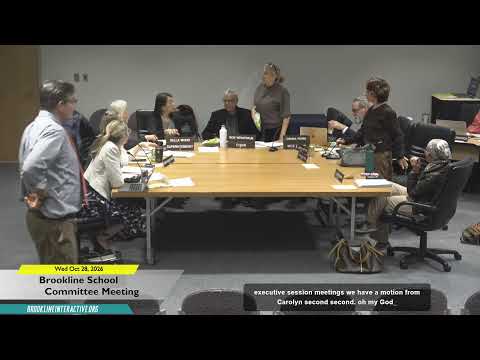 tap to load the tape · nothing plays until you do
the same, as a table
| time | kind | the moment |
|---|---|---|
| 24:37 | decision | Okay. [clears throat] Uh second item, consent agenda. I need a motion to accept the consent consent agenda, please. |
| 25:03 | decision | Not yet. Okay, Bob, you vote yes. We are unanimously accept the consent agenda. |
| 32:17 | pushback | I'm here about one course that she took last year, WISP, which I understand will be discussed today. Setting aside that… |
| 38:04 | pushback | And lastly, fourth, like I said last spring, we are deeply concerned and do not believe in the school committee… |
| 42:37 | pushback | In that time, you can imagine I've responded to all manner of crisis and kid problem. Not a single time has it been… |
| 43:07 | pushback | Uh, I'm concerned when I watch how much we are continuing to deploy her skills [snorts] towards this thing. Um, I hear… |
| 44:29 | decision | Do you trust our teachers? If the School Committee can decide at any time for any reason to overturn any class, why… |
| 51:16 | decision | But beyond fairness, don't we think that history, civics, and understanding our world is something critical for for us… |
| 52:07 | decision | You may have noticed I mentioned some names in my speech. If you would turn your attention to the papers that I've… |
| 1:01:28 | decision | Uh, students in grades 4 through 8 read and rate the nominated books over the year and then vote for their favorite… |
| 2:02:12 | decision | Uh and it is now it was unanimously approved by the school committee as I think you all recognize uh and uh it's now in… |
| 2:07:44 | decision | Um though I am hoping that we're going to some point come to a resolution on this issue. Um so, thanks for having me… |
| 2:34:58 | decision | Um we played devil's advocate uh one afternoon where we really talked through all of the all of the different options… |
| 2:40:25 | decision | I do respect that. But we weighed it all. Here's where we landed. The team unanimously recommends that the school… |
| 2:44:08 | decision | phones down and participate more, teaching them to think for themselves in the age of AI, aligning expectations across… |
| 3:26:54 | decision | No, no. I mean if you think we've heard a lot obviously, we're having some discussion. This is you know, obviously… |
| 3:31:37 | pushback | So a couple of thoughts that somewhat connected, some not, but um one is to say that I actually hear from parents who… |
| 3:46:33 | pushback | Um over 160 students and parents signed a petition being you know, being concerned about WISP for those reasons. |
| 1:04:31 | money | $8,500 — said 1 time |
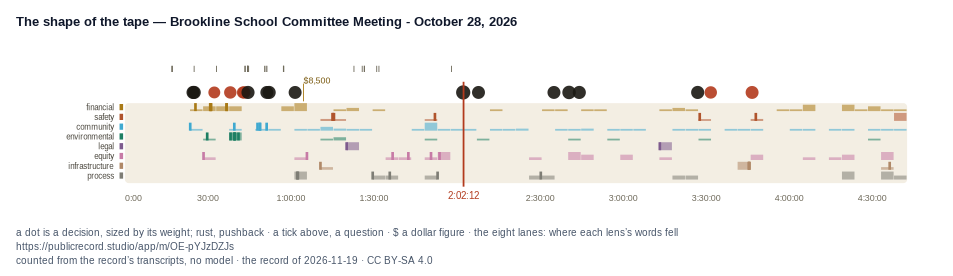
Cut from the analyzer’s scored moments — a measurement, not a choice made for you. Open a reel and press make this reel yours to re-cut it; tick any moment or transcript line below to cut your own.
The committee accepted the consent agenda [24:37] before opening public comment [31:30], where speakers addressed curriculum content standards [32:02], educator workload and support [35:56], religious holiday policies [46:08], and ninth-grade course leveling [52:43]. District administrators presented annual school plans and performance metrics for Driscoll School [59:42] and Ridley School [1:34:32], highlighting tiered instructional strategies, literacy programs, and MCAS performance data. High school staff and leadership then presented a multi-year review of the World History Support Program (WISP) [2:00:57], examining enrollment statistics [2:09:05] and course structure options [2:35:01], which led to extensive committee discussion and staff statements regarding course tracking, academic rigor, and educator autonomy [2:46:00]. Additionally, officials reviewed districtwide enrollment projections and high school class sectioning [3:55:31], received brief subcommittee reports [4:35:35], and discussed potential future business regarding School Resource Officers and translation services [4:38:14] before voting to adjourn into executive session [4:41:48].
What it means: The committee approved its consent agenda [24:37] [25:03] and heard public comments addressing content errors in social studies texts [32:20], union concerns [35:43], calendar start dates [48:15], and ninth-grade course leveling [52:33] [56:33]. School leadership delivered school improvement plan presentations for the Driscoll School [1:00:59] and the Florida Ruffin Ridley School [1:34:52]. High school administrators and faculty presented data and options regarding the ninth-grade social studies WISP curriculum [2:00:31] [2:09:05], recommending that the program continue [2:40:27]. Staff also provided a report on district enrollment trends and class sizes [3:54:33] [4:11:29], and the committee unanimously voted to approve a side letter agreement with the Brookline Educators Union concerning paraprofessionals [4:41:51] [4:42:25].
Who moved it: Meeting leadership led the consent agenda vote [24:37] [25:03]. Public comments were offered by community members including Betsy [31:48], BEU President Justin Brown [35:20] [35:43], and educator Sarah Schuster [38:51]. School improvement plans were presented by Driscoll Principal David Cook [1:00:46] and Florida Ruffin Ridley Principal Sarah Eukelous [1:34:24]. High school presentation leads included Head of School Anthony Meyer [2:00:57] and social studies teacher Jen Martin [2:05:16] [2:25:48], while administrator Aaron presented the enrollment update [3:58:05] [4:27:19]. The transcript does not specify which individual member originally moved the motion for the paraprofessional side letter before the roll call vote was taken [4:41:51] [4:42:25].
What to watch: Watch for ongoing board deliberations regarding the future structure of the ninth-grade high school social studies curriculum [2:34:29] [2:40:27] [3:42:41]. District administrators will use the presented enrollment models and class size figures to inform upcoming budget cycles [4:11:29] [4:22:45] [4:34:32]. The committee may also explore safety and police partnership suggestions raised during new business [4:38:24] [4:41:30] as the meeting transitioned into executive session [4:42:25].
Scored, not chosen for you — the salience bar is a measurement, and every moment is a receipt into the transcript below. With JavaScript on, tick moments to compose a reel — and tick moments on other meetings too; a reel can span the record.
→ the publish kit for this meeting — the clips worth cutting and draft copy, for a producer.
Counted, not modeled — each lens is a word list; drift compares the first half to the second.
the same, as a table
| word | mentions |
|---|---|
| school | 300 |
| students | 283 |
| work | 145 |
| wisp | 124 |
| grade | 98 |
| course | 94 |
| class | 93 |
| kids | 89 |
| last | 74 |
| years | 74 |
| high | 72 |
| teachers | 66 |
| every | 65 |
| data | 65 |
| student | 61 |
| little | 58 |
| much | 52 |
| educators | 51 |
| honors | 51 |
| middle | 50 |
| first | 49 |
| different | 49 |
| level | 49 |
| community | 48 |
| brookline | 47 |
| support | 46 |
| summer | 45 |
| classes | 45 |
| good | 44 |
| come | 43 |
| back | 43 |
| something | 43 |
| end | 42 |
| social | 42 |
| district | 41 |
| maybe | 40 |
| teacher | 40 |
| heard | 39 |
| studies | 39 |
| schools | 38 |
| talk | 38 |
| program | 38 |
| curriculum | 38 |
| great | 37 |
| clears | 36 |
| throat | 36 |
| working | 36 |
| many | 36 |
| part | 36 |
| slide | 36 |
| day | 35 |
| tonight | 35 |
| academic | 35 |
| take | 34 |
| history | 34 |
| wanted | 34 |
| parents | 33 |
| able | 33 |
| understand | 33 |
| families | 33 |
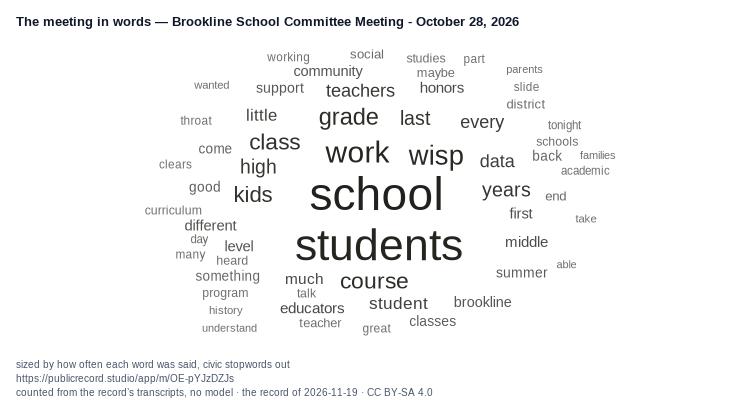
“school” came up 300 times. Sized by how often; civic stopwords out. With JavaScript off, a word opens the tape at its first mention.
0:43 [music]
6:07 Mhm.
6:13 [music]
16:05 Hey, everybody come to order. I hereby
16:07 convene the October 28th, 2026 meeting
16:11 of the regular school committee.
16:13 Welcome, everybody.
16:15 Um I have a couple of quick
16:16 announcements at the start of the
16:17 meeting. Um,
16:19 first of all, the next meeting's going
16:20 to be Thursday, November 12th due to
16:22 Veteran's Day being on the 11th. So,
16:24 we're going to back to a Thursday night
16:25 meeting.
16:27 Um, and another announcement right now.
16:30 [clears throat]
16:30 So, we have eight speakers for public
16:33 comment this evening and sometimes we
16:35 split those beginning of the meeting,
16:37 later in the meeting, but uh, we have a
16:40 very full agenda
16:41 and so we ask our speakers to please
16:43 adhere to the 3-minute limit. Betsy
16:46 Fitzpatrick will set the timer to help
16:48 us keep track of your time and we'll do
16:50 all eight in a row um, at the begin at
16:53 toward the beginning of the meeting.
16:55 Okay?
16:56 Questions, anybody? Okay.
16:58 So, we begin as usual with a moment of
17:01 inspiration and I am
17:03 very pleased to present Carolyn Thall
17:06 for tonight's moment.
17:07 Thank you, Bob. I think thank you. Is Is
17:10 my mic working?
17:13 [clears throat]
17:14 Does it
17:16 Is this Oh, maybe it just has to be
17:18 closer.
17:18 Testing. Testing.
17:19 Okay. I think it's working. It just
17:21 needs to be a little closer. Um,
17:24 okay, this is a sort of tough
17:26 This is sort of a tough thing. I mean,
17:28 not tough cuz there's so much to be
17:30 inspired by in our schools. Um, so
17:34 um, when I sat down to think about my
17:37 assignment from Bob um, to talk about a
17:40 moment of inspiration related to the
17:42 public schools of Brookline, um, I found
17:45 it difficult not due to lack of
17:47 inspiration but for too many options.
17:51 Um, I am in my final year as a PSB
17:54 parent, so I'm going to go a little
17:56 nostalgic
17:58 um, and forgive me if I wander a bit.
18:01 When I think about the notion of
18:03 inspiration in our schools,
18:06 um, what has ins- and and about what has
18:08 inspired me and more importantly my
18:11 children,
18:13 um, I immediately think of a related
18:15 word and notion, aspiration.
18:18 Um, aspiration is about reaching, having
18:22 goals, being engaged. And when PSB has
18:24 engaged my kids, and they've been so
18:27 motivated by their teachers and
18:30 developed their own aspirations, those
18:33 have been great moments of inspiration
18:35 for me. So, I'm going to do a little a
18:37 little run-through
18:39 going back to 2011. 2011, my oldest
18:43 child entered kindergarten. There were
18:45 26 kids in this class by the end of the
18:48 year with 11 native languages. Fabulous.
18:53 Um, the teacher, Sarah Yasenao, knew how
18:56 to differentiate, which is so important,
18:58 I think, in kindergarten because these
19:00 kids are coming in at such different
19:02 places. And did I mention 11 native
19:04 languages? Um, my daughter happened to
19:07 be a kid who had figured out how to read
19:09 at that point, and Ms. Yasenao would
19:11 send her and another girl who could read
19:14 out into the hall to read. Um, so they
19:17 were allowed to fly, and that was so
19:20 meaningful, um, and set this little girl
19:24 up, um, to be excited about and engaged
19:27 with school.
19:29 I'm going to do some personal shout-outs
19:30 here, too, which is not to not shout out
19:33 to everyone else. Um, in first grade, my
19:35 daughter had
19:37 retired teacher Mrs. Marcy Prager as a
19:40 long-term sub for most of the year.
19:42 Complete professional, she was
19:45 determined to challenge every single
19:47 child in the room and to keep bringing
19:49 them up and up and up. Mrs. Prager
19:53 taught a unit of her own making with
19:55 China as the central theme because she
19:57 had traveled to China and been so
19:59 inspired herself. Um, she modeled being
20:03 a citizen of the world, and the kids
20:05 were fascinated.
20:08 [clears throat]
20:08 Also first grade for my other child,
20:11 Laura Richardson.
20:13 Nationally recognized, deservedly so.
20:17 Beyond.
20:18 Um, she had the kids, and this was like
20:20 2015, so technology was sort of newer in
20:24 schools. She had the kids use technology
20:26 video to do projects about a subject of
20:30 their choice.
20:31 Um, my son made a video about your
20:33 brain. And I remember him on the little
20:35 video saying, "This is about your
20:37 brain." Um, and he blew up a balloon to
20:40 illustrate um, an expanding brain.
20:44 Very meta.
20:46 I think Mrs. Richardson's husband was
20:48 literally a rocket scientist.
20:51 Um, and also for Mrs. Richardson,
20:54 um,
20:54 the sky was the limit for her students.
20:57 Her belief in the ability of every child
20:59 was palpable.
21:02 Um,
21:03 third grade, Leslie Tomian.
21:06 Surely, wherever she goes, Leslie Tomian
21:09 is the smartest person in the room.
21:11 I remember her telling us at back to
21:13 school night that her idea of a fun
21:15 weekend was trying to think of new ways
21:17 to teach math.
21:19 And I will always remember a message she
21:21 put on her white
21:24 paper board on the last day of school
21:26 listing all of the things the students
21:28 had done and all of the skills they had
21:30 learned that year
21:32 and ending with, "You are ready for
21:34 fourth grade."
21:36 She was telling these little kids to
21:38 aspire to greatness. Fourth grade, aim
21:42 high,
21:43 go out there. You are ready.
21:46 Fourth grade,
21:47 Alyssa Henry.
21:49 I don't know what to say except
21:51 consummate professional,
21:53 no nonsense. We are going to show up
21:56 here and I'm going to have high
21:57 standards and teach you so much stuff
22:00 and you are going to learn because this
22:02 is the Did you have Mrs. The
22:04 I'm feeling it across the room.
22:06 [laughter]
22:07 Um,
22:08 that is the business we are in in here.
22:10 She was effective
22:13 beyond belief. Um, for the sake of
22:15 brevity, I'm going to jump ahead to the
22:17 high school. Um, one of my children was
22:21 inspired by school within a school. We
22:23 are so lucky
22:25 to have a humanities focused program
22:29 at BHS with SWS. Uh we know that the
22:33 humanities are becoming an endangered
22:35 species, but reading,
22:38 writing, philosophy, and thinking about
22:42 one's place in the world is essential.
22:45 That's a foundation of intellectualism
22:48 and well, our humanity. We could have a
22:51 whole
22:52 school committee meeting moment of
22:54 inspiration um here focused just on SWS
22:58 and the SWS staff and leadership
23:02 collective, all of you.
23:04 Um
23:06 Also at BHS, our kids can be in
23:10 rock-solid, fact-based, old-fashioned,
23:13 lots of work situations, and these have
23:16 been equally important and inspiring for
23:19 my children. Um I have one child who
23:21 really came alive as a learner um when
23:25 they entered the sort of notorious A
23:27 push class. Um this For this child, this
23:31 was the moment we'd been waiting for. Um
23:34 that he'd been waiting for to be part of
23:36 a community of learners who push each
23:39 other and push themselves um aspiring.
23:42 Um
23:44 So, a common thread when I think about
23:46 inspiration and PSB is seeing, and I've
23:50 seen it in these years that are coming
23:53 to a close, um that when our kids are
23:56 engaged, as they so often are in our
23:59 schools, and have big goals and
24:02 aspirations, they are inspired to work
24:05 hard, to do well, to go further.
24:07 Hard work feels good.
24:10 Achieving your goals feels good, and I'm
24:12 so grateful to the many PSB teachers who
24:15 brought my own kids along by modeling um
24:20 inspiration, aspiration with their
24:22 professionalism and dedication.
24:26 Thank you, Carol.
24:27 the end
24:28 Thank you.
24:29 And thank you to every teacher in the
24:31 Brookline Public Schools. Thank you.
24:34 Okay. [clears throat]
24:35 Uh second item, consent agenda. I need a
24:37 motion to accept the consent consent
24:39 agenda, please.
24:41 So moved.
24:41 Jesse moves.
24:43 I'll second.
24:44 Suzanne seconds. Are there any comment
24:45 or questions about the consent agenda
24:47 tonight?
24:49 Then we will take a vote, Faisal.
24:53 Yes.
24:53 Carolyn?
24:54 Yes.
24:54 Jesse?
24:55 Yes.
24:55 Anna?
24:56 Yes.
24:56 Laura?
24:57 Yes.
24:58 Sarah?
24:58 Yes.
24:59 Suzanne?
25:00 Yes.
25:00 Isabelle online?
25:01 Uh no.
25:03 Not yet. Okay, Bob, you vote yes. We are
25:05 unanimously accept the consent agenda.
25:08 Thank you.
25:10 Superintendent Bella Wong, your report,
25:12 please.
25:13 Sure. Actually, it's just a brief um
25:17 highlights of the last week and this
25:19 week. Um so, last week
25:22 I was invited by the BEF board to attend
25:26 our meeting and address them on the
25:28 importance of the system grants. So, I
25:30 appreciated being at FRR to do that.
25:33 And then Tuesday night, I was invited by
25:36 the board of Facing History
25:39 um to address my to to share with them
25:42 my experience of being a student in
25:44 Margo Strom's class.
25:47 And um
25:49 it was attended by the the Facing
25:52 History board, but also the teacher
25:54 advisory board. And I saw a former
25:57 teacher of mine from another school
25:59 district, so that was fun.
26:01 But I
26:03 was actually very emotional experience
26:05 for me to talk about how much um Margo
26:08 Strom meant to me as a teacher and also
26:10 inspired me to be
26:13 the educator I think um that I am today,
26:16 a big influence. To be among people who
26:19 knew Margo.
26:21 Um so, I was afraid I was going to cry.
26:25 I didn't, but they all cried.
26:27 Um but I I talked about the lessons
26:29 learned at that time and how they've
26:31 grown with me
26:32 and
26:33 and influenced
26:36 my life moving forward. So, that was a
26:38 really great experience. I was invited
26:41 to represent Brookline for the City
26:43 Council of Great Schools, this new
26:45 organization that has started um
26:48 and the meeting was in Boston and the
26:50 topic was emotional intelligence before
26:53 AI. So, the theme of um
26:57 that evening, the panel um panelists
26:59 were about the thoughtfulness of um
27:02 introducing AI to its students,
27:04 basically
27:06 pausing and being intentional about
27:09 that. So, I appreciated that. I also
27:12 wanted to um
27:13 thank the School Committee. I don't know
27:15 that I've ever thanked the School
27:16 Committee and and I don't know that
27:18 everyone understands why the Thursday
27:20 night meeting switched to Wednesday. So,
27:23 last week I also got to be part of my
27:27 Wellesley Town Band on Monday and
27:30 orchestra on Thursday. And I am reminded
27:33 to mention this because at the BPO
27:36 interview um Brookline Parents
27:38 Organization interview on Sunday night,
27:41 one of the questions was about hobby
27:43 and I said it's it's playing the
27:45 clarinet and how important it is for me
27:47 because when you play, you can't think
27:50 you you're immersed completely in the
27:52 music. Yes, Jessie knows this. And um
27:56 and how much I appreciate that the
27:57 committee changed the night so I could
27:59 be part of the orchestra as well. Um so,
28:02 both really meaningful respites for me
28:04 embedded in the week. Um also
28:07 appreciated that the Brookline Parents
28:09 Organization invited me
28:11 to speak um on various topics. I felt
28:14 like it was a really broad
28:17 um broad range and I also was honest
28:20 that questions around our um
28:24 you know, how we're supporting diversity
28:26 point of view um in schools, how we are
28:30 our
28:31 our um
28:32 philosophy around use of technology,
28:35 around AI.
28:37 Um that we are we are still working on
28:40 them actively, but it would be premature
28:43 for me to articulate a coherent vision
28:45 of where we all are representing the
28:47 entire district. And so um and also
28:51 about rigor.
28:53 Um so those those were three topics that
28:55 I knew coming into it that they are
28:58 things that we're still working on as a
28:59 district and coming together about our
29:03 our common understanding and how we want
29:05 to articulate that. But we're definitely
29:07 actively engaged on that. So I anyway
29:10 appreciated that opportunity to do that.
29:13 I also just just um
29:16 um so last week I was able to be in
29:18 Lawrence and Baker and Lincoln. And
29:21 while I was at Lincoln, I heard there
29:23 was going to be a pumpkin thing on
29:25 Sunday. So um I have my my I have a
29:29 adult disabled
29:31 child who's home on the weekends. So we
29:33 went we went to the Lincoln pumpkin fair
29:36 and I just couldn't believe what they do
29:39 to every square inch of that property.
29:42 And it was a beautiful day and so much
29:44 great energy, students running around
29:47 everywhere, every nook and cranny. So I
29:49 thoroughly enjoyed that. And then um
29:52 also in the week I got to tour
29:55 the Pierce building for the first time.
29:58 I think it was last week. Maybe it was
29:59 the week before, I don't know. But um I
30:02 it's the first time I've seen the inside
30:04 of what is in development and it's it's
30:07 really beautiful. It's going to be
30:09 really great and I can't wait for the
30:10 rest of you to see it as well um when it
30:13 opens. And I was at um Pierce Fisher on
30:16 the hill today on another beautiful day
30:19 anyway. So just um one of the best parts
30:22 of the job is being in schools
30:25 um visiting and and also representing um
30:30 our wonderful district. So thank you.
30:34 Thank you, Bella.
30:35 [clears throat]
30:35 For those of you who
30:37 excuse me, for those of you who are not
30:39 familiar with Margo Strom, Margo
30:41 Sternstrom,
30:43 she was [clears throat] a long-time
30:44 social studies teacher at the Runkle
30:45 School
30:46 in the
30:48 middle school and
30:50 she received a Title 4C grant from the
30:53 federal government to do innovative
30:55 education and I met her because I
30:56 actually was working under a Title 4C
30:59 grant at an alternative school in
31:01 Arlington. So, I got to know Margo from
31:04 the very beginning of our programs and
31:07 um
31:08 and she was the founder of that grant
31:10 provided her with the foundation for
31:12 Facing History and Ourselves, which went
31:14 on to be an incredible international
31:17 program. So,
31:18 Margo Strom, may she rest in peace.
31:23 And Bella, thank you for your
31:24 transparency about your personal life.
31:27 Thank you.
31:28 Um [snorts]
31:30 okay, [clears throat] now we have public
31:31 comment. I think we have eight public
31:33 commenters this evening. You have no
31:35 more than 3 minutes. Betsy Fitzpatrick
31:38 is brutal as the timekeeper, so she will
31:42 call you to the podium. You can speak
31:44 for up to 3 minutes. If you want to
31:45 speak for 30 seconds, that's fine, too.
31:48 Go, Betsy.
31:49 Uh our first speaker is actually online,
31:50 Shera Fisher.
31:52 You can start now, Shera.
31:55 Great.
31:55 Hi, thanks so much. I'm Shera Fisher at
31:57 BHS alum, a town meeting member and a
31:59 parent of a current sophomore. My
32:02 daughter loves BHS. I want to
32:03 acknowledge the wonderful teachers and
32:05 administrators and coaches she has
32:06 benefited from over the past year and a
32:08 half. She has been learning and
32:09 flourishing.
32:11 I'm here about one course that she took
32:13 last year, WISP, which I understand will
32:15 be discussed today. Setting aside that
32:17 it's unlevelled and and easy, my concern
32:20 is the content, errors and bias in the
32:22 materials. In the unit on world
32:25 religions, the readings on Christianity
32:27 and Judaism have numerous factual errors
32:30 and anachronisms as well as a repeated
32:32 bias underlying the texts.
32:34 One reading says Jesus was accused by
32:36 the Sanhedrin, the priestly body of the
32:39 Jews, brought to trial and condemned for
32:42 blasphemy. As they did not possess the
32:44 authority to execute Jesus, being
32:45 subjects of Rome, Jesus then went on
32:47 trial before the Roman magistrate,
32:49 Pontius Pilate.
32:51 This is stated as fact, no according to
32:53 the Gospels, no context. The implication
32:56 the Jewish leaders would have executed
32:57 Jesus if they could. The narrative that
33:00 Jews killed Jesus has been used to
33:01 justify violence against Jews for nearly
33:03 2,000 years. Why is this included and
33:06 with no context? And also as an aside,
33:08 the Sanhedrin served as a court, not a
33:10 priestly body, though some of its
33:12 members were priests.
33:13 During my exploration of this issue, I
33:15 learned that another parent had
33:16 identified some of these issues 2 years
33:18 ago and was told that one textbook with
33:20 some problematic sources would not be
33:21 included in the future. However, those
33:23 same problematic paragraphs from that
33:25 textbook were included verbatim in the
33:27 materials my daughter received. So, they
33:29 have not been removed and I'm happy to
33:31 provide the the passages.
33:33 The text frequently treat Judaism as
33:35 ending when Christianity begins. They
33:37 use outdated or Christian theological
33:39 terms like the Hebrews and the
33:41 promulgation of the law. They explain
33:44 Jewish concepts through Christianity,
33:46 even where the Jewish concepts came
33:48 first. Factual errors include the origin
33:51 of the Sabbath work prohibition and how
33:53 often Jewish prayer services take place.
33:56 Last December, I shared a five-page memo
33:58 with citations with the head of the WISP
34:00 course since the same materials are used
34:01 course-wide. She was responsive, she
34:04 acknowledged the Christian bias, and she
34:06 said that some of this some of these
34:08 issues are addressed verbally. That
34:09 isn't enough. Teachers differ, students
34:11 miss spoken points, and since these are
34:13 school written texts, the fix belongs in
34:16 the texts. She said they would review
34:18 the materials, but nothing was complete
34:19 at the start of the school year.
34:21 In this context, I reached out to school
34:24 committee. I want to be clear, I'm not
34:26 asking school committee itself to review
34:27 the content. It's not school committee's
34:29 job, and being elected to school
34:31 committee does not make one an expert in
34:33 everything taught in high school.
34:34 Teachers are indeed the professionals,
34:36 but when a concern like this is raised
34:37 and the school has not addressed it, and
34:39 now it seems even a year ago it was
34:42 already raised. Other experts should be
34:44 called in. I was recently told that the
34:46 materials are being revised and will be
34:48 ready before the unit is taught this
34:50 year in the spring, but the slides I saw
34:52 that will be presented tonight say the
34:54 summer curriculum work is complete. So,
34:56 I want to know whether this unit was
34:57 included and was outside expert review
35:00 part of it. I'm asking for three things.
35:02 One, qualified outside expert review of
35:04 the Judaism and Christianity units. Two,
35:07 that corrections are made in the text
35:08 themselves in writing. And three, that
35:10 the committee gets a a timeline and a
35:12 report back before this unit is taught
35:14 to this year's students. Thank you for
35:16 your time.
35:17 Thank you, Shira.
35:19 Next up.
35:20 Our next speaker is Justin Brown.
35:27 Valerie says joined us online.
35:30 Just try to hold that right there.
35:37 [clears throat]
35:39 Uh good evening, everyone. Uh I'm Justin
35:41 Brown, uh Lawrence educator currently
35:43 serving as president of the BEU. I'm
35:46 here tonight in my official capacity as
35:49 spokesperson for the union and will be
35:51 weighing in on the topic of WISP uh the
35:54 WISP discussion slated for later in the
35:55 agenda.
35:56 If you remember, I was here last spring
35:59 to deliver a statement about the same
36:01 topic.
36:02 Our position remains unchanged. Uh I
36:05 want to make crystal clear where we
36:07 stand on any move by the school
36:09 committee to overstep its role, break
36:13 from practice, and continue meddling in
36:16 internal the internal operational
36:18 workings of the school system.
36:20 I'll do that with the following four
36:22 points.
36:23 First, we believe in the foundational
36:26 role
36:27 of an elected school committee in our
36:30 collective democratic project.
36:32 We believe the school committee's job is
36:34 to fight for as robust a public school
36:36 system as possible
36:38 on behalf of all of its stakeholders. To
36:41 us, this means standing up against
36:43 fiscal austerity and fighting for
36:45 increased funding.
36:47 To that end, in coming weeks, I will be
36:49 reaching out to the school committee
36:50 leadership uh to offer an opportunity to
36:53 issue a joint statement urging state
36:55 leaders to increase funding for our
36:56 school district, specifically for uh the
37:00 special education circuit breaker
37:02 reimbursement amount and fixing the
37:03 Chapter 70 uh inflation cap issue.
37:08 Two.
37:09 We believe in educator autonomy and
37:11 academic freedom. Public education is at
37:14 its best when educators are able to meet
37:16 the needs of their students by
37:17 marshaling not only their own expertise,
37:20 experience, and skill set, uh but those
37:23 of their immediate team members, other
37:25 colleagues, and supportive
37:26 administrators. We will continue to
37:28 defend our existing protections against
37:30 any incursions.
37:33 Three. Like I said in the spring, we
37:34 believe in the process that it has
37:36 resulted in the WISP program. It was the
37:39 result of an investment in vision, time,
37:43 resources, staffing, reflection, and
37:46 adjustments.
37:48 At a time when MTSS is on everyone's
37:51 mind, here is a class that's giving
37:53 MTSS. Nothing quite beats educators
37:56 given the time and tools they need to
37:58 make informed choices about the students
38:00 that they care about.
38:02 And lastly, fourth, like I said last
38:04 spring, we are deeply concerned and do
38:06 not believe in the school committee
38:08 continuing to meddle and waste valuable
38:10 time and energy on this issue. You've
38:12 got a group of very talented educators
38:15 who have created a strong course and are
38:17 saying no notes. Instead of asking
38:19 ourselves, what can we be doing to make
38:21 sure our educators and students have
38:23 what they need in the face of escalating
38:25 costs and diminishing funds, you are
38:27 continuing to consider a distracting
38:29 turf battle with hard-working educators.
38:32 There is a process in place that has
38:34 worked well in the past and will serve
38:37 you well in whatever comes next. Please
38:39 use it. No more internal meddling when
38:42 bold outward-facing leadership to secure
38:44 a robust and fully funded school system
38:46 is needed. Thank you.
38:49 Thank you, Justin.
38:51 Uh our next speaker is Sarah Schuster.
38:54 After Sarah, it will be Britt Stevens.
38:59 Good evening. My name is Sarah Schuster.
39:02 I'm in my 11th year teaching social
39:03 studies at Brookline High School. Ahead
39:06 of the presentation on West tonight, I
39:07 want to speak about the personal toll
39:09 this ongoing debate has had on me as an
39:11 educator.
39:13 First, I want to start by saying that I
39:14 love my job. I love teaching and working
39:16 with students and I've spent the past 11
39:18 years working to become a better
39:20 educator. Teaching is challenging work,
39:22 but it is also deeply rewarding. At the
39:24 same time, this debate has caused me to
39:27 question whether the time, energy, and
39:29 expertise I put into my work are truly
39:31 valued and respected by my community.
39:34 Over the past few years, my colleagues
39:36 and I have spent an enormous amount of
39:37 time and energy defending a course that
39:39 we believe is serving our students well.
39:42 I would be lying if I said this process
39:44 has not taken a toll on me or affected
39:46 my work. That time and energy could have
39:48 been spent planning, collaborating with
39:50 colleagues, improving our curriculum,
39:52 and supporting students. Instead, we
39:55 have repeatedly had to redirect our
39:56 attention away from our job and toward
39:58 defending our work.
40:00 What has been especially difficult is
40:02 the feeling that our professional
40:03 judgment as educators is being
40:05 questioned and undermined. We are
40:07 educated professionals who invested who
40:09 have invested years in our training and
40:11 practice. We are not asking the school
40:13 committee to blindly support a program
40:15 simply because teachers believe in it.
40:17 My colleagues and I regularly reflect on
40:19 our curriculum, make revisions, and look
40:22 for ways to improve our courses. We also
40:24 seek feedback directly from students and
40:27 use that feedback to inform our teaching
40:29 and make improvements. We take our work
40:31 seriously and understand the importance
40:33 of evaluating our work. But, there is a
40:36 difference between evaluating a program
40:38 in good faith and making the educators
40:40 responsible for that program feel that
40:42 their expertise is not trusted.
40:45 It has been genuinely demoralizing to
40:47 feel that the people and institutions
40:49 that should be supporting educators have
40:51 instead become a source of so much
40:52 stress and discouragement. I do not
40:55 believe it was anyone's intention to
40:57 disrespect the work we have done, and I
40:58 know that we all want what we think is
41:00 best for students. But when you have
41:02 invested years of time, energy, and
41:05 expertise into developing and teaching a
41:07 course, having that work repeatedly
41:10 subject to public scrutiny by town
41:12 leaders without sufficient evidence to
41:14 justify it can feel deeply undermining.
41:17 I am sharing this because I want the
41:18 school committee to understand that
41:20 these debates have real consequences
41:22 beyond a discussion about course
41:23 offerings. This process has caused me to
41:26 question myself as an educator and has
41:28 affected how I experience a job I've
41:30 otherwise loved doing for 11 years. I
41:33 hope we can move forward in a way that
41:35 allows educators to once again feel
41:37 respected, supported, and trusted in the
41:39 work we do every day. Thank you.
41:42 [applause]
41:47 Thank you.
41:51 Uh I'm Brett Stevens. I'm one of the
41:53 coordinators at Brookline High. Um
41:54 that's a problem, what you just heard,
41:56 so I'm sorry that our colleagues are
41:58 feeling that way.
41:59 Uh
42:00 and I'm going to say with love to my
42:01 social studies colleagues, I don't
42:02 actually care about WISP personally.
42:05 Um
42:06 like
42:07 I'm not here to defend heterogeneity.
42:11 We have leveled courses at Brookline
42:12 High. We'll always have leveled courses
42:14 at Brookline High.
42:15 Uh I'm here to ask us respectfully, cuz
42:18 I appreciate how much time you give to
42:20 our district, to stop directing so much
42:22 time to this one singular
42:25 problem. Uh we're using a lot of
42:27 institutional capacity, years of
42:28 institutional capacity. I've been at BHS
42:31 for nearly 20 years.
42:33 In the last 10, I've been an
42:34 administrator.
42:35 In that time, you can imagine I've
42:37 responded to all manner of crisis and
42:39 kid problem. Not a single time has it
42:41 been about no their ninth-grade social
42:43 studies curriculum. That's not really
42:45 the big problem that exists in our
42:47 school. And we have plenty of things
42:49 that we could be working on.
42:50 Um for what it's worth, I've also known
42:52 Jen Martin for nearly 20 years,
42:55 uh, very closely as a coordinator for
42:57 the last several. I think I speak for
42:59 many when I say Jen is the best of us.
43:01 She's smart, she's a good listener,
43:03 she's fair,
43:04 committed, talented.
43:07 Uh, I'm concerned when I watch how much
43:09 we are continuing to deploy her skills
43:11 [snorts]
43:12 towards this thing. Um,
43:15 I hear a a Brookline phrase is a
43:17 Brookline High phrase like, what problem
43:19 are we really trying to solve? I don't
43:21 know. I've lost the thread.
43:23 Uh, if I understand where we are with
43:25 WISP, I wonder if role clarity is a
43:28 problem.
43:29 Does the School Committee understand
43:30 which decisions fall to their authority?
43:32 Do we, the educators, understand which
43:34 decision decisions fall to your
43:36 authority? Um, I don't maybe I don't
43:39 anymore. I'm I'm genuinely starting to
43:41 feel a little confused. I do know you
43:43 made the decision to bring us Bella
43:44 Wong. That was the right decision. She's
43:47 one of the strongest leaders we've had
43:48 in my time in this district.
43:51 The decision to listen to her and let
43:53 her lead, like logically that would be a
43:55 follow-up decision. So, I hope that we
43:57 listen to Bella
43:59 if we brought her here to lead us. She
44:01 is the one with
44:02 the role of superintendent. And so, when
44:04 I think of who I turn to when I need
44:06 help with curriculum, it's it's Bella.
44:08 And I believe that the School Committee
44:10 is there to support Bella. That's the
44:11 district I want to believe in and work
44:13 in.
44:14 Um, if we don't trust Bella or Jen, does
44:16 that mean you don't trust me? Do you
44:18 trust our principals?
44:20 Do you trust our teachers? If the School
44:22 Committee can decide at any time for any
44:25 reason to overturn any class, why would
44:27 I bring more classes to this body to
44:29 approve? Why would I ask teachers to do
44:31 more work to design more curriculum?
44:34 If I brought a class and it was
44:36 overturned by a future School Committee,
44:38 who would decide what the curriculum
44:40 would be after you overturned the course
44:42 that I believed in?
44:44 Uh, these are genuine questions. Like,
44:45 we're at a crossroads that I've never
44:47 seen us at before if I understand where
44:49 we are with WISP. And as a person who
44:51 loves this district and loves Brookline
44:53 High School, that's worrisome to me for
44:56 reasons related to how our teachers are
44:57 feeling, but also for reasons related to
45:00 needing to be collaborative so that we
45:02 can do the good work of supporting
45:03 students.
45:04 So I want to say it's not about WESP,
45:06 it's not about ninth grade social
45:07 studies, it's about where our work ends
45:09 and your work begins and how we do that
45:11 work together.
45:13 We need to sort that out because there
45:15 are things that need our attention and
45:17 we're here for the kids and I want to do
45:19 good work for them. Thank you.
45:22 [applause]
45:23 Thank you, Britt.
45:25 Our next speaker Our next speaker is
45:27 Josh Strechin, who's joining us
45:29 remotely.
45:31 Josh, you should be able to turn on your
45:32 camera and microphone now.
45:39 Good evening.
45:40 My name is Josh Strechin. I am
45:43 parent of two children at the Heath
45:46 School,
45:48 members of second grade in Miss Joshua's
45:50 class and kindergarten Miss Kucher's
45:53 class. I'm here tonight to talk about
45:56 school calendar. I know that this has
45:58 been a hot topic for quite some time
46:02 and I know that we were
46:06 We were very fortunate to have Dr.
46:08 Weintraub and Mrs. Thrall attend the
46:11 Heath PTO meeting back on the 19th, on
46:14 that Friday. They can attest that when I
46:17 say the following comments, I'm not the
46:18 only parent that feels this way.
46:21 In fact, everybody in the audience
46:23 raised their hand and is 100% in favor
46:26 for federal and state holidays only and
46:29 to remove the
46:31 what I'll call tier one
46:35 religious holidays.
46:36 And I say this as a practicing Jewish
46:39 parent.
46:40 Both my wife and I are heavily involved
46:42 in our temple. Our kids attend regular
46:44 Sunday school and attend holidays.
46:47 But honestly, I don't think that the
46:49 school committee is factoring into the
46:50 fact that most parents these days are
46:53 dual working households and the
46:57 the burden that having these non-federal
47:00 and state holidays off
47:02 are on the working parents.
47:05 Right now, we have to use our PTO time,
47:07 which is limited. We have to align it
47:09 with the school calendar, and so truth
47:11 be told, my wife and I do not have
47:13 enough PTO to cover all the days off
47:16 outside of summer, you know, take summer
47:18 vacations off, but when you have winter
47:20 break, you have uh February break, you
47:22 have April break, you have all the uh
47:25 religious holidays, we just don't have
47:27 enough time, and it is a huge burden for
47:29 us. I know I speak uh on behalf of many
47:33 parents that have been very vocal about
47:35 this, and I'm asking that the school
47:37 board, that
47:39 uh
47:40 uh Superintendent Wong really consider
47:43 that we only do state and federal
47:45 holidays. Again, I am saying this from a
47:47 practicing Jewish person who will pull
47:50 my kids from school for those holidays,
47:52 but we cannot continue to burden
47:54 families that will not have kids in
47:57 school, and then have to take time off.
47:59 I have emailed the school committee
48:02 numerous times. You guys have seen many
48:05 of my emails.
48:06 Um and like I said, I know I'm not the
48:08 only parent that feels this way. I would
48:09 also like the school committee to
48:12 consider, or also uh Superintendent Wong
48:15 to consider starting before Labor Day. I
48:17 know that that is a divisive uh amongst
48:21 the parents, and not everybody's in
48:22 agreement with that, but in reading the,
48:25 you know, currently now expired teachers
48:27 agreement, you guys have the ability to
48:29 start school on either the Wednesday
48:32 before Labor Day or September 1st,
48:34 whichever day is earlier. We are one of
48:37 the last starting school districts in
48:39 the eastern part of the state. We are
48:41 one of the last finishing school
48:42 districts in the eastern part of the
48:43 state. And I really think that we are
48:46 putting a lot of burden on families,
48:48 working families, which are the majority
48:50 of people that attend our schools, uh
48:52 dual working households, and I really
48:53 would like the school board to consider
48:55 both the removal of the tier one
48:57 holidays, and also to start school uh
49:01 prior to Labor Day.
49:03 I'm not going to take any more time. I
49:05 appreciate you considering my comments,
49:07 and I would love to talk about this for
49:09 much longer, but I want to be respectful
49:11 of the time. So, thank you.
49:14 Our next speaker is Oz Palchik.
49:37 Good evening. My name is Oz Palchik. Uh
49:39 you may remember me from the last two
49:41 times I've come to speak about the same
49:42 issue.
49:43 Uh I understand WISP is on the agenda
49:45 today, so I've come to share the
49:46 perspectives of myself, as well as the
49:48 perspectives of some of my peers.
49:51 Some of them were unable to attend due
49:52 to other commitments, and many others
49:53 did not feel comfortable coming here to
49:55 speak and wish to remain anonymous.
49:57 Over the past 2 months, I've gotten the
49:59 chance to experience WISP firsthand.
50:01 Most homework assignments give the
50:02 option to choose between mild, medium,
50:04 and spicy difficulty levels. I've chosen
50:06 the spicy level for every single
50:08 homework assignment thus far, and as
50:10 Brady noted, it assigns readings with
50:12 more advanced vocabulary instead of
50:13 going deeper into the topics.
50:15 I do want to acknowledge that I'm lucky
50:17 to have an amazing teacher. Shout out
50:18 Ms. Grub.
50:19 My main problem is that the curriculum
50:21 is designed to be easy enough for the
50:23 less interested students, while also
50:24 attempting to challenge the most more
50:26 advanced students.
50:28 The outcome? No in-depth discussions or
50:30 faster-paced classes. All you end up
50:32 with is more work.
50:33 One thing I've noticed in other advanced
50:35 classes, geometry advanced for example,
50:37 is that we're expected to come with at
50:38 least some level of background
50:39 knowledge. We can build off that base
50:41 knowledge to tackle harder topics at a
50:43 faster pace. And as Akshat mentioned,
50:46 the classes are more engaging, fun, and
50:47 appropriately challenging. In WISP, on
50:49 the other hand, everyone starts from
50:51 square one, no matter how much prior
50:53 knowledge they may have. But why is
50:54 that? Why have we decided as a district
50:56 that math, physics, and English are
50:58 worth giving a challenge to students,
50:59 but history isn't?
51:01 It's clear that different students have
51:02 different interests, and for students
51:04 like me who are interested in social
51:05 studies, taking away our opportunity to
51:07 be in a more advanced class surrounded
51:08 by more motivated kids is simply unfair.
51:11 But beyond fairness, don't we think that
51:13 history, civics, and understanding our
51:15 world is something critical for for us
51:16 as the next generation of voters and
51:18 leaders to deeply understand?
51:20 We will be navigating an increasingly
51:21 uncertain and complex world, and
51:23 understanding social studies is what can
51:25 prepare us as critical and informed
51:26 thinkers.
51:28 De-leveling social studies shows that as
51:30 a district, history is a topic that we
51:31 value less than the others, and to the
51:33 administrators of the social studies
51:34 department, I'm certain that's not your
51:36 intention.
51:37 WISP has many group projects, and as
51:38 another anonymous student recounts,
51:40 collaborating can be difficult because
51:42 not everyone is on the same academic
51:43 level or willing to put in the same
51:45 level of effort.
51:47 Lacking the challenge in class, many of
51:48 us turn to external sources. These may
51:50 include joining clubs at BHS such as
51:53 Quiz Bowl or Model UN, or even
51:54 self-studying AP courses like Max.
51:57 These are obviously great things to do
51:58 outside of school, but it shouldn't have
52:00 to be a replacement for in-school
52:01 education.
52:02 You may have noticed I mentioned some
52:04 names in my speech. If you would turn
52:05 your attention to the papers that I've
52:07 passed out, I've compiled some accounts
52:08 from some peers who are also
52:09 experiencing WISP. Thank you.
52:14 [applause]
52:16 Thank you.
52:17 Our next speaker is Lizzie Buel, who's
52:19 joining us remotely.
52:23 I'll give her a minute here.
52:32 Hi everyone.
52:33 I'm once again speaking in defense of
52:36 the WISP core, which I currently teach
52:38 at BHS along with US history standard
52:41 co-taught.
52:43 In meetings last year, I heard a school
52:45 committee member ask, "What is wrong
52:47 with standard level?"
52:49 in conversation about the value of
52:51 de-leveling.
52:53 I think this may have been intentionally
52:55 naive, but all the same, I will do my
52:58 best to explain an unspoken culture at
53:01 BHS.
53:03 First, let me say that I love teaching
53:05 the standard level.
53:07 They are the classrooms where I have the
53:08 most forthright conversations with
53:10 students, and often I am most in awe of
53:13 their achievement because they overcome
53:16 odds that are stacked against them.
53:18 These are juniors, however, students who
53:21 have chosen to take standard level
53:23 because they understand their needs as
53:25 learners,
53:26 whether as students with disabilities or
53:28 who are transitioning out of the English
53:30 language education program.
53:35 Maybe they're not that into history,
53:37 or they need to balance their schedule
53:39 with extracurriculars.
53:41 They've taken 2 years of history, and
53:43 they've had a chance to decide for
53:45 themselves.
53:47 At BHS, more than 70% of students take
53:50 honors or above.
53:52 There are only two to three sections of
53:54 standard level in any given course,
53:57 sometimes even less.
53:59 In the hallways, I've heard students use
54:02 the phrase,
54:03 "So and so takes standard level math,
54:06 English, social studies, science."
54:09 as a way to demean their fellow
54:10 students.
54:12 We know that eighth grade teachers
54:15 I'm sorry. We know that eighth graders
54:17 who are labeled as standard
54:20 tend to never leave that level.
54:22 If we return to leveled ninth grade, we
54:25 are asking eighth grade teachers to
54:27 place students in a track they may never
54:29 leave.
54:31 Does a 13-year-old have the
54:33 self-knowledge and fortitude to avoid
54:36 internalizing this label in a community
54:39 where academic tracking is cultural
54:41 currency?
54:43 We are asking for 1 year of one core
54:46 academic subject that happens to
54:49 emphasize the concept of community
54:52 for students to learn in a truly
54:54 heterogeneous space.
54:56 If they are high achievers,
54:58 this will be a year when they can choose
55:00 the spicy route, while also learning how
55:02 to be patient, supportive leaders,
55:05 and while absorbing other perspectives
55:07 and learning styles.
55:09 And all students can focus on learning
55:12 without stigma.
55:13 Thank you.
55:16 [applause]
55:18 Thank you.
55:20 And our last speaker this evening is
55:22 Justin Abramson
55:24 who should be joining in a moment
55:26 remotely.
55:38 Um give me 1 minute here just to see if
55:40 he's
55:44 He's joining right now.
55:45 Uh
55:46 he
56:05 Sorry about that, Justin. You should be
56:06 able to turn your camera and microphone
56:08 on now.
56:18 Apologies. I'd been expecting to speak
56:19 later and just got your note.
56:20 Thank thanks for your accommodating us.
56:22 Thank you.
56:23 Yeah.
56:24 Um
56:25 So yeah, I just wanted to speak comment
56:26 briefly on WISP uh cuz I feel like we're
56:29 having the wrong conversation around it.
56:31 Um
56:32 My takeaway from having reviewed the
56:33 presentation is that we have little here
56:35 that speaks to the fundamental questions
56:36 people have asked around the quality of
56:38 the course, its content. We also have
56:41 mixed evidence of the course goals being
56:42 met.
56:44 The data analysis for me appears to
56:45 suffer from confirmation bias and a
56:47 clear sense of a need to defend WISP,
56:49 and I think there's a fundamental
56:51 misunderstanding and disconnect in what
56:53 the actual ask around WISP is, but more
56:55 on that later.
56:56 As for the data, the first two slides on
56:58 inspection do not support the
57:00 conclusions.
57:01 Both are favorably attributed to WISP.
57:03 However, if one looks beyond the mean
57:04 values before and after, the 10th grade
57:07 honors enrollment data shows no impact
57:08 from WISP for 4 years, then a sudden
57:11 discontinuous jump in 25 and 26.
57:14 We should be asking ourselves the
57:15 question, "Huh?
57:17 Why for 4 years did WISP have no impact
57:19 and then suddenly in 2025 something did?
57:23 What was that? It was likely something
57:25 else."
57:29 Further, the next slide
57:32 gives a positive attribution to AP's
57:33 participation in scores.
57:36 This was also concurrent with the
57:37 introduction of an additional AP history
57:39 course
57:40 and re-centering of the scoring
57:43 which raised the number of four and five
57:45 scores on the AP US History exam
57:47 nationwide by a factor of two.
57:51 These are much more likely to be the
57:53 root cause for those results.
57:56 I bring this up not to point out that I
57:58 don't think WISP is having a positive
58:00 impact or to say that it isn't. I bring
58:03 it up to say that the data itself is
58:05 irrelevant to the question that we are
58:07 asking.
58:09 It's convoluted by a lot of other
58:10 changes both within the school and
58:13 without as well as COVID.
58:19 I hear consistently inconsistent
58:21 feedback on WISP from people I talk to,
58:23 which suggests that the course might not
58:26 be fine for all students. And I think
58:28 we've heard from Oz just now that he's
58:31 also asking for more challenge.
58:34 In the ELA course, which I think serves
58:36 as a model, 2/3 of students choose WISP
58:39 or uh choose the ELA unleveled course.
58:42 This suggests to me that if we were to
58:44 reintroduce the honors course
58:46 that we would in fact likely see a
58:49 similar breakdown where 2/3 of students
58:51 choose WISP and 1/3 choose honors.
58:54 The ask is not to eliminate WISP. The
58:56 ask is to seriously assess the course,
58:59 make it stronger,
59:01 and in the meantime offer students who
59:03 want the choice and the option of an
59:05 honors course
59:06 to have that as well.
59:08 It's simple. Everybody wins
59:11 and nobody's trying to take anything
59:12 away.
59:14 That's it. That's all I had.
59:16 Thank you, Justin.
59:20 Okay,
59:21 that concludes public comment.
59:24 Thank you all.
59:26 We now move on to presentations and
59:28 discussions current issues beginning
59:31 with the school improvement report from
59:35 the Driscoll School Principal David
59:37 Ukeles and next we will have um the same
59:40 report the not the same report another
59:42 report on the school council from Sarah
59:46 Yoon from the Ridley School. So, first
59:49 up David Ukeles.
59:52 Thank you everyone. Good evening. Um
59:54 I I just wanted to um
59:57 share my um
59:58 appreciation for you um
1:00:01 recognizing Margo Sternstrom. She was uh
1:00:04 somebody who hired me to work at Facing
1:00:05 History a thousand years ago and um I
1:00:07 really appreciated working there. It's
1:00:09 the reason why I became an educator and
1:00:11 her program was just outstanding and um
1:00:15 that's where I met Marty Sleeper and
1:00:16 where I got my first job working in the
1:00:17 public schools of Brookline as a
1:00:18 paraprofessional at the at the Runkle
1:00:20 School. So, um I just wanted to
1:00:23 recognize that.
1:00:24 So, thank you for having me here me here
1:00:26 this evening. Um I am going to go over a
1:00:28 review of our school improvement plan.
1:00:31 Um
1:00:32 Let's see if we can go to the next
1:00:33 slide.
1:00:35 Um I would like to um
1:00:37 recognize our school site council.
1:00:40 Excuse me. I uh
1:00:41 yeah, our council membership Nicole
1:00:43 McLellan, Beth Gilligan, Kyle DeMelo,
1:00:46 Cook and Lee Simmons.
1:00:48 Uh we have teacher reps Mary Ellen
1:00:50 Thorn, Maureen Doherty, Olivia Rael,
1:00:52 Svea Bisnette. Uh they all uh
1:00:55 contributed in putting together. This is
1:00:56 our a one-year um
1:00:59 uh school improvement plan for this year
1:01:01 and uh we I appreciate all the work that
1:01:04 went into putting this together.
1:01:06 Next slide.
1:01:08 Um before I I go into the budgetary
1:01:10 impact, I did have um
1:01:12 a couple of highlight notes that you
1:01:14 would see in my, um, school improvement
1:01:16 plan. Um, I just wanted to recognize a
1:01:19 few things. Our middle school students
1:01:20 are actively right now involved in the
1:01:23 Driscoll Book Awards reading challenge.
1:01:25 Uh, students in grades 4 through 8 read
1:01:27 and rate the nominated books over the
1:01:28 year and then vote for their favorite
1:01:30 book in the spring and that book
1:01:31 receives the most votes as a DSBA
1:01:33 winner. It It generates a tremendous
1:01:35 amount of reading throughout the course
1:01:37 of the year and I really appreciate all
1:01:39 the effort that goes into that.
1:01:40 Um, we are also about ready to embark on
1:01:42 our Driscoll Book Fair and 100 students
1:01:44 in our K-8 school,
1:01:46 um, including kindergarteners,
1:01:47 submitted, uh, posters to, um, advertise
1:01:51 our book fair this year. So, I
1:01:52 appreciate that.
1:01:54 I also wanted to give a shout out
1:01:55 briefly to our middle school students,
1:01:57 um, who publish a high-quality school
1:01:59 newspaper called the Driscoll Dragonian.
1:02:02 If you haven't had a chance to read it
1:02:04 or look at it, it is phenomenal. It's a
1:02:06 real publication. Um, it's a real
1:02:08 newspaper that comes out. Uh, anybody
1:02:11 listening to this, please go on to our
1:02:12 website, our PTO website, and, um,
1:02:15 subscribe to it. It involves, uh,
1:02:17 articles written by our middle
1:02:19 schoolers, uh, about the school and our
1:02:21 neighborhood. They do, um,
1:02:23 uh, they they rate restaurants. Uh, they
1:02:26 do, um, all sorts of, uh, work around,
1:02:29 um,
1:02:29 uh, just writing wonderful articles
1:02:31 about the Driscoll School, interviewing
1:02:33 teachers and the students as well. So,
1:02:34 uh, I just want to put give a shout out
1:02:36 to,
1:02:37 um, our Driscoll Dragonian. Um, also two
1:02:40 other highlights I wanted to mention to
1:02:42 School Committee is that our lab
1:02:43 enrollment at Driscoll has increased by
1:02:44 four students this year and we're really
1:02:46 proud of that, uh, which amounts to
1:02:48 about a 12% increase in our student
1:02:49 population in our lab program. And then,
1:02:52 uh, Winter House is another one of our
1:02:53 district-wide programs that we're very
1:02:55 proud of, uh, which has since doubled in
1:02:57 size and we're able to, uh, service
1:02:58 students from multiple schools around
1:03:00 the district. So,
1:03:01 um, I really appreciate all the work in,
1:03:03 uh, both of those programs.
1:03:05 Uh, the budgetary impact that I wanted
1:03:08 to, um, just take a look at very quickly
1:03:10 is that, um,
1:03:11 you know,
1:03:12 Driscoll, uh, continues to offer
1:03:14 professional development for our middle
1:03:16 school staff. Um,
1:03:18 Uh I was able to um secure
1:03:22 there's some uh professional development
1:03:23 funds last year. I'd like to do it again
1:03:25 this year to give them some time in the
1:03:26 summer to align uh learning, teaching uh
1:03:29 incentives, as well as uh code of
1:03:31 conduct with common values.
1:03:33 And that um we also have continued work
1:03:36 with Landmark this year and we it would
1:03:37 be beneficial to the success of all of
1:03:40 our students if we meet uh before the
1:03:42 start of school um
1:03:44 this year to agree on strategies that
1:03:46 work well with uh all of our students.
1:03:48 So, that's why I appreciate uh the time
1:03:50 that they work and that's some of the
1:03:51 funds that I'll be asking for this year.
1:03:54 Um also, because we do partner with
1:03:56 Landmark, uh another um
1:03:59 part of our budget that we were able to
1:04:00 secure last year was uh we
1:04:03 because we require certain common
1:04:06 supplies for our middle school students
1:04:08 uh such as homework binders, dividers,
1:04:10 agenda books, pencil cases, Chromebook
1:04:12 cases, and classroom binders that help
1:04:14 our students organize their work um and
1:04:17 develop a sense of consistency from
1:04:19 class to class.
1:04:21 Um because we require this for families,
1:04:23 last year was the first year I was able
1:04:25 to um
1:04:26 purchase all those materials for our
1:04:28 students. That includes um agendas. And
1:04:31 that's about an $8,500 ask. Uh sorry
1:04:33 about that. Uh at each year.
1:04:36 Um
1:04:37 and so uh the final uh budgetary uh
1:04:40 impact is is that um
1:04:42 one of the things I will talk about in
1:04:43 this presentation is the number of
1:04:45 staffing for our middle school and that
1:04:47 uh we have currently 10 sections in our
1:04:49 middle school and eight core content
1:04:51 teachers teach each each section. And um
1:04:55 given this level of staffing right now,
1:04:57 uh we're just not able to provide things
1:04:59 like um an advisory uh period for our
1:05:02 middle schoolers. Um and that we we
1:05:05 can't really provide a a a win block um
1:05:08 that where all teachers are available,
1:05:09 just because each of our teachers teach
1:05:12 um multiple grades and they teach five
1:05:14 classes per day. So, um that's uh some
1:05:17 of the um impact that we have that we're
1:05:19 looking forward to this year.
1:05:21 Next Next slide.
1:05:24 So, our district goal, in order to
1:05:25 achieve increase achievement for all
1:05:27 students
1:05:28 by establishing and implementing and
1:05:29 regularly assessing consistent
1:05:31 high-quality and challenging curriculum,
1:05:33 um we will engage in deep understanding
1:05:36 of MTSS. We've already
1:05:38 started embarked on that.
1:05:40 Um we'll implement use universal
1:05:42 evidence-based and tiered instruction
1:05:44 interventions that will provide
1:05:46 equitable student growth. Um we will our
1:05:49 educators will use district-wide
1:05:51 literacy and math assessments such as
1:05:52 DIBELS, Am Class, and STAR
1:05:54 within the MTSS framework to plan and
1:05:57 deliver targeted instruction that meets
1:05:59 the needs of students and with the
1:06:01 foundation in literacy and math skills.
1:06:03 And we'll also identify instructional
1:06:06 strategies to provide robust tier one
1:06:08 and two interventions in math and
1:06:10 literacy to increase achievement levels
1:06:12 for all students.
1:06:14 Next slide.
1:06:17 Um so, in order to do this, we will
1:06:19 continue the process of scheduling and
1:06:22 standardizing daily intervention blocks.
1:06:25 Um as we continue to grow in enrollment,
1:06:28 we will seek to ensure full staffing for
1:06:30 our WIN blocks to allow students to
1:06:32 access additional resources where needed
1:06:35 with the goal of WIN blocks being
1:06:36 staffed by student grade level
1:06:38 educators.
1:06:39 Um our grade level teams will use
1:06:42 district-provided curriculum to
1:06:43 strengthen those tier one and two tier
1:06:45 two instruction.
1:06:47 Uh teachers will use common assessments
1:06:48 to identify students in need of
1:06:50 improvement or extension in math and
1:06:52 literacy.
1:06:54 Uh teachers will use protocols within
1:06:56 MTSS for collecting and analyzing
1:06:58 student data that might include unit
1:07:00 assessments
1:07:01 and uh
1:07:02 as well as other formative assessments
1:07:04 from investigations, STAR, and Am Class.
1:07:08 And then in grades six through eight
1:07:09 this year, we are very fortunate to
1:07:12 again partner with Landmark. Uh we do
1:07:14 have 13 hours of Landmark
1:07:16 consultancy with Adam Hickey uh during
1:07:18 the school day to utilize for classroom
1:07:20 observations, debriefs, and common
1:07:23 planning time. And the focus will be on
1:07:24 staff creating consistent classroom
1:07:26 routines, teaching strategies, and
1:07:29 expectations across the content area.
1:07:32 Uh and I already mentioned about the
1:07:33 school supplies.
1:07:37 So, just where we are as a as a school,
1:07:40 um I just wanted to provide you some
1:07:41 information about our MCAS scores.
1:07:44 Uh right now you could see that uh our
1:07:46 students uh meeting or exceeding
1:07:49 um
1:07:50 the expectations in ELA uh is around
1:07:53 67%.
1:07:54 Um
1:07:55 our student growth percentage is uh up
1:07:58 about three points.
1:08:00 Um we're we're proud about the 67% but
1:08:02 we're we really have some work to do uh
1:08:05 in this area. Um
1:08:07 we do need to improve in uh essay and
1:08:09 writing, and uh my hope is that with the
1:08:12 second year uh implementation of fish
1:08:14 tank, which uh does allow for more
1:08:16 writing um starting with the younger
1:08:19 grades, uh that we'll see an improvement
1:08:21 in our overall writing content.
1:08:24 Um
1:08:25 what you can also see in the lower
1:08:27 right-hand corner,
1:08:28 uh the percentage of students meeting or
1:08:30 exceeding expectations in ELA does
1:08:33 increase as you move along by grade
1:08:35 level
1:08:36 um up to a point where 85% of eighth
1:08:39 graders uh met or exceeded expectations.
1:08:42 Uh but again, we do have areas of
1:08:43 improvement um in particular with our um
1:08:46 high-need students uh who were at about
1:08:49 42% um meeting and exceeding
1:08:52 expectations. So, we we certainly have
1:08:54 some work to do and hopefully with uh
1:08:56 the implementation of MTSS and the
1:08:58 ability to look at this data and examine
1:09:00 our own practices, students uh teachers
1:09:03 will be able to improve those scores for
1:09:05 our high-need students.
1:09:08 Next slide.
1:09:10 Um in math, uh you can see our we had uh
1:09:13 a rating of 74% of our students um K-8
1:09:17 uh
1:09:17 from three to three through eight uh met
1:09:19 or exceeded um expectations.
1:09:22 Uh that's up 3% from the previous year.
1:09:25 Um our student average uh
1:09:27 our student growth percentage was uh
1:09:30 70.9, which is a uh a really um
1:09:33 tremendously high number. Um usually uh
1:09:36 average is around between 40 and 60%.
1:09:38 So, we our students really did um um
1:09:40 improve.
1:09:42 Um
1:09:44 That's That was up seven points from
1:09:45 last year.
1:09:47 And um
1:09:48 one of the areas that we still need to
1:09:50 improve on is again um given uh these um
1:09:55 these scores, we do need to improve with
1:09:56 our high-need students, which scored at
1:09:58 about 56% of our high-need students um
1:10:01 met or exceeded um expectations.
1:10:05 Uh and if you do look at the percent
1:10:06 that meet or exceeded by grade level,
1:10:09 you'll see again that there is uh growth
1:10:11 over uh each grade level uh to a point
1:10:14 whereby eighth grade, 93% of our
1:10:16 students met or exceeded uh expectations
1:10:19 by eighth grade.
1:10:22 Next slide.
1:10:25 So, our next goal is to develop and
1:10:27 implement a culturally responsive
1:10:29 community engagement plan to foster
1:10:30 connections among caregivers,
1:10:33 um school
1:10:34 schools, the district, and the
1:10:35 community. And so, our our strategic
1:10:38 objective is to bridge the pre-K to five
1:10:40 and six to eight communities in order to
1:10:42 solidify our identity as a pre-K eight
1:10:44 school and maintain continuity between
1:10:46 grade levels. And we also want to
1:10:47 continue with school-wide traditions
1:10:50 that
1:10:51 involve our parent community. Um and we
1:10:53 have several that um require a lot of uh
1:10:56 involvement um
1:10:57 of our parents to help support those
1:10:59 traditions.
1:11:03 Next slide.
1:11:06 Um so, in order to do this, we want to
1:11:08 continue with traditions such as Arts
1:11:09 Equinox, Science Solstice. Um
1:11:12 those uh for those of you who are not
1:11:13 familiar with those, it's very unique to
1:11:15 uh this the the town of Brookline. Um
1:11:17 Arts Equinox has started back in the
1:11:18 '70s, and we have a full day of the
1:11:20 arts. Our elementary grade students are
1:11:23 engaged in art activities. Um Um, middle
1:11:26 schoolers go off campus, and uh they're
1:11:28 able to engage in activities off campus
1:11:31 uh in and around the the Brookline area.
1:11:33 Um, and it's a full day dedicated to the
1:11:35 arts, whether it's dancing, making
1:11:37 pottery, um metal work. Students have an
1:11:40 opportunity to explore and uh
1:11:42 participate in uh an art activity that
1:11:45 they might not be familiar with. And it
1:11:47 really is an appreciation of the arts.
1:11:49 We The school is really about uh
1:11:51 appreciation of the arts, and Art
1:11:53 Equinox is a wonderful way in which we
1:11:55 celebrate that. Science Solstice was
1:11:56 patterned after Art Equinox um in the
1:12:00 very same way. Uh we have a full day of
1:12:02 uh engagement in the sciences. Our
1:12:05 elementary grade students
1:12:07 I'm sorry.
1:12:08 Oh, yeah, our elementary grade students
1:12:10 um are engaged in science activities
1:12:12 throughout the day, and our middle
1:12:13 schoolers go off campus to uh businesses
1:12:16 uh such as 123 Batteries. They've gone
1:12:18 there in the past, where they get to
1:12:20 learn about high-performance batteries.
1:12:21 They go off to Boston University, that
1:12:24 where they can learn about electronics.
1:12:26 We've gone to the earthquake lab over at
1:12:27 Northeastern. All of these uh traditions
1:12:30 that we have, like Art Equinox and
1:12:32 Science Solstice, require a tremendous
1:12:34 amount of reaching out to our parent
1:12:35 community and communicating with them,
1:12:37 and they provide some of these um
1:12:40 activities for our schools our students
1:12:42 in school, um and they're also in in
1:12:45 many cases uh provide us the venues
1:12:48 where our middle schoolers go to learn
1:12:50 about what it's like to be a scientist,
1:12:52 what it means to uh how to become a um
1:12:54 how to become a scientist, and they get
1:12:56 to ask questions about how they uh
1:12:58 decided to become a scientist. So, it's
1:12:59 a wonderful experience for our students,
1:13:02 and again, it requires uh reaching out
1:13:03 to our parent community.
1:13:05 Um
1:13:06 Parents uh
1:13:07 We also prepare students for middle
1:13:09 school um
1:13:10 in order to ease the transition from the
1:13:12 elementary grades to middle school and
1:13:14 understand the day-to-day life in middle
1:13:15 school. And we do that by um
1:13:18 in May and June of this year or next
1:13:20 September, we're trying to figure out
1:13:21 which date we're going to host this. We
1:13:23 have every year we have a um an
1:13:26 orientation day for our sixth grade
1:13:28 families. It's a big jump and transition
1:13:31 for students to go from the 5th grade to
1:13:34 middle school, and this is simply just
1:13:36 to talk about what life is like moving
1:13:38 up to the middle school, moving to
1:13:39 another floor, switching classes,
1:13:41 um being able to uh have their own
1:13:43 lockers, and uh and answer questions
1:13:46 about that. It really is just an
1:13:47 overview of what life is like as a as a
1:13:50 middle schooler. I find it very very
1:13:51 helpful. This year we may just move it
1:13:53 to May and June so that parents have an
1:13:55 opportunity to ask questions before
1:13:57 their child moves into 6th grade next
1:13:58 year.
1:13:59 We also want to continue the tradition
1:14:01 to foster the connection between new
1:14:02 students and families and the Driscoll
1:14:05 School. And within the first few weeks
1:14:06 of school, we have a new parent coffee
1:14:09 um for uh new families.
1:14:11 And we also had grade lunch bunches for
1:14:13 students uh who are new to Driscoll
1:14:15 School.
1:14:16 And then finally, um we are providing
1:14:19 increased communication to our middle
1:14:21 school families by sending out a
1:14:22 newsletter. Uh we've already sent one
1:14:24 out in um
1:14:26 to September, and our middle school's
1:14:28 team just updates our middle school
1:14:30 families about um work that uh students
1:14:33 are working on as well as upcoming
1:14:35 events or uh just really keeping uh
1:14:37 families uh informed about what's going
1:14:40 on in the middle school. Uh parents are
1:14:42 so used to having communications from
1:14:44 their classroom teacher that this was a
1:14:46 nice way for our middle school team to
1:14:48 maintain that sense of communication
1:14:49 with our families.
1:14:54 And finally, our third goal is to to
1:14:56 develop a climate and culture in which
1:14:58 all students, staff, and caregivers
1:14:59 experience a strong sense of belonging
1:15:01 and safety.
1:15:03 Um so we uh our objective for this is to
1:15:06 identify individuals to needs and social
1:15:08 emotional health. Uh we want students to
1:15:10 have a sense of belonging, to feel safe,
1:15:12 respected, and valued by their
1:15:13 classmates and teachers, and to have
1:15:15 opportunities to share their unique
1:15:17 identity and culture with our broader
1:15:18 community.
1:15:23 So, our climate and culture team um
1:15:26 uh
1:15:26 will identify and implement ways to
1:15:28 connect students and staff to foster for
1:15:31 of belonging and safety.
1:15:33 Um and also ensuring middle school
1:15:35 students are paired with younger class
1:15:37 buddies. So, we we do have uh buddies.
1:15:40 We have our fifth graders who work with
1:15:41 our second graders. Eighth graders have
1:15:43 opportunities to have buddies with our
1:15:45 kindergarteners. Um our culture and
1:15:47 climate committee also is working on
1:15:50 this year uh creating a staff photo
1:15:52 board uh so that people can become
1:15:54 familiar with who is working in the
1:15:55 building. Uh it's a very large school
1:15:58 and it's new um and so we want to make
1:15:59 sure that students um know who our staff
1:16:02 are.
1:16:03 And um we also this year we want to Last
1:16:06 year we weren't able to uh have our
1:16:08 Juneteenth celebration um for a variety
1:16:11 of reasons. Um and this year we're going
1:16:13 to bring that back. And our work our
1:16:15 eighth graders take the lead in that um
1:16:17 and putting it and uh providing this uh
1:16:19 Juneteenth celebration. It's a wonderful
1:16:22 and whole school event where the entire
1:16:24 school goes out to the uh dress code
1:16:26 field. And our eighth graders um are um
1:16:30 uh the African American lead to Latino
1:16:33 scholars uh lead this uh event. And um
1:16:37 they're able to uh give presentations
1:16:39 about the history behind Juneteenth. Uh
1:16:41 we have a wonderful feast outside. And
1:16:43 so we have a It's it's just a great way
1:16:45 for us to bond as a community and as a
1:16:47 school. And uh we're going to bring that
1:16:49 back this year. And also our eighth
1:16:51 graders will uh
1:16:52 take kindergarteners to the book fair,
1:16:54 which is coming up soon. And then also
1:16:57 uh towards the end of the year, which is
1:16:58 This was This started last year. Our
1:17:00 eighth graders hosted a breakfast for
1:17:02 our kindergarteners. So, it was laid out
1:17:04 in the cafeteria.
1:17:06 Um the It was nicely decorated. Each
1:17:08 table was decorated. And our eighth
1:17:09 graders sat next to our kindergarteners
1:17:11 um as a
1:17:12 a early morning breakfast for them. So,
1:17:14 it's really nice uh way of uh bridging
1:17:16 that gap between our different grades.
1:17:18 But it also makes everyone feel part of
1:17:20 our community.
1:17:22 Um so, another way that we uh
1:17:25 support our students. Um for those of
1:17:27 you who haven't been to our community
1:17:29 meeting, um that's uh and every other
1:17:32 celebration that we have, K-2 uh will
1:17:35 present uh one week and then the
1:17:37 following week will be 3 to 5 where A
1:17:39 class will host it and and they'll talk
1:17:41 about what they learned that week.
1:17:43 Others classes will also uh present. Uh
1:17:46 it's all student-run. They get to
1:17:48 prevent uh present all the work that
1:17:50 they've done that week. Uh but at the
1:17:52 end of community meeting uh we have
1:17:54 what's called a high five. And so we
1:17:56 give a shout-out to students who uh have
1:17:58 done something well at that um that
1:18:00 week. Uh teachers fill them out. They
1:18:02 get a hand that's cut out and they come
1:18:04 up to the stage and they go through a
1:18:06 line
1:18:07 uh with the host class along with
1:18:09 teachers and get a high five from us.
1:18:10 And it's a great way that's a very PBIS
1:18:13 uh program that we have. Um and we're
1:18:15 going to try to continue with uh what's
1:18:17 called a postcard program for our middle
1:18:19 schoolers. Um again a PBIS program that
1:18:21 we've started years ago uh where
1:18:24 teachers will write out a postcard, a
1:18:26 handwritten note to uh families and
1:18:28 students about some of the good work
1:18:29 that our middle schoolers have done that
1:18:30 week.
1:18:32 Um we also will look at middle school
1:18:33 scheduling um and staffing to identify
1:18:35 and corporate times and resources for
1:18:37 our 6-8 advisory. That's something that
1:18:39 we're going to be looking at this year.
1:18:41 And we'll also um identify a group of
1:18:44 middle school students who are
1:18:45 interested in developing their
1:18:46 leadership leadership skills. Uh and
1:18:49 we'll meet with this group on regular
1:18:50 basis and plan one school-wide event
1:18:52 which was which is uh going to be um
1:18:55 Juneteenth celebration. We will also
1:18:57 have a a team of middle schoolers who
1:18:58 will uh do our morning announcements
1:19:01 um
1:19:02 e- each day. So Um
1:19:04 these are some of the ways in which uh
1:19:06 we are uh you know, building a strong
1:19:08 culture in our school
1:19:10 um and really uh build a sense of
1:19:12 community.
1:19:16 So I just wanted to show you uh from a
1:19:18 Panorama some of the data that I was
1:19:20 able to um highlight from that. Uh if
1:19:23 you take a look at our sense of school
1:19:25 belonging
1:19:26 uh
1:19:27 [clears throat]
1:19:27 going back from 2021, you can see that
1:19:30 our numbers up are up uh for from the
1:19:32 fall of uh 25-26 to 75%
1:19:37 um and by spring they're up around 79%
1:19:39 and we still do have students who still
1:19:42 need to find a you know a trusted adult
1:19:45 and find a you know a sense of um
1:19:47 belonging at the school. So, we still
1:19:48 have some work to do. Um, but I am uh
1:19:51 pleased with this number um and we're
1:19:54 constantly looking for ways um to
1:19:56 incorporate students into school
1:19:57 activity, school events, um make sure
1:19:59 that they're seen uh throughout the day
1:20:01 and um
1:20:03 uh this is something that we're
1:20:03 constantly working on.
1:20:05 Also, emotional regulation. You can see
1:20:08 that our numbers are upwards around
1:20:09 79-80% as of last year.
1:20:16 Um, and in terms of supportive
1:20:18 relationships, uh you'll see that that
1:20:20 has also grown over the years for at
1:20:22 Driscoll to where uh 79% in the fall of
1:20:25 last year students felt like they had
1:20:27 supportive relationships.
1:20:28 Um, and then 80% by spring. Again, we
1:20:31 still have about 20% of students who um
1:20:34 are we're we're we still need to work
1:20:36 on. And again, through hopefully through
1:20:38 our work this year through MTSS, this
1:20:40 will be one of our focuses
1:20:42 um in terms of trying to help students
1:20:44 feel supportive uh here at Driscoll.
1:20:47 Supported.
1:20:48 Um, and then the last one is
1:20:49 self-efficacy. Um, this is uh you can
1:20:52 see that it also has grown over the
1:20:54 years to where uh 91% of students felt
1:20:57 um you know they they they reported uh
1:21:00 being having self-efficacy uh at 91% and
1:21:03 then 89% in the spring. So, again, some
1:21:06 work to do, but um there's uh still um
1:21:09 good numbers and our staff works
1:21:10 extremely hard on making sure that our
1:21:12 students feel like they're competent,
1:21:15 that they can ask questions, they can um
1:21:18 uh
1:21:18 advocate for themselves. And uh so
1:21:20 again, through MTSS this year my hope is
1:21:22 that we can address not only the
1:21:24 academic issues, but um
1:21:26 all of our uh student needs, emotional
1:21:29 needs, and um and uh
1:21:31 uh
1:21:32 and all other things. So, uh that's
1:21:34 where we are at at Driscoll.
1:21:41 Thank you, David.
1:21:43 We need some comments, questions,
1:21:45 please.
1:21:46 Laura.
1:21:50 Thank you, Principal Eukelous. And as a
1:21:52 Driscoll parent, thank you and thank you
1:21:54 to your staff. My son has been there
1:21:56 since fourth grade, part of the lab
1:21:58 program, and has felt a intense sense of
1:22:01 community and has really been thriving
1:22:03 there. Um I was wanted to give you an
1:22:05 opportunity to talk a little bit more
1:22:06 about what you had in your the budget
1:22:08 section. Um you mentioned having the
1:22:11 opportunity to work with Landmark in
1:22:13 terms of professional development. I
1:22:15 myself have also worked with Landmark,
1:22:16 but probably a lot of people at this
1:22:18 table or out in TV land watching have
1:22:22 not. So, I would love it if you could
1:22:23 talk a little bit about Landmark, how
1:22:26 they are helping your school community,
1:22:28 and then dovetailing this to uh
1:22:31 supplies. Again, I can say as a
1:22:32 sixth-grade parent, thank you for that.
1:22:34 Um but if you could talk a little bit
1:22:35 more pedagogically about why you saw
1:22:38 that as something
1:22:40 uh that made sense fiscally for us to
1:22:42 do. What are the advantages and how has
1:22:43 that helped your community?
1:22:45 That's a great question. So, um
1:22:47 we have been working with Landmark, I
1:22:49 want to say 2011. Um and we Anne Larson
1:22:53 has been the consultant who we've worked
1:22:55 directly with over the years who uh who
1:22:57 she has guided our work in lab.
1:23:00 Um
1:23:01 and uh I was fortunate enough to take
1:23:03 the uh lab course that Adam Hickey um
1:23:06 uh taught back in I think it was 2013
1:23:09 uh where I really got to learn about
1:23:11 strategies that are used uh by Landmark
1:23:15 um such as using um organiza- first of
1:23:18 all, just having organizational binders
1:23:20 and um and notebooks. Um having a
1:23:24 consistent set of um ways of organizing
1:23:28 materials uh in binders, having a
1:23:31 consistent pattern of writing your
1:23:33 homework down in an agenda, and having
1:23:36 that stamped. Um and then having um you
1:23:38 know, consistent ways of
1:23:41 uh writing down notes, like with
1:23:42 two-column note taking. These are some
1:23:44 strategies uh that Landmark has
1:23:48 shared with us and our teachers have
1:23:50 employed over the years. Um
1:23:53 One of the one of the things that it
1:23:55 does is that for our lab students it
1:23:57 again it provides consistency from one
1:23:59 class to another. So a student isn't
1:24:03 getting to know the system of one
1:24:05 teacher and then moving over to another
1:24:06 subject and then trying to get to know
1:24:08 and understand the system of another
1:24:09 teacher. They're very consistent across
1:24:11 the board. And there are other some
1:24:13 there are some other strategies like
1:24:14 using
1:24:16 organ- organizers, graphic organizers
1:24:18 that also help our students succeed. So
1:24:21 what the most important piece of
1:24:25 Landmark is is that the strategies that
1:24:27 they use for our lab students are not
1:24:29 only good for our lab students but
1:24:31 they're good for all of our students.
1:24:32 And so we made a commitment as a school
1:24:36 that we would provide our students
1:24:38 middle school students
1:24:40 with the necessary materials to have
1:24:42 those organizational systems that allow
1:24:46 them to be successful in the classroom
1:24:48 and to be self-sufficient outside the
1:24:51 classroom. This year we are able to have
1:24:54 Adam Hickey work with our middle school
1:24:55 team.
1:24:56 We have I believe I can't remember how
1:24:58 many hours. I think it's like 18 hours
1:25:01 where he is going to be he's already met
1:25:02 with our middle school team to maybe
1:25:04 introduce
1:25:05 additional strategy. Something as simple
1:25:07 as the way he described it was let's
1:25:10 let's play around with
1:25:12 reminding our students that there's a
1:25:14 halfway point in the middle of a lesson.
1:25:16 And that's what we're going to play with
1:25:17 for a little while and see how that
1:25:19 turns out. These are all sorts of
1:25:21 strategies that allow our students to
1:25:23 become successful
1:25:25 you know again whether they're lab
1:25:26 students or not but Landmark provides us
1:25:29 with that type of sorry
1:25:31 that that type of um
1:25:34 those strategies and I really appreciate
1:25:37 it and that's why we invested in those
1:25:39 those materials for our students.
1:25:44 Other questions, Comments?
1:25:48 Jesse?
1:25:49 Yes, thank you. Um in comparing
1:25:52 the students meeting exceeding of ELA
1:25:55 and math, they seem to go in two
1:25:57 different directions if I heard you
1:25:59 right. Meaning that the ELA scores
1:26:02 between 25 and 26 actually dropped as
1:26:05 well as performance levels. And in math
1:26:08 it went uh the other direction. There
1:26:10 was actually a significant improvement
1:26:12 in math from 25 to 26 as well as
1:26:15 performance levels over time. And my
1:26:17 question is to what extent do you tie a
1:26:20 cause for the ELA dropping 25 to 26
1:26:25 after it was slowly increasing? Is that
1:26:27 the introduction of new curriculum or
1:26:30 some other additional causes that have
1:26:33 yet to be remedied?
1:26:35 Jesse, that's a that's an excellent
1:26:36 question. Um I I think we need to dig a
1:26:38 little bit further into the reason
1:26:42 behind that. Uh we did introduce um
1:26:45 uh our new ELA curriculum uh Fishtank
1:26:47 last year. It could have been uh so
1:26:50 again our our K through 5 teachers uh
1:26:53 implemented Fishtank. It was optional
1:26:55 for our middle school team. Um so it
1:26:57 could be related to an just adapting to
1:27:00 a new curriculum. Um that's kind of what
1:27:02 I would probably attribute it to. But I
1:27:05 think that um most likely with some of
1:27:07 the work that we're doing this year with
1:27:08 MTSS where we can actually dig into um
1:27:13 our lessons that we're providing our
1:27:16 students this year, what's working, how
1:27:17 can we improve them, and then seeing
1:27:20 what the results will be um not this
1:27:23 year but you know obviously in
1:27:24 September. I think that will probably
1:27:25 give us a better understanding of where
1:27:27 we are with EL with ELA. I do know that
1:27:31 as I had mentioned in my presentation
1:27:32 that um our
1:27:35 essay writing and our writing um needs
1:27:37 to be improved. And I do know that
1:27:40 Fishtank starting in second grade
1:27:42 provides uh students with a lot more
1:27:44 opportunity to write. Um and so I'm
1:27:47 really excited to see what our results
1:27:48 will be, but I think the only way we
1:27:50 could figure that out is to take a look
1:27:52 at next year's results. Um but we're
1:27:54 we're certainly going to and also uh you
1:27:57 know, we can monitor that through our
1:27:58 star assessments
1:28:00 um throughout the year. So um I think by
1:28:02 looking at star assessments and then
1:28:04 looking at our MCAS results, we'll have
1:28:06 a better understanding of uh
1:28:08 why there was a drop. I I think again, I
1:28:10 I I would probably guess that's what the
1:28:12 reason is that we started a new
1:28:13 curriculum, but my hope is that with
1:28:15 this new curriculum our second year in
1:28:16 involved with it, that those scores will
1:28:18 improve.
1:28:20 Thank you.
1:28:23 Kellen?
1:28:26 Thank you, Principal Uklas. That was
1:28:28 great and so interesting. Um I'm just
1:28:31 going to sort of second Laura's implicit
1:28:35 um
1:28:36 happiness with the Landmark stuff. I
1:28:37 think we've talked about this before. I
1:28:39 would love if we could do that at all of
1:28:41 our schools, including the supplies.
1:28:44 Going back to binders, touching paper.
1:28:47 Um
1:28:48 super valuable. And I just want to
1:28:50 appreciate the emphasis that you
1:28:53 described on on creating a school
1:28:55 community, including the connections
1:28:59 between eighth graders and
1:29:00 kindergarteners. Um that was just really
1:29:03 nice to hear and the way that you talked
1:29:05 about it. Um
1:29:08 really made it clear that this is this
1:29:11 is how you're
1:29:12 building belonging. Um and it sounds
1:29:14 like
1:29:15 successful. Um I just love the idea of
1:29:19 unifying around a school community.
1:29:22 Anytime we can come together and
1:29:24 celebrate the things that we have in
1:29:26 common, um I think is is great for all
1:29:30 of us. So I loved hearing about eighth
1:29:32 graders taking kindergarteners to the
1:29:34 book fair and the breakfast um and all
1:29:36 of your PBIS stuff. So thank you for
1:29:39 that.
1:29:41 Thank you.
1:29:45 5 4 3 2 Donna.
1:29:47 Donna, thank you.
1:29:49 Thank you so much, David. I thought that
1:29:51 was an excellent presentation and I
1:29:52 loved learning more about what's
1:29:54 happening inside your beautiful
1:29:55 building. Is I wonder is this the first
1:29:58 year where
1:30:00 you don't have
1:30:02 um
1:30:03 room for an extra block in middle
1:30:05 school?
1:30:07 Where
1:30:08 Well,
1:30:10 yes, so to give you a sense, our
1:30:12 teachers are right now we have
1:30:15 uh eight core teachers for 10 sections
1:30:18 and so each of our teachers teach five
1:30:21 classes per day
1:30:23 um and so it it doesn't allow us to
1:30:28 um have our middle school teachers teach
1:30:30 an advisory. That was per an agreement
1:30:32 with the union
1:30:34 a while back and so they can't like plan
1:30:37 for and teach another class. So they're
1:30:39 kind of at at max there, but they can
1:30:41 cover wind blocks. They do cover wind
1:30:43 blocks. And our wind blocks right now
1:30:46 allow them to meet with students who are
1:30:48 in that particular wind block. But yes,
1:30:50 it's pretty tight right now and that's
1:30:52 that's why I am hopeful that we can
1:30:55 work on that as a solution.
1:30:56 In the in the past have you had advisory
1:30:58 for middle school? And this
1:31:00 that's just restricted that to the 26-27
1:31:03 school year or that's been the case for
1:31:05 Well, mostly sixth grade. We've had
1:31:07 advisory in sixth grade because they
1:31:09 have three
1:31:11 three block three periods of
1:31:15 world language not five not five
1:31:17 periods. So it it opened up some time
1:31:19 where we were able to have advisory,
1:31:22 but given that we now have four sections
1:31:25 of sixth grade and our teachers are
1:31:26 teaching
1:31:28 multiple grade levels. We just don't
1:31:30 have the room on the schedule.
1:31:31 Right.
1:31:31 And I thought I saw it somewhere in the
1:31:33 presentation but now cuz I wrote down a
1:31:35 note but now I
1:31:36 now I I can't identify where it is. Did
1:31:38 you say that you were
1:31:40 um
1:31:41 trying to identify time for all content
1:31:44 teachers to be available at the same
1:31:45 time in sixth grade?
1:31:46 If we could. Yeah, if we could. That's
1:31:49 so that's that's that's more that's
1:31:51 actually more challenging than trying to
1:31:53 find the advisory because you you really
1:31:54 need the staffing to do that.
1:31:56 That's just something
1:31:58 I have to look a couple years in
1:31:59 advance. We do have I mean
1:32:02 my hope is that we can add some
1:32:03 additional FTE to our middle school. We
1:32:06 do have a fourth grade teacher and a
1:32:08 fifth grade teacher, one of whom will
1:32:10 move up into the middle school
1:32:12 section because we have four sections of
1:32:14 fourth grade coming coming up. That
1:32:16 would that will give us effectively 11
1:32:18 sections in 2 years. And so when you
1:32:21 have 11 sections, we're still going to
1:32:23 need some additional FTE in order to
1:32:26 schedule like a real wind block. And in
1:32:29 order to do that, you have to have the
1:32:31 flexibility in the schedule
1:32:33 in order to make that align. So it's it
1:32:35 hasn't been something that we've we
1:32:37 haven't been able to do it since
1:32:38 pre-COVID.
1:32:40 And the only reason why we did it
1:32:41 pre-COVID was because at that time
1:32:44 we had traveling health teachers who uh
1:32:48 went to each of the schools and we were
1:32:51 able to use that to help us
1:32:53 schedule. But since then we just haven't
1:32:55 been able to do it.
1:32:56 Thank you. I appreciate that it's
1:32:58 something you're thinking about. Thank
1:32:59 you so much.
1:33:02 Okay, David. I just want to say that my
1:33:03 own kids went to Driscoll
1:33:05 in the late '80s and '90s and I'm really
1:33:09 excited to hear that Arts Equinox
1:33:12 continues
1:33:13 30 years later and it sounds like you
1:33:17 also have the Good News Assembly,
1:33:18 although maybe you don't call it the
1:33:20 Good News Assembly, but they were both
1:33:22 incredibly special times and I love the
1:33:24 continuity and the tradition of the
1:33:27 Driscoll School. Thank you, David.
1:33:29 Yeah. You're welcome and you're you're
1:33:31 welcome to come by the school. We do,
1:33:32 believe it or not, down in our um
1:33:34 supply closet, we do have uh the
1:33:37 principal um
1:33:39 Carol Shraft actually put together photo
1:33:41 albums from years ago. So if you ever
1:33:43 want to come over and take a look
1:33:45 through the photo albums from like going
1:33:47 way back in the '80s and '90s, we have
1:33:48 those.
1:33:50 That sounds good. I'll see you tomorrow
1:33:51 morning.
1:33:52 [laughter]
1:33:53 Bella Wong.
1:33:54 Yeah, just something really quick. So
1:33:56 what um
1:33:57 Principal Uqalas identified about not
1:33:59 being able to have advisories has been
1:34:02 identified as something to look at for
1:34:04 the FY20 budget. So, Driscoll is the
1:34:07 only middle school that's not able to
1:34:10 have advisories.
1:34:12 So.
1:34:14 Okay.
1:34:15 You're excused. Thank you.
1:34:17 Thank you, everybody.
1:34:18 Thank you, David.
1:34:20 Okay, next up Sarah Ewen. Sarah.
1:34:24 Good evening, everyone, and thank you so
1:34:26 much for having me. It's my pleasure to
1:34:28 be with you and to present the school
1:34:30 improvement plan for Florida Ruffin
1:34:32 Ridley School.
1:34:34 Um and thank you so much, Betsy, for
1:34:36 sharing the screen and taking over slide
1:34:38 duty. I appreciate it. Um so, first of
1:34:40 all, I want to say a huge thank you to
1:34:44 um our school site council. This work
1:34:47 was very much a collaborative effort
1:34:49 among our teacher representatives and
1:34:52 our caregiver representatives. Um part
1:34:55 of our team this year for our school
1:34:56 site council, we have third grade
1:34:58 teacher Katie Judd and first grade
1:35:01 teacher Amanda Donahue, both of whom
1:35:03 have been in the district and been
1:35:04 working at Florida Ruffin Ridley for a
1:35:07 number of years. Um additionally, we
1:35:09 have Vice Principal Mary Gallant, Sarah
1:35:11 Chassner, parent of a second grader,
1:35:13 Rayut Broner, uh parent of a first
1:35:15 grader and fifth grader, and Joseph
1:35:18 Katz, parent of a seventh grader, and
1:35:19 Nina Fish, parent of a kindergartner and
1:35:22 third grader. I believe they're all
1:35:23 watching tonight. So, um thank you so
1:35:26 much for being here and uh again, huge
1:35:28 appreciation for the team uh for the
1:35:31 collaboration that went into this work.
1:35:34 All right. So, in a moment, we will dive
1:35:37 into our school improvement plan. Just a
1:35:39 note that uh when I presented it to our
1:35:41 subcommittee last year, we were in the
1:35:44 second year of a two-year plan at that
1:35:46 point. So, we are now for this year
1:35:48 launching a new school improvement plan
1:35:51 um on a one-year cycle, very similar to
1:35:54 Driscoll School, the presentation that
1:35:55 you just heard.
1:35:59 Okay. So, for our goal number one, uh
1:36:02 the district goal, uh which you heard
1:36:04 before from David Youklis, is increasing
1:36:06 achievement for all students by
1:36:08 establishing, implementing, and
1:36:10 regularly assessing a consistent,
1:36:11 high-quality, and challenging curriculum
1:36:13 delivered using evidence-based
1:36:15 practices.
1:36:17 Um and I'm sure it's no surprise that
1:36:18 similarly at Ruffin Ridley School, we
1:36:21 are um focusing a lot of our efforts
1:36:23 this year on our implementation of our
1:36:26 district-wide multi-tiered systems of
1:36:28 supports, the MTSS framework. And so our
1:36:31 strategic objective is that educators
1:36:33 will engage in professional development
1:36:35 to gain a deep understanding of the MTSS
1:36:38 framework and implement universal,
1:36:40 evidence-based, tiered instructional
1:36:42 interventions that provide equitable
1:36:44 student growth.
1:36:47 And so how we intend to arrive there, um
1:36:52 our first strategic initiative is we're
1:36:55 um investing in providing professional
1:36:57 development for teachers that focus on
1:37:00 our MTSS systems to gain a shared
1:37:03 understanding of tiered instruction
1:37:05 among staff. Um that work has already
1:37:08 been well underway. We kicked off our
1:37:11 welcome back sessions um on September
1:37:14 1st and 2nd, including I think it was a
1:37:16 total of 5 hours of this work on the
1:37:19 MTSS framework. Um and we are um
1:37:23 continuing on that journey uh throughout
1:37:26 the year. We have several faculty
1:37:27 meetings that are dedicated specifically
1:37:29 to MTSS work um in addition to
1:37:32 team-based meetings and school-based
1:37:34 MTSS team meetings. So our goals and
1:37:37 benchmarks are that 90% of staff will
1:37:41 attend those MTSS staff meetings as
1:37:43 measured by attendance in TeachPoint and
1:37:45 75% of general educators,
1:37:48 ELE teachers, special education, math
1:37:50 and literacy specialist staff will
1:37:53 report having an increased shared
1:37:55 understanding of instructional tiers
1:37:58 amongst colleagues as measured by staff
1:38:01 surveys. In a school as large as Rough
1:38:04 and Ready, as you can imagine, we have
1:38:08 such a an amazing group of skilled
1:38:11 educators that I feel really fortunate
1:38:13 to work with every day. Um and many of
1:38:16 us bring a rich background from prior
1:38:20 experiences in working with MTSS systems
1:38:24 in other districts. And for some of us,
1:38:27 it is, you know, um a new system that
1:38:30 we're learning. So, um given the the
1:38:34 depth and breadth of our staff, we want
1:38:36 to ensure that we're able to arrive in a
1:38:38 place where we really have common
1:38:41 language, shared understanding, people
1:38:44 are feeling confident um about, you
1:38:47 know, implementing the system with
1:38:49 fidelity and its positive impact on
1:38:52 students.
1:38:53 Our second strategic initiative is that,
1:38:56 and this is a little bit of a
1:38:57 continuation of some work that we
1:38:59 started last year. Um so, piloting the
1:39:01 use of UFLI, which is a Unity University
1:39:04 of Florida Literacy Literacy Initiative,
1:39:07 excuse me,
1:39:08 um in 50% of classrooms and intervention
1:39:10 spaces to augment students' decoding
1:39:13 skills as part of our MTSS system and
1:39:16 [snorts] training our K-8 K-8 general
1:39:19 education, special ed, ELE, and reading
1:39:23 specialists in um some additional
1:39:25 science of reading work, um professional
1:39:28 development work.
1:39:29 And how we will measure that through our
1:39:31 goals and benchmarks by June 2027, we
1:39:35 want to see that 90% of our educators
1:39:37 will have completed the course through
1:39:39 Hill for Literacy. Um Hill for Literacy
1:39:42 is um widely recognized in the state.
1:39:45 They've done work with other districts
1:39:46 like Newton Public Schools, um districts
1:39:49 across the Commonwealth. They were the
1:39:51 DESE vendor that ran the Literacy Launch
1:39:54 Institutes that happened this summer
1:39:56 throughout the Commonwealth. So, they're
1:39:57 a um
1:39:58 a DESE proven provider um that we are
1:40:00 looking to work with for this purpose.
1:40:03 Um and the percentage of FR students who
1:40:06 are not meeting or are partially meeting
1:40:09 expectations will decrease between the
1:40:12 beginning of year and end of year
1:40:15 um, STAR and DIBELS assessment windows.
1:40:18 And specifically, we're looking at the
1:40:20 students who are not meeting
1:40:22 expectations, we want to decrease that
1:40:24 by 50% and students partially meeting
1:40:27 decrease by 33%. Um, a I think an
1:40:30 important piece of context
1:40:31 [clears throat]
1:40:32 for our school is that in the 2026
1:40:37 uh, DESEA accountability report, which
1:40:39 is a largely based on last year's MCAS
1:40:42 data,
1:40:43 um, our school met 83% of DESEA targets
1:40:47 overall. And our accounted
1:40:49 accountability rating with DESEA raised
1:40:52 up two points to 92. In both cases,
1:40:57 those are the highest that they have
1:40:58 been since DESEA began measuring these
1:41:02 metrics. So, that's the highest
1:41:04 accountability rating that we've had um,
1:41:06 since 2012 is when DESEA started this
1:41:08 work. And that's the highest percentage
1:41:11 of targets um, that we've had similarly
1:41:14 since 2012. So, there's a lot of really
1:41:17 great work happening with our educators
1:41:19 every day um, and we're looking to build
1:41:21 upon that and specifically looking at
1:41:24 um,
1:41:25 further decreasing those gaps with our
1:41:27 students who are not yet meeting
1:41:29 benchmark.
1:41:30 Um, and lastly for strategic
1:41:31 initiatives, we want to create
1:41:33 school-wide systems for teachers to
1:41:35 engage in data protocols, implement
1:41:38 tiered instruction,
1:41:40 and collaboratively discuss progress
1:41:42 towards student learning goals. We're
1:41:45 really fortunate this year um, that we
1:41:47 have been able to um, make some
1:41:50 adjustments to the schedule to
1:41:52 incorporate um, MTSS meetings within
1:41:55 grade level teams so that they have this
1:41:57 dedicated time and space to engage in
1:42:00 this work um, which we launched um,
1:42:03 earlier this school year.
1:42:05 And our goals and benchmarks are that by
1:42:07 June 2027, 100% of grade level teams
1:42:10 will utilize data effectively to
1:42:13 implement tiered instruction
1:42:14 interventions during win blocks or what
1:42:17 I need blocks, as measured by meeting
1:42:19 agendas and data sheets.
1:42:22 And that the student growth percentage
1:42:23 SGP for historically marginalized group
1:42:27 will exceed the average SGP for students
1:42:30 in grade levels as measured by the end
1:42:31 of the year universal screener. So
1:42:33 again, looking at MCAS, STAR, um math
1:42:37 and Dibels. And I should note that um
1:42:40 the what I need block is new to the
1:42:43 elementary level at Rough and Ready this
1:42:46 year. Um we have had those in the middle
1:42:48 school, but they are new to the
1:42:50 elementary school and we are continuing
1:42:52 them at the 6th through 8th level as
1:42:54 well.
1:42:57 Okay, and I have some data and I
1:42:59 recognize that some of this is a little
1:43:00 bit harder to see in this format, but
1:43:03 I'm going to walk us through this. Um
1:43:06 so what we're looking at first here is
1:43:09 uh upper elementary into middle school
1:43:12 um
1:43:13 growth data SGP data
1:43:15 uh according to STAR, and this is end of
1:43:18 the year last year. When we
1:43:20 did the majority of the work as a school
1:43:22 site council to put together this plan,
1:43:24 we were working in heavily with STAR
1:43:26 because the MCAS data had not yet been
1:43:28 finalized. Um
1:43:30 but our MCAS data is similar. So while
1:43:33 you do see a bit of a parabola shape
1:43:35 there on the right, um the literacy SGP
1:43:39 data is actually relatively flat. Um so
1:43:43 the earliest data from 2024
1:43:46 uh students, the SGP on average was
1:43:48 around 53.5%
1:43:51 at its peak on the parabola, it was 56%
1:43:55 and then again back to 53. So that's a a
1:43:59 a change of three percentage points. So
1:44:02 it is a change, but not a not a major
1:44:05 change. Um but what I wanted to
1:44:07 highlight more significantly is what you
1:44:10 see at the bottom portion of the screen,
1:44:12 which is some of the
1:44:14 um risk ratio data, which measures um
1:44:18 how likely um students within different
1:44:21 populations are to be um at meeting
1:44:25 benchmark versus others. So, as you can
1:44:28 see on the screen right here for reading
1:44:31 for upper elementary into middle school,
1:44:34 we have on the left-hand side are
1:44:35 students who are English learners, and
1:44:37 we have on the right-hand side students
1:44:39 who identify as black. In both cases,
1:44:42 there is a risk ratio that is above a
1:44:45 1.0, which is the ideal is a 1.0.
1:44:49 Um in the case of the English learners,
1:44:52 it's 3.4,
1:44:54 um and in the case of students who
1:44:56 identify as black or African American,
1:44:59 1.9. So, as you saw in the language for
1:45:02 our goals and benchmarks, one of the
1:45:03 things that we're really zooming in on
1:45:05 is trying to um work on closing that
1:45:09 risk ratio, decreasing those
1:45:12 disproportionality uh data points.
1:45:17 Thank you, Betsy. And then this is um
1:45:19 similarly looking at that reading data
1:45:22 for upper elementary, and on the
1:45:23 left-hand side you have students who
1:45:25 identify as Hispanic or Latino, and on
1:45:28 the right-hand side it's students who
1:45:31 have disabilities. So, students with um
1:45:33 IEPs, individualized education plans.
1:45:36 So, on the left for um students who
1:45:38 identify as Hispanic or Latinx, the risk
1:45:40 ratio is a 1.8, and on the right it's a
1:45:43 2.1. And again, we are aiming for 1.0.
1:45:49 Okay, and then this is um
1:45:52 DIBELS data, so looking more at those
1:45:54 structured literacy pieces for students
1:45:57 who are in the early elementary grade
1:45:59 bands. Um same idea, we're looking at
1:46:02 the um overall picture, but specifically
1:46:05 zooming in on the risk ratio piece. So,
1:46:10 on the bottom there, um on the left-hand
1:46:12 side. This is students who identify as
1:46:15 Latino in the lower grade bands, that
1:46:18 risk ratio is a 1.7. And then on the
1:46:21 right, um, students who identify as
1:46:23 black, it's a 2.4.
1:46:28 And then again, the DIBELS data here,
1:46:31 and we're looking at, um,
1:46:33 additional populations. So, on the
1:46:35 left-hand side, you have the risk ratio
1:46:37 for students with IEPs at 2.3. And then
1:46:40 on the right hand, it's, um, students
1:46:42 who are English learners, and that's a
1:46:44 2.4.
1:46:47 [clears throat]
1:46:48 So, that's the baseline data that we're
1:46:50 going to be measuring our success
1:46:51 against in this particular plan for this
1:46:54 year. Um, and now looking at the STAR
1:46:56 data for math as well.
1:46:58 Um, so in math on our MCAS, we did have
1:47:03 some, um,
1:47:05 some strong growth this year. Um,
1:47:07 similarly with the STAR data, it was
1:47:09 reflective of growth, um, across the
1:47:11 board this year. Um, and similar to what
1:47:13 I heard from Driscoll School, our
1:47:16 literacy data overall was a bit more
1:47:19 flat, whereas math, we did see
1:47:22 improvement. Um, and so a lot of the
1:47:25 improvement target data that you saw
1:47:27 from the Department of Education is
1:47:29 reflective of our growth in math.
1:47:31 Um, okay. So, for grades 3 through 8 in
1:47:34 math, according to our STAR data, um,
1:47:36 you can see on the bottom, um, left-hand
1:47:40 corner of the screen, we're looking at
1:47:42 in this case, um,
1:47:44 the students who identify as black on
1:47:47 the left, and then on the right,
1:47:48 students who identify as Hispanic or
1:47:50 Latino, and we have a respective, uh,
1:47:52 [clears throat]
1:47:52 risk ratio here of 2.9 and 2.0.
1:47:57 And then for, uh, students who identify
1:48:01 as Oh, I think I repeated that one.
1:48:03 That's Latino on the left, and then on
1:48:05 the right is students who are, uh,
1:48:07 English learners, and that risk ratio is
1:48:09 1.7.
1:48:13 Okay. So, our second goal, uh, the
1:48:15 district goal is to develop and
1:48:16 implement a culturally responsive
1:48:18 community engagement plan to foster
1:48:20 connections among caregivers, schools,
1:48:23 the district, and the community. And for
1:48:25 us as a school, we are um saying as a
1:48:28 site council that our educators will
1:48:30 provide clear, consistent updates on
1:48:32 student progress, growth areas, and
1:48:34 successes to foster open communication
1:48:38 that strengthens family-school
1:48:40 partnerships and ensures all parents and
1:48:42 caregivers understand their child's
1:48:44 academic progress.
1:48:47 And our strategic initiatives to that
1:48:50 end, um so we are developing a
1:48:53 consistent K-8 family communication plan
1:48:56 for all students who are not meeting or
1:48:58 partially meeting grade-level
1:48:59 expectations and receiving some of those
1:49:02 tier two and tier three interventions.
1:49:06 Um and our goal there is that by June
1:49:09 2027,
1:49:11 educators will provide families with
1:49:13 clear, consistent updates on student
1:49:15 performance so that families and
1:49:17 caregivers have an increased
1:49:20 understanding of their students'
1:49:21 performance,
1:49:23 um and we're measuring that using survey
1:49:25 data to families and caregivers.
1:49:28 And we've already begun collecting our
1:49:30 baseline data in our outreach to our
1:49:32 families and caregivers this fall.
1:49:35 Next, the grade-level teams will
1:49:36 collaborate to provide um uniformed
1:49:39 grading practices for report cards and
1:49:42 progress reports across grade levels to
1:49:44 ensure consistency and and continuity
1:49:46 for families in literacy specifically.
1:49:49 We're focusing there because of the
1:49:52 transition to the Fishtank curriculum.
1:49:55 Um we think this is a good opportunity
1:49:57 to um really zoom in on, you know,
1:50:00 aligning and cohering in that area. So,
1:50:03 our goal is that by June 2027,
1:50:05 grade-level teams will implement
1:50:07 matching grading rubrics that align to
1:50:09 the Fishtank rubrics um for ELA progress
1:50:13 reports so families increase their
1:50:14 understanding of curriculum expectations
1:50:17 and student performance as measured by
1:50:19 family and caregiver surveys.
1:50:22 And third are we want to increase
1:50:25 workshops on how families can support
1:50:28 their children academically. We're
1:50:29 really fortunate at Florida Ruffin
1:50:32 Ridley School to have a rich, vibrant,
1:50:34 and diverse community. We have families
1:50:36 from all over the world. We welcome new
1:50:39 families every year.
1:50:42 We just received a new family of three
1:50:44 students this morning
1:50:46 and that's a wonderful part of the
1:50:48 culture of our school and we want to
1:50:50 ensure that all of our families and
1:50:52 caregivers, whether they've been with us
1:50:54 for a day,
1:50:56 whether they're new to the school in the
1:50:57 community, or whether they're continuing
1:50:59 on with us and have had several children
1:51:02 through our school, we want to make sure
1:51:04 that there's a shared common
1:51:05 understanding and so this is one of the
1:51:07 ways that we are attending to that need
1:51:09 this year. So that goal and benchmark
1:51:11 looks like
1:51:13 by June we're going to host at least two
1:51:16 opportunities for caregiver workshops
1:51:19 and caregivers and families will note
1:51:21 increased understanding of curriculum
1:51:23 expectations
1:51:25 or universal assessments as measured by
1:51:28 those post workshop surveys.
1:51:31 I know that you know, it can be
1:51:33 confusing if you're not used to the
1:51:36 education system in the United States or
1:51:38 in Brookline to you know, really deeply
1:51:40 understand what is DIBELS and what does
1:51:42 it measure and you know, what are we
1:51:45 attempting to do through the fish tank
1:51:46 curriculum. So I think this will be a
1:51:48 really great opportunity for our
1:51:50 families.
1:51:53 All right and goal area number three,
1:51:56 the district goal is to partner with
1:51:57 families and the community to create
1:51:59 safe environments that promote belonging
1:52:02 and our strategic objective educators at
1:52:04 Florida Ruffin Ridley School will
1:52:06 increase school belonging by using data
1:52:08 driven intervention and initiatives
1:52:10 and engaging the community to increase
1:52:12 whole staff belonging, student
1:52:13 engagement, and student belonging.
1:52:17 And our strategic initiatives, we want
1:52:19 to continue to implement tier one social
1:52:22 emotional learning curriculum in our
1:52:24 pre-K to eight classrooms and refine our
1:52:26 school wide positive behavior
1:52:29 interventions and support systems.
1:52:31 Um our PBIS system is really robust and
1:52:34 wonderful.
1:52:35 Um we uh award bees uh given that we are
1:52:39 the bees um to students who are
1:52:41 demonstrating that they're meeting our
1:52:42 school wide expectations. We celebrate
1:52:45 these achievements in our community
1:52:47 meetings that we do by grade band, K to
1:52:49 two, three to five, and six to eight.
1:52:51 Um and so the way that we're measuring
1:52:53 this in particular is that by the end of
1:52:55 the year, we want to reduce disciplinary
1:52:57 referrals um when we're comparing with
1:53:00 the previous academic year. And we want
1:53:03 to also um
1:53:05 achieve that SEL instruction will be
1:53:07 embedded in both morning meeting
1:53:09 advisory and the what I need block, the
1:53:11 new win block in K to five, um as
1:53:14 measured by administrative observations
1:53:16 and walk-throughs.
1:53:17 Next, we want to use Panorama
1:53:20 student survey data to design and
1:53:22 implement programs to increase student
1:53:24 belonging, engagement, and mental
1:53:26 health, including and not limited to
1:53:29 these are some of our hallmarks,
1:53:31 uh our Metco boy group which started
1:53:34 running in its current iteration last
1:53:36 year and has been really successful, our
1:53:39 clinical service, our access and equity
1:53:42 uh buddy program, um which we started up
1:53:45 again last year after a brief hiatus, um
1:53:48 our steps to success programming, girls
1:53:51 on the run, our buddy classrooms within
1:53:54 the grade bands at FRR, and our
1:53:56 culturally responsive professional
1:53:58 development, um which is a scope of work
1:54:00 that we began at the tail end of last
1:54:02 year and have been continuing this
1:54:03 school year.
1:54:05 So, we're going to measure that by the
1:54:06 end of the 2026-2027 school year, at
1:54:08 least 85% of students in grades K to
1:54:10 eight will report a strong sense of
1:54:12 school belonging on the Panorama survey,
1:54:15 and that uh results falling in the low
1:54:17 zone, and low is the language used by
1:54:20 the Panorama survey, um
1:54:22 for historically marginalized student
1:54:24 groups, and we named the groups as they
1:54:27 are defined by the Department of Ed,
1:54:29 DESE, um, that they will measure as
1:54:32 medium or better on our our Panorama
1:54:35 survey. So, again, paying attention to,
1:54:38 um, our historically marginalized
1:54:39 students and ensuring that we're
1:54:41 measuring growth as measured by
1:54:43 Panorama.
1:54:47 Uh, additionally, we're going to have
1:54:48 staff continue to engage in culturally
1:54:50 responsive professional development to
1:54:51 increase staff and student belonging,
1:54:53 and by the end of the school year, at
1:54:55 least 85% of students in grades K-8 will
1:54:58 report that strong sense of belonging.
1:55:00 And, um, also, we want to see an
1:55:02 increase of staff belonging and sense of
1:55:04 community as measured by beginning of
1:55:06 the year and end of the year survey
1:55:07 comparison.
1:55:09 And lastly, we want to increase
1:55:11 workshops on how families can support
1:55:13 their children socially and emotionally.
1:55:15 Um, and what that looks like is, again,
1:55:18 thinking by June 2027 that we as a
1:55:21 school will will host some caregiver
1:55:23 workshops, um, and families and
1:55:25 caregivers will note increased
1:55:27 understanding of SEL,
1:55:29 um,
1:55:30 expectations or universal assessments as
1:55:32 measured by family and caregiver
1:55:35 post-workshop surveys.
1:55:40 And here is some of our Panorama, uh,
1:55:42 school belonging data, um, again, that
1:55:45 was used to inform some of this goal
1:55:48 planning. Um, and so, as you can see,
1:55:51 overall, um, we've been around the upper
1:55:55 70s since 2024, hovering in that range,
1:56:00 um, and and we want to see those numbers
1:56:02 increase. And then, supportive
1:56:04 relationships is around, um, similarly
1:56:07 around that area, but we want to
1:56:09 continue to grow in that regard.
1:56:14 And, um, similarly, breaking it out by
1:56:16 student subgroup, so we can see there
1:56:18 has been a little bit more variance in,
1:56:21 um, our our students who identify as
1:56:24 English learners or multilingual
1:56:25 learners.
1:56:28 And then students with disabilities,
1:56:30 again, we want to see some increased
1:56:33 growth there
1:56:34 um compared with prior years.
1:56:38 And um METCO,
1:56:40 again, there's been some variance and it
1:56:42 was
1:56:44 uh higher at the end of last year, but
1:56:45 we want to see that to continue to grow.
1:56:49 And then this is for students who
1:56:51 identify as black or African-American.
1:56:53 Similarly, some variance ending around
1:56:56 the mid to high 70s, similar to the
1:56:58 overall Panorama data, but we want to
1:57:01 see that grow this year as well.
1:57:05 And this is for students who identify as
1:57:07 Hispanic Latinx. Um so again,
1:57:11 fairly high in the spring of last year,
1:57:14 but we have room to improve and we're
1:57:16 and we're going for that improvement.
1:57:23 And I think that's the end of the
1:57:24 presentation. So I welcome your
1:57:25 questions. Thank you.
1:57:27 Thank you, Sarah.
1:57:30 Comments, questions from the uh
1:57:33 school committee.
1:57:36 Suzanne.
1:57:39 Yes, thank you, Sarah. I'm Suzanne. I'm
1:57:40 not sure we've actually met in person,
1:57:43 but it's good to see you.
1:57:44 Not yet.
1:57:45 Yeah.
1:57:45 Good to see you.
1:57:47 Um I would just want if you could
1:57:48 comment. I'm I'm not familiar with
1:57:49 University of Florida's literacy
1:57:51 initiative UFLI.
1:57:52 Is that an additional phonics
1:57:56 program? Is that
1:57:58 You use that wish wish tank. Yeah, could
1:58:00 you say a word about that?
1:58:02 Absolutely happy to. So that is a
1:58:04 curricular resource that is available
1:58:06 district-wide
1:58:08 um and is being used in other schools as
1:58:10 well, including Lawrence School I know
1:58:12 has had some focus on that. Um so they
1:58:15 do a structured literacy program. So it
1:58:17 is phonics, phonemic awareness, um
1:58:19 decodables, all of all of the structured
1:58:22 literacy components are included in UFLI
1:58:25 and we're using it most heavily in the
1:58:27 tier two intervention spaces.
1:58:30 So do we Are we still do Are you doing
1:58:32 um in addition foundations?
1:58:35 Yes, we still use
1:58:36 So this is a a tier two supplemental.
1:58:39 It's a supplemental.
1:58:40 Okay, thank you very much. Appreciate
1:58:42 it.
1:58:42 Thank you.
1:58:52 Okay, Sarah, go ahead.
1:58:54 What's up, Sarah?
1:58:57 We can't let the um opportunity go by to
1:58:59 just say that, you know, this is really
1:59:01 a great way for us to get to know you.
1:59:02 It just feels so meaningful to have it
1:59:04 laid out this way, to understand your
1:59:06 goals, and to understand like your
1:59:07 motivation, and how seriously take all
1:59:09 of this. So just wanted to say thank
1:59:11 you.
1:59:14 Thank you. I really appreciate that.
1:59:16 Oh, Principal Yoon, it it's Donna. I
1:59:18 wanted to say thank you as well and echo
1:59:20 Sarah's gratitude, but also um take just
1:59:23 a few minutes to recognize that you have
1:59:25 such an enormously large and complex
1:59:28 school community, and so um I think it's
1:59:31 um
1:59:33 so impressive how you're
1:59:35 sort of focused in on your population,
1:59:37 and I appreciate all of your efforts.
1:59:39 Um and look forward to what you and your
1:59:43 school community can accomplish
1:59:44 together.
1:59:47 Thank you, Donna. I appreciate that.
1:59:50 Sarah, I just want to say when I visited
1:59:51 you last spring
1:59:53 and you were relatively relatively new
1:59:56 to the position, I was super impressed
1:59:59 by how familiar you were with the place,
2:00:03 with the kids, with the faculty, and
2:00:05 with the
2:00:06 um curriculum. I mean, you were amazing.
2:00:08 So I just want to thank you for being
2:00:10 amazing.
2:00:12 Thank you so much. I really appreciate
2:00:14 that. That's quite the compliment. Thank
2:00:16 you.
2:00:18 Okay.
2:00:20 Maybe no more comments or questions.
2:00:21 Okay, Sarah, you're free.
2:00:22 Thank you.
2:00:27 All right, it is warrior time.
2:00:31 It is the Brookline High School ninth
2:00:33 grade social studies crowd. I don't know
2:00:35 who's presenting, but
2:00:37 whoever is presenting, come on up. Hi
2:00:39 Anthony. Hi Jen.
2:00:42 Hi Steph.
2:00:45 [clears throat]
2:00:48 Good. Yes. Good. Good evening. Oh, good.
2:00:51 I was worried I was going to be talking
2:00:52 to a few backs cuz of the new
2:00:54 configuration.
2:00:55 Uh thanks for having me. My name is
2:00:57 Anthony Meyer. Uh I'm the head of school
2:01:00 at Brookline High School. I'm going to
2:01:01 offer a few
2:01:02 uh opening thoughts before turning it
2:01:04 over to Dr. Jen Martin and Ms. Stephanie
2:01:07 McAllister Poon. Um so um I have been
2:01:11 the head of school. This is now my 11th
2:01:13 year as the principal of Brookline High
2:01:15 School. It's my 23rd year at Brookline
2:01:18 High. First as an English teacher uh and
2:01:21 then as an associate dean, a dean, and
2:01:23 now in this important role.
2:01:25 Um
2:01:27 I want to just be clear in that the
2:01:28 second year of my principalship, I made
2:01:31 a series of decisions to support the
2:01:34 WISP course and to support the sort of
2:01:36 burning down of what was then our ninth
2:01:39 grade set of course offerings. Um so I
2:01:42 supported those decisions financially. I
2:01:45 supported them philosophically. I
2:01:47 supported them politically. Um in
2:01:51 uh in particular, I supported time for
2:01:54 both Steph McAllister uh and for Sarah
2:01:57 Schuster um to work on exploring,
2:02:01 developing, and refining a new set of
2:02:03 ninth grade offerings.
2:02:06 Um
2:02:07 So WISP was born in 1920.
2:02:12 Uh and it is now it was unanimously
2:02:15 approved by the school committee as I
2:02:17 think you all recognize uh and uh it's
2:02:20 now in its eighth year. Um
2:02:23 So I support WISP. I support the
2:02:25 teachers and I support the larger social
2:02:28 studies team. You're going to hear why
2:02:31 tonight. It's about its place in our
2:02:34 social studies course ecosystem, sort of
2:02:36 how it fits in the overall trajectory of
2:02:40 offerings. Certainly, its place in our
2:02:42 8th to 9th grade transition. As I said,
2:02:45 I've been here for 23 years and I've
2:02:48 heard a lot of talk about wanting to
2:02:50 work on our 8th and to 9th grade
2:02:52 transition and the myriad problems we
2:02:55 have. Um and what I see from the WISP
2:02:58 team is action that's concrete, that's
2:03:01 evolving, and that is always improving.
2:03:04 Um
2:03:06 Uh I also you're going to hear about the
2:03:09 uh curricular and programmatic efforts
2:03:11 the WISP team undertook this summer
2:03:14 um and that continue. Um
2:03:17 I want to emphasize that our teachers in
2:03:20 this course and in all of our courses
2:03:22 and um several of you are educators are
2:03:26 continuously working on improving their
2:03:28 courses. That is the work that teachers
2:03:30 do all the time and that's true of our
2:03:33 WISP team
2:03:34 uh and true of all the wonderful
2:03:35 teachers at Brookline High and across
2:03:37 this district. Um I'm going to speak
2:03:40 specifically and I you heard from
2:03:42 several people, but you heard from Sarah
2:03:44 Schuster, one of the founders or one of
2:03:46 the lead teachers in developing this
2:03:48 course, the impact that scrutiny that is
2:03:52 fair. It is good to question our
2:03:54 courses. It is good to push us to make
2:03:57 improvements. And I want to be clear it
2:04:00 has an impact. It has an impact on
2:04:02 Sarah, it has an impact on our team, and
2:04:05 that reverberates across uh our system.
2:04:09 So, I want to be super clear. I support
2:04:11 Stephanie McAllister. Um
2:04:13 she has been in the district for 30
2:04:16 years. She has taught all kinds of kids
2:04:19 in that time. For the last, I want to
2:04:21 say 10 years or so, uh I have trusted
2:04:24 her every year to run our teachers
2:04:26 mentoring teachers program. She is a
2:04:28 model teacher and I say this every year
2:04:31 to the new teachers who join us, whether
2:04:33 they're in their first year teaching, in
2:04:35 their ninth year and made a switch to
2:04:37 Brookline, that Liz Crane and Steph
2:04:39 McAllister, two Caverly Award-winning
2:04:42 teachers,
2:04:43 um are awesome because for many reasons,
2:04:47 um but because they can teach all kids
2:04:50 incredibly well.
2:04:51 Um and so, bless you. Um
2:04:54 and bless Stephanie. Um
2:04:56 Uh so, um that's important as a leader,
2:05:00 and I think it's fair to say Steph
2:05:01 McAllister and I don't always agree. And
2:05:04 there are times where she's critical of
2:05:05 my decision-making
2:05:07 uh or my approach. Um and yet, I trust
2:05:10 her, and I trust what she's going to
2:05:12 tell you tonight. Um I also trust
2:05:16 wholeheartedly Jen Martin. I hired her
2:05:19 when Gary was smart enough to take a
2:05:21 leave during '21-'22.
2:05:24 Darn you, Gary. But, um I hired Jen in
2:05:26 an interim role. I then hired her again,
2:05:29 uh I think in advance of '23-'24, to be
2:05:32 our permanent forever social studies
2:05:34 coordinator. I want to be clear that I
2:05:37 meet with Jen very regularly, and I
2:05:40 would say in the last 2 years,
2:05:42 incredibly uh rare not rarely,
2:05:44 incredibly regularly. Thank you. Um
2:05:48 Uh I meet with her. I support her. I
2:05:50 supervise her. I evaluate her. I'm aware
2:05:54 of complaints that come her way, and I
2:05:57 really appreciate the way Dr. Fisher
2:06:00 framed that complaint um and what she's
2:06:02 asking in response to that complaint. Um
2:06:06 and that's work that Jen and her team is
2:06:08 undertaking. Um and our students, our
2:06:12 families, our educators deserve um to
2:06:15 have responses and action in terms of
2:06:18 changes in our curriculum. And I believe
2:06:20 in the WISP team's ability to do that. I
2:06:23 think finally,
2:06:25 um
2:06:26 I want to make clear, and you can hear
2:06:28 it in my voice, I am a little
2:06:30 uncomfortable, as you've heard from
2:06:32 others, about the role school committee
2:06:35 might play in our course offerings. And
2:06:38 what I hope is that those of you who
2:06:40 might be leaning in that direction have
2:06:42 some discomfort as well because I think
2:06:45 it's going to have impacts beyond
2:06:48 I I understand the ask, which is that we
2:06:51 offer a world history honors course.
2:06:56 I don't know that I'm totally clear why
2:06:58 that is the case. I certainly hear words
2:07:01 like rigor that are important. I hear
2:07:04 about supporting
2:07:06 certain populations of learners and I
2:07:09 think some of those decisions have real
2:07:11 ramifications
2:07:13 for our 8th to 9th grade transition, for
2:07:15 our 9th graders, for our students, and
2:07:18 for our staff. So, with that I want to
2:07:20 say thank you. I'm going to sit down,
2:07:22 but please imagine me looming behind Jen
2:07:25 and Stephanie in full support of their
2:07:27 excellent work. So, thank you.
2:07:31 All right, that means it's me.
2:07:35 Hi, everybody. I'm Jen Martin. I run the
2:07:38 social studies department. This is not
2:07:39 my first time here.
2:07:41 Um though I am hoping that we're going
2:07:44 to some point come to a resolution on
2:07:46 this issue. Um so, thanks for having me
2:07:49 back. I wore this incredible shirt cuz I
2:07:51 thought it would really pop for our
2:07:53 YouTube viewers and for all of you. Also
2:07:56 because I I really derive a lot of joy
2:07:59 coming and representing the educators in
2:08:02 my department and also speaking on
2:08:03 behalf of students and thinking about
2:08:05 what kind of education we're delivering.
2:08:07 So, it's kind of energy I'm bringing
2:08:08 tonight. Um so, next slide, please.
2:08:14 Perfect. Um as Anthony said, I won't
2:08:16 dwell on this. I do just want to remind
2:08:18 everybody, I've said this before, but
2:08:20 when we created WISP, it is built on the
2:08:22 9th grade honors curriculum. We took
2:08:24 those resources and then we built a
2:08:26 class. So, in thinking about whatever
2:08:29 decision ends up happening around
2:08:30 honors, that is something that I do need
2:08:32 everybody to be keeping in mind and to
2:08:34 think about as I give my own comments on
2:08:36 this. And I have already presented
2:08:38 multiple times what the courses of the
2:08:39 goals are, but I thought for people at
2:08:41 home who might want to access these
2:08:42 slides, it made sense to uh put them
2:08:45 back up there. Um but I will not go over
2:08:47 them now. I'm going to assume that
2:08:48 people will read them. Go ahead and go
2:08:49 to our next slide.
2:09:01 It's right. I'm excited for it. It's
2:09:02 going to
2:09:05 There we go. Excellent. So, tonight
2:09:07 we're going to present the data that we
2:09:09 did um our analysis. It's over 10 years
2:09:11 of data. Um I think a really robust data
2:09:14 showing um that the high school social
2:09:17 studies department is doing well. Um and
2:09:20 I'll talk a little bit about the caveats
2:09:21 to that. Um and we're going to present
2:09:23 the summer curriculum work, which Steph
2:09:25 will do um as one of the teachers who
2:09:26 did that work. And then uh I'll tell you
2:09:29 what the department is recommending for
2:09:30 next steps. Next slide.
2:09:33 All right. So, this slide I'm I'm not
2:09:35 going to go through every single thing
2:09:36 of it. And actually, it was really
2:09:37 interesting cuz one of the public
2:09:39 comments was talking about this. So, I
2:09:41 will just say that um there's a lot of
2:09:43 interesting stuff going on when we
2:09:44 analyze the data. One of the things the
2:09:46 team had to do was think about the fact
2:09:48 that we launched during COVID, the year
2:09:51 COVID happened. And so, as you can
2:09:53 imagine, the first 2 years were quite
2:09:55 difficult to discern what was going on.
2:09:57 Um and so, you're going to notice on all
2:09:59 the data um charts, it sort of explains
2:10:03 what years we're using. And I will be
2:10:05 honest, we sat together and confused
2:10:07 ourselves as we talked about this.
2:10:08 Because you have to do a lot of math
2:10:10 about okay, did that class were they the
2:10:13 WISP class? Had they made it yet? Etc.
2:10:15 etc. And then we also talked about how
2:10:18 um using all of the years when WISP
2:10:21 started and a class finally got into the
2:10:23 thing,
2:10:24 also COVID was happening simultaneously.
2:10:26 So, what we tried to do was say, let's
2:10:28 do the last 3 years. Um and the reason
2:10:30 we did that, we did the 3 years before,
2:10:33 and so we're doing the last 3 years now.
2:10:35 Uh before anybody says that's because
2:10:37 you're there was bad stuff in COVID.
2:10:39 Actually, the COVID numbers help us. We
2:10:41 removed those so that they wouldn't
2:10:42 change when I say help us, they the data
2:10:45 looks the same as what I'm showing you.
2:10:47 They were on a positive trend, um but we
2:10:49 just felt like that for us at least we
2:10:51 didn't think that it was helpful to have
2:10:53 all the COVID years mixed in. Um and
2:10:55 then the last thing I will say is that
2:10:58 some of the numbers have changed and
2:10:59 that's because you wouldn't believe how
2:11:01 much uh time it takes to look at all of
2:11:04 this data. Um nearly 20,000 enrollments,
2:11:07 more than 100,000 grades, getting it
2:11:09 right took months to correct. Um we
2:11:11 communicated with Open Architects
2:11:13 multiple times during this process to
2:11:15 say we don't think this is right, we
2:11:16 think you're missing a class, and the
2:11:18 amount of time it takes to figure that
2:11:19 out is actually quite complicated. Um
2:11:21 and so some of the numbers I presented
2:11:22 in June are not exactly the same. I'm
2:11:24 just explaining why that is. Things were
2:11:26 corrected. Um and then uh it says right
2:11:29 on the slide, we um do not purport to to
2:11:32 say that WISP is the reason these
2:11:34 numbers are the way they are.
2:11:36 We also are aware that the rest of the
2:11:38 whole universe is is happening while
2:11:40 we're teaching WISP. And I would point
2:11:42 you to this kind of social studies
2:11:44 ecosystem here. Um all of the courses
2:11:46 that are in gold are new courses as
2:11:48 well. They happened right after WISP. So
2:11:51 we have no idea. Is it WISP? Is it
2:11:53 global studies? Is it adding this AP? Is
2:11:55 it this elective that we added? We don't
2:11:57 know the answer to that and I don't know
2:11:59 how we would figure that out, but um I
2:12:01 just want to say we we know the same we
2:12:03 know that um as it was presented. All
2:12:05 right. So, um let's get to the data.
2:12:08 My goal is to actually go through this
2:12:11 relatively quickly, um so that we can
2:12:13 actually hear about the summer work,
2:12:14 which I'm really excited about, and
2:12:16 because I think people can read the
2:12:17 charts and decide for themselves what it
2:12:19 says. Um we asked the question, how has
2:12:22 the implementation of WISP potentially
2:12:23 impacted enrollment in 10th, because
2:12:25 that's the next class. Um and the trend
2:12:27 was largely positive. Before WISP, about
2:12:30 66% of 10th graders were in honors.
2:12:32 After, it's about 72%. Standard is
2:12:34 falling. Um and then you'll notice on
2:12:36 each slide, I pulled out some stats that
2:12:39 we discussed. Um and you should know
2:12:41 there are like
2:12:43 millions of bullet points that we talked
2:12:44 about for every single one of these
2:12:46 categories um in different groupings
2:12:49 etc. So I just wanted to give examples
2:12:51 of the types of groups that we were
2:12:52 looking at um and anytime there was a
2:12:55 stat that was troubling it's included.
2:12:57 We did not remove any stat that would
2:13:00 make everybody wonder. I think people
2:13:02 can see that if they've looked at the
2:13:03 data ahead of time. Um okay. So uh
2:13:07 largely positive it looks like honors
2:13:09 enrollment is up and standard level is
2:13:11 down. Um so I mean also that's an
2:13:15 interesting way to interpret it as
2:13:16 positive. I think our standard classes
2:13:17 are doing good job too but you can see
2:13:19 there's a line there of when WISP starts
2:13:20 and you can kind of see every year and
2:13:22 how the trend is moving. Go ahead into
2:13:24 the next slide.
2:13:27 There was a question about you know is
2:13:29 having a
2:13:30 a heterogeneous class going to impact
2:13:32 our APs? Um no uh it seems like the
2:13:35 trend is actually the opposite. Again
2:13:37 I'm not attributing that to WISP I'm
2:13:39 simply telling you what the stats tell
2:13:41 us. Um juniors and seniors are taking
2:13:43 more APs. I included how much what what
2:13:46 the percentages actually translate in
2:13:47 the number of students. Um we know the
2:13:49 scores are going up also I'm I'm not
2:13:52 attributing that to WISP. I don't think
2:13:53 WISP made kids get fives on the AP. No
2:13:56 teacher has claimed that. Um we're just
2:13:58 sharing that it does not seem that it's
2:14:00 having certainly a negative impact which
2:14:02 we're happy to see. Um and you can see
2:14:05 there are some specific groups that we
2:14:07 raise in this slide. Latino students
2:14:09 especially are really having a an uptick
2:14:11 in their enrollment in APs which is
2:14:13 wonderful. Um go ahead to the next
2:14:15 slide.
2:14:17 This was a
2:14:18 This was a hard one to wrangle. The
2:14:20 teacher who did this is in the room. Um
2:14:22 okay. So as you can imagine one of the
2:14:25 things we did was we we literally looked
2:14:26 at 10 years of kids' grades and their
2:14:28 GPAs and all different groups. Um and
2:14:33 you know the trend is largely positive.
2:14:35 WISP students um you know post WISP
2:14:37 students are earning equal or higher
2:14:39 history grades at every grade level. Um
2:14:42 overall trends at BHS have remained
2:14:43 steady as has the department. We looked
2:14:46 to see if grade inflection inflation was
2:14:48 maybe part of this. It doesn't appear to
2:14:50 explain it. Um, I pulled out a couple
2:14:52 interesting stats for people to look at.
2:14:54 One particularly interesting one because
2:14:56 of a later slide is that we have black
2:14:58 students in 10th grade, their GPA is
2:15:00 rising, 2.5 to 2.8. But then, it's not
2:15:04 translating necessarily in enrollment at
2:15:07 the honors level. So, that's a question
2:15:08 that we're asking ourselves. Um, the
2:15:10 other thing that's really interesting
2:15:12 about this one, um, that we think is
2:15:14 interesting is that there's something
2:15:15 kind of exciting, which is that if you
2:15:17 combine the knowledge that more kids are
2:15:20 maybe trying more challenging classes
2:15:22 and they're getting better grades in
2:15:25 those classes, which is kind of great.
2:15:27 Um, so we were excited about that. Next
2:15:29 slide.
2:15:32 This is the big one. This is the one I
2:15:33 know everybody wants to see.
2:15:35 Um, and here it is. Uh, this was one of
2:15:38 the big questions about WISP and our
2:15:40 hope was that we would have a positive
2:15:42 impact on different groups in the school
2:15:44 that were getting stuck, as some of the
2:15:46 opening comments were saying, in our
2:15:48 standard level classes once they entered
2:15:50 in ninth grade. Um, so, you know, the
2:15:53 trend is
2:15:55 positive, but not for all groups. And
2:15:57 so, that's what I'm going to talk about.
2:16:00 Um, you know, we have AP participation,
2:16:01 as I said, rising for every group. Fewer
2:16:04 students are in standard except for our
2:16:06 black students. Latino students are in
2:16:08 honors and AP in much higher numbers.
2:16:10 Students with IEPs go from 31% to 48%.
2:16:14 But black students are the one group
2:16:16 with fewer honors than before WISP. So,
2:16:19 some of that is movement to AP.
2:16:23 Okay. But that does not explain the rise
2:16:25 in standard. So, I'm, you know, I can
2:16:27 say, yes, there are few. Also, if you
2:16:30 there's approximately 100, um, black
2:16:32 students in each class, so they're kind
2:16:34 of like each represents one percentage
2:16:35 point is another way to think about it
2:16:36 as well. That's not exact, but just a
2:16:38 way to, you know, possibly,
2:16:40 uh, think about it. So, that's the part
2:16:42 we're really focused on. Um, and early
2:16:44 numbers this year are encouraging. So, I
2:16:47 can't really tell you the numbers yet
2:16:48 cuz kids are still kind of moving. I
2:16:49 signed a drop form today. So, um I can
2:16:53 just tell you that uh you know, at least
2:16:55 14 seniors who are black are in AP this
2:16:58 year, up from five last year. Um and I
2:17:02 know there are questions about uh you
2:17:04 know, well, what AP are they taking? Um
2:17:06 black students in A push went from one
2:17:07 last year to seven this year. So, um the
2:17:10 honors numbers look similar. They are
2:17:12 much higher. I don't know if that's a
2:17:13 problem with the data set that we have.
2:17:15 It's making me want to kind of go back
2:17:16 and be like, that seems like a dramatic
2:17:18 jump compared to what I'm showing you
2:17:20 now. So, that's kind of an interesting
2:17:21 question, but um either way, we're not
2:17:23 shying away from looking at these
2:17:25 questions and saying like, okay, so
2:17:27 what's going on here? And thinking about
2:17:28 who can we partner with? Our scholars
2:17:29 program, for example.
2:17:31 All right, next slide.
2:17:34 Okay, one of our big questions. This was
2:17:36 a This was also a very hard one. This
2:17:39 chart, this uh bar chart, does not show
2:17:43 you the actual difficulty it took to get
2:17:46 to this chart. It looks so simple, and
2:17:48 yet so many pages and discussions were
2:17:51 had to make this for you. Um so, we
2:17:54 wanted to know truly, the question was,
2:17:56 can we get these standard level ninth
2:17:58 graders, where the data showed us
2:18:00 clearly before we created WISP, they
2:18:02 just kind of got stuck there. So, we
2:18:04 wanted to know like, well, so after
2:18:05 WISP, is there more movement? Are kids
2:18:07 more likely to kind of have a fluidity
2:18:09 through their course selection?
2:18:11 Um and so, that's what this is trying to
2:18:13 answer. Um so, it's kind of following
2:18:15 each ninth grade class forward. Um and
2:18:18 so, you know, it looks like for the most
2:18:21 part, yeah. The trend is positive. Um it
2:18:24 it's not world-shattering, but it's not
2:18:26 declining either. So, we're we're
2:18:28 excited to see that it does seem like
2:18:30 kids are moving into different levels.
2:18:32 Is that because of WISP? Is it because
2:18:33 of global studies? Is it because of
2:18:35 other courses we've added? You know, all
2:18:37 of that works in concert with each
2:18:38 other. It's called a program of study.
2:18:41 That's how we created it, you know, as
2:18:42 the professionals. Yeah.
2:18:43 This the what's one doing three?
2:18:46 Um
2:18:47 It's grade levels. My apology. So, it's
2:18:49 sophomore. Yeah, it's grade levels. Oh,
2:18:51 my first, yeah, that's one of my uh
2:18:53 You know, there I was, Jesse. Remember
2:18:55 how excited I was about my chart? Uh,
2:18:58 all right. That's why I wore the
2:18:59 strawberries so that I could just think
2:19:00 to myself, "It's all right. I'm wearing
2:19:01 a great shirt." All right. Um, the other
2:19:04 thing I want to say is that something
2:19:06 kind of interesting that came out of
2:19:07 this that's not here. Well, I think I
2:19:09 might have put it in the box, yeah.
2:19:11 Um,
2:19:11 I, students with IEPs, they have overall
2:19:14 a really interesting trajectory that's
2:19:16 increasing, which is lovely. But, their
2:19:18 10th grade honors placement was flat,
2:19:20 and so we were like, "Why is that
2:19:22 happening?" And we had long discussions
2:19:24 about it. Um, but their gains are coming
2:19:26 later in like 11th and 12th grade. And
2:19:28 so, it turns out it kind of makes sense
2:19:30 to us like many students with
2:19:31 disabilities need more time to build
2:19:32 those skills and confidence before maybe
2:19:34 taking a leap. We're hoping that WISP is
2:19:36 part of the puzzle that gave them a
2:19:37 strong foundation, and then they're
2:19:38 feeling strong enough by 11th and 12th
2:19:40 grade to kind of do something new. Um,
2:19:43 but to be clear, the goal in WISP was
2:19:45 never to push every student into AP.
2:19:47 That is not our goal. Um,
2:19:49 our goal is for students to have more
2:19:51 mobility coming out of ninth grade, and
2:19:53 the data is telling us that for most
2:19:54 groups, they do. And um, where that
2:19:57 isn't true, we are going to focus and
2:19:59 try to understand why, okay? Um, next.
2:20:04 This is a great one cuz you just heard a
2:20:06 student talking about how they feel
2:20:07 about WISP. So, um, as you all know, we
2:20:11 have surveyed every WISP class um, since
2:20:13 its conception. We've largely tried to
2:20:16 keep that survey similar to the first
2:20:18 one. We did add some new ones for you
2:20:20 this year. Um, but we're careful cuz
2:20:22 once we switch it, we can't compare the
2:20:24 the uh, classes. Um, here's the deal.
2:20:27 Students rate WISP much like their other
2:20:30 social studies classes. So, in a typical
2:20:32 class survey, like mine, class I teach,
2:20:35 4 to 8% of students rate the course
2:20:37 poor. What that really means is like one
2:20:39 to two kids didn't like your class.
2:20:41 I'm not going to lie, in my mind when I
2:20:43 read them every year, I'm like, "Why do
2:20:44 I have so many haters?" I like think to
2:20:46 myself like,
2:20:47 "I didn't get this one to two kids." We
2:20:49 don't know who they are, so it's fine,
2:20:51 and it's all after they've left, but I
2:20:53 perseverate over it, and I I every
2:20:55 teacher here does, too. So, they're all
2:20:56 nodding for those of you who are on
2:20:59 uh, uh online. So, um
2:21:01 that number, 4 to 8% in a normal class,
2:21:05 um in WISP, we actually have the number.
2:21:08 So, on average, 3.4 say
2:21:12 they don't like the class. So, that's
2:21:14 within the range of what we see in all
2:21:15 of our classes, including our AP
2:21:17 classes.
2:21:18 Um it's less than one student per class.
2:21:21 Um
2:21:22 about three in four say that it was good
2:21:24 or great.
2:21:25 Which of course makes you all wonder
2:21:26 about the one in four, which I'd like to
2:21:28 talk about as well. I'm going to mention
2:21:29 them a couple of times. Um I just want
2:21:31 to be honest, it does not surprise us. I
2:21:33 feel sometimes like um people who aren't
2:21:37 teachers uh hear that somebody is not
2:21:40 having the best experience, educational
2:21:42 experience, and they're shocked. And
2:21:43 they're like, I'm going to resolve that
2:21:45 for you. Um 22 years here at Brookline
2:21:48 High, um I can just tell you we're not
2:21:51 that surprised. Um the reason is because
2:21:53 satisfaction depends on a lot of
2:21:55 different things. When you're a teacher,
2:21:57 you know this. It could be the format,
2:21:59 which seems to be the topic that we're
2:22:01 discussing tonight. Um but our surveys
2:22:03 haven't been able to untangle the why of
2:22:06 the one in four kids who are rating it
2:22:08 fair, right? So, there's another
2:22:09 category, fair. Um our conversations I
2:22:12 did a I did a focus group with 30
2:22:14 seniors. I have a little bit more
2:22:15 insight actually into why they might
2:22:18 think this. Um for example, ancient
2:22:20 world history turns out is the least
2:22:22 interesting content of all of their
2:22:23 history courses. They also some of them
2:22:26 also complained about the format. It was
2:22:27 a combo, and I'm going to talk about
2:22:28 that in a second, but this year um in
2:22:31 response to the committee, I do want to
2:22:32 say we've added uh a couple of questions
2:22:34 that have to do with why are you
2:22:36 choosing the readings you're choosing?
2:22:37 What are your goals? I gave you a couple
2:22:39 some examples of the top reasons why
2:22:41 kids choose the level that they choose.
2:22:43 Um and that's going to help us
2:22:44 especially at the end of this year
2:22:45 because we did so much work this summer
2:22:48 on increasing that and also tying it to
2:22:51 explicit connections with your
2:22:52 recommendation, which um Steph will talk
2:22:54 about. So, next slide, we're almost to
2:22:56 Steph here.
2:22:59 All right. So, um I sat down with 30
2:23:01 seniors
2:23:02 um
2:23:03 uh and I told them, "Hey, I'm the
2:23:06 department chair at uh Brookline High
2:23:08 School." They actually knew that. And I
2:23:10 said, "I did not make this class WISP
2:23:12 that you took." That's also true. I
2:23:14 didn't make it. I was not the
2:23:15 coordinator at the time. And I said,
2:23:17 "But there's a big debate going on and
2:23:19 there's a couple different viewpoints.
2:23:20 And I don't want to tell you anything
2:23:22 about what I think about WISP yet. I
2:23:23 just want you to tell me what your
2:23:24 experience was like." I had them fill
2:23:27 out in writing some answers to questions
2:23:29 so I could kind of get a sense, and then
2:23:30 we had a really great discussion about
2:23:32 it actually. So, um of those 30 seniors,
2:23:35 18 of the 30 said, "We should keep the
2:23:38 shared ninth grade class." And yes, some
2:23:40 had complaints.
2:23:42 Um a lot of you have asked me, "Where
2:23:44 are the kids who like this course?" Um
2:23:46 it turns out that a mixed-level class
2:23:49 about very old history does not inspire
2:23:51 the masses to come out and speak on its
2:23:53 behalf. So, um here are the quotes that
2:23:56 I got. Uh and as you can see, um for me,
2:24:00 what surprised me in that conversation
2:24:01 was the nuance. So, students would say
2:24:04 things like, "Yeah, sometimes the class
2:24:06 was annoying because I wanted to do X
2:24:08 and the kid next to me was doing Y." But
2:24:11 then the same kid would say, "But also
2:24:14 that was the only class I had my best
2:24:16 friend from middle school in because we
2:24:17 were divided in all of our other
2:24:19 classes." And so, all of the kids, every
2:24:23 single one of them, even those who chose
2:24:25 bring bring back honors, those who said,
2:24:27 "Just keep it as it is," they all could
2:24:29 talk about the nuance because they're
2:24:31 seniors. And I That's why I chose
2:24:33 seniors, by the way. They're at the end.
2:24:35 They've chosen all their courses. They
2:24:36 can look back and see, you know, how how
2:24:39 how does it feel now? Now that you've
2:24:40 gotten where you've gotten. Um and so,
2:24:42 you know, there's lots of quotes on here
2:24:44 for you to consider. I have more of
2:24:46 them. I just thought I would choose a
2:24:47 few. Um and I tried to represent the the
2:24:50 percentage of kids who were saying, you
2:24:52 know, had concerns versus those who
2:24:54 supported the one shared class. But some
2:24:56 things like um I think it was super
2:24:58 impactful. It pushed me to continue
2:25:00 being in honors and now AP my senior
2:25:02 year. Probably looking back going into
2:25:03 my freshman year, I would have never
2:25:05 thought I was smart enough. Another
2:25:07 student said, "Students' future
2:25:08 shouldn't be decided at 13. Even though
2:25:10 I could handle the honors class after I
2:25:13 took after it, I might not have picked
2:25:15 it because the label made it seem like
2:25:16 it's above my abilities as a student."
2:25:18 So, I just encourage you to read the
2:25:19 others and to sort of see that students,
2:25:22 you know, 18-year-old, 17-year-olds,
2:25:23 they there's nuance in the answer. Both
2:25:25 things can be true. Okay? All right. So,
2:25:28 um I'm going to pass it over to Steph
2:25:30 who's going to talk to you about all the
2:25:31 summer work that we did and then I'll
2:25:32 take it at the end and sort of give you
2:25:34 our recommendations.
2:25:37 Thanks.
2:25:38 Hi, everybody.
2:25:39 Uh again, uh my name is Stephanie
2:25:41 McAllister Poon. Uh I am a social
2:25:43 studies teacher. This is my 31st year uh
2:25:46 teaching uh at Brookline High School um
2:25:48 and my 31st year of teaching um ninth
2:25:51 grade world history in some way, shape,
2:25:53 or form.
2:25:54 [snorts]
2:25:55 So, um I'm going to talk a little bit
2:25:57 about some of the curriculum work that
2:25:59 we did this summer um in relation to um
2:26:02 our WISP curriculum. So, um I think next
2:26:05 slide.
2:26:07 Yeah.
2:26:10 There we go. Perfect. Um
2:26:13 So,
2:26:14 uh one of our goals with our curricular
2:26:16 uh work this summer was in response to
2:26:18 some of the questions raised here
2:26:21 um last year. And so, we wanted to look
2:26:23 at our tiered reading systematically
2:26:25 both in terms of how we use them in the
2:26:27 course and how we encourage students to
2:26:30 challenge themselves appropriately.
2:26:33 [snorts]
2:26:33 So, when we began designing this course
2:26:35 um almost 10 years ago now, um we wanted
2:26:38 to ensure that we read challenging texts
2:26:40 um and that they were accessible to all
2:26:42 students. Um so, we began by looking at
2:26:45 um some of the primary source texts that
2:26:47 we used in our honors class and thought
2:26:48 about how to bring the same content to
2:26:50 students who might struggle with reading
2:26:52 those texts. Um so, we created versions
2:26:55 that included more vocabulary support,
2:26:57 guided reading questions, more
2:26:58 bold-faced terms. Um we also created
2:27:01 differentiated texts for secondary
2:27:03 source readings when the content was
2:27:05 more significant than the text itself.
2:27:07 Primary source, you want to read the
2:27:08 text itself, of course.
2:27:10 Um in order to help students understand
2:27:12 the different levels of support for
2:27:14 texts, we labeled them by the salsa
2:27:16 varieties that you've of course uh heard
2:27:18 about. Uh a mild reading would be would
2:27:21 potentially include all of those types
2:27:23 of support, vocabulary supports, reading
2:27:25 question guided reading questions. A
2:27:26 medium uh reading might have some of
2:27:28 those things, whereas a spicy reading
2:27:30 would have uh none of those particular
2:27:32 text support strategies.
2:27:34 So this summer, we wanted to look
2:27:36 systematically at our tiered readings in
2:27:38 order to do a few things. Um first, we
2:27:40 wanted to create some additional
2:27:41 differentiated reading assignments.
2:27:44 Uh these take a lot of time, as you can
2:27:45 imagine, as we read a wide variety of
2:27:47 texts uh to find content we want
2:27:49 students to learn at different lexical
2:27:52 levels of lexical complexity. Um and
2:27:54 then we create the vo- vocabulary and
2:27:56 strategic reading supports. Um we also
2:27:58 wanted to ensure that we had tiered
2:27:59 readings evenly distributed throughout
2:28:02 the um
2:28:03 um school year.
2:28:05 Um so that students would be given uh
2:28:08 have the opportunity can consistently
2:28:09 and routinely be given the opportunity
2:28:11 to try the different levels uh to learn
2:28:13 about what they need in order to be
2:28:15 successful. So a lot of the this is
2:28:17 helping them determine as learners what
2:28:20 kinds of supports they need uh to be
2:28:22 able to get as much as they can out of
2:28:23 the course.
2:28:25 Um so the other thing we worked on this
2:28:26 summer um was to retool our midyear exam
2:28:30 this year um to make it more cumulative
2:28:33 as well as adding a writing assignment
2:28:35 prior to the exam to better assess
2:28:37 students' uh abilities. Um our midyear
2:28:40 still includes writing, but we wanted to
2:28:41 ensure that we had a significant writing
2:28:43 piece before the course recommendation
2:28:45 season, which is in February-March.
2:28:48 So we have an analytical uh writing
2:28:50 scope and sequence in WISP um that
2:28:53 culminates in a thesis-driven research
2:28:55 paper in the final quarter. Um and it is
2:28:58 a defining academic task for students,
2:29:00 but it can't be used as a metric to help
2:29:01 us determine level placement for 10th
2:29:03 grade because it comes so late in the
2:29:05 year.
2:29:06 Um so by making our mid-year exam
2:29:07 cumulative and adding a drafted writing
2:29:09 assignment um in the second quarter,
2:29:11 we've given our students additional
2:29:12 opportunities to stretch um and stronger
2:29:15 measures to help us do course selection
2:29:17 the following year.
2:29:19 Um, so this ties into the final thing
2:29:21 that uh we wanted to consider as we
2:29:22 looked at our tiered readings this
2:29:24 summer um and that is uh which ones were
2:29:26 kids selecting and why.
2:29:29 Um, you all raised the concern last year
2:29:30 that sometimes kids need uh you know,
2:29:32 greater pressure to choose harder
2:29:34 readings. Um, sometimes we think that's
2:29:36 true. Uh so we worked as a team to
2:29:38 create systems to keep track of what
2:29:40 level students are choosing so that we
2:29:42 can push them um and see where they need
2:29:45 more support.
2:29:46 Uh we also made clear to students that
2:29:47 we're kind of monitoring those choices
2:29:50 um and it will be one of the factors we
2:29:52 consider when making course
2:29:53 recommendations for 10th grade. Uh we
2:29:55 want to ensure that a student who's
2:29:56 considering honors 10th grade history
2:29:58 has a solid experience with some of our
2:29:59 more spicy materials um and feels able
2:30:02 to challenge uh take on challenging
2:30:03 texts.
2:30:05 Um, and this message is clearly landing.
2:30:07 Um, I just read a primary source
2:30:09 somewhere uh in their medieval Japan
2:30:11 unit right now and we read uh the 17
2:30:13 article constitution by Prince Shotoku.
2:30:16 I'm sure it's uh on your reading list
2:30:17 right now by your bedside table.
2:30:20 Um, I offered uh students mild, medium,
2:30:22 and spicy options. Uh again, the
2:30:24 differentiation being uh a lot of uh
2:30:26 vocabulary and text support versus none.
2:30:29 Um,
2:30:30 greater uh edited version uh extensive
2:30:33 version.
2:30:34 Um,
2:30:35 and um
2:30:37 so I laid them out so that students can
2:30:39 select them and I I ran out of spicys
2:30:41 because so many students chose the
2:30:43 spicy.
2:30:45 Um, they were working with a partner and
2:30:46 I suggested that they should work at the
2:30:47 same level cuz they were going to do
2:30:48 some paired reading out loud and things
2:30:50 like that. Um,
2:30:52 and I had a few students who um
2:30:55 based on their reading level generally
2:30:57 and the year their the challenges that
2:30:59 they have with reading um
2:31:01 would probably have been in a
2:31:04 I would have rec- I imagine recommended
2:31:06 for a standard level class if we had
2:31:08 one.
2:31:08 Um, and they chose spicy.
2:31:11 Um, and uh, you know, I can only
2:31:14 speculate as to why, but uh, what I
2:31:16 imagine they wanted was to see
2:31:18 themselves as scholars and see
2:31:20 themselves as the smart kid.
2:31:21 Cuz that's the way they talk about it
2:31:23 with each other.
2:31:25 Um, so anyway, that's just anecdote. So,
2:31:27 these are a few of the areas that we
2:31:28 worked on uh, this uh, summer. Uh, we
2:31:30 were really grateful to have funding to
2:31:32 do this curriculum work. Um, it's the
2:31:33 work we do tend to do every year as we
2:31:35 continue improve to improve the course
2:31:37 and use our experiences in the classroom
2:31:39 uh, to inform what needs to be added,
2:31:41 removed, or updated. So,
2:31:44 that was the bulk of our summer work.
2:31:45 Thanks.
2:31:47 All right, thanks to staff.
2:31:50 Um, now Betsy, in an incredible move,
2:31:54 you're going to move backwards, too.
2:31:57 It's going to be great.
2:31:59 Ooh, one forward.
2:32:02 Yes. Oh, you know, um, I really
2:32:05 appreciated hearing from the principals.
2:32:07 And the main reason uh, my kids went to
2:32:09 Pierce, so I would have I would have
2:32:10 loved a Pierce one, but I enjoyed the
2:32:12 other two. Um,
2:32:14 that you heard the letters MTSS
2:32:18 so many times tonight already. So, it
2:32:21 seems like I might have nailed it on
2:32:23 this one. I'm feeling really good about
2:32:24 this slide. Um, as most of you know,
2:32:27 this year our district focus is MTSS and
2:32:30 this of course stands actually I'm not
2:32:32 even going to tell you. You heard it so
2:32:33 many times. Um, put simply, we're trying
2:32:35 to find good strong teaching for every
2:32:38 student, which is considered tier one
2:32:39 supports, and where you can add support
2:32:42 for students who need more. And WISP
2:32:44 grew out of the same research behind
2:32:46 this statewide work, including universal
2:32:48 design for learning. And honestly,
2:32:51 if anybody in this district wants to see
2:32:53 tier one at its best, planned by master
2:32:55 teachers, and refined for seven years by
2:32:57 a team responding to feedback every
2:32:59 year, they should come to a WISP
2:33:00 classroom. WISP is the model for exactly
2:33:02 what the district is asking every
2:33:03 teacher to do.
2:33:05 Okay, so, next slide.
2:33:08 Um, if you're wondering what do social
2:33:10 studies think about after they do
2:33:12 something this of this scale? Well,
2:33:14 we're worried. We're asking questions
2:33:16 like, "Why aren't black students' rising
2:33:19 grades translating into more honors
2:33:21 enrollment?" This is This is troubling.
2:33:24 We are worried about this. Um
2:33:26 we didn't even include English language
2:33:28 learners cuz what we discovered in the
2:33:29 data is that the numbers are so small,
2:33:31 we don't know how to make sense of it.
2:33:33 Also, English language learners enter in
2:33:35 through specialized programs. Sometimes
2:33:37 a junior EL student might end up in a
2:33:39 WISP class with freshmen. It's very
2:33:42 complicated. So, we're having really
2:33:43 nuanced discussions about where does
2:33:46 where do all of our courses, but
2:33:47 especially WISP, play into an EL
2:33:49 student's like life at the high school?
2:33:52 Um and then our big question is what
2:33:54 impact did the summer curriculum
2:33:55 revisions had? So, what you just heard
2:33:56 Steph talking about, you know, are
2:33:58 students going to push themselves more
2:33:59 when we attach it to, "Hey, that's going
2:34:02 to be tied to your recommendation." Uh
2:34:04 early anecdata, remember Mariah taught
2:34:06 me that one in our last one,
2:34:08 um is that it might it might be. Um you
2:34:11 know, we're kind of interested in seeing
2:34:12 and then we'll survey them, of course.
2:34:14 Um okay. So, let's get to the
2:34:17 recommendation part.
2:34:18 I would ask for a drumroll, but it feels
2:34:20 like it's late. So, um
2:34:23 the question you asked us to answer is,
2:34:25 "What should the ninth grade history
2:34:26 look like going forward? What is our
2:34:28 professional opinion?" And so, that's
2:34:29 what I'm going to deliver to you
2:34:30 tonight. I stand here representing the
2:34:32 BHS social studies department, many of
2:34:34 whom are sitting here and the rest of
2:34:35 them are all online.
2:34:37 Um many of these teachers have spent
2:34:40 countless hours on this question, okay?
2:34:42 We debated every option this summer.
2:34:44 We've also debated it in the years since
2:34:46 we've had WISP, but we really focused
2:34:49 in, okay? As the kids would say, we
2:34:50 locked in and we started debating this.
2:34:53 Um we played devil's advocate uh one
2:34:55 afternoon where we really talked through
2:34:57 all of the all of the different options
2:34:58 and in the end we agreed unanimously.
2:35:01 So, in option one, we're going to move
2:35:03 from the right to the left, okay? So,
2:35:05 the purple one.
2:35:07 In option one, separate the classes, put
2:35:10 them in two different rooms, call one
2:35:11 honors, call one standard. I want to be
2:35:14 completely honest with you.
2:35:16 Uh we taught in the old system. Sitting
2:35:18 in this room right here, raise your hand
2:35:21 if you were here to teach ninth honors
2:35:24 standard. Okay, so we have a we have a
2:35:26 lot of us here.
2:35:27 Um we taught that system. We studied 10
2:35:31 years of data and we drew on our
2:35:33 professional judgment and all of it
2:35:35 points us in the same direction.
2:35:37 Returning to two separate levels would
2:35:38 mean knowingly rebuilding a system we
2:35:40 watched fall short and expecting a
2:35:43 different result. It would ask us to
2:35:45 unsee what we already know,
2:35:48 which is really hard. Um we're actually
2:35:51 the only ones in here who have
2:35:54 experienced both. No student who's
2:35:56 experiencing right now knows what their
2:35:58 experience would have been in nine
2:35:59 honors. And I don't purport to know
2:36:01 whatever student felt about that class,
2:36:02 but I just genuinely need you to know
2:36:04 that we strongly oppose this. We feel
2:36:06 that recommending it would literally go
2:36:08 against our professional responsibility
2:36:09 to our students. Okay. So, option two,
2:36:13 the blue one, this is what we call mixed
2:36:15 level. Um one shared class, two
2:36:18 different labels. We also weighed the
2:36:20 one shared class. Um our department
2:36:22 actually uses this model in other
2:36:23 grades, so we took that one really
2:36:25 seriously. Um but those courses are
2:36:27 designed from the start as a mixed level
2:36:29 course with different assessments and
2:36:30 expectations at every level that WISP
2:36:33 was not designed to do. Every WISP
2:36:35 student reads the sources from what was
2:36:37 our ninth grade honors curriculum,
2:36:39 writes the same essays, takes the same
2:36:41 tests. The only difference is support.
2:36:44 So, picture two students side by side
2:36:46 doing the same work. One uses a graphic
2:36:48 organizer to get started or needs a few
2:36:49 vocabulary words bolded, right? Um and
2:36:52 under this option, we would make sure
2:36:54 that there's a permanent record telling
2:36:56 that student, "Yeah, you did the work,
2:36:58 but you're not honors."
2:36:59 And that is hard for us. It's hard for
2:37:01 us to understand why a kid using a
2:37:03 graphic organizer needs to be labeled
2:37:05 that way in their first year.
2:37:07 For a 14-year-old in their first year of
2:37:09 high school, that's the opposite of the
2:37:10 confidence we're trying to build. Some
2:37:12 of suggested we simply call the students
2:37:14 um
2:37:15 who chose spicy honors. That's an
2:37:17 oversimplification of what our
2:37:18 mixed-level classes are. Those courses
2:37:20 have separate assessments, as I said,
2:37:22 different expectations, they're built
2:37:24 from the ground up, and in WISP, most of
2:37:25 the assignments are the same for
2:37:26 everyone. A few times per unit, they do
2:37:29 their salsa options, give students a
2:37:31 chance to challenge themselves, and to
2:37:32 begin learning about their own style and
2:37:34 goals, but our mixed-level courses work
2:37:36 well in 10th to 12th. They were designed
2:37:38 that way from the start. Students chose
2:37:40 them after they've had a year of high
2:37:42 school to know themselves as learners.
2:37:44 Turning WISP into one would mean
2:37:45 rebuilding it from the ground up, which
2:37:46 would take hundreds of hours and
2:37:48 thousands of dollars. It would bring
2:37:50 back exactly what WISP was built to
2:37:51 avoid, labeling students in their first
2:37:53 weeks of high school before they've had
2:37:54 a chance to show what they can do. So,
2:37:56 we don't recommend it. Fear not.
2:37:59 This department believes in levels. You
2:38:01 wouldn't believe it by what I just said,
2:38:03 but stay with me. We offer more than any
2:38:06 other department at BHS. We are so
2:38:09 leveled. I to the freshmen who came and
2:38:12 spoke, which I so appreciated, don't
2:38:14 worry, you will have so many levels
2:38:16 coming your way. Um and I've heard many
2:38:18 of you talk about your own children
2:38:20 coming up into the different levels. Um
2:38:22 we're just want our students to try high
2:38:25 school before they take on that label,
2:38:27 because as they come from 8th to 9th, um
2:38:30 they haven't even done any of it yet.
2:38:31 So, something to consider. So, of the
2:38:33 four options, we've got two left, as you
2:38:35 can see if you're following along with
2:38:36 me here. Um that leaves WISP or honors
2:38:38 for all. Our recommendation is to
2:38:40 continue WISP. Remember that ecosystem
2:38:42 you saw earlier? WISP is where it
2:38:44 begins, and every course that follows is
2:38:46 designed kind of in concert with it.
2:38:48 That's how we create a course of
2:38:49 studies. Changing it does disrupt the
2:38:52 ecosystem. Our 10th grade teachers have
2:38:54 never been more prepared for incoming
2:38:55 students, because they know exactly what
2:38:57 every student learned in 9th grade.
2:38:59 We've also just made some real
2:39:00 improvements. As Steph just said, this
2:39:02 committee suggested that students needed
2:39:04 more motivation to choose their spicy.
2:39:06 We built it in, linking students' work
2:39:08 to their course recommendations. We'd
2:39:10 really like the chance to see those
2:39:11 changes in practice and keep adjusting.
2:39:13 We will keep listening. We will keep
2:39:15 acting on what we hear, and keep
2:39:17 preparing um every student for what Bob
2:39:19 likes to call their dignified next
2:39:21 steps.
2:39:22 Um, if there is to be an honors
2:39:24 designation, honors for all is the only
2:39:27 option we would not oppose. It is not
2:39:29 our recommendation, but it does keep
2:39:31 every student in one class and no
2:39:32 student is told that they aren't honors
2:39:34 material on the first day of high
2:39:35 school.
2:39:37 We know not every student loves WISP.
2:39:40 In a typical class of 23, about four
2:39:42 students rate it fair.
2:39:44 Okay? And about one rates it poor.
2:39:47 You asked us to make a decision.
2:39:49 Decisions mean weighing everything
2:39:51 honestly. On one side, you have students
2:39:53 who haven't maybe connected, right, with
2:39:55 WISP, families who have raised concerns.
2:39:58 We have listened to those. Their
2:39:59 concerns have shaped our summer work.
2:40:01 And on the other side, you've got 18
2:40:03 other students in that room. 10 years of
2:40:05 data showing the course is
2:40:07 presumably working.
2:40:10 Their experience also matters.
2:40:12 Both are part of the picture and neither
2:40:14 one alone should decide the future of
2:40:16 this department or the thousands of
2:40:17 students still yet to come. Not everyone
2:40:20 is going to agree with where we landed.
2:40:21 I do respect that. But we weighed it
2:40:24 all. Here's where we landed. The team
2:40:25 unanimously recommends that the school
2:40:27 committee continue WISP as the
2:40:28 foundation of our social studies
2:40:29 program. Now, um, I've just got two more
2:40:32 minutes here, but I really want to
2:40:34 separate what was when I'm representing
2:40:35 the department and when I'm talking for
2:40:36 myself. So, I'm switching over now. If
2:40:39 you'll indulge me in a few of my own
2:40:41 thoughts here.
2:40:42 I was not the department leader when
2:40:43 WISP was created. And I didn't build
2:40:46 this course. I'm not motivated by being
2:40:49 right. Cuz I didn't make it.
2:40:51 Um, I'm motivated by getting it right.
2:40:54 Getting this right. That's what
2:40:55 motivates me. Our process was thorough.
2:40:58 The most thorough, I would challenge any
2:41:00 other high school class at BHS that has
2:41:04 done this much work in responding and
2:41:06 saying here is what we saw. Okay?
2:41:09 Our analysis is careful. We have done
2:41:11 that work and I agree wholeheartedly
2:41:13 with the team. This debate hinges on
2:41:15 what we mean by rigor. And for some,
2:41:16 rigor means more content, faster pace,
2:41:19 and an honors title. And those are not
2:41:21 bad things.
2:41:22 But rigor is more than that as well.
2:41:25 It's also reading the Analects of
2:41:26 Confucius, wrestling with a question
2:41:28 that doesn't have a right answer. It's
2:41:30 weighing sources that disagree
2:41:32 and asking who wrote this and why and
2:41:34 changing your mind when evidence tells
2:41:36 you to. It's defending an argument in
2:41:38 front of 100 classmates. It's listening
2:41:40 with respect to someone who sees the
2:41:41 world differently. It's taking a
2:41:43 research paper from a blank page to
2:41:46 Akbar the Great, the Forgotten
2:41:47 Visionary, one of the current
2:41:48 submissions from 2 years ago. It's using
2:41:51 the past to understand your own
2:41:52 community so you can take part in our
2:41:54 democracy and above all it's becoming an
2:41:56 independent learner with the skills to
2:41:58 reach the goals that you set for
2:41:59 yourself. By any definition, I don't
2:42:02 believe the social studies department
2:42:03 has a rigor problem. All of our courses
2:42:07 are rigorous. I stand behind every
2:42:08 course we teach or as our students would
2:42:10 say, I'm standing on business. That's a
2:42:13 meme if [clears throat] you don't know
2:42:13 it. Only I had a younger crowd, they
2:42:16 would have it would have killed. That
2:42:17 joke would have really killed.
2:42:18 [snorts]
2:42:19 And I know everyone in this room wants
2:42:20 the same thing. I know we all want every
2:42:23 student to be ready for what comes next.
2:42:25 So I ask sincerely, what evidence
2:42:28 suggests that an honors label would make
2:42:30 WISP more rigorous? We had honors ninth
2:42:33 grade. We taught it. We were there. It
2:42:36 isn't a new idea. We know what it was
2:42:37 like. What is the proof that it would be
2:42:40 different this time? We don't have that
2:42:42 proof. So it's hard for us.
2:42:44 Bob, last year you told the Brookline
2:42:46 News that WISP was driven by 30% of our
2:42:48 students who are students of color,
2:42:49 low-income students, students with
2:42:50 special needs and that educational
2:42:53 equity means the other 70% matter a lot
2:42:56 as well. That's what you said.
2:42:58 I agree with you, okay?
2:43:00 The 70% matter. Where I disagree is the
2:43:03 idea that WISP was driven by the 30%.
2:43:05 WISP was built for every student. And
2:43:07 the data I shared tonight shows that
2:43:09 it's actually serving that 70% too. In
2:43:12 fact, many of the gains I reported
2:43:13 tonight came from the students outside
2:43:15 of that 30% those groups. So remember
2:43:19 before WISP, 70% of our ninth graders
2:43:21 were already in honors. Those classes
2:43:24 were already mixed.
2:43:26 Leveling wouldn't create a class for the
2:43:28 top few.
2:43:29 It would recreate a class for most of
2:43:31 our students and place the other 30% in
2:43:34 standard labeled before they even had a
2:43:36 chance to try high school. If we care
2:43:38 about rigor and we always should, here
2:43:41 is where our department wants to put its
2:43:43 energy, helping students to put their
2:43:44 phones down and participate more,
2:43:47 teaching them to think for themselves in
2:43:48 the age of AI, aligning expectations
2:43:50 across all of our courses, something
2:43:52 WISP actually already does very well,
2:43:54 keeping our courses relevant so our
2:43:56 students learn how to navigate a
2:43:57 fast-paced and diverse world. This is
2:43:59 also about more than WISP. I think you
2:44:02 get that sense from the amount of people
2:44:04 who have spoken. When a department
2:44:06 brings you 10 years of evidence,
2:44:08 a unanimous professional recommendation,
2:44:11 I'm hopeful that it carries real weight
2:44:13 and that it tells educators across the
2:44:16 district that their expertise is valued.
2:44:18 I wish we were here tonight simply to
2:44:20 celebrate the gains with you
2:44:22 and to be pushed to keep working for
2:44:24 that student writing the 10-page
2:44:26 research paper and the student who needs
2:44:27 a few words to be defined and to keep
2:44:29 closing the gaps that we named tonight.
2:44:32 Instead, we're asking whether to return
2:44:33 to a system we left behind eight years
2:44:35 ago. We understand why these questions
2:44:38 are being asked. We've tried to answer
2:44:40 it honestly with evidence. We hope the
2:44:43 next conversation can be about how to
2:44:44 build on what's working.
2:44:46 Earlier I said rigor means weighing
2:44:47 evidence even when the sources disagree
2:44:49 and being willing to change your mind. I
2:44:51 hope you saw what I did there. I was
2:44:52 really trying to like set you up and
2:44:53 then now here we are at the end. Um we
2:44:57 all need the skills like that in the
2:44:59 world that we live in. We ask that of
2:45:00 our students every day. We ask it of
2:45:02 ourselves, too. So, I'll close on a
2:45:04 hopeful note. I hope that each member of
2:45:06 this committee and our whole community
2:45:08 will bring the same social studies
2:45:09 skills I described to this question.
2:45:11 Weigh the evidence with the same care
2:45:13 our teachers have brought to it, okay?
2:45:15 And if you weigh it all and it and you
2:45:17 come to a different conclusion, that is
2:45:19 okay.
2:45:21 That's what living in a heterogeneous
2:45:22 society is like.
2:45:24 It's also what a WISP classroom looks
2:45:26 like every day. Students who see the
2:45:28 world differently, they work through
2:45:29 hard questions together, and they learn
2:45:31 from one another. So, I'm hoping we can
2:45:33 do the same. Thank you, and I'm excited
2:45:35 to answer questions.
2:45:37 [applause]
2:45:38 THERE'S PLENTY MORE STATEMENTS.
2:45:41 YEAH, AND actually
2:45:48 [screaming]
2:45:49 All right. Thank you. Thank you,
2:45:51 Anthony. Thank you, Stephanie. Thank
2:45:53 you, Jen.
2:45:54 Um the senior leadership team members
2:45:58 would also um have
2:46:00 We have We have statements that we've
2:46:02 drafted that reflect our own
2:46:04 perspectives. So, we're not We're not
2:46:06 speaking as a
2:46:07 like this is a
2:46:09 as the team, we're speaking as members
2:46:11 of the SLT.
2:46:12 Um so, I invite
2:46:14 either Karen or Robin to come up first,
2:46:17 and then I will I'll be third.
2:46:29 Good evening, and I want to thank the
2:46:31 committee for your ongoing dedication to
2:46:33 our students. We all share the same
2:46:36 fundamental goal. Providing a rigorous,
2:46:38 engaging, and supporting academic and
2:46:41 social-emotional experience for every
2:46:43 9th grade student.
2:46:45 Curriculum design, determining both the
2:46:48 content of what is taught, and the
2:46:50 instructional methods of how it is
2:46:52 delivered, is the primary professional
2:46:54 responsibility of our teachers and
2:46:56 curriculum coordinators. Our educators,
2:46:59 as you've heard tonight, are highly
2:47:01 trained experts who carefully calibrate
2:47:04 these courses to ensure vertical
2:47:06 alignment and academic rigor.
2:47:08 Currently, our 9th grade course serves a
2:47:11 vital purpose.
2:47:12 Heterogeneous grouping in this one
2:47:15 social studies course has been carefully
2:47:17 designed by our curriculum leaders and
2:47:19 educators to build academic and
2:47:22 social-emotional skills,
2:47:24 foster a cohesive of grade level
2:47:26 community, and ensure equitable access
2:47:30 to high-level historical inquiry with
2:47:32 engagement and challenge for all
2:47:34 students.
2:47:35 A foundational course examining
2:47:37 identity, power, and history is not just
2:47:41 an academic exercise. It is essential
2:47:44 preparation for civic life.
2:47:46 These types of spaces push students to
2:47:48 think critically
2:47:50 and learn alongside peers with diverse
2:47:52 experiences and perspectives,
2:47:54 pushing their development as informed
2:47:56 and civic-minded students.
2:47:59 Our students [clears throat] need the
2:48:00 tools to navigate complex narratives,
2:48:03 understand systemic structures of power,
2:48:06 and engage in respectful inquiry-based
2:48:08 dialogue with their peers that is not in
2:48:11 the abstract.
2:48:13 This enriches all students' academic and
2:48:15 social-emotional learning.
2:48:17 It does not detract. It does not damage.
2:48:21 It does not derail anyone's future
2:48:23 prospects.
2:48:25 There is a profound irony in this
2:48:26 dialogue. We are discussing a course
2:48:28 designed to help ninth graders navigate
2:48:31 power dynamics
2:48:33 while simultaneously witnessing the
2:48:35 committee's potential desire to exercise
2:48:37 unilateral power to erase or change it.
2:48:42 The role of the school committee was an
2:48:44 ongoing discussion during my first
2:48:46 deployment in PSB.
2:48:48 And one of the people who frequently
2:48:49 raised it was our esteemed former BHS
2:48:52 head of school,
2:48:53 Bob, as you may remember,
2:48:55 you frequently reminded senior
2:48:57 leadership myself
2:48:59 and my colleague [snorts] Jennifer
2:49:00 Fishamulla, who is here to this evening,
2:49:02 which is delightful to see you,
2:49:05 of our jobs and roles vis-a-vis the
2:49:07 school committee.
2:49:09 And from your perspective, it was to
2:49:11 keep the school committee out of your
2:49:12 school
2:49:13 and out of your classrooms.
2:49:16 And by that, you meant respectfully
2:49:19 allowing you and your educators to bring
2:49:21 their leadership and pedagogical
2:49:23 expertise to matters such as this.
2:49:26 And to honor the experience and
2:49:27 excellence of our educators. And your
2:49:30 educators valued this immensely.
2:49:33 So, I would be remiss if I didn't stand
2:49:35 up here tonight and do my job.
2:49:38 This represents, from my perspective, a
2:49:41 significant overreach of the committee's
2:49:43 intended role, ignoring the boundaries
2:49:45 that Bob, you rightfully championed.
2:49:49 Erasing this course or fundamentally
2:49:51 changing the design of ninth grade
2:49:53 social studies
2:49:54 and overriding the collaborative process
2:49:57 of educators to design,
2:49:59 to respond to critique as they have
2:50:01 done,
2:50:02 and improve their courses undermines and
2:50:04 strips away at the professional autonomy
2:50:07 of our teachers and leaders.
2:50:09 I don't believe that is what you stand
2:50:11 for,
2:50:12 nor what we want for the district, our
2:50:15 leaders, our educators, and most
2:50:17 importantly, our students. Thank you.
2:50:22 [applause]
2:50:32 I'LL START BY SAYING OUR EDUCATORS and
2:50:34 our my colleagues are always a a tough
2:50:37 act to follow.
2:50:38 But, I want to begin by acknowledging
2:50:40 the thoughtful work of our educators
2:50:43 and that they have undertaken in
2:50:45 response to the questions and concerns
2:50:47 that have been raised about WISP.
2:50:49 They have listened to feedback.
2:50:52 They have examined course and
2:50:53 departmental data. They've reflected on
2:50:55 the experience of students, and they
2:50:58 have made revisions to provide more
2:51:00 consistent opportunities for academic
2:51:02 challenge throughout the course.
2:51:04 When we talk about continuous
2:51:05 improvement,
2:51:07 this is the kind of reflective practice
2:51:09 we want to encourage and support and
2:51:12 that I want to stand behind.
2:51:14 I also want to offer a perspective from
2:51:17 of my own and my experiences working
2:51:19 with adolescents. As many of you know
2:51:21 that as a 32-year educator, much of that
2:51:25 was spent in an eighth grade classroom
2:51:28 and working with students as they made
2:51:29 the transition to the high school and as
2:51:31 an building administrator at the middle
2:51:34 and high school level.
2:51:37 Last spring I had the opportunity to
2:51:38 have a a conversation with a former
2:51:40 colleague who has taught eighth grade
2:51:43 for about 12 years after spending the
2:51:46 first half of her career teaching high
2:51:47 school including AP courses.
2:51:51 As we chatted she reflected on how she
2:51:53 has grown as an educator the skill it
2:51:55 takes to teach a heterogeneous class
2:51:57 well which is a very difficult and how
2:52:00 intentionally she has worked to develop
2:52:02 her craft. And I know those same
2:52:04 conversations and reflections are going
2:52:06 on in the rooms where our educators are
2:52:08 meeting.
2:52:10 We also talked about the beauty and
2:52:12 brilliance and sometimes frustration of
2:52:15 teaching 14-year-olds.
2:52:16 And how that same student that just blew
2:52:19 you out of the water with remarkably
2:52:21 sophisticated thinking and insight
2:52:25 can also struggle with the ability to
2:52:27 punctuate a sentence or sometimes put
2:52:29 their name on a paper.
2:52:30 And that who that student is changes
2:52:32 from day to day at that point.
2:52:34 Um
2:52:36 that tension is part of what I have
2:52:38 always loved about working with students
2:52:41 of this age.
2:52:43 It made me stay in a classroom for a
2:52:45 long time even as I took on leadership
2:52:46 opportunities and what brought me as a
2:52:49 building leader to work with students of
2:52:51 that age group.
2:52:54 I also think it is a reminder of how
2:52:55 careful we need to be about the
2:52:57 assumptions we make about students and
2:53:00 their academic potential.
2:53:02 The academic skills we sometimes use to
2:53:04 make placement decisions as Jen alluded
2:53:06 to how quickly somebody can move through
2:53:09 content
2:53:10 or what level of support they need
2:53:13 um at this transition does not always
2:53:16 tell us the full story about a student's
2:53:17 capacity for complex thinking
2:53:20 or embarking on challenging work.
2:53:24 Every year students come together at BHS
2:53:26 from eight different K-8 schools
2:53:29 bringing with them a range of
2:53:30 experiences, perspectives, and academic
2:53:33 strengths.
2:53:34 WISP is the one academic core academic
2:53:37 course that they have the opportunity to
2:53:40 learn together.
2:53:42 The content, design, and purpose of WISP
2:53:45 are connected.
2:53:47 It provides a shared intellectual
2:53:49 experience where students examine world
2:53:51 history through the lenses of identity,
2:53:53 status, and power.
2:53:57 There is real educational and social
2:54:00 value in having everyone at the table to
2:54:02 explore these complex and interconnected
2:54:04 concepts, establishing a common
2:54:07 foundation for subsequent work within
2:54:09 the social studies course of study.
2:54:12 We have a responsibility as a district
2:54:14 to ensure both access and appropriate
2:54:16 academic challenge for our students. I
2:54:18 don't think anyone in this room
2:54:20 disagrees with that.
2:54:22 But, I also firmly believe that both can
2:54:25 be present in the same classroom
2:54:28 when it's done with intent. And, I
2:54:30 appreciate the questions that have been
2:54:31 raised and the thoughtful way that the
2:54:33 social studies department has responded.
2:54:36 As we've talked about before, those
2:54:38 questions are necessary for us to think
2:54:40 about as we continuously improve our
2:54:42 practice and the experience of our
2:54:44 students.
2:54:46 I support the department's
2:54:47 recommendation to maintain WISP as a
2:54:50 heterogeneous course and allow the time
2:54:52 to understand the impact of the
2:54:54 revisions that have been made this
2:54:55 summer.
2:54:56 I also appreciate their commitment to a
2:54:59 coherent departmental course of study
2:55:01 that builds on this shared foundation,
2:55:03 while also providing opportunities for
2:55:05 continued academic growth and challenge.
2:55:10 [applause]
2:55:16 Thank you, Robin. Thank you, Karen.
2:55:20 I um I want to acknowledge that we are a
2:55:24 new team, the senior leadership team.
2:55:27 And, so as we considered
2:55:30 and anticipated the discussion tonight,
2:55:33 we each drafted our own statements.
2:55:37 And, um
2:55:38 we come with this
2:55:40 perspectives as we do um with decades of
2:55:43 experience
2:55:45 and we don't take this moment lightly.
2:55:49 And um everything we say is with the
2:55:52 utmost respect
2:55:53 with the care of the committee,
2:55:56 um your attention to this topic
2:55:59 and to the community.
2:56:01 Um
2:56:03 I will just say based on our observance
2:56:07 and I think that we each have come to
2:56:10 the district very open
2:56:12 to what what is of interest to the
2:56:15 community
2:56:16 um
2:56:17 compels [clears throat] us to at least
2:56:19 share
2:56:20 our independent perspectives.
2:56:23 So, mine is um
2:56:26 colored by my own experience outside but
2:56:29 also within the district.
2:56:31 Um so, WISP
2:56:33 um has been highlighted for me as a
2:56:35 topic of concern since I arrived.
2:56:38 Um in my entry interviews with educators
2:56:41 and community members, it was clear the
2:56:44 topic of WISP, whether it should be
2:56:46 leveled or not
2:56:48 was um
2:56:50 at a very high level of interest. And
2:56:53 so, here we are 15 months later.
2:56:56 Okay.
2:56:58 Well, I committed myself to be open to
2:57:01 listening and learning about this. I
2:57:03 must admit it troubled me that we would
2:57:07 be considering leveling the last
2:57:09 unlevelled academic core class in the
2:57:12 ninth grade.
2:57:14 In my experience amongst several
2:57:16 high-performing districts ninth grade
2:57:19 English and history social studies have
2:57:23 long been held intentionally unlevelled.
2:57:29 I believe it is healthier
2:57:34 to allow students to transition into a
2:57:37 highly competitive high school
2:57:39 environment with some unlevelled
2:57:42 classes.
2:57:44 It was my experience
2:57:47 some years ago, I guess before you ever
2:57:49 had honors ninth grade, but my
2:57:52 experience entering Brookline High
2:57:54 School was unlevelled social studies and
2:57:58 English.
2:57:59 As a non-native English language
2:58:02 speaker,
2:58:03 I believe it offered me a critical
2:58:07 experience to be able to access the
2:58:11 advanced, more intensive classes with
2:58:13 greater confidence.
2:58:16 And I also believe that it created um
2:58:21 the start of foundational base of
2:58:24 respect and trust for my peers. They
2:58:27 came from different backgrounds. It was
2:58:30 really important for me to be among
2:58:33 peers whose parents had very different
2:58:35 career choices
2:58:37 than mine. And I think it was important
2:58:39 for my peers to be with me.
2:58:43 And um
2:58:44 the heterogeneity
2:58:46 of exposure across peers from all over
2:58:49 town
2:58:51 remains
2:58:52 in my opinion the most important part of
2:58:55 my educational experience in Brookline.
2:58:58 I cherished all those opportunities.
2:59:02 And with hindsight as an adult looking
2:59:04 back, I wish I had more of those
2:59:07 experiences. I wish I knew more students
2:59:10 that were different from me um in my
2:59:13 time here because Brookline is that
2:59:14 special in the diversity that it offers.
2:59:19 Um and so one of the most special things
2:59:20 in Brookline is its diversity
2:59:23 and and high-quality heterogeneous
2:59:26 academic experiences are an opportunity
2:59:31 for greater, more um it is a it's just
2:59:35 an extraordinary opportunity, especially
2:59:36 here in Brookline.
2:59:38 And this is a huge part of what makes it
2:59:41 a unique and special place to grow up
2:59:44 in.
2:59:45 I note
2:59:47 that when the presentation um
2:59:50 was given us there on the I in one of
2:59:53 the early slides, you see the map
2:59:56 of all the courses. And I was struck
2:59:58 that it's a highly leveled department,
3:00:01 as Jen noted. It's it's there the
3:00:04 pathways. I will say so again, I started
3:00:08 in a heterogeneous unlevel class and I
3:00:11 went on to take AP US history and AP
3:00:14 European history as a non-native English
3:00:18 language learner.
3:00:20 Um if I had my druthers, I would have
3:00:23 more built-in heterogeneous experiences,
3:00:26 not fewer. So So I just want to be open
3:00:29 about where I come from.
3:00:33 I am dismayed by the amount of time
3:00:36 the members of the history department
3:00:38 have expended
3:00:40 to defend the importance of maintaining
3:00:42 the last non-leveled all ninth grade
3:00:45 academic experience. And I also do
3:00:48 appreciate the importance of addressing
3:00:51 community concerns. I understand that
3:00:53 the members of the committee are
3:00:55 representing voices that they hear. So I
3:00:58 believe it was our responsibility
3:01:01 to address those concerns. But I also
3:01:03 feel we've met that responsibility.
3:01:07 And then it's time to draw this to to a
3:01:09 close.
3:01:10 The department has represented their
3:01:12 recommendations.
3:01:14 Their recommendation after a lot of
3:01:17 considered thought, cuz I know they
3:01:18 really worked on this and they have been
3:01:21 working on this for the last 15 months
3:01:23 that I have been here
3:01:25 is to keep on working
3:01:28 with their course as they have been and
3:01:31 will continue and be responsive to
3:01:34 community feedback, but to have WISP as
3:01:37 it is
3:01:39 as an accommodation and and um response
3:01:42 to what was asked of them. They have
3:01:45 given
3:01:46 options, what they looked at for honors.
3:01:50 Um the one they are least supposed to or
3:01:53 would accept is um WISP as it is with
3:01:56 the honors label, but it it really isn't
3:02:00 it really isn't what it was meant to be.
3:02:04 So, I'm sorry.
3:02:06 Um it's not easy for me to um
3:02:12 I know I know where some members have
3:02:14 expressed themselves. So, it's not easy
3:02:16 for me to say something different in
3:02:18 that cuz I respect all the thought and
3:02:21 what you're representing comes.
3:02:23 And um
3:02:25 anyway, I appreciate your your
3:02:27 listening.
3:02:31 [applause]
3:02:42 I'm the only one sitting at this table
3:02:45 who looks around this room
3:02:47 and sees
3:02:50 some of the most extraordinary educators
3:02:52 in the world.
3:02:54 I'm talking about teachers. I'm talking
3:02:56 about school leaders.
3:02:58 I'm looking at Anthony. I'm looking at
3:02:59 Hal, Britt, Brian, Steph,
3:03:05 John.
3:03:08 I I know your work.
3:03:11 I worked with you.
3:03:13 And
3:03:15 listening to Jan
3:03:16 and Steph and Anthony tonight
3:03:19 just demonstrated
3:03:21 how extraordinary each of you is
3:03:25 um and how deeply committed you are
3:03:28 to our kids.
3:03:30 And so, I want to thank you.
3:03:32 I guess I want to apologize for being
3:03:34 part of making you do all this extra
3:03:35 work.
3:03:36 Um but I have to be me
3:03:40 and you guys have to be you.
3:03:42 Um
3:03:44 and
3:03:44 you know, the fear
3:03:46 that I have I'm going to say some things
3:03:48 a little bit later. I just But I just
3:03:49 have to respond
3:03:51 to what I just listened carefully to.
3:03:54 Um
3:03:56 and
3:03:59 I I I guess I fear
3:04:02 um
3:04:04 you know, lost relationships.
3:04:06 Um you know, if I disagree with some of
3:04:08 the stuff you guys were saying and
3:04:10 representing
3:04:11 because I love you guys. You know that.
3:04:14 All the people I mentioned and others.
3:04:17 Um
3:04:19 You were you are hugely important to me
3:04:22 in my life.
3:04:24 Um
3:04:25 So,
3:04:28 I'll say a few words later which
3:04:30 represent who I am.
3:04:33 And I hope that you respect that. Just
3:04:35 as I will I respect everything that I
3:04:38 heard. And I'm going to acknowledge at
3:04:40 the beginning of what I mean and write
3:04:41 this down
3:04:43 when I was preparing a couple of
3:04:44 remarks.
3:04:46 But I'm going to acknowledge that I may
3:04:48 be wrong
3:04:50 in my view, in my perspective.
3:04:53 And I'm open to what I heard tonight.
3:04:56 Um and I'm going to open up the
3:04:58 conversation to all members of the
3:05:00 school committee, questions, comments.
3:05:02 Suzanne.
3:05:03 Val, I'll have some questions.
3:05:04 Oh, Val, go go.
3:05:06 Thank you.
3:05:07 Um
3:05:08 first, I want to thank all of the
3:05:10 educators
3:05:12 uh who've come out tonight, the social
3:05:14 studies department, Brett,
3:05:16 Anthony, um other deans who are there,
3:05:18 folks I can't see,
3:05:20 uh our senior leadership team,
3:05:22 and everyone who's written into us.
3:05:26 I
3:05:28 I feel like we are so far afield at this
3:05:30 point from
3:05:33 the policy and governance role and our
3:05:36 lane.
3:05:39 I feel like we've lost our way. Um and
3:05:42 so I I want to apologize, quite frankly,
3:05:45 to
3:05:46 um the educators and our senior
3:05:48 leadership team
3:05:50 who
3:05:51 we have put so much on
3:05:54 over one class.
3:05:56 Um
3:05:58 Yeah, anyway, thank you to our educators
3:06:00 and our senior leadership team and and
3:06:02 for them to be in unison
3:06:05 I just think we've all gone far afield.
3:06:11 Thank you, Belle.
3:06:12 Others?
3:06:13 Faiza.
3:06:15 Did you Suzanne, you just pointed to
3:06:17 Belle.
3:06:18 Okay, Faiza, go go.
3:06:21 [clears throat]
3:06:22 Thank you.
3:06:24 Thank you. Um
3:06:26 Um thank you. Thank you to all our
3:06:29 educators and um thank you, Jen, for
3:06:32 being here. Thank you.
3:06:34 Um I see um intense amount of effort
3:06:38 going to this.
3:06:40 And um as someone who does this job on a
3:06:43 daily basis
3:06:45 I I I hear you. Um creating a course is
3:06:49 no joke.
3:06:51 And then constantly reflecting on it as
3:06:53 reflective practitioners like our
3:06:55 educators do, it's even harder. Creating
3:06:58 a course is just like giving birth to a
3:07:01 child and then
3:07:03 maintaining it and constantly improving
3:07:06 on it with teacher input all our
3:07:09 educators that we respect so much who
3:07:12 are in the field who are dealing with
3:07:14 the students and um you know, a lot
3:07:17 that's going on. Um I'm super grateful
3:07:20 to all of you. Thank you so much. Um I
3:07:23 and I also want to thank our senior
3:07:25 leadership team. Um thank you, Belle,
3:07:27 and Robin and um Karen. Um
3:07:31 I do have uh some questions and some
3:07:34 comments about the what we are still
3:07:37 asking. Um thank you, Jen. I'm sorry you
3:07:40 have spent so much time here.
3:07:42 I'm ready. I'm sitting there.
3:07:43 One way of of looking at it is that we
3:07:46 we we want to benefit from your being
3:07:50 Here I am. Please ask the questions.
3:07:51 Thank you. Actually, the comment about
3:07:54 why aren't black students rising grades
3:07:56 translating into honors enrollment? This
3:07:59 is something that you reflected on is an
3:08:02 area of concern.
3:08:03 I was thinking
3:08:05 it it could possibly be more than what a
3:08:08 course is offering. You know, we are in
3:08:11 Right.
3:08:11 You right. It we it could be a
3:08:13 systematic and and it probably is the
3:08:16 systematic and the institutional
3:08:18 oppression that
3:08:20 the kids are experiencing. It's the lack
3:08:22 of confidence that cannot be just pushed
3:08:26 over, you know, to the other side by one
3:08:28 course. What we would like to see, I
3:08:32 would like to see
3:08:33 Yeah.
3:08:33 and and I really appreciate it if it can
3:08:36 be done is that if our educators and and
3:08:39 I'm not saying it's not happening. It
3:08:41 probably is that if our educators
3:08:43 continue to encourage the EL students
3:08:45 and
3:08:46 Yes.
3:08:46 African-American students. It's hard
3:08:48 work, but it's going to take years and
3:08:50 years and years of this encouragement.
3:08:53 Um and that of course I come from a
3:08:55 place that we are all humans. We have
3:08:58 assumptions. We have biases and we need
3:09:00 to constantly keep them in check. And I
3:09:03 know as educators we do when we do
3:09:05 reflective
3:09:06 practice of thinking through our course,
3:09:09 thinking through our actions. And what
3:09:11 do they say? A teacher makes how many
3:09:13 decisions in one day? Incredible. So,
3:09:16 thank you
3:09:17 Thank you.
3:09:18 for everything.
3:09:18 Um you didn't ask a question, but I just
3:09:20 want to tell you that
3:09:21 the way you framed it was perfect
3:09:23 because the summer work that we did was
3:09:25 to design a data collection tool for all
3:09:28 WISP teachers. So, we used to think of
3:09:31 our salsa options as just like kids get
3:09:33 to decide. Do you want to do it or not?
3:09:35 And one of the advantages is like you
3:09:37 have you're in the play. Maybe tonight's
3:09:39 not the spicy reading for you even
3:09:41 though you would normally choose spicy.
3:09:42 We like that. We we think it like
3:09:44 provides for a healthy
3:09:46 mental health as well as other things.
3:09:49 Um but we also we're not keeping track
3:09:51 really stringently about like so what
3:09:53 are they choosing? And so with the
3:09:56 recommendations from the school
3:09:57 committee, we are tracking it this year
3:10:00 and our number one goal was to see which
3:10:03 groups do we need to focus on. So, not
3:10:05 only do we have a tracking system, we're
3:10:07 going to be able to intervene like right
3:10:09 at the end of quarter one. We're going
3:10:10 to be able to see and look and go, "Ah,
3:10:12 okay." When I said we're going to
3:10:13 partner with our, you know, with our
3:10:15 heads of MECO of scholars to actually go
3:10:18 in maybe to a scholars class and to talk
3:10:19 with those kids one-on-one and sort of
3:10:21 figure out what's going on. Why don't
3:10:22 you ever choose spicy? As kind of those
3:10:23 early signs so that we don't get to the
3:10:25 point of the recommendation process and
3:10:27 don't know until it's too late. Um and
3:10:29 you're right. Yeah, we're obviously
3:10:31 fighting against a current. Um but yeah,
3:10:33 I really appreciated that comment and I
3:10:34 do think the summer work is going to
3:10:36 yield some good results. That's our
3:10:37 hope.
3:10:39 [snorts]
3:10:41 Thank you, Fraser. Thank you, Jen.
3:10:44 Laura.
3:10:47 Thank you so much. Um as a fellow
3:10:49 history teacher, I do believe history's
3:10:50 the most important topic every
3:10:53 high school. [laughter]
3:10:54 Um so, thank you to the work that you're
3:10:55 doing. Um
3:10:57 I'm [snorts]
3:10:58 bringing together several different
3:10:59 threads of thought, you know, I I was
3:11:00 just recently elected and on the
3:11:02 campaign trail, this is something that
3:11:03 parents care a lot about. There's a lot
3:11:06 of concern. And I I do worry that we are
3:11:11 not
3:11:13 we're not giving that concern the
3:11:15 validity that it deserves and that we
3:11:18 are too quick to brush it off as, "Well,
3:11:20 parents don't know." Because I think
3:11:22 that concern is valid and we need to
3:11:24 hear it and it comes from the lived
3:11:25 experience of their students.
3:11:27 Um and that's where phrases like it does
3:11:29 not harm gives me pause because I'm not
3:11:32 sure if it's about a course not harming
3:11:34 so much as a course propelling forward.
3:11:36 And so, that is a place I will that I am
3:11:38 I am sticking on.
3:11:40 Um the other thing that I would love to
3:11:41 hear a little bit more about is you guys
3:11:44 have talked about the summer work and
3:11:46 the work you've done. I'd love to hear
3:11:47 more about like the
3:11:49 concrete changes and innovations that
3:11:51 have come from this. How does WISP look
3:11:54 differently this year versus last year?
3:11:56 I am interested in how these changes are
3:11:58 designed to help, you know, like you
3:12:00 said, maybe prepare kids for
3:12:01 higher-level work. And like what is the
3:12:03 role of spicy? Cuz I'm I have to say
3:12:05 listening to presentation the spicy
3:12:07 work, how does that because I'm now
3:12:08 confused because I attended back to
3:12:10 school night and back to school night we
3:12:11 were said we were told that your kid
3:12:12 could go into honors without ever taking
3:12:14 a spicy reading.
3:12:16 And so that I'm really now so if that's
3:12:18 true then why would a child choose to do
3:12:21 spicy work if you don't get I mean my
3:12:23 kid also does the humanities class, you
3:12:25 get
3:12:26 credit if you do honors. You don't get
3:12:28 credit if you do it for on first history
3:12:30 and you don't have to do it to go into
3:12:32 honors.
3:12:33 So I'm confused and I can see why that
3:12:36 is bringing a bunch of concern from
3:12:37 parents because if I'm sitting here
3:12:39 confused and this is the topic and a and
3:12:42 a his and a subject that I love so
3:12:44 deeply, I can't imagine what our parents
3:12:48 listening to this, they're probably more
3:12:50 confused than I am. So I would love to
3:12:51 give you some chance to clarify and
3:12:53 explain.
3:12:54 Yeah, I'll I'll pass it to Steph to talk
3:12:56 about curricular work but um so actually
3:12:59 uh there are no
3:13:01 uh requirements for levels. So the
3:13:03 answer to your question is um every
3:13:05 single kid at the end of every single
3:13:06 year can decide what class they want to
3:13:08 go into. The teacher makes a
3:13:10 recommendation. It can be overrid by
3:13:12 just a simple email to your guidance
3:13:14 counselor that says uh we do not agree,
3:13:16 please put them into the other level.
3:13:18 And so um it's about parent autonomy to
3:13:20 choose for their kids and uh they see
3:13:22 the teacher recommendation so that is
3:13:23 the answer to your question. Uh whether
3:13:25 or not a teacher will recommend your
3:13:28 child, that's going to depend on what
3:13:30 they choose because how else can they
3:13:32 base it off? They're not going to just
3:13:33 have a conversation in the hallway and
3:13:34 the kid's going to say, well, now I've
3:13:36 decided actually I'm really into uh deep
3:13:39 readings and you know, so uh
3:13:42 you can absolutely take honors with
3:13:43 never doing spicy by just having your
3:13:46 parent override your teacher
3:13:48 recommendation. That's how that happens.
3:13:50 Um and it happens frequently, actually.
3:13:52 Um and sometimes it works great and
3:13:53 sometimes it doesn't. I'm in the middle
3:13:55 of signing a lot of forms and I'm always
3:13:56 interested in knowing what the
3:13:58 correlation with the two are. And so I
3:14:00 think there's other coordinators here
3:14:01 who also do that that uh leg work where
3:14:03 we look back and we go, "Ah, yes. Okay."
3:14:06 Um but sometimes it works out great. So,
3:14:07 that's actually quite unique to
3:14:08 Brooklyn, by the way. Um it is not true
3:14:11 in all districts, but that's the answer
3:14:12 to the short answer to the first to that
3:14:14 question.
3:14:16 Uh so, I can speak a little bit more to
3:14:19 some of the curricular changes that we
3:14:20 made. So, a lot of what when we were
3:14:23 originally designing the tiered
3:14:25 readings, a lot of it was to make sure
3:14:27 that very challenging material was
3:14:29 accessible to students who had more
3:14:31 difficulty with those readings.
3:14:33 Um and also thinking about areas of like
3:14:36 extension and growth. So, a kid who's
3:14:38 really passionate about something and
3:14:39 interested in something, like what's an
3:14:41 extension activity that they could do to
3:14:43 learn more about. Um and so, uh the work
3:14:47 this summer was to sort of more
3:14:48 formalize and look across our course and
3:14:51 say like, "Where are those opportunities
3:14:54 happening? And where could we be more
3:14:56 systematic to make sure that every
3:14:58 quarter, every unit, there are those
3:15:00 opportunities?" Um to uh go deeper on a
3:15:04 homework assignment if you're
3:15:06 interested, um have more supports on a
3:15:08 reading assignment wherever you fall on
3:15:11 that spectrum. So, really designing
3:15:13 you know,
3:15:14 a number of new options within the
3:15:19 coursework, right? Um
3:15:21 and then the other piece that we were
3:15:23 looking at was really thinking about um
3:15:27 more ways to do that sort of
3:15:30 recommendation analysis,
3:15:32 um both by the tracking of what kids are
3:15:35 actually reading. I mean,
3:15:36 I can tell you as a as a teacher, I have
3:15:38 a pretty good sense of who's doing what
3:15:41 pretty much all the time, even without a
3:15:42 tracker. Like, I kind of know, right? I
3:15:44 know who's doing what all the time, but
3:15:46 to to be more formal about sort of like,
3:15:48 "Okay, I can now reflect back to a kid
3:15:50 and say, 'Oh, look, this is what you've
3:15:52 been doing. Can you talk to me about
3:15:54 why?'"
3:15:56 Um and there's lots of reasons why.
3:15:58 Um but also to uh so, the
3:16:01 that was part of it. Uh so, sort of keep
3:16:03 track more.
3:16:04 Um and also think about uh
3:16:07 revising some of the work that they do
3:16:09 in the second quarter to give them to
3:16:12 give us and them another right more
3:16:16 formal writing opportunity that we can
3:16:18 then evaluate as part of that process of
3:16:21 thinking about
3:16:23 level selection for next year.
3:16:25 Because so much of the cumulative work
3:16:28 that we do, we know our students really
3:16:30 well and their abilities really well by
3:16:33 the end of the year, but we make course
3:16:35 recommendations halfway through.
3:16:38 So really wanting to try and think about
3:16:39 that as well
3:16:40 a little bit more carefully.
3:16:43 Thank you, Steph.
3:16:46 Donna.
3:16:50 Thank you so much. I really appreciate
3:16:53 the presentation and of course all the
3:16:54 time and work.
3:16:56 I have one
3:16:58 hopefully easy question and then maybe a
3:17:00 little bit more of a spicy question.
3:17:04 I love it.
3:17:06 Do I get to opt for the mild?
3:17:08 Is this a heterogeneous space or not?
3:17:11 Hey, go for it.
3:17:12 Some of the
3:17:14 um when you did the work over the
3:17:15 summer, did you look at some of the not
3:17:18 only
3:17:19 the methodologies and other things like
3:17:21 that, but were you also looking at some
3:17:23 of the content and the inaccuracies that
3:17:25 Dr. Fisher may have mentioned? Not
3:17:28 specifically those, but I'm just saying
3:17:29 No, we Yeah, we can talk about
3:17:31 the content for that sort of thing as
3:17:33 well?
3:17:33 No, and in fact when Dr. Fisher was
3:17:35 making her comments, there's a confusion
3:17:37 a little bit about WISP summer work.
3:17:39 WISP summer work was funded by this
3:17:40 committee.
3:17:42 We were in We were one of the actually
3:17:44 one of the only professional development
3:17:46 groups meeting in the summer. That's
3:17:48 what we used the money for was to get
3:17:49 you this report. It was not to do
3:17:52 revision of material. So what I think I
3:17:54 completely understand her
3:17:56 interpretation, which is how did you do
3:17:57 all this work on WISP and not end up
3:18:00 with these fixed by the end of the
3:18:01 summer. And it's actually because the
3:18:03 money that I'm using to address those By
3:18:06 the way, which I've told her and I will
3:18:09 tell all of you. I think you all know
3:18:10 this. We are absolutely engaged in
3:18:12 fixing the readings. Um we are using
3:18:14 grant money for that and that money was
3:18:16 not given um to us until actually late
3:18:19 in the summer by the state and it can't
3:18:20 really be disbursed to teachers. So, the
3:18:22 work started right as the school year
3:18:24 was starting and I've got a great team
3:18:25 working on it and um every everything's
3:18:28 going to be prepared for students by
3:18:29 that time, but it's not that we um we're
3:18:31 doing WISP work and we were like, but
3:18:33 not that work. It they're not connected.
3:18:36 Um the money the pot of money that
3:18:38 involved that work that extra work was
3:18:41 came later. That's all. It's a simple
3:18:42 explanation. I was able to use my grant
3:18:44 money though to hire a consultant who
3:18:46 actually did the readings who's
3:18:48 wonderful uh Dan Osborne who's literally
3:18:50 the best. Um we absolutely adore him and
3:18:53 he did the readings uh without looking
3:18:55 at what the parent had written. So,
3:18:56 yeah, I've done we've done quite a bit
3:18:58 of work on it just not the teacher part
3:18:59 of it where they're actually writing.
3:19:01 They've been reading a ton. So, we're
3:19:02 we're we're well on our way.
3:19:04 Thank you. So,
3:19:06 here's a I'm I'm not going to put you on
3:19:07 the spot so you don't have to actually
3:19:09 answer.
3:19:09 do it.
3:19:10 It could be
3:19:11 Anthony can I or no one can answer um if
3:19:14 that that's also an
3:19:15 It's my old option.
3:19:17 [laughter]
3:19:17 um pass
3:19:18 I guess what I would say is and I'm
3:19:20 going to I'm going to start my question
3:19:22 by saying
3:19:24 um piggybacking on a little bit of what
3:19:26 Laura said. There is we do hear from a
3:19:29 lot of families and we do hear from a
3:19:30 lot of students and we have Oz in the
3:19:32 back there. Sorry, Oz.
3:19:34 But um
3:19:35 Still here.
3:19:36 that do have feedback on the course or
3:19:39 um want to share their experiences. I
3:19:41 think and I think I said this last
3:19:42 [snorts] time when you were here in the
3:19:43 spring, I think we did a disservice both
3:19:45 to the course, to you, to the educators
3:19:48 in the school by not having the
3:19:49 conversation or discussions sooner
3:19:52 because there was not really a forum um
3:19:54 or a mechanism through which people
3:19:57 could funnel
3:19:59 feel heard.
3:20:00 Mhm.
3:20:00 Okay? And so, what ends up happening is
3:20:02 some of these things
3:20:04 bubble up. Um and as the school
3:20:06 committee for some of us or many of us
3:20:10 we it is are questions that are
3:20:12 you we hear either on the campaign trail
3:20:14 or in our email or when we go to schools
3:20:16 or whatnot. And so I guess my question
3:20:19 is
3:20:21 how do we
3:20:24 bring forward
3:20:26 these concerns and this feedback
3:20:29 without
3:20:31 [clears throat]
3:20:31 making not you just I mean the general
3:20:34 you feel as though it is overreach but
3:20:38 rather truly a discussion where we're
3:20:40 saying hey this is what we're hearing.
3:20:43 Yeah.
3:20:44 Like how do we do that in a way that is
3:20:47 more constructive?
3:20:48 Oh,
3:20:49 what a good social studies skill. Um
3:20:52 yeah and I don't know Anthony if you
3:20:53 want to yeah great.
3:20:55 [laughter]
3:20:55 I'm really I'm willing to answer
3:20:57 anything but it's you looked ready so.
3:20:59 Well, I don't know that I'm ready but
3:21:00 [laughter]
3:21:01 um
3:21:02 Donna I really appreciate the question.
3:21:04 I think it's a really important one and
3:21:06 Laura I appreciate the way that you
3:21:08 framed um that that it would all at all
3:21:12 feel like we were dismissive of what are
3:21:15 valid concerns about our ninth ninth
3:21:18 grade program.
3:21:20 I I mean it's a
3:21:22 your question is so big.
3:21:23 Yeah.
3:21:24 Because I think
3:21:26 you know
3:21:27 Bella and Karen and Robin and Asa and I
3:21:30 had an opportunity to we're going to
3:21:32 start in Finland and Estonia
3:21:34 uh and um so we had the opportunity to
3:21:37 be there and there is incredible trust
3:21:40 in schools in those two countries and in
3:21:43 educators to deliver um the work that
3:21:47 helps meet um state standards or uh
3:21:50 country standards. Um so a great deal of
3:21:53 autonomy for schools, a great deal of
3:21:56 respect and autonomy for teachers. They
3:21:59 don't even and this is a fault don't
3:22:01 even observe and evaluate their
3:22:03 teachers. There is just great trust and
3:22:06 over the last several years for many
3:22:09 reasons that we all know well and we
3:22:11 have different perspectives probably
3:22:13 also there has been some undermining of
3:22:17 that trust. Some of that is the
3:22:19 responsibility of or the fault of school
3:22:22 leaders.
3:22:24 Some of it is the really hard navigating
3:22:28 really hard
3:22:30 experiences within our community well
3:22:32 beyond. And so I think my fundamental
3:22:35 answer on the spot would be
3:22:39 you hired Bella and Bella is an
3:22:41 incredible leader and an incredible
3:22:43 person and she leads the school
3:22:46 committee with Aaron. Sorry, leads not
3:22:49 the school Bob, you lead the school
3:22:51 committee.
3:22:52 Um leads the district with Robin and
3:22:57 Aaron and Karen. And so I think it to me
3:23:00 is that role piece that Karen emphasized
3:23:03 around what is the role of school
3:23:05 committee. And I think to be really
3:23:08 frank, I think some of the advice you've
3:23:10 gotten about on courses, I don't agree
3:23:15 with that advice and I'm not a lawyer.
3:23:17 But I don't agree
3:23:19 that school committee ought to be making
3:23:21 choices about what courses we're
3:23:23 offering. I think it puts you in
3:23:26 uncomfortable, discomfiting
3:23:29 space
3:23:31 and it ripples across the system. So I
3:23:33 think we have work to do to restore
3:23:36 trust and I Don, I think you're right
3:23:38 that some of the delay in having this or
3:23:43 these discussions had the effect of
3:23:47 projecting a [clears throat] we're not
3:23:49 taking your concern seriously. I mean
3:23:52 I'll just tell you a very quick and
3:23:54 really sad story that to me is a good
3:23:57 anecdote. Most teachers on back to
3:24:01 school night
3:24:02 do a note card activity where they say
3:24:04 tell me a little bit about your kid,
3:24:06 tell me how I can best support them.
3:24:09 And one of our teachers in reviewing the
3:24:12 note cards received
3:24:15 a note that essentially said I don't
3:24:18 trust you
3:24:19 to teach
3:24:21 and the topic happened to be Judaism and
3:24:23 I think it was part of what this very
3:24:25 concern
3:24:26 arose, but there was a belief and I'm
3:24:29 not I the parent was being honest about
3:24:32 what their very real concerns were. Um,
3:24:36 and that's a really
3:24:38 hard that's hard. I feel badly that that
3:24:41 parent has that concern that we're not
3:24:44 going to deliver what we need to deliver
3:24:47 accurately or well. I'm disturbed to
3:24:50 hear that Dr. Fisher had heard that the
3:24:53 similar concerns that she raised uh
3:24:57 were not acted on and so that's work
3:24:59 that we have to do and I think some of
3:25:02 Jen has an incredible presentation style
3:25:05 and can find everything funny um, even
3:25:08 the hardest things and I think sometimes
3:25:10 that exudes a like we're all set and I
3:25:14 think the reality is we've got work to
3:25:16 do and I believe the WISP team is doing
3:25:18 it, but now I'm getting a little
3:25:20 tangential. Um, so those are just some
3:25:23 thoughts and I welcome if Jen or others
3:25:26 want to, but but I think there's work to
3:25:28 do um
3:25:30 around engaging with parents and
3:25:32 guardians in particular. I would just
3:25:34 say you've heard anecdotes on the
3:25:37 campaign trail, in your email from both
3:25:41 students and parents. I hear them more
3:25:44 as parent guardian and community
3:25:46 concerns. Um
3:25:49 but you have a different role and
3:25:51 receive different communications than I
3:25:54 do and those are really valid and
3:25:56 important. Um, so I think it's in the
3:25:59 daily work of educational leadership as
3:26:01 a decision at a time, a day at a time
3:26:03 trying to make those with integrity, try
3:26:06 to communicate the whys of those
3:26:08 decisions um, and making sure we're
3:26:11 hearing feedback on that.
3:26:14 Agreed.
3:26:16 So, I I'm looking at the clock and
3:26:19 I used to watch school committee
3:26:21 meetings
3:26:22 before I was a member of the school
3:26:23 committee and I said these people are
3:26:25 nuts.
3:26:26 [laughter]
3:26:26 They they have these meetings that go on
3:26:28 and on and on and we're in the middle of
3:26:31 one right now
3:26:33 and so
3:26:35 I
3:26:36 I want to say something
3:26:38 and are there other people who have to
3:26:39 say something?
3:26:41 Jesse has to say something. Suzanne has
3:26:43 to say something. Carolyn has and we're
3:26:45 going to be here till midnight. No.
3:26:48 No, no. I mean if you think
3:26:50 we've heard a lot obviously, we're
3:26:52 having some discussion. This is you
3:26:54 know, obviously tonight we're not voting
3:26:56 on anything. It's just a conversation.
3:26:57 You guys did the work, you presented the
3:26:59 work well and you know, when we have
3:27:02 course catalog
3:27:04 uh presentations, then we actually vote
3:27:06 on the course catalog. That's not what's
3:27:08 going on tonight. Okay.
3:27:10 Jesse, go.
3:27:13 Hang in there.
3:27:15 Hi, I'll try to be brief.
3:27:17 Um in listening to Oz and in listening
3:27:19 to students at other school committee
3:27:21 meetings who have come and spoken about
3:27:23 their love of a history and social
3:27:24 studies,
3:27:25 I wonder about
3:27:27 the issue with
3:27:29 leaving those students behind or sort of
3:27:31 systematically treating them inequitably
3:27:33 by not providing them the strongest, the
3:27:36 most rigorous situation that they can be
3:27:38 in in order to really fuel the fire,
3:27:40 fuel the passion that they come into
3:27:42 when they leave eighth grade. Um kids
3:27:44 that are you know, 14 going on 15 or so
3:27:47 that eight to ninth grade transition can
3:27:49 be really fiery in their passion, very
3:27:51 energetic about their ideas and for
3:27:53 those that we've heard about over the
3:27:54 last now my third year on school
3:27:56 committee, I've heard this each year uh
3:27:58 from at least one student speaker um and
3:28:01 as Laura and Donna both and Bob all
3:28:04 pointed out, I heard a lot of this um
3:28:06 the year I was running in in uh whenever
3:28:09 it was 23 22 20 23 and early 24.
3:28:13 Um from parents and parent groups and
3:28:15 site meetings and all the other places
3:28:17 it just came up over and over and over
3:28:20 in the sense that it was treating strong
3:28:22 students inequitably. That That is to
3:28:24 say that a teacher can't really
3:28:26 practically that best teachers cannot
3:28:28 practically give a certain segment
3:28:31 within the classroom their full
3:28:33 attention because they've got other
3:28:34 students and if you're pairing strong
3:28:36 students with
3:28:38 less strong students in a in a attempt
3:28:41 to help the the the weaker student or to
3:28:45 instill civic engagement and other
3:28:47 things and leadership skills in the
3:28:50 stronger student. That still means that
3:28:52 strong student may be learning some
3:28:53 things which they might learn in clubs
3:28:54 and other places, but we're instilling
3:28:56 it within the the history course
3:28:59 while they could be moving ahead in
3:29:01 their own in all of those students in
3:29:03 that tier could be moving
3:29:06 ahead in on on on their trajectories.
3:29:09 And so when parents, you know, speak to
3:29:10 me about this, it's not in math because
3:29:12 I think then there'd be an explosion,
3:29:14 but in history
3:29:16 parents talk to me and I and I read what
3:29:19 all everything that comes into the email
3:29:21 and I really think very deeply about the
3:29:23 about what do you do with a with a child
3:29:26 who has a a real strong commitment to
3:29:30 learning a subject and they get to ninth
3:29:33 grade and they're looking ahead to AP
3:29:35 and they're looking ahead to honors and
3:29:37 finishing strong and they spend an
3:29:39 entire year
3:29:40 waiting
3:29:42 in a sense. And so that concerns me.
3:29:45 So
3:29:46 I guess the other thing is is that the
3:29:48 data that was presented tonight after a
3:29:50 lot of work, I understand. We talked
3:29:52 about it back in March and February was
3:29:55 didn't really show a significant change.
3:29:58 It did show a
3:30:01 in terms of the number of students going
3:30:02 into
3:30:04 AP would have been the same anyway.
3:30:05 Those are the strong students. They were
3:30:07 they're waiting to get to AP. If there
3:30:08 was AP ninth grade, they'd be there,
3:30:09 right? Or some kind of accelerated
3:30:12 course that meets their skills and
3:30:15 creativity and energy level.
3:30:17 But it doesn't But it doesn't exist. So
3:30:19 what the data did show is that there is
3:30:20 a challenge with black students and that
3:30:23 we're going to try to understand what is
3:30:24 happening. We also talked about whether
3:30:26 that is systemic, maybe it's not only in
3:30:28 history, but you didn't show comparisons
3:30:30 with other
3:30:32 courses like math and whatever. I'm not
3:30:34 We're not asking you for more data right
3:30:36 now. All I'm saying is is that they may
3:30:37 be broader as you yourself pointed out,
3:30:40 maybe broader than just the history
3:30:42 curriculum.
3:30:43 And
3:30:44 and all the other data really showed not
3:30:46 a significant change, you know, in terms
3:30:48 of ups or downs in in where in where
3:30:51 students ended up. Um which could just
3:30:54 lead to the conclusion that, you know,
3:30:56 strong students go on to strong course
3:30:59 challenges.
3:31:01 Students with a little lesser ability go
3:31:02 into perhaps make other choices. And so
3:31:06 it's just a comment about, you know,
3:31:07 what I heard tonight and and my real
3:31:09 concern that the the strong students get
3:31:12 the absolutely strongest support from
3:31:14 our curriculum. Thank you.
3:31:15 Thank you, Jesse. Susan.
3:31:20 So a couple of thoughts that somewhat
3:31:23 connected, some not, but um
3:31:25 one is to say that I actually hear from
3:31:27 parents who are either pleased with the
3:31:29 whisk or really don't understand what
3:31:32 the problem is at all that there is a
3:31:33 problem. So
3:31:35 I just I know that we hear from those
3:31:37 who um are concerned and and want what
3:31:41 they call, you know, rigor, more
3:31:44 but there are also a lot of parents, I
3:31:45 would say the the mass a vast majority
3:31:48 of them who I think are pleased. And so
3:31:50 that's not to take away from those who
3:31:52 aren't
3:31:53 who have questions, but is to say we
3:31:55 don't really hear from those who are
3:31:57 pleased because they got a lot of things
3:31:59 going on with dealing with the teen if
3:32:02 things are going okay, they're not going
3:32:03 to come up and speak at school
3:32:05 committee. So that's one thought.
3:32:08 Another is I think the school committee
3:32:10 has work to do about what it means to
3:32:11 stay in our lane. And so what how do we
3:32:14 respond to the public when they talk to
3:32:17 us about things they consider problems,
3:32:19 whether is a day of
3:32:21 reckoning, what is day of whatever those
3:32:23 days are.
3:32:25 Or
3:32:26 Yes, all of those.
3:32:28 You know, or if it's a course, a
3:32:31 particular course, or it whatever it
3:32:34 might be, and it's not something that's
3:32:36 in our lane, how do we respond to the
3:32:37 public? And I think we could do some
3:32:39 work around that. Talk about it. How
3:32:41 what How should we respond? What What
3:32:43 would be a reasonable thing to say? Not
3:32:46 that we would agree on saying the same
3:32:47 thing, but how do we say that? And how
3:32:50 do we let the public know that that's
3:32:51 not really something that we're supposed
3:32:53 to do.
3:32:55 Quick little anecdote. I am friends with
3:32:58 some of the teachers that used to work
3:32:59 with Bob, and I said, "So, tell me, what
3:33:02 was it that made it special, you know,
3:33:04 with Bob?" And they said, they said this
3:33:07 person said, I'll say they,
3:33:09 uh that Bob let us try things. When we
3:33:13 had an idea,
3:33:14 Bob gave us the autonomy to try it. If
3:33:18 it didn't work, we would have a
3:33:19 conversation about it. We might change
3:33:21 things. We might not do it. But he he
3:33:24 didn't you didn't Bob say to them, "Oh,
3:33:27 no, I won't let you do that." Or "Oh,
3:33:30 no,
3:33:31 let's take it to some place else and get
3:33:33 a vote on it." You You let If it was
3:33:35 reasonable, you let them try it. And so,
3:33:37 I think that's in a sense what we're
3:33:39 doing here, trusting, I think, what you
3:33:41 were saying, that we trust our
3:33:44 educators. And I completely trust our
3:33:47 educators. I truly do. And I think that
3:33:50 we should stick with your
3:33:51 recommendation, which is to keep WISP as
3:33:54 it is.
3:33:55 My third comment, if I could just I do
3:33:58 think that MTSS talks about
3:34:00 differentiation, which you mentioned,
3:34:03 and that includes the whole range of
3:34:05 learners. So, it's not just giving extra
3:34:08 support to learners who maybe don't have
3:34:11 the background that they need. It also
3:34:14 talks about differentiation for those
3:34:16 students who are at the other end, who
3:34:18 come in with a lot of whatever skills
3:34:20 they need, and how do we develop that?
3:34:22 And so, when I think of MTSS, that's
3:34:25 what I think of, both, you know, K
3:34:27 through 12, that we talk about providing
3:34:31 support and differentiation for all our
3:34:34 learners and that I know is a lot of
3:34:36 work. I mean, that's really tough to do.
3:34:39 It's much easier if you have them
3:34:40 leveled because
3:34:42 you don't have to do as much
3:34:43 differentiation, but it's really
3:34:45 critical to the way we are preparing our
3:34:47 students all the way K to 8 and then
3:34:49 into the high school. And that we should
3:34:52 in fact and I think you've talked about
3:34:54 that offer support and differentiation
3:34:57 for all learners. And I think that
3:35:00 you're committed to doing that and I
3:35:01 think that's one of our responses that
3:35:03 we need to say to the public is that we
3:35:06 are committed to doing that. Uh we're
3:35:08 not trying to
3:35:09 I don't want to say level the playing
3:35:11 field. We want to bring everybody in.
3:35:14 Everybody can come in and we're going to
3:35:16 raise everybody according to their
3:35:18 needs.
3:35:19 Thank you, Susan. Thank you.
3:35:22 Kelly, you want to be last?
3:35:23 No, you're last.
3:35:24 I'm last. Oh.
3:35:26 I mean, one more.
3:35:28 Everybody gets to speak once, right?
3:35:29 Well, if you you want to say something?
3:35:31 Okay. I didn't No, you have to raise
3:35:33 your hand.
3:35:34 This is a class.
3:35:36 Callan.
3:35:37 Only
3:35:37 cuz I'm trying to Thank you. Only cuz I
3:35:40 have all these weird notes that I'm
3:35:42 going to now try and
3:35:44 say. So, um
3:35:48 thanks for being here
3:35:50 as always and
3:35:53 um
3:35:54 I feel like I and I So, first of all
3:35:58 it makes me sad and uncomfortable when
3:36:01 this start is starting to feel like sort
3:36:04 of like a
3:36:05 power struggle. I almost feel like maybe
3:36:07 we need like a therapist or something.
3:36:09 Um
3:36:10 there is no vote on our agenda.
3:36:13 So, I I don't know anything about sort
3:36:15 of
3:36:16 voting or not voting, but as far as I'm
3:36:19 concerned there's no
3:36:20 there's no option before us
3:36:23 right now um
3:36:25 to certainly get rid of this class and
3:36:28 um
3:36:30 and I
3:36:31 think I you know, I'm really listening
3:36:34 to this and we have talked about this a
3:36:35 lot.
3:36:37 And I think it's a really fair um sort
3:36:40 of rhetorical question for us to ask
3:36:42 ourselves like, why are we still talking
3:36:44 about this?
3:36:45 And I guess I'm I'm wondering and
3:36:47 starting to think that maybe this WISP
3:36:50 has sort of become a proxy
3:36:52 for other questions. Um just other, you
3:36:56 know, questions that
3:36:58 the public has, parents have, students
3:37:01 have, underlying concerns. Um maybe just
3:37:06 whether it's about changes that have
3:37:07 happened, um
3:37:10 you used the phrase you wanted to burn
3:37:12 down we were doing. So, if people sort
3:37:14 of sense a a shift, um and I and as
3:37:18 Laura said,
3:37:20 I think those are valid concerns. Um
3:37:22 whether it's the school committee's um
3:37:24 job or role or even capacity to answer
3:37:28 those questions, I'm not sure. Um but we
3:37:30 are sort of the conduit to the public,
3:37:33 so maybe this conversation informs us
3:37:37 that we as a school committee, you know,
3:37:40 need to have more information or tools
3:37:43 about um being able understanding
3:37:45 ourselves, um changes and shifts and as
3:37:49 everyone has talked about, Bella,
3:37:52 you know, has done so much communication
3:37:55 and shares so much of her vision and
3:37:59 it's just been such a totally different
3:38:01 experience for me as a school committee
3:38:04 member, um last year and this year.
3:38:09 Still we're we're here in this WISP
3:38:11 thing, um but I I guess I'm maybe that
3:38:15 I'm hoping that, you know, if if WISP is
3:38:18 sort of a proxy and there may be more to
3:38:21 it, but if it's a proxy for just
3:38:24 broader or even specific concerns about
3:38:28 changes or, you know, what is on earth.
3:38:31 Um
3:38:32 I do hear that term used and and
3:38:35 sometimes um people from within the
3:38:38 school community community are saying
3:38:40 like it's a label.
3:38:42 Um is it just a label or is it what is
3:38:46 happening? And I'm really interested in
3:38:48 that question. Um so maybe we can all
3:38:51 flag that for future conversations just
3:38:53 like
3:38:55 in in in an exploratory way, in an
3:38:57 important way for us all to understand
3:38:59 each other. Um
3:39:01 and understand what's happening
3:39:04 in our wonderful wonderful
3:39:06 high school um
3:39:09 that serves our students I think in the
3:39:11 round. Um
3:39:14 amazingly
3:39:15 amazingly.
3:39:17 Um
3:39:18 So that's sort of a a thought and I'm
3:39:21 trying to sort of be positive here. Um
3:39:25 because I do think that the the it's
3:39:28 it's
3:39:29 I think that the
3:39:31 um
3:39:33 I'm not sure it's the course as much as
3:39:36 the concern
3:39:38 you know that maybe decisions were what
3:39:41 whether they were ideologically driven
3:39:43 or academically driven. Um and I'm not
3:39:45 sure it's the content I don't think
3:39:49 the content
3:39:51 is in question. I think maybe the the
3:39:54 approach has just been perplexing. Um
3:39:59 and it worries parents and students and
3:40:01 I feel that's valid. Um
3:40:04 you know I'm the first to say
3:40:07 how
3:40:09 amazing my both of my children's
3:40:11 experience has been um at the high
3:40:13 school. Um and there've been moments
3:40:17 where
3:40:19 I felt like is the I'm I'm are are we
3:40:22 going to lose them as a learner, one of
3:40:24 them.
3:40:26 Earlier on. And and that has worked out
3:40:29 wonderfully. Maybe that's maturity. I
3:40:31 think I probably said this last time.
3:40:33 But when you hear your child say like it
3:40:36 doesn't matter or it sucks
3:40:39 that's a
3:40:40 heartbreaking. Right? That's like
3:40:42 panic-inducing.
3:40:45 Are you going to lose this kid? Cuz we
3:40:47 want them to be engaged. So, for me,
3:40:49 that's where like the concern comes
3:40:52 from. Um and so, again,
3:40:55 I I hope maybe we can
3:40:58 [clears throat]
3:40:58 sort of look at this and and and go
3:41:01 forward with different conversations
3:41:03 that might get to some of what's under
3:41:05 the surface.
3:41:07 Thank you, Carolyn. Sarah.
3:41:09 So, I'll repeat the same to everybody
3:41:10 [clears throat] that spoke tonight, um
3:41:12 as was said before.
3:41:14 And I really feel like you've shown us
3:41:16 tonight a kind of a call to the school
3:41:18 committee to do what you're doing so
3:41:20 well and what um Bella always asks us to
3:41:22 do is to put the student learning at the
3:41:25 center of everything that we do.
3:41:27 And um I noticed you doing that tonight,
3:41:29 and I thought about, as you were
3:41:31 speaking, the times that I heard you
3:41:33 speak about the student that maybe, you
3:41:35 know, wouldn't have thought themselves
3:41:37 an honor student in ninth grade, that
3:41:38 does use the graphic organizer, right?
3:41:41 That might be the kid in the group that
3:41:42 those really smart kids that show up and
3:41:44 tell us how they need honors class might
3:41:46 actually roll their eyes to work with,
3:41:48 right? And when you talked about all
3:41:50 that, I really felt seen tonight. And
3:41:52 so, I, you know, I hope that we can
3:41:54 follow your lead.
3:41:55 And to the idea of the I I think that
3:41:58 all students are important, you know,
3:41:59 the student that needs the graphic
3:42:00 organizer, but the student that is
3:42:02 really advanced needs
3:42:04 um needs you guys, too. And what you've
3:42:06 done well is you've planned a class. And
3:42:10 when you plan a class for a teacher, you
3:42:12 really offer them the ability to
3:42:14 differentiate because you give them the
3:42:16 materials that they need. It's a lot
3:42:17 different when you're a teacher planning
3:42:19 your own classes as you go along, right?
3:42:22 And so, I really think that the strong
3:42:25 message that you've given us tonight is
3:42:27 how this is a class for everybody, or in
3:42:30 the ways that it isn't you hope for it
3:42:32 to be. And I also hope that it's a call
3:42:34 to the school committee to make sure
3:42:35 that we do the same. Thank you.
3:42:38 Thank you, Sarah.
3:42:39 Okay, Bob [clears throat] Weintraub's
3:42:40 going to be Bob Weintraub, trying to
3:42:41 wrap it up. Um this conversation, as you
3:42:44 know, is hard for me. I'm used to being
3:42:47 a protagonist, and here I feel like an
3:42:49 antagonist. Um it's not comfortable.
3:42:53 Um as you know, I spent 22 years at the
3:42:55 high school
3:42:56 innovating at Brookline High, loving
3:42:58 Brookline High School, the kids, the
3:43:00 faculty, staff, the powerful academic
3:43:02 culture, and the very caring social
3:43:05 culture. Brookline High School today, of
3:43:07 course, remains a truly great high
3:43:10 school, a truly great public high
3:43:12 school. And by the way, that's due to
3:43:14 you guys.
3:43:15 Period. All of you who spoke tonight,
3:43:18 and the and all of your colleagues who
3:43:20 do the work every day, and it's late,
3:43:21 and you guys have to get up and go to
3:43:23 teach tomorrow.
3:43:24 [clears throat]
3:43:24 Okay, one of the reasons I ran for
3:43:26 school committee
3:43:27 was in response
3:43:29 to what I was paying attention to at the
3:43:32 high school, and there was an ongoing
3:43:34 process where you ultimately, you can
3:43:37 correct me if I'm wrong, but ultimately,
3:43:39 I think
3:43:40 um under the under the leadership of um
3:43:43 um
3:43:44 the senior director for the high school,
3:43:47 um there was a proposal to de- de-level
3:43:49 the entire ninth grade.
3:43:51 Is that wrong? I mean, that was the
3:43:53 There was a conversation about that. You
3:43:54 read a book by uh Carol Birkhead from uh
3:43:58 Yes?
3:43:59 I'd push back a little on the
3:44:00 de-leveling.
3:44:00 Okay.
3:44:08 So,
3:44:09 And I just want to say
3:44:11 Go, go, go.
3:44:12 Sorry, I do need to say this, and it it
3:44:14 actually relates to Carolyn. Absolutely,
3:44:16 you were right to point to that, Jesse.
3:44:17 Um I just want to remind everyone before
3:44:19 you launch into this, um that
3:44:23 WISP was created before that ever
3:44:25 happened. We we independently created
3:44:27 it, and part of what I think I just need
3:44:28 to say this, I wanted to say it right
3:44:30 after Carolyn talked, I really really
3:44:33 really felt seen by your comment of
3:44:36 like, maybe it is about WISP, and maybe
3:44:37 it's about more than WISP. But I need to
3:44:39 say
3:44:41 we're in a room full of educators at
3:44:43 9:30 at night and that has an impact on
3:44:47 us. Like we're just social studies
3:44:48 teachers trying to get our course of
3:44:50 study going. We can't carry on us every
3:44:53 worry of every parent and every
3:44:55 frustration they've ever had towards the
3:44:58 school district and that's kind of how
3:45:00 it's felt. So I just want to say before
3:45:01 you lump us in, we were de-leveled
3:45:03 before that.
3:45:04 listen. I can
3:45:06 I acknowledge at the beginning I I may
3:45:08 be very wrong here. I could be wrong,
3:45:10 but I have to be me. So, you know, put
3:45:12 up with it for another three or four
3:45:13 minutes. So, you've heard me you've
3:45:16 probably Anthony has certainly heard me
3:45:17 say this. Um when I was the head of the
3:45:19 school we every we had the road show in
3:45:21 the spring, went out to every elementary
3:45:23 school, sold the high school. We wanted
3:45:25 100% market share. You're very familiar
3:45:27 with all that. Some of you were part of
3:45:29 that. Um
3:45:31 and at the end of the I did it 160
3:45:33 times, I think. Went out to the road
3:45:35 show. And at the end of every road show,
3:45:37 this is not an exaggeration, parents
3:45:39 would come up to me and say, "Thank God
3:45:42 that Brookline High School has those
3:45:43 honors and AP classes uh because we've
3:45:46 just experienced nine years of
3:45:48 heterogeneity
3:45:49 heterogeneity [clears throat]
3:45:51 and many of the parents said, "My kid
3:45:53 needs to be more challenged." I'm, you
3:45:54 know, so that was that was one of my
3:45:57 realities.
3:45:58 So,
3:45:59 [cough and clears throat]
3:45:59 after many years as a school leader,
3:46:02 deeply committed to the core value high
3:46:04 academic achievement for every kid,
3:46:08 I believe that de-leveling
3:46:11 is not the best way to honor that core
3:46:13 value. I just that's where I am. Um I
3:46:16 also heard as
3:46:18 you heard a little bit tonight, volumes
3:46:21 over the past few years from students,
3:46:22 from parents who had serious concerns
3:46:25 about whether the course WISP truly
3:46:27 served the academic needs of all
3:46:28 students.
3:46:30 Um
3:46:31 over 160 students and parents signed a
3:46:33 petition being you know, being concerned
3:46:35 about WISP for those reasons.
3:46:38 Um
3:46:39 and several year well, actually several
3:46:40 years ago I wasn't part of the school
3:46:42 committee at the time, but um the
3:46:44 English department came here, you
3:46:46 certainly remember that, advocating for,
3:46:49 um,
3:46:49 I think a de-leveled ninth grade class.
3:46:52 And the School Committee, not me, School
3:46:53 Committee voted 7-2 to reject that. So,
3:46:57 this, you know, it the School Committee
3:46:59 does those things. Um, you know, it's
3:47:02 not called I don't think it's called
3:47:03 meddling. I, you know, we have a
3:47:05 responsibility to oversee the well-being
3:47:06 of the school system. And part of that
3:47:09 means pushing back sometimes. We can't
3:47:11 We can't be a rubber stamp for
3:47:12 everything that comes forward to us. Um,
3:47:15 that's irresponsible. You know, okay.
3:47:18 So, last night, I was fortunate to have
3:47:21 dinner with a former student of mine,
3:47:23 Dr. Ramon Gonzalez, who was a student of
3:47:25 my doctoral student of mine at Teachers
3:47:27 College when I was down there.
3:47:29 Um, he was the founder and for 20 years
3:47:34 Yeah. He was the principal of
3:47:37 Intermediate School, High School 223 in
3:47:39 the South Bronx, in the most
3:47:40 impoverished congressional district in
3:47:43 the United States. Um,
3:47:46 and
3:47:47 when he came to that school in 2000, I
3:47:50 think it was 2002, to to be the founding
3:47:53 principal, it was the most dangerous and
3:47:55 the most, um,
3:47:57 unselected school in the City of New
3:48:00 York. Um,
3:48:02 and he created a miracle. And he created
3:48:05 a miracle by
3:48:08 by demanding and
3:48:11 basically it's about high expectations,
3:48:12 high expectations for every child, and
3:48:16 support, support, support for every
3:48:18 child. There was summer teaching, there
3:48:21 was summer recreation, there was
3:48:23 after-school
3:48:24 tutoring. He engaged the AmeriCorps
3:48:27 program to come in and tutor the kids
3:48:30 every day after school. Um, most parents
3:48:33 were working at least, you know, one two
3:48:35 jobs. Um,
3:48:37 he he he described yesterday I I used to
3:48:39 leave school for meetings with the
3:48:41 Chancellor at 5:00 and the school was
3:48:44 full of kids. And
3:48:47 so the the magic of what he did it he
3:48:49 transformed a school
3:48:52 uh from being dangerous and
3:48:54 underperforming dramatically to one of
3:48:56 the top schools in New York City in a
3:48:58 matter of five or six years
3:49:01 by high expectations and support.
3:49:03 Academic support, social support,
3:49:04 emotional support. He he had the the
3:49:07 school bought a whole bunch of books and
3:49:09 every bodega in the community had free
3:49:12 books sponsored by IS 20 IS IS 223.
3:49:17 Okay. So he you know I asked him I said
3:49:20 I'm I'm going to the school committee
3:49:22 tomorrow night. I'm going to talk about
3:49:23 WISP
3:49:25 um unlevel scores blah blah blah. And he
3:49:26 said I don't believe in deleveling. I
3:49:28 don't believe in unlevel scores. I
3:49:30 believe in launching kids into powerful
3:49:34 academic programs with support.
3:49:37 You know the calculus project was that.
3:49:40 African American scholars like the
3:49:41 African American Latino scholars
3:49:43 programs like tutorial. These are equity
3:49:45 programs that work.
3:49:47 Okay? And you do it every day. So
3:49:51 my you know so my response to the the
3:49:53 possibility of deleveling ninth grade
3:49:57 um and you know WISP was there
3:49:59 beforehand, you know, is just I think
3:50:02 there's an alternative way to reach the
3:50:05 kind of results that we want with every
3:50:06 child. And as you know equity means
3:50:10 taking care of these kids, taking care
3:50:11 of those kids, taking care of these
3:50:12 different strategies, different uh
3:50:15 programs, different interventions. And
3:50:18 so
3:50:19 let me see what I wrote at the end.
3:50:22 Okay.
3:50:26 Yeah. So you know finally
3:50:28 my concern about WISP, my concern about
3:50:30 delevel classes, unlevel classes, um I
3:50:34 brought it here.
3:50:35 I had a meeting with Anthony, had a
3:50:36 meeting with Anthony, Jen, and Bella
3:50:39 last spring.
3:50:41 And I felt there was a commitment by
3:50:44 Anthony and Jen and Bella
3:50:46 to come forward like you did tonight
3:50:48 with
3:50:50 you know with alternatives, with um
3:50:52 choices.
3:50:53 You know, Brookline High School is
3:50:54 defined by academic choices.
3:50:57 The course catalog is a brilliant
3:50:59 document of choices. And so,
3:51:03 I'm an advocate for
3:51:05 choices. I'm an advocate for kids coming
3:51:07 to Brookline High School after 9 years
3:51:08 of of heterogeneity and having a choice
3:51:11 for high-powered academic classes. And
3:51:14 so, I was hoping and asking that you
3:51:17 come forward with a recommendation for
3:51:19 WISP. Fine. WISP is
3:51:21 I mean, I looked at the curriculum of
3:51:23 WISP. WISP was really is really a very
3:51:25 interesting
3:51:26 course.
3:51:27 Um
3:51:29 but I wish that WISP
3:51:30 there could be a WISP honors.
3:51:33 As a choice.
3:51:34 You know, WISP regular, whatever, WISP
3:51:36 honors, you know, because
3:51:39 the finally, the academic culture of a
3:51:41 classroom,
3:51:43 you know, we talked about the variety of
3:51:44 ways that we deal with the kids in WISP,
3:51:46 but the academic culture of a classroom
3:51:49 is dependent upon kids sort of, you
3:51:51 know, on the same
3:51:53 on the same academic
3:51:55 page. Where they inspire each other,
3:51:58 they're engaging with each other. I've
3:52:00 heard that over and over and over again.
3:52:02 That's really interesting.
3:52:03 So, you'd you'd like to make sure that
3:52:05 all of the um kids that fall into your
3:52:09 category are together and the others
3:52:12 aren't able to be there. Is that what
3:52:14 you're saying?
3:52:14 That is not the translation, Sarah.
3:52:16 Okay, can you state then what you're
3:52:17 No, I'm just saying that
3:52:19 in it's First of all, it's hard to teach
3:52:22 a heterogeneous class.
3:52:23 Oh.
3:52:23 Secondly,
3:52:25 I've heard
3:52:26 from my own kids, from many other kids
3:52:28 that um if they're going to be in
3:52:31 school, they want to be in school in the
3:52:33 most productive academic culture.
3:52:35 And so,
3:52:37 a heterogeneous culture is more
3:52:38 difficult to create the kind of
3:52:41 engagement, intellectual engagement that
3:52:43 you have
3:52:45 um
3:52:46 in a more leveled class. I taught Okay,
3:52:48 but I taught Points of View for many
3:52:50 years.
3:52:50 Uh-huh.
3:52:51 Right? So,
3:52:53 that was a standard level class. I love
3:52:56 teaching that class. Did the kids love
3:52:58 the class? No.
3:52:59 Did the Did those kids that I taught
3:53:02 engage the way that I wanted them to to
3:53:04 engage? Did they read everything that we
3:53:05 wanted them to read? Did they read the
3:53:07 core bus? Not Not the way you or I would
3:53:11 want, but
3:53:13 I love those kids. Teachers Teachers
3:53:16 love their children, their kids. And
3:53:19 And I was You know, I look back on those
3:53:21 days and those those classes.
3:53:24 I love those classes and I had great
3:53:26 relationship with those kids. They knew
3:53:27 I loved them. They knew that I pushed
3:53:29 them. They didn't want to be pushed. And
3:53:31 so, you know, do I think a standard
3:53:32 class can work for kids? Of course. Do I
3:53:35 think an honors class? Yeah. AP Yeah. It
3:53:37 depends on loving those kids, pushing
3:53:38 those kids, and expecting a lot from
3:53:40 those kids, and giving them the kind of
3:53:42 support that they need. I'm done.
3:53:45 That's, you know, it's a conversation.
3:53:48 Let's move on, okay? Thank you. I mean,
3:53:50 thank you for listening and thank you
3:53:51 for being here.
3:53:53 Um
3:53:54 It's one course.
3:53:56 Brookline High School's got more than
3:53:57 one course.
3:54:11 [clears throat]
3:54:25 Okay.
3:54:28 We have a presentation
3:54:32 Sorry.
3:54:33 We have a presentation on enrollment.
3:54:40 I was assured everyone was here for me.
3:54:43 [laughter]
3:54:45 Justin, come on, man. Come on, Justin.
3:54:48 Come on. Come on. A little little tiny
3:54:50 bit of love, Justin.
3:54:51 Um
3:54:53 [clears throat]
3:54:53 All ready.
3:54:56 Uh so, with that said,
3:54:58 um
3:55:01 Yeah.
3:55:01 Yeah. All right. Okay.
3:55:03 Uh, Betsy uh has up the slides.
3:55:06 anticipating you all night.
3:55:08 Oh, I know. Baited breath, every one of
3:55:10 you.
3:55:11 Okay.
3:55:13 Any who.
3:55:14 So,
3:55:15 uh Betsy has up the presentation. Um I I
3:55:18 really want to make sure I thank uh
3:55:20 Megan and McKenna who did really the
3:55:23 yeoman's work of this. Um I reviewed
3:55:26 most of it. I
3:55:28 added one or two slides, but they did
3:55:31 the vast majority of the work. And thank
3:55:33 you, McKenna. Thank you, Megan. I think
3:55:35 it's appropriate to um
3:55:38 uh
3:55:39 recognize them in public.
3:55:41 Uh, so quick agenda. Um these are the
3:55:43 items we're going to go through. Very
3:55:44 similar to if you were here last year. I
3:55:47 I don't think the agenda has changed
3:55:49 much. We may have moved one or two items
3:55:51 around.
3:55:52 There. But did you have your pen up? Cuz
3:55:54 okay.
3:55:55 Um so, one thing to remember is our
3:55:58 fiscal 27 enrollment is not certified
3:56:02 yet. It was due Friday the 23rd. Um and
3:56:06 DESE kind of gets to these things when
3:56:08 they get to them. So, we expect to hear
3:56:11 at some point. These numbers may change
3:56:13 by one or two bodies depending on how
3:56:16 DESE sees certain things. It's not as
3:56:18 cut and dry as you might think
3:56:19 sometimes.
3:56:21 Um so, we're waiting for that.
3:56:24 Uh, the next slide, I'm sorry, Betsy,
3:56:26 we're two ahead of you. Think we're one
3:56:28 ahead of you, sorry. Uh, next The next
3:56:30 slide tracks enrollment over time. Uh,
3:56:34 interesting, you can see um you know,
3:56:36 some slow upward progression, then COVID
3:56:39 hit.
3:56:40 Um and we've sort of been in this, you
3:56:43 know, sort of steady um figuring things
3:56:46 out uh for a period of time with some
3:56:48 decline.
3:56:50 Um [snorts] I I want to make sure it's
3:56:52 pretty small, but this chart does not
3:56:55 include some of these slides include and
3:56:58 don't include certain groups and we try
3:57:01 to call that out. DESE has very specific
3:57:04 parameters, but we also want to share
3:57:06 things like full enrollment. So, this
3:57:09 particular slide is what's reported to
3:57:11 DESE. It does not include early
3:57:14 childhood students under age 3 by
3:57:18 October 1st. Uh it also doesn't include
3:57:21 our out-of-district students. You'll see
3:57:23 that comment at the bottom. It's very
3:57:25 small.
3:57:26 Um
3:57:27 but that gives those numbers.
3:57:29 So, then we have elementary enrollment
3:57:31 uh by school and grade.
3:57:34 Uh worth noting um kindergarten
3:57:37 enrollment is lower than we anticipated.
3:57:41 Um you will see in later slides that
3:57:43 there is a gap between um our outgoing
3:57:48 graduates and our incoming kindergarten
3:57:50 students. And that makes up a big
3:57:52 portion of sort of our enrollment drops
3:57:55 and our challenges.
3:57:57 Uh going to the next slide.
3:58:01 Uh and feel free to stop me. I'm trying
3:58:03 to in the interest of time trying to
3:58:05 make sure we get through this, but I
3:58:06 want to make sure I hit everything.
3:58:09 Uh this is our BEAP enrollment by site.
3:58:13 Um
3:58:14 uh worth noting there are two sites you
3:58:17 will see on here, Beacon and Potterham.
3:58:20 Those are not um PSB locations. Those
3:58:24 are um
3:58:25 uh
3:58:26 places we rent. Um Potterham is at
3:58:30 Temple Emeth
3:58:31 and Beacon is Temple
3:58:34 Yeah.
3:58:35 Ohr Ovad Shalom.
3:58:37 Sorry.
3:58:37 Working on my making sure I pronounce
3:58:39 those.
3:58:40 That's right.
3:58:40 Um you know, I think we've talked about
3:58:42 there's some conversation about those
3:58:44 sites. We'll certainly have some
3:58:46 conversations about that later.
3:58:48 So, moving on.
3:58:50 Um drop from uh yep.
3:58:53 Uh the next is uh we thought it would be
3:58:56 of interest um and I think Caroline uh
3:58:59 mentioned this
3:59:00 uh after we shared this. This is the
3:59:03 actual sections by school and grade.
3:59:07 So, when you look at the calculations of
3:59:10 average class sizes and things like
3:59:12 that, you would take the total number of
3:59:14 students and the number of sections, and
3:59:17 that's how you would get to some of
3:59:18 those average class sizes.
3:59:21 Um [snorts] the middle school, grades 6
3:59:24 through 8 in particular,
3:59:27 these are based on homeroom assignments.
3:59:29 There is some variance when you start
3:59:32 getting into um
3:59:34 specials in particular, because students
3:59:37 move around a little bit. Those should
3:59:39 be relatively consistent though. We
3:59:41 don't magically add, you know, 100
3:59:44 students when that happens, but there is
3:59:46 some movement among class sizes.
3:59:51 Uh so, K to 8 enrollment class size
3:59:54 averages is the next slide.
3:59:58 Uh you will see that all of our K to 8
4:00:00 classrooms are below guidelines.
4:00:04 Um
4:00:05 nothing much more to to say here. There
4:00:07 are some They are bigger, they're
4:00:09 smaller. Uh we are looking at trends,
4:00:12 and we are looking at um
4:00:15 how we manage classroom space um on an
4:00:17 ongoing basis.
4:00:19 Jesse.
4:00:21 Yeah, talking about um classroom space,
4:00:23 if we could go the slide that you had
4:00:24 enrollment over time.
4:00:26 Mhm.
4:00:26 Um I don't know if we can go back two or
4:00:28 three maybe.
4:00:29 Back to enrollment over time? Sure.
4:00:30 Yeah.
4:00:32 Mhm.
4:00:33 One more. Yeah, so I guess my question
4:00:35 is
4:00:36 um for fairly the same school number
4:00:40 number school buildings
4:00:41 Mhm.
4:00:41 and reasonably speaking the same number
4:00:44 of classrooms, more or less. So,
4:00:48 um there it looks like there's a
4:00:50 difference of about a thousand
4:00:53 seats. From that is that a Is that an
4:00:55 appropriate interpretation of that?
4:00:57 Um
4:00:59 it Well, it So,
4:01:01 you know, certainly something we want to
4:01:03 look at is our space utilization. Uh
4:01:05 that feeds into some of the
4:01:07 conversations we're having about uh
4:01:09 Beacon and Puttenham in particular.
4:01:11 Uh
4:01:13 it also the reality is that um we are
4:01:17 extremely step variable. So, our ability
4:01:21 to upon a reduction in some number of
4:01:24 students, it's very challenging to
4:01:27 necessarily reduce classroom space on
4:01:30 that. So, you have to imagine that
4:01:32 enrollment is across
4:01:34 K all the way up through 12, right? So,
4:01:37 you've got 13 grade levels basically.
4:01:40 Right.
4:01:40 And then you've got multiple
4:01:43 um communities, right? So, spreading
4:01:46 that around, it's not out of the
4:01:49 question that you could have significant
4:01:52 drops. And when we start talking about
4:01:54 the potential for big decisions, which
4:01:57 gets into the potential conversation and
4:02:00 and I I hesitate say this, but things
4:02:02 like school closures, start putting
4:02:04 those things, those are huge
4:02:06 undertakings. Those are undertakings
4:02:08 that involve a tremendous amount of
4:02:11 planning, a tremendous amount [snorts]
4:02:13 of
4:02:14 um you know, political will and things
4:02:16 like that. So, I mean, if I I think if
4:02:19 that's where you're getting, there's a
4:02:20 much longer process for that. Um and
4:02:24 that's maybe much more challenging than
4:02:26 sort of just a comment here and looking
4:02:30 at some some individual trend data.
4:02:33 Yeah, um just to clarify, what that's
4:02:34 not my behind-the-scenes question um
4:02:37 that you mentioned about school
4:02:38 closings. I guess what would be what
4:02:40 would be interesting to see is what's
4:02:41 the the emptiness by school.
4:02:44 What what?
4:02:45 What the empty empty seat count by
4:02:46 school.
4:02:47 Yes.
4:02:47 So, if we're down by a thousand and
4:02:49 we've replaced two buildings, um it
4:02:51 would be very helpful to know how does
4:02:53 that translate, you know, at Hayes, the
4:02:55 smallest school, Riddle, the largest
4:02:57 school, and the one the other six in
4:02:59 between.
4:02:59 Sure.
4:03:00 Thanks.
4:03:00 Sure.
4:03:01 Yep. And that I I
4:03:03 absolutely
4:03:05 Um so, we were on um, class sizes. Uh
4:03:09 Uh, we can go to the next.
4:03:11 Uh, next slide speaks to our native
4:03:14 language support program. We thought it
4:03:16 was uh, relevant to add this
4:03:19 information, um, just so you could see
4:03:22 how many students we are um,
4:03:24 reaching with this program and how it
4:03:27 does impact enrollment at specific
4:03:30 sites. So if you look at the number of
4:03:32 students for whom NLSP is a zoned
4:03:36 school,
4:03:38 73,
4:03:39 but the majority of students are either
4:03:42 there because they're buffered and they
4:03:44 were put in put in that school because
4:03:46 of NLSP being in a buffer or they're
4:03:49 very specifically going there for
4:03:52 they're not in a buffer, they're in
4:03:53 another zoned area, but they're going
4:03:56 there because of NLSP.
4:03:58 Right?
4:03:59 It's And so we're wondering, too, that
4:04:02 it's driving It also has budgetary
4:04:04 implications.
4:04:06 That we might be having sections that we
4:04:08 wouldn't have but for the NLSP.
4:04:12 Particularly at FRR cuz 23 are not in a
4:04:16 zoned or a buffer.
4:04:18 Um,
4:04:19 so anyway, it's just something for the
4:04:21 school community to be aware.
4:04:23 And um,
4:04:25 Yep.
4:04:25 Okay.
4:04:26 Yeah.
4:04:26 W- What could you explain exactly what
4:04:28 that program is and how it
4:04:31 is different from uh, getting uh, ELL
4:04:35 services?
4:04:36 So we So at um,
4:04:39 So at the schools that in the languages
4:04:41 that are listed, so for instance, Baker
4:04:44 is identified as Korean native language
4:04:49 um,
4:04:49 support program. And so if you First,
4:04:52 you had to be eligible for ELL services.
4:04:55 Right.
4:04:56 And if you are eligible for ELL services
4:04:59 and your native language is one of those
4:05:02 um, six at the top, you could go You
4:05:06 could have been enrolled in that school.
4:05:08 Um, and so I actually put the program in
4:05:11 abeyance this last summer cuz it was it
4:05:14 was clear it was skewing the enrollment.
4:05:16 Um, so no matter where you live
4:05:18 Right.
4:05:19 in Brookline, you could go to the school
4:05:22 with that native language, but you first
4:05:23 have to qualify for
4:05:25 Right, but is it a pull-out program?
4:05:28 Push-in? You go in?
4:05:29 It's you're just you're just you're just
4:05:31 there for EL you're there you're
4:05:33 enrolled
4:05:34 Right.
4:05:34 and you're getting your EL service
4:05:36 there.
4:05:36 Okay.
4:05:37 Should be understood across all eight
4:05:38 schools.
4:05:40 You can have your English language
4:05:42 service no matter where you are. Yeah,
4:05:44 across the eight schools.
4:05:46 Theoretically, once you are no longer
4:05:49 eligible for English language support
4:05:54 Mhm.
4:05:54 you can be asked to go back to your home
4:05:57 district school, but that's challenging.
4:06:00 Yeah.
4:06:00 So, we've kind of created an issue where
4:06:04 you've created this program, you have
4:06:05 students that are there
4:06:08 out of their zone, out of their buffer
4:06:10 zone
4:06:11 and then you have more students that
4:06:13 come
4:06:14 that might be eligible for English
4:06:16 language support and the native language
4:06:19 support program. So So, now you're
4:06:21 over-enrolling that school cuz even
4:06:24 those students
4:06:26 were eligible, they were there and then
4:06:28 it's hard to say now you need to go back
4:06:31 to your home district.
4:06:33 The But I But everyone should remember
4:06:36 that you get strong EL service no matter
4:06:39 where you're at across the eight
4:06:41 schools.
4:06:42 And so this is something
4:06:45 native language um program started 25
4:06:48 years ago and it's just I feel like the
4:06:53 school community if you want to keep it
4:06:55 you should understand has budgetary
4:06:57 implications and if you want to keep it
4:07:01 FRR
4:07:03 you can see like for Japanese it's in
4:07:05 two schools and you can see what's
4:07:07 happening with the Hebrew language
4:07:09 program at FRR. If you want to keep it,
4:07:12 you really should start another site. So
4:07:15 this is something for school committee
4:07:17 to decide if you want to do this. It has
4:07:19 budgetary implications and we're kind of
4:07:21 presenting it to you to think about.
4:07:23 Yeah.
4:07:24 Oh.
4:07:25 Just where the level of I appreciate the
4:07:27 level of detail that you're providing
4:07:29 now and so I'm guessing that with what
4:07:31 you're saying you're sort of previewing
4:07:34 that like we'll come back to this.
4:07:36 Right. Like if you So So school
4:07:38 committee
4:07:39 You're not like asking us to make a
4:07:40 decision.
4:07:40 School committee right. It's It's
4:07:42 previewing like and so right now we're
4:07:45 already
4:07:46 have things that we know we need to add
4:07:49 for FY 28 and so we're it's you know
4:07:52 it's there there's clearly going to be
4:07:54 more things that we would like to add
4:07:56 than
4:07:57 is affordable.
4:08:00 So.
4:08:01 I just wanted to say that in the budget
4:08:03 considerations is also transportation,
4:08:05 right? Because we transport for these
4:08:07 kids, right?
4:08:09 No.
4:08:09 I I don't think we do.
4:08:11 Okay.
4:08:11 No.
4:08:14 Cuz it's completely cuz you can get that
4:08:17 service at your
4:08:19 school so it's completely voluntary. So
4:08:21 no.
4:08:22 Um I'm interested in finding out if we
4:08:25 know
4:08:27 what other districts do have this NLSP
4:08:30 program or is it just
4:08:32 It's unique to
4:08:34 It's unique to Brooklyn.
4:08:36 So yeah. So that makes me think why why
4:08:39 do we have this program? Like pros and
4:08:41 cons.
4:08:42 Sorry. Maybe I Sorry.
4:08:44 Should Aaron continue?
4:08:45 Yeah.
4:08:46 Am Are we getting sidetracked?
4:08:48 Um
4:08:49 there's a lot of questions right here.
4:08:50 Okay.
4:08:51 Let's go. Question quick.
4:08:54 I don't have a question. I just want to
4:08:56 Can you correct me if I'm wrong, please
4:08:58 Bella, but responding to Suzanne's
4:09:00 question about what is different about
4:09:02 this about um
4:09:05 NLSP from
4:09:07 the EL program is one is I think I
4:09:10 assume that when it was conceived of it
4:09:13 was intended to create a little bit of a
4:09:15 community. Um But second of all, I
4:09:18 thought that
4:09:19 the EL teacher is a native speaker of
4:09:23 the language being taught that that the
4:09:25 students are
4:09:26 that also speak native way. So that's a
4:09:28 difference.
4:09:29 Russian language speakers. The EL
4:09:32 teacher
4:09:33 Russian language speakers. The EL
4:09:36 teacher there is a Russian native
4:09:38 language speaker.
4:09:40 What?
4:09:41 Yeah. So that's part of it. It also
4:09:44 affects your hiring.
4:09:46 All right.
4:09:48 All righty.
4:09:49 So if we move on to average class sizes
4:09:53 of BHS, so this is a much more nuanced
4:09:57 slide than some of the prior. You'll
4:10:00 notice that Hal and Anthony are still
4:10:02 here. Um we'll let them answer some
4:10:05 questions later. Um couple comments on
4:10:08 this. You'll note there are 29 classes
4:10:12 with 20 uh of 20 plus students. So with
4:10:16 the exception of three performing arts
4:10:18 courses, all of these classes, to my
4:10:21 understanding, are AP, honors, or
4:10:24 advanced courses of some sort. So these
4:10:27 this is not by any means the norm. There
4:10:30 are specific reasons why some of those
4:10:32 performing arts classes would be larger.
4:10:35 So you're talking band, you're talking
4:10:37 chorus. Well, those teachers want
4:10:39 everyone together. They want all of
4:10:41 their students in a in one class. So it
4:10:45 it's really important to remember that
4:10:47 you know, this is this is not way
4:10:49 outside the mean
4:10:51 um or the norm.
4:10:54 So [clears throat] moving on again, Hal
4:10:56 and Anthony can answer any nuanced
4:10:58 questions.
4:10:59 So then we get into how well did our
4:11:02 projection perform last year? So when we
4:11:06 projected FY27 enrollment um
4:11:10 relative to um this year, you'll notice
4:11:14 uh there was some variance of 83 total
4:11:17 students.
4:11:19 Um, that's a variance of about 1.2%.
4:11:22 Um,
4:11:23 I would factor out the variance and out
4:11:26 of district. We frequently, when we
4:11:29 project numbers for next year, we're
4:11:32 looking at potential cases of students
4:11:35 who may go out of district, right? So,
4:11:37 we're not It It's not truly a
4:11:40 projection. We're not factoring back and
4:11:43 doing a rolling average.
4:11:45 We're taking a best guess at what our
4:11:47 potential placements might look like.
4:11:50 So, if you factor that out, the net the
4:11:53 net variance is really only about 1.06%.
4:11:58 If you look at some of the numbers by
4:12:00 Cropper or Nezdek who who who make a
4:12:03 profession out of this, they're a little
4:12:06 closer, sure. Um, but you know, using
4:12:10 sort of the limited resources we have, I
4:12:12 think 1% isn't terrible.
4:12:14 Um, you know, we're doing the best we
4:12:16 can.
4:12:17 Um, so then going to the next slide, you
4:12:20 will actually see
4:12:22 how far apart, for example, Cropper and
4:12:25 Nezdek are.
4:12:27 Right? So, you know, I thought this was
4:12:30 really interesting and and actually
4:12:32 Bella recommended carrying it out
4:12:34 further, so so we could really see that.
4:12:37 And I think it makes sense. So, even the
4:12:39 best people
4:12:41 in the business of projecting this stuff
4:12:44 are wildly different, right? So,
4:12:46 Cropper's saying, you know, we're going
4:12:48 to go up at some point. Nezdek says,
4:12:50 we're going to keep going down. Um,
4:12:53 it's hard. We don't have a crystal ball
4:12:55 and and everyone's kind of doing the
4:12:57 best they can to figure this out. Um,
4:12:59 it's worth noting that they do use
4:13:02 different methodologies.
4:13:04 Cropper uses GIS data,
4:13:06 uh, and they impute some things out of,
4:13:09 um, policy decisions,
4:13:12 um, such as, you know, for example, No
4:13:13 Child Left Behind was a factor in in
4:13:16 some of their enrollment projections in
4:13:18 the past. Um, whereas NESDEC uses
4:13:21 something a little more similar to what
4:13:23 I've utilized in the projections and I
4:13:25 think Susan did in the past, which is a
4:13:26 cohort survival rate model.
4:13:29 So, we speak to each cohort and we look
4:13:33 at past performance and we impute
4:13:36 forward based on that past performance
4:13:39 of that cohort.
4:13:41 Just quick question, maybe?
4:13:43 Um, is is one of the Yeah, quick
4:13:44 question on this one. Is one of the
4:13:45 differences between Cropper and NESDEC
4:13:47 that NESDEC also uses birth rate?
4:13:49 Is what?
4:13:50 Birth rate.
4:13:51 Meaning that Meaning that
4:13:52 But I I Well, I know NESDEC is using
4:13:55 birth rate.
4:13:55 Right. That was my question.
4:13:56 Um, I
4:13:58 believe Cropper I mean, Cropper is
4:14:00 looking at birth rates as well.
4:14:02 Well, the reason I say that is because
4:14:04 overall in Massachusetts, birth rates
4:14:05 are going down. It's not It's not
4:14:07 surprising at all that the birth rates
4:14:08 in Brookline are going down year over
4:14:09 year for the last five or six years. So,
4:14:11 kids born in '27, five years from now,
4:14:14 they're going to be less kids. I mean,
4:14:16 so this is probably
4:14:18 partially the reason, not only I mean,
4:14:20 there are reasons of you know,
4:14:22 immigration into Brookline, etc. But
4:14:24 looking at the state and then
4:14:25 Brookline's average goes down about 100
4:14:29 over the last couple of years per year
4:14:31 of in birth rate. So, maybe an aging
4:14:34 community, aging community, less people
4:14:37 moving in with young children, migration
4:14:39 to private schools, all kinds of
4:14:40 different reasons. But if you look at
4:14:41 birth rate,
4:14:42 you see something that looks very very
4:14:44 much like the like the NESDEC
4:14:45 projection.
4:14:46 Right.
4:14:47 So.
4:14:47 Absolutely.
4:14:49 Val has her hand up.
4:14:51 Thanks. Um, this might be a question for
4:14:54 Megan who's been here for a little bit
4:14:56 for this.
4:14:57 Um,
4:14:58 are you seeing, especially in these
4:15:00 lower grade numbers, do you think that
4:15:02 there's any attribution to
4:15:05 um, federal policies on
4:15:09 university
4:15:11 uh, placement for postdocs and things
4:15:13 like that that we used to have many of
4:15:15 coming to this country?
4:15:17 Yes.
4:15:18 Um, I
4:15:18 I can't say that that's for sure uh,
4:15:21 happening. Anecdotally, have we had
4:15:23 people who are more delayed in their
4:15:25 planned arrivals to Brookline? I can say
4:15:28 yes, we've had that happening
4:15:30 but I don't have any data points that
4:15:33 can say that that's the like a
4:15:35 significant portion of the decline in
4:15:38 these lower grades.
4:15:42 I'm sorry hey Megan I didn't I I didn't
4:15:44 even you were quiet for so long I didn't
4:15:47 thank you.
4:15:49 And I would say also that birth rates
4:15:51 are not the best predictor here in
4:15:54 Brookline historically
4:15:56 the kids who were born in Brookline
4:15:57 don't necessarily make it to
4:16:00 kindergarten with us very often which is
4:16:02 why we've often used
4:16:05 different factors
4:16:07 beyond just birth rate.
4:16:15 We're okay?
4:16:15 Okay.
4:16:16 Okay, we can pop to the next the next
4:16:19 breaks down these projections
4:16:22 between elementary middle and high
4:16:24 school and you can definitely see
4:16:27 some trends emerging so
4:16:30 um
4:16:31 the first little graph there you will
4:16:33 see we are in blue our actual is in blue
4:16:37 so we are beneath both Nasdaq and
4:16:39 Cropper in the elementary grades in
4:16:42 terms of projections.
4:16:44 Once you get up to middle school where
4:16:47 we're somewhat between but we're closer
4:16:49 to Cropper.
4:16:50 And then when you get to high school
4:16:53 we're still above both.
4:16:56 So high school again I think it's those
4:16:58 core we it's those cohort shifting
4:17:00 through our
4:17:02 our cohorts particularly post covid are
4:17:05 continuing to maybe decline a little bit
4:17:08 the refresh rate in kindergarten
4:17:11 is declining high schools holding on
4:17:14 those students that have been here are
4:17:15 holding on.
4:17:17 But
4:17:19 we're you know
4:17:21 You always have a bunch of kids coming
4:17:22 back from private schools to the high
4:17:23 school.
4:17:25 Um yeah, so in some of
4:17:29 we we provided some information
4:17:32 at the very end on
4:17:34 summer student registrations and and
4:17:38 migration in and migration out. You will
4:17:41 actually see
4:17:43 uh make sure I have it. The number of
4:17:45 students enrolling in mass private
4:17:48 schools um has declined
4:17:52 on a percentage basis. So students going
4:17:55 out to mass private schools uh represent
4:17:59 a a lower percentage and a lower number
4:18:02 uh than in the past.
4:18:05 And same for returning. Actually, we're
4:18:07 retaining more students
4:18:09 um
4:18:11 numerically at the high school level.
4:18:14 Um they are not going out to private
4:18:16 schools at the the numbers that they
4:18:18 are, which may have something to do with
4:18:20 the economic situation. Um and or, you
4:18:23 know, people are just really happy with
4:18:25 Brookline High.
4:18:26 Both end.
4:18:28 It's one year though, hard to call it a
4:18:29 trend, but
4:18:30 Yeah.
4:18:31 Okay. I'm just looking at the clock, so
4:18:34 I'm going to move it along.
4:18:35 Oh, wait. I get less time than
4:18:38 [laughter]
4:18:39 You get far less time than that.
4:18:41 I thought I
4:18:42 How's that equitable?
4:18:44 I'm sorry, Aaron.
4:18:45 We love you. It's okay.
4:18:49 Okay. Um we can move on. So
4:18:53 uh I have conducted some projections.
4:18:56 This is very similar to what Susan did
4:18:58 last year.
4:19:00 Um so my methodology,
4:19:02 um and I agree with Susan's methodology
4:19:05 relative to what was done.
4:19:07 My only difference
4:19:09 is that I am using a four-year moving
4:19:11 average rather than a three-year moving
4:19:13 average that Susan used. And the
4:19:15 reasoning behind that
4:19:17 is
4:19:19 typical forecasting uses a five to
4:19:22 seven-year moving average if you know
4:19:25 the data is relatively reliable.
4:19:28 4 years ago was COVID, right? So, most
4:19:33 people recognize 2023 as being the end
4:19:37 of fiscal 23 being sort of the end of
4:19:39 the COVID era.
4:19:41 And so, the data prior to 23 is really
4:19:45 not helpful in formulating real
4:19:48 projections and looking at real trends.
4:19:51 So, Susan likely used a 3-year moving
4:19:54 average. Right? Over the prior 3 years.
4:19:57 Because that butted up against COVID.
4:20:00 So, I'm extending it out to four,
4:20:02 assuming I'm here next year, it will be
4:20:05 a 5-year moving average. And I intend to
4:20:07 be. This isn't
4:20:08 Okay.
4:20:10 [laughter]
4:20:11 Um so, again, I I think, you know, 5 to
4:20:14 7 is a good range for us to use. Um you
4:20:17 know, 3 to 4 might be a little light cuz
4:20:20 you're not really getting like
4:20:21 longitudinal trends uh in less than
4:20:24 that.
4:20:25 Yes, ma'am.
4:20:26 Can I ask a
4:20:28 Very good. Quick question. So, I know
4:20:30 that uh town meeting and and other
4:20:33 bodies are considering a new apartment
4:20:36 buildings, new condos that could be
4:20:37 going up in the next few years. Um there
4:20:39 could be new building in the Chestnut
4:20:41 Hill uh area. Are you taking into
4:20:44 account when you're making these
4:20:45 projections these potential projects?
4:20:48 Okay.
4:20:49 So, we just um the
4:20:51 The
4:20:52 town um
4:20:53 department uh
4:20:55 Planning.
4:20:55 Sorry, planning department. Um just
4:20:58 shared with us some development that's
4:21:00 going on. Uh Megan and we just got it
4:21:04 was it yesterday, Megan?
4:21:06 Um
4:21:07 Yes.
4:21:07 We're we're we're looking at that
4:21:09 information and we will do our very best
4:21:12 to incorporate that into this as we plan
4:21:15 forward. So, there will be some
4:21:17 discussions, conversations about what
4:21:19 that likely impact will be.
4:21:21 Yeah, just
4:21:21 Am I Am [clears throat] I wrong that
4:21:22 historically it's always lower than we
4:21:24 imagine it to be when the buildings are
4:21:27 planned?
4:21:29 The actual enrollment.
4:21:31 Yeah, probably.
4:21:33 Um you know, which I guess if actual is
4:21:36 below what our moving average projection
4:21:38 is,
4:21:40 that actually means that that things may
4:21:42 be accelerating a little bit, right? At
4:21:44 some point because
4:21:46 we're we're pressing beyond what sort of
4:21:49 that average is. So, I'm that might be a
4:21:51 little
4:21:52 concerning disconcerting or whatever,
4:21:55 but um you know, again, Cropper I mean,
4:21:58 Cropper may have, you know, the magic
4:22:00 beans. I don't know. Maybe we will start
4:22:02 shooting up.
4:22:03 Jesse.
4:22:04 Yeah, just to follow up on uh Laura's um
4:22:07 comment. We don't We have no real
4:22:09 timeline in town meeting about when
4:22:10 these things will be built or will ever
4:22:12 be built. These are just plans right
4:22:13 now. Even if they started building in
4:22:15 the next two or three years, it'd be at
4:22:17 least two plus years before then, which
4:22:19 would see about 5 years from now. And um
4:22:22 most of these house Most of this housing
4:22:24 may claim uh a small percentage of
4:22:26 affordable housing. Um but we don't know
4:22:28 if the affordable housing is going to be
4:22:29 filled completely with young families
4:22:31 with children. Um and the rents for the
4:22:34 other parts of those buildings in order
4:22:36 to make the uh finances work out right
4:22:38 are quite high. And so, that's again a
4:22:41 major focus of us at town meeting uh
4:22:45 this month and in the spring will be how
4:22:47 do we attract, you know, through various
4:22:50 warrant articles that'll look at
4:22:51 changing things. How do we attract
4:22:53 younger families who are essentially, as
4:22:55 we heard at the select board last night,
4:22:57 um priced out. And once they once they
4:22:59 get to a certain part in their graduate
4:23:01 education or whatever, they can no
4:23:03 longer afford to to to live here, and so
4:23:05 they
4:23:06 move move elsewhere.
4:23:08 Yep.
4:23:11 So, we're okay there?
4:23:11 Yeah.
4:23:12 Projections. Uh
4:23:14 So, quick summary slide.
4:23:16 Um so, the the first comment relates a
4:23:20 little bit to the extra slides we added
4:23:23 and then the extra slides at the end
4:23:25 that deal with summer migration.
4:23:27 Our real challenge and why we move those
4:23:30 outside of the main presentation
4:23:33 is those
4:23:35 we sat down well I sat down being new to
4:23:38 this and I tried to track um migration I
4:23:41 assumed migration plus the cohort swaps
4:23:46 between kindergarten and um graduation
4:23:50 should reconcile. Those should match. Um
4:23:53 it turns out that obviously when they're
4:23:56 just tracking summer migration in and
4:23:59 out that doesn't take the rest of the
4:24:01 year into account. So you will see if
4:24:04 you look at those slides there was
4:24:06 actually an a net increase of students
4:24:10 in over the summer
4:24:13 which then means that during the rest of
4:24:15 the year what's happened is that
4:24:17 migration has moved maybe from summer
4:24:21 to the rest of the year. So if we go to
4:24:24 this I I I wasn't wanting to dwell on
4:24:26 them but thank you Betsy.
4:24:28 Um
4:24:28 Well okay
4:24:29 So that's me, right? We have a we have a
4:24:33 net drop that that you know it no thank
4:24:36 you. Thank you.
4:24:37 Um
4:24:39 that [clears throat]
4:24:40 you know
4:24:40 it it would seem to if you look at the
4:24:43 cohort difference between kindergarten
4:24:46 and graduation it would lead you to
4:24:49 believe that we should have an increase
4:24:50 if you're looking at this in a vacuum.
4:24:54 But we have migration through the whole
4:24:56 year.
4:24:57 Right? And so this only accounts for
4:25:00 summer migration. So what this tells me
4:25:03 is our trends have shifted. Our students
4:25:06 aren't migrating over the summer as
4:25:08 much.
4:25:09 At least this year they didn't migrate
4:25:12 over the summer they migrated throughout
4:25:15 the year and that could be as we've
4:25:17 talked about policy shifts things like
4:25:20 that that may have caused people to make
4:25:22 decisions
4:25:24 um
4:25:25 in a different time frame than the end
4:25:28 of the school year, right? So maybe with
4:25:30 less and very intentional planning for
4:25:34 their children's education or what have
4:25:36 you. I I'm just I'm spitballing a little
4:25:38 bit there, but that's one possible uh
4:25:41 there are possibly other answers for why
4:25:43 that migration
4:25:45 um ended up like that.
4:25:48 But I just we thought it was an
4:25:49 interesting trend, but we The problem is
4:25:52 it doesn't really tell the full picture.
4:25:54 And if we were to present those slides
4:25:56 next year, I would want to do full
4:25:59 annual migration.
4:26:01 Um I think you know, I think that was
4:26:04 put there deliberately at one point to
4:26:06 talk about sort of the summer workload
4:26:09 that goes on. You can see we have a lot
4:26:11 of students even in the summer
4:26:13 in and out, and it speaks to the work
4:26:15 that Megan and Gayathi are doing
4:26:18 all summer and now all year, especially,
4:26:22 bringing new students in, um
4:26:23 transitioning students out, and tracking
4:26:27 that data.
4:26:28 Um some of the other summary comments,
4:26:32 um as I mentioned, graduating cohorts
4:26:35 are larger than kindergarten incoming.
4:26:38 Um enrollment forecasts are vulnerable.
4:26:42 We just talked about policy decisions
4:26:44 and things like that.
4:26:46 Um we do have some specific programming
4:26:49 such as NLSP that impacts what
4:26:52 enrollment looks like at individual
4:26:53 schools and class sizes.
4:26:56 Um and then some of those advanced
4:26:59 classes as we talked about and targeted
4:27:01 classes at BHS have impacts. You really
4:27:04 can't just look at it as a straight this
4:27:07 is our class sizes. You need to, you
4:27:10 know, listen to some of the nuance that
4:27:12 goes on between those class sizes.
4:27:15 Whereas elementary might be a little
4:27:16 more straightforward.
4:27:19 Thank you, Aaron.
4:27:20 we're good.
4:27:21 Good. Thank you.
4:27:23 Thank you. Anything else?
4:27:24 Carolyn
4:27:25 Oh, Carolyn.
4:27:26 Nice and nice and quick, Carolyn.
4:27:28 Well, I want I have a couple questions
4:27:30 for Hal and Anthony. Oh, and I just feel
4:27:32 so bad that you're here. I'm so sorry,
4:27:35 and it's four nothing, and it's
4:27:37 somewhere in the sixth inning, and we're
4:27:39 all going to miss it. Um
4:27:42 But, I do want And And, you know, no,
4:27:45 Al, take your shoes off.
4:27:46 bad that you're still here. Um and I
4:27:48 would have liked to have had a separate
4:27:50 little meeting during the day
4:27:52 That was a joke.
4:27:53 to just ask because it's important to me
4:27:56 to understand how BHS is looking for you
4:27:59 guys when we start to talk about the
4:28:00 budget and your needs. Okay.
4:28:03 You answered generally, so it's pretty
4:28:05 much as it always is. The 29 classes
4:28:07 that have 28 or more students are your
4:28:09 APs, et cetera.
4:28:11 Nothing
4:28:12 AP's, advanced classes, classes that
4:28:14 Nothing new.
4:28:15 have historic data. Sorry. Classes that
4:28:17 we have historic data on, where we know
4:28:18 they're going to there'll be some
4:28:19 attrition, especially coming up toward
4:28:21 the end of the first quarter.
4:28:23 Um and
4:28:25 how many classes overall
4:28:28 have 15 or fewer students? And, what are
4:28:31 they? Like, are you seeing low
4:28:33 So, we certainly have some between 10
4:28:35 and 15 in performing arts. We have some
4:28:39 uh in wellness.
4:28:41 One or two, I think there's one physics
4:28:43 class, one bio class, one chemistry
4:28:45 class that's 15, 14, 15 in that
4:28:48 neighborhood.
4:28:49 just a sectioning thing?
4:28:50 That's just a sectioning thing, you
4:28:51 know, that that's
4:28:53 Yeah, it's the way it rolled out.
4:28:57 We added Yeah, we got funding that
4:28:59 helped us a lot with physics, and so
4:29:01 that helped us to shift
4:29:04 uh
4:29:04 person over to bio, and and helped to
4:29:07 ease some of the the the strain on
4:29:09 numbers throughout. Uh
4:29:11 but, yeah, there's an individual There
4:29:13 are a couple of individual sections here
4:29:14 and there are just anomalous sections.
4:29:17 Um and how did things look this year in
4:29:19 terms of students accessing
4:29:22 APs? Like
4:29:24 Ev- Did everybody get what they
4:29:27 hoped for?
4:29:28 Uh
4:29:29 most people got what they hoped for. You
4:29:31 know, some people want a lot. You know,
4:29:33 a lot of juniors want to be in
4:29:36 AP statistics, for example.
4:29:38 Yep.
4:29:38 So, we don't have room for all the
4:29:41 juniors who would want to be in AP AP
4:29:43 Stats to be in AP Stats. So,
4:29:52 Based on [clears throat] what we know
4:29:53 about attrition from that class, yes.
4:29:55 So, we're we're comfortable building it
4:29:58 at that number knowing that it's going
4:30:00 to come down.
4:30:01 But no major
4:30:03 No major. We had, you know, we had a
4:30:04 wait we had a very small wait list. I
4:30:06 managed the wait list this year. It was
4:30:08 a very small wait list. So, there were
4:30:09 six unsatisfied juniors for AP Stats.
4:30:13 There were
4:30:15 uh several unsatisfied students for one
4:30:18 of the AP Sciences. Those kids had a
4:30:21 most almost all of those kids had a
4:30:24 different AP Science that they were
4:30:25 already seated in, but they either
4:30:27 wanted a second one or wanted a
4:30:29 different one than the one they got.
4:30:30 When we tried to satisfy all, in the end
4:30:33 we came up It was a pretty short list in
4:30:35 the very end of kids who didn't get into
4:30:37 that course.
4:30:39 Caroline, I just want to add one thing
4:30:41 Hal said that's really important. Our
4:30:43 physics numbers weren't looking good.
4:30:45 Our classes were looking large and we
4:30:48 always have usually have a little bit of
4:30:50 money held by admin and finance and we
4:30:53 work with Robin, Karen, Bella, and Aaron
4:30:55 to say we could really deploy 0.6 FTE
4:31:00 and we magically hired somebody and now
4:31:02 I look at those numbers and there are 23
4:31:04 kids, 24 kids, chemistry, you know,
4:31:07 across the board in all of those
4:31:09 sections. Similar in chemistry where we
4:31:12 cap at 24. So, it was just a really good
4:31:15 example of a high-functioning district
4:31:18 saying you've got a problem, we can help
4:31:20 fix it.
4:31:20 can have that
4:31:21 And we'll deploy it quickly and we'll
4:31:22 make a hire before the start of the
4:31:24 year. So, credit to the district.
4:31:26 and then it came right. Okay, that's
4:31:28 great to hear. And then were there any
4:31:30 classes that didn't run cuz they were
4:31:32 under enrolled?
4:31:36 So, we didn't wind up running the uh
4:31:39 responding to literature standard level
4:31:41 course because there was just not enough
4:31:43 kids to make it a viable course. It
4:31:45 would have There were a couple of
4:31:47 factors involved there, but the numbers
4:31:48 just weren't high enough.
4:31:49 Yep.
4:31:49 And the climate science and social
4:31:51 justice course didn't have enough. It
4:31:54 was
4:31:54 innovation fund?
4:31:56 It had been. Yeah.
4:31:58 And so then, sorry, cuz this is a little
4:31:59 bigger and again, I would be happy to do
4:32:02 this in a different setting.
4:32:03 Um
4:32:04 I am just always interested in what
4:32:06 enrollment is looking like in the
4:32:08 relatively new classes, like the
4:32:10 innovation fund classes, like um Marcy's
4:32:14 class,
4:32:15 Justice in Action,
4:32:17 the AP African American Studies, the
4:32:20 Heritage Spanish.
4:32:23 So
4:32:24 Yeah, the uh Heritage Spanish, I think
4:32:27 it's about 14 and 19, 19 in the second
4:32:30 year. Uh and there was a we had a
4:32:32 scheduling
4:32:33 We we had a
4:32:35 class that should have allowed
4:32:38 a class that that a number of those kids
4:32:40 are in sort of blocked out some kids
4:32:42 from getting into that class, so there
4:32:43 was just a little scheduling little
4:32:45 unfortunate part of scheduling for that
4:32:47 uh Heritage one. The African American
4:32:50 has 35 kids. That's Jen Martin who
4:32:52 teaches that. So, she's accepted
4:32:55 somewhat begrudgingly, but accepted a
4:32:58 larger than normal cohort of kids in
4:33:00 that class.
4:33:01 so it's just it's the one section.
4:33:02 It's one section, 35 kids. It's 30 kids
4:33:05 in the AP side and five kids on the
4:33:07 honors side.
4:33:08 And the Justice in [clears throat]
4:33:10 Action got four four bursting sections.
4:33:13 I could have filled to I could have So,
4:33:15 that's two social studies, two English
4:33:17 sections. I could have easily filled
4:33:20 another section just with kids who
4:33:21 requested it. So, if we had built more
4:33:24 of those uh
4:33:26 but we like the model of having the two
4:33:28 paired classes. That way they can
4:33:29 combine and do it I
4:33:31 So, an odd number doesn't work.
4:33:33 Is that what you're saying?
4:33:34 Uh right.
4:33:36 Uh wait, I'm No, I'm I'm think I'm
4:33:37 misspelling the Justice in Action. It's
4:33:39 just the one section.
4:33:41 Is that right? It's F and G?
4:33:43 F and G for both. Yeah, yeah, I'm right.
4:33:44 Yeah, F and G for both. Yes. They like
4:33:46 having it mashed that way that way if
4:33:48 they have a combined uh speaker, they
4:33:50 can bring all of the kids in at the same
4:33:52 time to uh hear the speaker.
4:33:55 So, basically those relatively new
4:33:57 classes are all thriving.
4:33:59 Yes.
4:34:00 Super interesting. Okay. And then is
4:34:03 there anything else that you want us to
4:34:05 know about
4:34:08 enrollment staffing?
4:34:11 I'll repeat what I've said many times in
4:34:13 this body. You'll remember you you know
4:34:14 you saw Aaron's slide that shows the
4:34:17 decline in overall district staffing and
4:34:19 if there was a similar graph that showed
4:34:21 the high school, you would see not a
4:34:23 decline. So, what I'm sorry, enrollment.
4:34:27 Enrollment, sorry.
4:34:28 Uh you would
4:34:31 you would see that. And so, when
4:34:32 budgeting time comes, let's remember
4:34:34 that there's been this decline at the
4:34:36 K-8 level and no decline at the high
4:34:38 school level.
4:34:39 Okay. Al, Anthony, brilliant job.
4:34:42 Scheduling 2,000 2,200 kids with very
4:34:47 very little with very few problems. And
4:34:51 it's a huge thing and
4:34:53 you know, you you do it brilliantly.
4:34:55 Thank you.
4:34:57 Thank you, Bob.
4:34:59 You're part of it, Anthony.
4:35:01 I'm not doing this?
4:35:04 Al calls you across the hall says,
4:35:05 "Anthony, help me out."
4:35:06 I'm really sorry you guys had to be here
4:35:08 so late.
4:35:11 We're good?
4:35:12 Oh.
4:35:13 Megan, thank you.
4:35:15 Thanks.
4:35:17 Thank you, Megan.
4:35:21 Okay. We're going to postpone the public
4:35:24 school public school of Brookline policy
4:35:26 manual dis- uh discussion till next
4:35:28 time, Suzanne. Okay? And sub- quick
4:35:32 subcommittee liaison reports.
4:35:34 Curriculum.
4:35:35 Curriculum is going to meet on November
4:35:38 10th.
4:35:40 Okay.
4:35:41 Interesting topic to be revealed.
4:35:44 Okay, great. Diversity, equity,
4:35:45 inclusion, and justice, Sarah?
4:35:49 Not you?
4:35:50 It is me, yes.
4:35:52 No update. Okay. Finance capital, Jess?
4:35:55 Yeah, quickly we had we have
4:35:57 we've had no meeting since the last one.
4:35:59 It's monthly. It's coming up in about
4:36:01 early November. And the other part on
4:36:03 the capital side was um
4:36:05 due to my also being a liaison to the
4:36:06 building commission, I would had the
4:36:08 privilege of spending morning with Bella
4:36:11 and Helen at the Pierce School tour of
4:36:13 the new building
4:36:15 under construction. It was very
4:36:16 impressive.
4:36:17 Great. Policy?
4:36:19 Suzanne?
4:36:20 Oh, yeah, we have we have a lot to talk
4:36:21 about
4:36:21 Yeah.
4:36:23 Right.
4:36:24 [laughter]
4:36:24 I will just say before the next school
4:36:26 committee meeting you will be getting
4:36:30 policies that we're going to talk about.
4:36:31 So, be sure to read them.
4:36:33 Okay.
4:36:34 Okay, thank you. Negotiations last night
4:36:36 we had a meeting.
4:36:37 Think we made some progress. We'll see.
4:36:40 Um
4:36:42 Any liaison reports?
4:36:44 Donna?
4:36:45 You want to go first?
4:36:46 Please.
4:36:46 I'll just do very quickly. Um
4:36:50 I forgot. Oh, last Saturday evening I
4:36:53 went to
4:36:55 METCO's [clears throat]
4:36:56 annual "It Takes a Village" evening,
4:36:58 which this year was at the Mix in
4:37:01 Dorchester. I had the opportunity to
4:37:04 talk with a lot of our Boston families,
4:37:07 which I um really appreciated. And um
4:37:11 I don't remember who I said it to. I
4:37:13 said it to someone today.
4:37:16 I don't know who it was. Anyway,
4:37:18 um many of the METCO
4:37:22 parent Brookline METCO parents were also
4:37:24 METCO students themselves, which I think
4:37:27 um
4:37:28 speaks to if it you know, I come from
4:37:33 the restaurant business, so it's like
4:37:34 repeat business means you're doing
4:37:36 something really well. So, I want to say
4:37:37 that I
4:37:39 I think it speaks to how successful the
4:37:41 METCO program is.
4:37:43 Um
4:37:44 Thank you.
4:37:44 The end.
4:37:45 Other liaison, Jessi?
4:37:47 Yeah, Bob and I attended the CPAC
4:37:49 meeting last week. The main topic was a
4:37:53 presentation by Chief Pastor on
4:37:55 procedures when students go missing.
4:37:58 There was a lot of detail presented,
4:38:00 very valuable slides, and a very
4:38:03 spirited discussion with the parents who
4:38:04 came plus those online.
4:38:06 Jen was brilliant.
4:38:08 As as always. Any other liaison reports?
4:38:11 to talk about Pierce next time to lump
4:38:13 it all together.
4:38:14 Okay, great. Thank you. Okay, new
4:38:16 business.
4:38:18 I have one.
4:38:20 We have new business?
4:38:21 Go ahead, Jesse.
4:38:22 Okay, so one of the things that Chief
4:38:24 Pastor and I had a discussion about, I
4:38:26 think Bob brought it up, was the topic
4:38:27 of SROs in the schools.
4:38:30 Chief Pastor suggested that the key
4:38:33 reasons for bringing SROs back in the
4:38:35 schools,
4:38:36 number one is school safety given all
4:38:38 the kinds of issues that we see around
4:38:39 the United States.
4:38:41 So while they're not really acting as
4:38:42 police officers in a building, they
4:38:44 would be technically a first responder
4:38:46 if something, God forbid, was to happen.
4:38:48 Second thing was early intervention with
4:38:51 with students in in terms of building
4:38:53 relationships and friendships. Meaning
4:38:55 that they come to see police officers as
4:38:58 real people.
4:38:59 There's
4:39:00 There are relationships formed that
4:39:02 could be extremely beneficial to all
4:39:04 kinds of our kids. And the third was
4:39:06 they're specially trained.
4:39:09 For example,
4:39:10 besides interventions and you know,
4:39:13 stopping, for example, fight or violence
4:39:15 or things like that, God forbid that
4:39:16 should happen. There are other things
4:39:18 like a bicycle training for kids whose
4:39:20 parents want them to bike to school.
4:39:22 They can provide that kind of training.
4:39:24 Also stuff with the internet and
4:39:27 handling social media. They're specially
4:39:28 trained to work with kids, too. So after
4:39:29 you build a
4:39:31 a collegial and friendly relationship
4:39:33 with these officers that don't cost the
4:39:36 district any money
4:39:38 by the way as well,
4:39:40 is
4:39:41 an excellent way of building rapport. I
4:39:44 know myself and whenever I see a police
4:39:45 officer, you know, I'm thank you for
4:39:47 your service kind of thing every single
4:39:48 time
4:39:49 because it's a dangerous business, but
4:39:51 that for a small child can be scary.
4:39:54 Like these guys go out there and they've
4:39:55 got, you know, uniforms and all this
4:39:57 other thing. Um but the experience has
4:39:59 actually been we heard it from Debbie
4:40:00 Hat 2 years ago
4:40:02 um when this when I brought this up as
4:40:03 well was that um there are very positive
4:40:05 relationships that can be uh built as
4:40:07 well. Um and it's completely supported
4:40:10 by the uh police department uh in terms
4:40:12 of their volunteering to um re-engage
4:40:15 with the school district to look at
4:40:16 bringing them back. So, I would just
4:40:18 place uh an idea out there that on some
4:40:21 future of school committee we dock it um
4:40:24 a discussion about SROs.
4:40:26 Thank you, Jesse.
4:40:27 Um I just want to add to that that um
4:40:30 Jen made [clears throat] a very
4:40:30 compelling uh argument in terms of if
4:40:33 you have a SRO and some child
4:40:35 disappears, the the police officer is
4:40:37 there. That you don't have to call in to
4:40:39 the department and get somebody come
4:40:41 there and the police officer knows the
4:40:43 kid and um knows something about the
4:40:45 kid. And so,
4:40:47 in terms of efficiency, um having the
4:40:49 SRO there would be very very helpful,
4:40:51 according to Jen.
4:40:53 Carolyn.
4:40:54 So, um
4:40:56 Sorry, before Suzanne [clears throat]
4:40:58 raised and then Faiza, you were
4:41:00 commenting on and Bella, you were
4:41:01 answering about the native language
4:41:03 speaker program. And sorry, I was a
4:41:05 little like, let's go, let's go because
4:41:07 it was so late and we were getting
4:41:09 sidetracked from Aaron. So, sorry. And I
4:41:12 would like to raise it as new business
4:41:14 anyway just like if at some point we
4:41:16 could just get a little I I don't really
4:41:19 know what's involved. So, it would be
4:41:21 great to just get a little bit educated
4:41:23 about what that program is.
4:41:26 Um especially if we're going to
4:41:28 contemplate
4:41:30 Absolutely.
4:41:30 changes. Thank you.
4:41:31 Okay. [clears throat]
4:41:32 Uh any any other new business? Okay,
4:41:35 then we need a motion to meet in
4:41:36 executive session pursuant to
4:41:38 Massachusetts General Law chapter 38
4:41:41 [laughter]
4:41:43 for the purpose I have to I have to read
4:41:44 it. Uh section 21 for the following
4:41:47 purposes. Purpose three, discuss
4:41:48 strategy with respect to collective
4:41:49 bargaining Brooklyn with the Brooklyn
4:41:51 Educators Union A B paraprofessionals
4:41:55 because an open meeting will have a
4:41:56 detrimental effect on the bargaining
4:41:58 position of the committee and the chair
4:42:00 so declares and purpose seven to review
4:42:03 and approve the minutes from October
4:42:05 14th, 2026 and October 19th, 2026
4:42:08 executive session meetings. We have a
4:42:10 motion from Carolyn second.
4:42:13 Second.
4:42:14 Uh Faiza, how do you vote?
4:42:15 Yes.
4:42:16 Carolyn?
4:42:17 Yes.
4:42:17 Jesse?
4:42:18 Yes.
4:42:19 Donna, Bell?
4:42:20 Yes.
4:42:21 Bob, yes. Suzanne?
4:42:23 Yes.
4:42:23 Sarah?
4:42:24 Yes.
4:42:24 Laura?
4:42:25 Yes.
4:42:25 Unanimous. We move into executive
4:42:26 session. We will not be back in public
4:42:28 session.
4:42:30 Oh my god.
AI-touched surfaces are labeled; verify against the official record. The tape is embedded from YouTube, never rehosted.