Brookline School Committee Meeting - October 14, 2026 (Audio Fixed)
words this meeting uses School Committee · superintendent · bylaw · Town Meeting · warrant · capital improvement plan (CIP) — the glossary says what they mean
 tap to load the tape · nothing plays until you do
the same, as a table
| time | kind | the moment |
|---|---|---|
| 4:48 | decision | Next up, we have the Excuse me. Next up, we have the consent agenda. Fairly long. |
| 6:00 | decision | I know you had some questions about the Prism 2 grant. So, this is sim we had a similar grant for part of our fish tank… |
| 8:59 | decision | If there are no further questions on the consent agenda, I ask for a motion to accept consent agenda. Suzanne makes the… |
| 9:23 | decision | Val, yes. |
| 10:12 | decision | Yes, Bob. Yes. Unanimously approved. |
| 17:06 | pushback | How are you? Uh, my name is Yasmine Sharief and I'm a sixth grade teacher at Baker School and I'm here to share my… |
| 25:27 | decision | Uh, good evening. Uh my name is Eric Lauraniano and I live next to Potterham uh golf course and I want to speak a… |
| 30:53 | decision | Restricting library access robs Driscoll's middle schoolers of a space to exercise that newfound freedom and to access… |
| 31:24 | decision | If you want to understand what you lose when you adopt a fixed schedule for the library, the next time you see a… |
| 36:51 | decision | rubrics for teacher evaluation and so through the summer um and also in communication with um the leadership we asked… |
| 43:10 | pushback | about related to use of facilities, maintenance and repairs, work order systems, emergency response, security and… |
| 49:18 | pushback | Okay. Um when I arrived when I arrived in Brooklyn, there had been a middle school study on the concern about the 8 to9… |
| 1:14:32 | decision | Um our next goal is in math and um Lawrence, we've been working hard on math since for many many years. You know that… |
| 1:20:10 | pushback | K through eight. It's really a family dynamic often and that's a big part of our work. And again, our subgroups are the… |
| 1:35:43 | pushback | taking a standardsbased approach and establishing that through really strong rubrics. And I mentioned that we've been… |
| 1:37:31 | decision | So also um you asked you were asking about middle school but I believe our progress reports were just updated for a K5… |
| 2:20:12 | pushback | for context, David or Julie, can you just quickly tell us like other boards and commissions that have heard this and… |
| 26:13 | money | $160,000 — said 1 time |
| 2:45:22 | money | $200,000 — said 1 time |
| 2:45:25 | money | $300,000 — said 1 time |
| 2:48:26 | money | $90,000 — said 1 time |
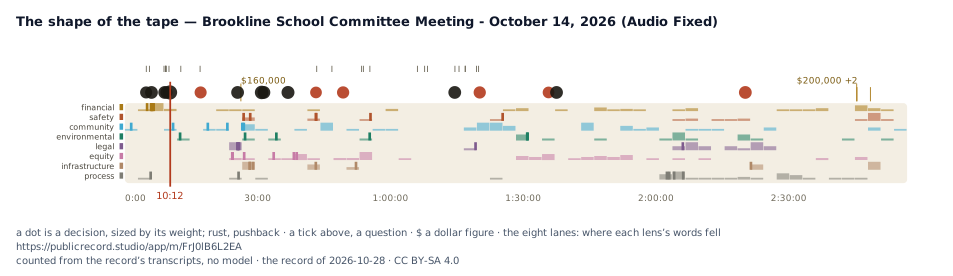
Cut from the analyzer’s scored moments — a measurement, not a choice made for you. Open a reel and press make this reel yours to re-cut it; tick any moment or transcript line below to cut your own.
During the meeting, the committee voted to approve the consent agenda [8:50] and authorized a special event alcohol license [9:58]. Members of the public voiced concerns regarding reduced middle school library access under new scheduling models [17:03], [20:39] and lighting impacts near the local golf course and residential areas [25:15]. The superintendent presented a report on educational insights from Estonia [32:21] alongside district strategic goals focused on equity, multi-tiered systems of support, and curriculum alignment [34:36], [39:41]. Presentations covered the Lawrence School improvement work [1:00:06] and the BEEP preschool program, whose school improvement plan was formally approved [1:43:31]. The committee evaluated proposed town meeting warrant articles regarding outdoor light pollution regulations [2:05:09] and recorded a vote on the matter [2:32:08]. In addition, the board voted to approve the upcoming budget guidelines [2:38:20] and passed a motion to remove outdated philosophy statements from the district policy manual [2:44:06]. Subcommittee updates addressed ongoing capital facilities and shade structure projects [2:45:22], [2:48:26] before the committee voted to enter executive session to discuss collective bargaining and litigation [2:56:10].
What it means: The meeting covered several town school district actions, including approving a prism grant for preschool literacy [5:01] [6:10] [9:23], granting a one-day license to serve alcohol at an annual school fundraiser [9:34] [9:43] [10:12], and adopting draft budget guidelines [2:34:49] [2:38:30]. District officials presented progress reports on district goals [34:32], school improvement plans for the Lawrence School [58:58] and the BEEP program [1:47:36], and details on light pollution bylaws under warrant articles 12 and 13 [2:02:29] [2:04:09]. The committee voted 5-4 in favor of recommending favorable action on the lighting warrant articles after evaluating potential impacts on school athletic scheduling [2:11:00] [2:32:29].
Who moved it: The session was hosted by members of the school committee [0:12], with presentations delivered by Superintendent Wong [32:02], school principals [58:32] [1:41:39], and local advisory representatives [2:03:35]. Motions were voted on by named committee members including Suzanne, Bob, Carolyn, Laura, Jesse, and Sarah [9:19] [9:23] [10:10] [10:12] [2:31:59] [2:32:29] [2:37:11] [2:38:30]. However, the transcript does not settle who explicitly initiated the oral motions for every individual agenda item [9:07] [2:29:20] [2:37:00].
What to watch: Residents and staff used public comment to raise concerns over recent middle school library schedule changes that limit student book access [17:08] [19:12] [21:14]. Ongoing items to monitor include the district development of a strategic equity plan [38:51], future evaluations of school grade configurations [38:08], construction updates on the Pierce school building project [2:46:23], and upcoming contract strategy discussions regarding the paraprofessional unit held in executive session [2:55:34].
Scored, not chosen for you — the salience bar is a measurement, and every moment is a receipt into the transcript below. With JavaScript on, tick moments to compose a reel — and tick moments on other meetings too; a reel can span the record.
→ the publish kit for this meeting — the clips worth cutting and draft copy, for a producer.
Counted, not modeled — each lens is a word list; drift compares the first half to the second.
the same, as a table
| word | mentions |
|---|---|
| school | 204 |
| students | 140 |
| work | 96 |
| high | 58 |
| last | 57 |
| schools | 56 |
| lawrence | 54 |
| part | 49 |
| little | 47 |
| middle | 41 |
| district | 40 |
| come | 39 |
| around | 39 |
| library | 39 |
| student | 38 |
| plan | 38 |
| years | 37 |
| goals | 36 |
| first | 35 |
| data | 35 |
| mtss | 34 |
| great | 33 |
| brooklyn | 33 |
| equity | 33 |
| terms | 32 |
| building | 31 |
| lighting | 31 |
| lights | 31 |
| much | 30 |
| education | 30 |
| different | 30 |
| goal | 30 |
| team | 29 |
| day | 28 |
| educators | 28 |
| teachers | 28 |
| grade | 28 |
| learning | 27 |
| already | 27 |
| instruction | 27 |
| special | 27 |
| math | 27 |
| curriculum | 26 |
| good | 26 |
| able | 26 |
| every | 25 |
| use | 25 |
| program | 25 |
| working | 25 |
| golf | 25 |
| thinking | 25 |
| impact | 25 |
| even | 24 |
| maybe | 24 |
| access | 24 |
| community | 23 |
| many | 23 |
| couple | 23 |
| council | 23 |
| philosophy | 23 |
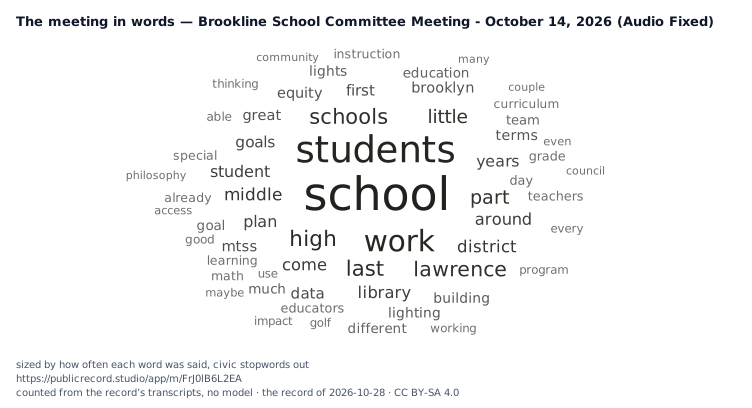
“school” came up 204 times. Sized by how often; civic stopwords out. With JavaScript off, a word opens the tape at its first mention.
0:12 Okay, welcome everybody to the October
0:15 14th, 2026
0:17 Brookline School Committee meeting. We
0:20 uh hope that this will be another
0:22 engaging and exciting meeting for
0:24 everybody here and in the in the
0:27 audience out there. U so welcome to the
0:30 school committee meeting. Um
0:32 we're obviously operating in our new to
0:35 intimate format here so we can talk to
0:38 each other more easily. Um and we're
0:40 going to begin as we have been beginning
0:42 each meeting with a moment of
0:44 inspiration and tonight's moment of
0:46 inspiration will be brought to you by
0:48 our vice chair Donna Perry.
0:52 Thank you Bob. Um,
0:55 for my moment of inspiration,
0:58 I want to go back almost 15 years to
1:01 when my kids and I were relatively new
1:03 to PSB.
1:05 Our principal at Lawrence was Rick
1:08 Rogers and our vice principal was Monica
1:11 Crowley. I remember Rick as a
1:14 soft-spoken man, an instructional
1:16 leader, an academic, a deep listener
1:20 with kind eyes. Rick was admired,
1:23 respected, and loved in the Lawrence
1:25 community. His leadership was powerful,
1:27 but not loud. It was rooted in
1:29 mentorship, relational trust, and
1:32 integrity.
1:34 Principal Rogers did many extraordinary
1:36 things, but I think his gift was his
1:38 innate ability to make every child in
1:40 that K8 building feel seen. I think
1:43 today we would call that belonging. For
1:46 Rick, it just seemed to come naturally
1:48 on every student's birthday. And I think
1:51 Sarah, and if Justin's still in the
1:52 room, he'll remember. Every student's
1:54 birthday, Rick would visit their
1:57 classroom and personally deliver a
1:59 handwritten card to them. Every single
2:01 student, every birthday, and the kids
2:04 waited for those cards, he made them
2:06 feel so important.
2:09 even when they were in trouble. If you
2:11 were sent to the principal's office, one
2:14 of the consequences might be losing your
2:16 free lunchtime, and instead you'd be
2:17 forced to spend it one-on-one with Mr.
2:20 Rogers.
2:22 One beautiful spring day, I happened to
2:24 be walking across an empty Lawrence
2:26 field around lunchtime when I saw Rick
2:29 come through the side door with a little
2:30 boy who couldn't have been more than six
2:32 or seven.
2:33 I immediately recognized what I'd come
2:35 to think of thanks to my own child as a
2:38 lunchtime discipline date. They walked
2:41 over to the track and I was several
2:43 hundred feet away so I couldn't hear
2:45 what Rick said, but I watched the little
2:47 boy nod eagerly and crouched down into a
2:49 sprinter's position while Rick looked at
2:51 his watch. And then the boy took off.
2:55 Rick stood there timing him, his eyes
2:57 moving between his watch and the little
2:58 boy as he ran his lap around the field.
3:02 When the boy crossed the imaginary
3:03 finish line, Rick gave him a high five
3:05 and then the two of them walked slowly
3:07 back towards the school, deep in
3:09 conversation.
3:11 I have remembered those moments for more
3:13 than a decade.
3:15 This was likely an interaction that
3:16 began with a little boy being sent to
3:18 the principal's office, maybe with
3:20 butterflies in his belly, worried about
3:22 what awaited. And somehow Rick turned it
3:25 into a moment of genuine connection.
3:28 There was no audience, no recognition,
3:30 just a principle in his child. And a few
3:33 minutes in which that child had his
3:35 principal's complete attention.
3:37 When I sat down to write my moment of
3:39 inspiration and thought about how to
3:41 describe it, I thought of a verse in
3:43 Proverbs from the Hebrew Bible about
3:46 righteousness, integrity, and what we
3:48 pass from one generation to the next. In
3:51 Hebrew it reads
3:54 a
3:56 righteous person walks in his integrity
3:59 and fortunate are his children after
4:01 him. I think sometimes people of
4:04 extraordinary character are recognized
4:06 not through grand acts but through the
4:08 small things they do when they think
4:10 they have when they have no idea anyone
4:12 is watching. Rick Rogers probably had
4:15 hundreds of moments like that with
4:17 hundreds of children. I happened to
4:19 witness one. How fortunate all those
4:21 children were to have been touched by
4:23 this extraordinary and yet ordinary man.
4:27 More than a decade later, I still
4:28 remember a little boy who likely
4:30 struggled in his classroom running
4:31 around the Lawrence field and a
4:33 principal standing there watching every
4:35 step. Thank you.
4:40 Thank you, Donna.
4:43 Next up, we have the Excuse me. Next up,
4:45 we have the consent agenda. Fairly long.
4:48 Are there any comments before we vote to
4:50 accept it consent agreement? Yes,
4:52 Carolyn.
4:53 Um I think I have a question and this is
4:56 bringing forward something that came up
4:58 in finance when we looked at that. Um so
5:01 in 2H the um prism grant for beep um
5:09 literacy
5:11 curriculum I think like study and
5:14 purchase. So um
5:18 I think there was just curiosity be
5:20 curiosity given that we've been engaged
5:23 in purchasing and rolling out a new
5:26 curriculum literacy curriculum just like
5:29 how does this align with
5:32 fish tank and that work?
5:38 Okay, great. Thank you.
5:40 Thank you Carolyn. Thank you Robin.
5:49 Hi. Um, so I I watched the subcommittee.
5:52 I know you had some questions about the
5:54 Prism 2 grant. So, this is sim we had a
5:57 similar grant for part of our fish tank
6:00 um adoption that supported some
6:02 professional learning and supported the
6:05 purchase of some of the materials. Um,
6:07 for this Prism 2 grant, it's specific to
6:10 um preschool. So it's only a preschool
6:14 grant. It's a in a preschool cohort. And
6:16 so what they are going through, they
6:18 already use some materials that are
6:20 aligned with what we use at the K8. Um
6:24 but they do not have they're looking
6:26 for, you know, to make a more robust
6:28 literacy curriculum for our our beep
6:30 students. Um so part of the grant funds
6:33 the work of the committee through their
6:36 se their selection. They are part of the
6:39 Massachusetts implement
6:42 um cohort for imp uh for for the um
6:46 selection for the investigate and
6:48 selection as well, but it's one that's
6:49 targeted again specifically to
6:51 preschool, but it follows the same
6:53 framework. Um so this fall they'll be
6:55 engaged in some vision setting with
6:57 their committee um which includes um a
7:01 number of stakeholders on educators.
7:04 around February, they'll be um reviewing
7:08 curriculum and beginning to look at
7:09 that. At that point, they'll also bring
7:10 in Kristen Gray, who's our K8 literacy
7:13 coordinator to help with that alignment
7:15 and also to be another member of that um
7:19 of that committee after they've created
7:20 their vision. Um really what they're
7:23 looking at, they are looking at
7:25 materials are based on playful learning.
7:27 So, it's it's age appropriate. It's it's
7:29 aimed at middle at preschool students.
7:31 Um it's really to provide tier one
7:33 instruction for all students involved
7:35 that are participate in BEEP. Um I think
7:37 one of the questions you had because it
7:39 does support the purchase um the
7:42 potential purchase of curricular
7:43 materials and it covers a portion of it.
7:45 So I think you asked the question around
7:46 like what would be the um what PSB would
7:50 have to contribute. Um my understanding
7:52 from talking with Margaret um our
7:54 principal and you'll hear from her
7:55 tonight as well for her school
7:56 improvement plan um potential to be f
8:00 what the the gap between what is funded
8:03 by the um grant and what might need to
8:06 be provided for purchase could
8:07 potentially be part of the paid for out
8:11 of the revolving fund. It may require
8:13 some thoughtful you know planning for us
8:15 as part of the budget process but that
8:18 um that's that it's it's a small amount.
8:21 It's really it's not as uh as large a
8:24 purchase obviously as a as a K8 literacy
8:27 program. We're talking about a much
8:28 smaller um ask from the from the get-go.
8:31 Um and the grant does cover a good
8:34 portion of that. So um it's to yeah so
8:37 it's to to support BEP with early
8:40 literacy to build on resources and align
8:42 with ones that we already have and also
8:45 bring coherence with the K8 selection.
8:48 Thank you Robin. Any other questions on
8:50 the consent agenda?
8:53 Is online?
8:58 If there are no further questions on the
8:59 consent agenda, I ask for a motion to
9:02 accept consent agenda. Suzanne makes the
9:05 motion. We have a second.
9:07 Second.
9:08 Jesse seconds it. Laura, how do you
9:10 vote?
9:10 Yes.
9:11 Have you vote?
9:13 Yes.
9:14 How do you vote?
9:15 Yes.
9:16 How do you vote?
9:16 Yes.
9:17 How do you vote?
9:18 Yes.
9:19 Suzanne,
9:20 yes.
9:21 Val,
9:22 yes.
9:23 Bob, yes. Unanimously approved the
9:25 consent agenda. Thank you very much.
9:28 Item number three. On November 5th, the
9:32 Brooklyn High School Innovation Fund
9:34 will have their annual Galorama
9:36 fundraiser at the high school. And so I
9:39 need to entertain a vote to authorize
9:41 Brooklyn High School, the innovation
9:43 fund to serve beer, wine, and hard
9:46 seltzers during the annual gayama on
9:49 November 5th. Um to be held in the STEM
9:52 wing lobby from 7 o'clock in the evening
9:55 until 10 o'clock in the evening. Do I
9:57 have a motion?
9:58 So move that. Jesse moves it.
10:00 Suzanne seconds it
10:07 yes.
10:08 Yes,
10:09 Sarah.
10:09 Yes,
10:10 Laura.
10:10 Yes,
10:11 Val.
10:12 Yes,
10:12 Bob. Yes. Unanimously approved.
10:14 Congratulations, Brooklyn High School.
10:16 Have an amazing gayama on the 5th of
10:19 November. Okay, moving right along.
10:22 Anukica, we have a student report. Let's
10:24 go.
10:26 Hi everyone. I hope everyone's doing
10:28 well. I think if you asked most of the
10:30 students at the high school, they would
10:32 say they're doing really busy. Um, but
10:35 we started off the month with our annual
10:37 back to school night, which was guided
10:39 by the Brooklyn High School Ambassadors
10:41 Program, which is the student body who
10:44 assists in helping parents find their
10:47 students classrooms and get to meet and
10:48 greet the teachers and also the advisory
10:52 junior and senior keepers acted as
10:55 guides during this night. It was really
10:57 great as I heard from my mom as well as
10:59 many of my teachers. Um, a couple other
11:03 things. uh the interim progress reports
11:05 were released on October 8th and that um
11:09 is a normal occurrence halfway through
11:11 each quarter and the only change is that
11:15 attendance this year has been slightly
11:16 shifted due to the new schedule. We have
11:19 longer class periods and as a result um
11:22 there is a lower quota for um the amount
11:25 of attendance that you have to fulfill.
11:27 Um, so you cannot be absent um as many
11:30 days as you could in the past and if you
11:32 did um exceed those absences that would
11:35 have been mentioned on your IPR. Um, as
11:40 for this week, we began the week with
11:41 the day off for Indigenous People's Day
11:44 and there was a celebration that was
11:45 hosted at FRR that several high school
11:48 students attended. Um, and this Saturday
11:51 at 7:45 a.m. there will be the PSAT
11:55 administered at the high school, which I
11:58 will be in attendance for. Um,
12:01 in other note, student government has
12:03 officially began its year at the high
12:05 school. With legislature, our student
12:07 and faculty branch hosting the elections
12:10 for a student and faculty chair as well
12:12 as student council elections being
12:14 completed. We now have a full student
12:16 council and will be proceeding with
12:19 student council business very soon. Um,
12:22 and lastly, on a very positive note for
12:25 both the staff and the students of the
12:26 high school, our studentr run
12:28 restaurant, the Tap and Green, is
12:30 officially in operation for the school
12:31 year. Thank you,
12:33 Anukica. Great job. Does anybody have
12:35 any questions for Anukica Banerjee, the
12:38 amazing student rep? We do have some
12:40 questions. Sarah,
12:42 mine's a comment. Um, I wanted to This
12:44 year when I went to back to school night
12:45 at the high school, there were a couple
12:47 of teachers that decided to not only
12:49 present who they were and their
12:50 backgrounds, but they also sort of
12:52 unveiled a little bit the way that they
12:54 teach by sharing something that they
12:56 taught with the parents and it really
12:58 felt to me like a highlevel conversation
13:01 about how they approach education and I
13:04 really enjoyed that. So,
13:06 thank you Sarah. Hi, Carolyn.
13:09 I just have to do my annual I love back
13:12 to school night. I guess this was my
13:14 seventh. Um, it's talk about
13:18 inspiration.
13:20 It's just amazing. Um, and my husband
13:24 feels the same way. We just leave
13:26 pinching ourselves saying, "How could we
13:29 be so lucky to be able to have our
13:34 children at a school with teachers who
13:36 are so dedicated, so smart,
13:40 so enthusiastic." Um
13:44 so love last one and I will also say a
13:48 couple of the teachers um commented
13:51 specifically that they are really liking
13:53 the 70inute period. They really are
13:56 feeling like that's giving them an
13:58 opportunity to like switch up what
14:00 they're doing really dig into the
14:03 material. Um so that was a positive note
14:06 too.
14:06 Thank you very much Laura.
14:09 As the mother of a ninth grader, this
14:11 was my first BHS back to school night.
14:13 And I want to echo what was said. I was
14:15 incredibly impressed by the passion and
14:18 intelligence of the educators, the the
14:21 care they put in into how well-run it
14:23 was. In addition to giving shoutouts to
14:26 high school for back to school night, I
14:28 also want to give shoutouts to our uh
14:30 middle schools that are also welcoming
14:32 parents in as well. I had the
14:34 opportunity to attend uh the parent open
14:37 house at Driscoll which was also it I
14:40 left feeling very confident about my
14:42 son's education and knowing that the
14:44 students were in very capable hands and
14:47 I think that was a really lovely thing
14:49 to be able to attend as well.
14:56 Monica, thank you so much for your
14:58 student report. I was hoping you might
15:00 um give some feedback on this on the new
15:02 six day schedule and if you feel like
15:04 you're falling into a routine and how
15:07 others are experiencing that.
15:09 Absolutely. So, I'll speak for myself. I
15:11 do really enjoy it. I think the idea of
15:13 having fewer classes in a day is really
15:16 beneficial, especially given the
15:17 homework load and that just allows
15:20 students who play sports and have other
15:21 extracurricular activities to balance
15:23 their life slightly better. I think the
15:25 key challenge is just planning out.
15:28 Normally you would say on Mondays I
15:29 would have this activity, on Tuesdays I
15:31 would have this activity. And the idea
15:33 of there being a day one through six
15:35 does challenge that slightly. And I
15:37 think for teachers as well, I've talked
15:38 to a couple and just being able to set
15:40 office hours and a consistent schedule.
15:43 I think that's the the main difficulty
15:46 with the schedule. But otherwise, people
15:47 are adjusting. And originally we they
15:51 tried to introduce brain breaks which is
15:54 a middle school concept that many of you
15:56 might be familiar with. Um and I think
15:59 we've slowly been weaned off of those.
16:00 So I think we're getting somewhere. But
16:03 yeah, overall pretty great.
16:05 Thank you.
16:07 Okay. I just want to say I I fondly
16:10 remember back to school night at
16:11 Brooklyn High School and when we were
16:13 lucky enough to have the Red Sox in the
16:15 playoffs during that time. You know, the
16:18 format is the parents come and they
16:20 follow their students schedules
16:22 throughout the throughout the night and
16:24 during passing time I would announce the
16:26 Red Sox scores
16:28 and cheer the Red Sox on when they were
16:31 doing really well. Anyway, thank you
16:33 Anukica very
16:36 Okay. Public comment. We have four four
16:40 people making public comment tonight.
16:42 You have three minutes. Betsy is the
16:44 timekeeper. She's brutal.
16:47 So t take your take your three minutes
16:51 and let's get going.
16:52 Uh Yasm mean Sharief, you're first. Hold
16:56 it right up.
16:57 Hold it right up. Okay. Good evening.
16:59 How are you? Uh, my name is Yasmine
17:02 Sharief and I'm a sixth grade teacher at
17:03 Baker School and I'm here to share my
17:06 concerns about how recent changes to the
17:08 library program are affecting our middle
17:10 school students and their access to
17:11 books. In previous years, sixth graders
17:14 had a bi-weekly library period that
17:16 included a short lesson and an
17:17 opportunities to select books. Between
17:20 scheduled visits, students could also
17:22 stop by the library during the school
17:23 day as their schedules allowed to return
17:25 or exchange books. Last year, our sixth
17:28 graders checked out more books than any
17:30 other grade at Baker School. Many of our
17:33 students are enthusiastic, voracious
17:35 readers who genuinely love books.
17:37 Fostering that enthusiasm is something
17:39 we should be actively encouraging,
17:41 especially as students get older and
17:43 develop lifelong reading habits. Within
17:45 days of the school year beginning, my
17:47 new group of sixth graders were already
17:49 eagerly asking when they could go to the
17:51 library to get new books. I had to
17:53 explain that access to the library would
17:55 look very different this year. Under the
17:57 current program, there are no
17:58 opportunities for students to
18:00 independently visit the library during
18:01 the school day to select or exchange
18:03 books. Instead, they will have access to
18:05 the library just 15 times over the
18:08 entire school year. For many students,
18:10 this is a significant disappointment and
18:12 a real barrier to their reading habits.
18:14 Some devour books at a rate of one per
18:16 day, meaning they may finish several
18:18 books. Oh, sorry. My phone just rang and
18:21 then it disappeared. Oh no, my time.
18:23 Hold on.
18:25 um
18:27 instead they will have access to type
18:29 15. Okay. For many students is a
18:31 significant disappointment and a real
18:32 barrier to their reading habits. Oh no,
18:34 I read that. Shoot. Hold on. Although
18:36 the library is open for 10 minutes
18:37 before school and 10 minutes after
18:39 dismissal, these brief windows are not
18:40 practical for many middle schoolers who
18:42 need time to prepare for the school day
18:44 or have family responsibilities and
18:45 other commitments after school. These
18:47 limited hours are not an adequate
18:49 substitute for access during the school
18:51 day. The school committee policy itself
18:53 supports the importance of providing
18:55 students with flexible needs-based
18:56 access to library resources. With only
18:59 15 20-minute periods available to my
19:01 sixth graders for this entire school
19:03 year, they should at minimum be
19:05 permitted to visit the library during
19:07 the school day to return books and
19:08 select new ones when they finish
19:10 reading, provided their schedules allow.
19:12 Unfortunately, due to changes in the
19:14 library program this year, this is not
19:15 possible. At a time when children are
19:18 spending increasing amounts of time on
19:19 technology and screens, we should be
19:21 creating more opportunities for them to
19:23 engage with books, not fewer. Unlike
19:25 many elementary classrooms, middle
19:27 school classrooms typically do not have
19:29 extensive classroom libraries. For many
19:31 students, the school library is their
19:33 primary source of books, and restricting
19:35 access makes it harder for them to
19:37 sustain their reading habits. If our
19:39 goal is to foster a schoolwide culture
19:41 of reading, reducing access to books,
19:43 particularly for students who are
19:45 motivated and eager to read, is
19:46 counterproductive, a more flexible
19:49 library schedule would also benefit
19:50 teachers and students who need library
19:52 resources for research assignments and
19:54 special projects. I respectfully ask
19:57 that the current library program be
19:58 reconsidered and that middle school
20:00 students at minimum be given
20:01 opportunities to access the library
20:03 during the school day on an asneeded
20:05 basis. Our students have demonstrated
20:07 that they want to read and we should do
20:09 everything we can to support their
20:10 interest by ensuring they have
20:12 meaningful, consistent access to books.
20:14 Thank you for your time and
20:14 consideration.
20:18 Thank you.
20:20 Next up,
20:22 Amanda.
20:25 Hi, Amanda.
20:31 Good evening. My name is Amanda
20:33 Crutchmar and I am here speaking tonight
20:36 on behalf of our K8 school librarians. I
20:39 have been the Pierce K8 school librarian
20:42 for the past 17 years. Just one year
20:45 ago, I stood up here as your Caverly
20:48 Award-winning teacher. I spoke of the
20:50 power of books, the joy and
20:52 effectiveness of true collaboration
20:54 between school librarians and teachers,
20:57 and the value of our school libraries as
20:59 the hearts of our schools.
21:01 Unfortunately, I am standing here
21:03 tonight just one year later, reeling
21:06 from the cuts that were made last year
21:08 to our educational technology teachers,
21:11 our high school librarian, and the 50%
21:14 budget cuts to our school libraries.
21:17 Now, I am asking you to reconsider our
21:20 district's decision to use our K8 school
21:23 libraries as K8 teacher drop off
21:25 specials like art, music, or PE. This K5
21:30 dropoff model will not only deprive
21:33 students of their access to information
21:35 and books, but erode our schools
21:37 cultures of reading that the public
21:39 schools of Brooklyn has always valued.
21:42 Historically, our school libraries have
21:44 had flexible schedules where teachers
21:47 attended library class with their
21:48 students so we can collaborate, co-e,
21:51 provide readers guidance together with
21:53 the teachers knowledge of student needs
21:56 and the librarian's knowledge of books.
21:58 Students could come to the library
22:00 whenever they needed a book, even when
22:01 we were teaching a class since there was
22:04 always multiple adults in that space to
22:07 assist.
22:09 We could reschedule missed classes,
22:11 manage our fabulous collections, and
22:12 developing program develop programming
22:14 and instruction based on student and
22:17 teacher needs. This flexibility is what
22:20 made our school library programs so
22:22 successful. We were told that this
22:24 disruptive change to our school library
22:26 programs was due to the need for the
22:28 implementation of the multi-tered system
22:30 of supports model known as MTSS.
22:33 The district's response to DESIE
22:35 directives instead of thoughtfully
22:38 strategizing how to find time for
22:40 teachers to do this work, hiring
22:42 additional staff to implement this model
22:44 effectively or implementing a slow roll
22:47 out to determine the value of this
22:48 model. The district has instead rushed
22:51 through a major shift in our already
22:53 understaffed and underfunded K8 school
22:55 libraries
22:57 without even officially telling us.
23:00 There were no department meetings where
23:03 we could strategize there plan a
23:06 schedule that made sense that could work
23:09 well. None of that. Our neighboring
23:12 school districts who use this model of
23:14 library as a drop off schedule are K5
23:18 schools with separate middle school
23:20 buildings that have full-time certified
23:21 school librarians and flexibly scheduled
23:24 library programs in Brooklyn. in this
23:26 fixed drop off model will not only take
23:29 away from all K8 students ability to
23:31 access library resources on an asneeded
23:34 basis, but it'll obliterate our middle
23:37 school library programs since the focus
23:39 has to be on those K5 fixed classes.
23:43 While most of our schools have multiple
23:45 art, music, and PE teachers to provide
23:47 services to all KA classes, we continue
23:50 to be the only school librarian in each
23:52 building. Whether our enrollment is at
23:55 400 or 900, teaching all KA classes,
23:58 working with every teacher, managing our
24:00 wonderful school libraries, that are
24:02 resources for all becomes impossible.
24:06 Decades of research across more than 30
24:08 states links strong library programs to
24:11 higher reading and math and writing
24:13 scores with the largest benefits for
24:16 low-income students, English language
24:18 learners, and students from historically
24:20 marginalized identities. Those are the
24:23 very groups this district has publicly
24:25 committed to serving better. The drop
24:28 off model removes every one of those
24:29 researchbacked ingredients at once in
24:32 exchange for a cheap scheduling
24:34 convenience.
24:36 I understand the goal. Teachers need
24:38 time to review data and the district
24:40 wants instructional consistency. Those
24:43 are legitimate goals, but this
24:45 particular solution was designed for a
24:47 district structure that we don't have.
24:51 And it quietly closes the school library
24:53 to the students who need it most. THANK
24:56 YOU.
25:03 THANK YOU, AMANDA. NEXT,
25:07 Eric Liano.
25:15 Uh, good evening. Uh my name is Eric
25:17 Lauraniano and I live next to Potterham
25:20 uh golf course and I want to speak a
25:22 little bit aside from education about
25:25 the proposed lighting bylaw coming up
25:27 for a vote. The proposed lighting bylaw
25:30 specifically names Potterham and
25:32 Potterham Woods as sensitive areas and
25:35 where lighting will not be permitted.
25:38 We're asking the school committee and
25:40 town meeting members to request an
25:41 amendment to the bylaw to remove
25:44 Potterham and Potterham Woods from that
25:46 list or vote no on the proposal
25:49 altogether. As written, the bylaws will
25:51 pre prevent Potterham from adding
25:54 compliant shielded uh lights to the
25:57 driving range. Without these lights, the
25:59 driving range cannot operate during the
26:02 fall and the spring days of daylight
26:04 savings time. It just gets dark very
26:06 very early. We can't operate from 4 to
26:09 about 8:00 p.m. at night. Those few
26:13 hours will mean about $160,000
26:16 in lost revenue to the golf course,
26:20 which is important to maintain and
26:22 improve the golf course. But is more
26:25 than just golf. We have October Fest. We
26:28 offer a spring festival. We do uh movies
26:31 for families on the fairway. We um also
26:35 have um concerts and many other
26:38 activities. Uh not to mention Potterham
26:40 Woods, which is a great walking trail.
26:43 The driving range and golf course
26:45 welcomes people from everywhere. I've
26:47 met people there who are retirees,
26:49 firefighters, police officers, students,
26:52 uh kids from the neighborhood, dads and
26:55 moms with their kids. It's just a great
26:57 diverse place and we need places like
27:00 this in the growing uh communities of
27:03 Brooklyn and I think it's so important.
27:06 We do have to be aware of the
27:08 environment and sensitive to uh wild uh
27:12 to wildlife. The proposed lights are
27:14 very modern. They're very limited in
27:17 where they shine. They will be directed
27:20 directly on the um driving range. So
27:24 they're not going to be lighting up and
27:26 they're going to be very very minimal
27:28 where the golfer stands and up to 150
27:31 yards where they can see the ball
27:33 flight. Beyond that there will be no
27:35 lights and the driving range is 250
27:38 yards. All of that other area will be
27:41 entirely dark. I have here a map that I
27:46 um gave to the committee where it shows
27:49 that Putterham is not itself a wetland.
27:53 There are several small wetland in and
27:57 around Putterham and those orange areas
28:00 there are the ones that are wetlands.
28:04 This map also shows that there will be
28:08 lights added to West Roxbury Parkway to
28:11 light the new bike path and road. Um,
28:15 also we have lights across the street um
28:18 at night at Skyline Park. The fire
28:21 station is lighted. The parking lot for
28:24 Potterham is lighted. There is a deck in
28:28 the patio that is lighted. The public
28:31 works building is lighted. So we think
28:34 we can just add a little bit of lighting
28:36 to the beginning of the driving range so
28:38 that Potterham can continue to flourish.
28:41 Thank you very much.
28:44 Thank you. Next up,
28:49 Andrew Porter, please.
28:56 Good evening. My name is Andrew Porter.
28:59 I live on Waverly Street and my daughter
29:01 Sophia attends Driscoll. I'm here today
29:03 to ask you to reinstate a flexible
29:05 schedule at the Driscoll Library that
29:07 affords middle schoolers the opportunity
29:09 to visit the library throughout the day
29:11 throughout the week. I understand that
29:13 K5 teachers need planning time, but
29:15 meeting this requirement should not
29:16 compromise Driscoll Middle School
29:18 library access or special programs. This
29:20 is the second year I have volunteered
29:22 weekly in the library and I am
29:24 witnessing the effects of the current
29:25 policy. What was once a community space
29:28 is now a room with books in it that
29:29 students must now enter like any other
29:31 classroom. I grew up in Florida in a
29:34 working-class family with a father and a
29:36 big brother who both failed fourth grade
29:43 and a grandfather who held only a sixth
29:46 grade education, which is the grade my
29:48 daughter Sophia is now enrolled in. At
29:50 Driscoll,
29:52 I knew that if I was going to get out of
29:53 Florida, education would be my way out.
29:56 My high school did not offer an advanced
29:58 placement curriculum. So, when I entered
30:00 11th grade, I made an arrangement with
30:02 my teachers. Instead of attending class,
30:04 I went to the school's library and
30:06 taught myself AP.
30:09 Sorry, sorry.
30:12 I scored high on three tests, went to
30:14 college and graduate school, and now my
30:15 daughter Sophia attends Driscoll. If my
30:18 school had a policy like the one now in
30:20 place at Driscoll, I and my daughter
30:22 Sophia would not be here. I know the
30:25 comparison is not exact, but the stakes,
30:27 I would argue, are no lower for our
30:28 middle schoolers. Middle school means
30:31 more independence and responsibility.
30:33 Restricting library access robs
30:35 Driscoll's middle schoolers of a space
30:36 to exercise that newfound freedom and to
30:39 access that part of learning that is not
30:40 about instruction and fact retention,
30:42 but curiosity and discovery. Driscoll
30:46 students need an open library in a way
30:47 that your spreadsheets and schedules
30:49 cannot quantify or capture. An example
30:51 of the loss that results from the
30:53 recently adopted schedule is the end of
30:55 the library's participation in the Zoo
30:57 New England hatchling turtle program.
30:59 For the last two years, Driscoll
31:01 students had the awesome responsibility
31:03 of raising
31:05 threatened turtles over the course of
31:06 the school year. The Turtles brought
31:09 together students from across the
31:10 student body. From kindergarteners to
31:12 almost freshmen, from avid readers to
31:14 self-p profofessed non-readers, with the
31:16 library serving as the nexus for this
31:18 shared obsession with these tiny,
31:19 adorable, utterly dependent creatures.
31:22 If you want to understand what you lose
31:24 when you adopt a fixed schedule for the
31:25 library, the next time you see a
31:27 Driscoll dragon, ask them about the
31:29 turtles.
31:31 A school library should be open always
31:33 for everyone. The current fixed schedule
31:35 means that this is not the case,
31:37 especially for Driscoll's middle
31:38 schoolers, and I urge you to find a way
31:40 to correct that. Thank you for hearing
31:42 from me. Good luck.
31:51 Thank you very much. That concludes
31:52 public comment for tonight. Next up,
31:56 exactly on time, 6:40 according to the
31:58 agenda,
32:00 Superintendent Bella Wong will have her
32:02 superintendent report. Thank you.
32:04 Pressure pressure to stay on time.
32:07 Anyway, thank you. Um so I want to thank
32:11 the committee um for for
32:15 approving um last week's leave to be
32:18 able to go to Helsinki um Talon and
32:21 Tartu. So I returned um from Estonia on
32:26 Monday evening and so this is probably
32:29 my 12th experience of being part of an
32:32 educator tour to other places to visit
32:35 for the purpose of visiting schools.
32:37 This is the fourth tour that I've led
32:40 and um and so we we spent some time in
32:43 in Helsinki. We visited two schools
32:46 there, one school in Talon and then
32:48 three schools in Tu. Well in T we were
32:52 25 kilometers from the Russian border.
32:55 Um, Finland also has the largest shared
32:58 border of any other European country
33:00 with Russia and so geopolitically it's a
33:03 very interesting place to be and to
33:06 visit. Um, we had 18 educators visiting
33:11 the schools and I feel we had some
33:13 really important takeaways a very
33:15 productive trip um just and so Finland
33:20 has been known for their PISA scores.
33:22 They're not as high as they were before,
33:24 but interesting with Finland, they never
33:26 thought it was about their PISA scores.
33:29 Um, what's appealing about Finland is um
33:32 the schools across the country have very
33:35 narrow gaps from each other. So, they
33:37 have this equity across the way. Um, and
33:40 there's a strong focus on students,
33:42 whole child and support, social
33:44 emotional supports. Um, es and also in
33:47 Estonia. Estonia interesting is now one
33:51 and two in their PISO scores. Um they
33:54 are ahead of us in technology and the um
33:59 we learned we were exposed to a lot of
34:01 frameworks about AI that might be
34:03 helpful for us and um and also their
34:07 personalization their strong sense of
34:09 social emotional supports and their
34:11 focus on students being able to be
34:13 comfortable in their environment and
34:16 thriving. We also visited so we visited
34:18 K12 schools and vocational schools. So,
34:22 um hopefully we might be able to share
34:25 some of those takeaways later al
34:26 together.
34:28 Um the other thing I'd wanted so I was
34:32 asked to update on where we are on my
34:34 superintendent's goals. Betsy might be
34:36 able to put the goals up on the screen.
34:39 Thank you. And so just as um just as a
34:42 reminder. So the first was the is the
34:45 student learning goal decreases
34:46 disproportionality for PSB students. to
34:49 no longer be identified by Dussy as dis
34:53 disproportionate. And so that is tied um
34:56 to our our goals around MTSS.
35:00 So MTSS launched last year but really
35:03 more robustly this year and across the
35:06 K5 and also um also in our middle
35:10 school. And so where we are right now is
35:12 that all these schools have their MTSS
35:15 teams. Um there have been a couple
35:17 faculty meetings focused on the
35:19 implementation of MTSS.
35:22 I would say just about now teachers are
35:25 being able to look at um data um al
35:29 together. So it took a little while for
35:31 us to um get our systems up and rolling
35:34 to be able to do that. I think next year
35:36 we'll be able to start sooner but I
35:38 would say it wasn't until October that
35:39 we were be able to really have the data
35:41 to look at. Um so that's where we are
35:44 right now. Um I've talked with the
35:48 leadership team about making sure we
35:50 establish our base metrics um to be able
35:53 to measure growth and so to select what
35:56 what metrics that we'll be looking at.
35:58 The second goal professional practice
36:01 goal was is working towards achieving
36:04 100% evaluation of all unit AB and
36:07 unaligned administrators to sustain high
36:10 quality instruction
36:12 um and implement an evaluation system
36:14 for professionals. This work actually
36:17 began um in the summer and um as the
36:22 district review report notes that when
36:24 Robin presented at the last meeting um
36:28 the district had been on the 2012
36:31 rubrics for teacher evaluation and so
36:34 through the summer um and also in
36:36 communication with um the leadership we
36:40 asked if maybe we could look at the 2024
36:43 standards but um narrowing and focusing
36:46 on the critical indicators that we
36:49 wanted everyone to focus on as opposed
36:51 to just adopting all of the all of the
36:54 um 2024 standards and we picked the ones
36:58 that were tailored to support our work
37:00 around MTSS and supporting high quality
37:03 instruction. Um so I am very
37:07 appreciative in the communication we had
37:09 with principles and all our
37:11 administrators and also with the
37:13 leadership to support
37:16 to 2024 standards. So we are well
37:20 underway on that. At this time is when
37:22 educators are doing their self
37:25 assessments to pick their goals for the
37:27 year. So they also will be picking
37:29 professional goals, student learning
37:31 goal and also other goals that they
37:33 might that will be aligned to the SIPs
37:37 of which you're going to hear two
37:39 tonight and you're going to hear more of
37:41 that um reports on the SIPs through
37:43 December.
37:45 um to align with the SIPs which are also
37:48 aligned with our priority district goals
37:50 which are aligned actually with the
37:52 goals that I set out um for um 26 27. So
37:57 I think we we've made um a really good
37:59 start and we're well underway on that
38:02 goal.
38:04 The other so then there are four
38:06 district improvement goals. The first
38:08 one evaluating the grade configurations
38:10 to improve scheduling and staff equity
38:12 across the K8 schools. You will receive
38:16 an enrollment report um in no I could be
38:20 the end of October or the start of
38:22 November. We we're still working on that
38:24 timing. Once we have our enrollment set,
38:27 we will we will lean into looking at the
38:31 great configurations moving forward. Um
38:34 so that's that's where that is. So,
38:36 we're just waiting for enrollment
38:38 numbers updated and then we'll So, we
38:40 haven't started looking, we haven't done
38:42 any work looking at grade configurations
38:46 um yet. The next district improvement
38:49 goal is establish equity leadership team
38:51 and develop a strategic equity plan is
38:54 required by the state. Um so, the state
38:59 um has had a diversity educator act, but
39:02 it's been updated to be the leads act
39:06 and that was um signed in
39:11 I should say so it's not this year but
39:13 actually before this year and part of
39:15 the there are many parts to the leads
39:18 act and one part is to ensure that every
39:22 district has a plan for recruiting
39:25 hiring retaining um diversity of staff
39:30 um within the schools and so that has
39:34 also So um been extended to make sure
39:38 that there is training for to ensure
39:41 cultural proficiency um for staff and
39:44 also it is now just generally being
39:47 expanded to ensure that we have um
39:51 practices of antibbias and um to support
39:56 belonging and inclusion in our schools.
39:59 And where we are on on this is um over
40:05 the summer just to determining how we
40:07 were going to build the plan. And um the
40:10 state requires that you either have a
40:14 DEI officer or you have a team
40:16 designated. The SLT senior leadership
40:19 team is assuming the responsibility of
40:21 being that equity team. So it's on top
40:24 of the other things that we're doing for
40:26 the districts. Um we also engaged um
40:31 Disa Am Jackson to be um consultant with
40:36 us in building this and so she actually
40:39 worked um with us and was introduced to
40:42 the administrators on August 28th. So
40:45 the admin the larger group of
40:46 administrators so between 60 and 70
40:49 educators for the district and um so
40:52 we'll be working with her on creating
40:54 the plan. So that's where we're at where
40:56 we um have identified this as a priority
41:00 goal and they have engaged with a
41:03 consultant who will be working with us.
41:05 The next step is the selection of a
41:08 screening committee um that will work
41:11 with SLT and also just laying out some
41:14 of the professional development. We have
41:16 already done some professional DMA
41:19 development during the summer
41:20 particularly on the August 28th date and
41:22 we have also plans for the PD day um for
41:26 in November and um and so we just and
41:30 then we also continue to be a member of
41:33 ideas and so there's a conference coming
41:35 up and actually we're really excited
41:38 because um when we've made the offerings
41:40 the number of people who are asking to
41:43 be um part of the that are offered
41:46 through ideas has exceeded the a lotment
41:49 that we had set aside. So, we're going
41:50 to see if we can do some more funding um
41:53 through our title two grant. So, but
41:55 that's great because we we were within
41:59 our spots last year and we've exceeded
42:01 just for the interest um in the
42:03 district. So, so that's where we stand
42:06 on on um district improvement goal
42:09 number two. The third district
42:12 improvement goal was a placeholder to
42:15 address concerns identified by the
42:16 district curriculum assessment report,
42:18 the district review report which Robin
42:21 presented. And so they highlighted for
42:23 us concerns around supervision
42:25 evaluation
42:27 um development of a articulating a
42:30 professional development plan um also
42:33 MTSS
42:35 and the development of an equity plan.
42:37 So actually those things were already
42:38 incorporated in the goals and the
42:40 priorities that we had set for
42:42 ourselves. I do want to say that even
42:44 though MTSS is encouraged by the
42:48 district report, we actually believe in
42:51 the premise of MTSS and what it wants to
42:54 do. It's not merely a mandate. It's
42:56 something that we endorse as good for
42:58 all students in the district. The fourth
43:01 district improvement goal was sort of a
43:04 compendium.
43:06 about related to use of facilities,
43:08 maintenance and repairs, work order
43:10 systems, emergency response, security
43:12 and safety and transportation practices.
43:15 So there are bits and pieces of this
43:17 that we've been addressing. Um so I
43:20 checked in with um is it Anakah? Anukica
43:25 Anukica because the high school had a
43:27 major
43:28 yes evacuation drill and so the district
43:33 really wasn't doing the drills um last
43:36 year and we started doing them last
43:38 year. Um the high school is is our most
43:41 complex evacuation drill. Um there are
43:44 several buildings that are involved and
43:47 um and the area is quite tight and so I
43:50 know I don't know if they timed your
43:53 evacuation drill.
43:55 Okay. So that's kind of a thing where we
43:57 do we time and see how we got everyone
44:00 out. So um anyway, so so I'm really glad
44:03 to hear that. I heard it went well and
44:05 that there were also some takeaways. So
44:07 doing the drills is really important
44:09 because you find out obstacles to
44:12 getting out of the building and how how
44:14 you deal with that. Um so that so I just
44:17 want to give kudos to um Joe Albuquerque
44:21 who's been lead working with the town
44:23 and working with um each of our schools
44:25 and in improving our drills and
44:27 evacuation.
44:29 Um so we are still in evaluation process
44:33 um related to the use of the facilities
44:36 um just just um collecting information
44:40 about who's using the buildings, whether
44:41 they're renting the buildings or they're
44:43 not renting the buildings, but they're
44:45 in the buildings. So that's still in
44:47 process, the collection of that data. Um
44:51 and I I think that's that's just where
44:53 we stand right now. So, so even though I
44:56 guess we're we're in the second month of
44:57 school and so I think making good
45:00 progress. Um the other thing I just
45:03 wanted to highlight before um going on
45:07 to the next topic is we did send out um
45:12 a school calendar survey or a survey on
45:14 school calendar. It went out to all our
45:16 families and it's gone out to all our
45:18 staff. That survey will close on Monday
45:22 and so we'll send another reminder out
45:24 um on on the school calendar. And so
45:27 we're seeking input on what we will
45:29 recommend for the year forward and for
45:32 for years after that. um
45:37 just and so
45:40 I I I think it's okay to share um
45:45 very early even on the weekend we had
45:48 already achieved 50% rate of return from
45:51 staff and so we're going to hopefully
45:54 get more and more but that actually is a
45:56 really positive beginning and um for
46:00 families it was um at 17% on the weekend
46:04 which may sound low but actually for
46:06 family surveys that sometimes 70% is
46:10 where you are at the end. So there's
46:12 high interest and so my saying this is
46:14 to encourage everyone who got a link to
46:17 to do that survey. It's really important
46:20 I think um school calendars are
46:22 different by community and it should
46:24 reflect um input from the community on
46:28 um on that. And that's it for my report
46:33 today.
46:34 Thank you.
46:34 I don't know if you have questions.
46:36 Oh, questions. Sarah,
46:39 are we open to discussing the um goals
46:42 or do we want to kind of is that a
46:44 presentation this time and we'll discuss
46:46 them more later?
46:48 I think it was an update. So, it's just
46:51 giving you a snapshot, but definitely I
46:53 don't
46:53 at a later date we'll have more of a
46:55 discussion.
46:56 I I don't think it precludes a
46:58 discussion. I'm guess I'm looking to the
46:59 chair. It's an update and you can
47:02 Tonight was an update and of course
47:05 there are possible questions that you
47:07 might want.
47:09 I would go. Okay. All right. Um the
47:12 first one isn't really about you. It's
47:14 just about any new superintendent. Um
47:17 I'm surprised in the setting of goals
47:19 not to see a real emphasis on getting
47:22 out into schools. And so I would love to
47:24 I think that your your goals are great
47:25 as they are. I would love you to flesh
47:28 out in some way um you know more time
47:31 with people in the buildings to know the
47:33 programs to know the educators to
47:35 especially know the K to8 um buildings.
47:38 Absolutely. So these are the goals that
47:39 were presented in June at a group by
47:42 school committee um but I am I've
47:44 actually cycling into two schools a week
47:47 right
47:47 and so I'm cycling through schools I
47:50 think I'm actually starting my second
47:52 round already.
47:53 Okay. So I guess what I'm saying is I
47:55 would love to see that somewhere written
47:57 in just because I think it's so
47:59 important is is knowing the schools. But
48:02 um but we're not updating these at this
48:04 point. So maybe maybe my
48:06 but I guess I'm saying that actually
48:07 that that I'm that goal of yours.
48:10 Yes, it's happening and and and sort of
48:13 I don't know if it's um it should just
48:16 be part of regular practice and so last
48:19 year was difficult for me um to get out
48:21 into schools and so um
48:25 last year was just difficult. Yeah.
48:27 And so it should be actually part of
48:29 one's regular practice. So again, I'm
48:32 already starting the second cycle.
48:34 That's great.
48:35 Yeah. I had I had more. Um I was also
48:38 wondering um when I hear you speak about
48:42 so where you said evaluation of grade
48:43 configuration to improve scheduling and
48:45 staff equity across the K8 schools. I
48:48 feel like as I hear you talk in these
48:50 meetings that idea has um become more
48:54 and more about the overenrollment of our
48:56 largest K to8 school and so I wondered
48:59 if that might be something to rewrite at
49:01 some point is it seems to be a goal of
49:04 yours to address.
49:06 Um it is not the primary reason for for
49:12 that goal.
49:13 Okay. Um when I arrived when I arrived
49:16 in Brooklyn, there had been a middle
49:18 school study on the concern about the 8
49:22 to9 transition
49:24 um that students in the 8 to9 transition
49:27 were getting different minutes of
49:29 instruction per subject. And so that's
49:32 really what that is addressing. Um
49:36 we have 8K8 schools and we have schools
49:39 that are sectioned from two to five and
49:43 um practically speaking when we allocate
49:45 staffing particularly around specials
49:48 it's really challenging to um
49:52 it's really challenging to schedule them
49:54 across schools in a in a way that's
49:56 equitable. And it's fair that when
49:59 teachers need to go from one school to
50:02 another that there hasn't been allowance
50:05 for travel. So I don't know if people
50:06 realize it's a generally a 0.1 FTE. So
50:10 if a teacher is already scheduled
50:13 to point 8 and they need and they it's
50:17 they almost can't travel because by the
50:19 time they get to the other school the
50:21 allocation of time they can teach is is
50:24 not what is needed. So then we have
50:26 teachers who are assigned.8
50:29 but they are 1.0
50:31 And that's not necessarily fair across
50:36 all staff that situation. So um and then
50:41 also the way scheduling is happening
50:43 when students graduate
50:46 from grade eight and enter grade nine
50:48 the difference of minutes. So it's so
50:50 they're looking is there a way we can
50:53 look at our grade configurations to
50:55 alleviate that disparity when we go to
50:58 89.
51:00 It's not about one one school. It's
51:02 about how all the schools the the
51:05 allocation of minutes
51:08 are are different.
51:10 Understood.
51:11 Yeah. But it's good to ask the question.
51:15 Yeah.
51:19 Thank you. Just super quick. when we did
51:21 the um when we pushed out the calendar
51:24 survey, I just want to ensure it went
51:26 out to out of district families because
51:27 I know sometimes
51:30 they're not always that there's certain
51:32 hiccups in in some of our um platforms
51:35 and pushing information out to them.
51:38 Absolutely. I'll have to double check
51:41 um because it would affect it would
51:43 affect them as well.
51:47 Suzanne,
51:48 thank you. Thank you, Bella. I wonder if
51:50 Belle if you could just spend a few
51:51 minutes talking about the work that you
51:53 envision for Denisa and the equity plan.
51:56 Um can you tell me a little bit about
51:58 what what her goals might be or what
52:00 your goals with her are or what's the
52:03 work?
52:04 So we so administratively we're lean I
52:08 so we have three deputies and and myself
52:12 and then there's not that much
52:13 infrastructure in the next level. So um
52:18 having engaging Darnisa is to help
52:21 supplement
52:22 um and based on her experience with
52:24 other districts and her work. So she is
52:27 ex she's been part of she's has been and
52:30 still part of Harvard Graduate School of
52:32 Education. She's been part of different
52:35 um
52:37 means of organization to work with
52:39 schools. She has um she's worked with
52:41 the MECO program. She's presented to the
52:44 superintendent through the MASS
52:46 conference several times. Um, and so and
52:50 she's worked with other districts. I
52:52 have known her over time. So we're
52:54 somewhat familiar. I she actually was
52:57 she actually had a contact with NATC. So
53:00 when I was in NATC, I got to work with
53:01 Disa then. Um, so it's really having her
53:06 pulling us to like a to to start to
53:10 finish and um and then also consulting
53:15 with our steering committee on ideas
53:18 around how to do training and um
53:21 challenges, overcoming obstacles,
53:24 getting like how do you how do you get
53:27 people to be able to do this with
53:29 limited time on on other things?
53:33 But it's really leaning in on her
53:36 experience.
53:40 So I have worked with her in the past as
53:42 well. Um and uh but that was a while
53:45 ago. So I don't I don't quite know where
53:47 she is today in her thinking. And is it
53:49 a a lot around cultural competence or
53:52 we're
53:53 going beyond that now?
53:54 No, she so um when she presented at MIS
54:00 um her focus is academic.
54:03 Okay.
54:03 And so driving educational equity
54:06 through academics.
54:08 Um so she so she in with in terms of um
54:12 inclusion and belonging she would say
54:15 that diversity, inclusion and belonging
54:18 are building blocks to equity that you
54:21 have to master those building blocks to
54:23 be able to achieve equity. And so I
54:25 really like the idea that she considers
54:27 building toward equity a developmental
54:29 process like organ
54:32 And um so sometimes I think
54:35 it can be it's like sort of um one time
54:39 things and so she really emphasizes um
54:45 how these are discrete things that you
54:46 need to master to be able to get to
54:48 equity. Where she's where she has now
54:52 evolved um with that still in place is
54:56 saying that um
54:59 tiered intervention supports must be in
55:02 place. So, MTSS, but she also advocates
55:05 for UDL,
55:07 yes, universal design. And so, she leads
55:11 with um making sure that all students
55:14 are getting what they need academically
55:17 within
55:18 an environment that's culturally
55:20 supportive, right? So, she leads with
55:24 the academic part um but also within
55:29 student doesn't feel safe to learn,
55:31 they're not going to learn as well. But
55:33 she feels um anyway, so that's that's
55:37 Disa. So she's a good partner for us um
55:41 and working with MTSS. We have
55:44 introduced we've mentioned that UDL, but
55:47 you know UDL will come, but we're
55:50 focused right now on MTSS.
55:53 Thank you. I appreciate
55:55 anybody else.
55:57 So,
55:59 I want to commend Superintendent Wong
56:01 for being a really longtime leader in
56:04 organizing these international trips for
56:06 educators where they visit places that
56:10 do things perhaps differently um and
56:13 well and learn from the international
56:16 community of educators and um the fact
56:19 that that Superintendent Wong is a
56:21 leader in this and has been for a while
56:23 to me that polishes the mystique of
56:24 Brooklyn public schools as She's a
56:27 leader way beyond Brooklyn and I just
56:29 want to commend you for that. You use
56:31 some terminology like Pisa that we well
56:34 some of us know but I think the the
56:37 viewing audience probably doesn't know
56:39 some of these terms. P is like the
56:41 international achievement test that
56:44 measures achievement in reading and
56:46 writing and mathematics internationally
56:49 and then they rank nations on how well
56:52 they're doing. So Bella went to Finland
56:55 other and Estonia. Finland was
56:58 historically the highest PISA scorer in
57:01 the world as she said now they're
57:03 probably number five but Estonia where
57:05 she visited is now the number one Pisa
57:09 nation in the world. So I just want to
57:11 commend you on being a part of that
57:14 international exploration of education
57:17 throughout the world. Thank you. Um,
57:19 also the term SIP, which we're going to
57:21 learn more about tonight, school
57:23 improvement plan. So, we're gonna have
57:25 every school leader present their school
57:28 improvement plan, which is an annual
57:29 thing, but SI sometimes we use acronyms
57:32 that that viewing audience probably
57:34 doesn't know. So, I'm going to try to do
57:36 the best I can to clarify what these
57:38 things mean. MTSS, we talk about that.
57:42 Okay. So having said that and having no
57:46 more questions, we move on to the first
57:50 SIP school improvement plan presentation
57:52 by Lawrence school principal Vanessa
57:54 Bel. Vanessa, welcome to the podium.
57:59 Thank you.
58:18 You can if there's an arrow, you can
58:20 just let us know.
58:21 Okay. Sure.
58:21 Yeah.
58:22 Okay. Um, hello.
58:27 Sorry, I'm so used to not using a mic
58:29 even at Lawrence. Greetings. Nice to see
58:32 all of you. I'm Vanessa Blo. I'm the
58:33 principal at the Lawrence School. This
58:35 is my fourth year in Brooklyn. Um, after
58:38 quite some time away, I started here as
58:40 a special ed parah many, many moons ago
58:43 at Lawrence School and have returned to
58:46 hopefully stay and finish my career here
58:48 in Brooklyn. So, I'm very happy to be
58:50 joining you all today. Um, my school
58:53 improvement plan is in a little bit of a
58:55 different place than some of my
58:56 colleagues because we are finishing out
58:58 our plan this year. So, this is the last
59:00 year of our plan. Um the districts that
59:02 I've worked in, unlike um Superintendent
59:05 Wong, I come from districts where most
59:07 plans are two or three-year plans
59:09 mirroring a strategic plan cycle. And so
59:12 we are just wrapping up our plan this
59:15 year. Um what right I'd like to give
59:17 thanks to our new school council. We've
59:20 just started with our new school council
59:22 team who's up there on um the slide
59:25 right now. And I believe you've all seen
59:28 our school improvement plan. So you've
59:30 seen how that iteration is that this is
59:32 the final year of our plan. So what this
59:35 school council will be doing this year
59:37 is monitoring our goals how we do in
59:39 this last year of this cycle and we are
59:42 going to be working on crafting our next
59:44 goal um as a one-year goal per
59:47 superintendent Wong's um direction. So
59:50 starting next year we will be in a
59:52 one-year plan cycle. All right. So thank
59:55 you to my former team who helped me
59:58 develop this. our previous school
59:59 council just rolled off after two years
1:00:01 and so that is a new team that's joining
1:00:03 us. Um we always like to put down what
1:00:06 our budgetary impact is. We are a public
1:00:08 school and we are thankful to the
1:00:10 Brookline um taxpayers who have done so
1:00:13 much to support our schools over the
1:00:15 years which is why we have the high
1:00:17 performing schools we do. certainly our
1:00:19 parent and caregiver community, um
1:00:22 dedicated educators, and when I think
1:00:24 about our budgetary impact at at
1:00:26 Lawrence, um it's certainly our high
1:00:28 need students that drive our needs. Um
1:00:31 there's no doubt about that. Right now,
1:00:32 we are sitting around 44% highne
1:00:35 students at Lawrence School. What we
1:00:38 have seen is a little drop in our
1:00:40 population. I talked about this last
1:00:41 year. We've seen international students
1:00:43 at Lawrence go down. We've actually see
1:00:46 seen our lowincome students um rise
1:00:49 quite significantly and you won't see
1:00:51 this yet until SIMS projections I
1:00:54 believe that will come out in the next
1:00:56 month or so. Um but we've always sat
1:00:58 around 11% low-inccome at Lawrence and
1:01:01 this year I believe we're running closer
1:01:02 to 15 or 16%. So we've seen less
1:01:05 international students. Um but our EL
1:01:07 population still continues to drive a
1:01:09 lot of our conversations as well. We sit
1:01:11 around 16% of our students that are EL
1:01:14 at Lawrence. Um, one of the numbers
1:01:16 that's actually dropped in addition to
1:01:17 our overall population is our percentage
1:01:19 of special education students. We have
1:01:22 been working really hard on MTSS already
1:01:24 at Lawrence and we have seen a shift in
1:01:27 um, as we've implemented those
1:01:30 initiatives in MTSS. We've actually seen
1:01:33 our population of special education
1:01:35 qualifying students go down. So, we are
1:01:37 sitting right now um, around 13 and a
1:01:41 half% special ed. when I came in um
1:01:44 three and a half years three a little
1:01:45 over three and a years ago now we were
1:01:47 sitting closer to 17% which is about
1:01:49 what a lot of the schools in Brooklyn
1:01:51 are at but we are we have dropped down
1:01:53 in that special education um eligibility
1:01:55 area but overall we continue to be about
1:01:58 44% high need so when we're talking
1:02:00 about MTSS and you see these um threads
1:02:04 of MTSS and equity throughout my plan
1:02:07 and um that's because as the Lawrence
1:02:10 team likes to think about it we see that
1:02:12 as embedded in the work MTSS is at the
1:02:14 heart of what we are doing and have been
1:02:16 doing. So we started really um as I came
1:02:19 in focus on PBIS positive behavior
1:02:21 intervention systems and supports and
1:02:24 that was our precursor to preparing
1:02:27 Lawrence for MTSS work and over the last
1:02:29 year and a half we've really been
1:02:31 already forging ahead with that work
1:02:33 believing that um as we were
1:02:35 implementing our new literacy work that
1:02:38 all of this was the heart of the work
1:02:40 that we need to do as educators. All
1:02:41 right. So, um I know you've had a chance
1:02:44 to look at our goals already. What I'd
1:02:47 really like to focus on and is sort of
1:02:48 telling the story of where we are
1:02:50 sitting right now and what we see the
1:02:51 work to do if that makes sense to all of
1:02:53 you. All right. So, our first we have
1:02:55 three SIP goals. Our first is literacy.
1:02:57 Our second is math based and our third
1:03:00 is social emotional learning. And um so
1:03:04 in terms of our literacy goal, we're
1:03:07 really looking to use our um strong
1:03:10 highquality instructional practices and
1:03:13 our curriculum it woven in with our MTSS
1:03:17 framework to meet the needs of all
1:03:19 students. And when I look when you look
1:03:21 at the overall goals that we've set,
1:03:23 you'll see that I use that percentage of
1:03:26 85%. 85% of our students meeting or
1:03:29 exceeding. And this is this runs through
1:03:32 all of those goals in terms of what
1:03:34 we're looking for. We always know we're
1:03:36 going to have outlier students at
1:03:38 Lawrence. One of the big drivers we have
1:03:40 is an incredibly transient population.
1:03:43 And so I did the math. Um you know in
1:03:45 the last year last year we had 91
1:03:48 students unenroll from Lawrence. So we
1:03:50 have about 17 to 20% turnover of
1:03:53 students at Lawrence in a given year.
1:03:55 That's not counting kindergarten. That's
1:03:56 not counting eighth grade. Um, and so
1:03:58 that's an incredibly high number for a
1:04:00 school that makes it really challenging
1:04:02 to set goals because the students you're
1:04:04 looking at in the fall and our cycle at
1:04:07 Lawrence is unusual um, partially driven
1:04:10 by our international population. We have
1:04:12 a huge influx of students usually
1:04:15 February to May and that's very unusual
1:04:18 to from most schools. And then we also
1:04:20 have our apartments that lead to a lot
1:04:23 of enrollment very late into the summer
1:04:25 and into September and October. So our
1:04:27 numbers are a little different in that
1:04:29 way. Um but so we have seen a as I
1:04:33 mentioned a drop in a little bit in our
1:04:36 special education population. Our high
1:04:38 needs have stayed the same but our e
1:04:40 population continues to be one of the
1:04:42 populations we really want to focus on
1:04:44 as well as looking at our
1:04:46 disproportionality.
1:04:47 Um and so that would be our students of
1:04:49 color and then also how of our how are
1:04:52 our special education students doing.
1:04:54 So, as we go into these goals, you'll
1:04:56 see that we have goals. Um, the
1:05:00 benchmarks and objectives are really
1:05:02 looking to see, can we hit 85% of our
1:05:05 students at Lawrence, meeting and
1:05:06 exceeding, and that includes our EL
1:05:08 students, our special education
1:05:10 students. And we're also always looking
1:05:13 for growth percentiles in the average
1:05:15 range, which is 40 to 60 for all of our
1:05:18 measures. I know you've heard this if
1:05:19 you've heard presentations on MCCAST. I
1:05:22 know there's going to be an MCCAST
1:05:23 presentation. I'd actually like to focus
1:05:25 on some of the other data and I know
1:05:26 I've put all of them in here, but I know
1:05:28 there's going to be an MCCAST
1:05:29 presentation soon. So, I'm going to
1:05:31 focus on some of our other data sets um
1:05:33 so that you can see those. So, if we can
1:05:35 skip ahead, Betsy, to a couple. Um, so
1:05:38 when we're talking about our goals, so
1:05:41 we're talking about SGPS on things like
1:05:44 um both STAR and MCCAST, but also for
1:05:46 our earliest learners, our foundational
1:05:48 literacy skills with M MCLASS, also the
1:05:51 Dibbles assessments, which we know is a
1:05:53 mandated one from the state. So those
1:05:55 are K3 students and woven through all of
1:05:58 this work. So my initiatives are all in
1:06:00 there. I know you've had a chance to
1:06:01 read those. Um, we are mid work here.
1:06:05 And how are we doing? Well, the MTSS
1:06:08 work, as I mentioned, last year,
1:06:09 Lawrence really embarked on this journey
1:06:12 already. We started having regular data
1:06:14 conversations that were driving
1:06:16 instructional changes. Um, Betsy, if you
1:06:18 can flip to the next one. If um, sorry,
1:06:21 two more. So, we're really thinking
1:06:23 about tier one and tier two. I'm sorry,
1:06:25 two slides back. Sorry, little too fast.
1:06:29 I'm looking for the MTSS one. It's in
1:06:31 there. There we go. Okay. So, as I
1:06:35 mentioned, we're in year two of
1:06:37 implementing MTSS at Lawrence, and these
1:06:40 are the areas that we're really thinking
1:06:42 about. One, articulating our tier one
1:06:44 instruction and ensuring that all
1:06:46 students at Lawrence are receiving that.
1:06:48 And also defining designing tier 2 and
1:06:52 tier three interventions that will
1:06:53 support all of our student learners,
1:06:55 whether they're an EL student, special
1:06:56 education student, or not yet um
1:07:00 identified, or students who just require
1:07:02 a little more support. again lots of
1:07:04 high need students. How do we meet those
1:07:06 needs? Um and using data to inform our
1:07:09 decisions decision- making has been
1:07:12 integral to everything that we do. We
1:07:14 are having regular professional learning
1:07:16 communities, we call them CPTs here in
1:07:19 Brooklyn. Um especially K through five
1:07:21 that's focused on this. Our literacy
1:07:23 specialists, our math specialists at
1:07:24 Lawrence have been integral to this
1:07:26 work. And as a leadership team, we meet
1:07:29 with them regularly to plan this work.
1:07:31 and what are our data cycles going to
1:07:33 look like using now the um district data
1:07:37 protocol.
1:07:39 All right. So now we can skip ahead.
1:07:41 Let's look at some data. So how are we
1:07:43 doing at Lawrence? I mentioned that we
1:07:45 are really looking to see 85% of our
1:07:48 students meeting exceeding
1:07:50 on different assessments. and I talk
1:07:53 about our subgroups and again our L's at
1:07:55 Lawrence are a really important um group
1:07:58 for us to identify and look at and in
1:08:00 depth and the first part here what
1:08:02 you'll see is um DESI's reporting in
1:08:06 terms of how are our students who take
1:08:09 access testing which is the EL
1:08:11 assessment doing in terms of moving
1:08:14 towards um flap status which would mean
1:08:17 that they have left EL services and as
1:08:20 you can see we are exceeding our targets
1:08:22 in this way. How are we doing that?
1:08:25 Especially with such turnover of
1:08:27 students coming in, newcomers all the
1:08:29 time. We have made an incredible effort
1:08:33 and if you look back into those goals is
1:08:36 ensuring that every student sitting in
1:08:37 tier one instruction. So Heaggerty
1:08:41 Foundations, every single single student
1:08:44 at Lawrence has been in those classrooms
1:08:46 and we have put an incredible emphasis
1:08:48 on co-eing e teachers pushing into
1:08:51 classrooms, special educators pushing
1:08:53 into tier one instruction and then
1:08:56 figuring out what are the additional
1:08:57 supports above and beyond that. We've
1:08:59 also implemented a win model all um from
1:09:02 last year. Scheduling is essential with
1:09:05 an MTSS framework. And so those graphs
1:09:09 which are hard to see on the screen
1:09:10 here, but I know you have the
1:09:12 presentation, we have seen really
1:09:14 dramatic growth of our ELS over the last
1:09:17 couple of years at Lawrence um since we
1:09:19 have made this move to say we're not
1:09:21 going to pull L students out of that
1:09:24 quality um tier one instruction. They
1:09:26 need to be in the classroom. And so if
1:09:29 you look at where our students have
1:09:31 started and um so in terms of the dots
1:09:34 here, we have made over the last two
1:09:37 years dramatic growth of our L students
1:09:41 and particularly the the second column
1:09:44 and the third column are in decoding and
1:09:46 phmic awareness. Decoding is directly
1:09:48 tied to foundations. Phenemic awareness
1:09:50 is directly tied to heerty. And if you
1:09:53 look at those charts, it's hard to tell
1:09:54 right here in the colors. Um, but over
1:09:57 the last three years, we've seen
1:09:58 phenomenal growth in this area, which
1:10:00 really sets our students up for success
1:10:02 in terms of literacy. So, if you go to
1:10:04 the next slide, Betsy, on this slide,
1:10:07 what you'll see is our overall student
1:10:09 percentage on Dibbles. So, kindergarten
1:10:11 through third grade students take
1:10:13 Dibbles three times a year in Brookline.
1:10:15 As I mentioned, we were looking to shoot
1:10:17 for 85% by the end of these goals. We
1:10:21 hit um 87 two years ago and we just hit
1:10:23 almost 90% for our kindergarten through
1:10:26 third graders at Lawrence. That includes
1:10:28 every single L student. That includes
1:10:30 every single every single special
1:10:32 education student. As a matter of fact,
1:10:33 at first grade, we didn't have a single
1:10:35 student including first including
1:10:37 special ed or EL that was below grade
1:10:40 level on Dibbles. That sets us up for
1:10:43 tremendous success. So, we've actually
1:10:44 already met that goal. We have to
1:10:46 maintain it. Um um but we are
1:10:49 tremendously proud of that work and um
1:10:54 again literacy specialists, our K3
1:10:56 educators, all of them have been deeply
1:10:58 involved in this work and we're really
1:11:00 proud of it. So I wanted to highlight
1:11:01 that because that really is the building
1:11:04 blocks of all of the rest of our work at
1:11:06 Lawrence. All right. So um I also wanted
1:11:11 to put in a few slides about those
1:11:13 subgroups. And so, while we're not there
1:11:15 yet, as you can see, we've really had
1:11:18 some tremendous grow growth in our
1:11:20 subgroups as well. And this is something
1:11:22 we monitor carefully as well. So, two
1:11:24 years ago, we were at 69% for our black
1:11:27 and Hispanic subgroup K through three.
1:11:29 And that has risen to almost 74% now um
1:11:33 as of the end of last year. So, we are
1:11:36 again, we need to monitor our overall
1:11:38 student growth and achievement. We also
1:11:40 need to look at that subgroup really
1:11:42 carefully and dive into where are the
1:11:44 students that need a little bit more.
1:11:46 All right. And same thing, the next
1:11:48 slide shows our special education
1:11:50 subgroup. And again, you can see there's
1:11:52 been tremendous work by my team. Um, we
1:11:55 are fully committed in special education
1:11:57 at Lawrence to do as much co-eing as
1:11:59 possible. And I believe that is a huge
1:12:01 part of this. But we've also invested a
1:12:03 lot of work to um look at interventions
1:12:07 and match what we're giving each student
1:12:09 in terms of their specially designed
1:12:11 instruction in special education with
1:12:13 what their needs are. And I think we are
1:12:16 um we're really proud of the progress
1:12:18 that we've made in special education at
1:12:20 Lawrence.
1:12:21 All right. So, the next two, and I'm
1:12:23 going to go through these quickly, but
1:12:25 what I do want to point out is in STAR
1:12:27 and MCCAST, where we're really looking
1:12:29 third um for MCCAST 3 through 8, and for
1:12:33 STAR, we're looking at fourth through
1:12:34 8th. I wanted everybody to see the real
1:12:38 close alignment between STAR and MCCAST
1:12:41 data. So, this is our fourth through 8th
1:12:43 grade STAR from the spring. You can see
1:12:45 we were sitting at about 73 74% of our
1:12:48 students meeting and exceeding on STAR.
1:12:50 So again, this is higher level literacy.
1:12:53 We still have some work to do in the
1:12:54 comprehension. Fish tank just rolled out
1:12:57 last year. Um, so that's where we're
1:12:59 sitting. If you see that's at 73.5%,
1:13:02 next slide, Betsy. So this looks at how
1:13:06 are our students doing MCCAST in the
1:13:09 spring. So third through 8th grade, we
1:13:10 hit 73%.
1:13:12 Um, which again is the highest that
1:13:14 we've been at Lawrence. So we're proud
1:13:16 of that. We still have a lot of work to
1:13:17 go when you think of that 85%. The part
1:13:20 that I really wanted to highlight though
1:13:22 is, you know, we've talked about fish
1:13:24 tank. I know you've heard presentations
1:13:26 on it. There's a lot of questions about
1:13:27 what that does. What I saw that being
1:13:30 incredibly important for is our writing
1:13:32 instruction. And if you look at um so
1:13:34 that 2023 spring data, so that's right
1:13:37 before I arrived at Lawrence, and then
1:13:39 our data from this last spring, where
1:13:42 you will see the largest growth is in
1:13:44 essay and writing. And to me, that right
1:13:48 there is the story of the power of fish
1:13:51 tank. And it is already showing to be a
1:13:54 pretty significant boost in our students
1:13:55 writing. We've seen that. We have, as I
1:13:58 mentioned, piloted the district data
1:14:00 protocol. We actually did that with some
1:14:02 of the writing assessments from fish
1:14:04 tank last year. But when you look at
1:14:06 those essay and writing scores from 2023
1:14:09 at Lawrence to 2026, and again this
1:14:11 includes most of our L students do take
1:14:14 that um pretty significant growth in
1:14:17 those two areas of MCCAST. Great to see.
1:14:19 All right, so that's goal number one.
1:14:22 You can flip through.
1:14:25 Um our next goal is in math and um
1:14:28 Lawrence, we've been working hard on
1:14:30 math since for many many years. You know
1:14:32 that math, our adoption is a little
1:14:34 ahead of ELA, right? Fishtank is a newer
1:14:37 adoption. Foundations has been here a
1:14:39 couple more years. He's a couple years
1:14:41 in, but our math adoption was several
1:14:43 years before that in terms of
1:14:45 investigations and Desmos and um but we
1:14:49 still are hit we were setting that goal
1:14:51 again of 85% recognizing we have
1:14:54 different learners. If you flip through,
1:14:56 our goal in this area has been really to
1:14:59 work on differentiation. So how are we
1:15:02 meeting the needs of our highest
1:15:03 students through our math workshops and
1:15:06 how are we meeting the needs of the
1:15:07 students who need a bit more. So you'll
1:15:09 see similarly we're looking for our
1:15:12 subgroups to have growths in STAR and on
1:15:16 MCCAST of at least 55. So remember we're
1:15:19 looking for 40 to 60 but if we need to
1:15:21 close gaps we need to be above that
1:15:23 average of 50. Um
1:15:27 so similar types of goals. Let's go
1:15:29 right to how are we doing?
1:15:33 Um, again, we've had a lot of an a work
1:15:36 to create a model over the last couple
1:15:39 of years and schedules drive all of that
1:15:42 work. A model of math instruction again
1:15:45 that's tier one. Our math specialists
1:15:47 are pushing into classrooms. They are
1:15:49 pulling out almost no students. Our
1:15:51 special educators are pushing in. So
1:15:53 this allows us to really create a true
1:15:56 workshop model where we are
1:15:58 differentiating and we are continuing to
1:15:59 work on that. So again I like to point
1:16:03 out how star really is very good
1:16:05 indicator of how we're going to do on
1:16:07 MCCAST. This year you can see over the
1:16:10 last couple of years on that right how
1:16:12 we have steadily gone up and we just hit
1:16:14 80% third to eighth grade in terms of
1:16:17 students at Lawrence meeting or
1:16:19 exceeding in math MCCAST which is um
1:16:23 really exciting to see. The other thing
1:16:25 I like to point out about this is if you
1:16:27 look at that graph you will see that
1:16:28 exceeding group continue to grow. So if
1:16:32 you look all the way over on the MCCAST
1:16:35 and you look at the dark blue bands
1:16:38 continue to grow. Again, this is the
1:16:40 power of really having a differentiated
1:16:43 classroom supported by our math
1:16:45 specialists. Thinking about what every
1:16:47 child needs in that classroom and that's
1:16:48 the heart of MTSS.
1:16:51 All right, you want to hit go ahead to
1:16:53 the next one? Okay, so how are our
1:16:55 subgroups doing? Well, we still have
1:16:57 growth to make as you can see. um our
1:17:00 special educ special education subgroup
1:17:02 and our black and Hispanic subgroup. But
1:17:04 again, we have some really good trends
1:17:07 in the right direction. If you look at
1:17:09 that, our number of students who are
1:17:11 well below has gone down pretty
1:17:13 significantly as we've done this work to
1:17:16 improve um how we deliver math
1:17:20 instruction and what it looks like. All
1:17:22 right.
1:17:24 All right. So, um, this is just
1:17:27 something from Desi is they're putting
1:17:29 together and we did exceptionally well
1:17:31 this year in our accountability from the
1:17:34 state. We hit 98% and our math growth
1:17:38 over these last couple years is
1:17:40 certainly driving some of that um,
1:17:42 performance because as you can see we
1:17:44 are exceeding that typical growth across
1:17:47 the board in almost every single
1:17:48 subgroup at Lawrence. Thank you, Betsy.
1:17:51 You can go on. Okay. Our last goal is
1:17:53 really our social emotional learning
1:17:55 goal and this is really thinking about
1:17:57 student belonging and this is a really
1:17:59 tricky one in a school with so much
1:18:00 turnover um in terms of students. We
1:18:03 have students arriving every single day
1:18:05 from different countries um newcomers
1:18:08 with very little English or no English
1:18:10 and helping our students that come in
1:18:13 throughout the year feel part of
1:18:15 belonging of our community has been an
1:18:17 important part of our work. I mentioned
1:18:18 we started with PBIS a couple years ago.
1:18:21 We've really moved our work in terms of
1:18:23 belonging into our middle school
1:18:24 setting. Um, really taking to heart a
1:18:27 lot of the things that our middle
1:18:28 schoolers need to have a robust
1:18:31 opportunity at Lawrence to be school
1:18:33 leaders and really building on the idea
1:18:35 of the K8 model and how we use our
1:18:38 students there. So, a lot of our work
1:18:40 here is two-prong. One, making sure our
1:18:43 students feel like they belong in our
1:18:44 community through PBIS and our middle
1:18:46 school initiatives. And the other part
1:18:48 is really close monitoring of our
1:18:50 attendance data. Attendance, I know Dr.
1:18:52 Dubois comes and talks to you about
1:18:54 attendance data, but it is something we
1:18:56 regularly look at. So our goals in this
1:18:58 area are those two areas.
1:19:01 Um, in terms of how are we doing, we saw
1:19:04 tremendous growth last year in our
1:19:07 attendance data and this year it's
1:19:09 stagnanted a little. And so as an admin
1:19:11 clinical team, which includes our
1:19:13 counselors, um our special education
1:19:16 team facilitator, the building
1:19:18 administrators, and our school nursing
1:19:20 team, we are looking at attendance data
1:19:23 every single week. Who are our students
1:19:26 coming to school, who are not? It is
1:19:27 really challenging to hit benchmarks in
1:19:30 terms of students coming to school
1:19:31 regularly in such an international area.
1:19:34 We have a lot of students who struggle
1:19:36 with coming to school regularly for a
1:19:38 variety of reasons. mental health. Um,
1:19:40 we have students who travel regularly,
1:19:42 but all of those really do hit in terms
1:19:45 of our ability to get school regularly
1:19:48 and that impacts learning. We know that.
1:19:50 And so, how do we help families
1:19:52 understand that importance of getting to
1:19:55 school regularly? Um, they have to feel
1:19:58 like they belong in order to want to
1:19:59 come to school. Number one. Number two,
1:20:01 we have to work with families regularly.
1:20:03 K through eight. It's really a family
1:20:05 dynamic often and that's a big part of
1:20:08 our work. And again, our subgroups are
1:20:10 the ones that we're most concerned with
1:20:12 when we look at some of this attendance
1:20:14 data. So, if we go a little bit further,
1:20:17 Betsy,
1:20:18 we have several areas and ways of
1:20:21 measuring how our students feeling in
1:20:23 terms of culture. We have our panorama
1:20:25 data, which again, I know Dr. Dubois
1:20:27 comes in and talks you through. Um, and
1:20:31 we also, as I mentioned, have attendance
1:20:33 data. So, we can just flip ahead. So,
1:20:36 our belonging data as a as a school has
1:20:39 grown a little bit over time. As you can
1:20:41 see, we've continued to rise up in that
1:20:44 area. We do see a lot of those students
1:20:46 who are new to our school struggling.
1:20:49 And so, thinking about ways to make them
1:20:51 feel that they belong and integrate in
1:20:53 the community as quick as possible is
1:20:55 one of our biggest goals. I did want to
1:20:57 highlight if you would skip ahead Betsy
1:20:59 to the next I'm sorry flip keep going
1:21:01 one more oh this is oh okay there sorry
1:21:04 these are the ones I did add in terms of
1:21:07 some of our subgroups what I did want to
1:21:09 point out is um I did do a little bit of
1:21:12 dive into two subgroups that are
1:21:14 important um in terms of struggling with
1:21:17 attendance we have our steps to success
1:21:20 program which is a pretty large program
1:21:21 at Lawrence and a couple of years ago we
1:21:24 were hovering really around 50% % of our
1:21:26 students feeling a high level of
1:21:27 belonging in that subgroup. We have hit
1:21:30 80% this last year. So we have seen some
1:21:33 really tremendous growth in that. The
1:21:34 other one that's even more striking um
1:21:36 the year before I arrived so 22 23 our
1:21:40 MECO student sense of belonging was at
1:21:42 42% which is really concerning. Um we
1:21:46 hit 85% in the spring. So this focus
1:21:50 that we've had on building a sense of
1:21:52 community that goes from everything from
1:21:54 us being now the Lawrence Leopards and
1:21:56 having an identity, the PBIS work. We
1:21:58 have a spotted ticket program. Um we
1:22:01 have we have students who earn spotted
1:22:04 tickets and you can see the one on the
1:22:05 left there, principal of the day with
1:22:07 me, principal Khloe. Um, we also have
1:22:10 started a leopard pack, the principal's
1:22:12 advisory council, which is our version
1:22:14 of a student council and students are
1:22:16 selected to be on that for sixth or
1:22:19 eighth grade. They serve on a term and
1:22:21 we launched that in the spring and it's
1:22:23 been a tremendous um boon for our middle
1:22:25 school. So, those are some of the things
1:22:26 we're really working on building overall
1:22:29 belonging at Lawrence School. But um we
1:22:32 have our new leopard mascot. That's Lori
1:22:34 there in the middle um with one of our
1:22:36 pack members in the spring, our
1:22:38 inaugural pack. So that was an eighth
1:22:40 grade student now at BHS, but he was our
1:22:42 leopard at our last community meeting in
1:22:45 the spring. So wanted to end on some
1:22:47 happy leopard smiles and open it up for
1:22:51 any questions you have.
1:22:53 Thank you, Vanessa. That was great. Um
1:22:55 questions go.
1:22:56 Hard to be the first one, you I was just
1:22:58 going to congratulate Vanessa and being
1:23:00 the first one. So So um traditionally
1:23:03 the SI SIPs have been presented to
1:23:06 curriculum subcommittee and and so I ask
1:23:10 that the principles come to the school
1:23:11 committee as a whole. So because
1:23:13 everyone in the community can see and
1:23:15 also well I think the most important
1:23:18 interaction is between teacher and
1:23:20 student um in the district that the the
1:23:24 next most important um educator is the
1:23:26 building principal and you can see
1:23:28 they're the ones that make it happen.
1:23:30 Anyway, so Vanessa,
1:23:32 any questions? Happy to take them. I
1:23:33 know Margaret's waiting patiently at
1:23:35 home. Hi Margaret.
1:23:37 I'm sorry.
1:23:40 Um, hi Margaret. We'll get to you.
1:23:44 Donna, question.
1:23:45 Thank you. First of all, I want to say
1:23:47 thank you so much. That's an incredibly
1:23:48 impressive presentation, but more so the
1:23:51 work that you've undertaken
1:23:54 is just is is um incredible. I had a
1:23:57 couple of a couple of questions. First
1:23:59 of all, a really quick one. Is there a
1:24:01 space at Lawrence where the K8
1:24:04 um community can come together or No,
1:24:07 they're too big.
1:24:08 Okay, that's what They do K through five
1:24:10 meetings. Um the other part of having
1:24:12 this the pack, the leopard pack. Um
1:24:15 though they're not pack animals, which
1:24:16 is ironic, but the the pack, they really
1:24:19 said we needed to have community
1:24:21 meetings for the middle school. So we
1:24:22 just started those this fall. We've
1:24:23 already done our first cycle. We do we
1:24:26 did grade level meetings and so we're
1:24:27 starting to do middle school meetings as
1:24:29 well. But we do not have a space. As you
1:24:31 all know, we have the smallest
1:24:32 cafeteria. So we this year we're running
1:24:34 five lunches. Last year we had to run
1:24:36 six. Um, so space is always a challenge
1:24:39 at Lawrence. Some of those other spaces
1:24:40 didn't expand when they added those
1:24:42 extra classrooms. So, yeah, we do not
1:24:44 have a space that's large enough. The
1:24:46 one um time when we do all come together
1:24:49 is um Dr. Dominique, our K3 princip
1:24:53 assistant principal, she helps organize
1:24:55 our annual Halloween parade. And um
1:24:58 starting last year, we did come all
1:24:59 together for a community meeting out on
1:25:01 the tennis courts outside. So, as long
1:25:03 as we can do it outside, we did actually
1:25:05 have everybody come together. And that
1:25:07 was a really special time that hasn't
1:25:09 happened since Lawrence was much, much
1:25:10 smaller.
1:25:11 I was lucky enough to see your first
1:25:13 my K5 one.
1:25:15 It was pretty amazing because it was
1:25:16 early in the year.
1:25:17 Yeah.
1:25:18 It was
1:25:18 our our PBIS work has really like we our
1:25:21 students understand, be safe, be
1:25:23 respectful, be responsible. The
1:25:25 kindergarteners can um name it. We give
1:25:27 out spotted tickets. When I have a
1:25:29 principal of the day, they I had one
1:25:31 today. she was out giving out those
1:25:32 spotted tickets. So, there really has
1:25:34 been that community sense. We started
1:25:36 with K5, the pack, and all of these
1:25:39 efforts with our middle school has been
1:25:40 this second leg. And I'm really excited.
1:25:42 It's it was great to have our first
1:25:44 meeting with the pack. And um you know,
1:25:46 they're focused on service um spirit.
1:25:49 So, they pick our spirit days, they're
1:25:50 picking our service projects for the
1:25:52 year, and they also are going to be
1:25:54 coming and help run the K5 meetings and
1:25:57 um showing up as Lori. So, it's really
1:25:59 exciting. And so we are finding other
1:26:00 ways to infuse that cross.
1:26:02 Thank you. That's really great to hear.
1:26:04 And I just think that's actually another
1:26:06 another um it even makes it even more
1:26:09 impressive that you're able to build
1:26:11 this sense of you know the sense of
1:26:12 community in a space that doesn't even
1:26:14 have a a community space. I wanted to
1:26:18 ask about one of something you mentioned
1:26:20 um around pullouts. M
1:26:23 um am I did I hear you correctly when
1:26:25 you said this isn't my question but did
1:26:27 I hear you correctly when you said tier
1:26:29 2 happens in the classroom or maybe
1:26:32 for the most part yes
1:26:34 so when we were working with our
1:26:35 educators last year and rolling out the
1:26:37 MTSS framework um we really have to
1:26:39 think flexibly but even in terms of
1:26:41 specially designed instruction for
1:26:43 special education students traditionally
1:26:46 there's always been in Brooklyn a
1:26:48 learning center model or our intensive
1:26:50 programs and um even those students
1:26:54 really should be and so we have students
1:26:55 who are working on specially designed
1:26:57 instruction for math which would be or
1:26:59 or reading and that's above you know
1:27:02 even beyond if they're already on an IEP
1:27:04 but we those students are in the
1:27:06 classroom they might be looking doing
1:27:08 something slightly different or they
1:27:09 might be doing exactly what their peers
1:27:11 are doing but this is the power of
1:27:13 co-eing and it's the same thing we have
1:27:16 foundational L's now that are sitting in
1:27:18 fish tank and um Mari Kale one of our
1:27:21 educators is pushing in as an EL
1:27:23 educator into the classrooms and and
1:27:26 we're seeing some pretty phenomenal
1:27:28 growth in those students because they're
1:27:30 getting that exposure to that rich
1:27:32 high-quality instructional materials
1:27:34 with the supports to ensure that that
1:27:37 they can access it. That's really
1:27:39 incredible, Vanessa, and I want to
1:27:41 commend you on that because I do think
1:27:42 that um our I mean, our learning centers
1:27:45 are invaluable, but I do agree that like
1:27:47 missing out on tier one instruction is
1:27:50 really tough for students. And um
1:27:53 sometimes um that creates an additional
1:27:56 deficit. And so I wonder when you were
1:27:58 talking about the the the shift in the
1:28:00 numbers for special ed students. I'm
1:28:02 wondering if some of that is coming just
1:28:04 from the fact that um they're in the
1:28:06 room for the tier one instruction.
1:28:08 Absolutely. And sometimes it's looking
1:28:10 and seeing okay these children are
1:28:11 rolling around during heerty and so we
1:28:13 need to find and that this would be a
1:28:15 tier two. This kid needs a double dose
1:28:17 of heity. So we're going to have a parah
1:28:18 pull them so they get it a second time
1:28:20 later in the day oneonone but they are
1:28:22 then getting it twice. That's a good
1:28:24 example of a tier 2 intervention that
1:28:27 can happen right in the classroom.
1:28:28 Doesn't need to happen somewhere in a
1:28:30 literacy room. Um, but it also, I am
1:28:33 hopeful, will help with our sense of
1:28:35 belonging for our special education
1:28:36 students because if you are constantly
1:28:39 going into the learning center for every
1:28:41 instructional block, you cannot bond
1:28:43 with your classmates. In the same way,
1:28:45 if we have our L's sitting in an L
1:28:48 classroom all day, they don't get to
1:28:50 build those relationships with their
1:28:52 peers. So, I mean, that's the other
1:28:54 piece that I do hope will go up as we
1:28:56 really continue this effort to do as
1:28:59 much as possible in a workshop model in
1:29:01 the classroom.
1:29:02 Thank you.
1:29:03 Y
1:29:05 Suzanne,
1:29:08 thank you, Vanessa. I know how much hard
1:29:10 work this is to even go up a couple of
1:29:12 percentage points. So, you've made
1:29:14 terrific progress in many areas. It it
1:29:16 is the educators at Lawrence and they've
1:29:18 been committed as I said even before our
1:29:20 district really um was able to have the
1:29:22 structures in place to support MTSS. Um
1:29:25 Joel Peterson and Dr. Matt Dubois have
1:29:28 really supported me in this drive to
1:29:31 really um forge forward with this work
1:29:34 and I am hopeful that it'll help build
1:29:36 some structures now that we have we
1:29:38 tried the data protocols last year at
1:29:40 Lawrence and now all of the schools are
1:29:42 rolling them out. So, I'm really hopeful
1:29:43 that um the willingness of Lauren's team
1:29:47 to trial this and get a little messy
1:29:50 this last year is hopefully going to
1:29:51 benefit all Brooklyn,
1:29:53 but we know without strong leadership it
1:29:55 wouldn't have happen as well. So,
1:29:57 congratulations on that work. I wonder
1:29:58 if you could talk for just a minute
1:30:00 about um this is your goal three. You
1:30:03 were doing early on some good
1:30:05 educational equity work. Yep. And a
1:30:07 number of times you have office of
1:30:09 educational equity was closed. We know
1:30:11 that because of budget cuts. I wonder if
1:30:13 you could talk about how your work is
1:30:15 continuing. Sure.
1:30:16 How you're doing that without the
1:30:18 budget. I mean with with the cuts. So, a
1:30:20 lot of the work we did um alongside with
1:30:22 Christy Hernandez, who originally was
1:30:24 part of the Office of Education Equity,
1:30:26 and she's obviously now an assistant
1:30:28 principal over at um Pierce, but she
1:30:31 worked with our middle school team a lot
1:30:34 in terms of improving our advisory
1:30:36 program and looking at incidents of
1:30:38 harassment and hate speech and how do we
1:30:41 address those period places of harm in
1:30:44 our communities and using our advisory
1:30:46 better in the middle school setting. So
1:30:48 we did all of that work with her. Um in
1:30:51 addition to that, we had a culture and
1:30:54 climate team at middle school level. So
1:30:56 one of the things that you all fund is
1:30:58 stipens for what's called our culture
1:31:00 and climate teams, our student
1:31:02 intervention teams, and MTSS teams. This
1:31:04 is critical work for educators and our
1:31:07 culture and climate team at the middle
1:31:09 school was really looking at our grading
1:31:10 for equity practices, which um predated
1:31:13 me at Lawrence, but that's an integral
1:31:15 part of our grading practices. and we
1:31:17 wanted to look at that in terms of our
1:31:19 grading. And so if you look at some of
1:31:21 these um strategic initiatives that we
1:31:24 have in here, it is looking at our
1:31:26 grading practices specifically at middle
1:31:28 school. One of the things that they did
1:31:30 when we moved away from um moving into
1:31:33 grading for equity is we stopped using
1:31:36 the old um behavior and effort codes for
1:31:39 middle school on reporting. However,
1:31:41 what we saw is we still have a lot of
1:31:42 students in middle school who parents
1:31:44 are looking for that information. How
1:31:46 are my kids doing? We're looking to
1:31:48 transform and use both grading for
1:31:50 equity language and the resources from
1:31:52 there and also castle language. I
1:31:54 believe Dr. Dubois has talked to you
1:31:56 about castle um frameworks for social
1:31:58 emotional learning. There are whole
1:32:00 rubrics that we can look at which are
1:32:02 much more strategic and designed to
1:32:05 measure specific areas of competencies
1:32:08 for social emotional learning in a way
1:32:10 that effort and behavior grades can
1:32:13 become biased. And so this is again this
1:32:15 is a way of equity being embedded in the
1:32:17 work. It's um and the other piece of
1:32:20 this is obviously this push for co-eing
1:32:23 and making sure high quality um
1:32:25 instruction is available to all students
1:32:27 in the classroom. So I hope that answers
1:32:30 your question. Yeah,
1:32:34 Carolyn,
1:32:36 thank you for this Vanessa. Um I have a
1:32:39 quick question.
1:32:40 Sure.
1:32:40 And then a question.
1:32:43 Well, it might be for Bella and maybe
1:32:46 it's for to to sort of flag for later.
1:32:50 Um, and it's not directly from your
1:32:52 presentation, which I super enjoyed and
1:32:55 studied before the meeting. Um, you
1:32:57 mentioned that you it is necessary for
1:33:00 you at this time to be running five
1:33:02 lunches.
1:33:02 Yes.
1:33:03 Can you please tell us what your first
1:33:05 lunch?
1:33:06 We start at 10:30 in the morning. We
1:33:09 finish at about 1:40. So our seventh and
1:33:12 eighth grade that has to tie to the end
1:33:14 of the day because again we have a lot
1:33:16 of short you know school days and since
1:33:19 seventh and eighth grade have less of
1:33:20 those. So our schedule at Lawrence is
1:33:23 100% driven by conservatory when we have
1:33:26 that and also the lunch schedule. And
1:33:29 because of how big our school is like
1:33:32 again we talk about that enrollment we
1:33:34 dropped a little and it was really down
1:33:36 in June and so I was able to do five
1:33:38 lunches. we have been creeping creeping
1:33:40 up and so it it's a little tight in some
1:33:43 of those lunches at five. We really
1:33:45 should be at six but staffing it's very
1:33:47 challenging. Um
1:33:50 so yes it's a real it is a real
1:33:52 challenge as I mentioned they they added
1:33:55 on to the school classrooms but that did
1:33:58 not add well parking spaces. We've been
1:34:00 working on parking over in the Lawrence
1:34:02 region. Um they it did not add to our
1:34:04 cafeteria size. It did not add to our
1:34:06 music or gym spaces. So, we have to get
1:34:08 really creative as you've seen coming
1:34:10 over to tour where we're doing art in an
1:34:12 extended day classroom where we're doing
1:34:14 music. We have to be really creative
1:34:16 thinking about spaces for sure, but the
1:34:18 cafeteria is the biggest challenge for
1:34:20 sure.
1:34:21 Thank you. Yep. Um,
1:34:26 and then my other question, I think I
1:34:30 don't want to put you on the spot, but
1:34:31 maybe so you were talking about grading
1:34:33 practices in middle school. You're using
1:34:36 a model called grading for equity.
1:34:38 Yep.
1:34:39 Um I guess I want to maybe I don't know
1:34:42 if you need to answer, but I'm wondering
1:34:45 if as we're are do we have
1:34:49 consistent
1:34:51 grading practices across our middle
1:34:54 schools? Like do we have districtwide?
1:34:58 I can share a little bit if you want.
1:35:00 Um so in terms of common assessments,
1:35:04 they're moving towards that. So in fish
1:35:06 tank we're moving towards that Desmos
1:35:07 and math have common assessments. So
1:35:09 students are graded on a percentage
1:35:11 basis in middle school. So from that
1:35:13 perspective yes we have common
1:35:15 practices. Grading for equity um is
1:35:18 really looking at proficiency based. So
1:35:20 we look at our standards and so it is
1:35:23 taking a standardsbased approach and
1:35:26 establishing that through really strong
1:35:28 rubrics. And I mentioned that we've been
1:35:30 really examining this over the last year
1:35:32 because what we wanted to look at were
1:35:34 our grades aligned with MCCAST's
1:35:38 indicators. And what we actually found
1:35:40 is there was very good consistency. So
1:35:43 concerns about grading for equity maybe
1:35:45 elevating student um performance and not
1:35:49 being in line with where they actually
1:35:51 perform. We are actually seeing very
1:35:52 tight alignment. So that was part of our
1:35:54 work on our culture and climate team.
1:35:56 And what we saw was actually our
1:35:58 students performance academically again
1:36:00 we've been sitting at 80 up to 90% in
1:36:04 terms of our eighth graders meeting or
1:36:06 exceeding on MCCAST and our grading
1:36:08 practices are aligned. So we have been
1:36:10 doing that work to ensure that part. The
1:36:13 part that's been missing in middle
1:36:15 school as I mentioned is really those
1:36:17 other competencies that are tied into
1:36:19 how students do. And again, so a
1:36:22 homework is not counted quite as much
1:36:24 integrating for equity, but if you're
1:36:26 not getting that practice work in math,
1:36:28 you are not going to be as proficient as
1:36:30 your peers. So, how do we communicate
1:36:32 that necessity to parents while not
1:36:34 penalizing a student who may not have
1:36:36 the resources and supports at home? That
1:36:38 is really the basis of grading for
1:36:40 equity. I I don't know if that fully
1:36:42 answers it, but I I'm happy to talk
1:36:44 offline or in another time because I
1:36:46 think there is um a really strong need
1:36:49 for this in terms of our equitable
1:36:51 practices. Grading at middle school,
1:36:54 there's a lot and high school can be
1:36:56 very um
1:36:59 not as discreetly based other than math
1:37:02 on how a student's doing. There's a lot
1:37:04 of subjectivity to it, right? And so the
1:37:06 better and more clear your rubrics are
1:37:09 and defined the better it will be
1:37:11 aligned with learning outcomes.
1:37:13 So also um you asked you were asking
1:37:16 about middle school but I believe our
1:37:17 progress reports were just updated for a
1:37:20 K5
1:37:22 right. So there so yes so we always have
1:37:25 a mind for alignment. Um, but I will
1:37:28 also say that Vanessa in terms of her
1:37:31 adoption of MTSS and Fish Tank is ahead
1:37:34 of some of the other schools because she
1:37:36 was piloting and so so the reflection of
1:37:39 the data is is actually not just um from
1:37:43 one or two years like she's they've
1:37:45 embraced it there. Um any but that's
1:37:48 good because it's something that can be
1:37:49 modeled for the other schools. Thank you
1:37:53 Laura.
1:37:55 This is really impressive. So, thank you
1:37:57 and congratulations to you and your team
1:37:59 at Lawrence. Um, one of the questions I
1:38:01 had, so I know that I think it was your
1:38:03 second uh goal had to do with
1:38:06 mathematics and trying to, you know, get
1:38:09 all of your students up to was the 85%
1:38:11 proficiency rate.
1:38:12 Correct.
1:38:12 And I believe you mentioned that one of
1:38:14 the programs that you rolled out as part
1:38:15 of this was Desmos. Am I remembering
1:38:17 that right?
1:38:17 Desmos is the sixth to eighth grade
1:38:18 math. Yes. So, I guess one of the
1:38:20 questions that that I have about Desmos
1:38:22 is, you know, there's so much that's
1:38:24 good about it, but one of the things
1:38:26 that I've noticed as as a parent is that
1:38:28 it's computer-based. And so, now my kid
1:38:29 is doing mathematics on the computer as
1:38:32 opposed to, you know, taking notes on
1:38:34 paper. And so, I'm wondering like have
1:38:37 you noticed any
1:38:40 is it is it more difficult for students
1:38:42 to sort of show their work to find their
1:38:44 errors? I mean, it's wonderful having
1:38:47 edtech, but there's downsides, too. And
1:38:48 I was wondering if if you had
1:38:50 experienced some of that.
1:38:51 Um, so I think Desmos is incredible and
1:38:56 it's not just the program, it's the
1:38:58 educators doing it. And I know prior to
1:39:00 my time here, I've talked to Charles Dy
1:39:01 who is one of our seventh grade but our
1:39:03 eighth grade math teacher. And um, we've
1:39:06 had a lot of conversations back in the
1:39:08 day before a lot of budget cuts. There
1:39:10 were math coaches in the district and he
1:39:12 talks about the math coach working with
1:39:14 him in terms of individual conferencing
1:39:15 and working with students. Um, I would
1:39:18 urge any of you to come and watch some
1:39:21 math lessons in the classroom because
1:39:23 yes, it is computer-based, but it is
1:39:26 also incredibly differentiated which
1:39:28 allows students who are ready to again
1:39:30 have extension enrichment um in a way
1:39:34 that another program cannot. And so I
1:39:37 think there's incredible advantages. Um
1:39:39 I happen to have a child who just
1:39:40 graduated from um Cornell in STEM and I
1:39:43 have another one at Harvey Mud who's
1:39:45 embedded in engineering right now. And
1:39:48 so as you know they've gone through
1:39:50 schools recently very heavily
1:39:52 computer-based middle school and high
1:39:54 school programs and they said this is
1:39:56 what's prepared them for that STEM
1:39:58 setting in college. Um what it looks
1:40:01 like now as an engineering student. Um,
1:40:03 my youngest says, you know, she
1:40:06 constantly says a lot of people my age,
1:40:09 cuz I'm old of course at 51. Um, really
1:40:12 think that everything has to be pencil
1:40:14 paper. Um, but she said we're really
1:40:16 embedded in the mathematical thinking
1:40:18 and you can do that through
1:40:20 computer-based. It's they're they're
1:40:22 just wired differently than our
1:40:24 generations were. I think most of most
1:40:26 of us sitting in the room and how we
1:40:28 learned math. That being said, there is
1:40:31 still an incredible amount of
1:40:33 manipulatives
1:40:34 in the middle school level Desmos. You
1:40:37 see those digital manipulatives, but I
1:40:39 was just in a kindergarten classroom
1:40:40 today. They were counting actual bags of
1:40:43 materials, right? So, it has to be a
1:40:45 balance and um and there will always be
1:40:48 a balance. So, I don't think it's
1:40:50 impacting our students. I think they are
1:40:52 growing up as digital natives and so
1:40:55 it's just a different way of learning.
1:40:57 But I think it's allowing them to focus
1:40:59 on the mathematical thinking and the
1:41:01 processes and the problem solving.
1:41:03 Okay.
1:41:03 Answers at the clock. And Vanessa,
1:41:06 I could talk about these things forever.
1:41:07 I'm happy to come back.
1:41:09 Vanessa, I I loved reading
1:41:11 or come come visit. Come see math at
1:41:13 Lawrence.
1:41:14 Your report was amazing. The data was
1:41:16 amazing. The progress is amazing. That's
1:41:18 a reflection on you as as well as your
1:41:20 team. Thank you very much. Let's move on
1:41:22 to
1:41:22 Margaret. Margaret. Beep.
1:41:24 Margaret. um from beep. I Margaret,
1:41:27 correct me if I'm wrong. I think beep is
1:41:30 perhaps the earliest the first early
1:41:34 school systems early childhood education
1:41:36 program in the country. Maybe B.
1:41:39 It's one of the oldest ones. That's
1:41:40 correct. It's from 1972. So it's, you
1:41:43 know, um a lot of years old now. And
1:41:46 it's one of the most early inclusive
1:41:48 early childhood programs certainly in
1:41:49 the Commonwealth. For sure.
1:41:51 Yeah. Okay. Margaret Everheart. Beep.
1:41:52 Go. Well, I want just want to say thank
1:41:54 you to Vanessa for her presentation. Um,
1:41:57 I work with the most amazing principal
1:41:59 group. I work with the most amazing
1:42:00 administrators in the Commonwealth and I
1:42:03 feel very honored to be a part of this
1:42:04 school district and the public schools
1:42:06 of Brooklyn and I just wanted to congrat
1:42:08 congratulate Vanessa on her presentation
1:42:09 and the hard work at at her school. I
1:42:12 spent some time there. I've I've
1:42:13 actually witnessed that co-eing fish
1:42:15 tank um uh lessons and they're pretty
1:42:18 amazing and powerful. So, thank you
1:42:20 Vanessa for the presentation. Thank you
1:42:22 to the school committee for inviting me
1:42:23 this evening to talk a little bit about
1:42:25 beep. You will see that our school
1:42:26 improvement plan looks very different in
1:42:29 some ways from the school improvement
1:42:31 plans that you will see from the
1:42:32 elementary schools and from the high
1:42:34 school. So I'm happy to start going.
1:42:39 Yeah, I love we don't have a mascot and
1:42:41 be
1:42:44 um these are just some pictures from the
1:42:45 classroom some of the um the posters
1:42:47 that um teachers have done. Um I don't
1:42:50 think know if this is the most updated
1:42:52 version um Betsy since the slide in the
1:42:54 front looks a little different but we
1:42:56 can go ahead and see. Okay. So I want
1:42:58 you all to know that our first BEP
1:43:00 school council membership meeting is on
1:43:02 October 22nd. You will know that a half
1:43:04 a beep rolls over every year and we have
1:43:06 all new students and all new families
1:43:08 that start with us. And getting our site
1:43:10 council up and running takes a little
1:43:12 bit longer because half of the school is
1:43:14 new and we have to recruit new families
1:43:16 to be on the site council. So we will
1:43:17 have our first meeting on the 22nd and
1:43:20 this proposed school improvement plan I
1:43:22 will present to them and we will work on
1:43:23 it based on some of the work we've done
1:43:25 in the last few years and we will at the
1:43:27 first site come up council meeting elect
1:43:29 a chair and a co-chair and then begin to
1:43:31 approve the um school improvement plan.
1:43:35 So anytime that I start this work,
1:43:37 anytime I come before the school
1:43:38 committee and the community, I start
1:43:39 with gratitude because I am extremely
1:43:42 fortunate to be the principal of this
1:43:43 incredible program and as I said to work
1:43:46 in this incredible district. And so I
1:43:48 have to give thanks to the BE educators,
1:43:49 the teachers, the par professionals, the
1:43:51 specialists, the nurses, the social
1:43:53 workers, the team facilitators, everyone
1:43:55 in the program who works daily on behalf
1:43:57 of students and families. They are an
1:43:59 amazing staff of humans and as Vanessa
1:44:00 pointed out, they are the boots on the
1:44:02 ground as the term used today. They do
1:44:04 the work, hands in the in the in the
1:44:07 actual work. I have to thank the people
1:44:09 at the Driscoll School, Gabby and her
1:44:10 team. They make the breakfast and the
1:44:12 lunches for all of the beef classrooms
1:44:14 at Lynch Beacon at Potterham every
1:44:16 single day. And it is a quite a task. So
1:44:18 I I much appreciate her and a lot of
1:44:21 thanks to both Aaron and Rachel for for
1:44:23 our collaborative work together for our
1:44:24 distributive leadership which I could
1:44:26 not do without them. 23 classrooms
1:44:28 across across seven locations is
1:44:30 sometimes an impossible feat and without
1:44:32 them it would not be possible. And
1:44:34 thanks to Stacy and Saladine and of
1:44:36 course always to the parents who share
1:44:39 their children with me.
1:44:42 Okay, so you all have to come over to
1:44:43 the Lynch Center because by some miracle
1:44:46 um we had a renovation over the summer
1:44:48 and in three months from June, July and
1:44:50 August the place was completely
1:44:52 transformed. New floors, new carpets,
1:44:54 new walls, um new sinks, new cabinets,
1:44:56 new new um new countertops. It looks
1:44:59 utterly amazing. And I have to thank the
1:45:01 people that are listed here, Charlie
1:45:03 Simmons and Karen King and Ed Clancy and
1:45:05 Joe Albuquerque and Andrea Shutler who
1:45:07 was the SLP who worked on an internship
1:45:10 with me and created the capital
1:45:12 improvement plan that led to the
1:45:13 improvements at Lynch. So please come
1:45:14 over and see the building. You won't
1:45:16 believe it if you have been there most
1:45:18 recently.
1:45:21 Okay, so these are just a couple of the
1:45:23 highlights. I'm not going to go over all
1:45:24 of them, but I wanted to just focus
1:45:26 really on two of them. Last year, if you
1:45:27 recall, we did some rearranging and some
1:45:30 um redistributing of staff and we had a
1:45:32 new teaching model in beat. We had a
1:45:34 combined rise prek rise preschool
1:45:37 teaching model where we were doing much
1:45:39 more inclus inclusion by sharing staff
1:45:41 in a different way. That first year is
1:45:43 behind us. That first year was extremely
1:45:45 successful led to an incredible amount
1:45:47 of inclusion, a lot of reverse
1:45:49 inclusion, very intentional work around
1:45:51 that piece. And I am extremely proud of
1:45:53 the educators who made that model work
1:45:55 and happen. So I just wanted to point
1:45:57 that out and I wanted to point out that
1:45:59 we had a professional learning community
1:46:00 which we called grow the good and there
1:46:03 were six educators that joined me once a
1:46:05 month to work on the social emotional
1:46:06 well-being of adults because one of the
1:46:08 things that we know in education
1:46:10 particularly in early childhood is the
1:46:12 well-being of adults matters
1:46:14 tremendously for the outcomes for
1:46:16 students in the future. And so we worked
1:46:17 monthly on different topics around
1:46:19 well-being in the classroom, outside of
1:46:21 the classroom and how to take care of
1:46:23 themselves as educators. It was very
1:46:25 successful and we're trying to figure
1:46:27 out how to make it go happen this year
1:46:29 again and to grow that capacity and
1:46:31 other educators as well.
1:46:35 Always budgetary considerations are
1:46:37 extremely important part for us at beep.
1:46:39 These are the things that we think about
1:46:40 a lot. We look at the revolving fund. We
1:46:42 can moni constantly monitor the revenue
1:46:44 and the expenses. We're considering the
1:46:46 cost of being part of this prism too and
1:46:48 what will that mean for us as we if we
1:46:50 want to purchase new curriculum. We're
1:46:52 always looking at the leases and trying
1:46:53 to bring beep classrooms back into PSB
1:46:56 spaces, public school or Brooklyn
1:46:58 spaces. And so what does that look like
1:46:59 and what is that going to take? And then
1:47:01 also we're looking at our technology
1:47:02 needs because we do need to upgrade some
1:47:04 of our iPads and computers that we use
1:47:06 to track data for our students that are
1:47:08 in the RISE program. So those are some
1:47:09 of the things that we're thinking about
1:47:10 for the upcoming school year.
1:47:14 Okay. So, as Bella indicated, we we were
1:47:17 we we've been thinking a lot as a
1:47:19 district about our school improvement
1:47:20 plans and aligning them with the goals
1:47:22 of the district and the and the
1:47:24 superintendent school goals. And so,
1:47:25 you'll see three goals here in our in
1:47:26 our beep school improvement plan. The
1:47:28 first run around MTSS.
1:47:31 The second one is not about culture and
1:47:32 climate, but about spaces and and and
1:47:34 facilities because I I felt we cannot
1:47:36 have a school improvement plan for BEP
1:47:38 without talking about spaces and
1:47:39 facilities. And the last one will be
1:47:41 about equity. And so we are really going
1:47:43 to focus this year in beep as we have
1:47:45 for the last couple of years on tier one
1:47:47 instruction because when you think about
1:47:49 multiple multi multiple tiered systems
1:47:51 of support that's really just a fancy
1:47:53 way of saying how do students get what
1:47:55 they need every day in the way that they
1:47:57 need it right and that means really
1:47:59 solid really impactful tier one
1:48:01 instruction right so over the next year
1:48:04 we are going to spend that year really
1:48:05 continuing to strengthen our tier one
1:48:07 instruction and in beep that is very
1:48:09 specific it means a high quality quality
1:48:12 nurtured in classrooms, researchbased
1:48:14 core curriculum, what is the content
1:48:16 that you're teaching students and
1:48:18 positive supportive relationship
1:48:20 building. Our data will look very
1:48:22 different than the data that you see in
1:48:25 the elementary schools, but it will
1:48:26 drive the conversations of about what
1:48:29 our tier one instruction looks like.
1:48:34 I just threw this slide in because I
1:48:35 felt it was really important to point
1:48:37 out the ways that MTSS is a little bit
1:48:40 different in early childhood in pre-K
1:48:42 and really you should think about
1:48:43 kindergarten as well, right? Universal
1:48:45 design for learning, developmentally
1:48:46 appropriate practices and diversity,
1:48:48 equity, inclusion, culturally responsive
1:48:51 practices are at the core of MTSS and
1:48:53 early childhood. And so you should keep
1:48:55 that in mind as we think about what this
1:48:57 looks like for us in the early childhood
1:48:59 sphere of the public schools of
1:49:00 Brooklyn.
1:49:03 So, our first goal is around tier one
1:49:04 instruction and these are the these are
1:49:06 the the desired outcomes for us as a as
1:49:08 a school and how we're going to monitor
1:49:10 them and and follow along as students
1:49:12 do. And one of the things that that is
1:49:15 challenging for us being spread out over
1:49:17 23 classrooms um in seven different
1:49:19 locations is creating a master schedule
1:49:22 that allows teachers to have
1:49:23 collaboration time, consultation time,
1:49:25 and time with supervisors and
1:49:27 evaluators. And then when you do the
1:49:29 research on on MTSS and on the
1:49:32 implementation of it, you have to have a
1:49:34 solid master schedule. So we have been
1:49:36 working really hard to figure that out
1:49:39 and to build in capacity for us to do
1:49:41 the things that need to get done. And so
1:49:43 you will see that we created a sort of a
1:49:44 time on learning in the classrooms and
1:49:46 that we are going to adapt the data
1:49:48 protocols that um Joelle and Matt um and
1:49:52 the rest of the MCSS district team made
1:49:54 to fit BEEP so that we can use those
1:49:57 data protocols in our classroom
1:49:59 consultation meetings to fit for the
1:50:01 data that we that we collect in BEAP.
1:50:04 Data around social emotional learning,
1:50:06 data around the pyramid model, and data
1:50:08 around inclusive practices. And as
1:50:10 Superintendent Wong um said before,
1:50:13 having a clear professional development
1:50:14 plan around that is very important. So
1:50:17 we are looking at this professional
1:50:18 development plan that's actually from
1:50:19 DESIE and it's around job embedded
1:50:22 inclusive practice professional
1:50:24 development and we're going to can work
1:50:26 on that for this year hoping to get
1:50:28 through the first two modules as we
1:50:30 continue to build the capacity of
1:50:31 educators in that regard.
1:50:35 Okay, our favorite conversation around
1:50:37 be always involves facilities and space.
1:50:39 And so we in 2022 we did a presentation
1:50:42 to the school committee. Some of you
1:50:43 were on the school committee then many
1:50:45 of you were not. I included a link to
1:50:46 that presentation here in the slides
1:50:48 tonight. We are at that final slide that
1:50:51 2027 slide where we're talking about
1:50:53 moving into Pierce and thinking about
1:50:55 the future. And our goal is to
1:50:56 reestablish our beep inclusive
1:50:58 classrooms in public school spaces. We
1:51:01 have loved our partnership with the um
1:51:03 Trust Center for Early Learning. We love
1:51:05 our partnership out at Temple EMTTH. And
1:51:07 we know that those leases are costly and
1:51:09 impactful to the budget across the town.
1:51:11 And we are working to figure out how to
1:51:13 reestablish our classrooms in public
1:51:15 school spaces.
1:51:19 And so here's just that goal sort of
1:51:21 outlined in your very two simple terms.
1:51:24 And those conversations will begin this
1:51:26 week when I meet with superintendent um
1:51:28 Karen Schmuckler and with Aaron Osborne
1:51:30 to talk about what we're going to think
1:51:31 about as we move towards opening Pier
1:51:34 Pierce in 2027 and what else where can
1:51:37 we find other spaces within our public
1:51:40 schools for other beep classrooms.
1:51:41 Right? So this is going to be a big part
1:51:43 of our conversation over the next couple
1:51:44 of years. It was part of that original
1:51:46 plan. I think we probably need a new
1:51:47 five-year plan for beep spaces as well.
1:51:54 And then as um Superintendent Wong um
1:51:56 shared and as as um as Vanessa shared
1:51:58 like equity is at the heart of
1:51:59 everything that we do, right? Equitable
1:52:01 outcomes for all students, universal
1:52:04 design for learning, providing different
1:52:06 means of representation, expression, and
1:52:08 access. That is what equity is about
1:52:10 early childhood, right? It is grounded
1:52:11 in playful learning. It is grounded in
1:52:14 developmentally appropriate practice. It
1:52:15 is grounded in in the in the principles
1:52:17 of the National Association for the
1:52:19 Education of Young Children. If you have
1:52:22 solid core tier one instruction, you
1:52:25 know what everyone's getting across the
1:52:27 board in your school, it is based, it is
1:52:30 antibbias, based in research, based in
1:52:32 standards, then you're going to have
1:52:34 more equitable outcomes for students.
1:52:35 Right? So, one of the goals that we're
1:52:37 have this year is to participate in this
1:52:39 curriculum council through DESIE to do a
1:52:42 real look at our curriculum, not just in
1:52:43 literacy, because an early childhood
1:52:45 curriculum is not just about literacy.
1:52:47 It's the whole child. It's about it's
1:52:49 about literacy. It's about math. It's
1:52:51 about social studies. It's about
1:52:52 science. And it's about social and
1:52:54 emotional learning, which is really at
1:52:56 the core of everything that we do in
1:52:57 BEEP and in early child education.
1:53:02 So, you'll see on this slide, I've put
1:53:03 some links and re um and resources
1:53:06 connected to the curriculum council.
1:53:08 Right? We are going to through our work
1:53:09 with our curriculum council, through the
1:53:11 work with DESIE and the Prism Grant, we
1:53:13 are going to create a shared
1:53:15 instructional vision for BEA that is
1:53:17 grounded in these principles outlined
1:53:18 here because we know that shared
1:53:20 visions, right, common language, common
1:53:23 practices, equitable practices, and
1:53:25 measurable outcomes lead for long-term
1:53:27 out better outcomes for students and
1:53:29 really for families as well because you
1:53:32 engage families in the process early
1:53:33 enough and they have a better
1:53:35 understanding of what their children are
1:53:36 learning and how they're learning. doing
1:53:38 that this prism prism grant opportunity
1:53:40 is one that I did not actually think we
1:53:42 would get. I didn't think they would
1:53:43 actually give us the grant. Um it was a
1:53:45 very late submission. I was surprised
1:53:46 and happy. We spent three hours on the
1:53:49 high quality instructional material
1:53:50 network meeting today. So if my brain
1:53:52 seems a little frazzled, probably it is.
1:53:54 But it was it was wonderful. There were
1:53:56 so many districts there and we learned a
1:53:57 lot about really thinking about what the
1:53:59 next steps are in this process. So, it's
1:54:01 a great opportunity for the district.
1:54:03 And I will say that if there was a fish
1:54:05 tank in prek, we would look for that,
1:54:07 but they don't offer that. So, we'll
1:54:09 work with Kristen and we'll work with um
1:54:11 with Robin and with Joelle to really
1:54:13 think about which of the curriculums
1:54:14 that we might choose align best with the
1:54:17 practices of the district because for
1:54:19 the last few years, we've been doing
1:54:20 that Foundation's second step. Those are
1:54:23 all fully implemented in all B
1:54:25 classrooms and they carry over into the
1:54:27 elementary schools as well.
1:54:31 And this is just a great um bulletin
1:54:33 board that was out at our Partam
1:54:35 location last year. Mayor Rousin's class
1:54:37 did this. Thank you, Amu. Is a wonderful
1:54:38 book. If you don't know it, you should
1:54:40 definitely go get it and read it. It is
1:54:42 a terrific book for pre-K, but it's also
1:54:43 part of the fish tank um curriculum, and
1:54:45 they you read it in kindergarten. And I
1:54:47 was present last year at a couple of
1:54:48 times when kids were exploring the
1:54:50 topics in this book, the vocabulary in
1:54:51 this book, and the ideas of community
1:54:53 that it represents. So,
1:54:58 there you go. There you go. Um, if I
1:55:00 might, so you have a presentation from
1:55:02 another excellent educator in the
1:55:04 district. Um, I just want to point out
1:55:07 that Margaret is a singleton um, as the
1:55:10 principal of our preschool and she I've
1:55:14 had the privilege of working with many
1:55:16 talented preschool educators who take
1:55:19 what the district goals are and they
1:55:22 make them developmentally appropriate
1:55:24 for their students. And you've just seen
1:55:26 a really compelling argument for
1:55:28 Universal prek. Can you imagine if there
1:55:31 were Margarets multiplied
1:55:34 and every
1:55:34 or Rachel or Eron? Yeah.
1:55:36 Yeah. And so students would be able to
1:55:38 have this. So one of the things about
1:55:39 the learnings from Finland and Estonia
1:55:42 is the investment in early childhood.
1:55:44 Students don't actually start formal
1:55:46 education until first grade. But many of
1:55:48 them are reading and they're starting
1:55:50 with a level playing ground. And that is
1:55:52 the notion. But if you can imagine
1:55:54 Margaret multiplied over and over um but
1:55:57 She's amazing um member of the team and
1:56:00 anyway but just
1:56:02 that's kind of you. Thank you. It's kind
1:56:04 of you to say
1:56:06 thank you. Thank you. Are there any
1:56:07 questions?
1:56:09 Please I'm happy to answer any questions
1:56:11 about the grant if you had any more. I
1:56:13 knew you had some questions about
1:56:14 I was just going to comment and
1:56:15 congratulate you and thank you for that.
1:56:18 like I love which was why I was asking
1:56:21 about it in finance and I was grateful
1:56:24 to hear about it from Robin today just
1:56:26 to hear
1:56:27 that you had like the the the initiative
1:56:32 to apply for this grant and to you know
1:56:35 be so um enthusiastic about tying in
1:56:39 what BEP is doing to this initiative
1:56:42 that's so important to the district
1:56:43 right now. So, um, thank you for
1:56:46 applying and congratulations on getting
1:56:48 it and, um, that's just really great.
1:56:52 Um, um,
1:56:54 and
1:56:55 yeah, that's it. That's just a comment.
1:56:57 Thank you.
1:56:58 Thank you. I appreciate that. Yeah, I
1:56:59 appreciate the the support of Ashley
1:57:01 Sullivan in the um, finance office. She
1:57:03 really helped me get it going because we
1:57:05 only had like two days to submit it when
1:57:08 we finally realized we could. So, I was
1:57:10 grateful for the support of the district
1:57:11 and getting that work done as well.
1:57:13 Suzanne Fetterfield.
1:57:15 Thank you, Margaret. Thank you for all
1:57:17 your work. I'm so glad that the Lynch
1:57:19 Center got an upgrade.
1:57:20 Oh my god. It doesn't it doesn't it's
1:57:22 the you you have to come. All of you who
1:57:24 came last year, you must come.
1:57:26 Yeah, I looking forward to that.
1:57:28 It's amazing. I am so appreciative of it
1:57:30 and so are the families. We're kids are
1:57:32 going to make notes for everybody and
1:57:33 send it to the building commission.
1:57:34 Oh, that's great. Well, it's an old
1:57:36 building, so it needed a little love.
1:57:39 It got a lot of love.
1:57:41 Great. I noticed that you mentioned in
1:57:43 facilities perhaps going to the high
1:57:45 school with the classroom. I believe we
1:57:47 had
1:57:48 she didn't mention high school. She said
1:57:50 we were going to find places in the
1:57:51 schools. So
1:57:53 she I isn't No, it says something about
1:57:55 high school.
1:57:56 Oh
1:57:56 yeah. I think I think you know that's
1:57:58 always my hope, right? That we would
1:58:00 have high school spaces mostly. I have
1:58:03 to tell you because of the opportunity
1:58:04 to work with the high schoolers,
1:58:06 right? like not only that is wonderful
1:58:09 but the opportunity to work with high
1:58:11 schoolers they come to our program they
1:58:12 interned all year last year um the A
1:58:15 students come at the and they do
1:58:17 community service and it's a great
1:58:20 pathway and it's not a pathway that
1:58:21 involves you know it's a human pathway
1:58:23 it's human intelligence at its best um
1:58:26 I think we were at the high school at
1:58:28 one point weren't we or was
1:58:29 yes we for a long time we had
1:58:31 that's what I thought now
1:58:32 we'll see what happens I'm going to work
1:58:34 with the superintendent so it
1:58:35 takes a lot with facility I vote for it.
1:58:38 So,
1:58:38 it's not the superintendent you have to
1:58:40 worry about.
1:58:43 I had one more uh question. Could you
1:58:45 just talk a little bit about your
1:58:46 curriculum council?
1:58:48 Yeah. So, I um I'm happy to share I'm
1:58:50 not sure if I put the link in this in
1:58:52 the slides, but the curriculum council
1:58:54 is composed of the word stakeholders in
1:58:57 the process. So, there's teachers,
1:58:58 there's specialists, there's par
1:59:00 profofessionals, there's administrators.
1:59:03 Right now the only thing the only per
1:59:04 the only member that we don't really
1:59:06 have is like a parent or and or and or a
1:59:08 community member and we meet monthly and
1:59:11 review um what is curriculum what is
1:59:13 high quality in instructional materials
1:59:15 what is our vision and be what are we
1:59:17 currently doing how does it align with
1:59:18 the district and then once a month four
1:59:21 or three or four of us meet with the
1:59:23 high quality instructional material
1:59:25 network that is run by Desi and that was
1:59:27 the first meeting that we had um today
1:59:29 that was three hours so it's once a
1:59:30 month for three hours on on a Wednesday,
1:59:32 but the curriculum council will meet.
1:59:34 We'll look we'll break up into small
1:59:36 groups. We'll it requires around 10
1:59:38 additional hours of work per month to
1:59:40 look at the different components of the
1:59:42 implement MA process. But it really you
1:59:45 need to have a diverse set of voices
1:59:47 involved in the curriculum council and
1:59:49 Kristen Gray is going to join us in the
1:59:51 second phase of the curriculum council
1:59:53 um when we're looking at we're actually
1:59:55 exploring that different curriculum. So,
1:59:56 we're still working on composing some of
1:59:58 the elements of the council, but we have
2:00:00 a good solid council right now of
2:00:01 educators, par professionals,
2:00:03 specialists, and administrators.
2:00:06 So, Margaret, I noticed you the word
2:00:07 play on one of your
2:00:09 slides. I just want you to say it again
2:00:11 how play is so important for
2:00:13 preschoolers.
2:00:14 And when when um when Karen Schmuckler
2:00:17 came to visit and she and I toured a
2:00:18 couple of the beep classrooms recently,
2:00:20 we talked about the importance of that
2:00:22 piece and all of the curriculums for the
2:00:24 high quality instructional material
2:00:26 network. They're based in play. Based in
2:00:29 play that with measurable outcomes and I
2:00:31 think that's the hardest part for for
2:00:33 some people to wrap their head around.
2:00:35 But the play is the work of children.
2:00:36 Children learn through play. They learn
2:00:38 through manipulating material. They
2:00:40 learn through trial and error. And they
2:00:42 learn through guided play. And the
2:00:43 guided play is the key. Teachers putting
2:00:45 out intentional material, really
2:00:47 thinking about what am I trying to get
2:00:49 the kids to think about here and then
2:00:51 guiding them to to learn from that and
2:00:53 then following up with some from
2:00:54 conversations and some post assessments
2:00:57 as well. But play is the is the work of
2:00:59 children. And I think, you know, I think
2:01:00 that we've moved away from that in some
2:01:02 of our um upper younger grades, but it
2:01:05 is essentially the work of early
2:01:07 childhood.
2:01:08 Thank you. I really appreciate it's like
2:01:09 music to my ears. Thank you.
2:01:11 Me too. Me too,
2:01:12 Margaret. How hard is it to supervise
2:01:14 multiple sites?
2:01:16 So, the hardest part for me is that I
2:01:17 have to know everyone and then and like
2:01:19 I must know all 250 students and beep
2:01:22 like I need to know them for my own
2:01:25 sanity because they're they're beep
2:01:27 students. They're beepers as I call to
2:01:28 them. And so, you have to really be
2:01:30 intentional in planning and thinking
2:01:32 about who you when you're going to
2:01:33 visit, how you're going to go, how
2:01:35 you're going to interact with the
2:01:36 teachers, with the par professionals,
2:01:38 with the specialists. It's hard, but you
2:01:40 know, I will say it's there's a there's
2:01:42 a real momentum to the work. You get you
2:01:44 get to move around a lot. You get to see
2:01:46 a lot of different I get to go to
2:01:47 Driscoll, Ridley, Wrl, and Hayes. I
2:01:50 mean, that's pretty amazing, right? That
2:01:51 I get to go to all those places and
2:01:53 interact with all those principles and
2:01:55 all the different people that work in
2:01:56 those schools. Sometimes it's tiring,
2:01:58 but um it's worth it every minute of it.
2:02:00 And Rachel and Erin are amazing. We
2:02:02 split the responsibility of supervision
2:02:04 and evaluation and we meet once a once a
2:02:06 week as an administrative team and then
2:02:08 another time with our team facilitators
2:02:10 um to make sure that we're really
2:02:12 capturing all the things that we need to
2:02:13 capture.
2:02:14 Thank you. Thank you. Thank you. Thank
2:02:16 you.
2:02:16 Thank you so much. I had a lovely time.
2:02:18 Thank you for inviting me.
2:02:19 You're welcome. Come back.
2:02:21 I will. Thank you so much.
2:02:23 Okay, moving along. So in November town
2:02:27 at November town meeting there will be
2:02:29 two warrant articles 12 and 13 that have
2:02:32 to do with lighting in the town and
2:02:36 we've David Pollock is here who was uh
2:02:38 the former chair of the school committee
2:02:40 I believe.
2:02:42 Yeah among his other accomplishments
2:02:46 stresses. So David you're the sponsor I
2:02:50 think or co-sponsor
2:02:51 of the articles. Come on up and talk
2:02:54 about them. So the school committee will
2:02:57 only make a decision if there's an
2:03:00 impact of these two warrant articles on
2:03:02 the public schools of Brooklyn. So we'll
2:03:05 pay attention to you and then Kyle
2:03:06 Williams is here who's the athletic
2:03:08 director at the high school and maybe he
2:03:10 can make some comments about the impact
2:03:13 of these two articles on the public
2:03:15 schools. Okay, David.
2:03:19 Yes. Hello. Uh hello school committee
2:03:22 members. Um yeah, uh fun to be back in
2:03:25 in um uh the uh James Walsh uh school
2:03:30 committee room. David Pollock, uh town
2:03:32 meeting member from precinct 11, member
2:03:35 of the uh Brookline uh advisory
2:03:38 committee to town meeting. I chair the
2:03:40 land use zoning and sustainability
2:03:43 subcommittee of town meetings advisory
2:03:45 committee and I also have chaired since
2:03:49 um last year the moderators committee on
2:03:52 outdoor lighting and I'm joined by Julie
2:03:55 Jetty. Come on up Julie. Uh and Alisa
2:03:58 Plazanda. Uh we are three of the nine
2:04:00 members of the moderators committee that
2:04:03 has worked since January to uh bring to
2:04:06 town meeting two warrant articles that
2:04:09 will uh regulate and improve outdoor
2:04:12 lighting only outdoor lighting in
2:04:14 Brooklyn. And uh I spoke with the chair
2:04:18 uh a month or so ago and we both agreed
2:04:20 that it would be good for school
2:04:21 committee at least have a high level
2:04:22 understanding of these articles and
2:04:25 their fiscal impact or or you know not
2:04:29 so much fiscal impact on the school
2:04:31 facilities uh as a you know a matter of
2:04:34 of uh information. So we're going to
2:04:36 start with Alisa who's gonna you know
2:04:38 quickly run us through our high level
2:04:40 slide deck.
2:04:42 Yeah. Um thank you David. So, um I I
2:04:45 know you had the deck. So, uh David
2:04:48 mentioned we had nine members of the
2:04:50 committee, very diverse committee, and
2:04:52 we've been working for the past 10
2:04:53 months who developed the articles that
2:04:55 are before you now. So, light pollution
2:04:57 is a growing issue with a lot of
2:04:59 negative impacts. And while Brooklyn has
2:05:02 made some progress towards trying to
2:05:04 address light pollution, the most recent
2:05:07 two efforts stalled, which brings us to
2:05:09 where we are today. Um, so in brief, a
2:05:13 light pollution is bad for humans, even
2:05:15 worse for wildlife, and it unnecessarily
2:05:18 contributes to climate change. If you're
2:05:20 interested in the science behind um the,
2:05:23 you know, the negative impacts here, we
2:05:26 provided links in the explanation
2:05:28 section of article 12.
2:05:31 So through our research, walking tours,
2:05:33 and testimony from a range of
2:05:35 stakeholders, we identified four
2:05:37 categories of excessive lighting in
2:05:39 Brooklyn, and they're shown here. So
2:05:41 poorly shielded and poorly aimed
2:05:43 fixtures, bright white or blue white
2:05:45 LEDs that are particularly disruptive to
2:05:48 both humans and wildlife, lights that
2:05:51 aren't um serving a a use, and light
2:05:54 that is left on when it's no longer
2:05:56 needed. So um what we're proposing are
2:05:59 two articles to address these issues.
2:06:01 One is a slight revision to the existing
2:06:04 regulations of glare and light trespass
2:06:06 in the zoning code and these are largely
2:06:09 clarifications. That's warrant article
2:06:11 13 and a new general bylaw section under
2:06:16 part 8 public health and safety that
2:06:18 sets out the five guiding principles
2:06:20 that you see listed here and provides
2:06:23 corresponding outdoor lighting standards
2:06:25 in line with these principles. So the
2:06:28 requirements and standards are
2:06:29 straightforward extensions of the
2:06:31 guiding principles. You know in a
2:06:33 nutshell fixtures need to be shielded.
2:06:35 Lights should be turned off when they're
2:06:37 not um you know when they're not in use.
2:06:40 Um so we have curfews and with some
2:06:42 exceptions bulbs should be warm white in
2:06:45 color having a color corrected
2:06:48 temperature of 3,000 Kelvin or less.
2:06:50 There are a range of exemptions um you
2:06:53 know for safety and and and and so there
2:06:56 as well. So, for the curfews, these
2:06:58 curfews um align with existing town
2:07:02 curfews uh including the signed bylaw
2:07:05 and and they're not absolute. There are
2:07:07 there are exceptions. So, businesses can
2:07:09 have their lights on if they're open
2:07:10 later than the 11 p.m. curfew. And
2:07:13 residents can continue to use their
2:07:14 outdoor lighting if they're outside
2:07:16 late. So, that's not an issue. And then
2:07:19 for recreation use for both town fields
2:07:22 and private fields, uh, lights have to
2:07:24 be off by 10 p.m. unless there's an
2:07:26 earlier cut off that's, um, dictated by
2:07:29 existing policy. And this is consistent
2:07:31 with what's already in place um, with
2:07:33 the town. So these requirements would
2:07:36 phase in over time with a compliance
2:07:39 time frame tiered according to the cost
2:07:42 and difficulty of making the indicated
2:07:44 changes. So easy fixes need to be
2:07:47 completed within a year. More complex
2:07:50 changes, complicated changes need to
2:07:52 happen within five years. So that's for
2:07:54 private property. For the town, the town
2:07:57 needs to have a plan and be underway
2:08:00 starting to come into compliance by year
2:08:02 five and then be fully compliant by year
2:08:05 10.
2:08:07 So, the town also has uh excuse me, the
2:08:10 the bylaw also has uh additional uh
2:08:12 restrictions on outdoor lighting for six
2:08:14 key wildlife habitat areas while
2:08:17 allowing uh safety lighting around
2:08:20 buildings, parking lots, and walkways
2:08:22 and paths. And all of the properties
2:08:24 that are listed here are cited for their
2:08:26 habitat value in the 2025 open space and
2:08:29 recreation plan. So, the reason that um
2:08:33 protecting these nighttime habitats from
2:08:35 light pollution is so critical is
2:08:38 because while some wildlife has adapted
2:08:41 to human presence and our lights that
2:08:43 come with humans, many species have not.
2:08:46 And for them, even low levels of
2:08:49 artificial light disrupts the cycles
2:08:51 that they depend on for survival, for
2:08:53 reproduction, for feeding and
2:08:56 navigation. So it's um extremely
2:08:59 detrimental from a cost perspective. Um
2:09:02 in crafting our article, we were trying
2:09:03 to get the most bang for the buck. So
2:09:05 focused on you know the changes that
2:09:08 would have more impact um and trying to
2:09:12 you know uh make it very economic.
2:09:16 So also avoiding the fiscal shock to
2:09:18 both property owners and the town. So
2:09:20 that's the reason for you know the one
2:09:22 year versus 5year for private property
2:09:24 and then the five to 10year for town
2:09:27 owned property. So this shows this slide
2:09:30 shows um potential costs for different
2:09:32 types of things that might need to be
2:09:34 corrupted. And as far as the schools are
2:09:37 concerned, we think that the newer
2:09:39 schools are likely to already be in in
2:09:43 compliance because the requirements of
2:09:45 this article are completely consistent
2:09:47 with current best practice lighting
2:09:48 standards. Um, and for those lights that
2:09:51 don't conform, having that 10-year
2:09:53 compliance time horizon would allow
2:09:55 changes to be made as part of the
2:09:57 regular CIP process. So, I'm going to
2:09:59 flip it back to David to add anything
2:10:02 further and then happy to take your
2:10:03 questions.
2:10:08 Um, are there any questions? Sarah?
2:10:11 Um, well, I did want to have the
2:10:13 opportunity to ask Kyle if he thinks
2:10:15 that this impacts um, sports in any way.
2:10:18 Kyle, there's a request for you to come
2:10:19 on up and respond to that question. Will
2:10:22 there be an impact on our school
2:10:24 programs?
2:10:26 Thank you for being here.
2:10:29 Thank you for having me. I'm Kyle
2:10:31 Williams, director of athletics at the
2:10:32 high school. Um, I also started my
2:10:35 career as a pair professional at
2:10:36 Lawrence like Vanessa. Um, and as it
2:10:39 relates to the war articles, I want to
2:10:41 thank the moderators committee, uh, Mr.
2:10:43 olic for it seems like they've been
2:10:44 responsive to some of the feedback
2:10:46 throughout the process in terms of the
2:10:48 sites that were originally excluded or
2:10:50 or protected areas um as they might
2:10:52 impact recreational users. So, I
2:10:54 appreciate that. Uh the 10pm cutoff is
2:10:56 not an issue. It's consistent with
2:10:58 current practice. It's consistent with
2:10:59 trying to get kids home to their
2:11:00 families and to do homework. We're we're
2:11:02 happy with that. Um where I wanted to
2:11:05 present today was about capacity as a
2:11:07 whole. Um and so we've grown uh prior to
2:11:10 my coming we grew about 25% and then the
2:11:12 10 years before that we've grown another
2:11:14 30% in the past um four years and so
2:11:17 that's great and our facilities are our
2:11:19 biggest constraint at this point. Um and
2:11:22 we have plenty of partnerships with
2:11:23 recreation, with private schools, with
2:11:25 everybody uh in the area that we can. Um
2:11:27 but we see there are four ways to
2:11:29 increase capacity. Um that's acquiring
2:11:32 acres of land, which um I don't think is
2:11:34 something that necessarily the town is
2:11:36 going to be doing anytime soon to push
2:11:37 towards recreational athletics. Um
2:11:40 there's lights, synthetic turf, and uh
2:11:42 partnerships and pilots. And so lights
2:11:45 being one of those, I just wanted the
2:11:46 committee to understand that as we think
2:11:48 about future capacity for athletic
2:11:50 growth, active recreation growth, that
2:11:53 um
2:11:55 facilities in this case, the one
2:11:56 facility that's still included would be
2:11:58 the golf course, how that impacts the
2:12:00 high school is uh through boys golf in
2:12:02 the fall, girls golf in the spring, and
2:12:04 potentially Nordic skiing in the winter.
2:12:06 And again, this is forward thinking.
2:12:08 Currently, our Nordic ski group goes to
2:12:10 Western, the Western ski track. Um, and
2:12:12 that's a bit of a limiting factor in
2:12:13 terms of access and equity. That group
2:12:15 has grown from seven students uh, pre-
2:12:18 pandemic to 21 now. We see it as one of
2:12:20 our biggest growth opportunities of a
2:12:22 low skill, low commitment um, to
2:12:24 continue getting kids engaged in sports.
2:12:26 Um, golf has grown from 33 students pre-
2:12:29 pandemic to 64. Um, and we're really
2:12:31 starting to stress the um, relationship
2:12:34 with recreation, relationship with the
2:12:36 folks who are there in that 3 to five
2:12:38 window. Um, and so the golf course is is
2:12:41 one area where having additional
2:12:44 capacity,
2:12:46 what that looks like, what they would do
2:12:47 with lights, I don't I'm not necessarily
2:12:48 aware of specific plans, but additional
2:12:50 capacity for high school use would be
2:12:51 beneficial. The other area where lights
2:12:54 are particularly impactful on high
2:12:55 school users is this time of year. Um, I
2:12:58 just left the high school and, uh, our
2:13:00 permit goes till 5:30. We had 5:15.
2:13:02 There were seven youth soccer teams,
2:13:04 probably about 80 students ready to get
2:13:07 on the fields, uh, using the fields, the
2:13:09 lit fields. And when we get to next
2:13:12 week, we start having games that are
2:13:14 impacted, experiences that are impacted
2:13:16 because of darkness. Um, we're not able
2:13:18 to host playoff games in on Brookline
2:13:21 facilities. So, soccer, boys soccer,
2:13:23 girls soccer, football, field hockey, we
2:13:25 can't necessarily host. If we do, we
2:13:26 have to host at 2 p.m. Uh, we have to
2:13:28 get kids out of class to be able to host
2:13:30 before darkness. Um, and so it's not
2:13:32 necessarily about the Warren article
2:13:34 itself, um, except beyond perhaps the
2:13:36 golf course. Um, but it's about future
2:13:38 capacity and making you aware of the
2:13:40 impact of those potential those four
2:13:41 growth areas, the acquisition of land,
2:13:44 lights, synthetic turf, and uh,
2:13:45 partnerships and pilots. And the
2:13:47 partnerships and pilots, one to mention,
2:13:49 um, I haven't spoken with them, but is
2:13:52 uh, Northeastern uh, specifically
2:13:54 because they are our partner, they're
2:13:56 our venue that does have lights, so we
2:13:58 try to use them. we've rented from BEu,
2:14:00 but they're not uh in Brooklyn, so this
2:14:02 wouldn't apply to them, but Nor
2:14:03 Eastern's impact and on that 5-year
2:14:05 horizon of upgrading their lights. I
2:14:07 don't know exactly whether that would be
2:14:09 required of them, if they could be
2:14:10 expanded out or if they're even aware
2:14:11 necessarily of this work. Um, so I would
2:14:14 just name that as one of our partners
2:14:15 that might be impacted.
2:14:16 That was all super helpful. But can you
2:14:18 just be very clear? Um, if this were to
2:14:21 pass this, um, not thinking about the
2:14:24 future, just thinking about current, it
2:14:25 wouldn't change anything that you're
2:14:27 able to run currently.
2:14:29 Uh, it it should not. No.
2:14:30 Okay. And one more thing, because you
2:14:32 might be more in touch with this than I
2:14:33 am, or maybe somebody else around the
2:14:34 room is. Um, what do we think about just
2:14:37 lighting and or might be for you guys
2:14:40 for kids that kind of congregate
2:14:42 different places that aren't necessarily
2:14:44 playing sports but you know might go
2:14:46 find a basketball court or someplace to
2:14:50 see each other? I'm not really in touch
2:14:52 with that population myself. So, is
2:14:54 anybody around the table think that
2:14:56 we're going to be turning off lights
2:14:58 that would offer an opportunity for
2:14:59 people to get together safely?
2:15:01 No, because Yeah,
2:15:04 sorry. I guess that question is for
2:15:06 David and Julie, but my understanding I
2:15:10 think from the presentation is that the
2:15:12 curfew is 11 p.m.
2:15:15 So
2:15:17 I mean after 11 p.m.
2:15:20 And I guess that's always kind of the
2:15:26 Thank you. Julie Jenny, town meeting
2:15:27 member precinct 16 drilled into my head.
2:15:30 Um I um
2:15:34 um the uh parks and wreck has its own um
2:15:38 curfews for park
2:15:41 locations and those are usually dusk. Um
2:15:44 parks are most of our parks that are not
2:15:46 already lit are closed from dawn to
2:15:47 dusk. So that's um the case already
2:15:50 there. And uh one of the exceptions that
2:15:53 we uh made sure to make in the art in
2:15:56 the article was um lighting a pathway
2:15:59 allowing
2:16:01 um for walking or cycling. So those are
2:16:05 other areas maybe kids would be hanging
2:16:06 out, but I don't think this is this
2:16:09 affects them.
2:16:11 Laura,
2:16:13 kind of building off of Sarah's question
2:16:16 and and sort of building off um your
2:16:18 presentation, Mr. Williams, you know,
2:16:19 thinking about say future capacity. If
2:16:22 there was a park in Brooklyn that we
2:16:23 wanted to light a field so that we could
2:16:26 play soccer later into the evening,
2:16:28 assuming it wasn't one of the places
2:16:30 that was listed here, like horse
2:16:32 sanctuary, there wouldn't be anything to
2:16:34 preclude putting in lights as long as it
2:16:37 complied with the new regulations.
2:16:40 Correct,
2:16:42 Ella?
2:16:43 Um, this is a followup to Sarah's
2:16:46 question. It it has actually been on my
2:16:49 mind if there could be maybe a catchall
2:16:53 exception
2:16:54 if an if lighting would improve safety
2:16:57 in a certain area
2:17:00 if if if something
2:17:03 like we we don't not about current but
2:17:07 if if something were I don't know
2:17:09 factors can change and maybe
2:17:12 yeah there's there's very little
2:17:15 prohibition of lighting
2:17:17 anywhere in the articles. What it really
2:17:21 says is light should be shielded.
2:17:24 Uh so dark sky and also not shedding,
2:17:28 you know, away from where they're
2:17:29 supposed to light. They should be no
2:17:32 brighter than necessary for the task.
2:17:34 And um they should be turned off when
2:17:38 not needed. And then except perhaps for
2:17:42 sports lighting they should be maximum
2:17:45 warm white. Uh but there are
2:17:49 the um the general bylaw also references
2:17:54 uh the uh illumination engineers
2:17:57 society's
2:17:59 uh best practice publications which
2:18:01 there are many of for different kinds of
2:18:03 uses. And so, for instance, when you
2:18:05 look at the sports field lighting um
2:18:08 recommended practice document, it says
2:18:11 that it's better to have uh somewhat
2:18:13 higher color temperatures because you
2:18:15 get better color rendition and so you
2:18:17 get better visibility and when you have
2:18:19 large people racing around uh running
2:18:22 into each other, increasing visibility
2:18:25 is good for that use. So, even that is
2:18:28 allowed as an exception. So, you can put
2:18:30 lights basically wherever you want. They
2:18:33 just need to be according to current
2:18:36 best practice of how we want to light
2:18:38 our environment and not light the night
2:18:40 sky.
2:18:41 Right. And and if I could just add and I
2:18:43 I I pulled this slide up and I I went
2:18:45 through it very quickly just in the
2:18:46 interest of I know your meeting is
2:18:47 running long. Um but we do have a number
2:18:49 of exceptions for the curfew. So
2:18:52 entryway and egress lighting. Um safety
2:18:54 lighting is allowed to be on whenever
2:18:56 it's needed. So um
2:18:59 yes, I see that. I I missed it before.
2:19:02 Thank you. The safety lighting. Yeah.
2:19:05 Yeah. Sorry I went very quickly.
2:19:08 Um Carolyn,
2:19:10 um thanks for this and as a town meeting
2:19:13 member
2:19:15 it's helpful that we're talking about
2:19:16 the buildings. um
2:19:20 this kind of I appreciate I think also
2:19:23 for our purposes as a school committee
2:19:26 um the environmental impacts of lighting
2:19:28 are really was sort of the genesis of
2:19:30 this um and in other presentations we've
2:19:33 heard about the impacts on wildlife and
2:19:37 reproduction and habits so um really
2:19:42 important for us um from an
2:19:44 environmental perspective um and Just
2:19:47 for context, David or Julie, can you
2:19:49 just quickly tell us like other boards
2:19:52 and commissions that have heard this and
2:19:56 what the
2:19:57 So, four boards have already uh had
2:20:01 public hearings and voted. Um the
2:20:03 advisory committee met last night and
2:20:06 there was a couple of abstensions. Um
2:20:08 otherwise it was 20 whatever in favor
2:20:12 and none opposed. The select board
2:20:14 unanimously supported. Uh and then
2:20:17 yesterday morning or Tuesday yesterday
2:20:19 yesterday morning, the small business um
2:20:22 uh uh
2:20:23 Oh, okay.
2:20:25 Uh uh de development committee uh voted
2:20:29 to recommend and also the economic
2:20:31 development advisory board recommended
2:20:33 to. So on all four votes there there
2:20:36 hasn't been a single uh negative uh
2:20:39 voice.
2:20:39 Great.
2:20:40 So far so
2:20:41 awesome. Thank you,
2:20:42 Suzanne.
2:20:45 I'm just curious about the MBTA and the
2:20:49 stops.
2:20:50 They're the the the state uh properties
2:20:53 are just exempted,
2:20:55 right? They're they're very bright. I'll
2:20:58 say that.
2:20:58 We also can't really make rules for
2:21:00 them, so we didn't try.
2:21:01 Just thought I'd check. Thanks,
2:21:03 Jesse.
2:21:05 Um my question has to do with the
2:21:07 regulation. So what is your thinking
2:21:11 about how to follow up assuming that we
2:21:14 in town meeting precinct 14 um um uh
2:21:19 past the two warrant articles what would
2:21:22 the towns uh what's the setup for the
2:21:24 town to go you know what block by block
2:21:27 street by street what how how in the
2:21:29 long term similar to how trees have sort
2:21:32 of maybe worked maybe not worked with
2:21:34 for preservation um for protecting the
2:21:37 lighting outdoors is very important to
2:21:39 all of us. How would that be regulated?
2:21:41 And you know, I know I know I read
2:21:43 through the entire presentation there
2:21:44 might be some fines if people don't do
2:21:46 it over a long period of time, but what
2:21:48 is the plan? I mean, so that it's
2:21:50 equitably administered across the entire
2:21:52 town.
2:21:53 It's completely complaintbased. Okay.
2:21:56 And on a broad spectrum across the town.
2:21:59 So, if your lights aren't maybe your
2:22:02 light isn't strictly compliant, but if
2:22:04 nobody, you know, uh, calls the building
2:22:08 department, there is going to be no
2:22:10 surveys, no going block by block looking
2:22:13 for lights that aren't compliant.
2:22:15 Perfect.
2:22:15 Up until this point, uh, complaints
2:22:17 about lighting have always gone to the
2:22:19 building commissioner. Um and going
2:22:23 forward the general bylaw actually um
2:22:26 also brings in the uh uh commissioner of
2:22:30 public health the director of public
2:22:32 health. So it's sort of both andor their
2:22:35 design.
2:22:36 Thank you.
2:22:36 To do uh to do compliance to
2:22:40 Donna. So, I want to um like hone back
2:22:44 in on the um impact this might have on
2:22:48 the schools since that's the only thing
2:22:49 within our jurisdiction. And so, Kyle,
2:22:52 can you first of all, I want to I want
2:22:54 to say that I appreciate your sort of
2:22:56 forward thinking. And could you say a
2:22:59 little more about the northeastern part
2:23:02 of it? Your concern. I want to make sure
2:23:03 I'm understanding what your concern
2:23:05 might be. Is it accurate to say that
2:23:08 you're thinking that if they have to
2:23:11 comply with this regulation, they might
2:23:13 no long
2:23:16 offer the field anymore? Like they might
2:23:18 not even use the field or is that sort
2:23:20 of what you're thinking and then we
2:23:21 wouldn't have access to it.
2:23:24 Um I don't want to speculate necessarily
2:23:26 on what Nor Eastern might do or not do.
2:23:28 I don't even know about their awareness
2:23:29 level of this warrant article or its
2:23:32 impacts on their property. What I'll
2:23:34 share is that our usage there is um
2:23:38 we're we're very grateful for it and
2:23:39 it's really limited. Um they rightfully
2:23:43 prioritize their usages and their usage
2:23:45 has grown um in years as NCA uh
2:23:47 compliance has grown the number of out
2:23:50 ofseason hours they could participate.
2:23:52 And so um the short answer is yes. I
2:23:54 worry about it damaging the relationship
2:23:56 um and then impacting our access there.
2:23:58 Um, and our access there is already
2:24:00 limited in such a way that each of the
2:24:01 last five years we've had to lose uh or
2:24:04 move uh to another facility, a football
2:24:07 game each year. So 10% of our our
2:24:08 football games have had to go to uh
2:24:10 either an away venue. So we've gone to
2:24:12 Newton South, we've gone to Watertown,
2:24:14 we've played a home game at Newton
2:24:16 North. And so it's in a difficult
2:24:19 situation as it is. Um, and so any sort
2:24:21 of um
2:24:24 any sort of negative uh impact on them
2:24:27 would be I worry about the downstream
2:24:28 effect.
2:24:28 Okay, I think I understand that better.
2:24:30 But they can sorry but they can light
2:24:32 the field until 9:00 p.m. 10 p.m. 11
2:24:36 p.m.
2:24:37 Consistent with the bylaws. I think
2:24:39 it it they actually the they actually
2:24:41 have an agreement with the town to uh
2:24:43 turn off the lights at 9:00 p.m. Nor
2:24:45 Eastern does for the field just because
2:24:47 it's so embedded in the neighborhood.
2:24:49 That's idiosyncratic. But the way this
2:24:51 general bylaw is written, it's 1000 p.m.
2:24:54 or if there's something else in place,
2:24:57 which would be 9:00 p.m. for
2:24:58 So it doesn't sound like this would
2:25:00 impact
2:25:04 Oh,
2:25:05 my guess is the lights that are there
2:25:06 are not compliant.
2:25:08 Okay. So over the course of 10 years,
2:25:10 they might have to
2:25:11 five I think would be for the private
2:25:13 property.
2:25:13 Okay. And then sorry could you just say
2:25:16 a little on the for the golf course
2:25:20 the students would be more limited in
2:25:23 their access or they would not
2:25:24 No the golf course um point was twofold.
2:25:27 one around golf is that there's a lot of
2:25:31 it's a it's a very busy time in the
2:25:33 afternoon and so any capacity that the
2:25:34 golf course can expand into the evening
2:25:36 uh at the driving range especially would
2:25:38 open up opportunities for our students
2:25:40 in the afternoons because you wouldn't
2:25:41 see that that uh concentration of users
2:25:43 right after school
2:25:45 uh right before dark uh and then the
2:25:47 Nordic ski was just I think wishful
2:25:48 thinking the the golf course the
2:25:50 recreation department's been done an
2:25:51 awesome job working towards that they
2:25:53 don't have and I don't have know any
2:25:54 plans that they have for snow making or
2:25:56 otherwise Um, but where we compete now
2:25:58 is on a golf course. It's in in Weston.
2:26:00 Um, and so the opportunity to maybe do
2:26:03 that in the future um in Brooklyn would
2:26:04 be great.
2:26:05 Okay, that makes sense. Thank you.
2:26:07 Let me say something first, Carol.
2:26:09 Okay.
2:26:09 Um, so I'm trying to understand if it my
2:26:14 understanding is that with the curfews,
2:26:17 the nine, the 10, the 11, um, it doesn't
2:26:20 feel like there's any impact on the
2:26:22 athletic program or recreational
2:26:23 programs for the school system. Is that
2:26:25 true? I mean,
2:26:28 nobody's we're not we're not practicing
2:26:30 at 10 o'clock at night.
2:26:32 Um, it's the the backing up of
2:26:35 programming. So, if if we didn't have
2:26:38 users stacked one after the other, um, I
2:26:40 could expand and and go, you know, a
2:26:42 varsity practice at 3:30 and a JV
2:26:44 practice at 5:30 and go to 7:30, but
2:26:47 right now there's youth teams coming on
2:26:48 and then adult teams until the lights go
2:26:50 off. Another example is we're hoping to
2:26:52 implement uh inter mural programming.
2:26:54 And it would be great to be able to have
2:26:55 the inter murals go from 3:15 when
2:26:58 school gets out to 4:30 and then run
2:27:00 varsity practices, but our permits need
2:27:01 to end at 5:30 because we're working
2:27:03 backwards off of constrained capacity
2:27:05 due to darkness or due to uh 10 p.m.
2:27:08 which I think is totally reasonable. I'm
2:27:09 not asking for that to go later.
2:27:12 So I still need clarification. Will
2:27:14 there be an impact on our athletic and
2:27:17 recreational programs through this
2:27:19 warrant these two warrant articles?
2:27:21 I think there'll be a future impact at
2:27:22 the golf course because I think of in
2:27:24 terms of their uh revolving fund and and
2:27:27 the amount of use that gets there and
2:27:30 our desire to grow our use there. So I
2:27:32 think I think there'll be an impact
2:27:33 there and I think there will be an
2:27:35 impact on our partnerships. So
2:27:37 specifically Nor Eastern and the cost
2:27:39 that will be required for them to
2:27:40 upgrade their lights. So, the golf
2:27:42 course, they they want to they propose
2:27:43 to put lighting on the driving range.
2:27:45 We're not playing golf at 9:00 at night.
2:27:47 They're not putting lights on the golf
2:27:49 course,
2:27:50 right? But the drive the driving range
2:27:52 is is one of our big teaching tools. Uh
2:27:54 it's where we can actually find
2:27:54 capacity. We're not getting for our
2:27:57 girls JVB golf team. We're not getting
2:27:59 uh you know, eight more tea times at
2:28:01 3:15.
2:28:02 So, we're at the potentially the golf
2:28:03 course at 9:00 at night.
2:28:05 No, it would be pushing users. It would
2:28:06 spread the users out. Uh
2:28:09 okay. We are we're playing hockey till
2:28:10 11 o'clock at night, so it's not
2:28:12 unreasonable, but no, I don't plan on
2:28:13 putting girls JV golf at 9:00 p.m. at
2:28:15 the golf course.
2:28:17 Do you support these two Warren
2:28:18 articles?
2:28:20 Um, that's a loaded question. Uh, as as
2:28:23 written, it would be help. Go ahead.
2:28:27 I'm just
2:28:30 um I'm gonna run cover for Kyle. I I
2:28:34 appreciate that Kyle's here and um that
2:28:38 that the articles as written doesn't
2:28:41 directly impact um our athletic program,
2:28:46 but he but we by the nature of where we
2:28:50 are and we're in a concentrated space.
2:28:54 We are dependent on partners and so
2:28:56 Kyle's just making us aware that there
2:28:58 that there's that I appreciate. Yeah.
2:29:00 Yeah. Okay. Carolyn,
2:29:03 thank you.
2:29:06 This is the toughest issue we've ever
2:29:08 had.
2:29:08 It's it actually I don't think it's that
2:29:10 tough based on my under knowledge of it
2:29:14 from sort of where it started. So I
2:29:15 would like to move for all of the
2:29:17 reasons that David and Julie and Alisa
2:29:20 explained. I would like to move for us
2:29:22 to support this these two warrant
2:29:26 articles as written.
2:29:29 Seconded.
2:29:32 conversation.
2:29:36 I'm conf
2:29:38 Oh, thank you. Sorry. I'm going to be
2:29:39 honest. I'm a little bit confused about
2:29:41 why we need a motion if it doesn't have
2:29:42 a direct impact on the schools. So,
2:29:46 um
2:29:47 well, Kyle said there might be an
2:29:48 impact. Well, not it's not only on
2:29:51 athletics, but if there were any school
2:29:52 buildings through a survey that had
2:29:54 poorly shielded lights or too cool a
2:29:57 temperature or were left on
2:29:59 indiscriminately without timers,
2:30:01 eventually we would have to uh do that
2:30:04 R&M work maybe with Charlie Simmons's
2:30:06 group in order to remedy those things.
2:30:08 So we don't know at the moment
2:30:11 necessarily that there are any buildings
2:30:13 the school buildings which are really
2:30:15 town buildings but school buildings that
2:30:17 don't meet the requirements already but
2:30:19 if there are this this is why we want to
2:30:24 adopt these best practices.
2:30:27 Thank you.
2:30:29 I just I
2:30:31 had a process question. I'm sorry. So,
2:30:33 is are these the only two articles we're
2:30:35 looking at for the upcoming
2:30:38 um town meeting?
2:30:39 The only two that
2:30:41 Okay. Okay.
2:30:42 that have an impact.
2:30:44 Okay. That was that was vetted by a
2:30:48 group a sub government relations
2:30:50 subcommittee or
2:30:51 Well, there's been a lot of discussion.
2:30:53 I reached out to David because I thought
2:30:56 that and Kyle because I thought there
2:30:58 might be an impact on the schools. So, I
2:30:59 thought it was important for us to talk
2:31:01 about it. um wasn't committed to making
2:31:03 any motions, but there now is a motion
2:31:05 on the floor and it's seconded. We're in
2:31:07 the middle of a conversation and we have
2:31:09 to vote at some point
2:31:11 and it does sound like it has impact on
2:31:12 our athletic pro programs. I mean um so
2:31:16 I I kind of um didn't think that I would
2:31:19 be at this place in this conversation,
2:31:21 but I am hearing Kyle say that you know
2:31:24 football plays already um in you know in
2:31:28 Newton instead of in Brooklyn. we, you
2:31:30 know, um, we do have to think about what
2:31:33 we're able to offer.
2:31:34 Football doesn't play in Newton.
2:31:37 Occasionally, games are in other
2:31:40 locations um, across different sports
2:31:44 for the reasons that we don't have a lot
2:31:46 of fields and we rent our fields to
2:31:49 private schools.
2:31:52 Okay. Um, I personally am a little
2:31:55 confused about what how to vote here,
2:31:57 but we have a motion. We have it
2:31:59 seconded. And so I'm going to call the
2:32:01 question and let's vote starting with
2:32:03 Laura.
2:32:04 Uh, yes.
2:32:06 Sarah,
2:32:07 no.
2:32:08 Carolyn,
2:32:09 yes.
2:32:10 No.
2:32:12 Isa,
2:32:13 no.
2:32:14 Jesse,
2:32:14 yes.
2:32:15 Suzanne,
2:32:16 yes.
2:32:16 Val,
2:32:18 yes.
2:32:19 Bob,
2:32:21 no.
2:32:27 54.
2:32:29 54. Yes.
2:32:30 54.
2:32:33 Okay. 54. So, the school committee
2:32:35 supports both 12 warrant article 12 and
2:32:38 13 for town meeting. Okay. Thank you
2:32:40 very much.
2:32:40 Thank you.
2:32:42 Thank you for your patience too.
2:32:45 Uh remember I sat in this room for a lot
2:32:48 of years.
2:32:50 Um I just want to you know put the word
2:32:53 out. I totally agree with the four uh
2:32:55 opportunity d you know uh vectors for
2:32:58 expanded capaca field capacity and in my
2:33:02 own personal analysis lighting is the
2:33:05 least costly to get more hours of you
2:33:08 well turf maybe but turf's a maybe a
2:33:11 more difficult uh in Brooklyn um you
2:33:14 know uh political issue but I just want
2:33:17 to sort of either reassure remind you
2:33:20 all that there isn't n't um anything
2:33:24 anywhere in these articles that would
2:33:27 prevent uh any existing ball field of
2:33:31 any kind from having lighting to have
2:33:34 extended hours. So then that's an
2:33:36 advocacy opportunity for you to try to
2:33:39 get into this pick the fielder hill or
2:33:42 any other of the unlit fields and start
2:33:45 trying to get lighting on those fields
2:33:47 into the um into the CIP because there's
2:33:49 there's nothing against that in these
2:33:51 articles.
2:33:52 Thank you very much. Okay, thank you.
2:33:59 Okay,
2:34:01 that scrambled my brain.
2:34:04 All right, turn the lights.
2:34:07 We are now on budget development
2:34:09 guidelines, discussion, and possible
2:34:11 vote.
2:34:12 Who's up for this?
2:34:18 Well, I I I will start Yeah, I'll just
2:34:20 start off by saying that we reviewed
2:34:21 this document that was um um scheduled
2:34:25 by the superintendent to be ready in
2:34:28 early October and we we thank her for
2:34:30 having her and her team for doing that.
2:34:32 uh when we discussed it at finance and
2:34:34 capital um we felt that it first of all
2:34:36 as a one-pager it really captures a lot
2:34:40 of information and signals a um a real
2:34:44 um the sort of dedication to the core
2:34:46 principles that we're guiding towards
2:34:49 and we um unanimously unanimously
2:34:52 recommended that it brought be brought
2:34:54 to the next school committee meeting for
2:34:55 you know a discussion.
2:35:00 So who's presenting these budget
2:35:02 guidelines?
2:35:08 Who's Erin?
2:35:10 Are you presenting?
2:35:13 Someone should present.
2:35:14 It is it is
2:35:29 Yes.
2:35:39 Mike.
2:35:40 Yeah.
2:35:43 So, these come directly from uh the
2:35:46 superintendent's priorities to enact her
2:35:49 vision. Um the notes at the bottom come
2:35:53 down there. We felt that these were
2:35:56 simple enough that we could work
2:35:57 together and um meet all of these. Um
2:36:01 they also focus on uh the work that that
2:36:04 I believe we're already doing. So around
2:36:07 MTSS equity um ensuring that class sizes
2:36:12 are reasonable um and consistent with um
2:36:16 uh with history and uh school committee
2:36:19 guidance. So fairly simple one page as
2:36:23 Jesse shared
2:36:25 and uh yeah that's it.
2:36:28 Donna questions comments. Donna
2:36:31 I just want to say thank you um for this
2:36:33 work. I think um actually this one pager
2:36:36 does um it resonates for me and I
2:36:39 appreciate the sort of like more
2:36:41 simplified structure or architecture of
2:36:44 the document. Um, and I'm happy I if we
2:36:49 were to take a vote and make a motion, I
2:36:51 would make a motion to approve this, but
2:36:55 I can wait.
2:36:56 I'm going to make that motion then.
2:36:58 Let's go.
2:36:59 What's your motion?
2:37:00 To adopt the the draft budget. Hold on.
2:37:06 FY28 budget development guidelines.
2:37:08 Is there a second?
2:37:10 A second.
2:37:11 Carolyn seconds. Carolyn. But I do have
2:37:14 one little comment which I expressed at
2:37:16 finance too. So this is great. I love
2:37:18 it. This is just like I just like feel
2:37:20 the need to put this out into the
2:37:24 atmosphere on the B ensure class sizes
2:37:27 at the high school support equitable ac
2:37:29 access to academically rigorous program
2:37:32 lots of words. Um we talk a lot with our
2:37:36 K8 about sort of specific number
2:37:39 guidelines. I know the high school's
2:37:42 much more complicated because it's like
2:37:44 a whole district within just as a
2:37:48 I would love us to I would like us or
2:37:51 the district over time to sort of maybe
2:37:55 talk in more numbers and real guidelines
2:37:58 which might even actually be in I don't
2:38:00 know um about the high school because we
2:38:03 all love to keep our classes as small as
2:38:05 possible but um that's just like a a
2:38:08 wish. Thank you, Carolyn.
2:38:11 No further comments. Let's take a vote
2:38:13 on develop on approving the budget
2:38:15 development guidelines. Laura,
2:38:17 yes.
2:38:18 Sarah,
2:38:18 yes.
2:38:19 Val,
2:38:20 yes.
2:38:21 Um, Carolyn,
2:38:22 yes.
2:38:23 Donna,
2:38:24 yes.
2:38:24 Liza,
2:38:25 yes.
2:38:25 Jesse,
2:38:26 yes.
2:38:26 Suzanne,
2:38:27 yes.
2:38:27 Bob, yes. Unanimously approves
2:38:30 budget guidelines. Thank you.
2:38:31 Thank you, Erin.
2:38:33 Thank you. Um, next up, uh, removal of
2:38:36 philosophy statements, section 14 except
2:38:40 for 4B and 4 E1. Second reading,
2:38:44 possible vote. Suzanne,
2:38:49 we had the conversation in our last
2:38:50 meeting. That was first reading. I think
2:38:52 we had discussion at least some point.
2:38:55 So, um, yes, I would, uh, move to, uh,
2:39:01 remove the philosophy statements,
2:39:04 uh, except for 4B and 4E1.
2:39:10 Is that right?
2:39:10 There a second.
2:39:11 I would second.
2:39:12 Okay. Can you briefly describe what
2:39:15 we're doing? Well, so the in instruction
2:39:19 and teaching and learning there's the
2:39:21 instruction section of the policy state
2:39:23 policies. Um there are a number of
2:39:27 philosophy statements
2:39:30 before particular sections and they tend
2:39:34 to be very old. 1960s is the and and
2:39:37 some have been updated a little bit but
2:39:40 it's not really the place to put them.
2:39:42 It's it's a philosophy, not a policy.
2:39:46 And so we are suggest we meaning the
2:39:48 policy subcommittee voted four to zero
2:39:51 to bring this to the full committee and
2:39:54 we recommend that um we remove these
2:39:57 these philosophy statements.
2:40:00 Jesse, just as a um clarity for me, what
2:40:04 we have in printed copy here has no
2:40:07 philosophy statements in it, right? Or
2:40:09 are these the only two that still have
2:40:11 it and everything else?
2:40:12 No, section they've been taken out
2:40:14 except for these little subsections,
2:40:17 right? Okay.
2:40:18 Yeah.
2:40:19 So,
2:40:20 so there is no there is no philosophy
2:40:22 statement for uh student school
2:40:25 technology.
2:40:27 Say that again.
2:40:28 No, I thought that this was an exception
2:40:29 and that this is a philosophy philosophy
2:40:32 paragraph and that everything else in I4
2:40:34 doesn't have it.
2:40:36 Yeah, this is what we had.
2:40:37 Oh, this is the section. Thank you very
2:40:39 much. This is great. So, so you're
2:40:41 saying, for example, Suzanne, that 4A,
2:40:44 computer education,
2:40:45 right,
2:40:46 or gifted and talented, those philosophy
2:40:48 statements are all going away, and the
2:40:50 only ones that'll be left are I4B and I4
2:40:54 E1.
2:40:54 Correct.
2:40:55 Okay.
2:40:55 And the reason they're going away is
2:40:58 they are very, very old and outdated.
2:41:00 They're outdated. They say things that
2:41:02 and they aren't even up to the standards
2:41:05 from 1993.
2:41:06 Okay.
2:41:08 If may I speak? I also want to just add
2:41:11 on to another reason that I believe they
2:41:14 need to go away and I think I touched on
2:41:15 this last time. Um, as an avid user of
2:41:19 the policy manual, it actually um adds
2:41:23 to the confusion when you have
2:41:25 philosophy statements sort of scattered
2:41:28 throughout the the policy manual because
2:41:31 um as a user, you're thinking that
2:41:33 that's going to live in one specific
2:41:35 section. And so sometimes when I would
2:41:38 go through the policy manual to look
2:41:40 things up, you might have sort of like
2:41:42 an alternate sort of philosophy later in
2:41:45 the section or scattered in different
2:41:47 places and it's hard to
2:41:50 um when you're trying to research an
2:41:52 issue or whatnot. Sometimes you're
2:41:54 getting it's it makes it a little bit
2:41:56 more difficult to compile
2:41:59 um the information you need in one
2:42:00 place.
2:42:00 Right. any what you're saying is the
2:42:03 philosophy statements from the 1960s
2:42:05 um are in the context of a very very
2:42:08 different technological technical
2:42:11 environment and they have very little to
2:42:13 do with what's going on today. That's
2:42:15 why we're doing this.
2:42:16 Correct.
2:42:16 Okay, that's good.
2:42:18 Oh, hi.
2:42:19 Hi. Yes. So, to me the way it works is
2:42:23 that we have a philosophy then that
2:42:25 leads to a policy and the policy leads
2:42:28 to action plan. So to me it's like if we
2:42:32 are putting philosophy there that means
2:42:34 we have tied our policy and our action
2:42:37 to that philosophy
2:42:40 and and so my philosophy could differ
2:42:42 from yours but we may have the same
2:42:44 policy and I think when we have the same
2:42:47 policy uh that that brings people
2:42:50 together. Uh philosophy is usually is
2:42:53 where people differ from each other. So
2:42:55 I think having a policy manual just
2:42:57 stick to policy is a better approach
2:43:00 than having philosophies embedded. So
2:43:02 that would be my reasoning.
2:43:04 Okay. Any other comments?
2:43:06 Jesse.
2:43:07 So I guess in I4 E1 selection of books
2:43:10 and AV equipment under library. You're
2:43:13 saying that Roman numeral one here. You
2:43:15 can just look here if you want. Roman
2:43:18 numeral one is like a philosophy
2:43:19 statement that's being kept where it's
2:43:22 being removed from all the other I4s as
2:43:26 Betsy noted in here.
2:43:28 Yeah. I don't believe this is a
2:43:29 philosophy statement. This is
2:43:31 okay.
2:43:31 Uh this is a separate
2:43:34 uh piece about selection but it's not
2:43:37 about
2:43:37 okay great
2:43:38 the philosophy
2:43:39 of how we're going to select how we're
2:43:40 going to
2:43:41 select books.
2:43:42 So those items you need a policy on. So
2:43:47 you wouldn't want to exclude the whole
2:43:48 thing. And so
2:43:49 Oh, I'm not I'm not saying to do that. I
2:43:51 just wondered whether
2:43:52 there's there's another whole section
2:43:55 just on philosophy.
2:43:56 Perfect. Okay, great. I got it. Thank
2:43:57 you.
2:43:58 We're trying to
2:43:58 Okay, so we have a motion and a second
2:44:01 to remove the philosophy statement
2:44:02 sections I4 except for 4B or E1.
2:44:06 Fisa, how do you vote?
2:44:12 Yes.
2:44:13 Thank you, Jesse.
2:44:14 Yes.
2:44:17 Uh, Donna,
2:44:18 yes.
2:44:18 Caroline,
2:44:19 yes.
2:44:19 Sarah,
2:44:20 yes.
2:44:20 Laura,
2:44:21 yes.
2:44:22 Yes.
2:44:23 Bob, yes. Unanimously approved that.
2:44:25 Yay.
2:44:26 Okay. Um,
2:44:29 we're actually doing okay on time, not
2:44:32 disastrous. Um, we have, what do we have
2:44:35 now? Subcommittee and liaison reports.
2:44:38 And I want to announce first of all that
2:44:40 Jesse, who's on finance and capital, is
2:44:42 now our liaison to the building
2:44:44 commission. So I want everybody to know
2:44:46 that. Thank Jesse. Thank you so much.
2:44:48 Thank you.
2:44:49 Important. So do we have anything from
2:44:51 curriculum Carolyn?
2:44:53 No, we have not met and we have not been
2:44:56 able to um schedule a meeting yet, but
2:44:59 hopefully we will.
2:45:00 Okay. Uh Sarah, diversity, equity,
2:45:02 inclusion, justice.
2:45:03 No, we haven't met again.
2:45:04 Finance, capital projects. Jesse.
2:45:06 Uh yes. Do you want the building
2:45:08 commission one at the same time or you
2:45:09 want to
2:45:10 go for
2:45:10 I'll go for both. Okay. So um finance
2:45:13 and capital met. We had a very extended
2:45:15 discussion about the Driscoll School
2:45:17 playground. Um it ended basically with a
2:45:22 um the fact that there's a $200,000 plus
2:45:25 dollar option and a $300,000
2:45:29 option and no money at the current time.
2:45:32 Um so there's going to be more work done
2:45:36 and more discussions. Um we we got a
2:45:40 great uh report update from Aaron on the
2:45:44 mini CIP. One of the things that our
2:45:46 committee had asked was that we'd add
2:45:48 another column that tells us just the
2:45:50 simple status. Is it in play? Is it
2:45:52 complete? Is it not going to get done?
2:45:54 And that was added and just about
2:45:56 everything is was complete over the
2:45:58 summer. So like huge win for for
2:46:00 everyone. Um you saw the grants and
2:46:02 gifts that came through our consent
2:46:04 agenda today. budget guidelines came
2:46:06 through and in new business there were
2:46:09 two items that came up. One was that um
2:46:12 we would like the subcommittee to get a
2:46:15 future presentation about projected and
2:46:17 actual operating expenses for the newer
2:46:19 buildings. That would be like FRR
2:46:22 Driscoll and then looking ahead at
2:46:23 Pierce in terms of what the actual
2:46:25 operating expenses are. Um um and so
2:46:29 that was a uh a new business item. We
2:46:31 haven't moved past it yet, but uh it's
2:46:34 something that it's in in in the
2:46:36 long-term view for us. And u Okay. And
2:46:39 then that led to the building commission
2:46:40 part. Um actually I was at the meeting
2:46:42 yesterday and the um besides all the
2:46:46 stuff about the fire stations on the
2:46:48 pier school side um there's we're about
2:46:51 52 53% through the budget um of the 211
2:46:55 million for the project there's 103
2:46:57 left. And so, um, they're completely on
2:47:00 track, actually a little bit under
2:47:02 budget, but completely on track to, um,
2:47:05 get a certificate of occupancy by
2:47:07 October 29th, 2027. So, that would be,
2:47:11 you know, moving things in and then
2:47:12 starting in, you know, after in summer
2:47:14 28, which is which is which is really
2:47:16 good. Um, they um the the other thing
2:47:20 that I wanted to talk about just very
2:47:21 briefly then is that um, or two things.
2:47:23 One is that
2:47:26 Helen brought up the the fact that um
2:47:29 based on our experiences now with
2:47:31 Driscoll, the Pierce folks are going
2:47:33 back to left field and Sasaki to talk
2:47:35 about shading in advance for the lower
2:47:38 age students at the new Pierce outdoor
2:47:41 playground. This is not the one on
2:47:43 Harvard uh Harvard Harvard app. This is
2:47:46 the one that's in the nook of the
2:47:47 building. You can look at it outside in
2:47:49 the in the uh architect model. And so,
2:47:52 um, interestingly enough, there was a
2:47:56 part of the presentation that, um, MDS
2:47:59 did last night was that they went out,
2:48:03 uh, into, um, Waltham. And in Waltham,
2:48:06 they were able to put up um,
2:48:08 cantalievered sun shade umbrella systems
2:48:12 that rely only on one pole. So, the pole
2:48:15 is there and then the shade sits out.
2:48:17 They are removable in the case of an
2:48:18 orer or heavy snows or in cold weather.
2:48:22 Um the pricing they're going to be
2:48:24 working on right now it's just around
2:48:26 $90,000 for three of them. So these are
2:48:29 really expensive umbrellas. Um and you
2:48:31 know wow. So, um but and they they
2:48:34 actually showed, which was sort of
2:48:36 convincing actually, a um a shade model
2:48:39 in 3D animation that showed as the day
2:48:42 moves on what the um three shades over
2:48:45 three of the key playground elements
2:48:46 would be. And for most for the most part
2:48:49 of the hotter part of the day, they
2:48:50 would be um they would be uh shaded. Um,
2:48:54 I did discuss with them and ask a
2:48:56 question of but what about getting from
2:48:57 the building through the door to the
2:49:00 playground structures if it's hundred
2:49:02 and something degrees out there and they
2:49:03 agreed that that's hot. I mean, you
2:49:06 know, we're not looking if we're going
2:49:07 to shade the entire playground at the
2:49:09 Pierce outdoor one near the
2:49:10 amphitheater. It's going to be, you
2:49:12 know, a huge huge a huge project. And
2:49:15 so, um, there's going to be I'm going to
2:49:17 see if I can actually get out to Waltham
2:49:19 at some point and see what it looks like
2:49:20 just to get a sense of the actual
2:49:22 structure because it's in place right
2:49:23 now. Um, and, um, they're going to
2:49:26 they're going to continue to work with
2:49:29 LAP on, you know, in on on capital
2:49:32 projects to ensure that, um, that's sort
2:49:34 of a one possibility for us. They're
2:49:37 because the project is under budget
2:49:39 right now. In theory, this money could
2:49:41 come out of the building budget as a
2:49:43 change order. And so it would go in and
2:49:46 so um we the the building commission
2:49:48 meets once a month and um uh moved
2:49:51 through a lot of items last night. Um,
2:49:53 one thing I didn't notice, one thing I
2:49:55 didn't fully appreciate is fixing the
2:49:58 fire station on Babcock Street requires
2:50:01 the building of a temporary fire station
2:50:03 in that area like a block away because
2:50:06 residents of that area of North Brooklyn
2:50:08 would need to have um emergency response
2:50:11 commenurate with their with the distance
2:50:13 and the density. So, there's actually a
2:50:15 plan to put uh a fiveperson single
2:50:19 engine temporary fire station either in
2:50:23 a portion of the John Street parking lot
2:50:25 or another portion of the Babcock Street
2:50:28 parking lot. And that would provide
2:50:30 parking spaces for the firefighters that
2:50:32 are assigned to those to one of those
2:50:33 two buildings. So, that's a that's a
2:50:35 work in progress, but um uh it was you
2:50:37 know it was just something I didn't
2:50:39 really consider. I I asked like why are
2:50:41 you putting another fire station up in
2:50:42 it? This is temporary housing to provide
2:50:44 safety for residents in North Workline.
2:50:47 So, yeah. And it and it's funded by the
2:50:49 project under the bond that we took out
2:50:50 for the um in in the uh in what was it a
2:50:55 uh a bond two years ago or something or
2:50:57 something like that for the fire
2:50:58 station. So, it's within budget.
2:51:01 Thank you, Jesse, for all that work.
2:51:03 Appreciate it. Negotiations. We have our
2:51:06 next negotiations meeting will be you
2:51:08 tomorrow five o'clock and
2:51:12 making progress, you know, making
2:51:16 progress. We'll see how long it takes,
2:51:18 but we'll get there, right? Yeah. Okay.
2:51:21 Uh policy Suzanne.
2:51:23 Yeah. We have our next meeting Tuesday
2:51:25 the 20th and um our field director from
2:51:29 MASC, Alicia, is coming and she's going
2:51:32 to give us an overview and help us
2:51:34 figure out how we're moving forward. So,
2:51:36 stay tuned.
2:51:37 Thank you, Susan. Um any reports from
2:51:39 any additional liaison ships Sarah?
2:51:42 So um Jesse did part of Pierce and I'll
2:51:45 do the rest. I'll skip over the part
2:51:46 that overlaps. Um
2:51:48 Pierce rep.
2:51:49 So um they have started drywalling the
2:51:52 hallways and glazing the library since I
2:51:53 went on my last tour there. Um there's
2:51:55 some covering the the glazing on the
2:51:57 library windows. There's some covering
2:51:59 on it that's like little dots and what
2:52:01 that does is it reduces the solar heat
2:52:03 gain. Um MSBA will come through the
2:52:06 toilet project tomorrow. at 11 a.m. and
2:52:10 Kiki um plans to do a mockup of a room
2:52:13 to show the teachers and the principal
2:52:14 what it will be like to be in the space
2:52:17 and the path to the park will open up um
2:52:19 and the rest of the park excluding the
2:52:21 baseball fields will be open by November
2:52:23 11th.
2:52:24 I was just going to add that I'm going
2:52:25 to um Helen and I both be at that MSBA
2:52:28 meeting tomorrow for the tour of the
2:52:30 building. Great status update.
2:52:32 Great.
2:52:34 Um I'm just this is maybe it's sort of
2:52:38 curriculum adjacent. I just want to um
2:52:41 announce and plug that tomorrow evening
2:52:44 at 700 p.m. at the high school in the
2:52:48 MLK room is the um reading event of the
2:52:52 Whipple Fellows. Um and I don't know if
2:52:56 we got an email from Evan
2:53:00 um but I saw it on Facebook. I think it
2:53:03 was in our email actually because that's
2:53:05 how I found out about it.
2:53:06 Okay, good. Okay,
2:53:06 the went to school committee from uh
2:53:09 someone who runs the program. I don't
2:53:10 remember his name. I'm sorry.
2:53:11 And I I missed the email, but I'm going
2:53:13 to try and get over there. It's a really
2:53:15 great event. The Whipple Fellowship um
2:53:17 is a program um that's sponsored by um
2:53:22 um some parents in honor of their late
2:53:25 son. Um, and it gives an opportunity to
2:53:29 BHS students to do a really indepth um
2:53:32 very special writing project um with
2:53:36 with guidance from some of our teachers.
2:53:39 Um, and so then at this event they they
2:53:42 read and it's just one of those BHS
2:53:45 awesome things that makes Brookline
2:53:48 great. So,
2:53:49 thank you Carolyn. That's true. Um, any
2:53:51 other leaders reports?
2:53:54 Yes. you.
2:53:56 Yes, me. Um, I am the school committee
2:53:59 liaison to METCO. So, I have um just a
2:54:01 few announcements. One is um MECO just
2:54:05 published uh Brookline Mechco just
2:54:06 published their annual report. So,
2:54:08 that's available as school committee
2:54:10 members. We all have it in our inbox. I
2:54:12 also want to say that a week from
2:54:14 Saturday, which is the 24th,
2:54:17 um METCO is hosting its career day at
2:54:20 BHS. It starts, I think, at 8 a.m. And
2:54:22 they're always looking for volunteers.
2:54:25 Um I will be there in case anyone wants
2:54:26 to join me. And then Saturday night is
2:54:29 the um it takes a village event um that
2:54:35 is also hosted by Brooklyn MCO. It
2:54:37 traditionally was in the um Golden
2:54:40 Temple space. Yes. So it's in a new
2:54:42 location this year. Um I'm also going to
2:54:44 try to make it to that if I can survive
2:54:47 from 8 am to whatever the start time is.
2:54:51 Um, so if anyone is interested in
2:54:53 joining me, you're welcome.
2:54:56 Thank you. Thank you, Donna. Um, any
2:54:58 other leazison reports?
2:55:01 Okay.
2:55:04 Oh, new business. I'm sorry. New
2:55:05 business. Any new business?
2:55:10 Any new business? Anything new? No,
2:55:12 nothing new. Okay. Then
2:55:17 I need a motion to I need a motion to
2:55:20 meet in executive session pursuant to
2:55:22 mass mass general law chapter 30A
2:55:25 section 21A for the following purposes.
2:55:27 Purpose three to discuss strategy with
2:55:30 respect to collective bargaining with
2:55:31 the Brooklyn Educators Union unit A unit
2:55:34 B paraprofessional unit because an open
2:55:36 meeting will have a detrimental effect
2:55:38 on the bargaining position of the school
2:55:39 committee and the chair so declares.
2:55:42 Purpose three to discuss strategy with
2:55:44 respect to collective bargaining with
2:55:45 the Brooklyn Educators Union Unit A on a
2:55:49 grievance because an open meeting will
2:55:50 have a detrimental effect on the
2:55:52 bargaining position of the committee and
2:55:54 the chair so declares. And purpose seven
2:55:57 to approve the minutes from the
2:55:58 September 30th, 2026 executive session
2:56:01 meeting. Is there a motion to move into
2:56:04 executive session?
2:56:06 Seconded. I move. Oh, second it. Um,
2:56:10 you move.
2:56:10 We will vote. Fisa,
2:56:14 yes.
2:56:14 Come on, Fisa.
2:56:16 Jesse,
2:56:17 yes.
2:56:18 Suzanne,
2:56:18 yes.
2:56:19 Donna,
2:56:20 yes.
2:56:20 Carol,
2:56:21 yes.
2:56:21 Sarah,
2:56:22 yes.
2:56:22 Laura,
2:56:23 yes.
2:56:23 Val,
2:56:24 yes.
2:56:25 Bob, yes. And we are not returning to an
2:56:28 open session. Thank you very much. I
2:56:30 hope the audience appreciated this
2:56:32 exciting meeting. Check in next time,
2:56:35 October 28th, for another exciting
2:56:38 school committee meeting.
2:56:39 Good night. should
2:56:41 Yeah.
AI-touched surfaces are labeled; verify against the official record. The tape is embedded from YouTube, never rehosted.