Brookline School Committee Meeting - November 12, 2026
words this meeting uses School Committee · superintendent · public comment · executive session · METCO · collective bargaining — the glossary says what they mean
 tap to load the tape · nothing plays until you do
the same, as a table
| time | kind | the moment |
|---|---|---|
| 28:06 | decision | well appreciated and the innovation fund galama chooses a program to honor each year and this year the teachers… |
| 32:22 | decision | finally, maybe Superintendent Wong or one of my colleagues can correct me, but there are aspects of the school calendar… |
| 37:28 | decision | Sure. So, we look we looked I looked for trends in in the responses, you know, were there um a a bunch of redundant… |
| 41:50 | decision | um yankaporid alfit lunar new year and good Friday. And I want to apologize in the memo I sent to you. I misspelled… |
| 57:03 | pushback | on those days. Um but and it's it likely significant critical material would likely be deferred to be taught on another… |
| 1:00:08 | decision | we you know as we talk about an equity plan and we talk about what we did on professional day our focus on um MTSS… |
| 1:01:06 | decision | Layers of scaffolding. It can be in the curriculum. It could be in the clubs and activities. It could be um it could be… |
| 1:10:19 | pushback | Thank you. Bella, did you want to Should we continue with questions because I'm I'm concerned about time. |
| 1:25:59 | decision | And uh so I am we're not voting tonight, but I'm leaning now towards really supporting the superintendent and her… |
| 1:26:37 | decision | weren't necessarily a supporter of the category nomclature that we use but in the occasion that we do end up… |
| 1:43:15 | decision | Also, making sure again tracking the impact of the fish tank program now in its second year of adoption. Just because… |
| 1:50:28 | decision | So maybe you could expand upon that a little bit. In all the presentations that we got about fish tank and all the… |
| 2:02:07 | decision | Uh and putting them in a position to uh be successful, to be supported, to be feeling that they are seen and that they… |
| 2:24:16 | pushback | little bit some doors for us in terms of um when folks are available and when we can put certain things. So that's um… |
| 3:04:51 | pushback | Um so again, we're see we are seeing difference in how our students are performing overall. Um so particularly looking… |
| 3:22:00 | pushback | includes um some of our coordinators. It includes some classroom teachers. Um those in other um support roles across… |
| 1:53:11 | money | $10 — said 1 time |
| 3:41:05 | money | $188,000 — said 1 time |
| 4:01:02 | money | $188,455 — said 1 time |
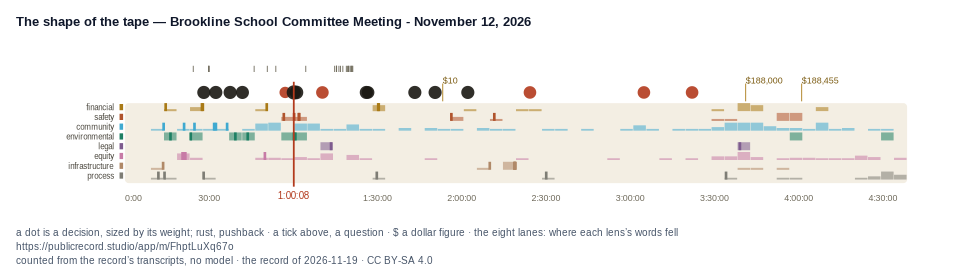
Cut from the analyzer’s scored moments — a measurement, not a choice made for you. Open a reel and press make this reel yours to re-cut it; tick any moment or transcript line below to cut your own.
The committee reviewed the district's Multi-Tiered System of Supports framework [16:28], received high school operational updates [27:18], and held an extensive discussion on proposed school calendar options and holiday observances following family survey feedback [31:45], [46:22]. Administrators presented school improvement plans and analyzed district MCAS performance data, detailing overall achievement alongside persistent demographic gaps [2:02:55], [2:31:02], [2:51:35]. During public comment, community members spoke on calendar closures, child care impacts, and racial equity concerns [3:31:42], [3:40:06], [4:07:01]. Finally, the committee voted to approve the consent agenda [4:26:50] and approved moving a policy regarding property oversight to the recreation department [4:31:07].
What it means: The meeting covered district administrative updates, school improvement plans, MCAS academic data reviews, and proposed options for the upcoming school calendar regarding religious and federal holidays [30:22], [41:50], [2:31:02]. School leaders detailed student performance trends across subjects such as English language arts, math, and science [2:38:44], as well as targeted support strategies like multi-tiered systems of support [21:40], [2:46:59]. Public comments addressed concerns around educational equity, student sense of belonging, and the operational and cultural impacts of different school calendar structures [3:31:50], [3:40:06], [3:43:44].
Who moved it: Donna Perry introduced administrative items [11:45], while Bella presented calendar options and community survey results [15:27], [32:44]. School administrators presented individual school improvement plans and district testing data [1:28:21], [2:31:02]. Members of the public, student representatives, and committee participants contributed feedback during public comment [3:31:38], [3:56:02], [4:06:47]. The provided transcript passages do not settle who formally moved specific procedural votes, though policy subcommittee members introduced a first reading regarding policy reviews [4:27:35], [4:31:07].
What to watch: The school committee will evaluate feedback and calendar versions before taking formal action on future calendar votes [41:50], [3:31:50]. Discussions surrounding policy updates, curriculum coherence, and addressing student achievement gaps will continue in upcoming committee and subcommittee meetings [2:46:59], [4:27:35]. The transcript passages do not settle the final choice of school calendar version or the specific outcome of policy revisions.
Scored, not chosen for you — the salience bar is a measurement, and every moment is a receipt into the transcript below. With JavaScript on, tick moments to compose a reel — and tick moments on other meetings too; a reel can span the record.
→ the publish kit for this meeting — the clips worth cutting and draft copy, for a producer.
Counted, not modeled — each lens is a word list; drift compares the first half to the second.
the same, as a table
| word | mentions |
|---|---|
| students | 333 |
| school | 272 |
| day | 120 |
| holidays | 112 |
| data | 101 |
| work | 98 |
| student | 93 |
| grade | 75 |
| last | 73 |
| within | 69 |
| high | 68 |
| days | 68 |
| calendar | 63 |
| brooklyn | 62 |
| years | 61 |
| important | 61 |
| schools | 61 |
| slide | 61 |
| growth | 59 |
| kids | 58 |
| people | 57 |
| support | 56 |
| take | 53 |
| families | 51 |
| able | 50 |
| state | 50 |
| district | 50 |
| first | 49 |
| start | 48 |
| good | 48 |
| together | 48 |
| equity | 47 |
| staff | 47 |
| sure | 45 |
| every | 45 |
| needs | 45 |
| something | 44 |
| across | 44 |
| different | 44 |
| much | 43 |
| plan | 43 |
| feel | 43 |
| proficiency | 43 |
| learning | 41 |
| community | 41 |
| around | 40 |
| end | 40 |
| holiday | 40 |
| religious | 40 |
| overall | 39 |
| little | 37 |
| attendance | 37 |
| teachers | 36 |
| survey | 36 |
| point | 35 |
| team | 33 |
| math | 33 |
| early | 33 |
| five | 32 |
| program | 32 |
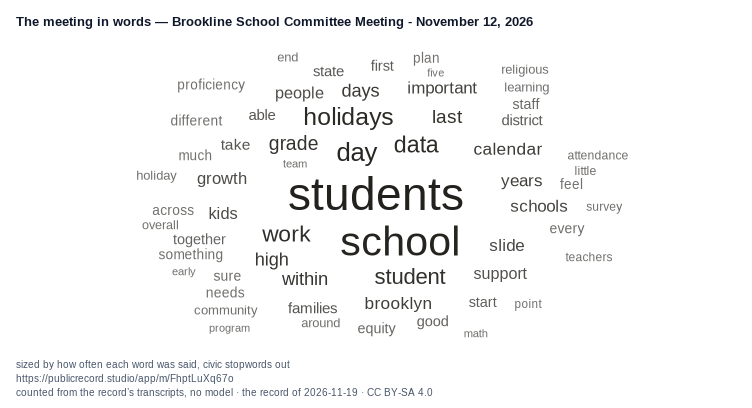
“students” came up 333 times. Sized by how often; civic stopwords out. With JavaScript off, a word opens the tape at its first mention.
2:06 Hey,
10:24 Hey.
10:33 Hey. Hey.
11:37 in progress.
11:41 Hi everyone. Welcome to the Brooklyn
11:43 School Committee meeting on Thursday,
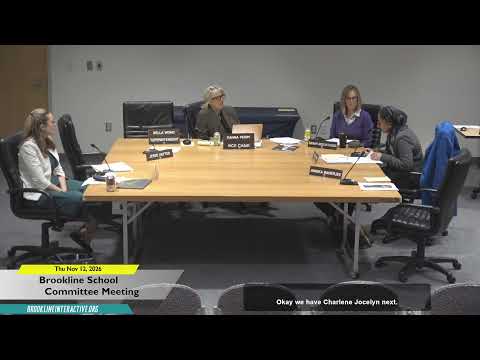
11:45 November 12th. Um I'm Donna Perry. I'm
11:49 going to chair the meeting this evening
11:52 um while our while Bob Winrober covers
11:55 at home from a medical procedure. We
11:57 also have Suzanne Federiel online. And I
12:01 believe that's it. Okay. Um
12:05 so we will start. I just want to point
12:08 out that the agenda for this evening is
12:10 a little inverted. Um, and that is
12:13 because um, Superintendent Wong has a
12:16 hard stop at 7 PM. So, we wanted to um
12:20 demonstrate a little flexibility
12:22 and uh, make sure that we have
12:24 sufficient time for um, her to
12:26 participate in in in her presentations.
12:28 Um, so that's the reason the public
12:30 comment is also pushed back. Um, but
12:32 we'll start with our moments of
12:34 inspiration brought to you by Dr. Jesse
12:36 Hector.
12:38 Thank you and good evening.
12:42 There was once a young boy who struggled
12:44 in school. He rarely completed his
12:48 assignments, avoided participating in
12:50 class, and frequently found himself in
12:53 trouble. His teacher saw a child who
12:56 wasn't trying. His classmates saw a
12:58 child who didn't fit in. And slowly the
13:01 boy began to see himself the same way.
13:04 Then one day, a school psychologist
13:06 invited him into her office. She didn't
13:09 begin by asking why he wasn't doing his
13:12 homework or why he was misbehaving.
13:15 Instead, she asked him a simple
13:16 question, "What is something you're
13:18 really good at?"
13:20 The boy thought for a long time.
13:23 Finally, he answered, quote, "I can fix
13:27 things." unquote. And he began telling
13:30 her stories about fixing broken radios,
13:33 refurbishing bicycles, and all kinds of
13:36 small appliances that he repaired at
13:38 home. For the first time in months,
13:41 someone at school listened to what he
13:43 could do rather than what he couldn't.
13:46 The psychologist worked with his
13:48 teachers and family. Together, they
13:50 found new ways to help him learn. Years
13:53 later, the boy graduated. He went on to
13:57 become predictably an engineer.
14:00 He never appeared in the school
14:02 psychologist's annual report as a
14:04 remarkable achievement. There was no
14:06 award ceremony, no newspaper article,
14:10 and no public recognition. But one day
14:13 he wrote her a letter.
14:16 It contained just two sentences.
14:19 Everyone else was trying to figure out
14:21 what was wrong with me. You were the
14:23 first person who wanted to know what was
14:25 right with me. We spend a great time, a
14:29 great deal of time discussing curricula,
14:31 budgets, assessments, and student
14:34 achievement all are very important. But
14:37 this particular week, which is National
14:40 School Psychology Week, reminds us that
14:43 some of the most consequential act work
14:45 in education takes place quietly, one
14:49 child at a time, often beyond the public
14:51 view.
14:53 Sometimes the greatest educational
14:55 achievement is not raising a test score.
14:58 It is helping a child discover that he
15:00 or she has something valuable to offer
15:03 the world. And that is why our school
15:05 psychologists deserve our recognition
15:08 and our gratitude. Thank you.
15:13 Wow. Thank you, Jesse. And I want to
15:15 then we'll maybe take a minute just to
15:16 thank all of our school psychologists. I
15:18 didn't realize it was school
15:20 psychologist week and uh you play such
15:22 an important role in our schools in our
15:24 system and for our children. So thank
15:27 you. That was really lovely. Um Bella
15:29 superintendent's report.
15:31 Thank you. Um and I agree that was
15:33 really beautiful. Thank you. Um so today
15:36 just for this part I thought I'd provide
15:39 a couple of updates. One is about our
15:41 professional day that we had on on
15:44 election day. So all the students
15:46 weren't in schools and all our faculty
15:48 um were able to come together. Our focus
15:51 on that day was MTSS multi-tered systems
15:54 of support. Um we started with an
15:57 amazing keynote by an alum Angela Burke
16:02 um who is educational consultant with
16:04 Novak and um she was just um it was just
16:09 great to have to you know just to have
16:11 someone 1994 is the year she graduated
16:14 to come and with her energy and it's
16:16 just inspirational for everyone to see
16:18 like a grad out there and um she hit the
16:22 just a really nice positive tone own and
16:25 encouraging. So the heart of the work of
16:28 MTSS is to create a a common framework
16:31 for everyone um across grade levels um
16:34 horizontally and vertically to be able
16:37 to have sort of the same language and
16:40 same set of strategies, same ways or
16:42 ways to share looking at data so that
16:45 all our really great teachers are
16:47 working more together all all together.
16:51 And um and so she she really said that
16:55 she really made that message clear um
16:58 that it's about all of us working
17:00 together to make a difference for all of
17:02 our students, particularly for our
17:04 students that aren't meeting benchmark,
17:06 but for all our students. Um when our
17:09 students aren't meeting benchmark, even
17:12 though there's growth from year to year,
17:13 the only way to close those gaps is to
17:16 accelerate the growth. And so that's the
17:19 power of um MTSS to be able to do that
17:22 all together. Um and the other
17:25 opportunity for professional day has
17:27 allowed our teachers to meet in gray
17:29 bands. So it's unfortunately they they
17:32 don't get that chance that often and we
17:34 have to think about how to maybe build
17:36 that more in to um the time that we have
17:39 available. But K through2 they were at
17:42 um they were at FRR. Did I get that
17:45 right? K2 was at FRR. Three through five
17:48 was at RNL. Thank you. And six through
17:52 eight was um at Lincoln. The preschool
17:55 convened, preschool classrooms convened
17:57 at Putterham. And our pair professionals
18:01 um were at Hayes. So everyone was all
18:04 together in their grade levels and the
18:06 work was more targeted um for them. And
18:08 that's the thing about this initiative
18:10 is making sure that our training and
18:12 professional development is also
18:14 differentiated and it's um more
18:16 impactful when when we are able to do
18:19 that. A huge thank you to our
18:22 principles, vice principles, our
18:23 curriculum coordinators, our directors
18:27 um and our tech support for being um for
18:30 supporting all the all um of our
18:32 sessions together. And a huge thank you
18:34 to BIG um for being able to stream our
18:38 keynote. So we're it's not possible for
18:40 us all to be in one place. So we were in
18:42 person at the high school with the
18:44 speaker and then she was streamed
18:46 elsewhere to the satellite to the
18:48 satellite site. So and um and big they
18:52 were they weren't they didn't just do
18:54 the tech support they were really
18:55 supportive. they really were, it was
18:57 clear they were also engaged in um
19:00 everything that we were doing and they
19:02 were appreciative of the keynote and
19:03 being a part of that. So um and then
19:07 finally our the the main people the who
19:10 really coordinated everything engaged
19:13 the speaker um so oversight everything
19:16 with Karen Schmuckler Robin Benoy Matt
19:20 Dubois and Joelle Peterson um so thank
19:23 you to them and then also I'm really
19:26 pleased that McKenna Bush is here our
19:29 new data director and I don't know that
19:30 everyone has been able to meet with her
19:33 or meet her and say below, but she has
19:35 really enabled she and her new team um
19:38 has really enabled us to be able to use
19:41 data in um much more productive way than
19:44 we than we certainly since last year but
19:47 I think in a long time. Um, so she
19:50 really supported our work around MTSS
19:52 because a big part of that is looking at
19:54 data and um and also you'll see um that
19:58 she supported the work for other agenda
20:00 items which is why she's here both for
20:02 my presentation on the school calendar
20:05 but also for she'll go off she'll go and
20:08 do remotely and then support Robin for
20:10 hers on MCCAST or be a resource. The
20:14 other update I wanted to give is um for
20:18 just in response to questions about what
20:20 we're doing.
20:22 Oh, so sorry.
20:24 Um
20:26 let me like get rid of that.
20:30 Um
20:32 is um in response to some of the
20:34 questions about what we're doing around
20:35 equity plan and equity work. And I
20:38 appreciate that's a question that people
20:40 are wondering about because um the
20:42 office of equal equity was eliminated um
20:46 effective at the end of 2025.
20:52 And um the state does require that every
20:55 district have either a DEI officer or a
20:59 um diversity, equity, inclusion team.
21:02 And so I appreciate that my colleagues
21:05 on the senior leadership team have
21:07 assumed the responsibility of being the
21:09 district um district's
21:13 diversity equity leadership team. And so
21:16 with that um we have been working hard
21:20 about putting things in place um and
21:23 what we hope to have by the end of the
21:26 year is a multi-year plan. All right. So
21:29 the work that we are doing um around
21:31 equity takes time to um gain traction
21:35 and so one major component is really
21:38 focus on the academic supports through
21:40 MTSS. Eventually we'll expand to UDL as
21:44 well. Um but our primary focus is right
21:47 now MTSS to and and to look at our um
21:51 student academic disparate outcomes and
21:54 how to narrow those gaps through this
21:56 also con common framing. The other is um
22:01 we are building um we have a new HR
22:04 director Julie Cullinine who's been
22:06 amazing as well and she has drafted the
22:09 beginning um for us around recruiting,
22:13 hiring, retention, diversification of
22:15 our staff. Um that's also part of the
22:18 state requirement that the district has
22:20 that plan. So we're um preparing that
22:23 draft to roll out. Um the plan does
22:26 include partnerships with um local
22:30 higher higher ed um entities in terms of
22:35 promoting building pipeline for us but
22:38 also for staff that we have um
22:40 particularly our pair of professionals a
22:42 pipeline for them to um pathways of
22:45 lensure or other certifications.
22:48 So that is also in the works. um we know
22:51 that this work is um
22:55 you know what I I'll say we have a lot
22:57 of expertise among us but it you know
23:00 it's always good to have um outside eyes
23:03 on this so we've engaged um a
23:05 consultancy with Darnisa Mont Jackson
23:08 who is um very actually has done a lot
23:12 of work at Harvard with other districts
23:14 um she has done work with MECO she's um
23:17 she speaks nationally she actually works
23:20 internationally as well. So, she's
23:22 engaged with us and again to help us
23:24 create a multi-year equity plan that
23:26 will be sustainable beyond the current
23:28 team um that will build on the systems
23:31 that we're putting in place. So, we do
23:34 welcome the intention on this because we
23:37 consider it very important um important
23:39 work for us to do and um so we are we're
23:43 working on it. I'm really hopeful by the
23:45 end of the year we'll see some impact on
23:47 some of the systems that we put in
23:49 place, but I do want to u make clear
23:51 that this is um it's a it's a multi-year
23:55 effort before you can see um big gains.
23:58 And I feel confident in the capacity of
24:01 our staff to be able to do this work.
24:04 And I actually really am very excited
24:07 and optimistic about what it will look
24:10 like when everyone is um working all
24:13 together. So, thank you.
24:18 And thanks so much, Superintendent W.
24:20 Does anybody have questions or comments?
24:26 Um if you don't mind, I'll I will I will
24:29 ask a question. Um, are you planning to
24:32 return to school committee at some point
24:34 to talk more about the equity plan when
24:36 it's ready? Um, it sounds like that
24:39 would be more towards the end of the
24:40 year.
24:42 Yes. Um, but we'll probably be providing
24:45 updates along along the way. And the one
24:47 part I forgot to mention is um senior
24:51 leadership team really wants to engage
24:55 with um like a a representative group to
24:58 help us in the work um be a sounding
25:00 board but also provide input to the
25:02 plans. So there was an invitation to all
25:05 staff in um units AB and the pair
25:09 professionals to express their interest
25:12 to be part of a steering committee. So,
25:14 we thought maybe a steering committee of
25:16 12, but as we're looking at all the
25:18 applicants and we want to make sure
25:19 every school's represented, that we're
25:22 representing um elementary, middle,
25:24 high, and preschool that we're
25:26 representing unit A, B, and PAR
25:28 professionals and subject areas. And we
25:32 can't do it with 12. So, it looks like
25:34 it's going to probably be 15. Um, but we
25:37 once we've identified that group, we'll
25:40 be happy to share out who who that group
25:43 will be. And um, so I I think we'll be
25:46 giving updates along the way. The equity
25:49 plan probably won't be realized till
25:51 later
25:54 in the spring.
25:54 Okay.
25:55 Yes,
25:55 that's fantastic.
25:56 Thank you. I also will um share that
25:59 FISA, Jesse and I were at Lawrence
26:02 earlier this week um as school committee
26:06 members are rotating through the
26:08 different schools and um we had a math
26:11 specialist run over super excited to
26:13 show us um Miss McGra to show us um some
26:16 of the MTSS work um and walk us through
26:20 exactly how the data that McKenna and
26:23 her team are providing is informing some
26:25 of the this the student learning and how
26:28 they're using that um to to impact
26:31 outcomes. So, it was really it was
26:32 really interesting and and it was it and
26:34 she was so engaged and excited about it.
26:36 So, it was really lovely.
26:39 Um student report. Yes, thank you.
26:44 Hi everyone. I hope everyone's doing
26:46 well. Um as most of you might know,
26:49 quarter 2 for the high school as well as
26:52 the middle schools ended on Monday this
26:55 week. And that means a couple things.
26:58 The first is that with this year's
27:00 change to the course level um change
27:03 time period, which essentially says that
27:06 students may not change the level of
27:08 their course after 10 days beyond the
27:10 end of quarter one or whichever quarter
27:14 uh quarter one always actually. Sorry
27:16 about that. And the other thing is that
27:18 the reports for quarter 1 will be out on
27:20 Tuesday of next week um on more events
27:25 that happened recently. We had the
27:26 innovation fund galarama um last
27:29 Thursday which was held at the 22 tap
27:31 and freshman building and um it was
27:34 covered by the cypress and I was told it
27:36 was a wonderful night and it was
27:38 celebrating the teachers mentoring
27:40 teachers program um which has been
27:42 around for quite some time now and very
27:45 well appreciated and the innovation fund
27:47 galama chooses a program to honor each
27:50 year and this year the teachers
27:52 mentoring teachers was a program chosen
27:55 Um,
27:57 as for student government at the high
27:59 school, student council has formed its
28:02 subcommittees where we work on bills to
28:04 amend or add to the student handbook
28:06 with the approval of legislature as well
28:09 as the head of school. And some of the
28:11 upcoming bills that were proposed were
28:14 the ideas of grade visibility to
28:16 students. Um, essentially how Canvas
28:19 operates is that teachers have the
28:22 ability to either disclose the total
28:25 grades of students or keep that
28:27 information hidden. And um there's
28:30 currently a petition for students to be
28:32 able to view their total grades at all
28:34 points um during the school year.
28:37 And additionally, there is some
28:39 discussion regarding the 18-year-old
28:41 absence policy as once a student is 18
28:45 currently, they're able to excuse
28:46 themselves from school and there's some
28:49 discussion around whether or not that's
28:50 actually acceptable. Um, as it's not
28:53 made very clear within the student
28:55 handbook. And the last thing is that the
28:58 AP classes, specifically the sciences,
29:01 are often double blocks during the
29:04 school week. However, the credit in a
29:06 student's report card doesn't
29:07 necessarily reflect that and there's a
29:10 petition for those classes to be
29:12 weighted in order to reflect that they
29:14 cannot take another class during those
29:16 periods. Um, also recently we had Dvali
29:21 which was a category 2 holiday this year
29:23 which meant it was a no homework weekend
29:25 and I think that was observed pretty
29:27 successfully at least from my point of
29:29 view as a student. And on some exciting
29:33 news, a lot of our varsity teams are
29:36 moving on into the postseason and
29:38 tournament season. And I believe the
29:40 boys varsity team had a match tonight um
29:43 in Welssley. And I don't yet know the
29:45 results, but fingers crossed. And that's
29:49 it for me. And any questions?
29:53 Any questions for Anukica?
29:58 No, thank you so much.
30:00 Thank you. Um,
30:01 Monica, what team was that tonight?
30:04 It was the boys varsity soccer.
30:06 Soccer. Okay. All right.
30:08 You're in the round of 16 and as is the
30:10 girls team as well.
30:11 Great. Thank you.
30:13 Thank you. Um, okay. So, we'll move into
30:16 presentations and discussions. And
30:18 before I turn over to Bella um to do the
30:22 first reading of calendar, um I wanted
30:24 to offer just a little bit of framing.
30:27 Um the school calendar for those um who
30:31 are not well verssed in the sort of the
30:33 technical parts of it. The school
30:34 calendar for the ensuing year is
30:36 prepared by the superintendent
30:38 um and submitted to the school committee
30:40 for approval annually. There's generally
30:42 there's two readings. Um we obviously
30:46 have um state instit instructional
30:49 requirements the number of minutes the
30:50 number of days. Um there are also I
30:54 think three provisions in our the
30:56 Brooklyn school committee policy manual
30:58 that um either refer to polic to
31:01 calendar or um that um through which our
31:06 calendar process is established. Um
31:12 and um finally I wanted to just flag a
31:15 couple considerations for the the
31:17 conversation. One is um
31:21 I want to acknowledge that there are
31:22 holidays that are also not observed
31:24 currently right in in in or not observed
31:27 as category 1 holidays in the Brooklined
31:30 um public schools. Um I think it's
31:33 important that we remain mindful of that
31:36 as we consider the the calendar. I want
31:39 to emphasize um respect and support for
31:42 the many different religious and
31:45 cultural holidays and celebrations ac
31:47 across our entire school community um
31:50 regardless of how they're recognized um
31:52 or categorized in the PSP calendar. And
31:56 um
31:58 finally, maybe Superintendent Wong or
32:00 one of my colleagues can correct me, but
32:02 there are aspects of the school calendar
32:05 um that are driven by commitments in
32:08 collective bargaining. So I'm
32:09 specifically thinking of the early
32:11 release days. So in other words, the
32:14 group sitting at this table and the
32:16 school committee members on Zoom are not
32:19 able to single-handedly
32:22 vote changes to those early release
32:24 dates. I think that's really important
32:25 for our community to understand. And uh
32:28 with that, I'll hand it off to Bella.
32:29 And sorry, finally, a gentle reminder
32:31 that Bella has to leave at 7 tonight.
32:34 Well, I I will try. You know, I don't
32:37 know. We'll see how it goes. Okay. Um
32:40 thank you. So, Betsy is graciously
32:44 um going to run my slides for me. So
32:48 last year when I was here around this
32:50 time I was asked to propose the school
32:52 calendar for the current year and I
32:54 understood at that time that um it was
32:57 re that Eid had been recently added to
33:01 the school calendar holiday list and
33:03 that lunar new year I think maybe the
33:06 year before had been added and um and so
33:10 it there was a question of whether it it
33:13 was um my understanding is that that
33:15 that Eid was added as to as a pilot. And
33:20 so I didn't feel having just been um
33:26 at PSB for a few months to be able this
33:28 to appine whether um the calendar should
33:33 change. I was much more comfortable
33:35 saying that we would keep all the
33:36 holidays for this year. And so that's
33:38 what we did. Um but I also understood
33:41 that when it come came to this point
33:44 that um I would be asked to make a
33:47 recommendation. And so I've thought
33:49 about um what how to approach that
33:53 question. Um and so so as you see here,
33:58 um I will present a calendar for next
34:01 year that has a pre-LOR day start and a
34:05 post Labor Day start. Um there will be a
34:08 version with all our current holidays
34:11 and there will be a version with state
34:13 and federal holidays only. And this is
34:15 in response to um sentiment that I've
34:19 heard that have that people have um said
34:22 at public comment last school year um
34:25 and also more recently.
34:28 Um I also decided to look at a 10-year
34:33 um range. So calendars over a 10-year
34:35 period just to see because sometimes
34:38 holidays don't fall during what would be
34:40 a regular school day. And so just so
34:43 everyone could see like what would be
34:45 the impact of decisions that we would
34:47 make. So a 10-year period and I just a
34:50 big thank you to my assistant Kathleen
34:53 um Davak who helped me do all those.
34:55 It's actually um you can make it's
34:57 they're very
34:59 um errorprone when you're looking at
35:02 calendars that far off and you're
35:04 counting days and the holidays don't
35:06 fall, you know, normally well anyway
35:09 typically from the same from year to
35:10 year. So, that was a lot of work. Um, a
35:14 huge thank you to McKenna Bush who is
35:16 here who helped design the survey.
35:19 Honestly, if she wasn't here, I don't
35:21 know that we could have done a survey as
35:22 sophisticated as um we were able to
35:25 provide. I will say that one question
35:28 came is that how do you know people who
35:32 are not part of Brookline
35:34 um were able to participate in that
35:37 survey? So, I will be honest. We could
35:39 have used a different
35:41 um could have used a different tool that
35:44 would have been more email specific, but
35:46 that would not have allowed for
35:47 translations. And so, that would have
35:50 been a very we could have done it, but
35:52 it would have been very logistically
35:53 very very very difficult to be able to
35:55 do that. So, we use'more, which allows
35:58 us to do the translations, and that's
36:00 important for us to be able to do that.
36:02 I don't know if you want to say more.
36:04 Um,
36:13 there you go.
36:14 On. Okay, great. Uh, we use Survey
36:16 Monkey to actually administer the
36:18 survey. I'd say the other element that
36:20 um prohibited the insurance of of making
36:23 sure that only Brookline families
36:25 participated was the degree of animinity
36:27 that is also kind of expected and I can
36:29 express this opinion without it being
36:31 tied to this is my specific student. So
36:34 um we wanted to give people the option
36:36 to to feel that they were not you know
36:37 that their response would not be tied to
36:39 them personally which we also felt was
36:41 important. So limitations to various
36:43 survey methods but it's the only thing
36:44 I'll add about the administration.
36:46 But because this concern had been
36:48 expressed McKenna was able to exercise a
36:51 a layer of analysis to determine um
36:55 whether she thought responses were
36:57 suspect or not. So I think in a very
37:00 conservative
37:01 analysis she decided that 98% were valid
37:06 for for the um for the parent survey. So
37:09 it I don't know if you could say a
37:11 little bit more about what that entailed
37:12 is sort of about repetitiveness or Yes.
37:19 Sure. So, we look we looked I looked for
37:21 trends in in the responses, you know,
37:23 were there um a a bunch of redundant
37:26 responses from the same IP address with
37:28 the same uh with the same votes cast, if
37:30 you will. Um so, just looked for for
37:32 patterns in responses and ultimately
37:35 felt like there was, you know, if there
37:36 was enough uniqueness about a response,
37:38 then it was considered valid, but
37:40 difficult to to trace, especially when
37:43 it's logical that a parent travels for
37:45 work, so they may be outside of the
37:47 state of Massachusetts. So it can make
37:48 perfect sense that um that their survey
37:50 would would come in from um outside of
37:52 the state. So um conservative analysis,
37:55 but again looking for duplicity in in
37:57 very consecutive responses um to make
38:00 sure that someone just wasn't refresh
38:01 refreshing and resubmitting. Um you you
38:04 would also have to kind of work your way
38:06 way around the system to be able to
38:07 submit another uh survey response from
38:10 the same browser. Um, but again,
38:12 we live in a modern world where it's
38:14 it's easy to kind of work your way
38:16 around to the parameters without
38:18 requiring, you know, a token or some
38:20 sort of unique identifier to say only
38:22 McKenna Bush can take this specific
38:24 survey link. So to protect people's
38:26 ability to take the survey anonymously,
38:29 we had to to kind of sacrifice other
38:30 other options.
38:32 I'll thank you. So, all to say that we
38:34 endeavored to make sure that um the
38:37 survey maintained integrity um to the
38:40 best of our capability. I'm not going to
38:42 say we're going to guarantee 100%, but I
38:45 also feel pretty good that um that
38:51 that the that the results we got are
38:53 we're we're relying on them. And so, but
38:55 even so, we're using 98%. So, the
38:58 analysis based on 98% of the responses.
39:01 Um, I also looked at anticipated student
39:04 staff attendance. Um, I just I just
39:07 wanted to be open to all the things that
39:09 people would want us to consider. Um,
39:13 and then also the impact on some
39:15 employee contracts because I know that
39:16 was raised. So, just to address that and
39:19 also our endeavor to have learning
39:21 supported by an environment that is
39:23 culturally responsive to all students.
39:25 So, these are all the things that I
39:26 considered. Um, I want to say that I
39:31 really wanted to exercise utmost care on
39:35 on this question. I know that um that
39:39 people have strong feelings about the
39:42 school calendar and and what what I
39:46 recommend and what the school committee
39:47 will choose and so try to be as
39:51 objective as possible. Um and I I just
39:55 want to say in the in the that um not
39:58 everyone will agree. So my analysis is
40:02 is um is my analysis but I tried to be
40:06 as fair as possible and also to be um
40:12 I I I'm going to say sensitive to what
40:15 we aspire to do is to um create
40:18 something that everyone can work with
40:20 and will support best learning by
40:22 students. So this slide is just to help
40:26 everyone understand what is it meant by
40:28 federal holidays, state holidays and
40:31 then our PSB additional religious
40:32 cultural holidays. So the federal
40:35 holidays are listed for you. All right.
40:38 So New Year's Martin Luther King's
40:40 birthday, Washington's birthday,
40:41 Memorial Day, Junth, July 4th, Labor
40:44 Day, Columbus Day, Columbus Indigenous
40:46 People's Day, Veterans Day,
40:48 Thanksgiving, and Christmas. They're
40:51 actually it's it's actually kind of a
40:53 little bit random, but those are the
40:55 federal holidays. Um the state holidays
40:58 are everything included in the federal
41:00 holidays plus Patriots Day. I also want
41:03 to note that February vacation always
41:05 includes President's Days. All right?
41:09 And April vacation always includes
41:11 Patriots Day. So I don't know if people
41:13 realize that it that somewhat mitigates
41:17 the um impact of holidays is that they
41:20 are included in those two holidays that
41:23 are on our calendar. And then our
41:24 additional religious cultural holidays
41:26 rashana
41:28 um yankaporid alfit lunar new year and
41:33 good Friday. And I want to apologize in
41:35 the memo I sent to you. I misspelled
41:37 rashashana in the first iteration but it
41:40 had been PDFed and sent to you. So I let
41:43 it be um because we sent so many
41:45 documents to you. My recommendation for
41:48 the next school year, the school
41:50 committee will be voting on next year.
41:53 All right. And we'll not be voting for
41:55 some time yet. Um by by um policy, it
41:59 needs to vote by the end of February.
42:01 Typically, we would like the calendar to
42:03 be voted well before then. Um but that
42:06 it has to be um reviewed by the BEu. Um,
42:11 currently some of the options for early
42:13 release day are on the table for
42:15 discussion. So, we will not be able to
42:17 finalize the school commit the calendar
42:20 for for next year until those are
42:22 resolved. Um, but this is this is um was
42:27 calendar for this time and so it's here.
42:29 Um, a the versions a include all of the
42:34 PSB religious cultural holidays. B are
42:38 federal and state holidays only. There
42:41 is a post Labor Day start and a pre-LOR
42:44 day start by in our contract agreement.
42:47 We can go as early as the Wednesday
42:49 before Labor Day. If we go earlier than
42:52 that, and this is why I've asteris it or
42:55 put a asterk on it is um the BEu needs
42:58 to agree if we were to start on a
43:00 Tuesday. For your information, this
43:02 school year we staff did start on a
43:05 Tuesday. Um, and so I don't want to
43:08 assume what the what the decision will
43:11 be for next year. Um, assuming we can
43:14 have a pre-LOR day start, my
43:16 recommendation is version A with a
43:18 pre-LOR day start, which would have um,
43:22 our first day for staff as August 31st.
43:24 The first day for students 92, not too
43:27 dissimilar from this year. And the first
43:30 possible last day would be June 16th to
43:32 the 26th. You can see it's it's
43:35 comparable to um option B.
43:41 All right. So that would be my
43:43 recommendation for 2728.
43:45 I will say a lot of energy was put into
43:48 making that recommendation which is why
43:51 um I would suggest that the that the
43:54 committee sort of make a determination
43:57 for a future calendar for including all
43:59 holidays or not. um or or you can
44:03 revisit it again um in the next year. Um
44:06 next slide, please. The other thing I
44:10 looked at was the 10-year forecast. And
44:12 so there are a lot of materials that
44:13 were distributed, but for this
44:15 presentation, just trying to hone in on
44:18 that possible first last day. So the
44:21 possible first last day for option A.
44:23 And then in parentheses, I put in where
44:26 it may be an option to have a pre-LOR
44:28 day start, which would impact the first
44:30 the possible first last day and the
44:32 possible first last day for option B.
44:36 I think it may surprise people that um
44:40 the first last day for option B, federal
44:44 and state holidays only, that is that
44:47 that is early. There's a lot of 613
44:52 dates. There's some 612 dates. And so
44:55 when I counted them up, um I think
44:58 there's seven to eight that are 612,
45:00 613, 614. I make note of this because in
45:05 the um comments on the surveys
45:08 there are there are definitely um
45:11 parents that find it parent guardians
45:13 that find it challenging to find child
45:16 care to accommodate the intermittent um
45:19 occurrence of of religious and cultural
45:22 holidays. But they're also
45:25 parent guardians that say you know
45:27 earlier end of school year is also going
45:29 to be financially logistically
45:31 challenging for us to find you know the
45:36 care that early. So so I feel the 10day
45:39 forecast 10-year forecast is helpful to
45:41 understand what the first possible last
45:43 day might be.
45:46 Um, for for option A, it's it seems a
45:49 little more consistent. 618 620. Um,
45:55 thank you.
46:01 Did I miss a day?
46:03 Oh, okay.
46:05 One, two, three, four, five, six, seven,
46:08 eight. Oh,
46:10 okay. All right.
46:12 All right. Thank you. I
46:15 Nope. It I'm going to say it was a bear
46:18 doing this. All right, next one. Thank
46:20 you.
46:22 U family response to survey. So, McKenna
46:25 may comment on this. We had 29% response
46:28 out of all the possible responses. Um
46:32 and then 43% for staff. Um McKenna can
46:36 opine on you know whether that's
46:39 considered robust. We think that is
46:41 actually robust for a community survey.
46:44 So I so we're going to assume that the
46:46 people who responded this is a very
46:49 important important topic for them. um
46:52 if school were in session um for
46:55 Rashashan and Yonapor and so red means
46:58 that I would go to school my ch my child
47:01 would go to school but they would miss
47:03 an observance um and so you can see that
47:07 it's the highest for rashan or yapur but
47:10 it's not insignificant
47:12 when you put the numbers together for
47:14 good Friday Eid i or a lunar new year
47:20 all right and then the Next slide asks
47:23 the families all right that's what would
47:26 happen for your family considering your
47:28 own household which calendar approach do
47:30 you prefer and it is um 38% to 62% 62%
47:37 of the people that responded
47:40 um that would favor state and federal
47:42 holidays only and then you have a more
47:45 numbers below of the actual now remember
47:48 this is 29% of all families
47:51 households that responded. The next
47:54 slide is really interesting.
47:57 What would you what would you um pref
48:02 what do you support if you consider the
48:05 broader community outside your
48:08 household? This is a significant shift.
48:11 It is a significant shift. Now 44%
48:15 say keep the calendar without any
48:17 changes and then um down to six 56% that
48:21 would say keep state and federal
48:23 holidays. Now remember the people who
48:25 are doing this this survey are the most
48:28 this is this is the most all right but
48:32 we have 29% responding that means about
48:35 70% of people who are also going to live
48:38 with the calendar
48:40 I think I I'm going to assume are more
48:43 flexible on what it is and also when you
48:46 look at the um
48:49 the the 50 the um 13 I'm Sorry, I used a
48:54 different number. But we use the number
48:56 out that's 130 1302
49:00 out of over 8200
49:05 possible responses. All right. So when I
49:08 take the the 132 and divide that by the
49:12 possible responses, that's reflecting
49:15 16% of the community that responded
49:19 to the survey about keeping state and
49:21 federal holidays.
49:23 Next slide please.
49:27 This is the family summary of themes.
49:29 And so it's pro it's one or the other.
49:33 Some are critical of the survey. It's
49:35 all there. Um but one one theme that
49:39 really um probably the most common we
49:44 expressed in the responses. Not everyone
49:46 had to put in a response, but a but a
49:49 common response was the commitment to
49:52 diversity, equity, inclusion. Um
49:55 students should not be forced to choose
49:56 between academic obligations and
49:58 practicing their faith. Um and then this
50:03 was true in um the family and staff
50:06 surveys in intermittent days. often they
50:09 provide critical mental health breaks
50:11 especially for middle school and high
50:13 school students to catch up on school
50:16 work and rest.
50:18 Um and then and as I said definitely for
50:23 some midyear random days off create
50:25 childare and financial burdens for
50:26 working parents. Conversely some also
50:29 feel having an earlier end of year can
50:32 also create increased child care costs
50:34 and difficulty to find early camp
50:36 options. Next slide, please.
50:38 Oh, sorry.
50:39 Is it okay to ask a question here for a
50:41 second?
50:42 You know what, Jesse? Can we save
50:44 questions?
50:44 I'm gonna try.
50:46 Yeah. And I realized the time, so I'm
50:47 going to try to keep talk faster. All
50:50 right. Thank you, Betsy.
50:53 Um, there were comments about continuous
50:56 school weeks promote better
50:57 instructional flow and consistency. It's
50:59 true. Sometimes it just feels, you know,
51:01 a little bumpy when we're in school or
51:03 out. Um and this is criticism on the
51:06 survey. They wanted people wanted to
51:08 appine about low attendance days,
51:11 earlier start dates, decreased um early
51:13 releases or more holiday closures. Um I
51:17 will comment on attendance and earlier
51:19 start. We tried every time we could and
51:22 remember there are some limitations um
51:25 due to our contract, but also when you
51:26 have an early Labor Day, when you start
51:28 before Labor Day, that's you're really
51:30 kind of cutting into summer. Um, and
51:33 then the the discussion of early
51:35 releases, which isn't really for today,
51:37 but is something that we we will look
51:39 at. I made a decision not to add more
51:43 holiday closures. And to somewhat where
51:46 Donna acknowledged at the beginning of
51:47 the meeting, there are a lot of other
51:49 holidays. And so I don't know where
51:53 where you where you end with more
51:56 holidays, but if certainly if people
51:59 advocated for a particular holiday, we
52:01 could add it to the list to consider. I
52:04 also felt
52:06 the pulse of the community that we were
52:08 all there was a lot of tension already
52:10 particularly around the um impact to the
52:15 pacing of the year but also to the
52:17 length of the year. So I did make a
52:19 decision not to add more holidays to the
52:22 survey. So I I'm
52:24 yes I decided not to do that. Um the
52:28 closures validate minority students and
52:30 families and fosters a sense of
52:32 belonging and community respect. And
52:34 that's a really important um theme that
52:36 that came up. Um some said excuse
52:39 absence for days when schools are in
52:41 session will exacerbate academic
52:43 pressure on students to make up missed
52:44 time.
52:47 Thank you Betsy. Right. So staff
52:49 response was 43%.
52:52 Um and so for the staff
52:56 if they if school were in session the
52:59 there was a significant percent that
53:01 would um miss Rashashana Yankapor and
53:04 Good Friday
53:06 and not an insignificant number that
53:08 would miss um Eid
53:11 or Lunar New Year. Right? So there's a
53:15 little difference in the staff, but
53:16 there are three three holidays that
53:19 would significantly impact staff
53:22 attendance. Um, now this is a survey, so
53:27 if we were to go to federal and state
53:29 holidays, whether this is the percent
53:31 that would happen, I don't know, but it
53:34 does raise a question of being able to
53:36 operate school on on those days. Next
53:39 slide, please.
53:42 on the question of um considering your
53:44 household, which would you prefer? It's
53:46 pretty even,
53:48 right? And then on the next slide, um
53:51 but if you consider outside of your
53:54 household
53:57 um and the broader community, it similar
53:59 to the family survey, it shifts to
54:02 keeping the current calendar. And I
54:05 think those are notable shifts. And I
54:07 think it really speaks to um you know
54:11 when we think about belonging and being
54:13 inclusive
54:15 sometimes it may mean we inconvenience
54:18 ourselves to be able to do that. And I
54:21 think about like when you're in a family
54:24 the things you do that may inconvenience
54:26 yourself um in the interest of others or
54:30 what may be important to them. So I
54:32 really feel this shift was is notable on
54:35 both sides about the influence of people
54:39 thinking outside their own household and
54:41 I I actually
54:44 think that's a positive. Next slide
54:47 please.
54:49 Staff summary themes again similar about
54:53 um recognizing the holidays support um
54:56 community inclusion, cultural education,
54:58 values of diversity.
55:00 Um they also said periodic single day
55:04 breaks give students especially high
55:06 school but I I would say it was included
55:08 in middle school from the families um
55:10 support their mental health just having
55:12 that break to catch up. There is also a
55:15 similar divide on childare and financial
55:17 impact between the single breaks versus
55:20 early versus early end of year. So
55:22 similar to our families. Next slide
55:25 please.
55:28 Um they people also said you know we
55:32 didn't get to weigh in on low attendance
55:34 pre- Labor Day starts changes to early
55:36 release days. Um, many noted that even
55:40 if they don't practice the holiday, they
55:42 supported that others do. Um, and then
55:45 some said they favored religious
55:47 observances should be handled through
55:49 excused abuses, no homework policies,
55:51 and reasonable makeup work
55:53 accommodations instead of full district
55:55 closures. So, I tried to show all the
55:58 sides on this. Thank you, Betsy.
56:01 So, I looked at anticipated staff
56:03 student attendance. We could anticipate
56:07 and I say not definitively because this
56:09 is you know a survey that's not tied to
56:11 actuality of like okay this is what
56:14 we're doing are you going to be in
56:15 school or not um significant low
56:18 attendance for staff and students on
56:19 Rashaashana and Yapor and for staff on
56:22 Good Friday as well over a 10-year
56:25 period. So this is the other thing you
56:27 know looking at the 10-year period two
56:29 of these holidays would happen on a
56:31 regular school day in most years. We're
56:33 not talking about all three. Um it may
56:35 not be possible to operate school safely
56:37 on those days. Um but and it's it likely
56:43 significant critical material would
56:44 likely be deferred to be taught on
56:46 another day. So the loss of learning for
56:49 those days would not be and and this is
56:51 the other my last sentence. Those are
56:54 days we don't get back. If we had
56:56 federal state holidays only, we would we
56:59 would have um we wouldn't have 180 days.
57:03 We we we would just lose them as opposed
57:07 to like when we have the holidays, we we
57:11 um we all of them we get them. We we
57:15 reschedu them. We get them. So if we
57:17 were to do this only on um low
57:19 attendance days, we lose them. We lose
57:22 them. Sorry. Next slide. I don't know if
57:25 I was that articulate on that, but I
57:27 hope my point was clear. Um, and while
57:30 the absences for Eid
57:33 I, so there's a typo there. Sorry. I or
57:37 Lunar New Year are not as substantial,
57:40 they are not at all insignificant.
57:44 Also, as I was reflecting on this
57:47 information, if we went to um federal
57:50 and state holidays only, it is more
57:53 likely on the days of high absenteeism
57:56 or low attendance,
57:59 it will affect the material that's being
58:01 taught on that day and it's more likely
58:04 that less substantial information would
58:06 be taught on that day. But on on day if
58:10 we went to federal and state holidays
58:12 only
58:13 for holidays that might still might
58:17 still be regular high attendance,
58:20 the material being taught on that day
58:22 probably wouldn't change.
58:25 But the impact on those students that
58:27 chose
58:29 to not go to school so they could
58:31 observe their holiday would be more
58:35 impactful. And I don't think that's
58:37 something
58:38 that people may have thought of. Um, but
58:41 as I reflected on the impact of what
58:43 that means, um, because you any decision
58:46 we make needs to be centered on the
58:50 impact to students and I I understand
58:52 the logistics
58:55 um of child care on both ends, but this
58:59 so so there's this next slide, please.
59:03 I just want to call your attention to
59:04 the time.
59:05 Yeah, I'm all right. Um, it should be
59:08 noted that staff attendance is impacted
59:10 if their children attend school
59:11 districts elsewhere that have a
59:13 different schedule than ours. So, we do
59:15 need to be mindful of other districts
59:18 that typically might have the holidays
59:20 that we would eliminate that if they had
59:24 them. Sorry, next slide. Um, just to
59:27 point out the PAR professionals are paid
59:29 for the Lunar New Year holiday. We
59:31 checked all the other contracts and that
59:33 it's just it's just the PAR
59:35 professionals. So that would have to be
59:37 negotiated. Um but that question came
59:40 up. So just for the paraprofessionals
59:44 belonging supports best learning. So as
59:47 we you know as we talk about an equity
59:49 plan and we talk about what we did on
59:51 professional day our focus on um MTSS
59:55 supporting all students. Um this is the
59:58 preamble, part of the preamble from the
1:00:01 civil student civil rights policy um
1:00:04 that school committee just
1:00:07 um
1:00:08 approved um last spring. And so it's
1:00:12 about creating an environment that's
1:00:14 physically and psych psychologically
1:00:16 safe, connected, encouraged, and can
1:00:18 flourish for our students. And um and
1:00:21 these are the district goals that are in
1:00:24 in that preamble. Joy and learning,
1:00:27 excellence in teaching, culture of
1:00:28 collaboration, celebration of
1:00:30 differences, commitment to equity, and
1:00:32 ethic of wellness. Next slide, please,
1:00:35 Betsy.
1:00:37 So,
1:00:39 what do we need to have to support an
1:00:42 environment that is inclusive and
1:00:45 supports a students feeling that they
1:00:48 belong? It's layers of scaffolding.
1:00:52 Layers of scaffolding. It can be in the
1:00:54 curriculum. It could be in the clubs and
1:00:56 activities. It could be um it could be
1:01:00 just the way we celebrate um in in a
1:01:03 cult or host cultural events. But one of
1:01:06 them is the school calendar. So we adopt
1:01:10 explicit anti-hate policies that cover
1:01:13 all religions, racial and ethnic
1:01:14 communities. This is incorporated in the
1:01:17 in our new civil rights policy. We
1:01:19 integrate diverse religious racial and
1:01:22 cultural perspectives in existing
1:01:23 curricula. We are not perfect at that.
1:01:26 We are This is still a work in progress,
1:01:29 but this is part of our This is part of
1:01:32 our work and that we're trying to
1:01:34 improve. Create inclusive calendar
1:01:36 policies recognizing holidays and
1:01:38 observances of all faith communities.
1:01:41 Train all faculty and staff in
1:01:43 recognizing responding to bias incidents
1:01:45 across all communities. We are launching
1:01:47 professional development in this year.
1:01:49 It's just the first. There'll be other
1:01:52 trainings that we'll do over time.
1:01:54 Establish student interfaith and
1:01:56 intercultural dialogue programs and safe
1:01:58 spaces. By right, students can practice
1:02:02 their religion in school and we have to
1:02:04 create safe spaces for that to happen.
1:02:07 Develop protocols for supporting
1:02:09 students experiencing hate-based
1:02:11 harassment of any kind. Thank you.
1:02:16 Next slide, please.
1:02:18 So in my considerations for the
1:02:21 recommendation to maintain the current
1:02:23 school holiday schedule for next year
1:02:25 but also I think for the years moving
1:02:27 forward.
1:02:29 Families find the intermittent holidays
1:02:31 a financial and or logistical challenge
1:02:33 to arrange child care. Early release
1:02:36 days exacerbate this challenge. Families
1:02:38 may likewise find it challenge to
1:02:41 arrange child care to cover in an
1:02:42 earlier end of year. So it's people have
1:02:46 different perspectives on this. Either
1:02:48 way, everyone agrees on the early
1:02:51 release days exacerbating this
1:02:53 challenge. That's not not something we
1:02:56 can resolve at this moment, but it's
1:02:58 something that we can look at not for
1:03:01 next year, but maybe in the longer term,
1:03:03 and that would be working with our our
1:03:06 educators together um on that. Over the
1:03:10 next 10 years, a calendar with federal
1:03:12 and state holidays only would have the
1:03:14 first possible last day be
1:03:16 612 three times, 613 twice, 614 twice,
1:03:20 and I hope my math was right, Jesse. Um,
1:03:24 family staff and families report the
1:03:26 breaks provided by intermittent holiday
1:03:28 support mental health of middle school
1:03:30 and high school students. And that's not
1:03:31 an ex insignificant
1:03:34 comment. um our students are functioning
1:03:38 under just high pressure all around. So
1:03:42 it's not an insignificant comment that
1:03:44 was brought up by both families and
1:03:46 staff.
1:03:47 Staff and families advocate for flexible
1:03:50 academic accommodations to decrease the
1:03:52 pressure of missing school for a
1:03:53 religious or cultural observance. And we
1:03:56 do do that. But if we had um there's a
1:03:59 different impact if we went to all
1:04:02 federal and state holidays on students
1:04:04 that chose to miss school to observe um
1:04:10 and there is an interest in pre-LOR day
1:04:12 start when feasible and we we have that
1:04:15 too. So when we can um it's reflected
1:04:18 sometimes the BEu need we need to work
1:04:20 with BEu if we can do um in some years
1:04:23 start on a Tuesday.
1:04:26 Is that my last slide? No. No, there is
1:04:28 an interest in evaluating the present
1:04:30 early release schedule. It's not going
1:04:32 to be done for next year. It's going to
1:04:34 be a longer range look at um I did note
1:04:38 the notable shift in both the staff and
1:04:40 family survey response when asked to
1:04:42 consider what is best for the community
1:04:44 outside of one's household. Um it it
1:04:47 speaks volumes. I think again students
1:04:50 observing a religious or cultural
1:04:51 holiday on a day when school is in
1:04:53 session bear greater impact if it is a
1:04:55 day when most students and staff are in
1:04:57 school and the importance of
1:04:59 establishing layers of scaffolding to
1:05:01 support belonging in schools for all
1:05:03 students that can be reflecting that in
1:05:06 the school calendar is one and
1:05:09 celebrating the tapestry of our
1:05:11 community can bring challenges. It can
1:05:13 be inconvenient. Um but
1:05:17 it's it's just you know it's an
1:05:19 important value which I think was
1:05:21 expressed um in the open response from
1:05:24 in both surveys and I think I have a
1:05:26 last I just want to note that I'm
1:05:29 adjusting the elimination of category
1:05:32 nomenclature I will say when I came to
1:05:34 district I wasn't comfortable with
1:05:36 category one two three so um we will
1:05:41 still have rules regarding academic
1:05:43 modifications or accommodations s
1:05:45 there'll still be all of that um but
1:05:48 it'll be distinguished it'll be when
1:05:50 school is not in session for religious
1:05:52 and cultural observances and then other
1:05:54 religious and cultural observations when
1:05:56 school is in session and that second one
1:05:58 is meant to be inclusive there are many
1:06:01 holidays
1:06:04 on like I am of mixed feelings about
1:06:08 listing because you're always going to
1:06:11 miss some and what does it mean if
1:06:12 you're not listed But moving forward, I
1:06:15 I'd like to say no, there is not a one,
1:06:18 two, three.
1:06:19 Either we're having school on that
1:06:22 holiday or or we're not. And that that's
1:06:26 that's um Thank you.
1:06:28 Okay. Thank you, Superintendent Wong.
1:06:30 And just one quick um clarification,
1:06:33 Lunar New Year was incorporated into the
1:06:37 2021 calendar. Um Junth then was the
1:06:41 next sort of closure that was
1:06:42 incorporated. that was in 2223 and Eid
1:06:45 was incorporated 2526 that was not
1:06:47 incorporated as a pilot so
1:06:49 okay
1:06:50 it was just incorporated into the
1:06:51 calendar I think it's really important
1:06:53 um
1:06:53 so I misunderstood that so thank you
1:06:55 um okay should we open it up to
1:06:58 questions or discussion
1:06:59 Jesse did you want to start since you
1:07:01 had something earlier
1:07:06 yeah sure um
1:07:09 so one of the just comments I mean I'll
1:07:12 make is that um I was struck that a
1:07:14 couple of times in the deck it re it
1:07:17 says that um periodic days off help
1:07:20 students mental health. They can rest.
1:07:21 They can do their catch up on their
1:07:23 work. That seems completely antithetical
1:07:25 to the purpose of the Jewish holiday
1:07:26 that school is closed for. So I'm
1:07:29 surprised that that we're talking about
1:07:31 students who would fast on Yum Kipper
1:07:33 but spend their whole day in school. I'm
1:07:34 surprised that we're talking about kids
1:07:37 needing mental health breaks and use the
1:07:39 Jewish holidays that they're taking off
1:07:40 or other holidays. to eat alfitter or um
1:07:43 lunar new year as a day to catch up on
1:07:46 homework, relax and or um um rest. Um
1:07:52 the other thing uh that I wanted to say
1:07:54 is that because there are no
1:07:55 demographics in here at all for staff or
1:07:58 students about their faith, observance,
1:08:00 family, we don't really have any way of
1:08:02 knowing in this survey result how the
1:08:04 data relate to who would take off and
1:08:06 who would not take off. It's just as
1:08:07 likely that a non-Jewish family could
1:08:10 have answered, I think we should have
1:08:11 all the religious holidays off because
1:08:14 the one would be for them to be Good
1:08:15 Friday. Um, and that would sort of could
1:08:17 skew the results because uh, and you
1:08:19 also have maybe Jewish parents who
1:08:21 decided that um, they do or do not want
1:08:23 it. So without I mean I didn't see any
1:08:25 data in here that talks to staff or
1:08:27 student or family demographic in terms
1:08:29 of religious faith observance. So
1:08:30 there's no way to tie the data together
1:08:32 in terms of we're just making a pretty
1:08:35 making an assumption without really much
1:08:37 evidence at all that um the data track
1:08:40 to the religious observances of the
1:08:41 families. But we don't know that unless
1:08:43 the survey somehow did it and it wasn't
1:08:45 um it wasn't it wasn't surprising. The
1:08:48 other thing um the intermittent days off
1:08:50 it said in the family summary provide
1:08:53 critical mental health breaks especially
1:08:54 for middle school and high school
1:08:55 students. I would look at this the other
1:08:57 way. keep school open and um all these
1:09:00 breaks cause you know like no full week
1:09:02 in November of a week of school. So just
1:09:04 keep school open and for the um and and
1:09:07 you know if we need to move to a full
1:09:09 week of school off like in March because
1:09:12 that's a whole month with no days off
1:09:14 maybe that's what we do and we take
1:09:15 other ones away. But the the fact is um
1:09:18 families and students and I'll just end
1:09:20 with this. Family and students who have
1:09:22 a very serious, passionate, deep
1:09:26 religious and spiritual connection to
1:09:27 those holidays would take them off
1:09:28 whether they're given off or not because
1:09:30 that's part of their faith observance
1:09:32 requirement. And I'll just say and end
1:09:34 with generation after generation after
1:09:37 generation of students uh who are
1:09:39 traditional um other than Russia Shan
1:09:41 Kipper because that was a demographic
1:09:43 you know years ago that was sort of
1:09:45 baked into the schedule because of the
1:09:46 large number of students um have been
1:09:49 able to super successfully get through
1:09:51 their schools get through their 12th
1:09:53 grade and move on from there. So I I I
1:09:56 would not frame the calendar as like a
1:10:00 doomsday for students who have to take
1:10:02 off because they're going to miss
1:10:03 critical material. I mean it's a day
1:10:04 here, it's a day there. Uh in years in
1:10:07 which an Orthodox Jewish student would
1:10:09 attend the public schools, it could be
1:10:11 13 days off that they would all miss. So
1:10:13 just some comments.
1:10:14 Thank you. Bella, did you want to Should
1:10:18 we continue with questions because I'm
1:10:19 I'm concerned about time.
1:10:21 No, I I No. Okay. Thank you, though.
1:10:25 uh Carolyn and again I'm sorry to keep
1:10:27 harping on the time but I want I do want
1:10:29 to be mindful that everybody who want
1:10:31 has who who wants to comment or has a
1:10:33 question for Bella can do so while she's
1:10:35 still here. Um so let's be um just
1:10:38 thoughtful about our our colleagues also
1:10:40 having an opportunity to speak.
1:10:42 Caroline, go ahead.
1:10:43 No problem. Thanks. And I'm in the car.
1:10:46 Um so I'll say just a few things at this
1:10:49 point. So, one thing which I've always
1:10:52 said, the public schools of Brooklyn has
1:10:55 many ways that we can and do celebrate
1:10:58 and acknowledge
1:11:00 our fabulous
1:11:02 diversity of our community and being
1:11:05 closed for school doesn't need to be
1:11:07 one. So, we are inclusive. We are not
1:11:10 discriminatory. And so I certainly don't
1:11:14 think we need to start sort of um
1:11:17 casting aspersions on people who wish to
1:11:20 have a tighter, cleaner um more
1:11:24 practical, more student learning focused
1:11:28 um academic
1:11:30 um schedule that there's somehow some
1:11:33 discriminatory or that one is
1:11:35 non-discriminatory and one is inclusive
1:11:38 and one idea isn't. Um, in fact, having
1:11:42 holidays is discriminatory. And I do
1:11:45 want to note, um, we were, I would say,
1:11:50 warned or cautioned, um, three years ago
1:11:52 by Associate Town Council Susan Harris
1:11:55 that we do need to draw a line. So, I
1:12:00 don't feel like we can continue to go
1:12:03 forward saying I don't know where we
1:12:05 draw the line. We have to draw the line.
1:12:08 But so if this is the line and this is
1:12:10 the end and these are the holidays that
1:12:13 the public schools at Brooklyn will
1:12:16 distinguish
1:12:17 um as being closed for school then
1:12:20 that's that. And so then when more
1:12:25 requests come whether it's the other two
1:12:28 Eid holidays which were included in the
1:12:31 original request whether it's the first
1:12:33 night of Passover whether it's St.
1:12:35 Patrick's Day or Dvali. Um, presumably
1:12:39 we're saying no if this is the end or we
1:12:42 have to have some sort of logical
1:12:45 criteria which comes back to um the old
1:12:49 conversation which is that school
1:12:53 closure is supposed to be based on um
1:12:57 low attendance and the inability to
1:12:59 operate school. Um, I still favor now
1:13:02 the notion that was raised um, three
1:13:05 years ago at least of only being closed
1:13:08 on state and federal holidays because
1:13:10 it's just clean, compact, and the math
1:13:13 tells us that this is the way we can
1:13:15 achieve our practical goals and it is
1:13:18 the only way to be fully inclusive and
1:13:21 fully non-discriminatory because the
1:13:24 legal accommodation, which we all know
1:13:26 Brookline goes above and beyond, applies
1:13:29 to everyone. one. Um, and the only other
1:13:32 comment I'll make
1:13:35 for now about the survey is this the
1:13:39 question um that you highlighted Bella
1:13:43 about um
1:13:46 uh the impact thinking beyond your own
1:13:50 household. Um,
1:13:53 in my household there was perplexed
1:13:57 response to that question. Like it's not
1:14:00 clear what that has to do with the
1:14:02 decision before us. Um the the survey
1:14:06 asked a very clear question that tracks
1:14:09 directly to the question before us which
1:14:12 is do you prefer to continue with the
1:14:16 holidays that we have or do you prefer
1:14:18 to only be closed on state and federal
1:14:21 holidays and the response there was
1:14:23 decisive. Um, as for open responses that
1:14:28 we don't see and we're not even being
1:14:30 told how many these interpretations are
1:14:33 based on, um, you know, we don't know.
1:14:36 But
1:14:36 Caroline, I'm going to stop you there
1:14:38 just so that we have a chance for other
1:14:40 people to speak as well. Val, did you
1:14:42 want to go ahead?
1:14:44 Thank you. I have a a question for
1:14:46 Bella. Um, in looking at the the
1:14:50 educator and staff data, how would you
1:14:53 deal with a situation
1:14:55 where say it were it it was only federal
1:14:59 and state holidays, but because of their
1:15:02 own observance or their child care
1:15:04 needs,
1:15:06 20 25% of teachers at one school were
1:15:09 not there, but only 5% at another school
1:15:13 were not there. How how would that work
1:15:15 if if the when if the schools had
1:15:17 different staff impacts? Would all
1:15:20 schools close? Would we then have a
1:15:23 different
1:15:24 calendar for nine different schools? How
1:15:27 would that
1:15:28 So, um we So, actually Erin and I I
1:15:33 thought he was here. Um we recently
1:15:35 discussed um could we have different
1:15:39 could we could we close one school and
1:15:42 keep the other ones open and um and we
1:15:45 can't. So you so if you can't open any
1:15:49 one of them you you can't you're going
1:15:53 to have to make up the days. So you
1:15:55 cannot I hope that made sense. So if you
1:15:58 if you can't run one school you have to
1:16:00 have 180 days. And I don't think
1:16:02 everyone would agree to come for the
1:16:05 181st day just to make up the day for
1:16:09 that school that you couldn't open.
1:16:13 Did that answer?
1:16:14 So you would close all schools. I just
1:16:16 want to understand how
1:16:17 Well, it's it's not because you
1:16:19 couldn't. It's because you have to make
1:16:21 up that all the closed schools have to
1:16:24 make up.
1:16:25 Yeah. Yeah. No, I I I get it. And so I I
1:16:27 don't see how anyone you couldn't get
1:16:29 everyone to come back for the extra day.
1:16:32 Okay. Thanks
1:16:33 Laura.
1:16:35 Hi. Thank you. So I have a couple of
1:16:37 questions I'm trying to wrap my head and
1:16:39 then a comment too. So I guess one of
1:16:42 the questions is what are do we have
1:16:45 metrics that we're using for determining
1:16:48 what days we are closing? Like how are
1:16:50 we deciding that Good Friday,
1:16:53 Rashashana, Eid, Lunar New Year. So I am
1:16:55 kind of interested about like sort of
1:16:57 the historical because that predates my
1:16:59 time on school committee. Were there
1:17:00 were there numbers of people that were
1:17:02 absent? Was it based on requests of the
1:17:06 community? And the reason I'm wondering
1:17:08 is as we started the conversation there
1:17:11 are holidays that aren't observed,
1:17:12 right? Diwali is not a closed day. So
1:17:15 again trying to think about this
1:17:17 conversation of a student h shouldn't
1:17:19 have to choose between going to school
1:17:21 and their faith. students are asked to
1:17:24 do that all the time. And so I am like
1:17:26 really curious about how are we making
1:17:28 those decisions that those are the
1:17:30 religious days like h how does what's
1:17:33 the historical
1:17:34 reasoning
1:17:36 behind that? And then how would you
1:17:38 begin to apply equal metrics to other
1:17:42 proposed holiday since there are so many
1:17:44 out there?
1:17:46 So the the holiday So Brooklyn has a
1:17:50 long history
1:17:51 of not having school on certain
1:17:53 religious
1:17:55 um
1:17:57 holidays. So we there was no data taken
1:18:02 before that happened. So the survey was
1:18:04 a way to get at that metric as you've
1:18:07 described. Um it's open response.
1:18:13 So I I thought people would be welcome
1:18:16 to say well you didn't list this day and
1:18:18 I would have also but um but that that
1:18:23 data is impossible for us to retrieve
1:18:25 prior to
1:18:28 prior to what what you've had for
1:18:30 actually decades now.
1:18:33 Okay. So, how would we decide if like
1:18:37 somebody came forward and said, "We want
1:18:38 Duality to be closed or we want to be
1:18:40 closed on All Saints Day, like what do
1:18:42 we have a metric that we could use to
1:18:44 determine if that holiday should be
1:18:47 added to the list?"
1:18:49 Well, you just the school committee just
1:18:50 recently added a holiday, right? So, I
1:18:53 really think that the
1:18:56 maybe someone else should speak to this,
1:18:58 but I think the motivation was um
1:19:02 not not attendance, but it was it was it
1:19:05 was out of being culturally inclusive,
1:19:08 but I defer to anyone else who was part
1:19:10 of that discussion.
1:19:13 Sarah, did you want to go ahead?
1:19:18 Yes. And then um another consideration
1:19:20 when we were having that conversation
1:19:22 was religious observance. So there are
1:19:24 holidays where people need to be you
1:19:28 know during a certain time that happens
1:19:29 in the morning in prayer um or at
1:19:32 services. And so that was the other
1:19:34 consideration.
1:19:37 Laura, did you have another question
1:19:38 before we go to FISA? I think
1:19:40 no. I mean I'm I'm just still trying to
1:19:41 like wrap my head around because like
1:19:43 there are so many holidays, right? Ash
1:19:46 Wednesday that requires somebody to be
1:19:47 at church, you know, and so just trying
1:19:50 knowing that there we have this really
1:19:52 diverse, wonderful community and and I
1:19:54 love that people want to be inclusive.
1:19:56 But I guess I'm wondering how do we end
1:19:58 up not being discriminatory if we say
1:20:00 these are our five holidays, nobody else
1:20:02 because we don't we don't have like an
1:20:04 attendance metric. We don't have
1:20:05 something that can be equally applied.
1:20:07 So if it's if this group says, well,
1:20:09 what you know, I'm just trying to figure
1:20:11 out where is the line in the sand. How
1:20:12 do we figure this out? because there's
1:20:13 no way to accommodate everything, but
1:20:15 we've accommodated some. So that
1:20:17 inherently means we are being
1:20:19 exclusionary and I'm just really
1:20:20 grappling with that there is no metric
1:20:23 and there are infinite number of
1:20:25 holidays that that aren't here. So h how
1:20:28 are we living this guideline of not
1:20:31 making kids choose when we are making
1:20:33 kids choose? We're always making
1:20:34 Sorry, a point of learning for me. Does
1:20:36 Ash Wednesday happen the service happens
1:20:39 before the school day ends?
1:20:40 It can. It depends on where you're
1:20:41 going. I mean, and that's true for Good
1:20:43 Friday. It's true for Monday, Thursday.
1:20:44 Um, all saints day is also a day of holy
1:20:46 obligation. Like, there's a there's so
1:20:49 many days. Um, and that's just off the
1:20:52 head for like the Catholic or Christian
1:20:54 calendar. And so, that's what I'm just
1:20:55 wondering is is where is
1:20:59 where is the line? Because if it's we
1:21:01 can't do everything. It's not we would
1:21:03 never hit 180 days. And so, if we say
1:21:06 these ones are okay, but not y'all,
1:21:08 aren't we inherently being
1:21:09 discriminatory? if there's no metric.
1:21:14 Uh FISA, thank you. So um first of all,
1:21:19 thank you superintendent for putting in
1:21:21 all this effort. This was intense amount
1:21:23 of data gathering and data analysis. So
1:21:26 I want to start with that gratitude.
1:21:29 Thank you so much. Um I do uh come from
1:21:32 a perspective of schools set a tone for
1:21:35 the community and this is a community.
1:21:38 If we start thinking
1:21:39 individualistically,
1:21:41 I feel that we are going to go in the
1:21:44 opposite direction of where we are
1:21:45 trying to be as a community in Brooklyn.
1:21:49 Um, so I want to us to remember when we
1:21:52 discuss Susan Harris that she used the
1:21:55 word fair. So we want to keep that in
1:21:57 mind as we are making the decision. And
1:22:00 again I want to come back to uh metrics
1:22:02 piece. I'm a numbers person. If we do
1:22:06 too much analysis, it can lead us to
1:22:08 paral par paralysis. So I want us to be
1:22:11 very careful when we start using metrics
1:22:15 to measure something that's equity
1:22:16 based. And it's extremely important for
1:22:20 a lot of community members to be sure
1:22:23 that their holiday is being celebrated.
1:22:26 And again, I just want to make sure that
1:22:28 Susan Harris used the word fair. Now if
1:22:31 we want to talk about how this whole um
1:22:34 um discussion of holidays or days were
1:22:37 given off um I remember two years ago a
1:22:41 community member uh Sana Harun did a lot
1:22:44 of analysis of this and she sent us that
1:22:47 analysis. I'll be happy to look it up uh
1:22:50 dig it in into my emails and forward
1:22:52 that to you but it definitely did not
1:22:54 start from the day of low attendance.
1:22:57 I'm also paying attention to Bella's
1:23:00 presentation where it says that if you
1:23:01 only give days of low attendance, there
1:23:04 will be two or three. And I want to I
1:23:08 want to be mindful of this discussion
1:23:11 because what kind of impact will it have
1:23:14 and on who are we disproportionately
1:23:18 uh discriminating against a certain
1:23:20 community? And I just want to leave it
1:23:21 at that. Thank you.
1:23:24 Um, just to clarify,
1:23:27 Superintendent Wong, we are not we're
1:23:30 choosing between the calendar options
1:23:31 you provided to us. Correct. Okay.
1:23:34 You will ultimately, not tonight.
1:23:37 Right. No. In other words, the options
1:23:39 are either federal and state holidays.
1:23:41 Pre-Labor Day or post Labor Day start or
1:23:47 maintaining the current holidays
1:23:48 pre-Labor Day or post Labor Day.
1:23:51 Right. And so, um, my recommendation is
1:23:55 keeping all the holidays with a pre-LORE
1:23:58 start if possible.
1:23:59 Okay. Um, Sarah, I know you responded
1:24:03 earlier to Laura, but did you want to
1:24:05 did you want to share any comments or
1:24:06 questions?
1:24:08 Thank you for including me. Um,
1:24:11 Superintendent Wong, I wanted to thank
1:24:12 you for it was a real comprehensive look
1:24:14 at this issue and um, I feel like your
1:24:17 memo increased my learning on this
1:24:18 issue, especially in the way that you
1:24:20 tied our um, discussion to our own
1:24:23 policies. So, I wanted to thank you for
1:24:25 that.
1:24:25 Thank you.
1:24:29 Um, let's see. We have um, Suzanne.
1:24:34 Suzanne and Bob are online. Do you have
1:24:35 anything you wanted to add or any um any
1:24:38 feedback or questions before we let
1:24:41 Bella go?
1:24:43 Not right now. Thank you.
1:24:46 Anukica. Oh, I'm so sorry.
1:24:51 I'm sorry. What? Donna,
1:24:52 I I was I was apologizing because I
1:24:54 didn't see that um our student
1:24:55 representative had her hand up. Suzanne,
1:24:57 do you want to go and then we'll pass it
1:24:58 off to Anukica?
1:25:00 Okay. Okay. I just want to say again as
1:25:02 everyone else said, thank you so much to
1:25:04 Superintendent Wong and also I want to
1:25:07 say that um this I really believe this
1:25:11 isn't just about metrics and numbers and
1:25:15 percents. I it's also about as as Bella
1:25:18 has said so many times, it's about
1:25:20 community and inclusion and and we know
1:25:24 that equity is not equal. It's about uh
1:25:28 recognizing what people need and and how
1:25:31 we can provide that. And I think we're
1:25:35 going to hear uh some strong voices on
1:25:37 both sides today uh at public comment.
1:25:40 But just to remind the committee that we
1:25:42 deliberated long and hard on the new
1:25:45 ones that we have added and and it was
1:25:48 presented by students and staff and
1:25:51 community uh about how important these
1:25:55 um holidays and holidays are for them.
1:25:59 And uh so I am we're not voting tonight,
1:26:02 but I'm leaning now towards really
1:26:04 supporting the superintendent and her
1:26:07 recommendation. Thanks.
1:26:10 Thank you Suzanne.
1:26:13 Um I know you mentioned earlier how you
1:26:16 weren't necessarily a supporter of the
1:26:18 category nomclature that we use but in
1:26:21 the occasion that we do end up
1:26:22 implementing the federal and state
1:26:24 holiday only schedule. What would be the
1:26:27 approach towards the homework policy on
1:26:31 those days that are not necessarily a
1:26:34 school holiday but are still religious
1:26:35 observances?
1:26:37 So, I'm assuming we would we would adopt
1:26:40 the policy that we apply for
1:26:46 what we currently have when when
1:26:48 students observe um holidays or cultural
1:26:50 events that are not
1:26:54 on the school calendar like they're
1:26:55 they're so they're they're opting to
1:26:58 observe but school is in session. So
1:27:02 there wouldn't be there wouldn't be the
1:27:04 two categories any or two groups.
1:27:07 So there would be an individual request
1:27:09 to be excused from certain coursework or
1:27:11 would there be
1:27:12 that's always been the case for the ones
1:27:14 that are not um there because there's a
1:27:17 there's a myriad of holidays. Um so even
1:27:21 there's so many holidays. So but every
1:27:24 student has a right to be able to
1:27:26 practice whatever holidays they they
1:27:29 want to. So they but they have to let
1:27:31 they just need to let the teacher know.
1:27:34 And I'll just for just further
1:27:36 clarification that policy is in that in
1:27:38 your packet and for folks at home it's I
1:27:40 think it's I3B right Betsy? Yeah. For
1:27:44 for homework guidelines
1:27:48 um
1:27:50 I think we'll close this what?
1:27:54 Yes. I think we'll close this um um
1:27:57 agenda item and move on. and thank
1:27:59 Superintendent Wong again for all of the
1:28:02 work. And McKenna, thank you for being
1:28:03 here.
1:28:04 Thank you. Yes. Thank you, McKenna.
1:28:06 Yes.
1:28:16 All right. So, we are moving on to 4B in
1:28:19 presentations and discussion, school
1:28:21 improvement plan overviews from Lincoln
1:28:23 and Hayes. Where are we starting, Betsy?
1:28:26 With
1:28:26 with who? Uh
1:28:34 Okay, we're starting with Asa and the
1:28:37 Haye School. Thank you so much.
1:28:57 I like seeing you take the role of
1:28:59 senior statesman. It always cracks me
1:29:02 up. You're our long-term principal.
1:29:06 Belleaguered, I think is the right word.
1:29:11 Well, thank you for having me tonight.
1:29:12 While Betsy is pulling up the slides,
1:29:14 I'll just say that I am going to move
1:29:15 through these because we have limited
1:29:18 time and I know you guys have a lot more
1:29:19 on the agenda with the big presentation
1:29:21 that Robin will give later on. Um, so
1:29:24 and a lot of it's not new. I made a
1:29:26 three-year plan. So, I am just updating,
1:29:30 but a lot of these things you've seen
1:29:31 before because I've been here twice
1:29:33 before and this is the third year of our
1:29:34 three-year plan. I will say that I made
1:29:36 a three-year plan in a time where there
1:29:39 wasn't a lot of guidance as to how many
1:29:41 years a plan should be. That's why
1:29:43 you're hearing about two-year plans,
1:29:44 one-year plans, and now a three-year
1:29:45 plan from the different schools. Um, so
1:29:48 we are in a position now where we have
1:29:50 quite a bit more guidance thanks to
1:29:51 Bella and the team in place now. So,
1:29:53 I'll move forward.
1:29:56 Um, we had a total rollover of all of
1:29:58 our school committee member or school
1:30:00 council members I should say also um
1:30:02 which is very exciting. So, as we going
1:30:04 to we're going to be developing our new
1:30:06 school improvement plan over the course
1:30:07 of this year. And so, it's really great
1:30:09 to have a lot of fresh voices on the
1:30:11 team.
1:30:13 Um, next slide. Budgetary impact. I do
1:30:16 very briefly always like to tell you
1:30:17 kind of how I see the money being spent
1:30:19 at my school. I have, of course, a small
1:30:22 bucket of money that I use, principal
1:30:23 directed funds, and I really use that
1:30:25 money to pay for um staff who are
1:30:29 working directly with kids in
1:30:30 extracurriculars or clubs. um making a
1:30:33 really good impact on our kids, but that
1:30:35 does take money and their time and so I
1:30:36 like to honor that with some nice
1:30:37 stipens for them, of course. And then I
1:30:39 work very closely with OSS around who we
1:30:42 are partnering with. We continue our
1:30:44 partnerships with um MGH Aspire that
1:30:47 really is directly directly tied to our
1:30:49 RISE program, a program designed to
1:30:51 serve students in Brooklyn on the high
1:30:53 needs end of the autism spectrum. So we
1:30:55 continue that partnership. We have a
1:30:57 partnership with Landmark Schools as
1:30:59 well. We have a new partnership with
1:31:01 collabably looking at our special ed
1:31:04 programming in the school. And so we're
1:31:07 really looking at I'm I'm helping make
1:31:09 decisions about how funds are spent at
1:31:11 the school which is exciting. We're
1:31:13 always thinking about our rise program
1:31:14 growth. Right now we're stable at three
1:31:16 classrooms and about 21 22 I can't
1:31:18 remember kids enrolled in the program
1:31:20 which is a lot for my little school.
1:31:22 We're the smallest school in Brookline
1:31:23 right now and I think we're going to
1:31:24 stay that way for a while. at the end of
1:31:26 next school year, at the end of this
1:31:28 school year, we'll start next year as a
1:31:30 two section school, K through eight. And
1:31:33 then finally, the final point of how I'm
1:31:35 spending my money is really the shifting
1:31:36 needs. One bullet point I want to say
1:31:38 here is we do have the lowest number of
1:31:40 kids who are enrolled who are English
1:31:42 learners 8% of our students but is this
1:31:44 the school for the size we are 20% of
1:31:46 our students have IEPs ranging from the
1:31:49 modest or um moderate to severe end of
1:31:53 the special education staffing needs
1:31:55 which is a significant portion of our
1:31:57 school considering we have probably we
1:31:59 have fewer than 400 kids but 20% of them
1:32:00 do have IEPs. So that's how I'm really
1:32:02 thinking about how my money is spent at
1:32:04 the school.
1:32:06 Next slide, please. The goals remain the
1:32:09 same. The first goal we'll talk about
1:32:11 right now is our K through three um
1:32:14 reading literacy. Are we meeting
1:32:16 benchmarks? Now, when I started this go,
1:32:19 this strategic plan or my school
1:32:21 improvement plan three years ago, this
1:32:23 was where we were launching. Right now,
1:32:24 we have completely revamped the entire
1:32:27 way that we teach literacy in schools.
1:32:29 So, that really proves to me how how
1:32:31 valuable it is to really rethink our um
1:32:34 school improvement plan right now.
1:32:36 These are the goals you have in front of
1:32:38 you. So, I'm not going to belabor them.
1:32:39 I'll go right into data.
1:32:42 Looking at our reading growth, K1 and
1:32:46 two and three. Currently, we don't have
1:32:49 kindergarten um dibble scores to report.
1:32:52 They'll complete their first assessment
1:32:53 in December. Um we do give them time to
1:32:56 get used to school and start learning to
1:32:58 read before we actually start to assess
1:32:59 them and really take that data. Overall,
1:33:02 our scores are very good. Um, and they
1:33:05 usually rise from the beginning of the
1:33:07 year to the end of the year, which is
1:33:08 what we really want to see. Um, most of
1:33:11 our majority of our students leave the
1:33:13 end of the school year in a much
1:33:15 stronger position than they started.
1:33:17 There's always a summer dip, but that's
1:33:18 something that we're really aware of and
1:33:20 we tend to start the school year with a
1:33:22 lot of supports in place. And for our
1:33:25 older students not in kindergarten,
1:33:27 we're taking that data almost
1:33:28 immediately to see where they're
1:33:29 starting the year at. And the trend
1:33:30 continues with rising over the course of
1:33:32 the year across the grades. That does
1:33:35 hold true also in the older grades as
1:33:36 well. But my goal is one through or K
1:33:38 through three.
1:33:40 Here's a next slide, please. Here's
1:33:43 another set of data for your pleasure.
1:33:45 Um the what what you're seeing here is
1:33:48 again just kind of the percent of
1:33:50 students at or above benchmark in the
1:33:52 current grades three, two, and then one.
1:33:57 In third grade, for example, you'll see
1:34:00 that's that top left quadrant. There is
1:34:03 there was an exception to that kind of
1:34:04 growth ratio that I was talking about.
1:34:06 Um, as they move through the school year
1:34:08 last year, their proficiency really
1:34:10 peaked at around 80% and then dropped to
1:34:13 76.2%.
1:34:15 But that's two students in my school. I
1:34:17 met with my literacy specialist today to
1:34:19 review this slide deck just to make sure
1:34:20 everything in was in order. And we knew
1:34:22 exactly who those two students were and
1:34:23 we're able to tell the story of those
1:34:25 students. And I think that that is the
1:34:26 benefit of a really small school is that
1:34:29 we can really act quite quickly to turn
1:34:31 the tide for those kids um when those
1:34:34 dips start to reveal themselves.
1:34:39 My second goal
1:34:41 going right into our strategic objective
1:34:43 again a positive increase in student
1:34:44 data returns particularly students with
1:34:47 disabilities and bipok students so that
1:34:49 every student can advocate for and
1:34:51 access what they need.
1:34:55 This is really around
1:34:57 the the data I'm going to show you is
1:34:59 really around our panorama survey data,
1:35:01 which is that data that they provide for
1:35:03 us through the panorama survey that we
1:35:05 give several times a year and have been
1:35:07 giving for quite a few years now.
1:35:10 And it's a little bit hard to see here,
1:35:13 but we're having really strong returns
1:35:15 on our data. We consistently have really
1:35:17 strong outcomes. Um, if you look down,
1:35:20 you'll see a couple of arrows going down
1:35:22 are staying neutral. one of the um at
1:35:25 the very bottom challenging feelings is
1:35:27 what that says and that's really are you
1:35:29 able to manage your challenging feelings
1:35:32 that you have that might be really
1:35:33 challenging for you and we are while
1:35:36 we're you know well above kind of the
1:35:38 80th percentile to in total um we did
1:35:41 have an 11% dip in that and that's
1:35:43 something that my school's student
1:35:44 support team looks at what does that
1:35:46 score mean
1:35:48 rating themselves we can see every kid
1:35:50 and across the board all of the scores
1:35:51 that they gave themselves So, we really
1:35:53 take a strong look at that,
1:35:56 but typically we're holding pretty
1:35:58 steady and we're either performing
1:36:01 at or above the level that we set for
1:36:03 oursel or we're outperforming other
1:36:05 Brooklyn public schools. So, that feels
1:36:08 good. It's great. I'm competitive. I
1:36:10 admit it. Um, but I think we should all
1:36:12 have high scores and I hope everyone
1:36:14 does.
1:36:17 Um, goal three. Did I skip that? Goal
1:36:20 two. Oh, monitoring goal three. I think
1:36:22 a slide got dropped here. One of the
1:36:24 goals that I had, goal three was really
1:36:26 around attendance. And this was a goal
1:36:28 that my former school council really
1:36:30 thought was important at the time. At
1:36:32 that time, we were coming out of COVID.
1:36:33 This was three years ago, and we were
1:36:35 still seeing a lot of students who were
1:36:36 having some school refusal behavior. And
1:36:38 so, it felt like an attendance goal
1:36:40 would be really smart to have that
1:36:42 partnered with the second goal, which is
1:36:44 around that kind of um personal hygiene,
1:36:47 you know, that mental health hygiene
1:36:48 goal. So put together, we wanted to
1:36:50 really see how um these goals would
1:36:52 really help tackle getting more and more
1:36:54 kids into school. And we have really
1:36:56 good data. Next slide, please. You'll
1:37:00 see I again lots and lots of data up in
1:37:03 the upper leftand corner. That's the
1:37:05 data over the course of the year by
1:37:07 week. And you can I think you can
1:37:09 imagine that first dip that's right
1:37:11 before Thanksgiving. The next dip is
1:37:13 right before winter break. And then the
1:37:15 final dip is like the last day of
1:37:17 school. So that's I think pretty
1:37:19 standard data across the district. Um
1:37:22 those are truly days of low attendance.
1:37:25 the bo the graph at the very bottom
1:37:27 beneath that you'll see that all the
1:37:29 schools that's the data for all the
1:37:31 schools were all on the same trajectory
1:37:33 and all flowing in the same direction
1:37:35 which shows that I think across the
1:37:36 board people in the the attendance
1:37:39 patterns in Brooklyn coming out of this
1:37:41 goes back to you know school year 2025
1:37:44 so two years ago they're on the upswing
1:37:46 for the entire district which is really
1:37:48 great and then for your review up in the
1:37:51 upper right hand corner that's just kind
1:37:53 of attendance by grade over the course
1:37:54 of the year. And our fifth grade had
1:37:57 really strong attendance last year, but
1:37:59 everybody was really peeking out at
1:38:00 about 65 and a or sorry, not 65, but 96
1:38:03 and a half percent 97 or percent or
1:38:06 higher per grade level over the course
1:38:08 of the year, which was pretty good. Part
1:38:10 of that is because we did put so much
1:38:12 effort into tackling students who were
1:38:15 having chronic absentee problems.
1:38:20 That's just student data. Yep. It's all
1:38:23 just student data. Yeah.
1:38:25 This just came out. I threw this slide
1:38:27 in um just a couple of days ago because
1:38:29 this came out in the Boston Globe. They
1:38:31 did a big expose. You might have seen it
1:38:32 or expose. I don't know if it was an
1:38:34 expose, but they did a big data dig on
1:38:36 why aren't kids in school. And these are
1:38:39 the problems of Brooklyn as well. We
1:38:43 have so many families who travel for
1:38:45 vacation whenever they want. A lot of
1:38:48 mental health days taken whenever they
1:38:50 feel the need to do so. a lot of travel
1:38:52 to visit relatives. Illness, of course,
1:38:55 people get sick. Everybody still gets
1:38:56 sick. Um, and then a lot of kids at
1:38:59 school travel for sports or other
1:39:00 competitions. So, they're just out of
1:39:02 school for reasons that have nothing to
1:39:05 do with things that are within my
1:39:07 control. I might hear in a hallway
1:39:09 somebody say, "All right, are you ready
1:39:10 to go?" Or pick up in the office. Are
1:39:12 you ready to go? We'll be back in a
1:39:13 week. And they've they're off on a
1:39:15 vacation. It's just like, "Oh, have a
1:39:17 great time. Where are you going?"
1:39:20 We do not just of note when families say
1:39:23 we're going on a vacation for a week. Is
1:39:25 there anything we can take with us? We
1:39:26 tell them no. That it's their
1:39:28 responsibility that when they get back
1:39:29 that they should make they need to make
1:39:31 up that work and it does impact their
1:39:32 grades. But I don't put an extra burden
1:39:34 on my teachers and ask them to prepare
1:39:36 anything in advance for families going
1:39:37 on vacation.
1:39:40 And then finally, while typically we
1:39:43 have only four goal, three goals, I had
1:39:45 a fourth goal over the course of three
1:39:46 years, which really was to take and tend
1:39:49 to very carefully my my growing rise
1:39:51 program. And that will continue to be a
1:39:54 goal and most likely a fourth goal when
1:39:56 we create our new school improvement
1:39:57 plan. the needs of those students are
1:39:59 just so profound and so special and you
1:40:02 know important that I feel like to not
1:40:05 have it as a goal would be negligent
1:40:06 because we always have to have our eye
1:40:08 on the prize when it comes to those
1:40:10 students.
1:40:14 And then finally, I wanted just to add
1:40:15 this one piece about MCCast. And I know
1:40:17 Robin's going to be speaking a lot about
1:40:18 MCCAST, but at our school, we have our
1:40:22 ELA scores tend to be very good and our
1:40:25 writing scores tend to be not great. And
1:40:29 so
1:40:31 that's a problem. So it's not just a,
1:40:35 you know, I recently had the the benefit
1:40:37 and the gift of being able to travel
1:40:38 with Bella and a cohort of other
1:40:40 Massachusetts um educators to Finland
1:40:42 and Estonia, and this is what they're
1:40:44 grappling with, too. Everybody's
1:40:45 grappling with this problem. What is
1:40:47 happening to reading and writing with
1:40:48 kids, language development, etc., but
1:40:51 really reading and writing. And so, you
1:40:53 know, I feel like I'm in great company,
1:40:55 but at the same time, we can't just say,
1:40:57 well, it's happening to everyone. So,
1:40:59 what I'll be introducing with my staff
1:41:00 is a four or five session kind of
1:41:02 professional development um tract that
1:41:05 we're going to accomplish this year that
1:41:07 really does say take stock of the tools
1:41:10 that we have. What are the ways we teach
1:41:13 writing in each grade level? Looking at
1:41:16 grade bands K through 2, 3, 5, 6, 8, and
1:41:18 saying, "This is how we're going to
1:41:20 commit as a grade band to teaching
1:41:22 writing moving forward using the rubrics
1:41:25 and all of the tools within the fish
1:41:27 tank curriculum so that we're using our
1:41:29 new curriculum with fidelity, but also
1:41:31 what are the other um ways that we're
1:41:34 teaching writing?" and then looking at
1:41:36 areas of strength and kind of callulling
1:41:37 out what are the things that are really
1:41:39 improving student writing, where is
1:41:41 student writing stalling? And so we're
1:41:43 going to spend a lot of time as a staff
1:41:45 looking at writing. We could look at
1:41:46 anything, but writing is something that
1:41:48 felt really technical. We have a lot of
1:41:50 expertise in the school and it felt
1:41:52 really technical and something that we
1:41:53 could accomplish together and then move
1:41:55 forward together in a pretty short
1:41:57 period of time. So I'm excited about
1:41:59 that.
1:42:01 And then here again I talk about what
1:42:03 are we doing to kind of make sure that
1:42:04 we're quote unquote turning the tide. An
1:42:06 integrated approach to student success.
1:42:09 Again we have so many consultants
1:42:10 working in our school. We have got to
1:42:12 all be rowing in the same direction
1:42:14 especially through the umbrella lens of
1:42:16 the MTSS multi-tered systems of support.
1:42:19 It all has to speak the same language
1:42:21 and we all have to be moving forward
1:42:23 with all of these um consultants in the
1:42:25 same way. We have all the schools are
1:42:28 really been
1:42:30 asked or required to have a critical
1:42:34 systematic use of data. I meet with my
1:42:36 teams, grade level teams every other
1:42:38 week. We look at math and literacy data
1:42:40 um at all grade levels and really make
1:42:42 decisions for kids through that lens
1:42:44 with my math specialists and literacy
1:42:46 specialists deeply involved of course in
1:42:48 all of that decision- making. And then
1:42:50 finally looking at that strong teacher
1:42:52 practice in writing. Again, teachers
1:42:54 teaching to the standard, clear
1:42:55 instructional focus on writing, fish
1:42:57 tank, implementing with fidelity, and
1:42:59 building consistent vertical practices
1:43:01 so that the student expectation and
1:43:03 experience is coherent and the
1:43:06 instruction flows from grade to grade.
1:43:11 Also, making sure again tracking the
1:43:13 impact of the fish tank program now in
1:43:15 its second year of adoption. Just
1:43:17 because we've launched it doesn't mean
1:43:19 we don't need can't tend to it. we must
1:43:21 make sure that we're doing it with
1:43:22 fidelity. And Brooklyn teachers are
1:43:24 really talented and they can easily look
1:43:27 at something and then adapt it. We need
1:43:30 to remain in the adoption phase for
1:43:32 quite a bit longer, I think, with fish
1:43:34 tank and that's something that we're
1:43:35 talking about and that's why looking at
1:43:36 this writing through the lens of fish
1:43:38 tank together will be so so helpful. And
1:43:41 then really really continuing to focus
1:43:44 on the persistent disparities and
1:43:45 outcomes. When I get my MCCAST data, I
1:43:48 already know who didn't do well. And
1:43:50 then when I read my MCCAST data, my my
1:43:53 worst fears are confirmed. Students who
1:43:56 have individual education plans tend to
1:43:58 not do well on MCCAST or as well as we
1:44:01 hope they would on MCCAST. And that kind
1:44:04 of makes sense because those students
1:44:06 are working on very particular goals
1:44:08 designed for them and their learning
1:44:10 needs. And they have academic
1:44:12 disability. So I expect some of that.
1:44:14 But year after year, we continue to
1:44:16 leave our black students behind on this
1:44:18 test, and that's just not um palatable.
1:44:21 Um and so we really do have to use our
1:44:24 talents to make sure that we are moving
1:44:25 the dial for all of these students. And
1:44:28 then really looking continuing to look
1:44:29 at school belonging and academic success
1:44:31 because those things are so tied
1:44:32 together and you can't have one without
1:44:34 the other, I truly believe. So we're
1:44:36 continuing to look at that especially
1:44:37 with students who have school refusal
1:44:39 issues, which like I said, we have fewer
1:44:41 and fewer, but the ones who do aren't in
1:44:44 school. they need to be.
1:44:47 And then my principal goals I've hear
1:44:48 written for you. Next slide, please,
1:44:51 Betsy. Yes, thank you. Um,
1:44:56 in short, build an ongoing professional
1:44:57 learning program that keeps pace with
1:44:59 what preK through eight students need,
1:45:02 strengthen my own practice and
1:45:03 supervision and evaluation so that I can
1:45:05 give my staff timely and specific and
1:45:07 actionable feedback. And I really do
1:45:09 believe that sits outside of the actual
1:45:12 process. The process itself, while
1:45:15 mandated and important, isn't as
1:45:17 important as the daily conversations I'm
1:45:18 having with my teachers. That for me is
1:45:20 where the real the world work is is
1:45:22 happening. And then recreate my school
1:45:26 improvement plan to really focus on
1:45:28 turning the tide on all of these issues.
1:45:30 And that's that. That's my presentation.
1:45:33 Wow. Thank you so much, Asa.
1:45:34 You're welcome. I um love that you
1:45:38 included your principal goals.
1:45:39 Oh,
1:45:40 so thank you for doing that. Sarah, did
1:45:42 you have a question or comment?
1:45:44 Yeah, I did have a question. Um
1:45:47 so I feel like I listen really
1:45:48 carefully. Well, first of all, I love
1:45:50 the attendance school.
1:45:51 Okay.
1:45:52 And I love the increasing rise and I
1:45:54 think that it's it's something that
1:45:55 benefits Hayes because you do say that
1:45:57 you're a small school. So very happy
1:45:59 that you're using um what your resources
1:46:02 well to benefit a great population. Um,
1:46:05 so I listen carefully to Bella and um
1:46:08 the to our superintendent and to our
1:46:10 assistant superintendents and when they
1:46:11 make decisions always ask them so who
1:46:13 are you talking to and consistently they
1:46:15 say the principles. So that you know
1:46:17 leads me to believe that we're a healthy
1:46:19 system.
1:46:19 Y
1:46:20 and um then I think that there's also uh
1:46:24 collaboration that happens between you
1:46:25 guys as principles
1:46:26 and we don't really hear about that and
1:46:28 so I was wondering because you've done
1:46:30 so much collaboration with your uncle
1:46:32 principal former and current about RISE,
1:46:36 if you could just tell us that to sort
1:46:38 of show how principles work together in
1:46:40 our district. Um, sort of specifically,
1:46:43 how do you work the relationship between
1:46:45 how you differentiate your two programs?
1:46:47 Who, you know, comes to you, who goes
1:46:48 there, how how do you get together in
1:46:50 order to make decisions?
1:46:52 So, I'll talk RISE specific.
1:46:55 We are lucky in that beep has a robust
1:46:58 rise program. And so a lot of the
1:47:00 students who come to rise hayes or rise
1:47:04 are already known entities. And so for
1:47:07 example, there's no real distinguishing
1:47:10 difference between the RUNLE program and
1:47:13 the Hayes program at this point except
1:47:16 for the RNL program is bigger. They have
1:47:18 an additional classroom. I think they
1:47:19 have slightly more capacity. But really
1:47:21 the students that we're seeing are
1:47:23 across the board, you know, really
1:47:26 measure by measure the same. um we see
1:47:30 both see a wide range of of students and
1:47:32 there's no difference in degree of
1:47:34 severity or need which is really great
1:47:36 and so this year we were able to kind of
1:47:39 split up the beep cohort coming into
1:47:42 either haze or rise sometimes by
1:47:43 friendships like these three are really
1:47:45 great friends and they need to stick
1:47:47 together so they're going to come to
1:47:49 Hayes and so we're able to do that with
1:47:51 the beep team which is really remarkable
1:47:53 and um that's something that I want to
1:47:55 keep doing and that has become kind of
1:47:57 more of the conversation
1:47:58 and also just some of the kids live in
1:48:00 the neighborhood so they'll
1:48:01 automatically come to Hayes. So those
1:48:04 are those are really the starting
1:48:05 points. What are the relationships like?
1:48:07 What are the needs like? But it's not
1:48:08 based on really anything beyond that.
1:48:11 Yeah.
1:48:11 And I have to assume that you
1:48:12 collaborate in terms of curriculum and
1:48:15 programming um
1:48:17 and field trips. Last year we went with
1:48:19 the rise uh team like ice skating which
1:48:22 was really fun. And so that's something
1:48:24 we want to do more of as well. So, not
1:48:26 only are we using kind of the same
1:48:28 curriculum, um, our ETFs get together,
1:48:31 our educational team facilitators get
1:48:32 together and kind of, okay, where are
1:48:34 you at? Here's where we're at. And we're
1:48:36 getting a lot better at that. But then
1:48:37 we're also doing kind of that social
1:48:39 emotional work where we're all coming
1:48:40 together, too. And we're spending a lot
1:48:42 of time with our families who have
1:48:44 children enrolled in RISE so that they
1:48:46 know that they have a cohort that
1:48:47 expands beyond Hayes. And so there's a
1:48:50 lot of work to make sure that they're
1:48:52 collaborating, which is having
1:48:53 playdates, going to the park, meeting
1:48:55 up, having coffee together,
1:48:57 commiserating, sometimes advocating for
1:48:59 the program as well. So we have a really
1:49:01 really strong parent um component to our
1:49:04 RISE program, but we really want it to
1:49:06 become really robust across the grade
1:49:08 levels or across the schools rather.
1:49:10 I'm only surprised that you say that
1:49:12 parents commiserate because I've never
1:49:13 done that.
1:49:14 No, no, never. No, but they do. We all
1:49:18 do. So yeah, they're really great. So
1:49:20 it's really it's becoming a really
1:49:22 lovely system that feels operational um
1:49:25 and um to the point where kids are so
1:49:28 happy and our staff is happy and we
1:49:29 really retain our staff. And that's what
1:49:31 we were really going for, retaining our
1:49:33 staff, keeping experts in the building,
1:49:35 growing the program, happy kids, happy
1:49:38 families, and then of course just this
1:49:41 feeling of just inclusion in the school
1:49:43 so that everybody knows they have access
1:49:45 to whatever they need at any time.
1:49:47 That's a goal for our students who are
1:49:49 neurotypical and in general ed and
1:49:51 that's the goal for all of our students.
1:49:53 They need to realize they can get
1:49:54 whatever they need at any time and
1:49:55 advocate it in the ways that they can
1:49:57 advocate it for it, you know, using
1:49:59 their own voice.
1:50:03 Anyone else? Okay, then I will I
1:50:05 actually do Oh, Jesse, go ahead and I'll
1:50:07 say I'll be last.
1:50:11 Yeah, thank you. And nice to see you
1:50:12 again.
1:50:13 Nice to see you, Jesse. Um,
1:50:15 one question I had was this relationship
1:50:18 that I did not know about, I guess maybe
1:50:19 between fish tank as a literacy program
1:50:21 and its impact on writing.
1:50:23 Mhm.
1:50:23 So maybe you could expand upon that a
1:50:25 little bit. In all the presentations
1:50:26 that we got about fish tank and all the
1:50:28 reading I did before we made our vote.
1:50:30 Yeah.
1:50:30 Writing wasn't a priority in in the in
1:50:34 the literacy program,
1:50:35 right?
1:50:35 Other than
1:50:36 reading the book and then maybe get
1:50:38 together as a group and write summaries
1:50:40 together and do it for group projects.
1:50:42 But that I don't know that that's the
1:50:43 writing you're talking about.
1:50:44 Fishtank actually has an intensive
1:50:46 writing component.
1:50:48 The kids Yeah, it really does. The kids
1:50:50 are doing a lot of writing through the
1:50:52 curriculum.
1:50:53 Um it was alarming at first like wow.
1:50:56 Not only it was it was alarming because
1:50:58 I think they people had the same
1:50:59 impression like okay this is a a you
1:51:02 know well-rounded literacy program but
1:51:03 the writing really began to stand out
1:51:05 once we implemented and um it was just
1:51:09 such a different way of writing than we
1:51:11 had been doing for a really long time.
1:51:14 So that was really intensive, feeling
1:51:16 intensive, but no, fish tank has a
1:51:18 really intensive writing component to
1:51:19 it, right?
1:51:20 Um, and one of the things I was looking
1:51:22 for at the start of the year, because
1:51:23 this is only year two, I was just like,
1:51:25 do kids have more stamina?
1:51:27 That's that's a marker that I'm really
1:51:28 asking about. In some grades, they
1:51:30 really do, the older grades, they really
1:51:31 do, and the younger grades that starting
1:51:33 to show the stamina is really And I
1:51:35 think that's going to be a marker that
1:51:36 we can track over time, too. Writing
1:51:38 stamina and the quality of writing, too.
1:51:40 Yeah. Thanks. And you know I appreciate
1:51:42 that you did that for the people at home
1:51:43 too who are listening that they know
1:51:44 there is a a tight connection.
1:51:46 My second question had to do with the
1:51:47 disperate outcomes. So a week or two a
1:51:50 meeting or two ago when we had the WHIS
1:51:52 presentation from the high school the
1:51:53 same situation came up where there
1:51:55 certain smaller communities who aren't
1:51:56 really being helped. They're they're
1:51:58 behind. They're not going where we
1:51:59 thought they would. We're going to
1:52:00 analyze. We're going to analyze or we're
1:52:01 going to study. I'd be really curious if
1:52:04 you have some thoughts now or could come
1:52:07 back at some later date and share with
1:52:09 us what kinds of approaches you're
1:52:11 taking to try to get under that problem.
1:52:13 And that problem is not unique to
1:52:14 Brooklyn. That's sort of in a lot of
1:52:15 places, but it would be um fascinating
1:52:18 to know what kinds of things you're
1:52:19 going to be working on too.
1:52:20 So, it is the shame of the nation.
1:52:23 It is not a Hayes problem. It's not a
1:52:25 Brooklyn problem. It's not a Boston
1:52:26 problem. It's truly the shame of the the
1:52:28 nation
1:52:29 that we leave very particular groups of
1:52:32 students behind decade after decade
1:52:34 after decade. It's not just year after
1:52:36 year, month after month. Identify
1:52:39 and kids love to be identified. They
1:52:42 don't. Um but additional services,
1:52:45 intervention blocks. We've revamped our
1:52:48 wind block so that we know exactly where
1:52:52 every kid is. We know exactly what
1:52:53 they're working on. We've implemented
1:52:55 planners. We have a new kind of um
1:52:58 system where you know you put everything
1:53:01 in your planner. You make a plan for how
1:53:03 to you're going to use any of your spare
1:53:04 time. That planner is reviewed by
1:53:06 teachers. If you complete your planner
1:53:08 for the month, you're entered into a
1:53:10 raffle and maybe you'll win like a
1:53:11 Duncan gift card or $10, that kind of
1:53:13 stuff. You know, we're really trying to
1:53:15 build up the capacity for every kid to
1:53:17 take agency over their own learning and
1:53:19 then to be open and available for
1:53:20 intervention when it's offered. Um, and
1:53:23 a lot of times that's the boundary
1:53:24 that's hard to get through because a kid
1:53:27 is like, I don't want it. I don't want
1:53:29 the help. I don't want to look
1:53:30 different. I don't want to step out of
1:53:31 the classroom. I just want to be with my
1:53:32 peers. And we have to insist like we are
1:53:36 the boss and this is necessary and
1:53:38 really, you know, designing systems
1:53:40 where they can feel they have some
1:53:42 ownership but also are, you know,
1:53:44 they're in charge of their own learning
1:53:46 as well and they have to do it. Yeah.
1:53:48 But it's tough.
1:53:50 Um, I have a couple of questions. I'll
1:53:52 try to be super quick. Um, the the PD
1:53:55 that you talked about for writing
1:53:56 scores, is that's a Haze specific PD?
1:53:59 Yes.
1:53:59 Okay. I hope um, you know, I hope you I
1:54:02 hope um there'll be some impact that you
1:54:05 can
1:54:06 Yeah.
1:54:06 share up to us because I think I do I do
1:54:09 have been following that writing is a
1:54:11 tremendous problem.
1:54:12 Yeah.
1:54:12 Um, across the country and um, I'm
1:54:15 interested in how we can improve that.
1:54:16 Yeah, me too. Um,
1:54:18 what else did I want to Oh, school
1:54:20 aversion.
1:54:21 I I referred to it as school aversion.
1:54:24 Um, can you talk a little bit about what
1:54:26 you have found to be the most effective
1:54:28 strategies?
1:54:30 Um, oh wait, Asa, can I also point out
1:54:33 that New York Times slide which bugged
1:54:35 me because it does did not include
1:54:37 disabilities as a reason for school
1:54:39 aversion.
1:54:40 Yeah.
1:54:40 Which is globe. Yes.
1:54:41 Yeah. Yeah. Sorry, what did I just say?
1:54:43 There's
1:54:44 Oh, thank There is that just says
1:54:46 because they were feeling afraid or
1:54:47 anxious.
1:54:48 Yes. Right.
1:54:49 That you're right. That encapsulates
1:54:51 encapsulates
1:54:52 slender pardon.
1:54:53 Anyhow, I would love to hear more about
1:54:55 you know what you found to be successful
1:54:57 or not successful.
1:55:00 Well, working directly with families,
1:55:02 offering supports, um being honest and
1:55:05 direct. We've are at the door. We're
1:55:09 meeting kids at their car door. It makes
1:55:11 it hard for a kid not to get out of the
1:55:13 car when I'm opening the door for them
1:55:14 and saying good morning and then they're
1:55:16 like, "Oh god, I gotta go." Um, so being
1:55:20 very present in their lives and being
1:55:22 very positive. Also looking at their
1:55:25 data that they take through the panorama
1:55:26 survey, but also careful class placement
1:55:28 because it's usually not just a one-off
1:55:30 that they were adverse to coming to
1:55:32 school, but it's typically a year after
1:55:34 year kind of simmering flowing problem.
1:55:38 So careful class placement, careful
1:55:40 teacher placement, careful peer
1:55:41 placement and so just creating the most
1:55:43 optimal conditions so that they know
1:55:45 that they have a connected person
1:55:47 throughout their entire day and that has
1:55:49 really paid off as well. Um but of but
1:55:52 oftentimes it is being right at the door
1:55:54 of the car and saying come on in. Um and
1:55:57 it's hard to say no to that. Yeah, we
1:56:00 have dragged a couple of kids into the
1:56:01 school and we tell parents to go away
1:56:04 and there are times when I have
1:56:06 literally taken the kid from the parents
1:56:08 arms and said you're on your own. Bye.
1:56:10 You're you leave. We have this from here
1:56:12 on. And we do have it in creating
1:56:13 conditions in school where they can
1:56:15 really um feel safe and have a safe
1:56:18 space and a plan. And so we're doing a
1:56:20 lot of work. I have a great student
1:56:21 support team really exceptional. So I
1:56:23 feel good about that.
1:56:24 Do you want to maybe choose a different
1:56:25 word than dragged? I'm sure you've never
1:56:26 dragged a kid. No, I I think that's the
1:56:28 right word.
1:56:30 Nope. Nope. I'm going this way and
1:56:32 you're coming with me and you're going
1:56:33 that way, mom. It doesn't often happen,
1:56:35 but I have dragged a kid once in a
1:56:37 while. Very rare. But um
1:56:40 and with love and you know, all heart,
1:56:43 but it is the case sometimes, but that
1:56:46 is pretty rare. But I do believe if they
1:56:48 can get into the threshold and the
1:56:49 parent can go the other way, then we can
1:56:52 start doing something else. And that
1:56:54 tends to be what shifts the tide for the
1:56:56 kid is the threshold moment. So we're
1:56:59 really curious about what what's
1:57:00 happening at the threshold moment and
1:57:02 identifying all the thresholds the kid
1:57:04 has to cross before they actually walk
1:57:06 into the building.
1:57:06 Yeah. Thank you. Classroom. Yeah, that's
1:57:08 incredibly thoughtful.
1:57:11 And I know you know for the students who
1:57:13 who are experiencing school aversion, it
1:57:16 is a real struggle.
1:57:18 And so I I think that your the approach
1:57:21 you take is just um I appreciate it.
1:57:25 Sure. Yeah. It's important.
1:57:26 Oh, Suzanne, sorry.
1:57:29 No, I just raised my hand. That's fine.
1:57:31 Thank you.
1:57:31 Okay.
1:57:32 Thanks, Asa, for this for all you're
1:57:34 doing. You mentioned you were
1:57:35 overhauling um the win period. Yes, we
1:57:39 did. And I just wondered if you could
1:57:40 talk about that a little more. Yeah,
1:57:42 when has been for a couple of years now
1:57:44 at Hayes and every school, you know,
1:57:47 does it a little bit different um was
1:57:50 okay, you're technically assigned to a
1:57:53 classroom at a grade level, so every
1:57:55 teacher is available, but then you could
1:57:58 move to another classroom to get help
1:58:00 from a teacher. And so over time, we
1:58:03 what we were finding is that kids who
1:58:04 were assigned to, let's say, Mr. Cook's
1:58:06 classroom would gravitate towards Mr.
1:58:10 Pequard's classroom. Why? Not because
1:58:12 Mr. Bard teaches ELA and they need help,
1:58:14 but it was because that's where their
1:58:16 friends were and that was not
1:58:18 productive. So, it was turning into more
1:58:19 of a social hour for a lot of students.
1:58:22 And so, now everybody has their assigned
1:58:24 classroom as usual, but they cannot
1:58:25 leave until after 15 minutes. The first
1:58:27 15 minutes is quiet sustained reading.
1:58:31 It is making a plan in your journal. And
1:58:33 then teachers communicate with other
1:58:34 teachers to say, you know, Billy needs
1:58:38 to come to Mr. Bard's class. Are you
1:58:40 expecting him? Yes, I am. Then Billy can
1:58:42 go. But other than that, kids are
1:58:44 working and then we have a whole menu of
1:58:45 things they can work on. Homework,
1:58:47 additional working on projects, etc.,
1:58:49 etc. Online math tools, you know, stuff
1:58:52 like that. So, we've tightened up where
1:58:54 kids can go. And because of that, we've
1:58:56 had a pretty dramatic increase in um
1:58:59 calmness and productivity, reading, etc.
1:59:03 And so, we feel pretty good about it.
1:59:06 Yeah.
1:59:06 Thank you.
1:59:07 Yes.
1:59:09 Thank you, Asa. Great. Thank you.
1:59:11 We have really appreciate it and
1:59:13 congrats on all the good work. Um, we
1:59:16 have Brian Detsio who's been waiting
1:59:18 patiently
1:59:20 to do the school improvement plan for
1:59:22 Lincoln.
1:59:35 Good evening everybody. Thank you for
1:59:37 having me here tonight. Um
1:59:41 to present Lincoln's school improvement
1:59:43 plan. Uh I am uh going to walk you
1:59:48 through like much like ASA, we are kind
1:59:51 of refining and carrying on some work
1:59:53 we've been uh at for the last couple of
1:59:55 years. Uh kind of with a new uh kind of
1:59:58 sense of focus as the district's uh
2:00:00 goals around MTSS come into focus as
2:00:02 well that supports the work we're doing
2:00:04 at Lincoln. Um, and so, uh, take it to
2:00:07 the first slide, Betsy. This is my, uh,
2:00:09 site council, uh, of, uh, caregivers and
2:00:13 our Lincoln staff. Um, super involved
2:00:17 folks, uh, both within the school and
2:00:19 outside the school and, you know, um,
2:00:21 you know, supporting uh, both teaching
2:00:24 and learning and extracurriculars and
2:00:26 pumpkin fest and our gardening program
2:00:28 and all of the things that kind of make
2:00:29 Lincoln. Uh so super grateful to them
2:00:32 for their contributions not only to the
2:00:33 site council but just more broadly uh
2:00:36 what they give to the Lincoln community.
2:00:38 Uh let's move it on along. So uh our
2:00:41 first strategic objective uh and goal
2:00:44 has to do with the implementation of
2:00:46 MTSS. you know, as I think about heading
2:00:50 into this year, the way that it makes
2:00:52 sense to me actually has to do with uh
2:00:54 work I'd done maybe I guess in my time
2:00:57 before I came to to Brooklyn uh when I
2:00:59 was a teacher and teacher leader working
2:01:01 in Boston public schools. Uh we had
2:01:04 worked with some folks who' kind of like
2:01:05 mapped out a frame of people, data, and
2:01:07 time as a way to look at uh the work
2:01:09 going on in schools. uh people in terms
2:01:12 of your staff and in terms of making
2:01:13 sure you uh uh support that staff that
2:01:17 you put them in positions to be
2:01:18 successful that you give them the tools
2:01:19 and the time they need. Uh data in terms
2:01:22 of the things that we are through uh the
2:01:24 work of McKenna uh and Matt Dubois in
2:01:27 particular able to to do in terms of
2:01:29 just knowing where our kids are on a
2:01:31 more ongoing basis in terms of their uh
2:01:34 academic performance, social emotional
2:01:36 performance, their dayby-day attendance.
2:01:39 Uh and then finally time. How are we
2:01:41 using the most valuable resource we have
2:01:43 with kids, our time with them every day?
2:01:46 Uh and putting them in a position to uh
2:01:48 be successful, to be supported, to be
2:01:51 feeling that they are seen and that they
2:01:53 are belonging and that they are making
2:01:55 connections with the students and staff
2:01:57 there as well. Uh so that's
2:01:59 fundamentally uh what all of this work
2:02:01 is about and a kind of a thread that I
2:02:02 kind of for my own uh sake and I think
2:02:05 others pull through it uh and kind of
2:02:07 carries through our uh our objectives.
2:02:09 And so this first one is really about
2:02:11 MTSS as the mechanism for driving
2:02:14 student performance and student growth.
2:02:16 Not just within um their academics but
2:02:19 also within uh what we learn about them
2:02:22 from the panorama survey and social
2:02:24 emotional development uh paying
2:02:26 attention to attendance. Um it is a
2:02:29 thing that you know within this goal and
2:02:31 the initiatives underneath it is driving
2:02:33 how we schedule our wind block right how
2:02:35 we use our time uh with students uh over
2:02:38 the course of the day over the course of
2:02:40 the week. Next slide please Betsy. So
2:02:43 I'm just going to take you through um
2:02:45 you know one marker we have uh and
2:02:47 you'll get a lot get a good taste of
2:02:49 this. We're we're spoiling all of
2:02:50 Robin's uh we're a terrible we are a
2:02:53 terrible lead in for you Robin. I'm
2:02:55 sorry. Um so uh our spring uh 2026
2:03:00 MCCAST uh performance last year uh you
2:03:03 can see our average SGP. Uh you can see
2:03:06 our average scaled score. This is for
2:03:08 students in grades 3 through eight and
2:03:09 the percentage of students who were
2:03:11 meeting and exceeding. Um we actually uh
2:03:15 you know I'll walk you through kind of
2:03:16 like a multi you'll see here on the
2:03:18 right the multi-year trend of where
2:03:20 students are performing. uh and I'll
2:03:22 take a look at growth and take a look at
2:03:23 subgroups as we move into additional
2:03:26 slides. Take the next one please Betsy.
2:03:29 So this looks at SGP right and you'll
2:03:32 get a good we're looking not only at
2:03:35 overall performance scaled score where
2:03:37 students meeting exceeding partially
2:03:39 meeting but also their growth relative
2:03:42 uh to themselves and other students who
2:03:44 performed similarly the previous year
2:03:46 and so we're looking for SGPS student
2:03:48 growth percentiles that are somewhere in
2:03:50 that 40 to 60 range. Uh so it is really
2:03:53 encouraging to see in a lot of our
2:03:54 grades like SGPS that are outside of
2:03:57 that range that are much higher. uh we
2:03:59 are paying, you know, we're paying
2:04:00 particular attention to our students who
2:04:02 are now in seventh grade uh with that
2:04:04 lower growth and slightly lower
2:04:05 performance that we saw. That's a cohort
2:04:07 of kiddos. Those are my friends uh and I
2:04:10 live with one of them at home as a
2:04:11 seventh grader who were in kindergarten
2:04:13 uh in 2020. Uh and so I think that there
2:04:17 are over time some things that we're
2:04:18 just mindful of in terms of the exposure
2:04:20 they had to how school looked uh for
2:04:23 them across their careers. Um next slide
2:04:26 please, Betsy.
2:04:29 As Asa said, we're always paying
2:04:30 attention to to our uh our MCCAST
2:04:33 performance, our attendance, our
2:04:34 panorama data based on different
2:04:37 subgroups. And so this slide gives you a
2:04:39 sideby-side comparison last year versus
2:04:41 this year. Uh I also appreciate that it
2:04:43 includes within it the number of
2:04:45 students uh in each of those cohorts. um
2:04:48 you know we are I think the uh second in
2:04:54 size from from Hayes maybe third but
2:04:56 we're small enough that it's the case
2:04:58 that yeah you know uh my you know
2:05:00 students in the 504 across grades K
2:05:03 through eight that's 21 students right
2:05:05 that's not an overwhelming number of
2:05:06 students each of those is a student that
2:05:08 we can know and name and you know bring
2:05:10 into one classroom if we needed to but
2:05:12 we wouldn't because they're across three
2:05:13 through eight uh but that gives you a
2:05:15 sense of where we were yearoveryear and
2:05:17 So we saw you know uh a slight backslide
2:05:20 in some ca in some s some categories
2:05:23 both in terms of our scaled score uh and
2:05:25 also in terms of that growth percentile.
2:05:28 And then next slide please Betsy. So
2:05:30 this is our slide where we're also
2:05:32 looking at our demographic groups,
2:05:33 right? And similarly, right, we're
2:05:35 seeing um a kind of decline overall in
2:05:39 the percentage meeting or exceeding
2:05:41 within particular groups. Uh seeing a
2:05:44 decline within overall uh scaled score
2:05:47 as well as their average SGP. And so
2:05:49 this is just something that we are uh
2:05:51 kind of continually mindful of, right?
2:05:53 We'll see again like where we see like
2:05:55 34 students under multi-racial uh 31
2:05:58 students under the category of black in
2:06:00 2026 22. So I know 22 of those students
2:06:03 remain with us at Lincoln uh because
2:06:06 some nine of them graduated and went on
2:06:08 to to BHS. Um next slide please Betsy.
2:06:13 Getting the same look here uh at ELA. Um
2:06:16 and the the slides are kind of set up
2:06:17 similarly. our overall performance. Uh
2:06:20 we're pleased with 71% of students
2:06:22 meeting or exceeding goal uh the sorry
2:06:24 meeting or exceeding uh metrics on
2:06:27 MCCAST. Again, an average SGP of over 65
2:06:31 uh is um positive. Uh can't read it
2:06:35 either with my reading glasses or my own
2:06:37 eyes from this far. Uh but again you
2:06:39 have the data over time on the right in
2:06:42 terms of uh seeing the last four to five
2:06:44 five years worth of uh MCCAST data uh in
2:06:47 literacy. Next slide please Betsy.
2:06:51 Uh similarly growth right um what is an
2:06:56 interesting phenomenon that occurs is
2:06:57 like the higher your scale score goes
2:06:59 the harder it is to continue achieving
2:07:01 high growth. those things that you need
2:07:02 to do to s sort of thin slice growth as
2:07:05 you get up and closer and close, you
2:07:08 know, above uh expectations are harder
2:07:11 to get to. Um and so that's kind of an
2:07:13 interesting phenomenon we see playing
2:07:15 out. Uh particularly like with an eighth
2:07:17 grade cohort last year that was uh
2:07:18 particularly strong. Next slide, please.
2:07:22 Uh so these two are going to take us
2:07:24 through our um student subgroups. So
2:07:27 again, paying attention, we saw a
2:07:28 similar trend, right? Like so within our
2:07:30 EL population last year for example um
2:07:34 we had in 2026 we had uh significant you
2:07:37 know we had very high growth uh as well
2:07:40 as average scaled scores but for
2:07:42 students on IEPs we saw a dip in growth
2:07:44 we saw a dip in scaled scores and so um
2:07:48 you know we're
2:07:50 within a few points uh in either
2:07:53 direction you know an average of 495
2:07:55 versus 488 is probably two to three
2:07:58 questions but nonetheless
2:07:59 um you know kind of has to sharpen your
2:08:02 focus and make you look a little bit
2:08:03 more deeply into the types of questions.
2:08:05 It was is there uh trends that are
2:08:07 emerging across grade levels or
2:08:09 disability types or uh what exactly is
2:08:12 going on there? Uh next slide please
2:08:14 Betsy. Again uh data uh disagregated by
2:08:18 our uh by race by other demographics. uh
2:08:22 similar trend within math, right? Um we
2:08:25 are, you know, seeing uh average scaled
2:08:29 scores that are close to proficient uh
2:08:32 and growth that is in that hoped for
2:08:34 range of 40 to 60, but we're seeing gaps
2:08:37 between how some groups are growing
2:08:38 versus others. Uh and that is something
2:08:40 that uh we again take heat of and pay
2:08:43 attention to and how we are um
2:08:47 how we are using the teacher planning
2:08:49 time we have how we're using our common
2:08:50 planning time together uh with grade
2:08:52 level teams as part of our MTSS work.
2:08:55 Thanks.
2:08:57 Uh this goal is uh around the ways in
2:09:00 which we communicate out and communicate
2:09:02 with and build community with our uh uh
2:09:05 our students and their families. Um next
2:09:08 slide please.
2:09:10 within this slide, right? This is where
2:09:11 we're doing our work around um not only
2:09:15 the ways in which we proactively
2:09:16 communicate out in terms of the
2:09:19 different um you know whether it be
2:09:23 newsletters, whether it be whether it be
2:09:25 different apps, whether it be you know
2:09:26 kind of just ways in which teachers are
2:09:29 uh holding uh workshares in concerts and
2:09:32 we are holding an art show or we're
2:09:34 holding a poetry slam in fourth grade at
2:09:37 the end of the year. what are the ways
2:09:38 in which we're connecting with and
2:09:39 providing opportunities for um kiddos to
2:09:42 show off for their families uh the great
2:09:44 work that they're doing. Uh similarly,
2:09:46 uh continuing to kind of grow and
2:09:48 support, I brought up at the beginning
2:09:49 some of those events that we have going
2:09:51 on at Lincoln that make Lincoln uh great
2:09:54 uh events such as C uh CultureFest
2:09:56 coming up on the 18th, our Ruby Bridges
2:09:58 Walk to School. Uh other PTO events like
2:10:00 our beginning and end of year picnic. Uh
2:10:03 we have Steam night that happens in
2:10:04 March. We have uh obviously pumpkin fest
2:10:07 which was uh just a few weeks ago. So
2:10:09 there's a lot of opportunities to kind
2:10:11 of you know not only be learning
2:10:13 together in community but also just kind
2:10:15 of be together and having fun uh and
2:10:17 occasionally throwing a pie in my face
2:10:19 uh as we did at pumpkinfest a couple of
2:10:21 weeks back.
2:10:24 Uh finally uh is our third goal which is
2:10:27 around student belonging. You know uh in
2:10:29 Superintendent Wong's slides earlier she
2:10:31 talked about how belonging supports best
2:10:33 learning. Um, and one of the things that
2:10:35 we're able to get back, you know, thanks
2:10:37 in large part to the um, panorama survey
2:10:41 that we've been doing for many years now
2:10:43 is a good sense of the um, feeling of
2:10:46 belonging students have uh, in and
2:10:48 around and and at Lincoln. And we've
2:10:51 been pretty uh, pleased with what we've
2:10:52 seen in terms of our growth over time of
2:10:55 student belonging. Um, and these next
2:10:58 slides take us through both student
2:10:59 belonging and then student self-efficacy
2:11:02 and supportive relationships. Um, how
2:11:05 we're doing that work, right, is we're
2:11:06 getting um, we're building a master
2:11:08 schedule that supports it. So, what that
2:11:10 looks like is, you know, daily morning
2:11:12 meeting time in K through 5. Uh, what
2:11:15 that looks like is tier one
2:11:16 implementation of an SEAL curriculum.
2:11:19 Um, we're paying attention to obviously
2:11:21 the panorama data and I'll talk a little
2:11:23 bit too about uh attendance and how
2:11:25 we're tracking that and steps we're
2:11:27 taking to ameliate like missed time and
2:11:30 lost time. Um, and then finally uh also
2:11:33 creating and supporting safe spaces
2:11:34 through our GSA, our young scholars
2:11:36 program, uh, METCO connections and
2:11:38 Lincoln links. Uh, we have an AAPI lunch
2:11:41 group and uh, other ways in which we're
2:11:43 trying to support and create space for
2:11:45 uh, all of our students.
2:11:48 So, this tracks our um student belonging
2:11:51 data over time. Uh we've been doing this
2:11:53 survey going back to 2020, right? But uh
2:11:56 that would be pretty pretty small on the
2:11:59 screen there. Uh so I've just grabbed
2:12:01 for you the last uh couple of iterations
2:12:03 of it. And so we begin the year. So on
2:12:06 the far right, right, that is the data
2:12:07 we just got back. All Lincoln kids. Uh
2:12:10 they are doing this in grades 3 through
2:12:13 eight. Uh that's what's captured here.
2:12:15 There's other measures that we are using
2:12:17 to capture kind of similar questions,
2:12:19 but it's not through panorama for
2:12:21 students in grades K and two because uh
2:12:23 they're not all sitting down on a
2:12:25 computer to complete a questionnaire
2:12:27 about their feelings just yet. So, uh
2:12:29 but uh we're kind of following a general
2:12:32 pattern here, right? Like we see, you
2:12:34 know, you can see belonging in the fall
2:12:35 is usually a little bit lower because
2:12:37 we're newer and we're getting to know
2:12:38 new kids and we're getting to new
2:12:39 classmates and new adults. Uh but then
2:12:42 pretty consistently over time that
2:12:44 belonging tips up. Um I looked I was
2:12:46 curious we enrolled since July 1 87 new
2:12:50 students at Lincoln. Um some amount of
2:12:53 those are kindergarteners but we had
2:12:54 huge churn within our you know 1 through
2:12:57 8 population as well. Uh even within you
2:13:00 know between July 1 and like September
2:13:03 15th we enrolled 11 new students within
2:13:05 our third grade 10 of whom were boys. Um
2:13:08 so that was an interesting uh dynamic to
2:13:10 emerge uh especially for our uh guidance
2:13:13 team who are trying to continue to
2:13:14 balance out classes. Uh so that's our
2:13:17 student belonging data right that's to
2:13:18 what degree do you feel like you are
2:13:20 known and seen and connected to folks at
2:13:22 school. Self-efficacy is how we track uh
2:13:25 to what degree can uh do students feel
2:13:28 like the things that are in put in front
2:13:29 of me can I do school? Can I do the
2:13:31 things that are asked of me? How
2:13:32 confident do I feel in my ability to be
2:13:34 successful here? Uh and we've achieved a
2:13:37 new high watermark for the fall uh with
2:13:39 94% of kiddos within that um frame
2:13:42 reporting like high feelings of
2:13:44 self-efficacy which is great. Uh and
2:13:46 then finally supportive relationships.
2:13:48 Uh so this is the degree to which kids
2:13:50 are identifying that they have
2:13:51 relationships either uh with so support
2:13:55 and care and connection with folks at
2:13:57 school, with family, with friends uh
2:14:00 that are you know people they can turn
2:14:02 to during uh difficult times. also
2:14:05 people that help them make feel make
2:14:07 them feel as if they belong.
2:14:10 Uh my next slide is they get into
2:14:12 attendance, right? And so I've been
2:14:14 paying a lot of attention to our daily
2:14:17 attendance rate over time. Um and
2:14:22 you know this is through November 5th at
2:14:25 this point that I've captured for you.
2:14:27 And so at this point in the year we're
2:14:29 at 96.9%.
2:14:32 We were two years ago we were at 96.3
2:14:35 but then we went on a pretty you can see
2:14:38 the lightish gray line on the screen. We
2:14:40 went through uh a real decline and end
2:14:42 of the year below our 95% goal for
2:14:44 attendance. And so I'm heartened to see
2:14:47 us like uh succeeding and staying above
2:14:49 90 uh 95% right now and at or above the
2:14:54 mark from last year which is when we
2:14:56 also got above 95% but it's a number we
2:14:58 watch that I watch pretty carefully. Um
2:15:01 we also pay in the next slide a lot of
2:15:03 attention to chronic absenteeism. These
2:15:05 are kiddos who miss 18 or more school
2:15:07 days. Um in 2425 that rate through
2:15:11 November was at 12 a.5% and we've been
2:15:13 managed to have that number so far or
2:15:15 kids who are on pace for that. Um, you
2:15:18 know, and I think as Asa was pointing
2:15:19 out, these aren't kind of national
2:15:21 trends that are playing out where we see
2:15:24 um overall school attendance in the
2:15:26 years as we get further and further away
2:15:28 from the COVID pandemic like intendance
2:15:30 overall improving. But we're mindful
2:15:32 always of uh that chronic absenteeism
2:15:35 number and, you know, making sure we're
2:15:37 not allowing kind of things to fall
2:15:40 through the cracks. Every everybody
2:15:42 obviously gets sick. Everybody obviously
2:15:44 maybe has to move, you know, be out of
2:15:46 town for family events, but um generally
2:15:48 speaking, we do our best work with you
2:15:51 when you're there in front of us. Uh and
2:15:53 you feel like you belong and you can be
2:15:55 the most successful. And then finally,
2:15:57 the last slide here has to do with
2:15:58 tardies. I've become a real stickler
2:16:00 about tardies. And the way I've realized
2:16:02 this is because every day, so parents
2:16:06 will find out
2:16:09 through an automated call that your kid
2:16:10 is absent. There's no way to know if
2:16:13 your kid was late. And in schools like
2:16:15 ours where so many kiddos are like send
2:16:17 off, you know, you hit fifth, sixth
2:16:19 grade, you're off walking on your own,
2:16:20 you don't know that your kid was 6, 7
2:16:23 minutes late because they stopped at one
2:16:25 stop or at Duncan until the report card
2:16:28 or the progress report comes and you
2:16:30 see, wait, they had 14 tardies. And so
2:16:32 we just send out an automated note every
2:16:34 day based on the attendance. Uh our
2:16:36 school admin does it and just says, you
2:16:39 know, your student was marked tardy
2:16:40 today. for more information, please log
2:16:42 into the parent portal to take a look.
2:16:44 You know, and so kids that were
2:16:46 previously, you know, just had folks who
2:16:49 were just trusting that they they left
2:16:50 the house at 7:48. Had they not made it
2:16:52 there by, you know, you should have made
2:16:54 it there in plenty of time. And so this
2:16:55 is just a way to kind of like highlight
2:16:57 like all of those minutes matter. Every
2:16:59 one of those minutes count. And if
2:17:01 you're coming in late, you know, even by
2:17:03 four, five, six minutes, it kind of has
2:17:06 a way of disrupting your whole flow for
2:17:07 the day. And so we're really keyed in on
2:17:10 tardies as well. And you can see over
2:17:12 the last two years like the the you know
2:17:14 we're on a pretty good trajectory for
2:17:16 this year and even better one than last
2:17:17 year and way better than two years ago.
2:17:22 And then I because I nerded out and
2:17:25 looked a lot at Panorama, I pulled what
2:17:27 were our lowest 10 days last school year
2:17:29 in terms of attendance.
2:17:31 Um, and the thing about it is like for
2:17:34 that 95% number that comes from the
2:17:36 state, they don't care whether it was
2:17:38 the last day of school. They don't care
2:17:40 if it was the day before Thanksgiving.
2:17:42 An absence is an absence is an absence.
2:17:44 And so what you see here are days where
2:17:46 like, you know, there were some ties at
2:17:48 the bottom, but you know, obviously the
2:17:50 last day of school, the last day before
2:17:52 the winter break, the next to last day
2:17:54 of school. There are days where our
2:17:56 attendance just kind of dips. So, it's
2:17:58 really important then on those other
2:17:59 days to really be focused on getting,
2:18:01 you know, if we're going to hit our 95%
2:18:03 goals, we want to be making sure that we
2:18:06 are uh really on it on those days that
2:18:08 aren't before the breaks. So, okay.
2:18:12 Thanks,
2:18:14 Brian. Thank you so much.
2:18:16 Um, we will open it up to questions or
2:18:19 comments.
2:18:22 Laura,
2:18:24 thank you so much for such a thoughtful
2:18:26 presentation and I love the nerd chart
2:18:29 at the end. That made me really happy.
2:18:30 Um, and I I do appreciate you pointing
2:18:32 out especially like in June and right
2:18:34 before major holidays the dips and I
2:18:36 think that's important information for
2:18:37 us to have. Um, my question is when you
2:18:41 mentioned a Ruby Bridgewalk, my history
2:18:43 teacher nerd ears also perked up and I
2:18:46 was wondering if you could tell us a
2:18:47 little bit about that.
2:18:49 Sure. So, the Ruby Bridges. So, there's
2:18:51 actually a couple of our schools in
2:18:53 Brooklyn who are uh organizing a Ruby
2:18:55 Bridges walk to school November 18th.
2:18:57 So, next Wednesday morning, we're going
2:18:59 to be doing ours from Clark Park. Um,
2:19:02 and it is done in commemoration of Ruby
2:19:04 Bridges. Uh, young girl who walking to
2:19:07 school integrated her school. Uh, and
2:19:10 the so our school librarian Deb Abner uh
2:19:14 has recorded a read, you know, a
2:19:15 readaloud of the book that we pushed out
2:19:16 to families inviting them to come and
2:19:18 gather at Clark Park. and uh come along
2:19:20 with us. Run is doing it. I don't know
2:19:22 if there there's a couple of other
2:19:23 schools in the district there as well.
2:19:24 So, yeah.
2:19:31 Um I had a couple questions if it's
2:19:34 okay. Um thank you so much for your
2:19:36 presentation. Um,
2:19:39 I wanted to ask, um, oh, first of all, I
2:19:43 love the idea of tracking tardies and
2:19:45 notifying parents, and I hope, um, so
2:19:48 thank you for taking that initiative. I
2:19:50 wonder if that will have an impact on
2:19:52 your, um, school aversion data. I
2:19:55 actually think there's pro might be some
2:19:57 correlation there. Um, so I'll be
2:19:59 curious to see if that's
2:20:01 So I think, you know, anecdotally I
2:20:03 think it does because I think one of the
2:20:05 things sometimes that students with uh
2:20:08 school aversion can feel is well if I'm
2:20:10 late then everybody's looking at me and
2:20:12 then that only can, you know, exacerbate
2:20:15 that anxiety. And so being on time is
2:20:17 one way to just be kind of rolling on
2:20:19 into the classroom with everybody else
2:20:20 when the doors open or when breakfast
2:20:22 ends. Um, but it just, you know, I think
2:20:26 it, we know from our own experience,
2:20:29 right? If you're late to work,
2:20:30 everything kind of just feels off all
2:20:32 day. Like there's a pebble in your shoe
2:20:34 no matter what you do. And so I think
2:20:36 that same experience exists for kids,
2:20:38 right? And obviously there are tons of
2:20:40 reasons why you're, you know, kids are
2:20:42 late all the time because they their
2:20:44 parent thoughtfully grabbed the first
2:20:45 doctor's appointment or the first
2:20:46 orthodontist checkup and they get there
2:20:48 late and that's fine. But what I'm
2:20:50 really trying to capture are those kind
2:20:51 of like unexplained unplanned for 6 7 8
2:20:55 14 minute you know um link you know uh
2:20:59 circuitous routes to school that uh that
2:21:01 end up costing us. So
2:21:02 thank you. I I'll be interested if you
2:21:04 know if if over time if you can like
2:21:07 share back on on what that looks like.
2:21:09 Um I wanted to ask you um about your
2:21:15 um MCCAST data specifically around IEP
2:21:18 students. Have you looked at all in your
2:21:21 this came up recently we were just
2:21:22 visiting um Lawrence
2:21:25 um and um Vanessa talked a lot about um
2:21:29 you know she's she's moving much more
2:21:30 towards a co-eing model
2:21:32 um and she actually mentioned that she
2:21:34 spends a lot of time looking at
2:21:36 schedules at the beginning of the year
2:21:37 to decipher when the pullouts for
2:21:40 students with services are happening. Is
2:21:42 that something that um that you're
2:21:45 incorporating into your process as well?
2:21:48 Like is there do you think there's any
2:21:51 correlation between um pullouts for
2:21:54 services and um some of the I the scores
2:21:58 we're seeing in MCCAST? Yeah, I mean I
2:21:59 think for sure I think that we very much
2:22:01 want to
2:22:04 look at
2:22:06 student need and if the IEP is calling
2:22:09 for time out of the classroom like this
2:22:11 is something you know anecdotally I've
2:22:13 been looking at for example in one of
2:22:15 our grades making sure that the pull out
2:22:17 is happening if I have an hourlong math
2:22:19 block and a student has 5 by30 they
2:22:23 should be in the room for the lesson and
2:22:25 then pulled out for support during the
2:22:26 more independent work time. Right? So
2:22:28 making sure that your scheduling uh of
2:22:31 that support best matches and best
2:22:33 support to students inclusion and also
2:22:36 gets them the support more in the time
2:22:38 frame when they need it than the
2:22:40 reverse. And sometimes we meet the
2:22:42 letter of an IEP without best meeting
2:22:45 the intention of it. And so that's some
2:22:47 real next level stuff that like I'm able
2:22:50 to get to at this point because we've
2:22:53 smoothed out so many other things
2:22:55 scheduling. But um it is it is an
2:22:58 important piece, right? When does the
2:23:00 pull out happen? Is it happening in a
2:23:02 way that has the student feeling like
2:23:03 they have seen the the lesson and then
2:23:05 are going and refining with a special
2:23:06 educator um or is it happening in a way
2:23:09 that kind of like creates a little bit
2:23:10 more um disorder for them. So um it's a
2:23:14 piece of it for sure. That makes a lot
2:23:16 of sense and actually do dovetales
2:23:17 nicely with my next question, which is
2:23:20 um what are what are the most
2:23:23 challenging aspects of building the K8
2:23:25 schedule at Lincoln or what what have
2:23:26 you experienced in terms of of
2:23:28 challenges over the past couple of
2:23:30 years?
2:23:30 Yeah. Um I think that shared staffing uh
2:23:35 has frequently been a challenge for us.
2:23:37 Um, you know, Lincoln, like Hayes, like
2:23:40 Wrunk and Driscoll to some degree are
2:23:43 kind of like small to medium-siz schools
2:23:45 where we in order to flush out our
2:23:48 entire teaching uh cohort need to share
2:23:51 with some stat to some other schools.
2:23:53 And what that does is kind of close a
2:23:54 little bit some doors for us in terms of
2:23:57 um when folks are available and when we
2:24:00 can put certain things. So that's um
2:24:02 that's frequently a challenge. I think
2:24:04 too, you know,
2:24:06 there's so many factors you take into
2:24:08 consideration around like the geography
2:24:10 of your building around like what looks
2:24:12 and works best in the flow of the day
2:24:13 for a kindergartener versus an eighth
2:24:16 grader. I'm less concerned in the flow
2:24:18 of a day about when I put PE for an
2:24:20 eighth grader than I am for a
2:24:22 kindergartener. Right? I know that
2:24:24 especially in those opening months with
2:24:26 our, you know, our five-year-olds who
2:24:28 are in their first couple of uh weeks of
2:24:30 school, I don't actually have 8 to 2:30
2:24:32 with them, right? They're with me for 8
2:24:34 to 2:30, but the the the the uh zoned in
2:24:38 time for them is a little bit shorter
2:24:40 than that. And so I schedule specials
2:24:42 towards the back end of the day and
2:24:43 frontload academics. And so, you know,
2:24:45 you want to be able to make those kind
2:24:46 of strategic moves to support, you know,
2:24:49 the the range of needs across K to8. But
2:24:52 sometimes shared staffing might throw a
2:24:54 wrench into that. So,
2:24:58 okay, thank you so much to Oh, we have
2:24:59 questions online. Sorry, Suzanne and
2:25:01 then Thank you, Betsy. We should switch
2:25:04 places. Okay, Suzanne, go ahead.
2:25:09 Thank you. Uh, congratulations, Brian. I
2:25:11 believe you've gotten some recognition
2:25:13 from some regional rankings.
2:25:16 Oh, the the US News folks. Yeah, thank
2:25:19 you. Um,
2:25:20 congratulations. That's great. So, I'm
2:25:22 really impressed with your math uh
2:25:25 student growth percentiles at 72 uh in
2:25:28 seventh grade, 72 and eighth grade, but
2:25:31 and and I'm also thinking about the
2:25:34 chart where you showed us that the
2:25:36 growth for instance, your black
2:25:39 students, I guess that wasn't
2:25:40 necessarily those grades, but were at at
2:25:43 a a much more median 48, I think, and
2:25:46 50. And I just wonder if you had some
2:25:48 thoughts about how you might address
2:25:50 that and and what might be going on at
2:25:52 the school.
2:25:54 Yeah. Um you know I think to address it
2:25:57 takes looking much more specifically at
2:26:00 the students involved. Um looking at the
2:26:05 um you know looking for commonalities
2:26:07 looking at the whether there are
2:26:09 particular
2:26:10 uh you know is it happening within a
2:26:12 particular grade level where we saw a
2:26:14 decline in SGP. is it happening in a
2:26:16 case where we would say that there were
2:26:18 some standards that maybe uh in
2:26:21 particular were lower for a subset of
2:26:23 students. Um and so it's really kind of
2:26:26 fine grain work and I'm encouraged that
2:26:28 we have the opportunity to do that each
2:26:32 you know on a more ongoing basis with
2:26:34 our teachers this year through the
2:26:36 weekly common planning time meetings
2:26:38 that we have. So we're able to get a lot
2:26:40 more, you know, it's when I talked about
2:26:41 people, data and time where we're able
2:26:43 to get a lot more fine grain and look
2:26:45 into individual students, look into
2:26:47 cohorts of students, look at what is the
2:26:49 planning for wind blocks in terms of uh
2:26:52 you know students who maybe performed
2:26:55 well in 2025 and then we saw a backslide
2:26:57 in 2026.
2:26:59 Yeah. Yeah. Thank you. I mean, I I
2:27:01 absolutely agree with you that you can
2:27:03 really get into that the fine grains
2:27:05 with the common planning time and that
2:27:08 the teachers can help each other as they
2:27:10 think about that. So, thank you for your
2:27:11 work, Brian. Appreciate it.
2:27:12 Thank you,
2:27:14 Carolyn. Go ahead.
2:27:18 Thanks, Donna. And I'll try and be
2:27:19 quick. I will be quick. Um, thanks,
2:27:21 Brian. And if you talked about this, I
2:27:25 away from the audio for a second. Um, I
2:27:28 think this is either the first or second
2:27:31 year that you've been able to have um a
2:27:34 slightly expanded adaptive learning
2:27:37 center, which is just a super special
2:27:40 amazing program that we're able to um
2:27:44 offer here in Brooklyn. So, I just
2:27:45 wanted to know just it's not part of
2:27:48 your if it's not part of your school
2:27:50 improvement plan, I still just was
2:27:52 wondering how that's going, how things
2:27:54 are looking. Just a quick touch on that.
2:27:57 Thank you. Uh yes. So, and I remember a
2:28:00 couple of years ago when we were having
2:28:02 conversations in the budget, Caroline,
2:28:03 you were uh one of the folks who came
2:28:05 out to visit the adaptive learning
2:28:06 center, the ALC. And so, we have been at
2:28:09 uh three classrooms uh instead of two in
2:28:12 the adaptive learning center. uh and
2:28:14 we've seen uh kind of real growth
2:28:16 actually from in district move-ins uh as
2:28:19 well as uh students coming up from beep
2:28:22 uh and have been able to better support
2:28:24 the needs of those students in the
2:28:25 program through having three separate
2:28:27 classrooms. Um we're well suited now I
2:28:30 think to um absorb and have those
2:28:34 students grow with us in place from
2:28:37 having had um the third classroom. And
2:28:40 one other point I did want to make too
2:28:42 um about the ALC and just I guess
2:28:43 Lincoln as a whole, but in particular
2:28:45 the ALC um is that we are a very very
2:28:48 excited that we are finally in a design
2:28:50 review process for the lake for the
2:28:52 playground at Lincoln. Uh Jesse, you and
2:28:55 I and Suzanne are going to be uh in a
2:28:57 lot of meetings together uh taking a
2:28:59 look at that coming up. But I'm excited
2:29:01 because uh we are the home to the
2:29:03 adaptive learning center, but we need a
2:29:04 more adaptive playground and play space.
2:29:06 And I'm really thrilled that um that is
2:29:09 finally on the table and something we're
2:29:10 going to take a look at. And it was um
2:29:13 so exciting for me to have the
2:29:15 opportunity um last week I spent some
2:29:17 time walking the grounds with uh one of
2:29:20 the architects uh and folks uh from
2:29:23 Brooklyn and thinking not only about
2:29:25 what's possible but also how to engage
2:29:27 our students and giving feedback and
2:29:29 giving input into uh what they wanted to
2:29:31 see going on in our uh reh refurbished
2:29:35 play space. But I guess to the original
2:29:37 question, no, Caroline, we uh you know,
2:29:40 the addition of the third classroom uh
2:29:42 for the ALC uh was absolutely needed at
2:29:46 that moment and has only been more
2:29:47 needed given the um growth in the
2:29:49 program over time as well.
2:29:52 That's great. Thank
2:29:56 Oh, Caroline, you cut out, but I think
2:29:57 you said thank you.
2:29:59 I did.
2:30:00 Awesome. Okay. Thank you so much, Brian.
2:30:02 We appreciate it and we love hearing
2:30:04 about all the amazing things happening
2:30:05 at Lincoln. Uh we will move on to MCCast
2:30:10 with Robin.
2:30:12 Yes.
2:30:13 Okay. Wonderful. Thank you.
2:30:27 All
2:30:40 right. Good evening, everybody.
2:30:43 I know um this this will take a little
2:30:45 while. Sorry for our for our audience. I
2:30:48 know you're here for um to speak. Um, so
2:30:52 this year we're looking again at our
2:30:54 MCCAST and remembering that these are
2:30:56 the districtwide um, results. We've had
2:30:59 principles coming and speaking about
2:31:00 each of their results as part of their
2:31:02 school improvement plans. Um, and that
2:31:04 is where they're digging in a little
2:31:05 bit. Um, so to start for our um,
2:31:10 presentation tonight, I just want to
2:31:12 start with the purpose of assessment.
2:31:14 And I'm going to apologize to my high
2:31:17 school Latin teacher um here as we talk
2:31:20 about it from assessment being from the
2:31:22 word the Latin acidare um meaning to sit
2:31:25 beside and I think that's an important
2:31:27 view of assessment because it's it's
2:31:29 that piece that makes it meaningful and
2:31:31 when we use that as a way to understand
2:31:33 what students are learning to understand
2:31:35 the impact of our instruction and to
2:31:37 determine what students need next. So we
2:31:40 look at it from that perspective. Um
2:31:43 there are some guiding questions as we
2:31:45 go through the presentation tonight. And
2:31:47 so the first is what did the 2026 MCCAST
2:31:50 results tell us about student
2:31:52 achievement and growth? And so within
2:31:54 this we're looking at our district-wide
2:31:56 results. As I said, we're looking at
2:31:57 historical trends in some cases and
2:31:59 we're also looking about at comparisons.
2:32:02 So in that we'll be looking at
2:32:04 comparisons of different student groups
2:32:06 within our district and also um
2:32:09 comparison with some of our neighboring
2:32:10 districts. Um, we're looking for
2:32:13 patterns in what we're seeing across
2:32:14 grade levels. You've seen that in some
2:32:16 of the principles presentations this
2:32:18 evening. Um, and also across our student
2:32:20 groups. Um, we're looking for areas of
2:32:22 progress. And, um, we're looking at
2:32:25 persistent differences in our outcomes
2:32:27 because we have them. Um, and then the
2:32:30 last thing is thinking about how the
2:32:31 findings, how we look at at these
2:32:33 results as a district, how it informs
2:32:35 the ongoing work that we have to improve
2:32:37 outcomes for all of our students. So
2:32:39 that you know from from my lens um in
2:32:43 curriculum and instruction is really
2:32:44 thinking about our curriculum, our
2:32:46 resources. We've talked a lot about
2:32:48 coherence and consistency um what
2:32:52 instruction looks like what assessment
2:32:55 looks like as we know we have a lot of
2:32:56 work that we're doing around common
2:32:58 assessments that help us understand um
2:33:00 and being able to work together around
2:33:02 what our students are learning and also
2:33:04 how we think about student supports. And
2:33:06 so you've heard MTSS over and over again
2:33:09 this evening in a number of
2:33:10 presentations and so it'll be thinking
2:33:12 about how that ties into the work that
2:33:14 we're doing.
2:33:16 Um the next slide I also like to remind
2:33:19 us as we get started that when we think
2:33:21 about MCCAST results they are a singular
2:33:24 metric and we have to think of them in
2:33:28 context of all of the other ways that we
2:33:30 know and understand our students and
2:33:32 their learning and their outcomes. So
2:33:34 when we think about MCCAST, it is a
2:33:36 statewide assessment. It's given
2:33:38 annually. So it's once a year in
2:33:40 multiple subjects. It is a broad
2:33:41 perspective and it really helps us think
2:33:43 about how students are performing
2:33:44 relative to state standards. And it is a
2:33:47 metric where again like as we look at
2:33:49 ourselves against the state as a whole,
2:33:51 if we look at other communities, we can
2:33:53 understand where our students are
2:33:54 relative to that and where an individual
2:33:56 student might be. We also have in the
2:33:59 context of our our assessment system, we
2:34:02 have district assessments. So across our
2:34:04 district, that's really thinking about
2:34:06 assessments that appear across um
2:34:08 classrooms and grade levels. So in our
2:34:10 younger grades, we have our benchmark um
2:34:13 assessments that happen in both ELA and
2:34:15 math multiple times a year. We also have
2:34:17 common assessments that happen multiple
2:34:20 times a year, sometimes at the end of a
2:34:22 unit or across different points in the
2:34:25 year, K through 12. And that's work our
2:34:27 high school departments have um invested
2:34:30 a lot of time in as well within their
2:34:31 courses. So multiple times a year. And
2:34:34 so again within those we're looking for
2:34:36 progress. We're looking for consistency
2:34:37 of performance of our students. We're
2:34:39 looking for patterns across all of them.
2:34:41 Um and then lastly is the day-to-day
2:34:44 learning that happens within our
2:34:46 classrooms. And I think that this is
2:34:47 important to remember that all of these
2:34:49 make up the system of how we know
2:34:51 students and how we understand students.
2:34:53 So that's looking at individual student
2:34:55 work. um whether it's individual
2:34:57 classroom assessments and observations
2:34:59 we make within the classroom of of how
2:35:01 students are learning or growing, what
2:35:02 their needs are as we are engaging with
2:35:05 them as we're sitting beside our
2:35:06 students and understanding um how
2:35:08 they're growing. And so those are more
2:35:09 immediate and allow us to make those
2:35:11 instruction instructional adjustments
2:35:14 like in the moment, you know, when you
2:35:16 see what a kid needs. Um whereas our
2:35:19 MCCAST or our broad state p um
2:35:22 assessments are are more trends. we get
2:35:24 them long after they help us think you
2:35:27 know in a bigger picture about how
2:35:28 things are going for our students. Okay,
2:35:30 next slide.
2:35:32 Um lastly in terms of setting context
2:35:35 just because you know not everyone may
2:35:38 understand when and how um it's given.
2:35:41 So it is our it's in annually our
2:35:44 students in grades three through eight
2:35:46 are have annually have ELA and
2:35:49 mathematics as an assessment and then
2:35:51 our students again in grade 10 are also
2:35:54 assessed in ELA and mathematics.
2:35:56 Science, technology and engineering are
2:35:58 in grades five, eight and 10, so
2:36:01 periodically. And civics is the newest
2:36:04 um test that our students take and they
2:36:05 only take it in grade eight. Um and
2:36:08 that's been going for a couple of years
2:36:09 now. So
2:36:12 as we think about um scores and what's
2:36:14 reported so student you what parents
2:36:16 receive in the end is a scaled score for
2:36:19 their student and it they are broken
2:36:22 into a performance level. So as we you
2:36:24 know talk about results tonight and as
2:36:26 you've heard in the principles we're
2:36:28 looking at our students meeting and
2:36:29 exceeding that would that would define
2:36:31 proficiency. Students are proficient
2:36:32 when they're meeting or exceeding um
2:36:35 relative to the state standards. We have
2:36:37 students that are partially meeting and
2:36:38 so when a student is partially meeting
2:36:40 um we have to look very closely at that
2:36:43 because it you know there might be areas
2:36:44 where they're they're quite strong it
2:36:46 might be areas you know like thinking
2:36:47 about areas of need within that and then
2:36:49 um also our students who are not meeting
2:36:52 um grade level expectations relative to
2:36:54 the standards and of course those are
2:36:56 some of our students that we want to
2:36:58 look most closely at in terms of what
2:37:00 they may need u moving forward. Um
2:37:02 alongside that we also students are also
2:37:05 given um growth percentiles. So you see
2:37:07 SGP so they're how their what their
2:37:09 growth looks like and thinking about
2:37:11 these two things are together are also
2:37:13 important because of course we want our
2:37:15 students to be proficient but we also
2:37:16 want them to be growing and we have to
2:37:19 also remember that a student can be
2:37:20 growing and not yet proficient and so
2:37:22 but what we want to see is enough growth
2:37:25 annually to get them to proficiency. So
2:37:29 we'll talk about that a little bit later
2:37:30 as we look at results.
2:37:33 Um as I just you know as I said
2:37:36 previously um about how what we're
2:37:38 measuring achievement and how we're
2:37:40 looking at growth that student growth
2:37:42 percentile 50 is a is median growth. Um
2:37:45 Brian I think mentioned it as his kind
2:37:47 of thinking about we're looking at that
2:37:48 40 to 60 is moderate growth. That's that
2:37:51 you know where we want our students to
2:37:52 be. um when we start to get over 60 we
2:37:56 are in the above average growth and so
2:37:59 looking at high and very high growth um
2:38:02 for our students. Okay, we can go to the
2:38:04 next slide.
2:38:09 All right, so as we start to look at our
2:38:11 results, we want to tie this to some of
2:38:13 our district priorities. So within our
2:38:15 strate
2:38:18 long day um as as we look at our
2:38:21 strategic priority within our strategic
2:38:23 plan we have a goal and you saw this
2:38:25 again in some of the um principal
2:38:27 presentations is to increase the
2:38:29 achievement for all students by
2:38:31 establishing and implementing and
2:38:32 regularly assessing a consistent
2:38:34 highquality and challenging curriculum
2:38:37 delivered using evidence-based
2:38:39 practices. So that is really um that I
2:38:42 think it's pri it's priority one within
2:38:44 our strategic plan under teaching and
2:38:46 learning.
2:38:48 Um okay next slide. So our benchmarks
2:38:52 and how are we doing? So within our um
2:38:56 strategic plan our 2026 ben district
2:38:59 benchmarks for proficiency were 74%
2:39:03 in ELA and math and 75% in science. as
2:39:07 you can see here again as we look at um
2:39:11 as a whole and all grades tested and how
2:39:14 students are doing across the board and
2:39:15 we'll unpack these a little bit later so
2:39:17 I'm not going to linger too long here on
2:39:19 this slide but um we did not meet our
2:39:21 benchmark for proficiency in all grades
2:39:23 tested for all students um we did meet
2:39:26 our proficiency for um math and we did
2:39:29 not meet our benchmark for proficiency
2:39:31 in science just shy of it. Um I think we
2:39:34 also want to just acknowledge that you
2:39:37 know while our um performance overall as
2:39:40 a district went up slightly in
2:39:42 mathematics it did decline just slightly
2:39:45 in both ELA and pro and science. I also
2:39:48 want to note that those are that is also
2:39:50 consistent with trends across the state
2:39:53 um that we're seeing.
2:39:55 Okay, next slide.
2:39:58 um within our student groups and for our
2:40:01 strategic plan um it's written as our
2:40:04 black and African-American students and
2:40:05 Hispanic Latino students combined and so
2:40:08 that's why those two groups of students
2:40:10 are combined for this slide because it's
2:40:12 relative to the benchmarks that were set
2:40:13 in our strategic plan but we will look
2:40:15 at them more closely later on
2:40:17 individually. So again um while we had
2:40:21 positive growth for proficiency our
2:40:24 benchmark was that the number of
2:40:27 students meeting or exceeding would
2:40:29 increase by three percentage points from
2:40:31 2025. We did not um meet that metric.
2:40:35 our students. We did have increased um
2:40:38 numbers of students um reaching
2:40:40 proficiency in both ELA and math um with
2:40:43 ELA up by 1.7 points percentage points
2:40:46 and math up by 1.5.
2:40:49 Our second benchmark that we had for um
2:40:52 within our strategic plan had to do with
2:40:54 growth that student growth the student
2:40:56 growth percentile the average would be
2:40:59 at least 50 in ELA in mathematics and we
2:41:02 did meet that benchmark. So within ELA,
2:41:05 students within this group in all grades
2:41:08 um were 53.5
2:41:11 um
2:41:12 SG average SGP in ELA and 56.9
2:41:17 for mathematics. So while we met our
2:41:19 benchmarks for growth um we did not meet
2:41:22 our benchmark for proficiency as
2:41:25 outlined in our strategic plan.
2:41:26 Well, I don't want to interrupt you. Did
2:41:28 you notice that you happened to say grew
2:41:31 for ELA?
2:41:33 um at the top by 1.7 and it's actually
2:41:36 went down by 1.7.
2:41:40 Oh, sorry. Just just so you know. Okay.
2:41:42 Thanks. Sorry.
2:41:45 I It's my eyes from the is where we are.
2:41:48 Sorry about that. We went down. Um
2:41:52 all right. So, moving on to ELA. And so,
2:41:55 this in within our ELA section, we're
2:41:58 going to o unpack kind of overall
2:42:00 achievement and growth. Um we will begin
2:42:03 to look at grade bands and we will also
2:42:07 look at student subgroups and then
2:42:09 finally look at our comparison to to
2:42:11 other district similar districts.
2:42:14 Um so overall achievement and growth in
2:42:18 ELA um was 69.6%
2:42:22 of our students met or exceeded. Um this
2:42:24 is a decline overall from last year as
2:42:28 we noted. Um again following a statewide
2:42:31 trend in that area. Um average student
2:42:33 growth was 57.5
2:42:36 down slightly from last year but still
2:42:38 over 50. So still um within that
2:42:41 moderate um moderate growth as a as a
2:42:44 whole. Um we are making growth for our
2:42:48 students. I think that's uh the
2:42:49 important piece that we want to kind of
2:42:50 focus on or the positive we want to
2:42:52 focus on. But we always want to kind of
2:42:54 look at um a decline. I think the other
2:42:57 thing to make that this always brings up
2:42:58 for me is as we're looking at each grade
2:43:01 band of students. It's not necessarily
2:43:04 the same students. So the 10th graders
2:43:05 that took it last year were not the same
2:43:07 10th graders that took it the year
2:43:08 before. And so as we're following any
2:43:11 group of students, we may want to look
2:43:13 at cohort data as well. That's just
2:43:15 another, it's not part of this
2:43:16 presentation, but it's also one of those
2:43:18 things that we unpack, particularly at
2:43:20 the school level when we're starting to
2:43:21 look at how students have achieved and
2:43:24 how they're growing over time. And I
2:43:26 think, you know, Brian again in his
2:43:27 presentation alluded to this of thinking
2:43:29 about the needs of our students that
2:43:31 this year's where this year's seventh
2:43:33 graders were during um the time of
2:43:35 school closures and during the pandemic
2:43:38 that is what their schooling has looked
2:43:40 like and where the impacts of that may
2:43:42 hit for different groups of students. So
2:43:43 I think that's just always an important
2:43:45 thing to remember.
2:43:47 Um proficiency over time which is our
2:43:50 next slide. So this compares kind of how
2:43:52 we've been um doing to previous years.
2:43:54 So our proficiency decreased as we said
2:43:58 um with a larger decline in grade 10. So
2:44:02 I think grade 10 for ELA the the decline
2:44:05 was around 6% somewhere in that
2:44:09 ballpark. And um that was similar to the
2:44:12 decline that happened in grade 10
2:44:14 statewide. And one of the questions I
2:44:16 think this committee asked last year and
2:44:17 I think everybody is asking states wide
2:44:20 as we see changes to grade 10 data is um
2:44:24 that that is no longer a requirement for
2:44:26 graduation. And so there's always we
2:44:29 can't say that that's the reason why we
2:44:31 need to kind of look closely at it, but
2:44:32 there is as we see trends um statewide
2:44:35 in the great grade 10 um test that is
2:44:38 always a question on people's minds. Um
2:44:41 so context matters as we look at our
2:44:44 results.
2:44:45 um
2:44:47 we look at comparison with similar
2:44:49 districts. So looking at our five
2:44:51 comparable districts, um Brook Lines's
2:44:53 third through 8th grade students have
2:44:55 performed above the six district average
2:44:58 for the past five MCCAST test years. So
2:45:01 overall, and again this is our students
2:45:03 overall within the in grades three
2:45:05 through eight. Um Lexington has
2:45:07 consistently been a top performer, but
2:45:09 um we have had the second highest
2:45:11 proficiency rate over that time span as
2:45:14 well.
2:45:16 um with the exception of 2025 where NE
2:45:18 needm had a 72% rate compared to
2:45:22 Brookline. Um if we go to our next slide
2:45:25 which is the 10th grade for ELA so
2:45:28 looking at those same five districts in
2:45:30 comparison to Brookline um we fluctuated
2:45:34 a little bit um and but we've been
2:45:36 slightly below the six district average
2:45:39 in three of the years on this. So, um,
2:45:43 it's just something to look at when we
2:45:45 look at our comparison to our
2:45:46 neighboring towns. And so, the the towns
2:45:49 that we're looking at here are Brooklyn,
2:45:51 Brooklyn in comparison to Actton,
2:45:52 Boxboro, Lexington, Nic, Nem, Newton,
2:45:56 um, some of our neighbors, and some of
2:45:58 our comparable districts across the
2:46:00 state.
2:46:03 Okay. So now as we start to look at our
2:46:05 ELA proficiency by race and ethnicity
2:46:08 class, um
2:46:11 I think we have to look at the
2:46:12 discrepancy. This is where we need to
2:46:14 start to think about the how the
2:46:17 outcomes for groups of students are
2:46:18 different even within a system that is
2:46:20 performing well. So as we look at ELA
2:46:23 proficiency by race and race and
2:46:25 ethnicity, we continue to see
2:46:27 substantial differences in outcomes
2:46:29 across student groups. So while
2:46:32 proficiency rates have fluctuated over
2:46:33 the past five years, we have not seen
2:46:35 consistent progress in narrowing these
2:46:38 differences,
2:46:40 they're important to consider as we
2:46:42 think about our overall district trends
2:46:44 and also as we the the proficiency rates
2:46:48 remain relatively stable while
2:46:51 significant differences still persist.
2:46:54 Um this is important as we think about
2:46:57 our work as a district around increasing
2:46:59 our multi our systems of support and
2:47:01 thinking about the cohesion across our
2:47:04 district. In doing that work um we need
2:47:07 to pay attention to not overall just
2:47:09 overall improvement but um what
2:47:11 improvement is reaching our students.
2:47:15 Okay. Um proficiency by high need
2:47:19 status. So high need status um is a
2:47:22 combination of students that are
2:47:25 identified as coming from lowincome
2:47:27 households are English learners and our
2:47:29 students on IEPs. And so when we think
2:47:33 about that that's those groups
2:47:34 altogether as one are considered high
2:47:36 needs. And so of the 14 just over 1400
2:47:41 students that were tested um 41% of
2:47:43 those students are considered high
2:47:46 needs. They're part of this high needs
2:47:47 group. So over the past five years,
2:47:50 we've again seen substantial differences
2:47:52 and persistent differences in ELA
2:47:55 proficiency between students identified
2:47:58 as high needs and those who are not. Um
2:48:01 it's averaged around 44%
2:48:03 over that time period and they reinforce
2:48:06 the importance of examining not over
2:48:08 only overall district data but thinking
2:48:11 a little deeper into our subgroups and
2:48:13 how students are performing.
2:48:15 Um if you go to the next slide because
2:48:18 that is broken that high needs group
2:48:21 makes up is made up of um three
2:48:24 different groups of students. Um it's
2:48:26 important to acknowledge that
2:48:29 three different categories of students
2:48:31 but they're not mutually exclusive of
2:48:34 one another. So a student could belong
2:48:36 to all three of these groups. They could
2:48:38 belong to one of these groups or two of
2:48:40 these groups. Okay? So, if you think
2:48:42 about it that way, a student could could
2:48:44 be an English learner. They could also
2:48:45 have an IEP, right? So, they'd be
2:48:47 they're counted in both as we start to
2:48:50 look at that. Um, as we look at this um
2:48:54 slide,
2:48:56 I think it's important to think about
2:48:57 the broader
2:48:59 um needs of our students. And so as we
2:49:02 look, we still see those again, even
2:49:04 within the high needs grouping, we see
2:49:06 persistent differences within the
2:49:09 performance of our students in the
2:49:10 proficiency levels that they're
2:49:12 reaching. And again, this is all
2:49:14 students three through eight and 10. So
2:49:17 um combined together. So
2:49:20 one thing to note um is the performance
2:49:23 of our EL students. And you know at the
2:49:26 same time we think about that they're
2:49:28 they are they are in varying places in
2:49:31 terms of looking at language acquisition
2:49:33 and where they may be um relative to
2:49:36 that but just understanding that as we
2:49:38 think about ELA as we think about how we
2:49:40 support students um you heard a lot
2:49:43 about you know curriculum earlier this
2:49:45 evening we think about writing and all
2:49:47 of those things and it really um one of
2:49:49 the things that um
2:49:52 a lot of the data brings home for me in
2:49:54 terms of how we think about how we
2:49:56 support students is how we support
2:49:57 students together as opposed to how we
2:50:00 support students in silos. So thinking
2:50:01 about how the system works with each
2:50:03 other as we as adults all working
2:50:05 together to work outcomes for students.
2:50:10 Okay, next mathematics.
2:50:14 So I will say that um we're seeing a
2:50:17 little bit of a different pattern with
2:50:18 math. Um
2:50:20 overall there um the results compared to
2:50:24 previous years into similar districts um
2:50:26 there are per there's improvement across
2:50:28 all of our groups. Um although we would
2:50:31 still start to examine some of the the
2:50:34 differences in outcomes that we're
2:50:36 seeing. So in math 75 74% of our
2:50:40 students were meeting or exceeding. So
2:50:41 they were considered proficient. We have
2:50:43 a much higher average um growth rate.
2:50:46 Both of these are up from the previous
2:50:48 year.
2:50:50 Um so what that indicates is the average
2:50:53 growth of our students as a whole is in
2:50:57 that high range. It's just you know just
2:50:59 into the high range 60 61 to 80. So
2:51:02 we're just we just made that cusp but as
2:51:03 an average we're doing quite well. Um so
2:51:09 both of these measures moved in a
2:51:11 positive direction for all of our
2:51:12 students. Um it's hard to see from the
2:51:15 audience here. I don't know if you on
2:51:16 the slide you can see where the state
2:51:18 line is on that exceeding um meeting and
2:51:21 exceeding by grade level. Um that's our
2:51:24 performance as a district relative to
2:51:26 the state as a whole. That's a pretty
2:51:27 consistent thing that you'll see. So
2:51:30 again, while we are holistically
2:51:33 performing much better than the state,
2:51:35 um we still have gaps in our student
2:51:38 performance that we need to look closely
2:51:40 at.
2:51:41 Um the next slide
2:51:44 is our proficiency over time and so it
2:51:48 has increased in grades three 3 through
2:51:51 8. Um 10 has grade 10 has again declined
2:51:54 slightly um much less so than ELA.
2:51:58 Um,
2:52:02 one thing that we think when we think
2:52:04 about our statewide results on this, so
2:52:07 our statewide average for 3 through
2:52:09 eight is 41%. That's remained steady
2:52:13 from last year to this year, while we've
2:52:15 shown some improvement. Um, and that
2:52:18 grade 10 um, proficiency for mathematics
2:52:20 statewide is at 44%. So those are
2:52:23 important numbers to keep in mind as we
2:52:25 are kind of looking at our data both
2:52:28 holistically and within our subgroups.
2:52:32 All right, the next slide is our
2:52:34 comparison to um
2:52:38 surrounding districts, other districts
2:52:40 across the state. Um and again these are
2:52:42 the same five districts that we um spoke
2:52:45 about earlier. So it has generally
2:52:46 performed very close. Brookline has
2:52:48 performed very close to the average of
2:52:50 these six comparison districts.
2:52:53 Proficiency has increased over this
2:52:54 period over time for our students in
2:52:57 grades three through eight. Um Lexington
2:53:00 within this group again is one of the
2:53:02 higher performers within this group. Um
2:53:05 and it just gives us some context as we
2:53:07 think about like where our overall
2:53:09 scores within our our 3 through8 are
2:53:12 compared to other districts that we
2:53:13 would consider ourselves with.
2:53:17 Um again as we look at grade 10 on the
2:53:20 next slide it's been generally performed
2:53:22 close to the six district average um it
2:53:25 exceeded the average in 2025. So we
2:53:27 actually um got above the average um it
2:53:31 has also remained above 80% statewide
2:53:35 again statewide um proficiency is around
2:53:38 44% our students overall again
2:53:41 holistically are at 80%.
2:53:46 So now looking at our subgroups again
2:53:48 this becomes an important comparison.
2:53:52 Okay. Um so we think about the
2:53:55 differences in math proficiency. That
2:53:58 red line again is in the last one is the
2:54:00 average our district average. Um
2:54:04 and then we are looking at our subgroups
2:54:07 of um students who identify as black.
2:54:09 those that identify as Hispanic or
2:54:10 Latino, those who are identified as
2:54:13 white, Asian or multi-racial students um
2:54:18 within this. So again, we see consistent
2:54:21 persistent difference in the outcomes of
2:54:25 our students. So there hasn't been um
2:54:27 tremendous change in that what would be
2:54:30 a gap in the achievement of our
2:54:32 students. Um
2:54:35 and again just stressing that while you
2:54:37 know we are high performing and we are
2:54:40 really proud of the work our students do
2:54:42 overall we also need to consider um the
2:54:46 proficiency of all of our students and
2:54:47 looking more closely and I think this is
2:54:49 a place where as we are able to use data
2:54:53 and we're able to put data in the hands
2:54:54 of our very um qualified and adept
2:54:59 teachers to be able to look at some of
2:55:00 those those trends. Um, I think it helps
2:55:03 them also think about how to address
2:55:05 some of that more clearly. Um, so the
2:55:10 next slide is again our high needs and
2:55:13 again we see our high needs grouping
2:55:15 again IEP students, those that are are
2:55:18 English language learners and those that
2:55:20 are identified as coming from um
2:55:23 low-income households. There is a gap.
2:55:26 it is the the overall outlook in math is
2:55:30 stronger than it is in ELA. It's a it's
2:55:33 a smaller gap, but a gap nonetheless.
2:55:35 Um, and so we need to be paying
2:55:38 attention to that. So the difference in
2:55:40 proficiency averaged over the past five
2:55:43 years is close to 36 percentage points.
2:55:46 So we um and this year it slightly
2:55:50 narrowed, but again we're talking a a
2:55:52 half a percentage point in terms of that
2:55:54 proficiency rating. um smaller again
2:55:57 like I said than the difference we saw
2:55:58 in ELA where the difference is around 43
2:56:01 but a difference nonetheless.
2:56:04 Now the next slide is again breaking
2:56:07 down that high needs group.
2:56:10 We actually see a you know we see some
2:56:12 differences in the outcomes of our
2:56:14 students. Okay. Again our um our EL
2:56:17 students this is a much stronger area
2:56:19 for them as a whole. Again, these are
2:56:22 all of our students. They could be
2:56:24 varying levels of of language
2:56:26 acquisition. Um that they are performing
2:56:29 still below our average but um stronger
2:56:32 category in terms of their performance
2:56:34 overall. Um and so the
2:56:38 the the narrative is the the gap
2:56:41 persists and that we need we need to
2:56:43 take a closer look at it.
2:56:45 Um
2:56:47 the last area is science or not the last
2:56:49 area because we have civics at the end
2:56:50 but science is next. And so again we see
2:56:55 a somewhat different pattern here. Um
2:56:58 proficiency declined but they really
2:57:00 varied by grade level. And remembering
2:57:02 that this is a group this is a test
2:57:03 that's only given in three grade levels.
2:57:05 So it's given in fifth grade, it's given
2:57:08 in eighth grade and 10th grade. And
2:57:11 these are tests that are a little bit
2:57:12 different than ELA and math. So ELA and
2:57:14 math are given yearly and so you're
2:57:16 you're looking at um students
2:57:19 performance relative to the standards
2:57:20 within that grade level, right? Um the
2:57:23 fifth grade test is really looking at um
2:57:28 cumulatively
2:57:31 until fifth grade what their science
2:57:32 experience has been. Um and then
2:57:35 similarly that eighth grade test is
2:57:36 testing in um six through 8 and it is a
2:57:41 test that crosses all areas of science
2:57:43 and and engineering technology. The 10th
2:57:46 grade test or it's referred to as the
2:57:48 10th grade test. Sometimes kids take it
2:57:49 in nth grade, sometimes they take it in
2:57:51 10th grade depending on the course that
2:57:53 they're taking, but is course specific.
2:57:54 So it's a little bit different test in
2:57:56 10th grade than it is in um five or
2:57:59 eight. Um so if they were taking a
2:58:01 biology course, they would be taking it
2:58:02 in biology. If they were taking it in,
2:58:04 you know, intro to physics, they would
2:58:05 be taking it in intro to physics.
2:58:09 And as we look at these um results,
2:58:11 overall um 73.3%
2:58:15 of our students are meeting um and
2:58:17 proficient in science. Um we had a
2:58:21 slight decline um this year in um after
2:58:25 an increase last year. Um unlike as we
2:58:28 said it does not cons because it is only
2:58:30 given periodically. we don't see the
2:58:32 growth percentile for our science
2:58:33 results. We don't have that measure. Um
2:58:36 so we won't be looking at that and we
2:58:37 will not be looking at growth for the
2:58:39 civics test either because it's again
2:58:41 they only take it at one point in time.
2:58:43 But this year as you know we're in a K12
2:58:46 science review and I think some of this
2:58:48 is you know the historical patterns
2:58:50 within science and this information it's
2:58:52 just one of the pieces of information we
2:58:54 take into consideration as we think
2:58:56 about um our program overall. So we are
2:58:59 engaged in that review right now.
2:59:01 Um
2:59:03 the next slide again is our comparison
2:59:06 to um our five districts that we um we
2:59:11 have identified. And so looking at our
2:59:14 science proficiency in grades five
2:59:16 through eight and it's again so thinking
2:59:17 about this in terms of the you know the
2:59:20 K8 experience and because these two
2:59:22 tests in grade five and eight again are
2:59:24 a cumulative test that covers you know a
2:59:27 number of areas of science and tech
2:59:29 engineering.
2:59:30 um that we are generally per perform
2:59:34 close to the average and again that line
2:59:36 that you see is the average of the five
2:59:38 districts over time.
2:59:41 Um in grade 10,
2:59:44 so grade 10 um we've only we've
2:59:47 performed above the average once in the
2:59:50 last five years. Um we are are generally
2:59:52 close to um but not generally above the
2:59:56 average. our rate was still um at 78%
3:00:00 proficiency which which you know overall
3:00:03 um is is an important thing to consider.
3:00:07 One thing I would also just kind of like
3:00:08 to point out about the high school
3:00:10 science one it is the last test given
3:00:12 and it is given in June. So anyone who
3:00:14 has ever had to proctor that with our
3:00:16 students knows that you know there's
3:00:18 that stamina of where they are in the
3:00:20 year but everybody's in the same boat
3:00:21 because they all give it on the same
3:00:22 day. So from a point of comparison
3:00:25 across the state they're all taking it
3:00:26 at that point in the year but it is um
3:00:28 it is given in June. So um when we break
3:00:32 down according to race and ethnicity on
3:00:35 the next slide.
3:00:38 So again we see still continue to see
3:00:40 the similar gap that we see. Um, one,
3:00:45 um, area of improvement is our students
3:00:48 identifying as black had an increase in
3:00:50 proficiency in this last year between
3:00:52 2025 and 2026.
3:00:55 A notable, um, increase in the
3:00:57 proficiency rate of our students. Um,
3:00:59 it's a one-year increase, which is
3:01:01 substantial, and it's something, you
3:01:02 know, to look closely at. We want to see
3:01:04 if that continues, right? So it's the
3:01:07 question would be, you know, as we start
3:01:09 to look at that, are there things that
3:01:10 we did within this last year in a
3:01:12 targeted way that supported our students
3:01:14 that we want to ensure that we continue?
3:01:16 So we're looking at we look at practice
3:01:18 alongside um our curriculum.
3:01:22 Um and then the last um groups that
3:01:26 we'll go through for the for science
3:01:27 again are high needs um students. So
3:01:31 this is the combined view again of all
3:01:33 students that fall into the high needs
3:01:35 category. Um pretty consistent across
3:01:39 years again um
3:01:42 high similar to math in some ways like
3:01:45 we're seeing stronger performance within
3:01:46 our high needs group within math and
3:01:48 science than we are in ELA. Um an
3:01:52 important thing to consider. Um but
3:01:55 overall the the difference within um the
3:01:58 way that our students that are
3:01:59 performing in the high needs category is
3:02:01 compared to the whole overall um we're
3:02:04 seeing a difference or those that aren't
3:02:06 identified as high needs. Um and then
3:02:08 again the next slide is the breakdown
3:02:11 of each of the groups. And so this is a
3:02:15 place where we're seeing, you know,
3:02:18 stronger performance from some groups um
3:02:20 particularly our our lowincome students
3:02:24 um are performing better within the
3:02:27 science standards. Um most concerning is
3:02:30 the decline with our EL students. And
3:02:33 again, we have, you know, we have to
3:02:34 look at um the size of the group. These
3:02:37 are different students than the year
3:02:38 previous that we're taking. But at the
3:02:40 same time we um where we we've
3:02:44 fluctuated quite a bit um so in that
3:02:46 particular group. So we really need to
3:02:48 understand what's happening um for our
3:02:50 students within those classes. And then
3:02:52 this again is an important um as we look
3:02:54 at the slides for our subgroup students.
3:02:56 We need to look at this within our
3:02:57 curriculum review and understand the
3:03:00 supports that are being built in and how
3:03:02 what that curriculum actually looks
3:03:03 like. Um and then lastly um is civics.
3:03:09 So, civics is a new test. It's only been
3:03:11 given for two years. Um, it is only
3:03:14 given in the eighth grade.
3:03:17 Um, and so what there is no SGP for
3:03:21 civics because they're not, you know,
3:03:23 taking year-to-year. Um, we are at a
3:03:25 rate of 78.8%
3:03:27 students of students that are meeting or
3:03:29 exceeding proficiency. You know, like
3:03:31 they're in the proficient category for
3:03:33 civics. And this is a large increase
3:03:34 from last year. They were still doing
3:03:36 really well. um you know in comparison
3:03:39 to the state um but in the state by
3:03:42 comparison the difference in students um
3:03:45 meeting and exceeding was only one
3:03:47 percentage point where ours raised by
3:03:49 seven 7.7 percentage points. So that's
3:03:53 um again something to watch. You know
3:03:55 it's one year. Um if we look at again
3:04:00 against the state, this is an important
3:04:02 thing to think about as a as a test that
3:04:04 is um just been launched in the last
3:04:07 couple of years. The state um rate of
3:04:09 proficiency is around 40%. So it holds
3:04:12 consistent with some of the other
3:04:14 performance data for the state as a
3:04:16 whole. Um whereas our civics part our
3:04:19 civics proficiency rate is rather high.
3:04:23 Okay. Okay. And then the last one,
3:04:27 the last couple um so by race, race and
3:04:30 ethnicity.
3:04:32 Um so again, we're see we are seeing
3:04:34 difference in how our students are
3:04:35 performing overall. Um so particularly
3:04:39 looking at our our students identified
3:04:42 as black, Hispanic, Latino,
3:04:43 African-American. Um again if we draw
3:04:46 back to our district-wide goal these
3:04:48 were the groups in terms of raisy we
3:04:51 were most cons concerned about. Um and
3:04:53 we are still seeing that persistent gap
3:04:55 although from one year to the next we
3:04:59 actually have seen um some growth in
3:05:02 that. So that's something to watch
3:05:04 within that um curriculum. Um and then
3:05:07 lastly our high needs
3:05:09 grouping of students. So this is overall
3:05:12 again we saw an increase um in our
3:05:15 students and how they are doing. Um, and
3:05:19 I think one of the things that is
3:05:20 encouraging to me about looking I mean
3:05:24 discouraging is a gap but encouraging
3:05:26 within this particular test and it makes
3:05:28 me like I'm curious right like I'm
3:05:31 curious to dig a little deeper into it
3:05:33 that the growth um between these two
3:05:35 years for some of our um our more
3:05:39 vulnerable students has been has
3:05:41 increased. It's greater than the our
3:05:42 growth overall right which is not the
3:05:45 case um in other spaces. So I think
3:05:48 that's an important thing to watch. And
3:05:50 then lastly,
3:05:52 um breaking down our high needs groups
3:05:55 for um for growth. Um I just want to
3:05:58 point out the the growth overall. I mean
3:06:01 all student groups were growing. Um but
3:06:04 the growth that happened for our EL
3:06:06 students um within that year and I know
3:06:09 that we had done some concentrated work.
3:06:11 um our coordinators
3:06:13 um had worked together um Greg Porter
3:06:17 and Mindy Palo and her group did a lot
3:06:20 of work around the eighth grade civics
3:06:22 curriculum and trying to think about how
3:06:24 we're sheltering um we're using
3:06:26 sheltering techniques within that to
3:06:28 support our English learners within the
3:06:29 curriculum. So there's been some focused
3:06:31 work there. Um and that makes me hopeful
3:06:34 um for the outcomes of that. So those
3:06:37 substantial differences still remain. Um
3:06:40 but there is some positive growth in
3:06:42 that that that gives me hope. Um and
3:06:44 then lastly, so what did they reveal?
3:06:47 And I think this is there's no punchline
3:06:49 here. The punch line was not hidden in
3:06:50 the presentation or in the the data. But
3:06:53 first, you know, district-wide
3:06:54 proficiency has remained relatively
3:06:57 stable over the past five years. Um
3:06:59 although patterns have differed across
3:07:01 subjects and grade levels, but overall
3:07:03 our, you know, our holistic data is
3:07:06 strong. We saw improvements in math and
3:07:08 civics even though um ELA and science
3:07:12 declined slightly this year but overall
3:07:14 strong.
3:07:16 Um secondly, we have substantial
3:07:19 differences in the proficiency in
3:07:21 proficiency that persists across our
3:07:23 student groups. Um and we need to pay
3:07:27 attention to that. So even when overall
3:07:29 proficiency has improved
3:07:31 um we are still seeing that same
3:07:34 consistent gap in the results for some
3:07:36 of our students um that we need to
3:07:38 attend to. And then thirdly uh while the
3:07:42 average student growth in ELA and math
3:07:44 has remained over 50 that represents
3:07:46 moderate growth relative to students
3:07:49 with similar prior performance. So when
3:07:51 we're looking at that growth, it's
3:07:52 always measured about against students
3:07:54 who um like an individual student's
3:07:56 growth is measured to against students
3:07:58 who performed similarly the year before.
3:08:01 Um for students who are not yet meeting
3:08:03 grade level proficiency, moderate growth
3:08:06 will not be enough from year to year to
3:08:09 reach proficiency um in the way that we
3:08:12 we want for all of our students. So if
3:08:14 we if we need to think about closing uh
3:08:17 an outcome difference for our students,
3:08:18 we need greater growth to reach
3:08:20 proficiency. Um so we need to attend to
3:08:23 that. Um and so then what does that mean
3:08:28 um for us? So what does it mean for our
3:08:30 work? So we need to build on our ongoing
3:08:32 ongoing work in curriculum and
3:08:34 instruction.
3:08:36 So that is our implementation of
3:08:38 consistent and coherent curriculum
3:08:41 across our K8 and across our
3:08:43 departments. I know our departments at
3:08:45 the high school are also working on that
3:08:47 as well. Thinking about courses for
3:08:49 students and the consistency across them
3:08:51 and that and you know as you heard in
3:08:53 the pre in the presentation at our last
3:08:55 meeting really thinking about each
3:08:57 course within the ecosystem of the
3:08:59 department like how they all fit
3:09:00 together to build an experience for
3:09:02 kids. So that's important. We need to
3:09:04 continue doing that work. Um we also
3:09:06 need to make sure that we are having
3:09:09 time for professional learning and
3:09:12 collaboration and so and for the ongoing
3:09:15 review of our um resources. So those are
3:09:17 really important. It's needed for
3:09:18 support. Um you mentioned co-eing and
3:09:22 you know the time you know seeing that
3:09:23 in action at Lawrence um and in terms of
3:09:27 support of that it also needs to make
3:09:29 sure we have a schedule that can support
3:09:31 that work um between our educators both
3:09:34 for planning and for within the
3:09:36 classroom and we also heard from Brian
3:09:38 and Asa how difficult that sometimes is
3:09:40 given the unique needs and sizes of each
3:09:42 of our schools. So we really need to
3:09:44 attend to that. Um we need to make
3:09:46 better use of the information we have
3:09:48 about students. So, we need to
3:09:49 strengthen um continue to use our
3:09:53 student data to guide instruction. Um
3:09:55 and I think that's some of the work that
3:09:59 um we are trying to do in a more
3:10:00 concerted way across the district. Um
3:10:05 and in part of that is making sure that
3:10:07 we have the time for that and the
3:10:09 ability to ingest for students. So,
3:10:11 using our data to help us think about
3:10:13 what students need. Um we also need to
3:10:17 strengthen our coordinated approach. So
3:10:19 that means again some of the work that
3:10:21 we've been trying to do around um
3:10:24 coordinated instruction and intervention
3:10:27 making sure that our teachers have
3:10:30 resources that they need to do that. One
3:10:32 of the pieces that we have un undertaken
3:10:35 as we've um kind of really launched into
3:10:37 the I'm going to use the K8 schools for
3:10:40 example is as we start to map the
3:10:42 resources that we have it also brings up
3:10:45 gaps in resources right gaps in
3:10:47 resources either you know in certain
3:10:49 areas or in certain places right so
3:10:52 making sure that we have a we have a
3:10:54 handle on that and that we can provide
3:10:55 what we need and then the last thing is
3:10:59 understand and um address persistent
3:11:02 differences in student outcomes. And
3:11:03 part of this also ties into that last
3:11:05 piece of as we're coordinating and using
3:11:09 our student data that we're also using
3:11:11 our resources well um that we're
3:11:13 examining patterns in student learning
3:11:15 that we're looking at our programs of
3:11:17 support um and our resources around it.
3:11:20 We're paying particular attention to
3:11:22 racial equity and to our students
3:11:24 identified in those that high needs
3:11:26 category. again. So, thinking about our
3:11:29 students with that are are our our
3:11:31 English learners that are coming from um
3:11:35 lowincome households and that are and
3:11:37 our students with learning needs, right?
3:11:39 Like in terms of um our IEPs and so
3:11:41 making sure that we're supporting all of
3:11:43 those students. Um, so that is
3:11:46 critically important and I think you
3:11:49 know ultimately it's about using what we
3:11:51 know about our students to make
3:11:53 thoughtful decisions about instruction
3:11:55 and supports so that we can continue um
3:11:58 and together. I think when you know
3:12:00 Bella at the beginning of the evening
3:12:02 mentioned our keynote on the PD day and
3:12:05 one of the things that resonated with me
3:12:07 that as she was you know she gave um
3:12:10 some analogies was the the analogy of a
3:12:13 of an orchestra or a symphony right this
3:12:16 idea that
3:12:18 you know like you all have to be playing
3:12:20 together like it's you need to be
3:12:21 working together and um and thinking
3:12:25 about how all those pieces fit right?
3:12:29 Versus just having individual people
3:12:31 playing, you know, beautifully playing
3:12:32 their instruments, but the coordinated
3:12:34 effort together that um arises when we
3:12:36 can do that. Um but that is where we're
3:12:40 at. So any question I mean I'm sure you
3:12:42 have questions. I'm sure we you have
3:12:44 many questions. So
3:12:45 thank you patiently sitting through my
3:12:47 many slides.
3:12:48 No, thank you. That was um very thorough
3:12:52 um and very detailed and we appreciate
3:12:54 all the work that went into it. It's um
3:12:56 really difficult to swallow. Um
3:13:01 so um
3:13:03 anyway, I thank you. Um Sarah, do you
3:13:06 want to go first?
3:13:08 So I just want to highlight what Donna
3:13:10 just said. Very helpful. Thank you. And
3:13:13 of course, yeah, we want to make sure
3:13:14 that we stop and reflect on these
3:13:17 persistent gaps. Um and so I just wanted
3:13:21 to make sure that we know all know that
3:13:23 we're doing that and we're interrupting
3:13:25 as much as we can. Um to that end and
3:13:29 you said that you would use data in
3:13:30 order to form deci informed decisions
3:13:32 going ahead. Um because we have
3:13:35 different levels of fidelity of adopting
3:13:38 MTSS across our different um K8 schools.
3:13:42 I really hope that you will um consider
3:13:46 um keeping numbers by race um for the
3:13:50 decisions like you know how many
3:13:51 pullouts do we do as we make our tier
3:13:53 one more robust um how do those at the
3:13:58 individual school based on the
3:14:00 individual decision of you know if we're
3:14:02 pulling kids out if they have more
3:14:04 access to win if they um have you know
3:14:09 uh if they have more co- teaching
3:14:12 I would really encourage us to keep data
3:14:15 based on race within the school with per
3:14:18 those decisions so that we can look back
3:14:20 and make decisions that are um smart to
3:14:23 the different subgroups by race um as we
3:14:26 go ahead with MTSS.
3:14:29 And I think one of the things that you
3:14:30 mentioned there is also this just the
3:14:33 when we think about our practice and the
3:14:37 system. So like we want to make sure
3:14:39 that all students are receiving core
3:14:42 instruction um in tier one um and that
3:14:46 we're layering on supports. So we're not
3:14:48 necessarily removing students and that
3:14:50 from what we talked you know removing
3:14:52 them from one place to we assume that
3:14:54 that's better for them to have access to
3:14:55 the core teacher but let's let's make
3:14:58 sure that we're keeping data to to
3:15:01 inform those decisions.
3:15:03 Yes. And I I think it's al also thinking
3:15:05 about like it's part of how we unpack
3:15:08 you know the what maybe has has happened
3:15:10 for our students. That's why schedules
3:15:11 are really important so that they align
3:15:13 so that kids you know we're not making
3:15:15 that that's why when is critically
3:15:18 important within you know having
3:15:19 designated times that don't in um pull
3:15:22 students from core instruction. Um and
3:15:25 that's where this the schedules we keep
3:15:28 bumping up the schedule against the
3:15:29 schedules as a challenge. Those are all
3:15:31 the assumptions that we make that we
3:15:32 know how they will impact the gap, the
3:15:36 racial gap, but
3:15:38 let's actually keep the data based on
3:15:40 where those cho choices are so that we
3:15:43 can really inform ourselves.
3:15:47 Um, I'm just going to piggyback on Sarah
3:15:50 and then I'll get to you Lord only
3:15:51 because I think it's somewhat similar. I
3:15:53 was going to ask whether
3:15:56 some of that data has been disagregated,
3:15:58 particularly the slides um where you
3:16:00 talked about um um by race and and the
3:16:04 high needs groups.
3:16:05 Has any of that for math, ELA, and
3:16:09 science and actually also for civics?
3:16:11 I'm interested in that. But has it been
3:16:13 disagregated either by school or by
3:16:15 gradeband? Because I think um
3:16:17 schools each have access to their data.
3:16:19 Yeah. And and so are we seeing I don't
3:16:21 want to call anyone out with
3:16:23 like necessarily bad data, but um
3:16:27 particularly bad data because all the
3:16:29 data is bad, but um Lawrence, for
3:16:32 example, who had a head start on MTSS
3:16:34 for a year and I I know Vanessa included
3:16:36 this in her presentation. I just can't
3:16:38 remember.
3:16:39 Um bless you. Or um you know, and I'm
3:16:43 thinking about by grade band
3:16:45 particularly when I see the eighth grade
3:16:47 um
3:16:48 against the backdrop of the civics's
3:16:50 eighth grade scores that have gone up
3:16:51 like
3:16:52 what what are you seeing that has that
3:16:55 what is the data telling you when it's
3:16:57 disagregated about what works
3:16:59 well I think that's where we we need to
3:17:00 dig in for okay right like some of the
3:17:02 principles have begun to do that work we
3:17:04 haven't started to unpack that together
3:17:06 but I think you know it's one of those
3:17:08 pieces of um
3:17:11 being able to have tools that allow us
3:17:13 to do that we're really fortunate to
3:17:14 have to have introduced some tools and
3:17:17 to you introduce some positions that
3:17:19 help us, you know, make sure that we're
3:17:22 um that what we're reporting is, you
3:17:24 know, like the the data that's being
3:17:26 reported is accurate so that the data we
3:17:28 get out when we get some of this from
3:17:29 from Desi is accurate and can help us
3:17:32 work through that. So,
3:17:33 and so when realistically when you guys
3:17:36 are starting to dig into that and
3:17:39 when would you have sort of like more
3:17:42 formed hypotheses? soon.
3:17:44 Uh I don't I don't know if I have
3:17:46 like would it happen in this school
3:17:47 year?
3:17:48 Well, I think so in some schools that
3:17:49 that they're starting to do that like
3:17:51 right so as they look at their grade
3:17:52 level data that is some one of the
3:17:54 pieces that they can unpack more
3:17:55 clearly.
3:17:56 Okay.
3:17:56 And so um I think it's happening.
3:17:59 Um but then you know also just
3:18:02 recognizing that
3:18:04 um a strong system of MTS you know like
3:18:06 a strong system isn't going to be built
3:18:08 overnight. And so we we had a
3:18:10 district-wide MTSS meeting this morning
3:18:11 and just kind of acknowledging that
3:18:13 there's, you know, it's it's about
3:18:16 progress, but we need to be mindful and
3:18:19 continue um the work, but it's not going
3:18:21 to we're not going to it's not like by
3:18:23 the end of the year we're magically
3:18:24 going to have it all down. But hopefully
3:18:25 we're in a better place than we were
3:18:27 when we started the year and continuing
3:18:29 on into the next.
3:18:30 Okay. Thank you, Laura.
3:18:34 Thank you so much for this report. It
3:18:36 was really illuminating. Um I have two
3:18:37 questions. Uh the first one has to do
3:18:39 with our students who are in IEP and I'm
3:18:42 wondering with like our students who
3:18:44 whether they're dyslexic or have some
3:18:46 sort of processing speed when they're
3:18:48 taking the MCCAST, is there any sort of
3:18:50 like extended time or accommodations
3:18:52 given to them to try to mitigate the
3:18:56 learning disability that they have?
3:18:57 Um any of our students with IEPs have
3:19:00 accommodations that are written within
3:19:01 their their IEP, their individual plan,
3:19:03 and those are allowed on the MCCAST. MCS
3:19:06 is not a timed test per se. It's not
3:19:08 like you have an hour to finish it. You
3:19:09 really have the whole day. Um so they
3:19:11 are they can take the time they need,
3:19:13 but they do have accommodations on that
3:19:15 as do our EL students.
3:19:16 Okay. And then where they are in their
3:19:18 language acquisition.
3:19:19 Thank you. That's that's really useful.
3:19:20 Um and then the other question I have is
3:19:22 when you were showing our peer districts
3:19:24 and in Lexington is consistently killing
3:19:28 it. Do we have a sense of what they are
3:19:30 doing differently than us that are
3:19:31 giving them their results? Is it is it
3:19:33 something they're doing? Is it something
3:19:34 that's different about their
3:19:35 demographics? Like what what's going on
3:19:37 here?
3:19:37 I'm I don't have an answer for that.
3:19:39 The water like
3:19:40 at the moment, but I I mean I think
3:19:42 that's that's one of the reasons why um
3:19:45 we look at our data compared to others,
3:19:47 right? Like I don't like like to think
3:19:49 about it in terms of a competit I don't
3:19:51 like the competitive nature of it when
3:19:52 we start to rank towns or things like
3:19:54 that. But when we we look at towns that
3:19:55 are similar or systems that we would
3:19:57 consider similar to ours um either in
3:20:00 size or demographics or things like that
3:20:02 um I mean that gives it a point of
3:20:04 collaboration and understanding what
3:20:05 others are doing
3:20:06 like have they been like so we don't
3:20:07 know if they've done MTS longer than us
3:20:09 or we have no sense of
3:20:11 trouble of of them. Thank you.
3:20:14 But it's a good question.
3:20:15 Thanks. And Robin, just again to to
3:20:18 piggy back, I'll ask the for with
3:20:21 Lexington, for example, I assume you're
3:20:23 also looking at their data compared to I
3:20:26 mean their data for some of the
3:20:28 Yes. And I did not dig into their
3:20:30 subgroup data, right?
3:20:32 Their overall data as compared to our
3:20:34 overall
3:20:35 uh Suzanne.
3:20:40 Yeah. Thanks. Thanks, Robin. So, Robin,
3:20:43 you talked about the orchestra all
3:20:45 playing together, but what who you
3:20:46 didn't mention was the conductor, and
3:20:49 I'm wondering um who's conducting this
3:20:52 within a school? Do we have designated
3:20:55 coaches that are looking uh in detail
3:20:59 with MTSS and how that applies to
3:21:02 individual students? Or are we asking
3:21:04 our administrators to be the coaches?
3:21:07 Are we designating people? Are we giving
3:21:10 them extra training? I mean, it's it's
3:21:13 not enough just to have the data. You
3:21:15 have to do something with it. And uh you
3:21:18 know, I appreciate that you said we all
3:21:20 have to be playing together, but it
3:21:22 really is helpful if you have somebody
3:21:24 conducting that or who's pushing that.
3:21:28 Um and I'm just wonder if you could
3:21:29 address that.
3:21:30 So, we have a couple we have a few
3:21:31 different groups right now. So, um we as
3:21:33 you know, we have a district-wide MTSS
3:21:35 team that includes building leaders. It
3:21:38 includes um some of our coordinators. It
3:21:41 includes some classroom teachers. Um
3:21:43 those in other um support roles across
3:21:45 the district. Um that is our district
3:21:48 team kind of looking as a whole. Um each
3:21:50 building the principal um has a student
3:21:53 intervention team which which they've
3:21:55 had in the past. So they have their
3:21:56 student intervention team and that's a
3:21:58 team that's looking more closely like I
3:22:00 have a student. I'm concerned about
3:22:01 them. I'm bringing them forward to the
3:22:03 team. We're going to look at what they
3:22:04 need. Um and so those have been in place
3:22:06 for a while. Um, but this year we also
3:22:09 have a school MTSS team. So that's a
3:22:12 that's a new team this year that's kind
3:22:13 of really thinking holistically about
3:22:15 the MTSS work at their at their
3:22:18 building. And so those are new teams um
3:22:20 that have just been built. The the high
3:22:22 school has had a team. I think it wasn't
3:22:25 called an MTSS team, but they're they've
3:22:26 had a team that's been working together
3:22:28 for a while. Um, as I said, all of our
3:22:31 kids have had student intervention teams
3:22:33 and now they have another layer of of
3:22:35 teams working.
3:22:37 And do our new data uh central office
3:22:40 data team, do they work are they
3:22:42 assigned to specific schools or do they
3:22:44 go in and help?
3:22:45 No, they're there available. I mean,
3:22:47 they're available for schools as they
3:22:49 need. They helped um with on our PD day
3:22:52 with um our three through five group um
3:22:56 as we were looking doing the universal
3:22:57 data protocol. They helped with some of
3:22:59 the um open architects introduction that
3:23:02 was done with um teachers in K5. They
3:23:05 were one of you know some of the people
3:23:06 that helped with that. Um so they're
3:23:08 accessible to our building leaders and
3:23:10 to our teams um to help them.
3:23:13 And so we talked about just one specific
3:23:16 set of data which is MCCAST. Do we have
3:23:18 the same breakdown for instance with
3:23:20 Dibbles and STAR and math assessments by
3:23:23 by race and demographics?
3:23:25 We are able to look at all of our
3:23:27 scores. um in that way. I have not
3:23:29 unpacked our our first, you know, um
3:23:32 benchmark of the year for everyone, but
3:23:34 that is something that um teachers in
3:23:36 school buildings are doing. They're
3:23:37 looking at their data around those to
3:23:39 kind of think about what interventions
3:23:40 need to happen for students.
3:23:43 Okay. Thanks, Robin.
3:23:46 Um FISA and Bob and then we'll go to you
3:23:48 after FISA.
3:23:50 Okay, great. Thank you Robin. Sorry,
3:23:53 this is u again a lot of data
3:23:56 deciphering. Thank you for putting it
3:23:58 together. Um my question is about um the
3:24:02 EL group. I consistently see them and
3:24:06 I'm an EL so it's a it's something
3:24:07 that's very close to my heart.
3:24:09 Um I see them consistently
3:24:12 underperforming. Uh but I did see good
3:24:15 results in in civics. Mhm.
3:24:17 Um, and I'm wondering, and I I believe
3:24:20 this question has been asked, but I'm
3:24:21 going to reiterate as to as to what was
3:24:24 done in civics that can be mimicked to
3:24:27 other subject areas because um
3:24:31 overall I feel like there could be a
3:24:34 system in place and I'm sure there is
3:24:36 that I'm not aware of. So, you know, the
3:24:39 EL director, how how does it work? How
3:24:42 what kind of system do we have in place
3:24:44 for to increase EL? um scores. And the
3:24:48 other thing that I wanted to know was
3:24:49 that I I wanted to um bring it up with
3:24:52 Mr. Denitzio when he was here that I'm
3:24:55 looking at math MCCAST metrics by group
3:24:58 and in his presentation and I saw that
3:25:01 the black students percentage of meeting
3:25:03 and exceeding was 29% as compared to 44%
3:25:08 last year. That's a huge drop. That's
3:25:10 like so so are we looking at um this
3:25:16 data not just as school um p you know
3:25:20 school to school but just overall in the
3:25:22 bigger picture and I'm sure you are but
3:25:24 I just wanted to reemphasize this that
3:25:26 this is this is a 15% drop in one year
3:25:30 and so you know I think that that's it's
3:25:33 important to point out and like I said
3:25:34 this is a district-wide
3:25:36 lens on it right like we're looking at
3:25:38 but I also So, I mean, we're talking
3:25:40 percentages. We're talking about stu
3:25:41 groups of students, but every single
3:25:45 data point within here is is a student.
3:25:48 And so, um, and we can think about like
3:25:51 what their individual needs are and how
3:25:53 we support them. So, I think that's the
3:25:55 I mean, this is a a lens. We need to pay
3:25:57 attention to the pattern. We need to as
3:25:59 a district look at what we can do. And
3:26:01 then we also need to think about the
3:26:03 experience of the individual student
3:26:04 that is in our school.
3:26:06 Right? That's somebody's child. that's
3:26:08 somebody who's having a hard time coming
3:26:09 to school that day. That's you know what
3:26:11 whatever whatever the you know the
3:26:13 background of a student might be. But I
3:26:15 I think that's always just an important
3:26:16 thing. I mean we we've just gone through
3:26:18 like a couple hours of charts and
3:26:20 percentages and behind all of that are
3:26:24 you know our students.
3:26:27 Yes. And so um I I am well aware that
3:26:30 these are not mutually exclusive groups.
3:26:32 this one student could be an EL could
3:26:35 also be falling in the you know Hispanic
3:26:38 category for example. So so there may be
3:26:42 some some
3:26:43 overlap. Yes. Exactly. Get it. Yes.
3:26:46 Thank you so much
3:26:49 Bob.
3:26:51 Yeah. Thank you. Thank you Robin. That
3:26:53 was a um very comprehensive thorough uh
3:26:57 presentation. A lot of great work. Um,
3:27:00 and you and I have talked about what I'm
3:27:02 about to say. Um, to me, the most
3:27:04 disturbing thing about looking at that
3:27:06 data is that really over the last five
3:27:09 years, there is there is really a crisis
3:27:13 um, in the performance and achievement
3:27:15 of African-American kids um,
3:27:19 and to a lesser extent the Latino Latina
3:27:21 kids as well. And so, you know, in a
3:27:26 sense the system has seen that. And the
3:27:29 good news is that you guys have just
3:27:30 arrived. Really? This is your second
3:27:32 year. Um but but do I guess what I'm
3:27:36 asking is how much of a crisis um do you
3:27:40 view that five-year trend where you have
3:27:44 absolutely disturbing
3:27:46 um achievement numbers on at least the
3:27:48 MCCAST test and probably it's um similar
3:27:52 in other um assessments. So
3:27:58 what are you I guess I'm asking like
3:28:01 okay now what you're here you got new
3:28:03 team fella's team is new um five years
3:28:06 of really really horrendous data on
3:28:09 black kids and Latino Latino Latina kids
3:28:12 now what
3:28:15 well I think if you see five years of of
3:28:18 data that's pretty consistent and
3:28:21 persistent
3:28:22 that doesn't have the outcomes that you
3:28:24 want, we need to do something
3:28:26 differently and I think that that's the
3:28:28 work that everybody's engaged in. Um, so
3:28:31 I I mean I I don't have a a magic bullet
3:28:35 if I if I did. Um, that would be
3:28:38 amazing. Um, but I don't. But I think
3:28:40 it, you know, like to your point, you
3:28:42 see a trend that it's and it, you know,
3:28:45 as Asa said, is um a trend that's
3:28:47 nationwide. It's not just here. It's
3:28:49 here in Brooklyn. Um, we are no
3:28:52 different than anywhere else. And so,
3:28:53 but we can control what we can control.
3:28:56 And so, if if we want a different
3:28:57 outcome, we need to do something
3:28:59 differently. So,
3:29:02 it's as simple as that.
3:29:06 Um,
3:29:10 I will also, um, before we move on to
3:29:12 public comment, I am so grateful that
3:29:14 everyone's being patient. Um I want to
3:29:16 just um
3:29:19 circle back to what something FISA said
3:29:20 and ask that when we
3:29:24 come back um when we come back to the
3:29:30 native language support program
3:29:32 conversation which will I think probably
3:29:35 come later on this year. Could you could
3:29:38 we look at some of the EEL data
3:29:41 grouped by which students like which
3:29:44 students are participating in that
3:29:46 program and which students aren't. I
3:29:48 think it would help inform
3:29:51 some it I think it would be informative
3:29:53 to look at it that way. Does that I know
3:29:55 I'm I don't feel like I'm being
3:29:56 articulate because it's
3:29:57 I know what you're asking but I think I
3:29:58 um I I think we'll I understand what
3:30:01 you're asking.
3:30:01 Yes. Thank you.
3:30:05 Okay. Shall we? Bob, that's an old hand,
3:30:08 right?
3:30:09 Yes.
3:30:09 Okay.
3:30:12 Okay. We will um move on to public
3:30:14 comment. Um again, I want to say thank
3:30:18 you to everybody for coming out. Thank
3:30:19 you for being flexible and adjust and
3:30:21 allowing us to adjust our schedule as is
3:30:24 our practice. We will not in be um
3:30:27 responding during public comment. Um,
3:30:30 but I want to um take a moment to say
3:30:33 that all of us, whether we're on Zoom,
3:30:36 as school committee members are sitting
3:30:38 at this table, we appreciate that you're
3:30:41 taking time to engage on on these
3:30:42 issues. Um, and um, we are listening
3:30:46 intently to everything that everyone has
3:30:48 to share. Um, Betsy will keep time. Is
3:30:53 that right, Betsy?
3:30:54 Yep. Okay. And everyone has three
3:30:56 minutes.
3:30:57 That's right.
3:30:57 Okay. Um I don't know where my list is.
3:31:02 Okay,
3:31:04 thank you. And my glasses. Okay,
3:31:06 just please note one and two are
3:31:08 together. Uh Emily speaking for
3:31:10 Got it. Okay. Um so we have the chair
3:31:14 and vice chair of CPAC speaking first.
3:31:16 Emily Jaffy and she's speaking on behalf
3:31:18 of herself and Sarah Bar. So she'll have
3:31:21 I don't have I don't know where your
3:31:23 timer is. Oh, six minutes. Okay. I'm
3:31:25 under.
3:31:27 Good evening. My name is Emily Jaffy and
3:31:29 I'm the co-chair of the Brookline.
3:31:32 Okay, sure.
3:31:34 Good evening. My name is Emily Jaffy and
3:31:36 I'm the co-chair of the Brookline
3:31:38 Special Education Parent Advisory
3:31:39 Council or CPAC. I'm here tonight to
3:31:42 express concern about the non-federal
3:31:44 holiday closures, no school days, and
3:31:46 early dismissals proposed in the 2728
3:31:48 calendar. I respectfully urge the
3:31:50 committee to adopt a calendar that
3:31:52 centers on children and families by
3:31:54 limiting holiday closures to federally
3:31:56 recognized holidays and reducing or
3:31:58 consolidating early dismissals as part
3:32:00 of the ongoing contract negotiations
3:32:01 with the BEu.
3:32:03 The conversation about diversity,
3:32:05 equity, and inclusion must extend beyond
3:32:07 religious and cultural observances.
3:32:09 Brookline families have diverse
3:32:11 financial circumstances, work
3:32:13 obligations, abilities, and needs. Every
3:32:16 additional closure and early dismissal
3:32:17 can impose a significant burden
3:32:19 particularly on single parents,
3:32:22 economically disadvantaged households,
3:32:24 and families of students receiving
3:32:25 special education services. Parents
3:32:27 without flexible work arrangements may
3:32:29 face unpaid leave and child care that is
3:32:31 unaffordable. These disruptions can mean
3:32:33 lost income and reduced financial
3:32:35 stability.
3:32:37 For the 18% of PSB students receiving
3:32:40 special education services who should
3:32:42 not be reduced to service delivery hours
3:32:44 in a grid or a point value, irregular
3:32:46 closures interrupt routines and
3:32:48 continuity in instruction interventions
3:32:50 and services. Their families also face
3:32:53 greater difficulty finding appropriate
3:32:55 and safe child care and transportation
3:32:57 that is often unavailable or cost
3:32:59 prohibitive.
3:33:00 Attendance itself is an equity issue.
3:33:03 Students from historically underserved
3:33:04 groups, economically disadvantaged
3:33:06 students, students with disabilities,
3:33:08 and students of color are
3:33:09 disproportionately affected by ab
3:33:11 absenteeism and disruptions. Students
3:33:13 who depend on school for specialized ser
3:33:15 instruction, language support, and other
3:33:17 services face particular consequences
3:33:19 when access is interrupted.
3:33:22 We recognize that early dismissals are a
3:33:24 significant part of the problem and that
3:33:26 reducing them requires addressing
3:33:28 contractual obligations. We urge the
3:33:30 school committee to push back firmly
3:33:32 during negotiations for the sake of our
3:33:33 students. Similarly, we urge the BEu to
3:33:37 meaningfully consider the impact of
3:33:38 early release days on the most
3:33:40 vulnerable members of our school
3:33:41 community. But a shift to a federal and
3:33:44 state holidays would provide some
3:33:45 muchneeded relief as well as
3:33:47 implementing a clear objective framework
3:33:49 for holiday closures going forward.
3:33:52 Limiting holiday closures and reducing
3:33:54 early dismissals would give families
3:33:55 greater predictability, ease
3:33:57 disproportionate childare burdens, and
3:33:59 preserve sustained periods of
3:34:00 instruction across subjects and
3:34:02 services.
3:34:03 Selecting which religious and cultural
3:34:05 holidays warrant closure also requires
3:34:07 subjective judgments while leaving other
3:34:10 meaningful observances unrecognized.
3:34:12 This risk signaling that some traditions
3:34:14 are more valued than others. A federal
3:34:16 holiday baseline paired with meaningful
3:34:19 accommodations for other observances
3:34:20 would provide a more cons more
3:34:22 consistent and reliable approach.
3:34:25 There is a deeper equity question here.
3:34:27 If calendar if calendar decisions feel
3:34:29 inclusive in principle but overlook
3:34:31 their practical consequences, we risk
3:34:34 prioritizing the appearance of equity
3:34:36 over famil family's lived experiences
3:34:38 and marginalizing the very families we
3:34:40 intend to support. To understand the
3:34:43 impact of our current calendar, let's
3:34:44 look at Brookline's public schools K to8
3:34:46 schedule. In November 2026, beyond
3:34:49 election day, Veterans Day, Thanksgiving
3:34:51 break, and regular Friday early
3:34:53 dismissals, there are four additional
3:34:55 early release days, leaving only 10 full
3:34:57 school days. In April, between Good
3:34:59 Friday, April vacation, Friday ear
3:35:02 releases, and other early dismissals,
3:35:04 students have just 10 full days. No one
3:35:06 needs a degree in education or
3:35:08 psychology to see that no school
3:35:10 November puts meaningful learning at
3:35:11 risk. How are young students expected to
3:35:14 maintain routines amid these amid these
3:35:16 disruptions? How do we protect
3:35:18 consistent learning for students with
3:35:19 disabilities, English language learners,
3:35:21 and others who depend on structure? And
3:35:24 how are working families supposed to
3:35:25 plan? Students and families and
3:35:27 educators benefit from breaks. But
3:35:29 honoring our commitment to equity
3:35:31 requires considering who can absorb
3:35:33 additional interruptions and who cannot.
3:35:35 Any non-federal holiday closure or early
3:35:38 dismissal should have a clear
3:35:39 evidence-based justification that
3:35:41 accounts for the burden on students and
3:35:43 families. Thank you for your
3:35:45 consideration and your dedication to
3:35:46 serving all Brooklyn students and
3:35:48 families equitably and compassionately.
3:35:51 Thank you,
3:35:54 Betsy. Is this list also out there? Do
3:35:57 folks know what order they're in or No,
3:35:58 it's not.
3:35:59 Oh, okay. All right. So, we have uh
3:36:00 Sarah Barrett and then Ro Fernandez
3:36:03 next. So Sarah and then roll.
3:36:05 And Sarah's joining us remotely. Sarah,
3:36:07 you should be able to turn on your
3:36:08 camera and microphone now.
3:36:17 Okay. Can everyone see and hear me?
3:36:20 Yes, we can.
3:36:21 Okay, great. Well, first of all, thank
3:36:23 you, Emily. Your testimony was eloquent
3:36:26 and really hit home, so I'm going to do
3:36:28 my best not to be redundant in my
3:36:30 comments here. Um, but good evening
3:36:32 members of the school committee. I'm
3:36:35 sorry. I really wanted to be there in
3:36:36 person tonight. Uh, but as a single
3:36:38 working mom, I had to be home with my
3:36:40 son to ensure that he had his homework
3:36:42 done, was logged in for his executive
3:36:44 functioning coaching, and get him to
3:36:46 bed, which I'll be doing as soon as I
3:36:48 finish up here. So, it's 9:15, uh, 9:25
3:36:52 actually now. Um, and like every other
3:36:55 night, I'm finding a way to keep him
3:36:56 from falling behind. My son has severe
3:36:59 learning disabilities that make
3:37:00 producing his schoolwork an uphill
3:37:02 battle every day. For kids like him,
3:37:05 consistency, structure, routine. They
3:37:08 aren't just helpful, they're essential.
3:37:10 Our kids depend on them. So tonight, I'm
3:37:14 speaking in strong support of revising
3:37:16 our current school calendar holiday
3:37:17 policy.
3:37:19 But before I begin, I want to unequiv be
3:37:21 unequivocally clear that I deeply value
3:37:24 the cultural and religious diversity of
3:37:26 the Brooklyn public schools. I myself
3:37:28 went to an international school in
3:37:30 Brussels for middle school and high
3:37:31 school with kids from over 40 countries
3:37:34 represented in my class of 120.
3:37:37 Every child in this district deserves to
3:37:39 be feel seen, be safe, supported, and
3:37:42 celebrated.
3:37:44 However,
3:37:47 our current approach, closing the entire
3:37:50 district for every requested cultural or
3:37:53 religious holiday, regardless of how
3:37:55 small the celebrating population is, is
3:37:58 creating unintended severe consequences
3:38:00 for working families and vulnerable
3:38:02 learners.
3:38:03 When schools close multiple times on a
3:38:05 month on dates that aren't recognized by
3:38:08 workplaces like mine, it places an
3:38:10 immediate financial and logistical
3:38:11 burden on parents like me.
3:38:14 As a single mom, I can't take endless
3:38:16 days off without risking my livelihood,
3:38:19 my mortgage, my property taxes, nor can
3:38:23 I easily finance child care for my son
3:38:25 to gap filled for the dozens of holidays
3:38:27 that I don't have in vacation days.
3:38:30 Putting all of that aside though, these
3:38:33 fragmented weeks throw the daily
3:38:35 routines that our children, our school
3:38:37 age children depend on, especially the
3:38:40 neurode divergent learners and students
3:38:42 with IEPs.
3:38:43 They depend on these and they put them
3:38:45 in a tail spin.
3:38:48 I came to Brooklyn over 10 years ago, 11
3:38:51 years ago for the public schools, and my
3:38:55 son has been failed at every turn.
3:38:59 Every disrupted week cost my son days of
3:39:02 regulation and academic momentum. We
3:39:04 don't have to choose between honoring
3:39:06 diversity and maintaining educational
3:39:08 stability. We can be like Lexington. Our
3:39:11 kids can thrive.
3:39:12 We can and we should provide generous
3:39:15 penalty-free excuse absences for
3:39:17 students and staff observing their
3:39:19 holidays alongside meaningful inschool
3:39:21 recognition and education. What we
3:39:24 cannot continue to do is pull every
3:39:26 single child out of the classroom
3:39:27 repeatedly throughout the year. I ask
3:39:30 you to consider the working parents, the
3:39:32 single inome households, the students
3:39:34 with learning disabilities who are
3:39:36 quietly absorbing the cost of this
3:39:38 policy. people like me and my son.
3:39:42 Please revise the calendar guidelines so
3:39:44 that we can celebrate our community's
3:39:45 diversity while keeping our kids in
3:39:47 school where they belong. Thank you for
3:39:50 your time and for your service to our
3:39:52 schools.
3:39:53 Thank you. Uh Raul Fernandez and um
3:39:58 Natalie Winter will be after after that.
3:40:03 Good evening everyone. I'm Raul
3:40:05 Fernandez, the executive director of
3:40:06 Brooklyn for Racial Justice and Equity
3:40:08 and proud dad of a kindergartner at
3:40:10 Fuita Ruff and Ridley. Uh I'm also one
3:40:13 of more than 500 community members who
3:40:16 signed our petition to demand action on
3:40:18 equity in Brooklyn schools. For years,
3:40:21 students, educators, and administrators
3:40:23 of color have sounded the alarm about
3:40:24 racial inequities in PSB. In 2021, five
3:40:28 black administrators, all women, left in
3:40:30 a single year. In 2022, a graduating
3:40:33 black senior wrote in the Boston Globe
3:40:34 that students who name the problem get
3:40:36 quote empty assurances. In 2023, the
3:40:39 Office of Educational Equity director
3:40:41 resigned, writing that the work felt
3:40:43 isolating, tokenizing, and unsafe in her
3:40:46 brave black skin. Rather than invest in
3:40:48 solutions, this committee voted 5 to
3:40:51 four in March of last year to close the
3:40:52 Office of Educational Equity, just as
3:40:54 equity work came under attack across the
3:40:56 country. That vote eliminated the only
3:40:59 staff trained to lead on racial
3:41:00 disparities and identity based bullying.
3:41:03 Two months later, our community raised
3:41:05 $188,000 to save portions of that
3:41:08 office. You voted six to three to turn
3:41:10 that money away, leaving no plan, no
3:41:13 staff, no funding for equity, just vague
3:41:16 talk of a school-based model with no
3:41:18 leadership, no coordination, and no
3:41:19 accountability. Those votes, your votes,
3:41:22 set back the work of educational equity.
3:41:25 This summer, Chair Winrob met with us
3:41:27 and expressed support for taking bold
3:41:29 action to close gaps in educational
3:41:31 outcomes, particularly for black
3:41:32 students. Superintendent Bella Wong has
3:41:35 hired a diversity consultant and is
3:41:36 convening an equity steering committee.
3:41:38 We see those steps, but Bob and Bella
3:41:41 are not the first school leaders to say
3:41:43 those words or even to take promising
3:41:44 steps. Bridge has been at this for a
3:41:47 decade. We've sat across from school
3:41:49 leaders like you who've told us exactly
3:41:50 what we wanted to hear. We see the
3:41:53 problem. It's egregious, disturbing
3:41:55 even. We're working on it. We'll do
3:41:57 more. Some actions were taken, but our
3:42:00 recent data analysis shows no measurable
3:42:02 progress, and some gaps have gotten
3:42:04 worse. So, we're done giving praise for
3:42:06 platitudes or even for promising first
3:42:09 steps. We are here to hold district
3:42:11 leaders accountable for results. Ask
3:42:13 yourselves, since your election, how
3:42:16 many of you have done the work to
3:42:17 understand the condition of kids and
3:42:19 families of color in the Brooklyn
3:42:21 schools? We are those families. And
3:42:23 aside from FISA, Suzanne, Sarah, and
3:42:26 Bob, we haven't heard from you. This
3:42:29 committee has found time to second
3:42:30 guessess an unlevelled freshman history
3:42:32 course that our educators unanimously
3:42:33 support. Fine. It's your power to do so.
3:42:37 But where have you been on the
3:42:38 substantial and persistent gaps and
3:42:39 outcomes and experiences for students
3:42:41 and families of color? Some of you have
3:42:43 spent more time advocating for the kids
3:42:45 and families with the most privilege
3:42:46 than for the kids and families who most
3:42:48 need our public schools. We're done
3:42:50 patiently waiting for you to see us.
3:42:52 This moment requires impatient
3:42:54 leadership. It's time to step up and you
3:42:56 can start tonight. Set aside the need to
3:42:58 defend past votes. Listen to us to our
3:43:01 stories and to our demands. Then use the
3:43:03 power temporarily bestowed upon you to
3:43:06 deliver results for the kids and
3:43:07 families who need it most. We're ready
3:43:09 to work with you as we always have been.
3:43:12 You say you care about us. Let's see.
3:43:14 I'll be expecting your call. Thank you.
3:43:31 Thank you. Um Natalie Winter and um up
3:43:35 next will be Ayana Aniki.
3:43:44 Good evening. I'm Natalie Winter,
3:43:46 campaign manager at Brooklyn for Racial
3:43:48 Justice and Equity, speaking on behalf
3:43:50 of Bridge community members and
3:43:52 endorsing organizations.
3:43:54 On the 2026 MCCAST, 27% of black
3:43:57 students in grades 3 through 8 met the
3:43:59 state math standard against 78% of white
3:44:02 students. That 51 point gap is nearly
3:44:06 double the statewide average. Comparing
3:44:08 by income, the district's own 2024
3:44:11 analysis finds that white students from
3:44:13 lowincome families outscore black
3:44:15 students from higher inome families. And
3:44:18 these inequities persist beyond testing.
3:44:21 Desi finds that black students in
3:44:22 Brooklyn over the past three years were
3:44:25 5.4 times as likely to be disciplined or
3:44:27 suspended as white students. In 2025,
3:44:31 the state cited Brookline for
3:44:32 significant disproportionality,
3:44:34 identifying black students with learning
3:44:36 disabilities at more than three times
3:44:38 the rate of their peers. This is not to
3:44:41 mention the ongoing mishandling of
3:44:43 racist incidents affecting both teachers
3:44:45 and students. We call on this committee
3:44:48 to direct the superintendent to deliver
3:44:50 in order one an independent equity
3:44:52 audit, two, a concrete plan with
3:44:55 timelines, three dedicated staff and
3:44:58 budget, and four annual public
3:45:00 reporting. First, complete an external
3:45:03 equity audit. This committee's own
3:45:06 strategic plan promised one by 2024
3:45:08 2025. It was never completed and no
3:45:11 revised timeline has been offered. An
3:45:13 audit is how the district finds out
3:45:15 what's actually driving these gaps. So
3:45:17 every dollar goes toward what works.
3:45:20 Second, the audit must inform a plan and
3:45:22 that plan must be built with students,
3:45:25 families, and educators, including METCO
3:45:27 families who have no vote in school
3:45:29 committee elections. It must also reject
3:45:31 the myth we hear too often that
3:45:33 supporting students who are falling
3:45:34 behind means holding back students who
3:45:37 are ahead.
3:45:38 Third, the plan needs dedicated staff
3:45:41 and budget. We are not asking you to
3:45:43 bring back the office of educational
3:45:45 equity. The work can take a different
3:45:47 form, but it cannot disappear.
3:45:50 Fourth, the district must report
3:45:52 publicly every year. Families shouldn't
3:45:54 need a public records request to know
3:45:56 whether gaps are closing. A yearly
3:45:58 public dashboard broken down by student
3:46:00 group would make that information
3:46:02 available to everyone.
3:46:05 These demands are not radical. Over 500
3:46:07 of your constituents have signed the
3:46:09 petition, including students, parents,
3:46:11 and educators. These demands are also
3:46:13 unanimously endorsed by seven
3:46:15 organizations. The Brooklyn Educators
3:46:18 Union, the Brooklyn Asian-American
3:46:20 Family Network, the Brooklyn High School
3:46:22 Black Student Union, Progressive
3:46:24 Brooklyn, Activist Evenings, Friends of
3:46:27 Brooklyn Public Health, and Brooklyn for
3:46:28 the Culture. In 2022, a Brooklyn High
3:46:32 School junior, Aavia, asked this
3:46:34 committee for nearly all of this. She
3:46:36 described years of expressions of
3:46:38 sadness and shock followed by empty
3:46:41 promises. We ask you to adopt these four
3:46:44 commitments so that the next student at
3:46:46 this microphone is reporting progress,
3:46:48 not repeating the same demands. Now
3:46:50 turning it over to Brooklyn students.
3:47:01 Uh Ayanna is joining us remotely. Ayana,
3:47:03 you can um unmute yourself now if you'd
3:47:05 like.
3:47:06 Hello everyone. Can you hear me? Okay.
3:47:08 Yes. Thank you.
3:47:10 Um my name is Ayana Neck. I'm a lifelong
3:47:13 resident of Brooklyn uh alumni of
3:47:15 Brooklyn Public Schools. And I just want
3:47:18 to speak to the federal uh calendar, how
3:47:22 I support Brooklyn schools being a part
3:47:24 of it from a couple of perspectives. One
3:47:27 being a mouthful of vulnerabilities. Um,
3:47:30 I'm a lowincome single parent household
3:47:33 of a black child um, in the school
3:47:35 systems. It was a huge challenge for me,
3:47:40 you know, being there for my son as his
3:47:42 only parent with um, the school day. So,
3:47:45 I actually ended up becoming an educator
3:47:49 in the public schools of Brooklyn just
3:47:50 so my calendar can align with his
3:47:53 because there's no possible way on my
3:47:55 income that I could find um adequate
3:47:58 child care and also be home for dinner
3:48:00 just to you know have those talks and be
3:48:02 there for my son. Um with that I became
3:48:06 a special education pair professional in
3:48:09 beep and then I saw a new challenge with
3:48:13 our once again very highly vulnerable
3:48:16 students. Um so when the week is
3:48:19 interrupted with a kid with needs
3:48:22 especially a child that's rigid and
3:48:24 dependent on a schedule it really does
3:48:26 throw their whole day off. We started
3:48:29 seeing lower attendance. We tended to
3:48:31 have um especially on the half days
3:48:33 there were students that really
3:48:35 struggled with mornings. So if their day
3:48:38 is starting at 9 10 o'clock in the
3:48:39 morning because you know they had their
3:48:42 challenges at home and it's a half day a
3:48:45 lot of parents just wouldn't send their
3:48:46 kid to school. And I think the best
3:48:48 ability is availability and if they
3:48:52 can't come no matter how hard they try
3:48:56 um they they can't perform. So, I think
3:48:59 it's really important. I don't think
3:49:01 there's even a question as to why we
3:49:04 should go to a federal holiday. Um, my
3:49:07 top priority is children in my work, in
3:49:10 my life. And I think the only reason not
3:49:14 to have a federal calendar would be to
3:49:18 not support children, our most
3:49:20 vulnerable children. Um, and those are
3:49:22 my thoughts. Thank you.
3:49:26 Thank you, Ayana. Next we have Chi-Chi
3:49:28 Woo.
3:49:32 Hi. Uh Chi-Chi Woo speaking as chair of
3:49:34 the Brooklyn Asian-American Family
3:49:36 Network, speaking on the topic of
3:49:39 cultural and religious holidays before
3:49:42 to be before this body one more time to
3:49:44 emphasize how important cultural and
3:49:47 religious holidays and the lunar new
3:49:48 year are to our community. Um I wanted
3:49:51 to thank Dr. Wong for her presentation
3:49:54 earlier for her recommendation that we
3:49:57 stick to a calendar with cultural and
3:49:59 religious holidays and most importantly
3:50:01 for presenting data and analysis that
3:50:04 not only shows the support for it but
3:50:07 how it's actually not the cultural and
3:50:09 religious holidays that take up so many
3:50:12 days that so they fall on school days
3:50:15 not that often and that if you eliminate
3:50:17 them you don't get that many days you
3:50:19 know I I feel for the previous speakers
3:50:22 especially the ones who talked about
3:50:24 special needs kids. Um, but the speaker
3:50:27 talked about how November they only had
3:50:30 10 full days. There are no cultural and
3:50:32 religious holidays in November. Those
3:50:35 are half days. Those are federal
3:50:37 holidays. Okay? It's not the cultural
3:50:40 and religious holidays if you want to
3:50:41 examine the calendar. And you know, the
3:50:44 lunar year is incredibly important to
3:50:46 our community, which I would like to
3:50:47 emphasize every chance I get to this
3:50:49 body. We are almost one in four students
3:50:52 in Brooklyn. We are by far the largest
3:50:55 racial minority.
3:50:57 And this holiday is very important to
3:50:59 our Chinese American, Korean-American,
3:51:01 Vietnamese American members. It was so
3:51:03 important that the effort to establish
3:51:05 it as a category 1 holiday. It baffin
3:51:08 was part of that effort, but it was
3:51:10 actually driven by the students over a
3:51:13 number of years. And in fact, um, one of
3:51:16 the students that was behind the effort,
3:51:18 Ashley Ang produced a video about how
3:51:21 important the Lunar New Year is to our
3:51:23 community. And I asked Betsy Fitzpatrick
3:51:25 to send you a link to that video, and I
3:51:27 hope you'll watch it and hear the
3:51:28 perspective of the students and
3:51:30 community members that this holiday is
3:51:33 important to. You know, the other thing
3:51:35 I want to say is, uh, I was a Brookline
3:51:38 PSB parent for 12, 13 years before the
3:51:41 Lunar New Year's holiday. And for all
3:51:44 that time we celebrated the holidays of
3:51:46 other communities, the Christian and the
3:51:48 Jewish holidays without any complaint.
3:51:52 Nobody talking about how we had too many
3:51:54 days off. Um it was important and it was
3:51:57 good to celebrate all those holidays but
3:52:00 there was never any challenge or
3:52:03 complaint of cultural religious holidays
3:52:05 until Lunar New Year and most important
3:52:08 significantly until Eid alfitter was
3:52:10 added. All of a sudden, we have too many
3:52:12 holidays. We got to get rid of them. H
3:52:15 how many decades have we celebrated
3:52:17 Christian and Jewish holidays without
3:52:19 any complaints? And all of a sudden,
3:52:20 when the holidays of other communities
3:52:22 are added, it's too much. That doesn't
3:52:25 feel right. It doesn't feel inclusive.
3:52:28 It doesn't feel respectful. Um and I
3:52:32 don't want to be here again year after
3:52:35 year defending the Lunar New Year
3:52:36 holiday. And we shouldn't have to do
3:52:39 that. Uh, finally, I just wanted to say
3:52:41 that Baffin also supports the petition
3:52:43 by Brook um, Brooklyn for Racial Justice
3:52:45 and Equity. We're one of the
3:52:46 co-sponsoring organizations. Thank you.
3:52:49 Thank you.
3:52:56 Next up, we have Sophia Leforest.
3:53:06 Hello all. Let us not forget why uh why
3:53:09 we bridge and I have come to speak at
3:53:11 the school committee. We cannot forget
3:53:12 the students who suffer from identity
3:53:14 based racism. The public schools of
3:53:16 Brooklyn should be a safe space for
3:53:18 students of all races, genders, and
3:53:19 more. I have been a part of the Brooklyn
3:53:22 community since kindergarten. And as
3:53:23 long as I've known, and probably longer,
3:53:26 there hasn't been a single school year
3:53:27 that hasn't resulted in a racial
3:53:29 incident from the high school to the
3:53:30 middle schools. That was not addressed
3:53:32 properly or with enough concern.
3:53:34 students, parents, and teachers are not
3:53:36 disciplined to the greatest extent due
3:53:37 to their privileges and lack of concern
3:53:39 or action from the schools. Fortunately,
3:53:42 I'm not one of the students at the high
3:53:43 school who has been forced to deal with
3:53:45 the most racism at school. I should not
3:53:47 have to be grateful for this reality.
3:53:49 Some people on this committee right here
3:53:51 believe kids who do better in school
3:53:52 feel better in school. Essentially
3:53:54 stating academic success equals
3:53:56 belonging. Others believe the reason for
3:53:58 the academic outcomes of black students
3:54:00 is because they're not being challenged
3:54:01 enough. Expecting more. Expecting more
3:54:04 from students of color also means
3:54:05 supporting them socially and emotionally
3:54:07 as they navigate the district.
3:54:10 Reiterating a bunch of stats said
3:54:11 earlier around MCCAST. According to a
3:54:14 Brooklyn news article published in
3:54:16 published on September 26, 2026 earlier
3:54:18 this year, in grades 3 to 8, 74% of
3:54:22 white students met or exceeded
3:54:23 expectations in English compared to just
3:54:25 35% of black students. In math, the gap
3:54:29 was even larger with 78% of white
3:54:31 students meeting expectations compared
3:54:32 to 27% of black students. At the high
3:54:35 school level, 87% of white 10th graders
3:54:38 met or exceeded expectations in math
3:54:40 compared to only 37% of black students.
3:54:42 These substantial racial achievement
3:54:44 gaps between white and black students
3:54:45 are outrageous and unacceptable. Our
3:54:47 root problem isn't a math or literacy
3:54:49 problem. It is a social problem for
3:54:51 students, administration, and teachers,
3:54:53 as well as a flat view of what progress
3:54:55 looks like. Adding to that, I have
3:54:57 noticed a harmful, incorrect, yet common
3:54:59 misconception in Brooklyn. Black
3:55:01 students are not motivated to succeed in
3:55:03 school. To some who may consider this a
3:55:05 fact, this is a systemic thought that
3:55:07 has existed for far too long. We are not
3:55:10 asking you guys to change the world.
3:55:11 We're asking us to change our towns and
3:55:13 our schools. Differences that we want to
3:55:16 see require many changes that we should
3:55:17 as a community strive to do. from the
3:55:20 way students and teachers uh students,
3:55:22 teachers, and administration are treated
3:55:24 to the painful systems that the high
3:55:25 school nurtures with or without
3:55:27 intention.
3:55:28 Um, for example, despite strong baseline
3:55:31 retention, black educators at Brooklyn
3:55:32 High School have historically reported
3:55:34 shorter tenures due to emotional
3:55:36 fatigue. Um, investigative reporting by
3:55:38 the Boston Globe highlighted that
3:55:39 because there are fewer educators of
3:55:41 color, they are frequently called upon
3:55:43 to handle racially charged situations or
3:55:45 act as unofficial adviserss,
3:55:47 accelerating burnout and turnover. I'm
3:55:49 not only fighting for my peers, but for
3:55:51 all the people of color in my community.
3:55:53 How can I feel safe at school if the
3:55:55 teachers and administration who are
3:55:56 supposed to be keeping me who are
3:55:58 supposed to meet are supposed to be
3:56:00 keeping me safe don't feel safe either?
3:56:02 My name is Sophia Forest. I'm currently
3:56:04 a junior at Brooklyn High and I hope to
3:56:06 see change in the next few years,
3:56:07 whether that comes before or after my
3:56:09 time as a Brooklyn student. Thank you
3:56:11 all.
3:56:21 Thank you, Sophia. Next, we have Siraj
3:56:24 Ariel. Is that online or
3:56:28 Oh, he's here. Oh, thank you. Did I
3:56:30 pronounce your name correctly?
3:56:32 Did I?
3:56:33 Yeah, I think so.
3:56:36 Hello everyone. My name is Siraj Ariel.
3:56:38 I'm a junior at Brooklyn High School.
3:56:40 When I was a middle school in Brooklyn,
3:56:42 my identity wasn't originally a core
3:56:44 issue for me. But as kids came up to me
3:56:45 and said racist stereotypes to me, I
3:56:47 started to rethink about how my identity
3:56:48 and my skin tone shaped how people
3:56:50 perceived me. In seventh grade, a kid
3:56:52 came up to me and said a really racist
3:56:54 Indian stereotype. I thought he was
3:56:56 joking and I ignored it. But the racist
3:56:58 stereotypes kept arising again and
3:57:00 again. And every time I would say, "I'm
3:57:02 not Indian. I'm Nepali." These kids
3:57:04 would not these kids would keep going
3:57:07 through their list of Indian stereotypes
3:57:08 anyway, each more harmful than the last.
3:57:11 As these stereotypes continued, I
3:57:13 questioned why I was born brown and wish
3:57:14 I was born white, so I don't have to
3:57:16 face these stereotypes that don't even
3:57:17 apply to me. But people aren't aware
3:57:20 that stereotypes not only hurt people
3:57:22 that they're intended for, but can also
3:57:23 hurt people who are not even included in
3:57:26 the attended audience for these
3:57:27 stereotypes. At the time, I felt like if
3:57:30 I went up to any of my teachers back
3:57:31 then or most of my teachers now about
3:57:33 the racism I face, they would not know
3:57:35 how to respond or would not relate to
3:57:37 the racism on my face. If I had someone
3:57:39 to go talk to about my experiences with
3:57:40 racism and harmful stereotypes, I will
3:57:42 feel more safe and more confident about
3:57:44 my race along with restoring my
3:57:46 confidence in the community. It is also
3:57:49 important to think about how
3:57:50 Asian-American students should be also
3:57:52 included in these conversations. Too
3:57:54 often, Asian-American students are
3:57:56 treated as one group despite having
3:57:58 different experiences with racism and
3:58:00 discrimination.
3:58:01 As we saw when in the debate surrounding
3:58:03 affirmative action, certain
3:58:05 Asian-American communities can be used
3:58:07 to challenge broader racial equity
3:58:08 efforts. We need to ensure that
3:58:10 Asian-American students and staff are
3:58:12 included in the conversations rather
3:58:13 than overlooked or being used as talking
3:58:15 points against reforms that would
3:58:17 otherwise benefit them and other people
3:58:19 of color.
3:58:20 school committee states on its website
3:58:22 that they prioritize creating policies
3:58:24 and practices so that every student
3:58:26 regardless of race, ethnicity,
3:58:28 nationality, etc. expresses a safe and
3:58:31 experiences a safe and welcoming
3:58:32 environment in our schools. However, if
3:58:35 this was truly a priority, why do so
3:58:37 many people of color continue to feel
3:58:38 unsafe and uncomfortable in their own
3:58:40 skins within the very schools that are
3:58:41 supposed to protect and support them?
3:58:43 School should be a place where students
3:58:45 feel safe and welcomed in, not shunned
3:58:47 in a place where they question their own
3:58:48 identity. Thank you.
3:58:57 Okay, we have Charlene Joselyn next.
3:59:17 I have always strived to be a high
3:59:20 achiever to dismantle stereotypes I was
3:59:22 assigned to at birth. I carried the
3:59:25 weight of feeling as if I had to
3:59:26 represent those who looked like me.
3:59:28 Being unable to prove my worth meant
3:59:30 letting my myself and my people down.
3:59:33 I believed that if I had to be the only
3:59:35 black person of color in in an AP
3:59:37 classroom, so be it.
3:59:40 I was willing to continue to feel the
3:59:42 imposter syndrome I felt for my entire
3:59:44 life at school.
3:59:46 I had no understanding as to why this
3:59:48 was the case for most of my life. My
3:59:51 lack of knowledge naturally led me to
3:59:52 subconsciously follow the rest of my
3:59:54 white classmates and adults in turning a
3:59:56 blind eye to the glaring issue.
3:59:59 It was only after my access to a greater
4:00:02 v variety of bipok spaces that I was
4:00:04 able to understand through of these
4:00:06 disparities.
4:00:08 Public Schools of Brooklyn data data
4:00:10 reports show that during the 2022 to 23
4:00:13 school year, eighth grade teachers
4:00:14 recommended 63% of students identifying
4:00:17 as black or African-American for high
4:00:19 school standard English as opposed to
4:00:21 honors.
4:00:22 24% of white students, 27% of Asian
4:00:25 students, and 52% of Hispanic students
4:00:28 were recommended to take standard. By no
4:00:30 means are these educational gaps a
4:00:32 natural coincidence.
4:00:35 I noticed the amount of academic
4:00:37 demotivation my peers were experiencing
4:00:39 as a result of societal conditioning and
4:00:41 deeply historical issues that go
4:00:43 unresolved to this day, including the
4:00:45 referral process to honors that ends up
4:00:47 segregating groups of students.
4:00:50 When baby step solutions to these issues
4:00:52 are offered by the community, they're
4:00:54 continuously shut down, worsening the
4:00:56 horrific gaps that insidiously poison
4:00:58 our society. As said earlier, the comm
4:01:02 the community raised $188,455
4:01:06 to attempt to preserve some of these re
4:01:08 resources. That money was ultimately
4:01:10 rejected by this committee with no
4:01:12 alternatives offered. I find myself now
4:01:15 in what I understand to be classrooms
4:01:16 that are a direct result of systemic
4:01:19 sorting, academic tracking, a lack of
4:01:21 diversity within our within our honors
4:01:23 and advanced teachers.
4:01:25 Even though my time as a Brooklyn
4:01:27 student is coming to an end, the deep
4:01:29 impact these years of under
4:01:30 representation have had on my life are
4:01:32 irreversible.
4:01:34 If this meeting can do something to mend
4:01:35 our ridiculous educational gaps and the
4:01:38 next little girl like me can go through
4:01:39 a little less of an isolating school
4:01:41 experience, then whatever detach
4:01:43 detachment I've had to feel will have
4:01:44 been worth it. Excuse me. My name is
4:01:47 Charlene and thank you.
4:01:58 Thank you, Charlene. Next up, we have
4:01:59 Hajar.
4:02:12 Good afternoon. Uh, good evening. Um,
4:02:14 it's actually been excruciating sitting
4:02:16 here listening to some of this testimony
4:02:18 after the MCCast that I was presented. I
4:02:20 am originally here to talk about the
4:02:22 calendar and I I want to acknowledge um
4:02:25 the previous comments about parents of
4:02:28 special needs and the need for um
4:02:30 regularity in the school calendar. Uh my
4:02:34 daughter has called this month no school
4:02:36 November and I think that's been like a
4:02:38 maybe a new term that's being used and I
4:02:40 want to also echo that uh there are no
4:02:43 religious holidays in November that are
4:02:45 being observed. Um the calendar is being
4:02:48 discussed but I really think we've spent
4:02:50 quite a lot of time talking about the
4:02:51 calendar. This is the third year that
4:02:53 the Muslim community has come here to
4:02:56 fight to keep Fetra on the calendar as a
4:02:58 religious holiday. As Chi-Chi Wu also um
4:03:02 mentioned uh these the holidays were
4:03:05 previously unquestioned for over 40 plus
4:03:07 50 years in Brooklyn for other
4:03:10 religions. And there it was mentioned
4:03:12 earlier today that we can't give
4:03:14 holidays to every holiday that is maybe
4:03:16 observed by somebody no matter how
4:03:18 small. We are talking about the three
4:03:21 major monotheistic religions of the
4:03:24 world that make up over 90% of the of
4:03:27 the entire world body, not just very
4:03:31 small minuscule religions. And it's
4:03:33 really belittling to have our religion
4:03:35 referred to in that way. So I just want
4:03:37 to point that out. Um there's other
4:03:40 solutions and someone mentioned how
4:03:41 Lexington is thriving. Lexington
4:03:44 actually gives
4:03:46 Lunar and other holidays off without all
4:03:49 of this um kind of public discourse that
4:03:52 has to happen every single year. Um, one
4:03:56 possible solution is that we could cap
4:03:58 the number of holidays that we honor up
4:04:01 to, let's say, four or five per year if
4:04:03 they impact the school calendar and
4:04:05 rotate them equitably from a
4:04:07 year-to-year basis. That is a solution
4:04:09 that some districts have proposed and
4:04:11 has been met with some success. That
4:04:13 could be a way to ensure equity and
4:04:15 minimal disruption if there's the will
4:04:17 to do so. I'm not sure there is the will
4:04:19 to do so. Um, but I actually want to
4:04:24 stop my commentary about the calendar
4:04:25 because I actually think this is a very
4:04:27 big distraction. We have a crisis as Dr.
4:04:30 Bob mentioned. I am embarrassed to sit
4:04:34 here and listen to the data that's just
4:04:36 been presented about racial disparities
4:04:38 in this town. We have a tremendous
4:04:41 amount of resources available to our at
4:04:43 our disposal. it is obviously being
4:04:45 handed down to some students in one way
4:04:48 but other students are not able to
4:04:50 access the curriculum and the resources
4:04:52 that we have. Um I think we should stop
4:04:56 spending time in this body debating
4:04:59 things like the calendar that we last
4:05:03 two three years ago we had maybe like
4:05:05 five meetings about this. Last year we
4:05:07 also had a bunch of meetings about this
4:05:08 and again this year we have hyper
4:05:11 analyzed one course at the high school
4:05:14 about what it is doing for students or
4:05:18 what the fact that there was no slide in
4:05:21 achievements of black students in the
4:05:22 WISP course that is a win compared to
4:05:25 what we just saw presented here today
4:05:28 across MCCAST data. Okay. Voters
4:05:31 nationally have spoken that we are
4:05:33 looking for inclusion. We have seen this
4:05:36 last election show that people don't
4:05:37 want racism and they don't want this
4:05:41 sort of I'm better than you supremacy
4:05:44 that exists in every one of the spaces
4:05:46 in Brooklyn. So, it's time for us to get
4:05:48 to work together. Okay? We cannot sit
4:05:52 here and watch 50 point gaps and do
4:05:54 nothing about them and ask what should
4:05:56 we do next? It's actually in your hands
4:05:58 what to do next. So, I encourage you to
4:06:01 do that and I encourage you to listen to
4:06:03 the educators and perform an equity
4:06:06 audit to understand where the problems
4:06:07 are because we cannot be failing all of
4:06:10 these black students and just then spend
4:06:13 all of our time talking about a
4:06:14 calendar. Thank you.
4:06:27 Thank you, Hashar. Um, Daryl Donatelli
4:06:30 is next.
4:06:32 Uh, Daryl, you should be able to unmute
4:06:34 yourself. There you go.
4:06:36 Perfect. Uh, thank you. And, uh, I am
4:06:40 going to take this back to a common
4:06:42 topic now, uh, in light of the previous
4:06:45 commenter there. Uh, so, good evening.
4:06:47 My name is Daryl Donatelli. Uh, I am a
4:06:50 parent of a second grader and a third
4:06:52 grader at Hayes School. Uh, was very
4:06:55 proud to hear Dr. Sealia speak earlier
4:06:57 tonight about all of the wonderful
4:06:58 things happening at high school. Uh but
4:07:01 I'm here tonight to ask you to support
4:07:04 calendar version 4. That's the version
4:07:06 with an earlier start. Uh and with
4:07:08 closures limited to state and federal
4:07:10 holidays. And I know it's very late. So
4:07:12 I'm just going to focus on three things
4:07:14 as part of my comment. Continuity of
4:07:16 learning, working families, and the end
4:07:20 of the school year. So first, let's talk
4:07:22 about continuity. As a Hayes parent, I
4:07:25 see how much our children's learning
4:07:27 depends on momentum. Uh, every scattered
4:07:30 day off forces teachers to restart
4:07:32 instead of moving forward, and that hits
4:07:34 hardest for students still building
4:07:36 foundational skills. I think we've heard
4:07:38 a lot about that in the comments so far
4:07:39 this evening. An earlier start gives us
4:07:42 more instructional time before winter
4:07:44 break and before testing, which also
4:07:47 came up as we were reviewing the timing
4:07:48 of the science test for MCCAST. and
4:07:51 fewer one-off closures mean longer,
4:07:54 steadier stretches of school. Uh there
4:07:56 was research done on Maryland schools
4:07:59 and they found that each lost school day
4:08:02 lowered the share of students passing
4:08:05 the state math tests by about a third to
4:08:07 a half of a percentage point with the
4:08:10 biggest effects felt in the youngest
4:08:11 grades.
4:08:13 Second, I'd like to talk about working
4:08:15 families. When school is closed on a day
4:08:18 most employers are open, parents
4:08:20 scramble. Not every district family can
4:08:23 take the day off or afford backup care.
4:08:26 And that burden falls hardest on hourly
4:08:28 workers, single parents, and families
4:08:30 without relatives nearby. I also want to
4:08:33 flag something about the dates. Uh next
4:08:35 year, Yam Kapor falls on Indigenous
4:08:37 People's Day when we're closed anyway.
4:08:39 Rashana and Eidal Fther fall on
4:08:41 weekends. So versions one and three cost
4:08:44 no extra weekdays this year which makes
4:08:46 them look better than they normally
4:08:47 would in a typical year. However, they
4:08:50 close three more weekdays than versions
4:08:53 two and four. And that's why I see this
4:08:55 as an equity question. State and federal
4:08:58 holidays are one rule that applies to
4:09:00 every family the same way known years in
4:09:03 advance. Anything beyond that forces
4:09:06 this committee to decide year after year
4:09:09 which traditions get a day and no list
4:09:12 will ever include anyone and everyone. I
4:09:17 ask you to adopt the single rule and to
4:09:19 pair it with a clear excused absence
4:09:21 policy so that any family can observe
4:09:23 any tradition without penalty. I say
4:09:26 this with deep respect for those
4:09:29 families who observe these holidays. And
4:09:32 third, let's talk about the end of the
4:09:34 year. Right now, school stretches into
4:09:36 the final week of June. And anyone who
4:09:38 has picked up a child from a classroom
4:09:40 that late in the year knows what it
4:09:42 looks like. Hot classrooms, attendance
4:09:44 dropping. Everyone is mentally finished.
4:09:48 Starting earlier lets us finish earlier
4:09:50 and lets families plan summer jobs,
4:09:51 camps, and child care with confidence.
4:09:54 Every option involves trade-offs, and I
4:09:56 appreciate the work you're putting into
4:09:57 weighing them, but version 4 is the one
4:09:59 proposal that addresses all three
4:10:01 concerns at once. It protects the rhythm
4:10:03 of learning. It gives families a
4:10:05 calendar they can plan around, and it
4:10:07 brings the year to a close before the
4:10:09 end of June. Thank you for your time and
4:10:12 for your service to our students.
4:10:15 Thank you, Darl. Next, we have Kevin
4:10:16 McKenzie.
4:10:19 What must be online?
4:10:21 Yes. Hi, I'm online. I hope that you'll
4:10:23 forgive me for having my camera off. Um,
4:10:25 I wake up at 4:30 every day and it is 10
4:10:28 p.m. I'm an hour and a half past my
4:10:30 bedtime and I feel it's kind of
4:10:32 inappropriate for me to show up in my
4:10:33 bathrobe uh ready for bed on school
4:10:35 committee on record. That said, my name
4:10:38 is Kevin McKenzie. I am a teacher at the
4:10:40 Lawrence School. I teach sixth grade
4:10:42 social studies and I am a town meeting
4:10:44 member in precinct 13. I am the town of
4:10:48 Brooklyn's diversity commission chair
4:10:50 and in my extra free time that I have I
4:10:53 also am the co-chair of progressive
4:10:54 Brooklyn. Um, I all of those hats, all
4:10:58 of those perspectives inform the way
4:10:59 that I will speak to you tonight. But
4:11:01 also, I will speak to you from the
4:11:03 perspective of someone who went to a
4:11:05 parochial Catholic school my entire
4:11:07 life, who has both autism and ADHD and
4:11:12 has been distressed at times this
4:11:14 evening. Um, in what has felt like the
4:11:16 infantilization of myself and students
4:11:19 that I have with a similar profile to
4:11:21 myself, I observed every Catholic
4:11:24 holiday you could ever possibly imagine
4:11:26 on the calendar. Ash Wednesday, you
4:11:28 betcha. I got my ashes every Wednesday.
4:11:31 Every possible Wednesday. I had every
4:11:34 possible assumption. All of those days
4:11:36 off.
4:11:38 It is disheartening to hear. And I will
4:11:41 just to be clear right now. I do not
4:11:43 observe any of these current five
4:11:44 holidays that are currently being
4:11:46 discussed, but my students do, and that
4:11:48 is why I am awake an hour and a half
4:11:50 plus after my bedtime speaking to you
4:11:52 tonight.
4:11:54 I am deeply concerned, as Hagar
4:11:56 mentioned earlier, that this is the
4:11:57 third year in a row that I've spoken to
4:11:59 you about this topic. I've been really
4:12:01 hoping that now that we have a strong
4:12:03 superintendent and senior leadership
4:12:04 team that this school committee would
4:12:07 actually commit themselves to the
4:12:09 business of governing our schools as
4:12:12 opposed to playing petty politics.
4:12:15 Unfortunately, that is not the case. I
4:12:18 am sitting here listening to prepared
4:12:20 speeches. I am sitting here watching
4:12:22 some members sitting on their phones
4:12:24 while high school students speak about
4:12:26 the abhorrent experiences they have
4:12:28 faced. And it's disheartening. It's
4:12:32 disheartening.
4:12:34 I know that you all deeply care about
4:12:37 our students and our staff. And I will
4:12:40 close because I know that there are
4:12:42 probably more speakers after me by just
4:12:44 concluding of what does rigorous
4:12:46 accommodations look like for students
4:12:47 who need to miss a day of school. It
4:12:50 looks like the day before I cannot
4:12:51 assign homework. It looks like the day
4:12:53 of I cannot introduce new instruction.
4:12:55 and it looks like the day after I cannot
4:12:57 have anything due or introduce anything
4:12:59 new or have a test or an assessment or a
4:13:01 quiz. Welcome to a category 2 holiday.
4:13:05 If you seriously want to address these
4:13:07 issues, no school November, as Hagar
4:13:10 mentioned, not a single religious
4:13:12 holiday falls in November. Pretty much
4:13:13 any calendar year for the projected next
4:13:16 10 years. It's also disingenuous to say
4:13:19 that the school year will end 5 days
4:13:20 earlier each year. They won't. There
4:13:22 isn't a single year in the next 10 years
4:13:24 where all five category 1 holidays will
4:13:26 be observed. But you all know that. So
4:13:30 it's also very easy for us to say make
4:13:32 demands because we have prepared
4:13:34 political speeches and maybe we're
4:13:35 pursuing higher political office that we
4:13:37 make demands of our school committee
4:13:39 members to take the BEu to task in
4:13:42 negotiations over early release days.
4:13:45 Those early release days are for
4:13:46 conferences. Are parents ready to have
4:13:48 different access to their educators? I
4:13:51 personally am not a huge fan of the
4:13:52 early release days abuing election day
4:13:55 right after I have now an early release
4:13:58 day or veterans day right after I have
4:14:00 an early release day. Those are not
4:14:03 super productive days.
4:14:06 That said, I would invite each and every
4:14:08 one of you to come and visit my
4:14:10 classroom, room 315 on the third floor
4:14:12 of the Mosa Lawrence School to come and
4:14:14 explain to my sixth grade students who
4:14:17 are studying later this year Judaism,
4:14:19 Christianity, and Islam why you want to
4:14:22 take away their religious and cultural
4:14:24 holidays. Why you want to take away from
4:14:26 the 20% of my students who celebrate
4:14:29 Lunar New Year their religious and
4:14:30 cultural holidays. My the invitation is
4:14:33 extended. If you would like to vote to
4:14:35 remove them, I expect to see you in my
4:14:37 classroom for a question and answer
4:14:38 panel with my very vigorous students
4:14:41 who, yes, believe it or not, in my
4:14:42 heterogeneous classroom, we do
4:14:44 document-based questions. We do high
4:14:46 school curriculum. So, it is possible to
4:14:48 challenge your students even if they're
4:14:50 11.
4:14:51 Thank you.
4:14:51 Thank you. And good night.
4:14:53 Thank you.
4:14:58 Okay, next up we have Mariam Keshk.
4:15:09 My name is Miam Keshk and I'm a junior
4:15:12 at Brookline High School. Two years ago
4:15:14 when I was a freshman, I stood right
4:15:16 here advocating for my first ever aid
4:15:19 alet off. The relief I felt when I
4:15:23 realized that I had actually made an
4:15:25 impact for my community was a joy that I
4:15:27 never knew I would get to experience.
4:15:30 The ability to forget about a rushed
4:15:32 prayer, to spend time with my family
4:15:34 without a ticking clock reminding me of
4:15:36 what I am missing, to feel recognized,
4:15:39 to celebrate without worries of missed
4:15:41 schoolwork stuck in the back of my head.
4:15:44 If we were to lose this day, it would
4:15:47 not just mean Muslims losing their
4:15:48 holiday. It would mean students having
4:15:50 to choose between their faith and their
4:15:52 education. Getting the day off provided
4:15:55 a necessary inclusion for Muslim
4:15:57 students in Brooklyn, and I felt so
4:15:59 proud to have helped us get there. I
4:16:02 don't want to have to make a decision
4:16:03 between my religion and my assignments.
4:16:06 I don't want to rush through something
4:16:08 before 9:00 a.m., something that is
4:16:10 meant to be dedicated to an entire day.
4:16:14 If you decide to keep our category 1
4:16:16 holidays, it would mean ensuring no
4:16:18 student feels like an outsider, like
4:16:21 they do not belong. It would mean
4:16:23 equality. Thank you.
4:16:30 Thank you so much. Uh
4:16:33 Marina, I thought I Oh.
4:16:47 Good evening everyone. My name is
4:16:49 Marina.
4:16:51 Um, I'm a Brooklyn resident, uh,
4:16:53 precinct 8. I'm here today to, uh,
4:16:57 oppose the removal of religious and
4:17:00 cultural holidays from the public school
4:17:03 calendar.
4:17:04 School is not just about solving math
4:17:07 problems, memor memorizing timetables,
4:17:10 or just simply passing exams.
4:17:14 It is also about learning how to become
4:17:16 thoughtful, compassionate, and
4:17:18 respectful human being.
4:17:21 Unfortunately or fortunately AI can
4:17:25 already do much of the academic work
4:17:27 anyway and we cannot even imagine what
4:17:30 academic academic fields and workplaces
4:17:33 it may replace and change in the near
4:17:37 future.
4:17:39 What it cannot replace though is the
4:17:42 human values we must teach and preserve
4:17:45 in our children. We are living in the
4:17:48 21st century in a globalized and
4:17:52 interconnected world. Our children will
4:17:56 grow up alongside people from different
4:17:59 cultures, backgrounds, and beliefs. We
4:18:03 should be teaching them to recognize
4:18:05 what unites us rather than focusing on
4:18:08 what divides us. We should teach
4:18:10 humanity empathy and mutual respect
4:18:14 regardless of race, religion, or sexual
4:18:17 orientation.
4:18:20 If we want to leave a better, kinder,
4:18:23 and more peaceful world for the next
4:18:25 generation, we must teach our children
4:18:28 to embrace one another, not fear or
4:18:31 judge one another.
4:18:34 And by the way, has anyone actually
4:18:36 asked the children what they want?
4:18:40 Too often, decisions that directly
4:18:43 affect young people are made by older
4:18:45 generations without giving them a voice.
4:18:47 Every child deserves the opportunity to
4:18:50 celebrate their culture and religious
4:18:53 traditions without feeling judged,
4:18:56 excluded, or anxious about falling
4:18:59 behind in school because of it.
4:19:02 Celebrating our differences does not
4:19:04 divide us. It teaches us respect one
4:19:08 another and that is one of the most
4:19:12 important lessons a school can ever
4:19:16 teach.
4:19:18 Also, I'd like to express my full
4:19:20 support for the BRG's petition to
4:19:23 petition to to advance educational
4:19:27 equity in Brooklyn public schools. Thank
4:19:30 you for taking steps towards that path
4:19:34 and please act on those steps and
4:19:37 promises. Thank you so much again.
4:19:42 Thank you Marina. We have Josh Dretan
4:19:45 nextly.
4:19:53 Uh Josh, you should be able to turn on
4:19:54 your camera and microphone now.
4:20:01 Good evening. Uh, my name is John
4:20:04 Fretchen. I'm a father of a second grade
4:20:06 and kindergartener at Hayes and I am
4:20:08 speaking to you tonight as someone
4:20:09 representing a practicing Jewish
4:20:11 household. Two weeks ago, I was the lone
4:20:13 public comment on school calendar in the
4:20:15 sea of WHIS commentators. Tonight, I am
4:20:17 a voice among many others urging you to
4:20:19 reconsider Brooklyn's public school
4:20:21 calendar.
4:20:22 Earlier tonight, Superintendent Wong
4:20:24 presented the survey results in which
4:20:26 62% of surveyed parents asked for the
4:20:29 district to observe only state and
4:20:30 federal holidays. If this was a week
4:20:32 ago, the Associated Press would have
4:20:34 fairly quickly called the vote in that
4:20:36 favor. 62%
4:20:38 of parents are asking the district to
4:20:40 reduce the number of days off, not just
4:20:42 because of their religious or inclusive
4:20:44 beliefs, but also because of the undue
4:20:46 burden these days place on our
4:20:48 households. Many students attending
4:20:50 Brooklyn public schools come from dual
4:20:52 working households. A religious day off
4:20:54 to those parents is a day that they
4:20:55 either have to take PTO time in which
4:20:57 honestly none of us have enough to cover
4:20:59 to account for all the holidays and the
4:21:02 breaks, arrange and pay for child care
4:21:04 or find a local organization running a
4:21:06 camp for that day. The social emotional
4:21:08 stress along with the financial burden
4:21:10 is real. I want to repeat what I said at
4:21:13 the start. I represent a practicing
4:21:15 Jewish household and I did select the
4:21:17 option that my child would stay home to
4:21:19 observe Barasha Shani and Yang Kapor in
4:21:22 the recent survey. Brookline does have
4:21:24 category 2 holidays when school is open,
4:21:26 classes are held, but no homework tests
4:21:28 or quizzes can be assigned that day. Why
4:21:31 can't we make all of the religious
4:21:32 holidays, not the non-federal and state
4:21:35 holidays category 2 days, just like the
4:21:37 majority of parents are pleading with
4:21:39 the district to do? This would allow
4:21:42 equity inclusion of all religions and
4:21:44 not have to handpick which holidays get
4:21:47 the days off and which do not. I
4:21:49 conclude my remarks with the final
4:21:51 request as negotiations with the
4:21:53 teachers and par professionals is now
4:21:54 ongoing. Please work to reduce the
4:21:56 number of early release days in the
4:21:58 calendar. They too place a heavy demand
4:22:00 on us parents. Thank you for your time
4:22:02 tonight and please truly consider what
4:22:03 the voices you are hearing tonight are
4:22:05 asking for. Federal and state holidays
4:22:07 only and a reduction in the early
4:22:09 release days. Thank you.
4:22:14 Thank you, Josh. Um, and last but not
4:22:16 least, we have Laura Honeywood.
4:22:25 Thank you.
4:22:28 Thanks.
4:22:29 I will not bow down to
4:22:34 racism.
4:22:36 I will not bow down to
4:22:41 injustice.
4:22:44 I will not bow down to
4:22:48 exploitation.
4:22:51 I'm going stand.
4:23:00 Last week at the end of a district
4:23:02 mandated training, a lovely speaker
4:23:05 asked us um what I was going to do in
4:23:08 order to support the district's uh as a
4:23:10 teacher in Berkeland what I was going to
4:23:12 do to support the district's vision of
4:23:14 equity. And I laughed out loud and then
4:23:17 I fumed for the rest of the morning
4:23:18 because it is so structurally obviously
4:23:22 consistently apparent to me that the
4:23:24 district does not prioritize equity.
4:23:27 that in fact the district is anti-quity.
4:23:29 And that is clear to me in such policies
4:23:32 as um as consistently poking at and
4:23:36 ignoring the data that supports a
4:23:38 teacher-driven data supported program of
4:23:41 WISP, which decades of educational
4:23:45 research say that tracking students is
4:23:47 racist, abbleist, classist, and yet
4:23:51 we're still talking about it. um in uh
4:23:54 overturning programs of 30 years of
4:23:57 student dialogue about topics of race,
4:24:01 ability, gender, and of course about the
4:24:04 office of equity. Uh the way that that
4:24:06 affects me as a teacher is that when
4:24:09 last spring a student brought in a
4:24:12 homeprinted
4:24:14 uh figurine of a gorilla with uh
4:24:17 exaggerated buttocks and lips and placed
4:24:20 it on the desk of an African teacher two
4:24:22 classroom doors down from mine. And then
4:24:25 when he came into my classroom crying,
4:24:27 asking how he could face his students, I
4:24:31 couldn't even tell him that that sort of
4:24:32 thing doesn't happen here because it
4:24:35 did. I couldn't even myself,
4:24:37 brokenhearted, walking down the hallway
4:24:39 wondering how I could possibly teach in
4:24:41 a district like this. How can I, a black
4:24:44 teacher, Ivy League educated, give my
4:24:48 time and talent to a district where that
4:24:49 happens? I couldn't even go to the
4:24:51 office of equity to talk to people about
4:24:53 it because you cut it.
4:24:57 And I'm not even actually really talking
4:24:59 to the school committee because it's
4:25:00 been apparent every year that I've
4:25:02 worked here that this this district has
4:25:04 gotten more systemically racist. I'm
4:25:06 more talking to the people that live in
4:25:08 the town, the families that say that
4:25:11 they support anti-racism, that say that
4:25:13 they support equity, that say that they
4:25:15 support students with disabilities. If
4:25:17 those are things that you really care
4:25:18 about, then I would push on your school
4:25:21 committee members to support
4:25:25 the the the the the key points for
4:25:28 equity. And I I would honestly, if you
4:25:30 really care about it, if that's
4:25:32 something that's really important to
4:25:33 you, equity in this district, then I
4:25:35 would run for school committee. Thank
4:25:37 you.
4:25:44 Thank you, Laura.
4:25:46 Uh that concludes public comment.
4:25:51 Uh
4:25:55 there we will keep going in our agenda.
4:25:58 So thank you very much for coming. Thank
4:26:01 you for bearing with us. I'm sorry we
4:26:02 were running behind. Um we are moving on
4:26:05 to our consent agenda.
4:26:10 Um,
4:26:13 on the consent agenda, we have October
4:26:16 28th school committee meeting minutes,
4:26:19 the accounts payable report from October
4:26:21 29th. Do we still have one? Do we still
4:26:24 have quorum?
4:26:26 Uh, yes. Okay.
4:26:28 Okay. I I I didn't know who was on.
4:26:29 Okay. Um, sorry. Uh, and then finally,
4:26:32 the student trip BHS music collective to
4:26:34 Los Angeles. Um, do we have a motion to
4:26:39 approve the consent agenda?
4:26:40 So moved.
4:26:41 Oh, thank you. Do you want to duke it
4:26:43 out or Okay, I'll give it to Sarah.
4:26:45 Okay. Uh, could do we have a second?
4:26:47 Okay. FISA's going to second. And now we
4:26:50 will vote on the consent agenda.
4:26:53 Um,
4:26:55 Laura,
4:26:56 yes.
4:26:58 FISA,
4:26:58 yes.
4:26:59 Sarah,
4:26:59 yes.
4:27:00 Uh, Carolyn,
4:27:02 yes.
4:27:03 Bob,
4:27:05 yes.
4:27:05 Val,
4:27:09 Suzanne,
4:27:10 yes.
4:27:11 Great. Oh, and I vote yes. So, yes.
4:27:14 Thank you. All right. Uh, we are going
4:27:18 to move on to item number seven, school
4:27:20 committee actions, PSP policy manual. I
4:27:22 believe Suzanne, you're going to lead us
4:27:24 through that item. Is that right?
4:27:26 That's right.
4:27:26 Okay. Thank you so much.
4:27:28 Sure. We'll try to make it short and
4:27:30 sweet. Um I first wanted I think I get
4:27:33 to say a few words about the whole
4:27:35 process about um reviewing the whole
4:27:37 policy manual. Can I do that Donna?
4:27:40 Yes. What whatever whatever whatever is
4:27:43 most effective. Thank you.
4:27:44 Okay. Well, I just want to let people
4:27:46 know that the policy subcommittee is
4:27:49 meeting with MASC, our field director,
4:27:52 Alicia, and uh she has taken a manual
4:27:56 and at MASC they have a person who takes
4:27:59 our manual and compares it to the MASSC
4:28:03 model draft policies. And then she comes
4:28:07 back to us as she did the our last
4:28:09 meeting and she tells us, you know,
4:28:11 which ones um uh fly, which ones of ours
4:28:15 are okay, which ones of of the policy
4:28:18 they think theirs would be a better uh
4:28:21 draft. And uh then gives us choices in
4:28:24 that. And so that's what we're going to
4:28:26 do. What it's going to require if we're
4:28:28 going to get through the whole manual is
4:28:30 that uh in advance of our meetings of
4:28:34 the whole committee when we are talking
4:28:36 about let's say section A which has many
4:28:40 different policies in it that I ask the
4:28:43 members to read it in advance because
4:28:45 we're going to cover a number of
4:28:47 policies in the same evening. So it'll
4:28:50 be a first reading and then there'll be
4:28:51 a second reading. But it's really
4:28:53 important that people be familiar with
4:28:55 the policies that we're going to be
4:28:56 reviewing so that they can ask the
4:28:58 questions and be able to make some
4:29:00 decisions. So are there just any
4:29:03 questions about that process?
4:29:05 So Suzanne, can I just recap what I
4:29:07 think I heard because I'm like at this
4:29:09 point a little bit loopy. I think that
4:29:11 you said that when the when the work is
4:29:15 completed at policy and it comes to full
4:29:18 school committee, we'll be expected to
4:29:19 read the sections in advance for first
4:29:24 reading and then of course again for
4:29:25 second reading. And I just want to
4:29:27 reiterate
4:29:29 some of those sections are incredibly
4:29:31 long. Um, so we recognize that that's um
4:29:34 a tremendous ask, but it's also super
4:29:37 important that we um get our policy
4:29:40 manual uh into the uh 2020s at least. Um
4:29:47 and so um uh I I really want to support
4:29:51 those efforts. So thank you. Does anyone
4:29:53 else have questions at this point or
4:29:54 should Suzanne continue?
4:29:57 Okay, no questions in the room. Suzanne
4:29:59 or online? Okay. So, we're going to then
4:30:02 can I we'll move on to our next piece of
4:30:04 business, which is that um
4:30:08 there's a a policy about the
4:30:11 miscellaneous adult education policies.
4:30:14 Um and we rec and so that has to do with
4:30:19 um our adult ed program, which we no
4:30:22 longer oversee. We gave that to the um
4:30:26 Brookline Recreation Department and they
4:30:28 are now overseeing that. So um we agreed
4:30:33 uh unanimously at the policy
4:30:34 subcommittee that we should um delete
4:30:39 those references to the adult education
4:30:42 program and senior leadership and
4:30:44 superintendent Wong are in agreement
4:30:46 with that. So just to give you a little
4:30:49 bit of context, it's been decades since
4:30:51 uh BHS students could receive high
4:30:53 school credit through the adult ed. So
4:30:56 those policies are outdated, do not
4:30:58 reflect current practice, and adult ed
4:31:01 is no longer the purview of uh PSB. It's
4:31:05 now managed, as I said, by the Brookline
4:31:07 Recreation Department. So, I would move
4:31:10 that we um
4:31:12 that we uh delete those policies that
4:31:16 have to do with the adult education
4:31:18 program.
4:31:20 I'm sorry, Suzanne. I only posted it for
4:31:22 a first reading. So,
4:31:24 yeah. Oh, so there's no there's no
4:31:25 motion.
4:31:25 No motion tonight. I'm sorry.
4:31:27 Thanks, I was about to say the same
4:31:28 thing. Thank you. All right.
4:31:33 Does anyone have any questions,
4:31:36 concerns, feedback for Suzanne?
4:31:40 No. Um, I want to, um, again extend an
4:31:46 enormous amount of gratitude to the
4:31:48 members of the policy subcommittee and
4:31:50 to Suzanne for her leadership. I think
4:31:53 um this has been work that um our policy
4:31:57 subcommittees over the past several
4:31:59 years have really tried have tried to
4:32:02 undertake um and they've made a lot of
4:32:05 they've invested a folks across these
4:32:08 past few years have invested a
4:32:09 tremendous amount of time and energy and
4:32:11 so we're looking forward to moving
4:32:14 moving um or or uh
4:32:17 we're looking forward to doing them
4:32:19 justice by getting through as much of
4:32:22 the policy manual this year as we can.
4:32:26 I also, if I could, just a shout out to
4:32:28 Betsy. She's really throwing herself
4:32:30 into this policy manual. She really
4:32:32 knows it well and she's really been a
4:32:35 tremendous help. So, thank you, Betsy.
4:32:37 Yes. And I and I'll say too, as Bets's
4:32:39 pointed out several times, I think um in
4:32:43 open session, that the work that we're
4:32:45 doing, if the the moving to the mask
4:32:48 policies will also help the public be
4:32:50 able to um access the policies um much
4:32:55 more effectively.
4:32:58 Um so we'll come back to this as a
4:33:00 second reading I assume maybe next
4:33:02 session. Is that does that sound right?
4:33:04 Okay.
4:33:05 Yeah. Right. Betsy. Yeah.
4:33:06 Okay. Yes, she's she says yes. Um, okay,
4:33:10 moving on. Yeah. Yes. We're like dwindle
4:33:13 dwindling numbers in the room. Okay.
4:33:16 Subcommittee and liaison reports. Uh,
4:33:19 anything from curriculum.
4:33:23 Hi.
4:33:25 Um, it's Carolyn over here.
4:33:29 Also fading. Um but we had um a the
4:33:35 curriculum subcommittee met on
4:33:39 someday this week,
4:33:40 Tuesday.
4:33:41 Um thank you. And um we
4:33:47 had a um
4:33:50 a sort of broad overview. We asked Robin
4:33:55 um Benoi, deputy superintendent of
4:33:58 teaching and learning to just sort of
4:34:00 orient um us a little bit to um how the
4:34:05 district is starting to grapple with
4:34:08 address, think about um artificial
4:34:11 intelligence in broad sense. Um no
4:34:15 pressure for her to give us the the
4:34:18 answers to these big questions. Um but
4:34:20 we just wanted to start a conversation.
4:34:23 Um so that was really interesting,
4:34:25 helpful. People can watch the um the
4:34:29 video if they want. Um
4:34:32 the curriculum subcommittee has three uh
4:34:36 educators on it in addition to myself.
4:34:39 I'm not an educator. Um so that was
4:34:42 really um interesting and helpful. We
4:34:46 had a really interesting um public
4:34:48 comment from a gentleman who is um a dad
4:34:52 at Driscoll of an eighth grader and he
4:34:55 is a philosophy professor at BEu.
4:34:59 So um he gave us some interesting
4:35:01 perspectives. Um we didn't solve any
4:35:05 problems but I think we sort of framed
4:35:08 some things and talked about what people
4:35:10 are interested in. Um, we offered our
4:35:13 assistance to Robin or whoever is going
4:35:16 to be sort of continuing to to frame
4:35:19 these questions, um, and take on the the
4:35:22 different threads that are are
4:35:26 encompassed by questions about AI, um,
4:35:30 student use, educator use, policy,
4:35:33 philosophy. Um, and we left it at that.
4:35:37 But it was it was I thought an
4:35:40 interesting conversation.
4:35:43 Any
4:35:44 Thank you, Carolyn.
4:35:46 Sure.
4:35:47 I actually am looking forward to
4:35:48 watching it. Um
4:35:52 maybe on on times two, but I'll watch
4:35:55 it. Um
4:35:56 always on times two.
4:35:58 Um diversity, equity, inclusion, and
4:36:00 justice. Okay, we will go to finance and
4:36:04 capital. I think Jessie
4:36:06 retired just a little while ago, so
4:36:08 we'll skip finance and capital. Unless
4:36:12 you're on finance and capital, is there
4:36:14 anything you want to share from the last
4:36:15 meeting? Okay.
4:36:16 Um, there is a finance meeting next
4:36:17 week, next Wednesday at five o'clock.
4:36:19 Okay, fantastic. Thank you. Uh,
4:36:21 negotiations,
4:36:23 Bob.
4:36:25 Yeah, we're continuing to negotiate.
4:36:29 You can see it on big. You can read
4:36:32 about it in bookline.news.
4:36:35 We have another session coming up on the
4:36:37 19th. Um, you know, it's been very
4:36:41 respectful, but we're moving too slowly.
4:36:43 So, we'll see if we can move it more
4:36:45 quickly. That's it.
4:36:47 Thank you, Bob. Um, policy. I'm unless
4:36:50 Suzanne, you have something else to add.
4:36:52 I'm going to skip you because we're
4:36:54 hearing about all the amazing work
4:36:55 you're doing. Are there any liaison
4:36:59 um updates?
4:37:02 No. Okay. Uh, new business.
4:37:06 New business going once.
4:37:09 Oh, FISA. Okay. I um would like to um um
4:37:16 request that we redisuss the norms that
4:37:19 were um mentioned and we all looked at
4:37:22 them. I would love to um for us to go
4:37:26 over them one more time so that we get
4:37:29 to discuss each and everyone in detail
4:37:31 and what they're about and just to just
4:37:34 to increase our understanding of them.
4:37:37 That sounds good, Betsy. We will um talk
4:37:40 about that. Um, I think I've mentioned
4:37:42 this before,
4:37:44 but anytime a member mention anytime a
4:37:47 member raises some something for new
4:37:49 business, it gets added to a tracker
4:37:51 that Betsy maintains and we look at it
4:37:54 um in our weekly docket meetings to try
4:37:56 to find time to um schedule the
4:37:59 conversation.
4:38:01 Um,
4:38:03 fine. We don't have executive session,
4:38:04 right?
4:38:06 No, no,
4:38:07 no, no executive session. So, this
4:38:09 concludes
4:38:10 the whatever the date is. Well, I don't
4:38:13 know. The Tuesday, Thursday, November
4:38:16 12th meeting of the Brooklyn School
4:38:17 Committee. Thank you so much.
4:38:19 No. No. How do we vote?
4:38:20 Oh, wait. Do we have to vote to close
4:38:22 it?
4:38:22 Yeah.
4:38:23 No.
4:38:23 No. Betsy said no. Okay. Bye y'all.
4:38:27 Good night, everyone.
4:38:28 Good night. Thank you. Night.
4:38:30 Good job. Good job.
AI-touched surfaces are labeled; verify against the official record. The tape is embedded from YouTube, never rehosted.